

Electronic Sensor Market Size and Forecast – 2026-2033
The Global Electronic Sensor Market is estimated to be val ued at USD 29.30 Bn in 2026 and is expected to reach USD 47.90 Bn by 2033, exhibiting a compound annual growth rate (CAGR) of 7.3% from 2026 to 2033.
Key Takeaways of the Global Electronic Sensor Market:
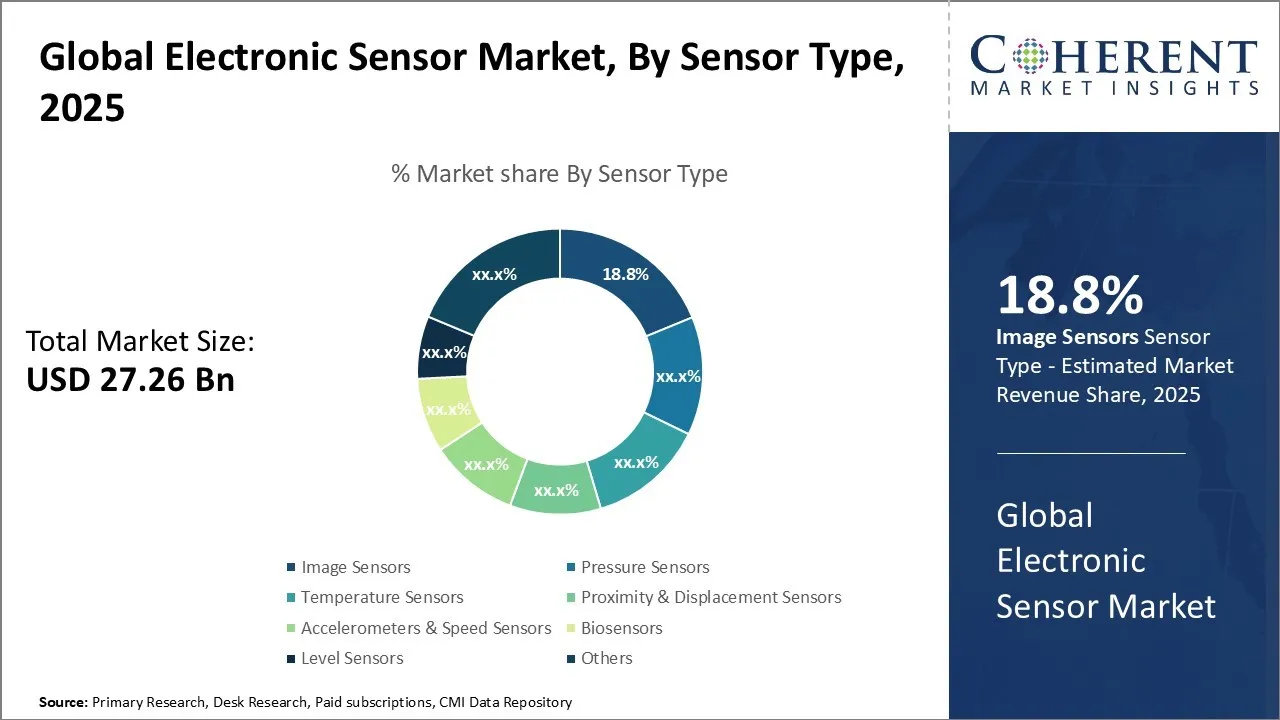
- The image sensors segment is expected to lead the market holding a share of 19.8% in 2026.
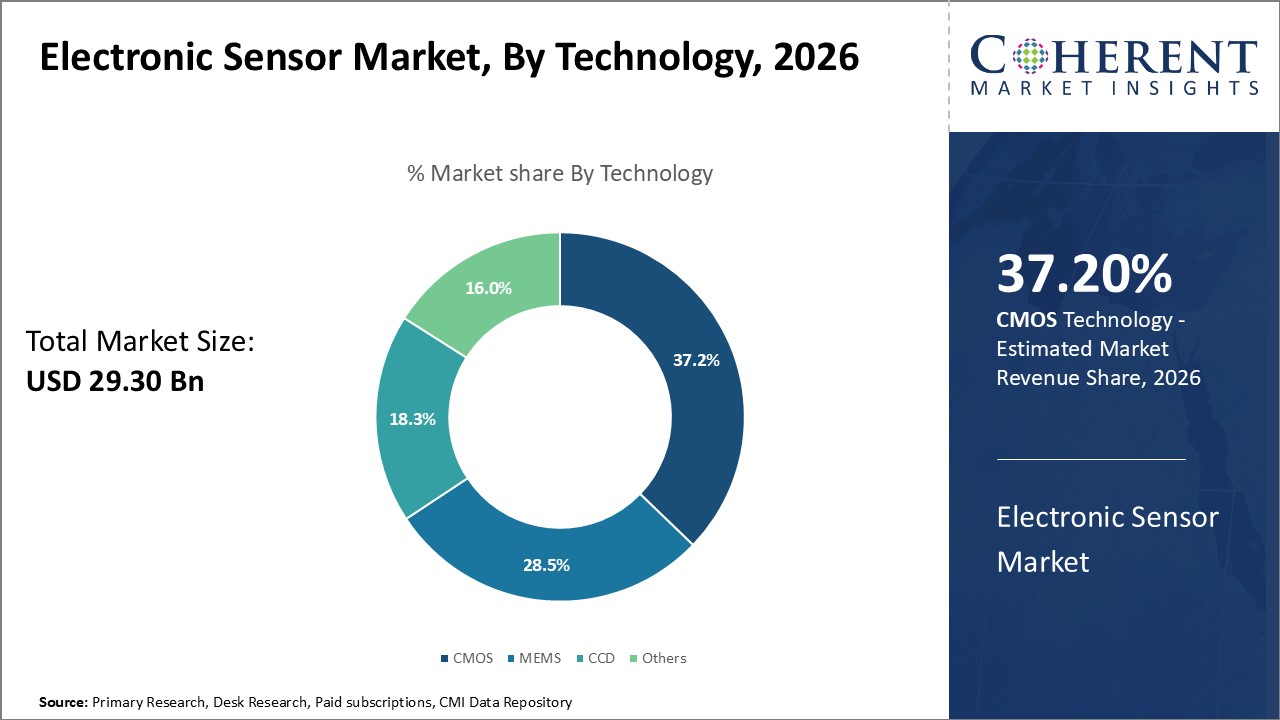
- The CMOS segment is projected to dominate with a share of 37.2% in 2026.
- The consumer electronics segment is estimated to lead the market with a share of 43.7% in 2026.
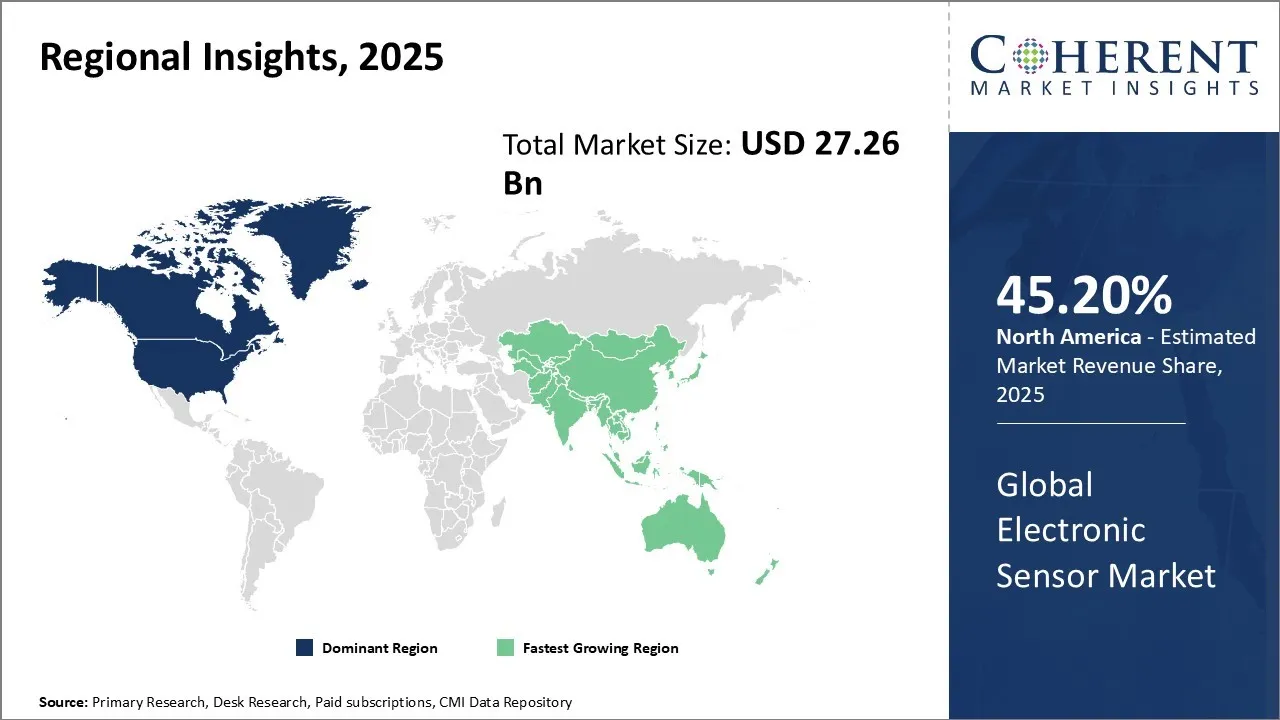
- North America is estimated to lead the market with a share of 45.2% in 2026. Asia Pacific, holding a share of 36.4% in 2026, is projected to be the fastest growing region.
Market Overview:
The electronic sensor market is experiencing significant growth due to the increasing demand for advanced sensing technologies across various industries, including automotive, healthcare, consumer electronics, and industrial automation. The increasing adoption of Internet of Things (IoT) devices, smart homes, and wearable technology is creating the need for sophisticated sensors that can accurately detect and measure various parameters such as temperature, pressure, motion, and light. To add to this, the growing emphasis on energy efficiency and environmental monitoring is fueling the demand for electronic sensors in applications like smart grids, renewable energy systems, and pollution control.
Current Events and Its Impact
Current Events | Description and its impact |
Geopolitical Shifts in Semiconductor Supply Chains |
|
Automotive Sensor Demand Surge |
|
Segmental Insights
- Current Industry Events of 2026
- Market Size Estimation
- Regional Breakdown
- Competitive Landscape
- Customer Intelligence
- Segmental Analysis
- Pricing Analysis
- Key Market Drivers, Challenges & Future Trends
- Customized Insights Section
Global Electronic Sensor Market Insights, by Sensor Type – Image Sensors Lead, Acting as the Visual Core of Modern Devices
In terms of sensor type, the image sensors segment is projected to hold the largest market share of 19.8% in 2026, as a result of the rapid adoption of image-based sensing in smartphones, security systems, and automotive applications. As visual data becomes central to both consumer experience and machine perception, image sensors serve as the foundation for devices requiring real-time imaging, recognition, and analysis.
A key factor behind this growth is the soaring demand for high-resolution camera systems, especially in smartphones and surveillance infrastructure. In addition, the proliferation of Advanced Driver Assistance Systems (ADAS) in vehicles has accelerated the integration of image sensors for lane detection, pedestrian recognition, and collision avoidance. These applications rely on precise visual input, further strengthening the image sensors' market position.
In 2024, Sony Semiconductor Solutions unveiled its IMX900 series image sensors designed for autonomous driving systems. These sensors feature high dynamic range (HDR) and Light Emitting Diode (LED) flicker mitigation, enabling vehicles to accurately interpret road conditions and signage even in challenging lighting environments.
Global Electronic Sensor Market Insights, by Technology – CMOS Segment Leads Due to Their Compact Size and Cost Effectiveness
Among technologies, the CMOS segment is expected to dominate the market with a forecasted share of 37.2% in 2026, owing to their compact size, low power consumption, and cost-effectiveness. CMOS technology has become the standard for sensor integration across most consumer and industrial applications.
The ongoing miniaturization of electronics and the growing demand for portable, battery-operated devices have fueled the need for sensors that can deliver high performance while conserving energy—an area where CMOS excels. Moreover, advancements in CMOS fabrication have significantly improved image quality, sensitivity, and speed, closing the gap with CCD sensors while offering greater scalability and integration potential.
In 2023, OmniVision Technologies launched a new ultracompact CMOS image sensor, OV08X, targeting mid-range smartphones. The sensor supports 4K video capture and real-time HDR processing, showcasing the continued evolution of CMOS sensors into high-performance, low-power applications.
Global Electronic Sensor Market Insights, by End-use Industry – Consumer Electronics are Creating Significant Demand for Electronic Sensors Due to the Rise of Smart Devices
By end-use industry, consumer electronics is expected to account for the largest market share of 43.7% in 2026, fueled by the continued rise in smart devices, wearable tech, and home automation systems. Electronic sensors have become indispensable in creating intuitive, responsive, and interactive consumer experiences.
From smartphones with gyroscopes and ambient light sensors to smartwatches equipped with biometric sensors, the integration of sensing capabilities has become a baseline expectation. The growth of voice-controlled assistants, smart TVs, and connected appliances is further accelerating the demand for environmental and motion sensors that can interpret user behavior and surroundings.
In 2024, Apple Inc. integrated a second-generation ultra-wideband (UWB) motion sensor into the Apple Watch Series 9, improving spatial awareness and enabling features like precise device tracking and gesture control. This exemplifies how consumer electronics continue to push the limits of sensor innovation to enhance user experiences.
The Role of Artificial Intelligence (AI) in the Electronic Sensor Market
Artificial Intelligence (AI) is playing a transformative role in the electronic sensor market by making sensors not just data collectors, but smart decision-making tools. Instead of just detecting a signal or reading a value, AI-enhanced sensors can now analyze patterns, predict failures, and adapt in real-time to changing conditions.
For instance, in industrial settings, companies like Siemens are using AI-integrated sensors to enable predictive maintenance. These sensors collect data from machines, and AI algorithms analyze this information to predict equipment failures before they happen, reducing downtime and saving millions in maintenance costs.
AI reduces the reliance on cloud-only processing. With edge AI, sensors themselves are becoming smarter, handling computation locally, which leads to faster response times and lower data transmission costs.
Regional Insights:
North America Electronic Sensor Market Analysis and Trends
North America, holding a share of 45.2% in 2026, is expected to dominate the global electronic sensor market. The region has a well-established market ecosystem, with a strong presence of major players in the semiconductor and electronics industries such as Rockwell Automation and Omron. The U.S., in particular, has been at the forefront of technological advancements, with a robust research and development infrastructure and a supportive government policy framework.
Asia Pacific Electronic Sensor Market Analysis and Trends
The Asia Pacific region, holding a share of 36.4% in 2026, is expected to exhibit the fastest growth in the global electronic sensor market. This growth can be ascribed to the rapid industrialization and urbanization in countries such as China, India, and South Korea. The region has emerged as a manufacturing hub for electronics and semiconductor products, with a thriving ecosystem of suppliers, manufacturers, and distributors, such as Huawei and Oppo. Government initiatives aimed at promoting the electronics industry, such as China's "Made in China 2026" and India's "Make in India" programs, have further accelerated the growth of the electronic sensor market in the region.
Global Electronic Sensor Market Outlook for Key Countries
U.S. Electronic Sensor Market Analysis and Trends
The U.S. electronic sensor market is characterized by a strong emphasis on innovation and technological advancements. The country is home to several leading companies in the electronic sensor industry, such as Texas Instruments, Honeywell, and TE Connectivity. These companies have made significant investments in research and development, resulting in the introduction of advanced sensor solutions for various applications. The automotive industry, in particular, has been a major driver of electronic sensor demand in the U.S. with the increasing adoption of advanced driver assistance systems (ADAS) and autonomous vehicles.
China Electronic Sensor Market Analysis and Trends
China electronic sensor market has experienced rapid growth in recent years, driven by the country's massive manufacturing base and increasing domestic consumption. The government's push towards industrial automation and the adoption of Industry 4.0 technologies has created a significant demand for electronic sensors in the manufacturing sector. China is also a major player in the consumer electronics market, with companies like Huawei, Xiaomi, and Oppo incorporating advanced sensor technologies into their products.
Germany Electronic Sensor Market Analysis and Trends
Germany continues to lead the Europe electronic sensor market, due to its strong industrial base and technological prowess. The country is renowned for its expertise in the automotive industry, which is a significant consumer of electronic sensors. German automotive giants, such as Volkswagen, BMW, and Daimler, have been at the forefront of integrating advanced sensor technologies into their vehicles, driving the demand for electronic sensors in the country. Additionally, Germany's focus on Industry 4.0 and the Industrial Internet of Things (IIoT) has spurred the adoption of smart sensors in the manufacturing sector.
Japan Electronic Sensor Market Analysis and Trends
Japan electronic sensor market is characterized by its strong focus on quality, reliability, and miniaturization. The country is home to several renowned electronic sensor manufacturers, such as Keyence, Omron, and Murata Manufacturing, known for their advanced sensor technologies and high-precision products.
Japan's automotive industry, which is a major contributor to the country's economy, has been a significant driver of electronic sensor demand. The increasing adoption of electric vehicles and advanced safety features has further fueled the growth of the market in Japan. Additionally, the country's aging population has created opportunities for the deployment of electronic sensors in healthcare applications, such as remote monitoring and assisted living. However, Japan faces challenges such as a shrinking domestic market and the need to expand its presence in emerging markets to sustain growth.
Market Players, Key Development, and Competitive Intelligence:
Key Developments:
- In March 2025, the multinational semiconductor manufacturer, STMicroelectronics, launched its upgraded STEVAL-MKI109D sensor evaluation board, designed to simplify prototyping for context-aware applications using MEMS sensors
- In February 2025, Greatech, a Germany-based hardware developer and manufacturer specializing in energy-efficient wireless embedded systems for terrestrial and satellite communication, launched Sensoco Loomair Solar, a light-powered CO₂ sensor with multi-connectivity designed for smart buildings.
- In January 2025, Mitsubishi Electric Corporation launched a MelDIR-brand 80×60-pixel thermal-diode infrared sensor (MIR8060C1) with a 100°×73° field of view.
- In August 2024, Renesas Electronics Corporation, a supplier of advanced semiconductor solutions, introduced an advanced all-in-one sensor module designed for indoor air quality monitoring. The RRH62000, the first multi-sensor air quality module from Renesas, integrates multiple sensor parameters in a compact design and accurately detects different particle sizes, volatile organic compounds and gasses harmful to human health.
Top Strategies Followed by Global Electronic Sensor Market Players
- Established Players: Established players in the global electronic sensor market are focusing on extensive research and development to innovate high-performance products. These companies invest heavily in R&D to stay ahead of the competition and meet the evolving needs of their customers.
- For example, Texas Instruments, a leading player in the market, has consistently allocated a significant portion of its revenue to R&D efforts. This has enabled the company to develop cutting-edge sensor technologies, such as their Digital Light Processing (DLP) technology, which has revolutionized the way sensors are used in various applications.
- Mid-level players, on the other hand, are focusing on delivering cost-effective solutions to target price-sensitive consumers. These companies are exploring collaborations with other players in the market to boost their technology and production capabilities.
- In 2023, Sensirion partnered with Digi-Key Electronics, a global distributor, to expand its global reach and leverage Digi-Key’s supply chain and distribution networks.
- Small-scale players are adopting niche specialization as a key strategy to differentiate themselves in the market. For example, some small-scale companies are developing sensors for specialized applications, such as medical devices or aerospace equipment.
- For instance, before its acquisition by TE Connectivity, First Sensor was a small German company specializing in optoelectronic and MEMS sensors for highly specific applications, particularly in aerospace, defense, and medical diagnostics. It developed radiation-hardened image sensors used in space telescopes and satellites, serving institutions like NASA and ESA, where ultra-specialized performance was required.
Market Report Scope
Electronic Sensor Market Report Coverage
| Report Coverage | Details | ||
|---|---|---|---|
| Base Year: | 2025 | Market Size in 2026: | USD 29.30 Bn |
| Historical Data for: | 2020 To 2024 | Forecast Period: | 2026 To 2033 |
| Forecast Period 2026 to 2033 CAGR: | 7.3% | 2033 Value Projection: | USD 47.90 Bn |
| Geographies covered: |
| ||
| Segments covered: |
| ||
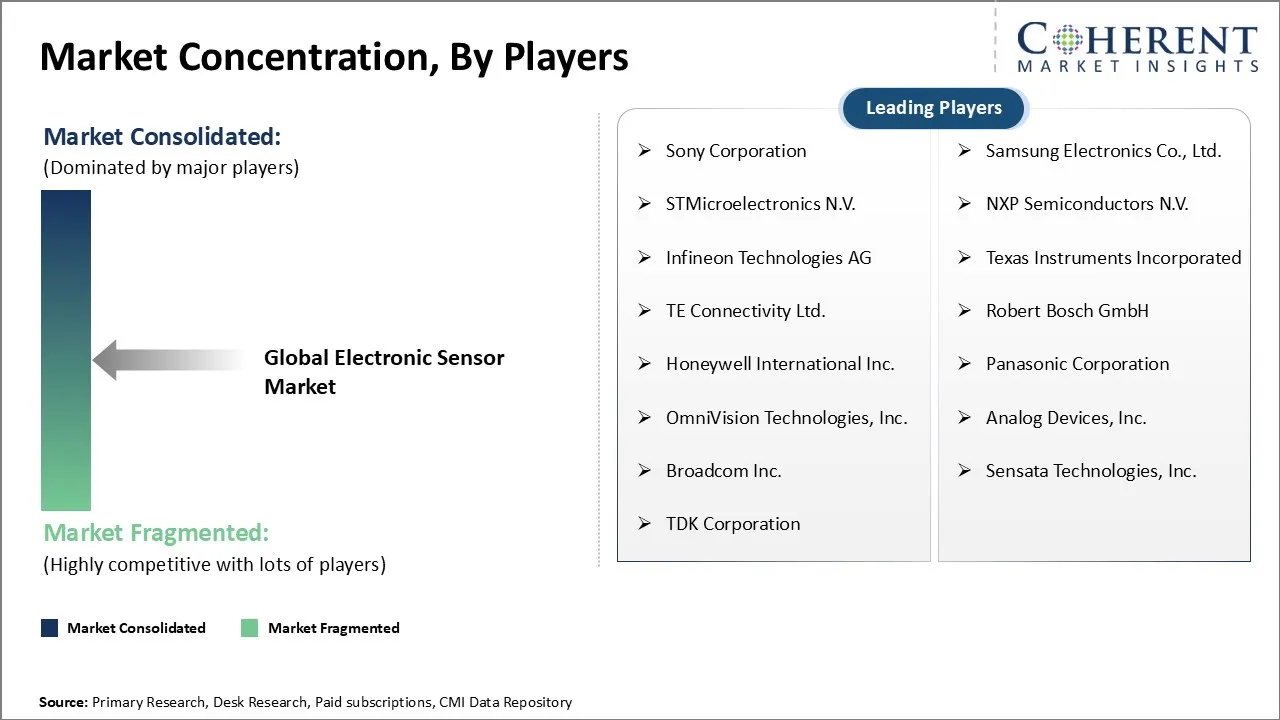
| Companies covered: | Sony Corporation, Samsung Electronics Co., Ltd., STMicroelectronics N.V., NXP Semiconductors N.V., Infineon Technologies AG, Texas Instruments Incorporated, TE Connectivity Ltd., Robert Bosch GmbH, Honeywell International Inc., Panasonic Corporation, OmniVision Technologies, Inc., Analog Devices, Inc., Broadcom Inc., Sensata Technologies, Inc., and TDK Corporation | ||
| Growth Drivers: |
| ||
| Restraints & Challenges: |
| ||
Market Dynamics
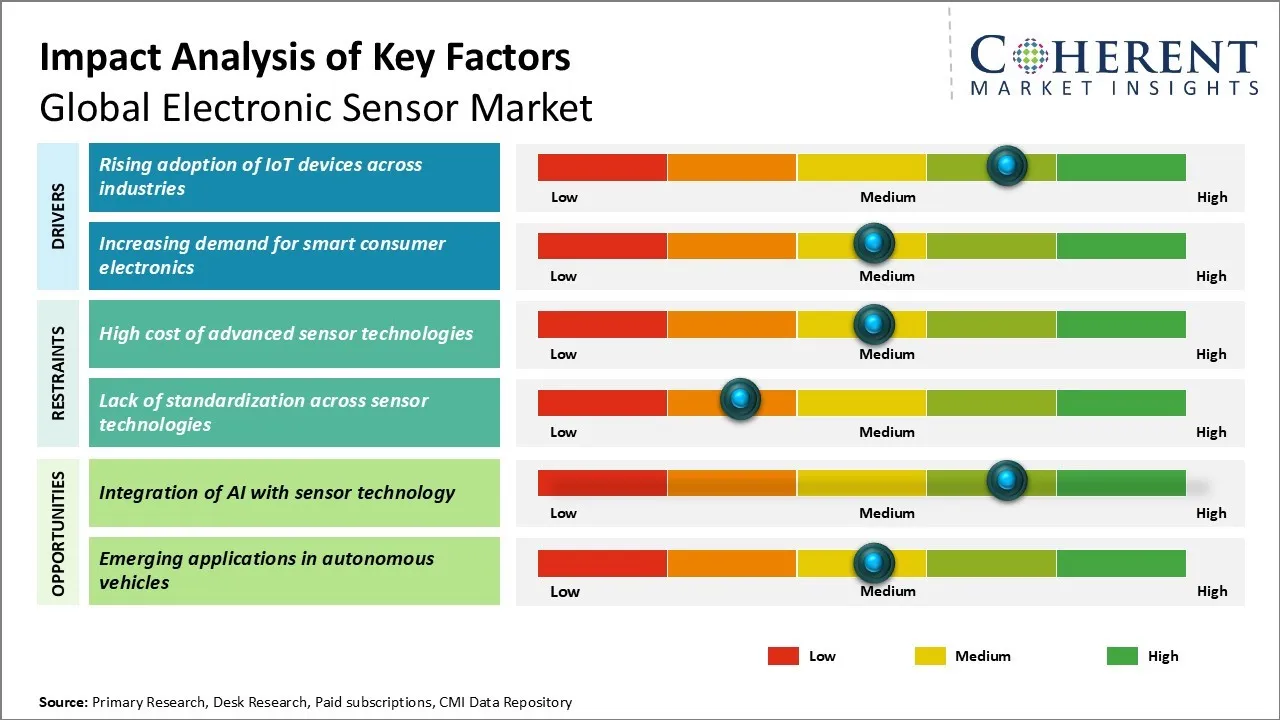
Global Electronic Sensor Market Driver - Rising Adoption of IoT Devices across Industries
The rising adoption of Internet of Things (IoT) devices across a wide range of industries is a significant driver for the global electronic sensor market. As more businesses embrace IoT technology to enhance their operations, streamline processes, and improve efficiency, the demand for electronic sensors is experiencing a substantial surge. These sensors play a crucial role in enabling IoT devices to collect, process, and transmit data seamlessly.
From manufacturing and healthcare to automotive and smart homes, the integration of IoT devices is becoming increasingly prevalent. Sensors are essential components in these devices, allowing them to monitor and control various parameters such as temperature, pressure, motion, and humidity. For instance, in 2024, Honeywell launched its NextGen Industrial IoT Sensor Suite, which integrates humidity, pressure, and motion sensors for remote monitoring in manufacturing plants.
Global Electronic Sensor Market Opportunity: Integration of AI with Sensor Technology
The integration of artificial intelligence (AI) with sensor technology presents a significant opportunity for the global electronic sensor market. By combining AI algorithms with advanced sensors, manufacturers can create smart, adaptive, and self-learning systems that can revolutionize various industries. AI-enabled sensors can process and analyze vast amounts of data in real-time, enabling them to make intelligent decisions and predictions based on the collected information.
For example, in the industrial sector, AI-powered sensors can monitor equipment health, detect potential failures, and schedule maintenance proactively, reducing downtime and improving overall efficiency. In the healthcare industry, AI-integrated sensors can enable personalized monitoring, early disease detection, and intelligent drug delivery systems. The combination of AI and sensor technology also facilitates the development of autonomous systems, such as self-driving vehicles and smart cities, where sensors can perceive and interpret the environment, making real-time decisions.
For instance, in July 2024, GE HealthCare formed a strategic partnership to use Amazon Web Services (AWS) healthcare and genAI services to build AI-enabled workflows that help improve the accuracy of diagnostic screening, streamline healthcare operations, and improve equitable care access and outcomes.
Analyst Opinion (Expert Opinion):
- The global electronic sensor market is entering a transformative phase, with several cutting-edge applications gaining traction in niche sectors while remaining underpenetrated by mainstream players.
- Powercast’s Matter-compliant sensors eliminate batteries and wiring by leveraging RF wireless charging, addressing the 60 million smart homes projected by 2025. While major players focus on traditional battery-powered devices, this technology enables seamless integration into ecosystems like Google Home and Amazon Alexa, with a single transmitter powering sensors up to 25 feet away.
- Lidwave’s Odem sensor uses software-defined fields of view for adaptive traffic management and industrial automation.
- Neuranics’ MMG sensor detects muscle magnetic activity with 0.1μT resolution, surpassing traditional EMG in spatial accuracy.
Speak to the analyst
Want personalized insights?
Take the findings above to one of our principal consultants, or have the report rebuilt around the segments, geographies and competitors you actually track.
Market Segmentation
- Sensor Type Insights (Revenue, USD Bn, 2021 - 2033)
- Image Sensors
- Pressure Sensors
- Temperature Sensors
- Proximity & Displacement Sensors
- Accelerometers & Speed Sensors
- Biosensors
- Level Sensors
- Others
- Technology Insights (Revenue, USD Bn, 2021 - 2033)
- CMOS
- MEMS
- CCD
- Others
- End-use Industry Insights (Revenue, USD Bn, 2021 - 2033)
- Consumer Electronics
- Industrial & Manufacturing
- Automotive
- Healthcare
- Others
- Regional Insights
- North America
- U.S.
- Canada
- Latin America
- Brazil
- Argentina
- Mexico
- Rest of Latin America
- Europe
- Germany
- U.K.
- Spain
- France
- Italy
- Russia
- Rest of Europe
- Asia Pacific
- China
- India
- Japan
- Australia
- South Korea
- ASEAN
- Rest of Asia Pacific
- Middle East
- GCC Countries
- Israel
- Rest of Middle East
- Africa
- South Africa
- North Africa
- Central Africa
- North America
- Key Players Insights
- Sony Corporation
- Samsung Electronics Co., Ltd.
- STMicroelectronics N.V.
- NXP Semiconductors N.V.
- Infineon Technologies AG
- Texas Instruments Incorporated
- TE Connectivity Ltd.
- Robert Bosch GmbH
- Honeywell International Inc.
- Panasonic Corporation
- OmniVision Technologies, Inc.
- Analog Devices, Inc.
- Broadcom Inc.
- Sensata Technologies, Inc.
- TDK Corporation
Sources
Primary Research Interviews
Stakeholders:
- Consumer Electronics Manufacturers (e.g., Product Managers, Hardware Engineers)
- Automotive OEMs and Tier-1 Suppliers (e.g., Vehicle Sensor Integration Specialists)
- Semiconductor Fabrication Experts (e.g., Foundry Engineers, IC Designers)
- Medical Device Companies (e.g., Clinical R&D Heads, Compliance Officers)
- Industrial Automation Integrators (e.g., IIoT Consultants, Factory Automation Specialists)
- AI and Edge Computing Startups (e.g., Machine Learning Engineers, CTOs)
Databases
- TechInnovation Index
- Automated Systems Report
- Digital Health Atlas
Magazines
- Smart Device Weekly
- Embedded Systems Review
- Sensors & Signal Processing Today
- Automotive Technology Magazine
- Next-Gen Electronics Monthly
Journals
- Journal of Smart Sensors and Systems
- International Journal of Microelectronics & Embedded Sensors
- IEEE Sensors Journal
- Journal of Automotive Intelligence Systems
- Medical Electronics & Monitoring Journal
Newspapers
- Tech Global Daily
- Electronic Systems Post
- Asia Industrial Times
- Smart World Tribune
- IoT Market Herald
Associations
- Global Smart Sensor Association (GSSA)
- International Society for Embedded Systems (ISES)
- World Federation of Electronics & Sensors (WFES)
- Association for Intelligent Devices and Networks (AIDN)
- Healthcare Sensor Consortium (HSC)
Public Domain Sources
- U.S. Census Bureau
- EUROSTAT
- World Bank
- United Nations Industrial Development Organization (UNIDO)
- ResearchGate
Proprietary Elements
- CMI Data Analytics Tool, Proprietary CMI Existing Repository of Information for Last 8 years
Get access to 250+ pages report
Every segment, forecast, competitor profile and data table behind the analysis above — available for instant download.
- ESOMAR Member
- ISO 9001:2015 Certified
- D-U-N-S Registered
- GDPR & CCPA Compliant
Missing comfort of reading report in your local language? Find your preferred language:
Transform your Strategy with Exclusive Trending Reports
Frequently Asked Questions
The Global Electronic Sensor Market is estimated to be valued at USD 27.26 billion in 2025 and is expected to reach USD 44.06 billion by 2032.
The CAGR of the global electronic sensor market is projected to be 7.1% from 2025 to 2032.
Rising adoption of IoT devices across industries and increasing demand for smart consumer electronics are the major factors driving the growth of the global electronic sensor market.
High cost of advanced sensor technologies and lack of standardization across sensor technologies are the major factors hampering the growth of the global electronic sensor market.
In terms of sensor type, the image sensors segment is estimated to dominate the market revenue share in 2025.
Sony Corporation, Samsung Electronics Co., Ltd., STMicroelectronics N.V., NXP Semiconductors N.V., Infineon Technologies AG, Texas Instruments Incorporated, TE Connectivity Ltd., Robert Bosch GmbH, Honeywell International Inc., Panasonic Corporation, OmniVision Technologies, Inc., Analog Devices, Inc., Broadcom Inc., Sensata Technologies, Inc., and TDK Corporation are the major players.
North America is expected to lead the global electronic sensor market in 2025, holding a share of 45.2%.