

Thermal Printing Market Size and Forecast – 2026-2033
The global thermal printing market is estimated to be valued at USD 53.90 Bn in 2026 and is expected to reach USD 74.34 Bn in 2033, exhibiting a compound annual growth rate (CAGR) of 4.7% from 2026 to 2033.
Key Takeaways
- Based on Technology, the Thermal Transfer segment is expected to lead the market with around 5 9% share in 2026, driven by high print quality, durability, and versatility across industries.
- Based on Printer Type, the PoS Printer segment is expected to hold approximately 37% share in 2026, supported by growing retail and hospitality applications and increased adoption of digital payment systems.
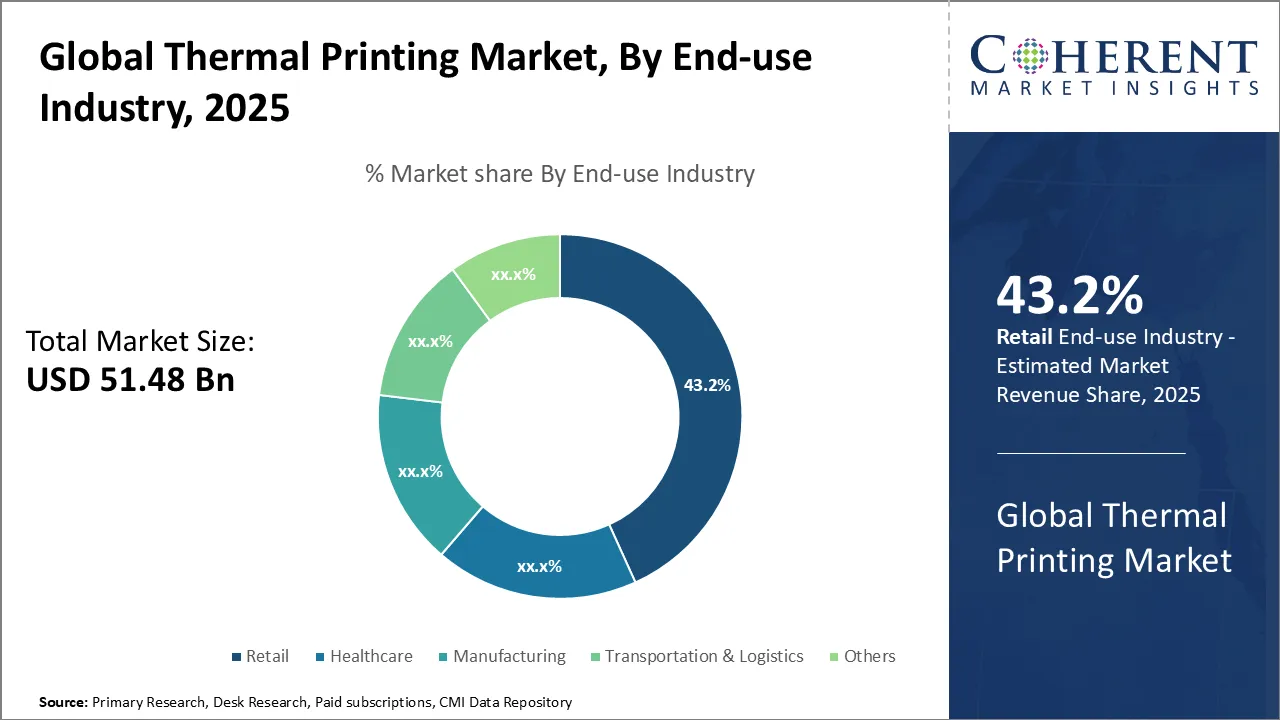
- Based on End-use Industry, the Retail segment is projected to account for around 44.3% share in 2026, driven by rising demand for efficient billing, labeling, and packaging solutions in retail operations.
- Based on Region, North America is set to lead the global thermal printing market with 43% share in 2026. While, Asia Pacific is anticipated to be the fastest growing region.
Market Overview
The thermal printing market which uses heat to transfer images to paper, is expanding. It has widespread applications across a variety of industries, low operating expenses, and fast printing speeds. It is frequently utilized in a variety of applications, including ticket, tag, and receipt printing, barcode labeling, and point-of-sale (POS) systems. Technological advancements are crucial in this dynamic market. To meet the changing requirements of end users, manufacturers are constantly striving to develop thermal printers that are energy-efficient, high-speed, and high-resolution. The functionality and ease of use of thermal printing solutions have been further enhanced by the incorporation of mobile printing capabilities and wireless connectivity.
Current Events and Its Impact
Current Events | Description and its Impact |
Global Supply Chain Disruptions and Semiconductor Shortages |
|
Digital Payment Revolution and Contactless Commerce Expansion |
|
E-commerce Growth and Last-Mile Delivery Evolution |
|
Segmental Insights
- Current Industry Events of 2026
- Market Size Estimation
- Regional Breakdown
- Competitive Landscape
- Customer Intelligence
- Segmental Analysis
- Pricing Analysis
- Key Market Drivers, Challenges & Future Trends
- Customized Insights Section
Thermal Printing Market Insights, By End-Use Industry - Retail Dominates Driven by Billing, Labeling, and Packaging Needs
In terms of end-use industry, the retail segment is projected to account for around 44.2% share in 2026, driven by increasing demand for efficient billing, labeling, and product packaging solutions. Retailers rely on thermal printing to streamline operations, improve inventory accuracy, and enhance customer experience through quick, error-free receipts and product identification.
Retail thermal printing extends beyond receipts, supporting barcode labels, price tags, shelf labels, and shipping labels. The rising e-commerce and omni-channel retail models further amplify the demand for reliable, fast, and high-quality printing solutions. Consumer expectations for fast checkout, transparency, and product traceability are key factors driving adoption.
For instance, in June 2025, Epson introduced a new series of retail-focused thermal printers with BPA-free paper compatibility, mobile POS integration, and high-speed printing for receipts and labels. This launch highlights the push toward safer, eco-friendly printing solutions while addressing the operational efficiency needs of modern retail and e-commerce sectors.
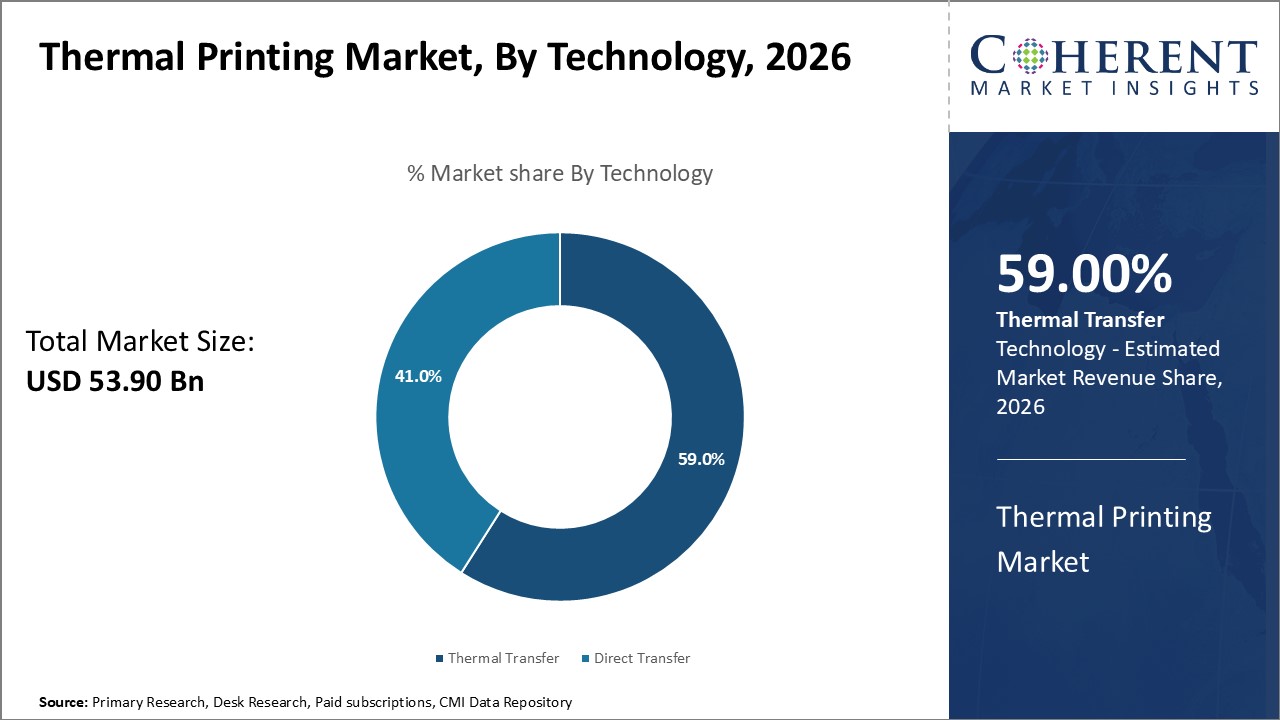
Thermal Printing Market Insights, By Technology - Thermal Transfer Leads Due to Print Quality, Durability, and Versatility
In terms of technology, the thermal transfer segment is expected to lead the market with around 59% share in 2026. Thermal transfer printers are preferred for their high-resolution printing, long-lasting labels, and ability to handle a variety of substrates including paper, polyester, and synthetic materials. Their versatility allows usage across diverse industries such as logistics, healthcare, retail, and manufacturing.
Thermal transfer technology ensures that printed information remains legible even in harsh conditions, making it suitable for asset tracking, shipping labels, and industrial labeling. The printers also support specialized ribbons for security, anti-counterfeiting, and compliance purposes. Operational efficiency is enhanced because these printers require minimal maintenance while providing consistent, high-quality output, reducing downtime and errors.
For instance, in January 2025, Zebra Technologies launched a new industrial thermal transfer printer series featuring high-speed, durable printing with eco-friendly ribbon options. This innovation supports growing industrial and logistics requirements, emphasizing reliability, longevity, and adherence to sustainability standards.
Thermal Printing Market Insights, By Printer Type - PoS Printers Dominate Due to Retail Expansion and Digital Payments
In terms of printer type, PoS (Point-of-Sale) printers are expected to hold approximately 37% of the market share in 2026. PoS printers are widely adopted in retail, hospitality, and e-commerce sectors, driven by the expansion of digital payment systems, fast transaction requirements, and efficient receipt printing. Their compact design and wireless connectivity options make them ideal for modern retail and mobile environments.
PoS printers improve customer service by reducing transaction time and supporting integrated billing, loyalty programs, and inventory management. They also offer low operating costs, easy integration with POS software, and compatibility with mobile and cloud-based systems. These printers support thermal paper and label media, which simplifies operations while maintaining cost-effectiveness.
For example, in February 2025, BIXOLON launched its next-generation PoS printers at EuroCIS 2025, featuring wireless connectivity, eco-friendly receipt printing, and enhanced reliability. This launch demonstrates the focus on sustainability, mobile integration, and improving retail transaction efficiency globally.
Regional Insights
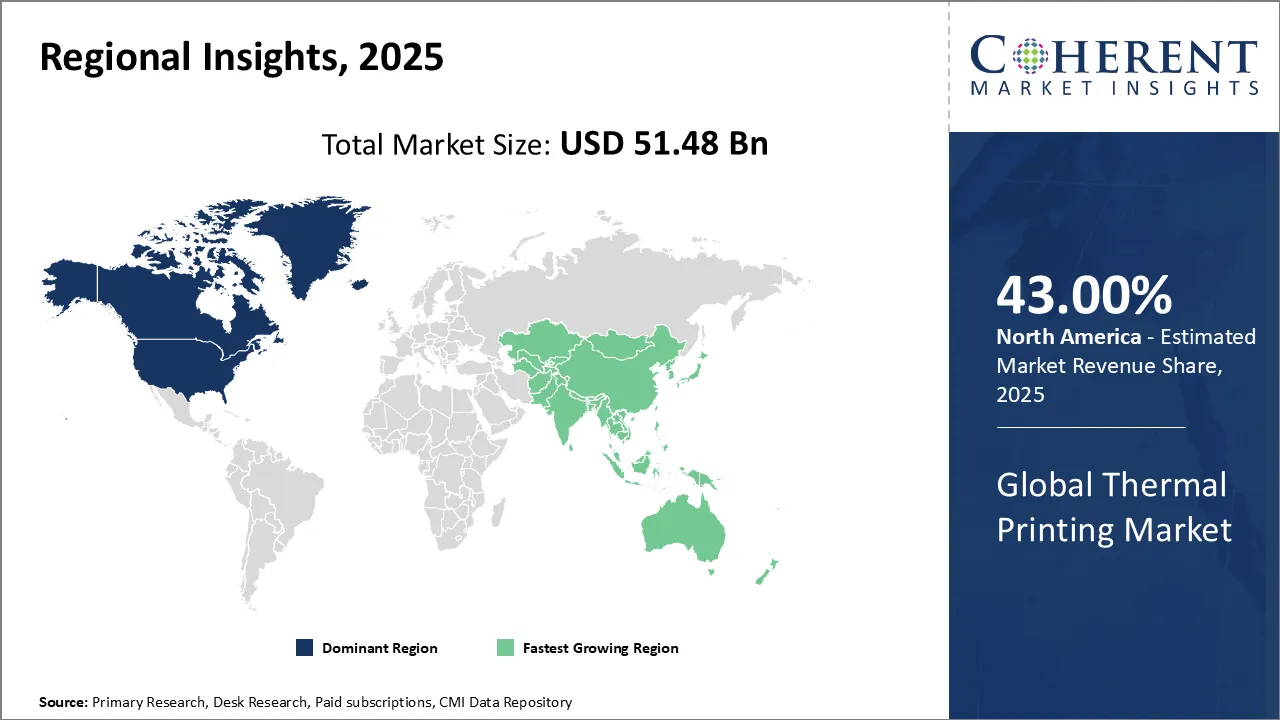
North America Thermal Printing Market Analysis & Trends
North America is set to lead the global thermal printing market with 43% share in 2026, driven by strong adoption across retail, logistics, healthcare, and manufacturing sectors. The region benefits from the presence of established manufacturers, advanced printing technologies, and early adoption of mobile and wireless thermal printing solutions.
The U.S. remains a key contributor, with significant demand for PoS printers, industrial label printers, and high-resolution thermal transfer systems. Growth is supported by increasing e-commerce activities, regulatory compliance requirements for labeling, and rising investments in supply chain automation. Additionally, North America is a major exporter of thermal printing solutions to other regions, reflecting its technological leadership and mature market infrastructure.
Asia Pacific Thermal Printing Market Analysis & Trends
Asia Pacific accounted for the second largest share of generating revenue for the market. This is mainly due to the rising technological advancement in developing countries, like China and India. Major companies and BNCs (Multi National Companies) are investing in these countries which is driving the market revenue growth. In addition, high disposable income, rapid industrialization, and rapid expansion of the automotive, medical, and electronics industries is anticipated to boost regional market expansion.
Thermal Printing Market Outlook Country-Wise
U.S. Thermal Printing Market Trends
The United States represents a highly mature and technologically advanced thermal printing market. Growth is largely driven by the widespread adoption of thermal printers in retail, healthcare, and logistics sectors. Retailers increasingly rely on PoS printers for efficient billing, digital payment integration, and customer engagement, while industrial and warehouse operations use thermal transfer printers for durable labeling and tracking. The country’s robust e-commerce sector further fuels demand for high-speed, reliable printing solutions for shipping labels and inventory management. Additionally, U.S. manufacturers are increasingly focusing on eco-friendly and BPA-free thermal papers, responding to regulatory pressures and consumer awareness about safety and sustainability. Strong infrastructure, skilled workforce, and early adoption of automated systems give the U.S. market a technological edge, making it a hub for innovation in thermal printing hardware, software, and consumables.
For instance, in January 2026, Epson introduced its new TM‑T20IV Thermal Receipt Printer in the United States, designed for both PC‑POS and mPOS systems in retail and hospitality, offering USB/Serial or USB/Serial‑Ethernet connectivity, a compact form factor, up to 250 mm/sec print speed, and paper‑saving features.
China Thermal Printing Market Trends
China is emerging as one of the fastest-growing markets for thermal printing, supported by rapid industrialization, expanding retail chains, and a booming e-commerce ecosystem. Thermal printers are extensively used in warehouses, logistics centers, and manufacturing facilities for labeling, inventory tracking, and supply chain automation. Retail adoption of PoS printers is accelerating due to rising smartphone-based payments, digital wallets, and cashier-less store models. The market is also witnessing increased demand for cost-efficient, compact printers suitable for small and medium enterprises. Chinese manufacturers are investing heavily in R&D to produce affordable, energy-efficient, and high-speed thermal printers to meet domestic and export demand. Government initiatives promoting digitalization, smart logistics, and IoT integration further contribute to rapid adoption, positioning China as a key growth engine in the Asia-Pacific thermal printing landscape.
For instance, in March 2024, HPRT announced the launch of three new thermal receipt printers (including model TP900‑i) at the “16th China Business Informatization Industry Conference” in Changsha, designed for fast‑printing in retail and food service environments.
Market Report Scope
Thermal Printing Market Report Coverage
| Report Coverage | Details | ||
|---|---|---|---|
| Base Year: | 2025 | Market Size in 2026: | USD 53.90 Bn |
| Historical Data for: | 2020 To 2024 | Forecast Period: | 2026 To 2033 |
| Forecast Period 2026 to 2033 CAGR: | 4.7% | 2033 Value Projection: | USD 74.34 Bn |
| Geographies covered: |
| ||
| Segments covered: |
| ||
| Companies covered: | Zebra Technologies Corporation, TSC Auto ID Technology Co., Ltd., Toshiba TEC Corporation, Honeywell International, Inc., Bixolon Co., Ltd., Citizen Holdings Co., Ltd., Star Micronics Co., Ltd., Seiko Epson Corporation, SATO Holdings Corporation, HP India Sales Private Limited and Brother International Corporation. | ||
| Growth Drivers: |
| ||
| Restraints & Challenges: |
| ||
Thermal Printing Market Driver
Higher Adoption of Automatic Identification & Data Capture (AIDC)
The use of barcodes in transactions has increased as the number of cashless payments has increased. The expansion of digital payments in India and the availability of numerous simple and convenient digital payment options have made it easier for citizens to live comfortably, increased financial inclusion, and the expansion of businesses and the economy. In addition, the proliferation of digital payments has encouraged the expansion of businesses, particularly SMEs. Barcodes make it possible for small and medium-sized businesses (SMEs) to accept digital payments without requiring costly point-of-sale systems.
Rising Use of Portable and Retail Thermal Printing Technologies
The retail sector utilizes specialized point-of-sale (POS) printers designed to deliver transaction receipts primarily to customers, making it the largest end user of thermal printing technology. The lowest but adequate thermal grades of receipt papers are direct thermal media. Both manned and increasingly automated self-checkout systems are used in the industry.
Over the next few years, direct thermal media with greater outdoor capability will replace thermal transfer products in the market. Because the printers are conveniently smaller than a portable desktop, this results in a situation that is more adaptable and comfortable for users. In order to provide more opportunities for customer engagement, additional kiosks will be placed in the future, particularly in the aisles rather than check-out areas.
Thermal Printing Market Opportunities
Technological Advancements
Market expansion is anticipated to be fuelled by ongoing technological advancements in thermal printing. Thermal printers' speed, resolution, connectivity options, and durability are all being improved through research and development. The presentation of cutting-edge highlights like remote availability, portable printing capacities, and cloud incorporation is extending the application regions for warm printing, subsequently driving business sector development. In a variety of industries, thermal printing is adapting to the rising popularity of mobile printing. Thermal printers that support mobile printing allow users to print directly from mobile devices like smartphones and tablets. This feature is especially useful in applications like ticketing, field sales, and delivery services, where mobility and on-the-go printing are essential.
Advancements in Healthcare Digitization
The medical care area is progressively embracing digitalization and computerization, which incorporates the utilization of warm printers for printing patient names, wristbands, solutions, and clinical reports. Thermal printing solutions are in high demand in healthcare facilities due to the emphasis placed on patient safety, precise labelling, and traceability. The market for thermal printers in this field is expected to expand as healthcare systems all over the world strive for greater patient care and efficiency. One important aspect of healthcare digitization is the transition from paper-based records to electronic health records (EHRs). Labels, wristbands, and other documentation required for accurate patient identification and tracking within EHR systems are printed by thermal printers, which are crucial tools. As more healthcare providers adopt EHR systems to streamline operations and improve patient care, it is anticipated that demand for thermal printers will rise.
Analyst Opinion (Expert Opinion)
The thermal printing market is experiencing a transformative phase, driven not just by adoption but by a demand for operational efficiency, precision, and sustainability. Enterprises are increasingly prioritizing high-resolution thermal transfer printers over direct thermal models due to durability and long-term cost efficiency in labeling, especially for logistics and healthcare sectors. For instance, Zebra Technologies’ Aurora Velocity™ and Epson’s TM-T20IV demonstrate how advanced printers are reducing label errors by up to 30%, minimizing waste and supply chain disruptions. Such innovations are setting new benchmarks for performance and reliability, reshaping procurement standards in retail and industrial operations.
End-users are signaling a clear preference for printers that integrate IoT-enabled diagnostics, cloud connectivity, and mobile compatibility. Retailers deploying POS thermal printers like Star Micronics’ StarIO. Online report up to 25% faster transaction times and a measurable reduction in operational downtime. In parallel, healthcare providers are investing in Bixolon and Citizen high-resolution label printers to improve patient safety and traceability, reflecting that thermal printing is no longer a transactional necessity but a strategic enabler for data-driven workflows. The market’s competitive edge is increasingly linked to technology adoption and service integration rather than sheer printer volumes.
Sustainability considerations are reshaping thermal printing purchasing decisions, with BPA-free and eco-friendly thermal papers gaining traction. Epson’s rPET solutions and Bixolon’s linerless receipt printers exemplify the push toward environmentally responsible printing without compromising quality. Analysts observe that companies failing to adopt sustainable media risk reputational and operational penalties, particularly as global supply chains tighten under ESG mandates. Success in thermal printing now hinges on the simultaneous delivery of reliability, digital integration, and environmental compliance, positioning forward-thinking firms to dominate high-growth segments in logistics, retail, and healthcare while setting industry-wide best practices.
Speak to the analyst
Want personalized insights?
Take the findings above to one of our principal consultants, or have the report rebuilt around the segments, geographies and competitors you actually track.
Thermal Printing Industry News
- In October 2025, Munbyn launched the first thermal label printer featuring a quick-swap printhead for instant replacement.
- In October 2025, HP introduced HP ThermaCore, a next-generation thermal inkjet technology for high-speed coding and marking. Stephan Kowalewski, HP’s EMEA category manager, shared insights on the product and the advantages of its ink and print system.
- In October 2025, Epson launched the S3200‑S1 solvent‑compatible printhead. While this is an inkjet technology rather than thermal printing, it reflects Epson’s hardware innovation pace.
Market Segmentation
- Technology Insights (Revenue, USD Bn & KT, 2026 - 2033)
- Direct Thermal
- Thermal Transfer
- Printer Type Insights (Revenue, USD Bn & KT, 2026 - 2033)
- PoS Printer
- Label and Tag Printer
- RFID Printer
- End-use Insights (Revenue, USD Bn & KT, 2026 - 2033)
- Transportation and Logistics
- Retail
- Healthcare
- Manufacturing
- Others
- Regional Insights (Revenue, USD Bn & KT, 2026 - 2033)
- North America
- U.S.
- Canada
- Latin America
- Brazil
- Argentina
- Mexico
- Rest of Latin America
- Europe
- Germany
- U.K.
- Spain
- France
- Italy
- Russia
- Rest of Europe
- Asia Pacific
- China
- India
- Japan
- Australia
- South Korea
- ASEAN
- Rest of Asia Pacific
- Middle East & Africa
- GCC Countries
- Israel
- Rest of Middle East & Africa
- North America
- Key Players Insights (Revenue, USD Bn, 2021 - 2033)
- Zebra Technologies Corporation
- TSC Auto ID Technology Co., Ltd.
- oshiba TEC Corporation
- Honeywell International, Inc.
- Bixolon Co., Ltd.
- Citizen Holdings Co., Ltd.
- Star Micronics Co., Ltd.
- Seiko Epson Corporation
- SATO Holdings Corporation
- HP India Sales Private Limited
- Brother International Corporation.
Sources
Primary Research Interviews from the following stakeholders
Stakeholders
- Interviews with thermal printer manufacturers, label converters, POS system integrators, logistics and supply chain managers, retail operations heads, and healthcare facility administrators across major regional markets.
Specific stakeholders
- Product development and R&D heads at leading printer manufacturers (e.g., Zebra Technologies, Toshiba TEC, Honeywell, Citizen Holdings)
- Procurement and operations managers at large retail chains and e-commerce companies implementing POS printers (e.g., Walmart, Amazon, JD.com)
- Labeling and printing supervisors at logistics and warehousing companies (e.g., DHL, FedEx, SF Express)
- IT and automation lead at healthcare providers using thermal printers for patient identification and medication labeling (e.g., Mayo Clinic, Cleveland Clinic, Beijing Hospital)
- Engineers and process specialists at printer component and thermal paper manufacturers (e.g., TSC Auto ID, Bixolon, Seiko Epson)
- Supply chain and sustainability officers focusing on eco-friendly printing solutions and BPA-free media adoption
Databases
- United Nations Comtrade Database
- World Trade Organization (WTO) Trade Statistics
- Eurostat – Industrial Production & Trade Statistics
- U.S. Census Bureau – Manufacturing & Electronic Equipment Data
- China Customs Statistics
- Directorate General of Commercial Intelligence and Statistics (DGCIS), India
- Japan External Trade Organization (JETRO)
- Korea Customs Service Data Portal
- Food and Drug Administration (FDA) – Medical Device Labeling & Packaging Section
- Indian Ministry of Commerce & Industry – Electronics & Printing Equipment Export Data
- Environment Agency (UK) – Recycling & Material Compliance Data
Magazines
- Packaging World
- FlexPack Voice
- Plastics Today
- Label & Narrow Web
- PrintWeek (Packaging & Thermal Printing Section)
- Packaging Europe
- Food & Beverage Packaging
- Printing Impressions
- RFID Journal (Printing and Labeling Section)
- Converters Expo Insights
Journals
- Journal of Applied Polymer Science (Printing & Coatings)
- Polymer Testing (Elsevier)
- Packaging Technology and Science (Wiley)
- Journal of Cleaner Production
- Resources, Conservation & Recycling (Elsevier)
- International Journal of Life Cycle Assessment
- Journal of Food Engineering (Labeling and Packaging Section)
- Progress in Organic Coatings (Thermal Paper and Barrier Materials Section)
Newspapers
- The Wall Street Journal – Manufacturing & Consumer Goods
- The Economic Times – Industry & Electronics
- Business Standard – Industrial Equipment & Packaging
- Financial Times – Supply Chain & Sustainability
- Nikkei Asia – Manufacturing & Printing Equipment
- The Hindu Business Line – Manufacturing & Technology
- South China Morning Post – Electronics and Printing Industry
- The Guardian – Environment and Circular Economy
Associations
- Thermal Printing Association (TPA)
- Electronic Components Industry Association (ECIA)
- International Label & Printing Association (ILPA)
- Indian Electronics & Components Manufacturers Association (IECM)
- Sustainable Packaging Coalition (SPC)
- American Institute for Packaging and the Environment (AMERIPEN)
- Packaging Industry Association of India (PIAI)
- British Printing & Packaging Federation (BPPF)
- European Bioplastics Association (EUBP)
- All India Electronics Manufacturers’ Association (AIEMA)
- National Association for Labeling and Barcode Technologies (NALBT)
Public Domain Sources
- Ministry of Environment, Forest and Climate Change (MoEFCC), India – Industrial & Electronics Waste Rules
- U.S. Environmental Protection Agency (EPA) – Sustainable Materials Management Reports
- European Environment Agency (EEA) – Industrial and Packaging Waste Statistics
- Ministry of Economy, Trade and Industry (METI), Japan – Electronics Recycling Policy Data
- Organisation for Economic Co-operation and Development (OECD) – Circular Economy & Printing Reports
- Central Pollution Control Board (CPCB), India – Extended Producer Responsibility (EPR) Data
- European Commission – Packaging and Industrial Waste Directive Reports
- United Nations Environment Programme (UNEP) – Global Electronics & Printing Reports
- Reserve Bank of India (RBI) – Industrial Output & Electronics Sector Reports
- Department for Promotion of Industry and Internal Trade (DPIIT), India – Printing & Electronics Sector Initiatives
Proprietary Elements
- CMI Data Analytics Tool, and Proprietary CMI Existing Repository of information for last 8 years
* Definition: Direct thermal printing, also known as thermal printing, is a type of digital printing in which an image is printed by passing thermal paper, which has a thermo chromic coating and is commonly referred to as such, over a print head that is made up of tiny electrically heated elements. When heated, the coating becomes black, resulting in an image.
Get access to 250+ pages report
Every segment, forecast, competitor profile and data table behind the analysis above — available for instant download.
- ESOMAR Member
- ISO 9001:2015 Certified
- D-U-N-S Registered
- GDPR & CCPA Compliant
Missing comfort of reading report in your local language? Find your preferred language:
Transform your Strategy with Exclusive Trending Reports
Frequently Asked Questions
The thermal printing market is estimated to be valued at USD 53.90 Bn in 2026, and is expected to reach USD 74.34 Bn by 2033.
The CAGR of the thermal printing market is projected to be 4.7% from 2026 to 2033.
Major players operating in the market include Zebra Technologies Corporation, TSC Auto ID Technology Co., Ltd., Toshiba TEC Corporation, Honeywell International, Inc., Bixolon Co., Ltd., Citizen Holdings Co., Ltd., Star Micronics Co., Ltd., Seiko Epson Corporation, SATO Holdings Corporation, HP India Sales Private Limited and Brother International Corporation.
In terms of end-use, retails are estimated to dominate the market revenue share in 2026.
North America is expected to lead the global thermal printing market.