

1T-MONOS Market Size and Share Analysis- Growth Trends and Forecasts (2026-2033)
The global 1T-MONOS market is estimated at USD 85.36 Bn in 2026 and is projected to reach USD 180.26 Bn by 2033, representing a CAGR of 11.3% during 2026–2033. The primary drivers are largely defined by the increasing adoption of embedded non-volatile memory in automotive electronics, growing demand for high-endurance memory solutions in microcontrollers, rising integration of advanced semiconductor technologies in industrial and IoT devices, and increasing requirements for reliable low-power memory in harsh operating environments. The International Organization of Motor Vehicle Manufacturers (OICA) reported in April 2026 that global vehicle production increased from 92.7 million units in 2024 to 96.4 million units in 2025, up 3.9%, while global vehicle sales increased 4.7% to 99.8 million units.
Key Takeaways
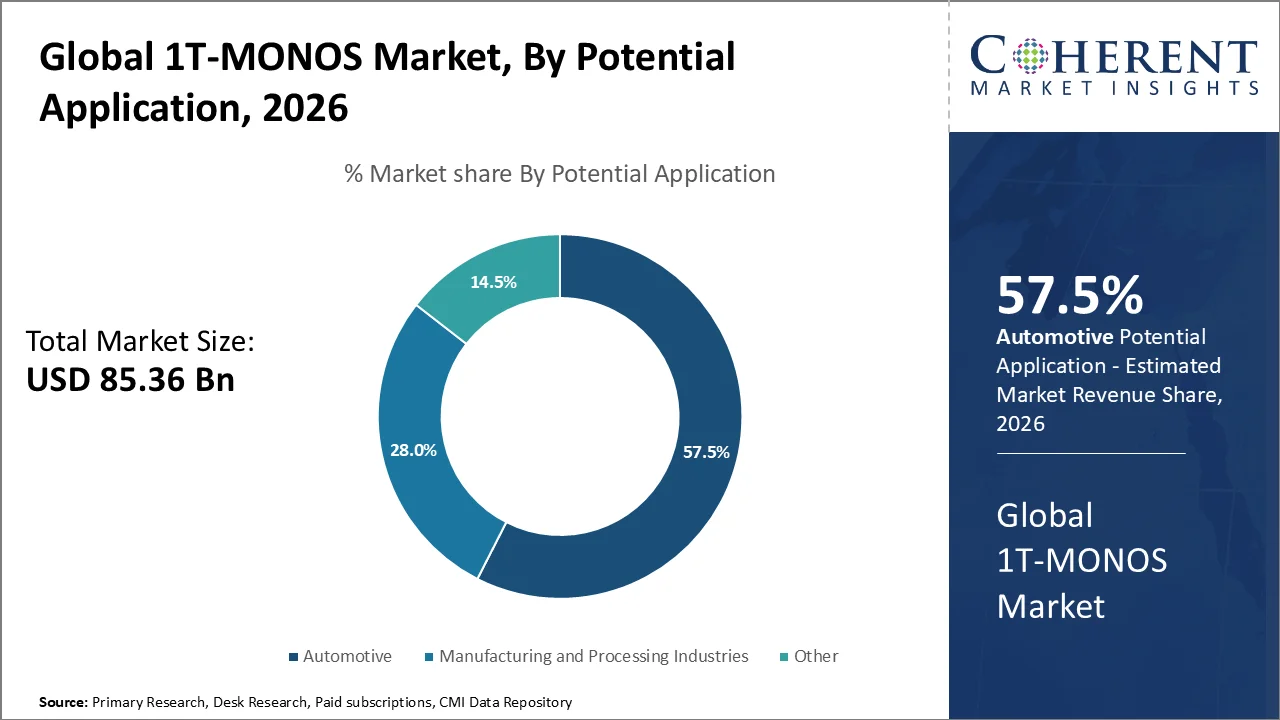
- The automotive segment is estimated to dominate the 1T-MONOS Market with 57.5% in 2026. The segment’s growth is driven by increasing deployment of electronic control units, battery management systems, ADAS, chassis and safety electronics, and other embedded control systems that require high-endurance and low-power non-volatile memory. Renesas’ 1T-MONOS technology has been shown to be capable of more than 100 million program/erase cycles at a junction temperature of 175°C, confirming its qualification for high-reliability automotive electronics.
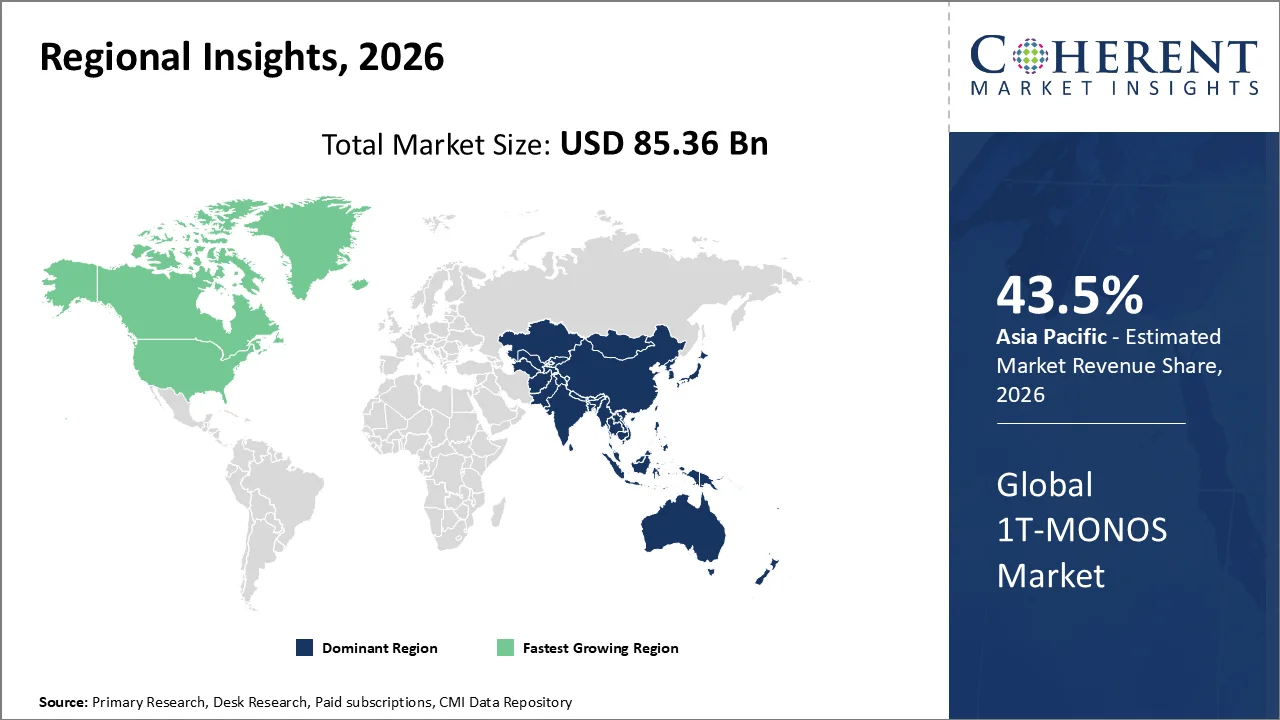
- Asia Pacific is projected to dominate the global 1T-MONOS Market with an estimated share of 43.5% in 2026. The region’s dominance is supported by its wide semiconductor manufacturing ecosystem, strong embedded-electronics production base, presence of major semiconductor companies in Japan, Taiwan, South Korea and China, and increasing adoption of advanced memory technologies in automotive, industrial and IoT applications. The Semiconductor Industry Association (SIA) announced in February 2026 that Asia Pacific/All Others semiconductor sales increased 45.0% year-over-year during 2025, with China sales up 17.3%, reflecting strong semiconductor demand across the region.
Market Drivers
Growing Automotive Electronics and ECU Deployment is Accelerating the 1T-MONOS Market
The increasing electronic content in modern vehicles drives the large demand for high-reliability embedded non-volatile memory technologies such as 1T-MONOS. Memory is increasingly required in automotive control systems to support frequent data rewriting, low power consumption, high-temperature operation and long-term reliability in applications such as electronic control units (ECUs), battery management systems, chassis control, motor control and safety systems.
In April 2026 OICA reported that global motor vehicle production rose 3.9% from 92.7 million units in 2024 to 96.4 million units in 2025, while global vehicle sales reached 99.8 million units, an increase of 4.7%. With the growing vehicle production base and increasing electrification and digitalization of vehicles, there are increasing demands for robust embedded semiconductor and memory solutions.
Rapid Expansion of IoT Devices is Driving Demand for Low-Power Embedded Memory
The rapid proliferation of IoT and connected electronic devices is driving the demand for compact, energy-efficient and reliable embedded non-volatile memory. Connected sensors, industrial controllers, smart meters, wearables and edge devices need embedded memory to store firmware, calibration information, security credentials, configuration settings and operational data that is changing rapidly. These requirements provide opportunities for MONOS based embedded memory technologies that can provide reliability at low power operation.
According to the 2026 Ericsson Mobility Report, total IoT connections globally reached approximately 22.3 billion in 2025 and are projected to grow to 47.1 billion by 2031, at a CAGR of around 13%. Cellular IoT connections alone were approximately 4.5 billion in 2025 and are expected to grow to 7.8 billion by 2031.
Current Events and Their Impact on the 1T-MONOS Market
Current Event | Description and its Impact |
European Commission Proposes Chips Act 2.0 to Strengthen Semiconductor Production (June 2026) |
|
EU Cyber Resilience Act Moves Toward Mandatory Reporting and Secure Product Lifecycle Requirements (2026) |
|
- Current Industry Events of 2026
- Market Size Estimation
- Regional Breakdown
- Competitive Landscape
- Customer Intelligence
- Segmental Analysis
- Pricing Analysis
- Key Market Drivers, Challenges & Future Trends
- Customized Insights Section
Segmental Insights
Why is Automotive Acquiring the Largest Share?
On the basis of application, the automotive segment is estimated to account for the largest 1T-MONOS Market share of 57.5% in 2026. The segment’s growth is owing to the increasing use of embedded non-volatile memory in automotive microcontrollers, electronic control units (ECUs), battery management systems, ADAS, chassis control, motor control, and software-defined vehicle architectures. High endurance, low-power operation, data retention, and reliability under elevated temperatures strengthen the suitability of embedded memory technologies such as 1T-MONOS for automotive electronics.
In February 2026, Renesas Electronics announced that its R-Car V4H automotive SoC had been selected for the Toyota RAV4’s ADAS control unit supplied by Denso. The R-Car V4H supports camera and radar sensor fusion, driver monitoring, Advanced Park, and panoramic-view functions.
1T-MONOS Market Trends
- The increasing deployment of industrial automation and intelligent manufacturing equipment is supporting demand for embedded controllers and associated non-volatile memory used for program storage, equipment configuration, calibration, and operational parameters. According to the International Federation of Robotics, the total number of industrial robots installed worldwide in 2024 was about 542,000 units, and the annual installations were over 500,000 units for the fourth year in a row.
- Rising use of automotive-grade flash memory for advanced cockpit, ADAS and infotainment platforms is driving higher memory requirements per vehicle. When MediaTek announced in August 2026 the qualification of Infineon’s 512 Mb automotive-grade Quad SPI NOR Flash for its Dimensity Auto Cockpit C-X1 platform, it highlighted the increasing need for dependable non-volatile memory for firmware and data storage in future vehicles.
- The increasing demand for automotive cybersecurity and secure firmware storage is driving the adoption of embedded memory architectures that can enable secure boot, software updates, cryptographic keys, and long-term data retention. Infineon added ISO/SAE 21434 compliant and post-quantum-cryptography ready capabilities to its AURIX, PSOC Automotive and TRAVEO MCU families in March 2026, demonstrating further the growing integration of security functionality in automotive microcontrollers.
Regional Insights
Asia Pacific Dominates Owing to the Strong Semiconductor Manufacturing and Embedded Electronics Ecosystem
The Asia Pacific region is estimated to account for the largest share of the global 1T-MONOS Market at approximately 43.5% in 2026. The region’s dominance is owing to its extensive semiconductor fabrication base, strong automotive and industrial electronics manufacturing, high concentration of MCU and memory manufacturers, and continued investment in advanced and specialty semiconductor capacity across Taiwan, South Korea, Japan, and China.
In April 2026, TSMC announced it is adding a new 3-nm fabrication plant at the Tainan Science Park in Taiwan, with volume production slated for the first half of 2027. TSMC specifically called out automotive and IoT applications as end markets supported by its expanding 3-nm capacity, further cementing Asia Pacific’s position as a major hub for advanced semiconductor manufacturing.
North America 1T-MONOS Market Trends
North America is expected to witness the fastest growth in the 1T-MONOS Market during the 2026–2033 forecast period. The regional growth is owing to accelerating semiconductor localization, expansion of domestic fabrication capacity, strong automotive and industrial semiconductor demand, and rising investment in advanced memory and embedded electronic technologies across the U.S.
In August 2026, the Semiconductor Industry Association (SIA) reported that semiconductor sales in the Americas rose 160.9% year-on-year in June 2026, outperforming the 124.4% growth recorded for Asia Pacific/All Other during the same period. This rapid expansion indicates strong semiconductor demand in North America and provides a positive demand environment for embedded memory technologies used in automotive, industrial, IoT and other electronic applications.
In January 2026, Texas Instruments introduced its new TDA5 automotive high-performance computing SoC family for ADAS and software-defined vehicles. The platform provides edge-AI performance of up to 1,200 TOPS and supports vehicle autonomy up to SAE Level 3.
Domestic Semiconductor Manufacturing and Embedded Processing Expansion is Accelerating the 1T-MONOS Market in the United States
The U.S. 1T-MONOS Market is expected to witness strong growth over the forecast period, supported by expansion of domestic semiconductor manufacturing, increasing development of embedded processing chips, and rising semiconductor requirements across automotive, industrial, IoT, and connected electronic systems. The increasing localization of mature and specialty semiconductor production creates a favorable manufacturing base for embedded non-volatile memory technologies such as 1T-MONOS.
In December 2025, Texas Instruments began production at its new 300-mm semiconductor fab in Sherman, Texas. The facility is expected to ultimately manufacture tens of millions of chips per day for automotive systems, industrial equipment, smart devices, medical electronics, and other applications.
China 1T-MONOS Market Trends
China is expected to witness strong growth in the 1T-MONOS Market over the forecast period. The country's growth is supported by rapidly expanding integrated-circuit production, large-scale automotive electronics manufacturing, increasing new-energy vehicle penetration, and rising domestic production of microcontrollers and other embedded semiconductor components.
According to China's National Bureau of Statistics, integrated-circuit production reached 334.2 billion units during January–July 2026, increasing 23.1% year-on-year. In July 2026 alone, China produced approximately 53 billion integrated circuits, representing 20.7% year-on-year growth, demonstrating the continuing expansion of the country's semiconductor manufacturing ecosystem.
Who are the Major Companies in 1T-MONOS Industry
Some of the major key players in 1T-MONOS Market are Renesas Electronics Corporation, Taiwan Semiconductor Manufacturing Company Limited (TSMC).
Key News
- In April 2026, Taiwan Semiconductor Manufacturing Company Limited (TSMC) announced its N2A automotive-grade process technology at the 2026 North America Technology Symposium. N2A is TSMC’s first automotive process based on nanosheet transistors and is expected to provide a 15–20% speed improvement at the same power compared with N3A.
- In October 2025, Renesas Electronics introduced the RA8M2 and RA8D2 high-performance microcontroller groups with integrated embedded MRAM. The devices use a 1 GHz Arm Cortex-M85 processor, provide 1 MB of integrated high-speed MRAM, and target industrial, IoT, HMI, and selected automotive applications.
Market Report Scope
1T-MONOS Market Report Coverage
| Report Coverage | Details | ||
|---|---|---|---|
| Base Year: | 2025 | Market Size in 2026: | USD 85.36 Bn |
| Historical Data for: | 2020 To 2024 | Forecast Period: | 2026 To 2033 |
| Forecast Period 2026 to 2033 CAGR: | 11.3% | 2033 Value Projection: | USD 180.26 Bn |
| Geographies covered: |
| ||
| Segments covered: |
| ||
| Companies covered: | Renesas Electronics Corporation and Taiwan Semiconductor Manufacturing Company Limited (TSMC). | ||
| Growth Drivers: |
| ||
| Restraints & Challenges: |
| ||
Analyst Opinion
- The 1T-MONOS Market is expected to benefit from the sustained expansion of automotive and industrial embedded processing, where high endurance, low power consumption, and reliable data retention remain important design requirements. Renesas generated ¥639.7 billion from its Automotive business in 2025, while its Industrial, Infrastructure and IoT business reached ¥671.8 billion, increasing 5.5% year-on-year.
- The market is likely to face increasing technology substitution pressure from next-generation embedded memories, making cost, endurance, temperature stability, and integration efficiency critical competitive factors for 1T-MONOS. TSMC has integrated MRAM at 22-nm and 16-nm in production with AEC-Q100 automotive qualification and embedded RRAM already in high volume production at 40-nm, 28-nm, 22-nm and 12-nm nodes.
- The foundry scale and process diversity will accelerate the commercialization of embedded-memory-enabled semiconductor products, particularly in the automotive, IoT and industrial electronics markets. In 2025, TSMC deployed 305 distinct process technologies and manufactured 12,682 products for 534 customers, while advanced technologies accounted for 74% of total wafer revenue.
Speak to the analyst
Want personalized insights?
Take the findings above to one of our principal consultants, or have the report rebuilt around the segments, geographies and competitors you actually track.
Market Segmentation
- By Potential Application (Revenue, USD Bn, 2021-2033)
- Automotive
- Manufacturing and Processing Industries
- Other
- By Region (Revenue, USD Bn, 2021-2033)
- North America
- U.S.
- Canada
- Latin America
- Brazil
- Mexico
- Argentina
- Rest of Latin America
- Europe
- Germany
- U.K.
- France
- Italy
- Spain
- Russia
- Rest of Europe
- Asia Pacific
- China
- India
- Japan
- Australia
- South Korea
- ASEAN
- Rest of Asia Pacific
- Middle East
- GCC
- Israel
- Rest of Middle East
- Africa
- South Africa
- Central Africa
- North Africa
- North America
Sources
Primary Research Interviews
- Semiconductor design engineers
- Embedded memory technology developers
- Microcontroller and automotive semiconductor manufacturers
- Semiconductor foundry and fabrication specialists
- Automotive electronics and ECU system engineers
- Industrial automation and IoT device manufacturers
- Semiconductor procurement and supply-chain professionals
- Key opinion leaders (KOLs) in embedded non-volatile memory technologies
Databases
- World Semiconductor Trade Statistics (WSTS)
- U.S. International Trade Commission (USITC)
- U.S. Census Bureau
- Eurostat
- National Bureau of Statistics of China
- World Bank
- OECD Data
- UN Comtrade Database
Magazines
- Semiconductor Engineering
- EE Times
- Electronics Weekly
- Electronic Design
- Semiconductor Digest
- EDN
Journals
- IEEE Transactions on Electron Devices
- IEEE Electron Device Letters
- IEEE Transactions on Semiconductor Manufacturing
- Microelectronics Reliability
- Solid-State Electronics
- Journal of Semiconductors
- Semiconductor Science and Technology
Newspapers
- The Wall Street Journal
- Financial Times
- Nikkei Asia
- The Economic Times
- South China Morning Post
- The Korea Herald
Associations
- Semiconductor Industry Association (SIA)
- SEMI
- World Semiconductor Trade Statistics (WSTS)
- IEEE Electron Devices Society
- JEDEC Solid State Technology Association
- European Semiconductor Industry Association (ESIA)
- Taiwan Semiconductor Industry Association (TSIA)
- Japan Electronics and Information Technology Industries Association (JEITA)
Public Domain Sources
- Renesas Electronics annual reports, technical papers, product announcements, and investor presentations
- Taiwan Semiconductor Manufacturing Company (TSMC) annual reports, technology updates, and investor presentations
- Semiconductor company product datasheets and technical documentation
- Government semiconductor policy and CHIPS program publications
- Automotive semiconductor and embedded MCU technical publications
- Patent databases such as WIPO, USPTO, EPO, and Google Patents
- IEEE and university research publications on MONOS and embedded non-volatile memory
- Public semiconductor fabrication capacity and technology-node announcements
- Automotive electronics, IoT, and industrial automation industry statistics
Proprietary Elements
- CMI Data Analytics Tool
- Proprietary CMI Existing Repository of Information for the Last 10 Years
Get access to 250+ pages report
Every segment, forecast, competitor profile and data table behind the analysis above — available for instant download.
- ESOMAR Member
- ISO 9001:2015 Certified
- D-U-N-S Registered
- GDPR & CCPA Compliant
Missing comfort of reading report in your local language? Find your preferred language:
Transform your Strategy with Exclusive Trending Reports
Frequently Asked Questions
The 1T-MONOS Market is expected to reach USD 180.26 Bn in 2033, compared with USD 85.36 Bn in 2026.
Major players operating in the global 1T-MONOS Market include Renesas Electronics Corporation and Taiwan Semiconductor Manufacturing Company Limited (TSMC).
The high development and fabrication costs and complex integration with advanced semiconductor nodes are the key factors hampering growth of the market.
The increasing adoption of embedded non-volatile memory in automotive electronics and growing demand for high-endurance memory in microcontrollers and electronic control units (ECUs) are major factors driving growth of the 1T-MONOS Market.
The 1T-MONOS Market is anticipated to grow at a CAGR of 11.3% between 2026 and 2033.
Among regions, Asia Pacific is estimated to account for the largest market share of approximately 43.5% in 2026, supported by its strong semiconductor manufacturing ecosystem, automotive and industrial electronics production, and presence of major semiconductor manufacturers.
North America is expected to witness the fastest growth during the 2026–2033 forecast period, owing to semiconductor localization, expanding domestic fabrication capacity, and rising investments in automotive, industrial, and embedded electronic technologies.