

Network As A Service Market Size and Share Analysis - 2026 To 2033
The Network As A Service market is anticipated to grow at a CAGR of 28.4% with USD 42.6 Bn in 2026 and is expected to reach USD 245.2 Bn in 2033. Adoption of cloud computing services (USD 26.6 Bn by 2025) and network virtualization has led to significant increase in data collected on various digital and social platforms. In cloud computing, the NaaS benefits in providing scalable, pluggable, and API (Application Programmer Interface) driven network management, where the users can deploy and manage their networks virtually. NaaS offers a networking framework that outspreads the cloud computing’s on-demand and self-service provisioning model to the network service provider.
Key Takeaways
- Technology services segment is expected to account the largest share of 55% in 2026, as enterprises are highly adopting software-defined networking (SDN), network automation, cloud management platforms, and virtualized network solutions. According to NVIDIA's AI in Telecom Survey 2026, 65% of telecom operators said that AI is driving network automation, while 89% plan to increase their AI spending in 2026. Of these, 33% expect to increase AI investments by more than 10%.
- WAN-as-a-service segment will dominate with 65% in 2026, WANaaS leads due to rapid adoption of SD-WAN, cloud connectivity, hybrid work models, and the need for secure connectivity across multiple offices and cloud environments. According to IDC FutureScape, by 2026, 65% of technology buyers are expected to prioritize as-a-service consumption models for infrastructure purchases.
- BoD segment will dominate with 30% in 2026, because enterprises need flexible bandwidth allocation for cloud applications, remote work, video communication, and high-volume data transfers. In 2026, around 221 zettabytes of data are expected to be created worldwide. This means about 402 million terabytes of new data will be generated every day. Also, 80–90% of enterprise data is unstructured, such as emails, videos, images, documents, and social media content.
- Information Technology & Telecommunication segment will dominate with 25% in 2026, IT & Telecom leads because telecom operators, cloud providers, and technology companies are early adopters of SDN, NFV, 5G networks, and cloud-based networking solutions. According to the International Telecommunication Union (ITU), around 6 Bn people, or 74% of the world's population, are using the internet in 2025. This is a surge from 5.8 Bn people (71%) in 2024, showing that internet access continues to escalate globally.
- North America is expected to acquire the dominant share of 39.70% in 2026, North America leads due to early adoption of cloud networking, SD-WAN, Software-Defined Networking (SDN), Network Function Virtualization (NFV), and subscription-based IT infrastructure. The U.S. spending on cloud infrastructure is expected to increase by 27% in 2026, reaching more than USD 500 Bn.
Segmental Insights
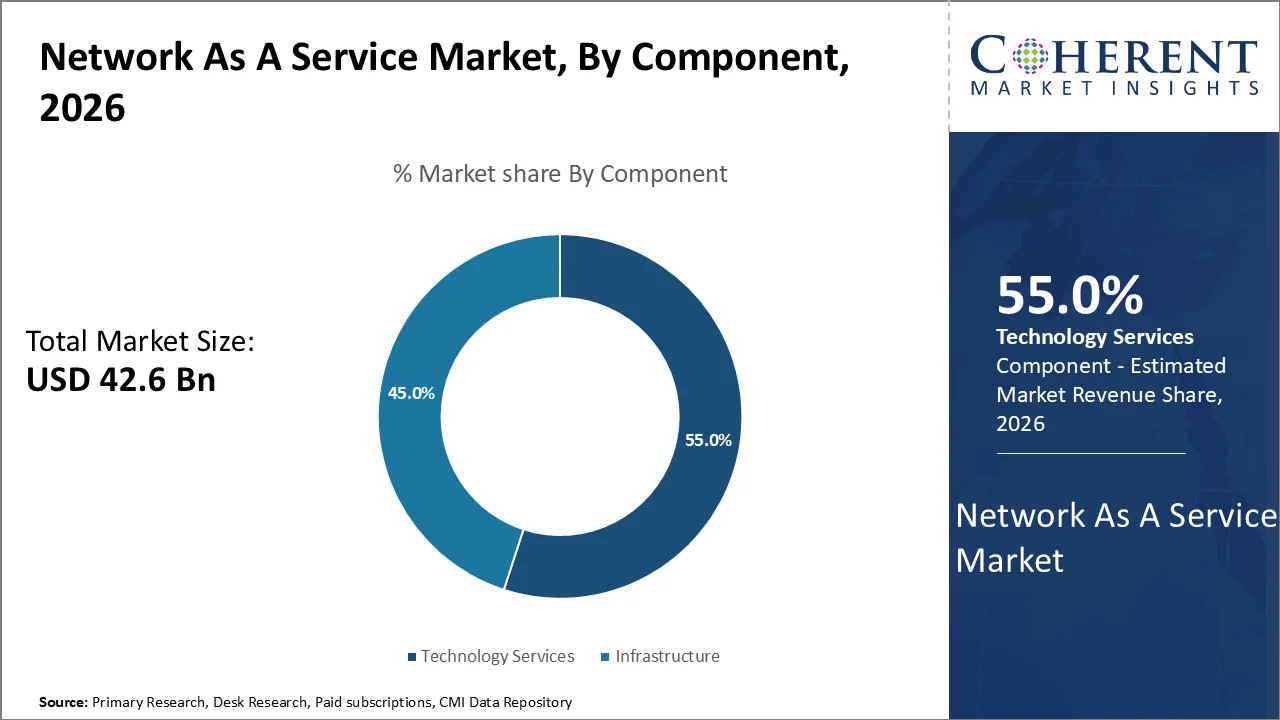
Why is Technology Services Segment Acquiring the Largest Market Share?
Technology services is projected to account for the largest share of component in 2026, representing approximately 55% of the total volume. Owing to the rapidly intensifying demand for managed networking solutions, cloud-based network orchestration, professional consulting, as well as end-to-end service management that organizations require to operate increasingly complex digital environments without bearing the full operational burden of network management internally. According to Gartner, 30% of enterprises are expected to automate more than half of their network activities by 2026, up from less than 10% in 2023.
The dominance of Technology Services can be fundamentally attributed to the paradigm shift that enterprises have undergone in recent years moving away from capital-intensive, on-premise network ownership toward outcome-based consumption models.
Technology Services within the NaaS framework have a broad spectrum of offerings, including network monitoring and management services, security-as-a-service layers integrated into network delivery, Software-Defined Networking (SDN) support services, network analytics platforms, etc.
- Current Industry Events of 2026
- Market Size Estimation
- Regional Breakdown
- Competitive Landscape
- Customer Intelligence
- Segmental Analysis
- Pricing Analysis
- Key Market Drivers, Challenges & Future Trends
- Customized Insights Section
WAN-as-a-service Segment holds the Largest Market Share
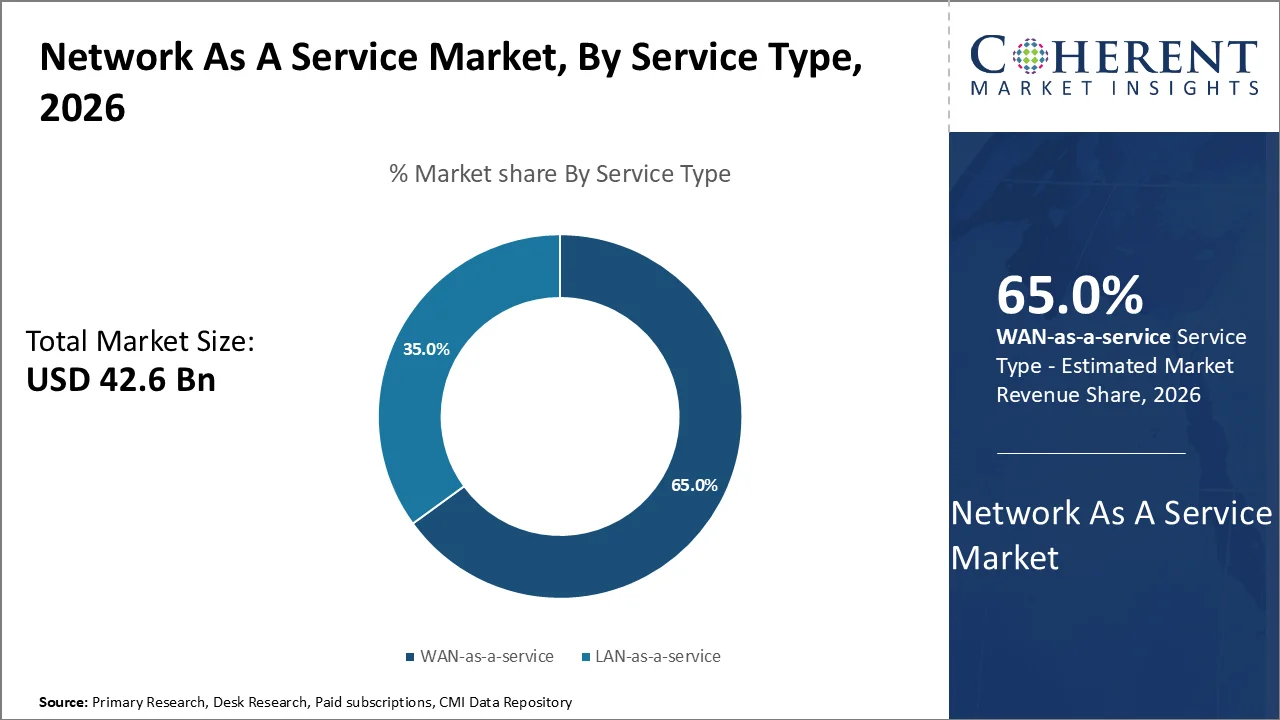
Based on service type, WAN-as-a-service dominates the market, accounting for a significant 65% share in 2026. WAN-as-a-service contributes the highest share in the market due to its inherent abilities to support large-scale, geographically dispersed enterprise network infrastructures that has consistent, high-performance connectivity across multiple locations.
Modern enterprises are no longer confined to a single physical location or a centralized data center which is augmenting the market. There are about 11,959 active data centers globally. With 4,542 data centers as of July 2026, the U.S. has by far the most globally.
On July 2026, Government authorities, telecom companies, as well as industry organizations met in Bangkok at the Broadband Development Summit APAC 2026 to discuss the future of AI-powered broadband and Wide Area Networks (WANs). The summit focused on building faster, smarter, as well as more reliable WAN infrastructure to support AI applications, cloud services, and cross-border digital connectivity.
Instead, they operate across multiple regions, countries, and even continents, requiring a strong wide-area networking services that can seamlessly integrate cloud platforms, remote branches, and headquarters under a unified, managed network architecture.
BoD Segment holds the Largest Market Share
Based on application, BoD segment dominates the market, accounting for a significant 30% share in 2026. Owing to its fundamental utility in enabling enterprises as well as service providers to dynamically measure their network abilities based on real-time traffic demands without the need for costly physical infrastructure upgrades.
STPI provides Bandwidth-on-Demand (BoD) services that allow customers to surge bandwidth according to their needs. It also provides online bandwidth monitoring tools as well as make sure reliable connectivity with more than 99.5% uptime.
The adoption of cloud computing, media streaming, remote work ecosystems, data-intensive enterprise applications, etc., has made dynamic bandwidth provisioning not merely a convenience but a strategic necessity for organizations looking operational agility as well as cost efficiency.
BoD fundamentally decouples network capacity from physical hardware constraints, making sure enterprises to purchase and consume bandwidth in a highly flexible, consumption-based model that aligns network expenditure directly with actual business activity.
Information Technology & Telecommunication holds the Largest Market Share
Based on vertical, information technology & telecommunication dominates the market, accounting for a significant 25% share in 2026. The inherent dependency on scalable, flexible, and dynamic network infrastructure are the factors propelling the market.
The IT & Telecom sector operates at the very core of digital transformation, requiring continuous network upgrades, real-time data processing, and seamless global connectivity, all of which are efficiently addressed through NaaS frameworks. Real-time data is expected to make up around 30% of the world’s total data. This means a large amount of data will be created and processed instantly from sources such as IoT devices, online services, and digital applications.
Telecom operators and IT service providers are increasingly transitioning from traditional hardware-centric network models to software-defined, cloud-native architectures that NaaS platforms inherently support.
Major telecom operators have been actively deploying Software-Defined Networking (SDN) and Network Functions Virtualization (NFV) as foundational elements of their network modernization strategies, as validated by initiatives under the TM Forum, a global industry association representing telecommunications and digital services companies, which has been actively promoting open digital architecture and NaaS adoption among its member organizations.
Current Events and Their Impact on the Network As A Service Market
Current Event | Description and its Impact |
Government-driven cloud adoption policies and digital infrastructure modernization programs (2025–2026) |
|
Expansion of cybersecurity regulations and zero-trust security requirements (2025–2030) |
|
Network As A Service Market Trends
- Enterprise IT strategies are highly prioritizing cloud-first architectures, enabling organizations to abandon legacy, hardware-centric networking models in favor of software-defined, cloud-delivered NaaS services. HPE released a new AI-focused networking strategy at Discover 2026, showing the integration of Juniper technology, Agentic AI networking, as well as new data center solutions.
- The high adoption of 5G networks is serving as a powerful NaaS accelerator, enabling ultra-low latency, high-bandwidth network slicing capabilities that are in line with NaaS delivery models. Orange Wholesale introduced a 5G Core Network-as-a-Service (CNaaS) solution that helps telecom operators launch 5G Standalone networks faster and at lower cost. It uses a cloud-based model to offer features such as network slicing, higher speed, better capacity, etc.
- Artificial Intelligence (AI) along with Machine Learning (ML) are being deeply used into NaaS platforms to enable predictive network management, autonomous traffic optimization, real-time anomaly detection, as well as intelligent policy enforcement. Cirion Technologies launched a Network-as-a-Service (NaaS) solution to improve enterprise connectivity across data centers, hybrid clouds, and AI environments. The platform enables automated network provisioning, real-time monitoring, as well as flexible scaling through a digital portal.
- Environmental, Social, and Governance (ESG) considerations are highly influencing enterprise purchasing decisions. NaaS, by consolidating shared infrastructure as well as enabling dynamic resource allocation, significantly reduces carbon footprints compared to traditional dedicated hardware deployments positioning NaaS as a critical enabler of sustainable IT operations.
Regional Insights
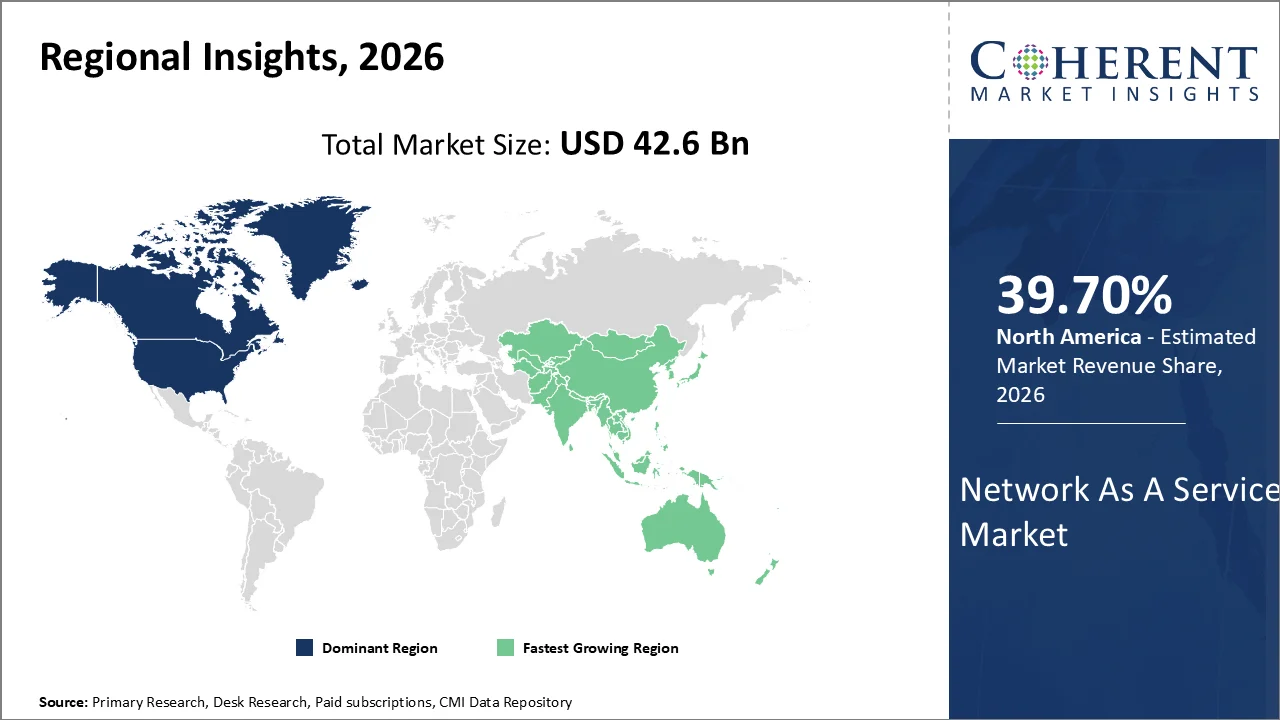
North America dominates owing to its highly advanced digital infrastructure
North America account 39.70% market share in 2026, owing to its highly advanced digital infrastructure, widespread cloud adoption, and the presence of a large number of technology-driven enterprises that are continuously seeking scalable and flexible networking solutions. The U.S. technology spending by businesses and government authorities are expected to reach around USD 2.9 trillion in 2026, growing at an annual rate of 8.3%.
The United States, in particular, is at the edge for NaaS adoption, driven by federal-level initiatives including the Federal Communications Commission's (FCC) broadband expansion programs that have consistently pushed organizations toward modernized, cloud-managed network frameworks. A survey in April 2026 found that 60% of companies had already adopted Network-as-a-Service (NaaS) fully or partly, while 31% were testing or evaluating NaaS solutions.
The high deployment of 5G networks across major metropolitan areas in the United States has further accelerated enterprise demand for NaaS solutions. As organizations look to leverage software-defined networking as well as virtualized infrastructure to complement next-generation connectivity.
For instance, in May 2026, AT&T Business launched a Quantum Resilient SD-WAN service to help companies protect their networks from future security threats. The service uses post-quantum encryption technology with Cisco 8000 Series Secure Routers to provide safer and more reliable connections.
Asia Pacific Network As A Service Market Trends
The Asia Pacific region is poised to be the fastest-growing region through 2026-2033, expanding at a CAGR of approximately 6.8%. Propelled by an unprecedented convergence of government-led digital transformation mandates, rapid 5G infrastructure rollouts, as well as an exponentially expanding base of digitally native enterprises demanding scalable, consumption-based networking architectures. In 2025, six out of the top ten countries with the highest 5G SA reach were from the Asia Pacific region. China had the highest 5G SA reach with 79.0%, followed by India with 49.2% and Singapore with 37.0%.
The Asia-Pacific Economic Cooperation (APEC) forum's Digital Economy Steering Group has been actively championing cross-border data flow facilitation as well as cloud infrastructure harmonization across member economies, creating fertile ground for NaaS consumption models to displace traditional hardware-centric networking.
For instance, in July 2026, China Unicom and Huawei launched the world’s largest 5G-Advanced (5G-A) GigaUplink commercial network in Beijing. The network covers key areas with more than 10,000 base stations. It achieved a 100 MHz uplink effective rate of 83%, a peak uplink speed of 1 Gbps, an average uplink speed of 397 Mbps, and only 0.1% weak coverage points with speeds below 20 Mbps.
Countries such as India, Japan, South Korea, and Australia have individually launched national digital infrastructure programs India's Digital Public Infrastructure initiative, Japan's Society 5.0 framework, and Australia's National Broadband Network expansion all of which actively encourage enterprises and public sector bodies to shift toward virtualized, subscription-based network services.
Unparalleled Concentration of Technology-driven Enterprises is Accelerating the Network As A Service Market Demand in U.S.
The U.S. contributes the highest share in the NaaS market in the region, owing to its unparalleled concentration of technology-driven enterprises, hyperscale cloud infrastructure, and a deeply embedded culture of IT outsourcing and managed services adoption across industries.
The United States is home to the largest cluster of Fortune 500 corporations in the world, many of which have publicly committed to multi-cloud networking strategies that inherently depend on NaaS platforms to manage traffic, ensure security, as well as maintain performance across distributed hybrid environments.
For example, the U.S. Federal Communications Commission's ongoing efforts under the Broadband Equity, Access, and Deployment (BEAD) Program, which allocated approximately USD 42.45 billion toward broadband infrastructure through the Infrastructure Investment and Jobs Act, has catalyzed significant network modernization activity across enterprise and government segments alike.
China Network As A Service Market Trends
China contributes the highest share in the Network as a Service market in Asia Pacific, due to its massive digital infrastructure investments as well as government-backed initiatives that have accelerated enterprise cloud adoption and next-generation networking deployments across the country.
The Ministry of Industry and Information Technology (MIIT) of China has been actively pushing forward its "Digital China" strategy, which mandates high adoption of cloud-native networking solutions across public as well as private enterprises.
Under this framework, thousands of state-owned enterprises and government agencies have been transitioning toward flexible, subscription-based networking models, which directly fuels NaaS adoption at scale.
Furthermore, China Telecom and China Mobile, two of the world's largest telecommunications operators, have been aggressively rolling out SD-WAN and virtualized networking services to enterprise clients across more than 300 cities, making NaaS accessibility far more widespread than in any other APAC nation.
Who are the Major Companies in Network As A Service Industry
Some of the major key players in Network As A Service market include, Cisco Systems Inc., Juniper Networks, Inc., IBM Corp., NEC Corp., VMware, Aryaka Networks Inc., Alcatel Lucent, Brocade Communications Systems Inc., AT&T Inc., and Ciena Corporation.
Key News
- In February 2026, Lumen Technologies doubled its Network-as-a-Service (NaaS) customer base to more than 2,000 businesses since Q3 2025. This growth shows that companies are increasingly using on-demand and programmable networks to support AI applications and cloud workloads.
- In February 2026, HPE introduced new networking and computing solutions to help service providers build modern AI-based networks. These solutions support faster and smarter networks with low delay and high capacity, from the core network to the edge.
Market Report Scope
Network As A Service Market Report Coverage
| Report Coverage | Details | ||
|---|---|---|---|
| Base Year: | 2025 | Market Size in 2026: | USD 42.6 Bn |
| Historical Data for: | 2020 To 2024 | Forecast Period: | 2026 To 2033 |
| Forecast Period 2026 to 2033 CAGR: | 28.4% | 2033 Value Projection: | USD 245.2 Bn |
| Geographies covered: |
| ||
| Segments covered: |
| ||
| Companies covered: | Cisco Systems Inc., Juniper Networks, Inc., IBM Corp., NEC Corp., VMware, Aryaka Networks Inc., Alcatel Lucent, Brocade Communications Systems Inc., AT&T Inc., and Ciena Corporation | ||
| Growth Drivers: |
| ||
| Restraints & Challenges: |
| ||
Analyst Opinion
- The Network as a Service (NaaS) market is undergoing a significant transformation, driven by the increasing demand for flexible, scalable, and cost-effective networking solutions across enterprises worldwide.
- Organizations are highly shifting from traditional hardware-centric networking infrastructures toward cloud-based networking models, primarily to reduce capital expenditure and enhance operational agility.
- The adoption of remote work culture and hybrid workplace environments has further accelerated the installation of NaaS solutions, making businesses to look for dynamic network management capabilities.
- Additionally, the growing deployment of 5G technology as well as edge computing is making substantial opportunities for NaaS providers to deliver enhanced connectivity with improved latency as well as bandwidth management.
Speak to the analyst
Want personalized insights?
Take the findings above to one of our principal consultants, or have the report rebuilt around the segments, geographies and competitors you actually track.
Market Segmentation
- By Component (Revenue, USD Bn, 2021-2033)
- Infrastructure
- Technology Services
- By Service Type (Revenue, USD Bn, 2021-2033)
- LAN-as-a-service
- WAN-as-a-service
- By Application (Revenue, USD Bn, 2021-2033)
- Bandwidth on Demand (BoD)
- Network Function Virtualization (NFV)
- Virtual Customer Premises Equipment (V-CPE)
- Integrated network security-as-a-service
- By vertical (Revenue, USD Bn, 2021-2033)
- Information Technology (IT) and Telecommunication
- Banking Finance Services and Insurance (BFSI)
- Manufacturing
- Government
- Healthcare
- Transport and Logistics
- Retail
- By Region (Revenue, USD Bn, 2021-2033)
- North America
- U.S.
- Canada
- Latin America
- Brazil
- Mexico
- Argentina
- Rest of Latin America
- Europe
- Germany
- U.K.
- France
- Italy
- Spain
- Russia
- Rest of Europe
- Asia Pacific
- China
- India
- Japan
- Australia
- South Korea
- ASEAN
- Rest of Asia Pacific
- Middle East
- GCC
- Israel
- Rest of Middle East
- Africa
- South Africa
- Central Africa
- North Africa
- North America
Sources
Primary Research Interviews
- Network Infrastructure Providers & Solution Architects
- Cloud Service Providers & Hyperscale Data Center Operators
- Enterprise IT & Telecom Network Managers
- Network Security & SD-WAN Solution Specialists
- Others
Databases
- Gartner IT Infrastructure & Networking Database
- IDC Networking & Telecommunications Research Database
- Statista Technology & Cloud Services Database
- S&P Global Market Intelligence Database
- Others
Magazines
- Network World Magazine
- IEEE Spectrum (Networking & Cloud)
- SDxCentral Magazine
- Light Reading Magazine
- Others
Journals
- IEEE Journal on Selected Areas in Communications
- Journal of Network and Computer Applications (Elsevier)
- IEEE Transactions on Network and Service Management
- Others
Newspapers
- The Wall Street Journal (Technology Section)
- Financial Times (Technology & Telecom Section)
- The New York Times (Technology Section)
- Reuters Technology News
- Others
Associations
- MEF (Metro Ethernet Forum) – NaaS & SD-WAN Standards Body
- TeleManagement Forum (TM Forum)
- Internet Engineering Task Force (IETF)
- Cloud Native Computing Foundation (CNCF)
- Others
Public Domain Sources
- U.S. Federal Communications Commission (FCC) – Telecom & Network Reports
- European Union Agency for Cybersecurity (ENISA) – Network Security Publications
- National Institute of Standards and Technology (NIST) – Cloud & Networking Guidelines
- World Economic Forum (WEF) – Digital Infrastructure Reports
- Others
Proprietary Elements
- CMI Data Analytics Tool
- Proprietary CMI Existing Repository of information for last 10 years
Get access to 250+ pages report
Every segment, forecast, competitor profile and data table behind the analysis above — available for instant download.
- ESOMAR Member
- ISO 9001:2015 Certified
- D-U-N-S Registered
- GDPR & CCPA Compliant
Missing comfort of reading report in your local language? Find your preferred language:
Transform your Strategy with Exclusive Trending Reports
Frequently Asked Questions
The Network As A Service market is expected to reach USD 245.2 Bn in 2033.
Major players operating in the global Network As A Service market include Cisco Systems Inc., Juniper Networks, Inc., IBM Corp., NEC Corp., VMware, Aryaka Networks Inc., Alcatel Lucent, Brocade Communications Systems Inc., AT&T Inc., and Ciena Corporation.
concerning data security and privacy challenges, as enterprises remain cautious about migrating sensitive network operations to third-party cloud environments is one of the major factors that is expected to hamper growth of the market over the forecast period.
the growing deployment of 5G technology and edge computing are driving growth of the global Network As A Service market.
The Network As A Service market is anticipated to grow at a CAGR of 28.4% between 2026 and 2033.
Among regions, North America is expected to account for a largest market share in the global Network As A Service market over the forecast period.
SaaS delivers software (e.g., email, CRM) via the cloud, while NaaS offers network services (e.g., connectivity, security). SaaS focuses on end-user applications, and NaaS is about managing the network infrastructure.