

Weather Radar Market Size and Share Analysis – 2026 To 2033
The global weather radar market is projected to grow from USD 297.2 Mn in 2026 to USD 401.8 Mn by 2033, registering a CAGR of 4.4% during 2026–2033. Market growth is driven by increasing demand for accurate weather forecasting, expanding use of radar systems for aviation safety, rising exposure to extreme-weather events, and government investment in meteorological observation and early-warning infrastructure. Weather radar solutions help detect precipitation volume, precipitation movement, and storm formation, providing early warning for various applications in aviation, defense, marine transport, agriculture, and disaster management. As of April 2026, the U.S. Next-Generation Radar network comprised 160 high-resolution Doppler weather radars operated jointly by the National Weather Service, Federal Aviation Administration, and U.S. Air Force.
Key Takeaways
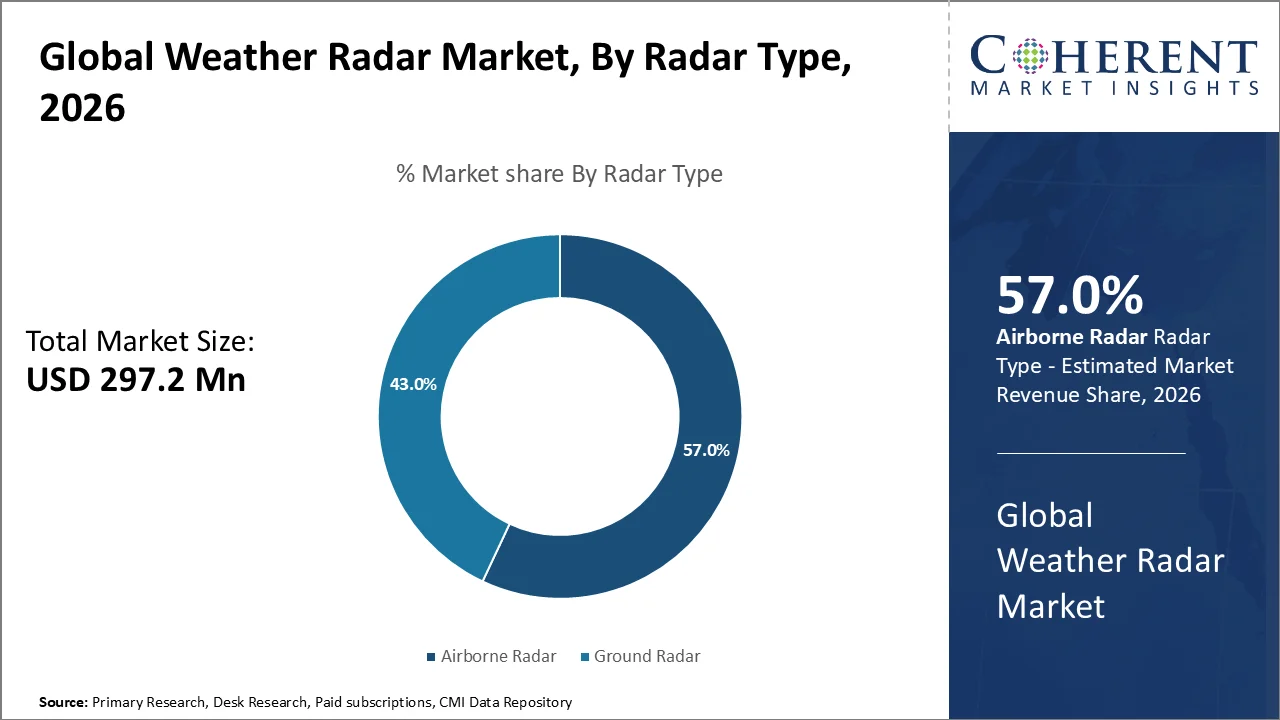
- The airborne radar segment is likely to dominate the Weather Radar Market with an estimated 57.0% share in 2026. The segment’s growth is owing to the increasing installation of advanced weather radars in commercial, military, cargo, and business aircraft for precipitation detection, turbulence identification, storm avoidance, and safer flight-route planning. In January 2026, Airbus stated that the company delivered 793 aircraft to 91 customers in the year 2025, and received 1,000 gross aircraft orders and a record year-end backlog of 8,754 aircraft, which is an indication of future installation base of airborne weather radars.
- The aviation segment is set to lead the Weather Radar Market with an estimated 40.5% share in 2026. The segment’s growth is owing to increasing passenger traffic, rising commercial aircraft operations, stricter flight-safety requirements, and growing demand for real-time storm, wind-shear, turbulence, and precipitation monitoring. According to IATA, global passenger demand increased by 5.3% in 2025, while the passenger load factor reached a record 83.6%.
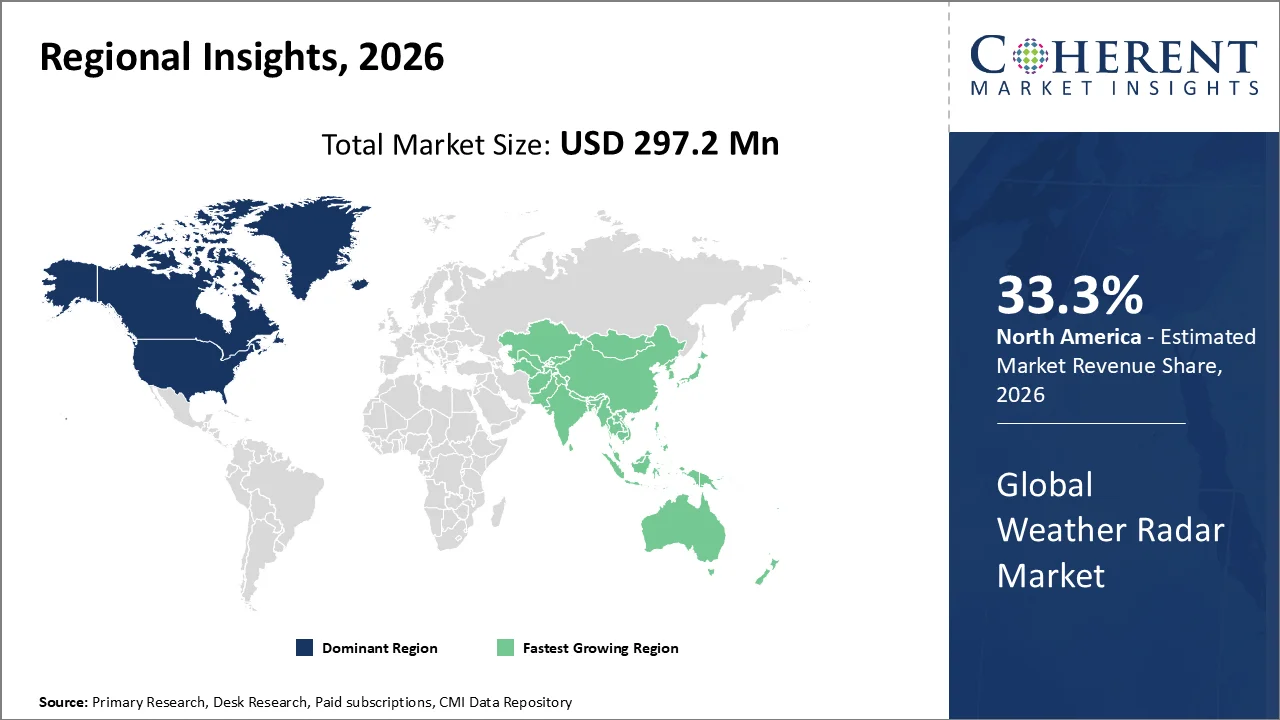
- North America is likely to dominate the global Weather Radar Market with an estimated 33.3% share in 2026. The region’s growth is owing to the presence of established radar manufacturers, modernization of national weather-monitoring networks, high commercial and military aviation activity, and rising requirements for severe-weather detection. NOAA recorded at least 1,735 confirmed tornadoes and 27-billion-dollar weather and climate disasters in the U.S. during 2024, reinforcing the need for advanced radar-based forecasting and early-warning infrastructure.
Market Drivers
Phased-Array and Dual-Polarization Technologies are Modernizing Weather Radar Systems
Technological advances in phased-array radar, electronic beam steering, dual polarization, signal processing, and three-dimensional storm imaging are supporting the replacement of conventional mechanically scanned radar systems. These technologies provide faster updates and more detailed information on precipitation type, storm structure, wind shifts, and rapidly developing hazards.
According to NOAA’s Advanced Technology Demonstrator had collected more than 290 hours of observational data and captured 13 tornadic supercells, supporting the operational validation of next-generation radar technology.
In March 2025, NOAA’s experimental phased-array radar observed multiple wildfires during a major wind, dust, and fire event in Oklahoma. The system was able to identify clear patterns of smoke plumes and the effects of turbulence on them, proving that advanced weather radars could not only help monitor storms but forecast wildfires and provide emergency assistance.
Increasing Extreme Weather Risks are Strengthening Demand for Real-Time Radar Monitoring
The growing frequency of intense rainfall, hurricanes, thunderstorms, and other fast-forming weather phenomena has made atmospheric monitoring increasingly necessary. This is where weather radar comes into play. It allows for obtaining frequent data about the intensity of precipitation, the location of the storm, wind speed and direction, thus allowing early warning to be given.
Under India’s Mission Mausam, advanced observation infrastructure is expected to enable severe-weather forecasting at a spatial resolution of approximately 5 × 5 km and improve forecast accuracy by around 10–15% by 2030.
In March 2026, the World Meteorological Organization announced that the years 2015-2025 were the 11 hottest years ever, and 2025 was 1.43°C above the average from 1850-1900. Additionally, the organization also revealed that extreme weather events had impacted millions of individuals and cost billions of dollars during 2025.
Current Events and Their Impact on the Weather Radar Market
Current Event | Description and its Impact |
G7 Governments Increase Funding for Climate Risk and Early-Warning Infrastructure (2026) |
|
China Implements the Action Plan on Early Warning for Climate Change Adaptation, 2025–2027 |
|
- Current Industry Events of 2026
- Market Size Estimation
- Regional Breakdown
- Competitive Landscape
- Customer Intelligence
- Segmental Analysis
- Pricing Analysis
- Key Market Drivers, Challenges & Future Trends
- Customized Insights Section
Segmental Insights
Why is Airborne Radar Acquiring the Largest Share?
On the basis of radar type, the airborne radar segment is projected to account for the largest Weather Radar Market share of 57.0% in 2026. The segment’s growth is owing to the increasing installation of weather radar systems across commercial aircraft, business jets, military aircraft, helicopters, and cargo fleets. These systems support real-time precipitation mapping, storm-cell identification, turbulence detection, ground-clutter suppression, and hazardous-weather avoidance during different phases of flight.
Moreover, Collins Aerospace’s MultiScan ThreatTrack airborne weather radar can identify weather hazards up to 320 nautical miles ahead and automatically monitor as many as 64 storm cells. Its automated threat evaluation, turbulence detection, and storm-top analysis demonstrate the growing integration of advanced radar capabilities in modern aircraft.
In April 2026, Boeing reported delivering 143 commercial aircraft during the first quarter of 2026, while its commercial aircraft backlog exceeded 6,100 airplanes valued at a record USD 576 billion. This substantial delivery pipeline supports long-term demand for airborne weather radars as part of aircraft flight-deck and avionics systems.
Aviation Holds the Largest Market Share
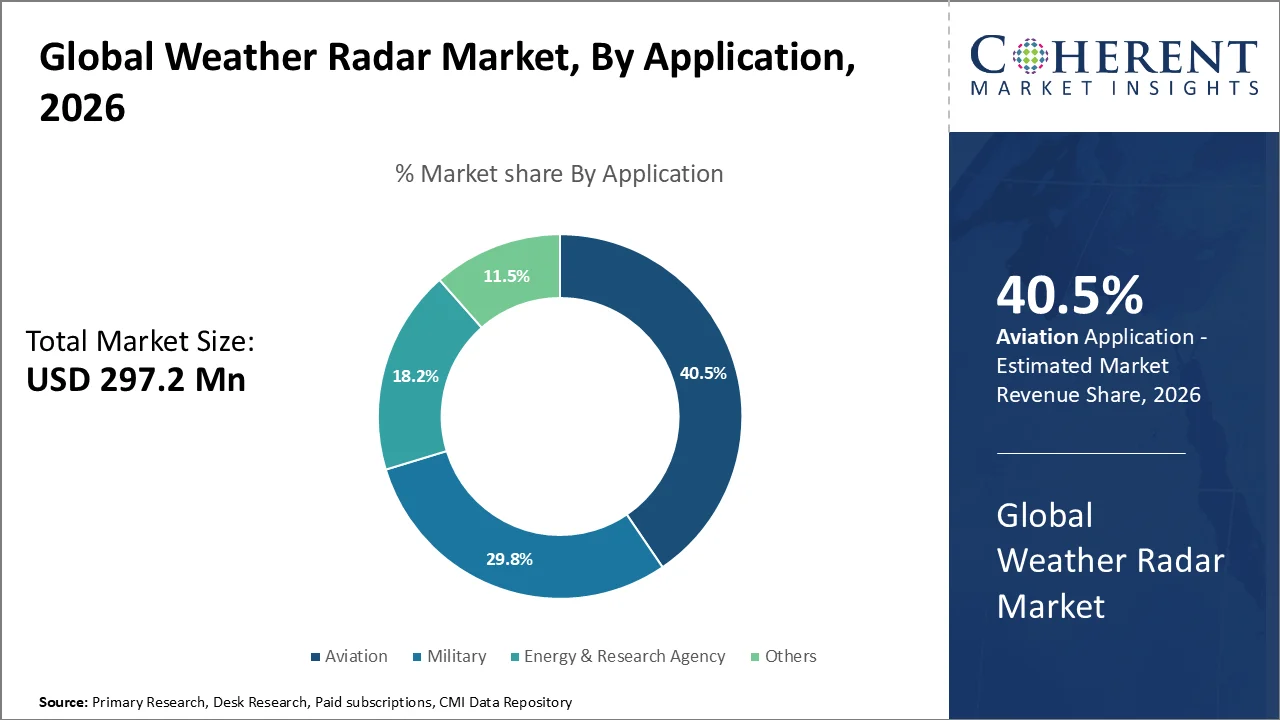
On the basis of application, the aviation segment is projected to lead the Weather Radar Market with a major 40.5% share in 2026. The segment’s growth is owing to rising aircraft movements, expanding commercial fleets, increasing airport traffic, and the critical requirement for real-time storm, wind-shear, hail, turbulence, and precipitation monitoring. Weather radars enable pilots and air-traffic operators to identify hazardous conditions, adjust flight paths, reduce weather-related disruptions, and strengthen passenger and aircraft safety.
According to EUROCONTROL, Europe recorded approximately 11.1 million flights in 2025, representing an increase of 4.1% from 2024, with an average of 30,474 flights per day. The increasing number of daily aircraft movements strengthens the requirement for reliable airborne and airport-based weather-monitoring systems.
In July 2026, Honeywell Aerospace announced that IndiGo selected its avionics and power systems for 810 Airbus A320neo-family aircraft.
Weather Radar Market Trends
- The increasing integration of artificial intelligence with weather-radar data is strengthening short-term precipitation and storm nowcasting. In October 2025, the World Meteorological Organization reported that its AI for Nowcasting Pilot Project uses real-time information from weather radars, satellites, and other observation systems to forecast rapidly developing events from minutes to hours ahead. A related workshop brought together more than 70 experts from meteorological agencies, universities, research institutions, and technology companies.
- The growing deployment of integrated radar and lightning-detection networks is replacing standalone weather-monitoring systems. In April 2025, Vaisala was selected to modernize Greece’s meteorological infrastructure through the installation of seven dual-polarization C-band weather radars and 12 advanced lightning sensors. The integrated network is intended to strengthen the detection of severe storms, flooding, lightning, and wildfire-related weather conditions.
- The transition toward solid-state weather radar technology is improving operational reliability and reducing dependence on conventional high-power radar transmitters. In its 2025 annual report, the Hong Kong Observatory stated that it implemented a solid-state weather radar to strengthen its long-range radar operations and improve the monitoring of rainstorms, tropical cyclones, low-level winds, and precipitation. Hong Kong also issued a record 16 Red Rainstorm Warnings and five Black Rainstorm Warnings in 2025, highlighting the operational need for modern radar infrastructure.
Regional Insights
North America Dominates Owing to its Established Radar Infrastructure and Expanding Private Observation Networks
North America accounts for an estimated 33.3% of the global Weather Radar Market share in 2026. The region’s dominance is owing to its established weather-monitoring infrastructure, strong presence of radar technology companies, high aviation and defense requirements, and increasing deployment of supplementary radars to address gaps in low-altitude weather observation.
In September 2025, U.S.-based Climavision expanded its private weather-radar network across 15 states and announced plans to address nearly 200 weather-observation gaps across the country. The company reported that approximately 130 million U.S. residents live in areas where lower-atmospheric weather conditions are not adequately measured by existing radar infrastructure.
Asia Pacific Weather Radar Market Trends
Asia Pacific is expected to be the fastest-growing region in the Weather Radar Market during 2026–2033. Regional growth is owing to government-led expansion of Doppler radar networks, high exposure to monsoons and tropical cyclones, increasing aviation activity, and rising investment in localized early-warning infrastructure across India, Japan, China, Australia, South Korea, and Southeast Asia.
Furthermore, India Meteorological Department commissioned two advanced C-band Doppler Weather Radars at Raipur and Mangaluru. The Mangaluru system is intended to strengthen the real-time monitoring of thunderstorms, heavy rainfall, cyclones, and localized convective weather across coastal and adjoining areas.
In July 2025, the India Meteorological Department issued a procurement tender for 20 C-band and 25 X-band polarimetric Doppler Weather Radar systems. A separate tender issued in May 2025 covered an additional eight S-band polarimetric Doppler Weather Radars, indicating a combined procurement pipeline of 53 advanced radar systems. This large-scale procurement is expected to create opportunities for radar manufacturers, component suppliers, software providers, installation companies, and maintenance-service providers.
Federal Radar Modernization and High Public-Safety Value are Accelerating the Weather Radar Market in the United States
The U.S. Weather Radar Market is witnessing sustained growth owing to the country’s extensive meteorological infrastructure, increasing severe-weather monitoring requirements, established radar-manufacturing ecosystem, and federal planning for the replacement of aging Doppler radar systems. Demand is shifting toward phased-array radar, faster atmospheric scanning, improved dual-polarization capabilities, and integrated radar-data processing for aviation, defense, emergency management, and public weather services.
In 2025, a NOAA-commissioned study estimated that the U.S. Next Generation Weather Radar network generates between USD 5.2 billion and USD 11.2 billion in annual societal benefits. The study was conducted to support the value assessment of NOAA’s proposed Radar Next replacement program as existing NEXRAD systems approach the end of their operational lives.
In August 2024, the U.S. National Weather Service completed a USD 150 million, nine-year Service Life Extension Program covering 159 NEXRAD weather radars. The modernization included upgrades to transmitters, signal processors, pedestals, equipment shelters, and generators.
China Weather Radar Market Trends
China is expected to witness strong growth in the Weather Radar Market over the forecast period. The growth is owing to the country’s expanding meteorological modernization programs, rising investment in phased-array and laser-based radar technologies, increasing exposure to typhoons and intense rainfall, and integration of radar data with artificial intelligence, satellites, and high-resolution forecasting platforms.
In July 2026, the China Meteorological Administration introduced an upgraded version of its MAZU artificial intelligence-powered meteorological early-warning solution. The platform integrates phased-array radar, Fengyun meteorological satellites, forecasting models, and intelligent processing terminals. The upgraded system improved forecast resolution from 9 kilometres to 3 kilometres, provides forecasts up to three days in advance, and updates the information every six hours.
Who are the Major Companies in Weather Radar Industry
Some of the major key players in Weather Radar Market are Furuno Electric Co., Ltd, EWR Weather Radar, Honeywell International Inc, Selex ES Gmbh, Beijing Metstar Radar Corporation Ltd., Vaisala, Garmin International Ltd, Glarun Technology Co, Ltd., AERODATA, Inc, and Anhui Sun Create Electronics Co. Ltd.
Key News
- In May 2025, Furuno announced the presentation of its WR2120 Doppler Weather Radar at Nor-Shipping 2025, held in Norway in June 2025. The compact radar was showcased alongside the company’s specialized marine, wave, oil, and ice radar technologies, supporting its expansion into localized meteorological monitoring.
- In June 2025, Honeywell announced that Brazil’s National Civil Aviation Agency certified its IntuVue RDR-7000 Weather Radar System for Bombardier Learjet 40 and 45 aircraft. The automated radar can detect turbulence from up to 60 miles and scan weather vertically to 60,000 feet, expanding Honeywell’s retrofit opportunity in Latin American business aviation.
Market Report Scope
Weather Radar Market Report Coverage
| Report Coverage | Details | ||
|---|---|---|---|
| Base Year: | 2025 | Market Size in 2026: | USD 297.2 Mn |
| Historical Data for: | 2020 To 2024 | Forecast Period: | 2026 To 2033 |
| Forecast Period 2026 to 2033 CAGR: | 4.4% | 2033 Value Projection: | USD 401.8 Mn |
| Geographies covered: |
| ||
| Segments covered: |
| ||
| Companies covered: | Furuno Electric Co., Ltd, EWR Weather Radar, Honeywell International Inc, Selex ES Gmbh, Beijing Metstar Radar Corporation Ltd., Vaisala, Garmin International Ltd, Glarun Technology Co, Ltd., AERODATA, Inc, and Anhui Sun Create Electronics Co. Ltd. | ||
| Growth Drivers: |
| ||
| Restraints & Challenges: |
| ||
Analyst Opinion
- The Weather Radar Market is supported by recurring public-sector replacement and modernization cycles rather than one-time installations. Australia’s Bureau of Meteorology states that a properly maintained weather radar has an operating life of approximately 20 years, after which major components or complete systems require replacement. The Bureau has also activated a new radar in Toowoomba to expand real-time rainfall and wind coverage. This creates sustained demand for new radars, transmitters, antennas, signal processors, calibration, and lifecycle-maintenance services.
- Market competition is shifting from standalone radar hardware toward integrated radar-data and decision-support platforms. In 2025, NOAA’s Multi-Radar/Multi-Sensor system generated approximately 500 new products every two minutes, while users accessed nearly two million radar-derived products during the year. NOAA also reported that its AI-enabled WoFSCast system can generate forecasts up to 10 times faster than conventional numerical forecasting approaches. These developments indicate that future revenue growth will increasingly include analytics, AI-based nowcasting, cloud processing, visualization, and subscription-based weather intelligence.
- Climate-resilience financing is opening new weather-radar opportunities across developing and previously underserved markets. A 2025 World Bank procurement plan for Rwanda included approximately USD 2.38 million for a radar system covering the Volcanoes and Virunga corridor, together with backup servers, spare parts, and a three-year warranty. Separately, the WMO has developed technical specifications to support World Bank weather-radar acquisitions and assessed operating and maintenance costs for national meteorological agencies.
Speak to the analyst
Want personalized insights?
Take the findings above to one of our principal consultants, or have the report rebuilt around the segments, geographies and competitors you actually track.
Market Segmentation
- By Radar Type (Revenue, USD Mn, 2021-2033)
- Airborne Radar
- Ground Radar
- By Application (Revenue, USD Mn, 2021-2033)
- Aviation
- Military
- Energy & Research Agency
- Other (Broadcast Stations, Federal and State Emergency Management, and Educational Institution)
- By Region (Revenue, USD Mn, 2021-2033)
- North America
- U.S.
- Canada
- Latin America
- Brazil
- Mexico
- Argentina
- Rest of Latin America
- Europe
- Germany
- U.K.
- France
- Italy
- Spain
- Russia
- Rest of Europe
- Asia Pacific
- China
- India
- Japan
- Australia
- South Korea
- ASEAN
- Rest of Asia Pacific
- Middle East
- GCC
- Israel
- Rest of Middle East
- Africa
- South Africa
- Central Africa
- North Africa
- North America
Sources
Primary Research Interviews
- Meteorologists and atmospheric scientists
- Weather radar system manufacturers and technology developers
- Radar engineers and signal-processing specialists
- Aviation safety and avionics professionals
- National meteorological agency officials
- Defense and military radar procurement managers
- Airport operators and air traffic management professionals
- Emergency-management and disaster-response authorities
- Energy, broadcasting, and research-agency representatives
- Key opinion leaders in weather observation and forecasting
Databases
- World Meteorological Organization (WMO)
- National Oceanic and Atmospheric Administration (NOAA)
- European Centre for Medium-Range Weather Forecasts (ECMWF)
- Federal Aviation Administration (FAA)
- International Civil Aviation Organization (ICAO)
- EUROCONTROL
- World Bank
- Organisation for Economic Co-operation and Development (OECD)
- European Organisation for the Exploitation of Meteorological Satellites (EUMETSAT)
- EUMETNET OPERA Weather Radar Database
Magazines
- Meteorological Technology International
- Weatherwise
- Aviation Week & Space Technology
- Air Traffic Management Magazine
- Aerospace Testing International
- Military Aerospace Electronics
- International Airport Review
Journals
- Journal of Atmospheric and Oceanic Technology
- Weather and Forecasting
- Atmospheric Measurement Techniques
- Bulletin of the American Meteorological Society
- Quarterly Journal of the Royal Meteorological Society
- IEEE Transactions on Geoscience and Remote Sensing
- IEEE Transactions on Aerospace and Electronic Systems
- Journal of Applied Meteorology and Climatology
Newspapers
- Reuters
- Financial Times
- The Wall Street Journal
- The Guardian
- The New York Times
- The Economic Times
- South China Morning Post
Associations
- American Meteorological Society
- Royal Meteorological Society
- World Meteorological Organization
- International Civil Aviation Organization
- International Air Transport Association
- Air Traffic Control Association
- International Association of Emergency Managers
- Institute of Electrical and Electronics Engineers
- European Meteorological Society
Public Domain Sources
- Company annual reports and investor presentation
- National meteorological agency publications
- Government radar procurement and modernization documents
- Aviation authority safety and traffic reports
- Weather radar product specifications and technical datasheets
- Public tender and contract-award databases
- University and atmospheric research publications
- Patent databases such as WIPO, USPTO, EPO, and Google Patents
- Regulatory and spectrum-management publications from ITU and national authorities
- Publicly available severe-weather and disaster-loss databases
Proprietary Elements
- CMI Data Analytics Tool
- Proprietary CMI existing repository of information for the last 10 years
Get access to 250+ pages report
Every segment, forecast, competitor profile and data table behind the analysis above — available for instant download.
- ESOMAR Member
- ISO 9001:2015 Certified
- D-U-N-S Registered
- GDPR & CCPA Compliant
Missing comfort of reading report in your local language? Find your preferred language:
Transform your Strategy with Exclusive Trending Reports
Frequently Asked Questions
The global Weather Radar Market is expected to reach USD 401.8 Mn by 2033, increasing from USD 297.2 Mn in 2026.
Major players operating in the global Weather Radar Market include Furuno Electric Co., Ltd, EWR Weather Radar, Honeywell International Inc, Selex ES Gmbh, Beijing Metstar Radar Corporation Ltd., Vaisala, Garmin International Ltd, Glarun Technology Co, Ltd., AERODATA, Inc, and Anhui Sun Create Electronics Co. Ltd.
High initial investment and installation costs, significant maintenance expenses, recurring calibration requirements, signal interference, and difficulties in covering remote or mountainous areas are the major factors hampering market growth.
The increasing adoption of weather radars in commercial and military aviation, rising government investment in meteorological infrastructure, growing severe-weather risks, and expansion of early-warning networks are boosting market demand.
The global Weather Radar Market is anticipated to grow at a CAGR of 4.4% between 2026 and 2033.
North America is expected to dominate the global Weather Radar Market with an estimated 33.3% share in 2026, owing to its established radar infrastructure, strong aviation and defense sectors, and continued modernization of weather-monitoring networks.
Asia Pacific is expected to be the fastest-growing region during 2026–2033, supported by government-led Doppler radar procurement, high exposure to monsoons and cyclones, and expanding early-warning infrastructure.