

Enterprise Mobility Management Market Size and Forecast — 2026-2033
The Global Enterprise Mobility Management Market size is estimated to be valued at USD 13.88 billion in 2026 and is expected to reach USD 25.87 billion by 2033, exhibiting a compound annual growth rate (CAGR) of 9.3% from 2026 to 2033.
Overview
Enterprise Mobility Management (EMM) refers to a unified approach for managing and securing mobile devices, applications, and data within an organization. It integrates key components such as Mobile Device Management (MDM), Mobile Application Management (MAM), and Identity and Access Management (IAM) to ensure secure access to corporate resources. EMM enables employees to work productively across multiple devices while protecting sensitive business data from breaches and unauthorized access.
The rise of remote and hybrid work, coupled with Bring Your Own Device (BYOD) adoption, has accelerated the demand for EMM solutions. Cloud-based EMM platforms now offer advanced analytics, AI-driven threat detection, and seamless integration with enterprise software such as Microsoft 365 and Google Workspace. Leading providers, including VMware, IBM, Cisco, and Microsoft, focus on balancing employee mobility with strong compliance and data security measures. As mobile endpoints and cyber risks increase, EMM remains essential for enterprises seeking flexibility, productivity, and regulatory compliance.
Key Takeaways
In the solution type, Mobile Device Management (MDM) leads the Enterprise Mobility Management market with a 43% share, driven by rising data security and compliance needs. Mobile Application Management (MAM) is the fastest-growing segment, supported by app-level security demand in BYOD setups.
In the Deployment Mode, Cloud-based deployment dominates the Enterprise Mobility Management market with a 56% share, driven by scalability, cost efficiency, and hybrid IT integration. It is also the fastest-growing segment, fueled by remote work and flexible access demands.
In the Enterprise Size, Large enterprises dominate the Enterprise Mobility Management market with a 61% share, driven by complex device networks and strict compliance needs. SMEs are the fastest-growing segment, boosted by digital adoption and affordable cloud-based mobility solutions.
North America dominates the Enterprise Mobility Management market with over 38% share, driven by advanced IT infrastructure, strong cloud adoption, and stringent data security regulations. Asia Pacific is the fastest-growing region (CAGR > 11%), fueled by SME digitalization, smart city initiatives, and rising mobile security awareness in India and China. The U.S. remains the largest contributor, with major investments from healthcare and BFSI sectors and leading players like Microsoft, IBM, and Cisco enhancing compliance-focused EMM solutions.
Enterprise Mobility Management Market Segmentation Analysis
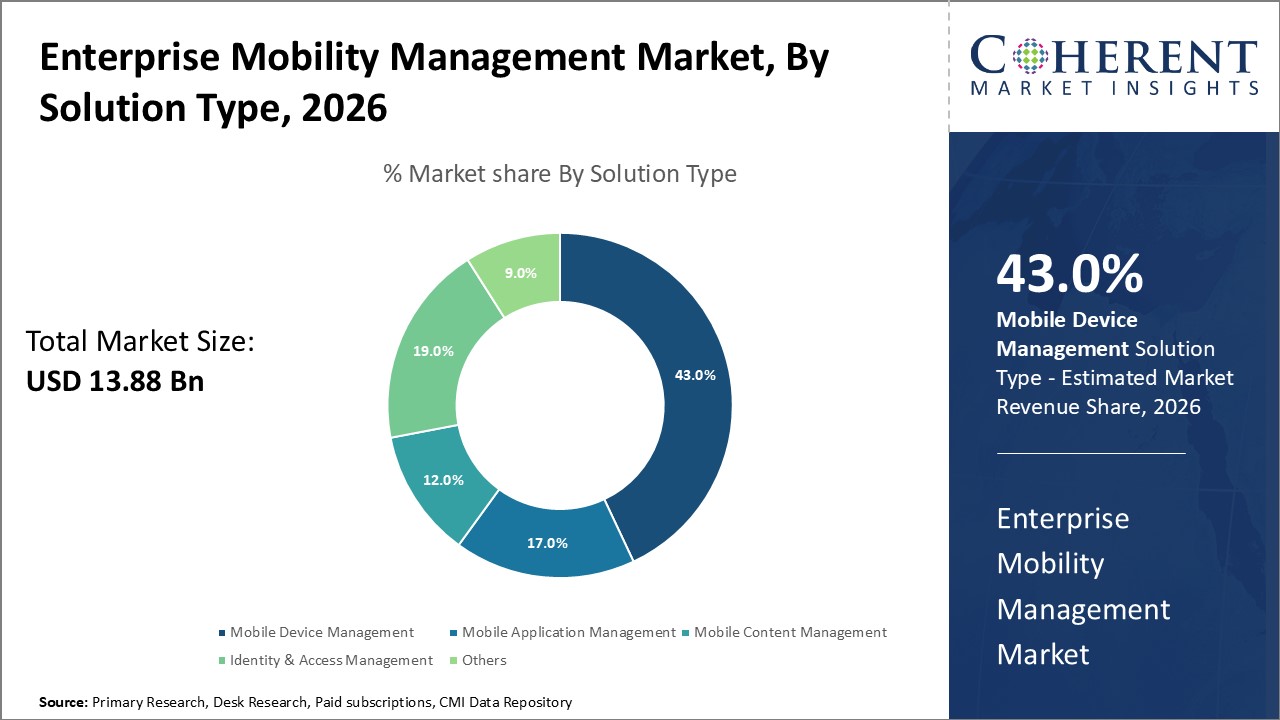
Enterprise Mobility Management Market Insights, By Solution Type
Mobile Device Management (MDM) dominates the market with a 43% share, driven by enterprises’ growing need for secure device configuration, tracking, and remote data wiping across multi-platform environments. Its leadership reflects heightened regulatory compliance demands and the need to safeguard enterprise data on mobile endpoints. Mobile Application Management (MAM) represents the fastest-growing segment, fueled by organizations adopting app-level security solutions that protect business data without enforcing full device control, making it ideal for flexible Bring Your Own Device (BYOD) setups.
Enterprise Mobility Management Market Insights, By Deployment Mode
Cloud-based deployment dominates the market with a 55% revenue share, driven by its scalability, cost-efficiency, and seamless integration within hybrid IT ecosystems. Its appeal lies in subscription-based models, automatic updates, and lower ownership costs, making it ideal for SMEs and agile enterprises. On-premise deployment remains vital for large organizations and government bodies prioritizing data sovereignty and customized control. Cloud-based solutions are also the fastest-growing segment, propelled by the rising adoption of remote and hybrid work environments requiring flexible and secure access.
Enterprise Mobility Management Market Insights, By Enterprise Size
Large enterprises dominate the market with a 60% share, driven by their extensive device ecosystems, strict compliance requirements, and advanced mobility management demands. These organizations implement comprehensive EMM suites integrating device, content, and identity management to maintain data security and regulatory adherence. Conversely, SMEs represent the fastest-growing segment, fueled by rapid digital transformation and cost-effective cloud-based EMM solutions. Increasing BYOD adoption and the need to enhance workforce productivity and data protection further accelerate EMM adoption among smaller organizations.
Enterprise Mobility Management Market Trends
The Enterprise Mobility Management (EMM) market is witnessing a strong shift toward AI-driven security and adaptive cloud solutions, enabling enterprises to enhance data protection, automate monitoring, and improve operational efficiency across device ecosystems.
In 2024, enterprises integrating AI and machine learning into EMM systems achieved a 29% reduction in security breaches through behavioural analytics and predictive threat detection, marking a pivotal advancement in enterprise cybersecurity.
The hybrid deployment model—combining cloud and on-premise frameworks—is gaining traction as organizations seek to balance scalability with data sovereignty, particularly in regulated industries such as finance and healthcare.
Zero Trust security frameworks emphasizing continuous authentication and dynamic access control are becoming a core focus, reshaping enterprise policies toward identity-centric protection.
Collectively, these advancements in AI integration, hybrid infrastructure, and Zero Trust adoption are redefining enterprise mobility strategies and significantly influencing global EMM market growth trajectories.
Enterprise Mobility Management Market Insights, By Geography
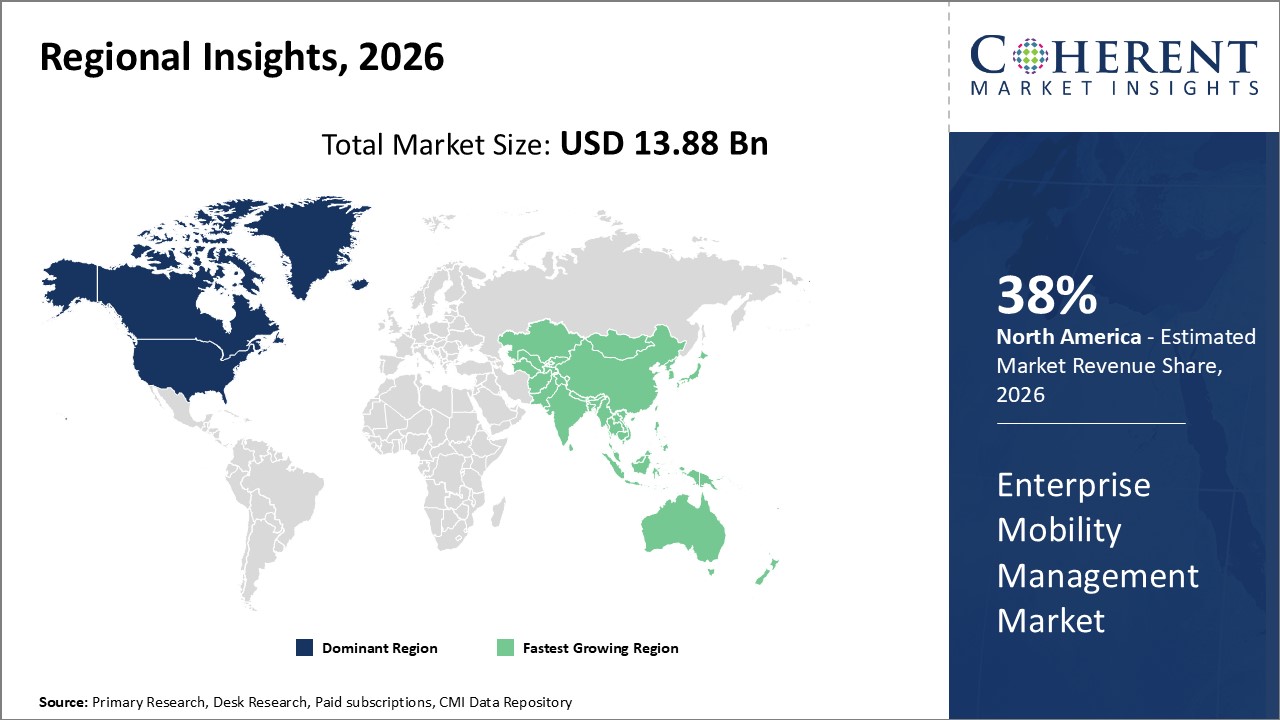
North America Enterprise Mobility Management Market Analysis and Trends
North America dominates the Enterprise Mobility Management market, accounting for over 38% of the global share, driven by advanced IT infrastructure, high cloud adoption, and stringent data security regulations. The region benefits from the strong presence of major technology players such as Microsoft and VMware, whose continuous innovations strengthen enterprise mobility frameworks. Additionally, government initiatives aimed at enhancing cybersecurity and promoting digital transformation further accelerate EMM adoption across industries, solidifying North America’s leadership position in the market.
Asia Pacific Enterprise Mobility Management Market Analysis and Trends
Meanwhile, Asia Pacific represents the fastest-growing region in the Enterprise Mobility Management market, projected to register a CAGR exceeding 11%. Growth is driven by rapid digital transformation among SMEs, government-backed smart city initiatives, and expanding enterprise ecosystems in countries like India and China. Rising smartphone penetration and growing awareness of mobile data security are fueling widespread adoption of mobility solutions. Leading regional players, including Samsung and emerging local technology firms, are capitalizing on this momentum by offering cost-effective, scalable EMM platforms tailored to diverse enterprise needs.
Enterprise Mobility Management Market Outlook for Key Countries
USA Enterprise Mobility Management Market Analysis and Trends
The USA holds a dominant position in the Enterprise Mobility Management market, supported by advanced mobility infrastructure and early adoption of emerging technologies. High investments from financial services and healthcare sectors in compliance-driven EMM solutions underscore the market’s maturity. In 2024, BFSI institutions increased EMM spending by about 18%, reflecting a strong focus on data security and regulatory adherence. Leading companies such as IBM, Microsoft, and Cisco continue to shape the landscape by offering customized solutions aligned with frameworks like HIPAA and GDPR equivalents. These factors collectively reinforce the USA’s status as a key contributor to global market revenue.
Analyst Opinion
One major actionable insight highlights the rising demand for Mobile Device Management (MDM) solutions, which account for nearly 43% of the Enterprise Mobility Management market share. In 2024, corporate spending on MDM rose by 16%, primarily driven by regulated sectors such as healthcare and finance seeking stronger device-level security and real-time monitoring.
Another key indicator is the expanding adoption of Mobile Application Management (MAM), particularly in industries like retail and logistics. In early 2026, global MAM deployments increased by 21%, resulting in a 11% rise in related revenue, as enterprises prioritized app-level data protection over restrictive device control.
Cloud-based Enterprise Mobility Management platforms also gained momentum, capturing over 55% of total market revenue in 2026. Their scalability, integration flexibility, and subscription-based pricing continue to attract enterprises, especially in North America and Europe, where cloud implementations rose 18% year-over-year in 2024.
Additionally, the integration of IoT and wearable devices within EMM frameworks has strengthened market potential, contributing to around 13% of enterprise investments in 2024. Large manufacturing organizations increasingly leverage IoT-enabled EMM systems to enhance operational efficiency, improve productivity, and support connected workforce management.
- Current Industry Events of 2026
- Market Size Estimation
- Regional Breakdown
- Competitive Landscape
- Customer Intelligence
- Segmental Analysis
- Pricing Analysis
- Key Market Drivers, Challenges & Future Trends
- Customized Insights Section
Market Scope
| Report Coverage | Details | ||
|---|---|---|---|
| Base Year: | 2026 | Market Size in 2026: | USD 13.88 billion |
| Historical Data for: | 2020 To 2024 | Forecast Period: | 2026 To 2033 |
| Forecast Period 2026 to 2033 CAGR: | 9.3% | 2033 Value Projection: | USD 25.87 billion |
| Geographies covered: |
| ||
| Segments covered: |
| ||
| Companies covered: | Microsoft Corporation, IBM Corporation, VMware, Inc., MobileIron, Inc., Citrix Systems, Inc., BlackBerry Limited, Cisco Systems, Inc., SAP SE, Sophos Ltd., Ivanti, Inc., SOTI Inc., Jamf Holding Corp., Google LLC, Oracle Corporation, Dell Technologies Inc., ManageEngine (Zoho Corp), Samsung Electronics Co., Ltd., Salesforce.com, Inc., Blackberry Cylance | ||
| Growth Drivers: |
| ||
Enterprise Mobility Management Market Growth Factors
The Enterprise Mobility Management (EMM) market is primarily driven by the rapid adoption of BYOD (Bring Your Own Device) policies that enhance employee flexibility and reduce operational costs. Organizations are increasingly embracing mobile-driven work environments, necessitating robust management platforms to ensure productivity and data security. Additionally, the surge in cyber threats and data breaches has pushed enterprises to adopt comprehensive mobility management frameworks that safeguard sensitive corporate information while maintaining compliance with evolving data protection regulations.
Another key driver fuelling market expansion is the accelerated shift toward cloud-based technologies, offering scalability, cost-efficiency, and seamless integration with existing IT infrastructure. North America and Europe lead this adoption due to advanced digital ecosystems and a mature enterprise base. Simultaneously, government-led digitization initiatives and enterprise modernization efforts in emerging economies, particularly in Asia Pacific, are further stimulating demand for flexible and secure EMM solutions across industries.
Enterprise Mobility Management Market Development
In August 2026, SOTI has launched SOTI VPN, an integrated virtual private network within its Enterprise Mobility Management (EMM) platform, MobiControl, to enhance mobile data security for retailers. Using WireGuard technology, it ensures encrypted, always-on connectivity across devices, reducing user error and safeguarding retail transactions amid rising consumer concerns about data breaches and online privacy.
In October 2026, Stratix Corporation acquired Mobility CG to expand its leadership in Enterprise Mobility Management (EMM) and Managed Mobility Services across North America. The acquisition enhances Stratix’s carrier partnerships, lifecycle management, and service delivery, integrating Mobility CG’s logistics and device expertise. This strengthens Stratix’s end-to-end mobility solutions for sectors like healthcare, retail, logistics, and government.
Key Players
Leading Companies of the Market
Microsoft Corporation
IBM Corporation
VMware, Inc.
MobileIron, Inc.
Citrix Systems, Inc.
BlackBerry Limited
Cisco Systems, Inc.
SAP SE
Sophos Ltd.
Ivanti, Inc.
SOTI Inc.
Jamf Holding Corp.
Google LLC
Oracle Corporation
Dell Technologies Inc.
ManageEngine (Zoho Corp)
Samsung Electronics Co., Ltd.
Salesforce.com, Inc.
Blackberry Cylance
These companies have adopted varied competitive strategies ranging from strategic acquisitions to bolster their EMM portfolios to partnerships for enhanced cloud infrastructure. For instance, VMware’s acquisition of a cloud-native EMM platform in late 2024 bolstered its market presence, resulting in a 22% increase in client acquisitions in Q1 2026. Similarly, Microsoft strengthened its SaaS offerings by integrating advanced analytics into its EMM suite, enabling predictive security measures which increased user retention by 18% globally.
Enterprise Mobility Management Market Future Outlook
The future outlook for the Enterprise Mobility Management (EMM) market remains highly promising, driven by the ongoing digital transformation and the increasing shift toward hybrid and remote work models. As enterprises continue to prioritize mobile workforce enablement, demand for unified and AI-integrated EMM platforms will surge. Advancements in Zero Trust security, automation, and predictive analytics are expected to redefine enterprise mobility strategies, enhancing compliance and risk management. Moreover, the growing integration of IoT and edge devices within enterprise networks will expand EMM’s scope, positioning it as a critical enabler of secure, connected, and efficient digital workplaces globally.
Enterprise Mobility Management Market Historical Analysis
The historical evolution of the Enterprise Mobility Management (EMM) market traces back to the early 2010s, when the widespread adoption of smartphones and tablets in workplaces led to the emergence of Mobile Device Management (MDM) solutions. Initially focused on securing and tracking enterprise-owned devices, EMM expanded to include Mobile Application Management (MAM) and Mobile Content Management (MCM) to address growing data security and productivity needs. Over the years, rising Bring Your Own Device (BYOD) adoption and increasing regulatory compliance requirements accelerated market growth. By the late 2010s, the shift toward cloud-based EMM platforms and integration with identity and access management systems transformed the landscape, setting the foundation for today’s AI-driven, analytics-enhanced mobility management solutions.
Sources
Primary Research Interviews:
Chief Information Officers (CIOs)
IT Security Managers
Enterprise Mobility Consultants
Cloud Infrastructure Directors
Databases:
Statista Mobility & IT Reports
Gartner IT Management Database
IDC Enterprise Mobility Insights
TechNavio ICT Repository
Magazines:
CIO Review
TechCrunch Enterprise
InformationWeek
Computerworld
Journals:
Journal of Information Technology
International Journal of Mobile Computing and Multimedia Communications
IEEE Transactions on Mobile Computing
MIS Quarterly
Associations:
Mobile Marketing Association (MMA)
Cloud Security Alliance (CSA)
International Association for Mobile Technology (IAMT)
Information Systems Audit and Control Association (ISACA)
Get access to 250+ pages report
Every segment, forecast, competitor profile and data table behind the analysis above — available for instant download.
- ESOMAR Member
- ISO 9001:2015 Certified
- D-U-N-S Registered
- GDPR & CCPA Compliant
Missing comfort of reading report in your local language? Find your preferred language:
Transform your Strategy with Exclusive Trending Reports
Frequently Asked Questions
Dominant companies include Microsoft, IBM, VMware, MobileIron, Citrix, and BlackBerry, who have consistently innovated their EMM product portfolios and pursued strategic expansions.
The market size is projected to grow from USD 13.88 billion in 2026 to USD 25.87 billion by 2033, reflecting a CAGR of 9.3%.
The cloud-based offer the largest growth opportunities.
Trends point toward increased adoption of AI-powered EMM solutions, hybrid deployment models, and Zero Trust security frameworks, which will redefine market dynamics and enhance revenue generation.
The market is highly competitive with focus on continuous innovation, mergers, and strategic partnerships. Challenges include evolving cybersecurity threats and integration complexities.
Market players typically adopt cloud-based subscription models, strategic acquisitions, and partner ecosystems to expand market share and enhance solution offerings.