

Call Center Software Market Size and Forecast — 2026-2033
The Global Call Center Software Market is estimated to be valued at US$ 76.64 Bn in 2026 and is expected to reach US$ 227.70 Bn by 2033, exhibiting a compound annual growth rate (CAGR) of 19.9% from 2026 to 2033.
Key Takeaways of the Global Call Center Software Market:
- The on-premise segment is expected to lead the market holding a share of 58.8% in 2026, due to security and control benefits.
- The IT & telecom segment is projected to dominate with a share of 25.7% in 2026 as the sector deals with a high volume of technical support queries.
- North America is expected to lead the market with a share of 38. 7% in 2026, owing to the strong presence of major players. Asia Pacific, holding a share of 23.8% in 2026, is projected to be the fastest growing region, owing to competitive labor costs and tax incentives.
Market Overview:
The call center software market is expected to witness significant growth over the forecast period. The growth can be attributed to increasing digitization and the adoption of cloud-based solutions across various industry verticals. Other factors, such as rising focus on providing enhanced customer support and experience through call centers will further, drive the demand for call center software. Integration of artificial intelligence and machine learning capabilities into call center software solutions is also emerging as a key trend in the market.
For example, in August 2024, NICE launched an upgraded version of its Enlighten AI platform, which uses machine learning to automatically score 100% of customer interactions, detect compliance risks, and deliver personalized coaching to agents.
Current Events and Their Impact
Current Events | Description and its impact |
Regulatory and Data Privacy Developments |
|
Geopolitical and Economic Uncertainty |
|
Insights by Deployment
Global Call Center Software Market Insights by Deployment – On-premise Segment Dominates Due to Security and Control Benefits
The On-Premise segment is expected to hold the largest share of 58.8% in the global call center software market in 2026. Companies in industries like banking and healthcare that handle sensitive customer data prefer having full control over critical aspects like data access, backups, disaster recovery, and regulatory compliance. On-premise call center platforms also provide customizability that allows features to be tailored exactly as per businesses' specific workflow and process requirements. Customizations can be implemented on-the-fly without needing to depend on a third-party vendor for changes.
Furthermore, many large enterprises with extensive legacy infrastructures find it easier to integrate new on-premise call center systems within their existing IT architecture. The upfront capital costs of setting up an on-premise installation also allows for predictable operational expenses over the long run compared to cloud solutions whose costs vary based on usage. While cloud offerings are gaining traction, the on-premise segment is expected to remain dominant as security, control, and compatibility concerns continue to outweigh the flexible scalability that cloud provides, especially for regulated and risk-averse industries.
Insights by End-use Industry
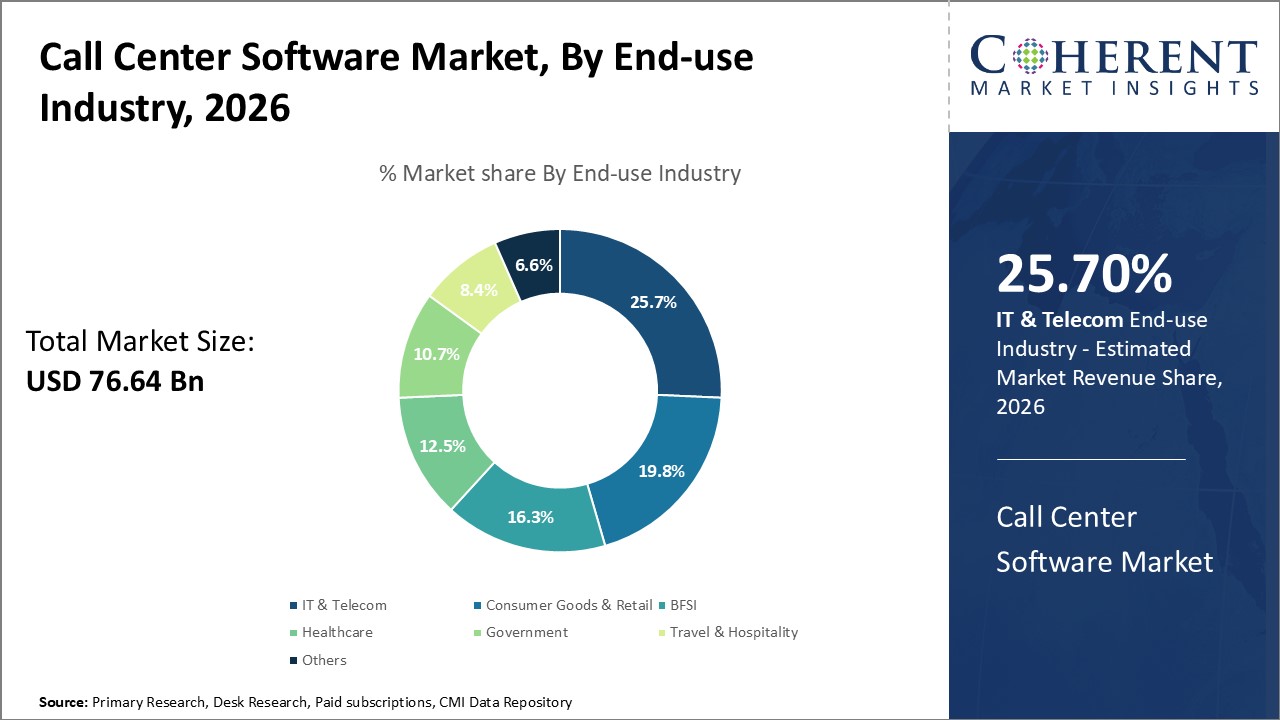
Global Call Center Software Market Insights by End-use Industry – IT & Telecom Leads Due to High Customization Needs
The IT & Telecom segment is expected to account for the largest share of 25.7% in the global call center software market in 2026. The telecommunications sector deals with a high volume of technical support queries on issues like network connectivity, billing problems, device malfunctions, etc. on a daily basis. Thus, they require highly customized call center software that can seamlessly integrate with their existing complex IT infrastructure. Their call agents also need to access a wide pool of technical information resources in real-time to efficiently resolve issues.
As such, IT & telecom companies favor call center platforms that offer the most flexible customization options and interoperability capabilities to suit their specific IT architecture and support workflows. Vendors in this space also require features like predictive dialers, call recording, and agent performance analytics to optimize round-the-clock large scale technical support operations.
Role of Artificial Intelligence (AI)
Artificial Intelligence (AI) is profoundly reshaping the call center software landscape by automating interactions, improving agent performance, and enhancing customer experience through real-time insights.
AI-powered virtual assistants and chatbots, such as those integrated by Zendesk and Five9, handle routine queries across voice and text channels—reducing agent workload and enabling 24/7 customer service. For instance, Five9’s Intelligent Virtual Agent (IVA) uses conversational AI to handle Tier 1 inquiries and escalates complex issues to human agents, improving call deflection rates by up to 40%.
In the backend, AI enhances real-time speech analytics, sentiment detection, and workforce optimization. Platforms like NICE CXone and Talkdesk utilize AI to monitor live conversations, flag compliance risks, and provide agents with on-screen coaching tips during calls. In July 2024, Talkdesk launched its "AI Trainer" module, allowing clients to customize AI models based on their own call data—improving model accuracy for specific industries like healthcare and retail.
With these advancements, AI is not only automating workflows but also enabling a more predictive, personalized, and data-driven approach to customer service—ushering in a new era of proactive engagement in contact centers globally.
Regional Insights
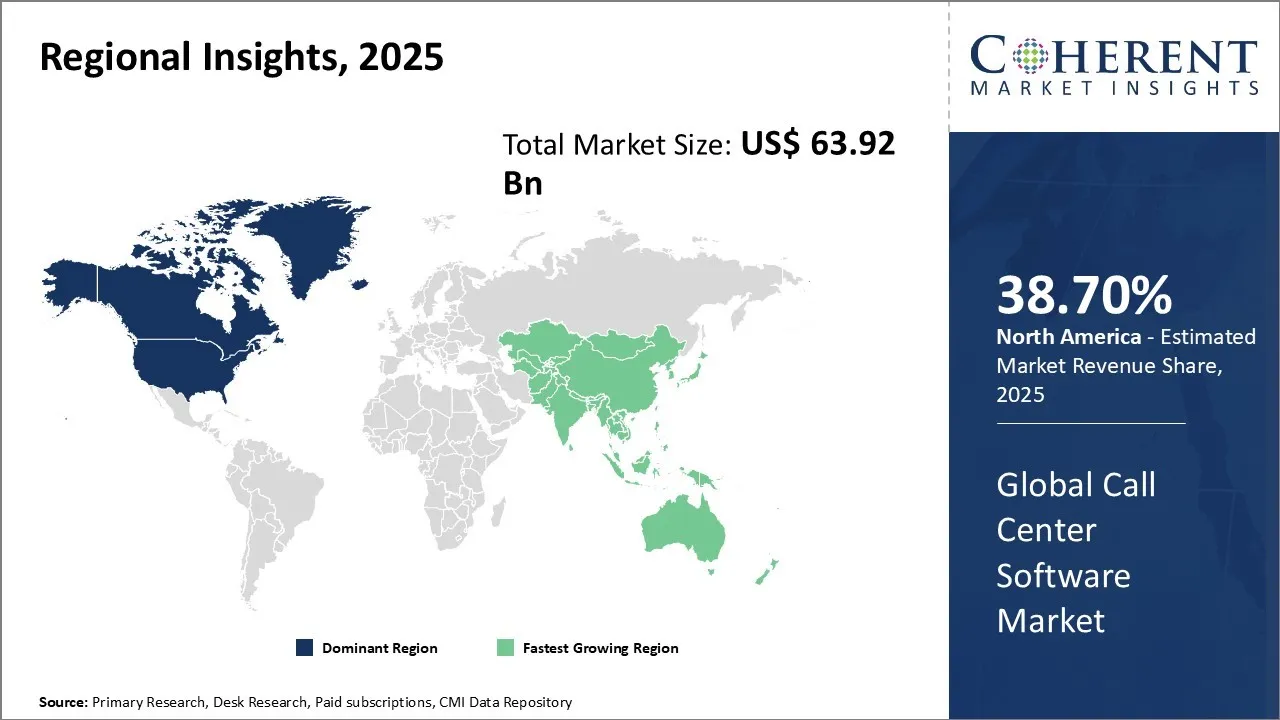
North America Call Center Software Market Analysis and Trends
North America, holding a share of 38.7% in 2026, is expected to dominate the call center software market. The lead can be attributed to the strong presence of major players and tech giants based in the U.S. and Canada. The region has emerged as an innovation hub for call center technologies, with U.S.-based companies heavily investing in R&D to develop advanced solutions. Furthermore, growing demand for customer support outsourcing from various industries including telecom, IT, and healthcare has significantly boosted adoption. Major U.S. companies, such as Talkdesk, Five9, and Aircall, have established themselves as leaders and continue expanding within the region.
Asia Pacific Call Center Software Market Analysis and Trends
The Asia Pacific region, holding a share of 23.8% in 2026, is expected to exhibit the fastest growth, led by countries like India, Philippines, and China. This can be largely associated with their competitive labor costs and tax incentives that have encouraged global enterprises to establish offshore call centers. Regional governments are also offering subsidies and relaxed regulations to attract investments. For example, India's Digital India program aims to transform the country into a digitally empowered knowledge economy by improving digital infrastructure and services. This has spurred local call center software providers like Bold360 and CallHippo to establish a vast customer base.
Call Center Software Market Outlook for Key Countries
U.S. Call Center Software Market Analysis and Trends
The U.S. continues to lead the global call center software market, both in size and technological sophistication. A growing appetite for seamless, omnichannel customer support, and a serious push toward AI-powered insights are fueling this dominance. Major players like Genesys, Five9, and NICE CXone remain at the forefront, offering all-in-one platforms that bring together voice, chat, email, video, and even social media—giving businesses the tools to meet customers wherever they are.
Canada Call Center Software Market Analysis and Trends
Canada’s call center software market is thriving thanks to a unique blend of a well-established BPO sector and a vibrant startup scene. The country’s regulatory stability, combined with its diverse and multilingual workforce—especially French-English bilingual talent—makes it an attractive destination for North American customer support and outsourcing operations.
Montréal, in particular, is making waves as a tech innovation hub. Local startups like Nectar and Mia Technologies are gaining traction with AI-powered solutions designed to enhance real-time agent support, analyze emotional tone during calls, and deliver smart performance feedback. At the same time, Canada’s strong stance on data privacy, through frameworks like PIPEDA, is driving demand for secure, cloud-based call center solutions.
India Call Center Software Market Analysis and Trends
India continues to lead as a global BPO powerhouse, with over 1.4 million people employed in call centers across cities like Bengaluru, Pune, and Hyderabad. The country is rapidly moving up the value chain from voice-based support to tech-enabled service delivery. Domestic firms such as Knowlarity, Exotel, and Ace Cloud Hosting are at the forefront, offering cloud telephony and AI-driven automation solutions tailored for both domestic and international clients.
China Call Center Software Market Analysis and Trends
China’s call center software market is picking up serious momentum, largely fueled by aggressive digital transformation across key industries and the government’s “Go Out” policy, which is encouraging homegrown tech companies to step beyond domestic borders.
One standout is Zoom Connectivity, a cloud communications company based in Beijing. They have made impressive headway with their AI-powered call recording and voice analytics solutions, which are particularly well-suited for financial services and e-commerce—two sectors experiencing skyrocketing customer engagement needs. In Q3 2024, Zoom Connectivity joined hands with Thailand’s True Digital Group, enabling multilingual customer support capabilities throughout ASEAN.
End User Feedback and Unmet Needs
End users broadly value the improved responsiveness, automation, and multichannel engagement enabled by modern call center software solutions. Features like AI-powered routing, real-time analytics, and cloud-based flexibility are especially appreciated for enhancing customer experience and agent productivity. However, many organizations report integration complexity with legacy systems, especially in industries like healthcare and banking where older CRMs and telephony setups are still in place. High subscription and implementation costs are also seen as a barrier, particularly for small and mid-sized businesses that lack the budget and in-house IT expertise to manage complex deployments.
Another recurring concern is the inflexibility of prebuilt automation workflows, which often require custom coding to adapt to specific business logic. As customer expectations evolve, users are also calling for more proactive support tools—like predictive customer behavior models and automated quality assurance features—to reduce manual oversight and improve first-contact resolution.
Market Players, Key Development, and Competitive Intelligence
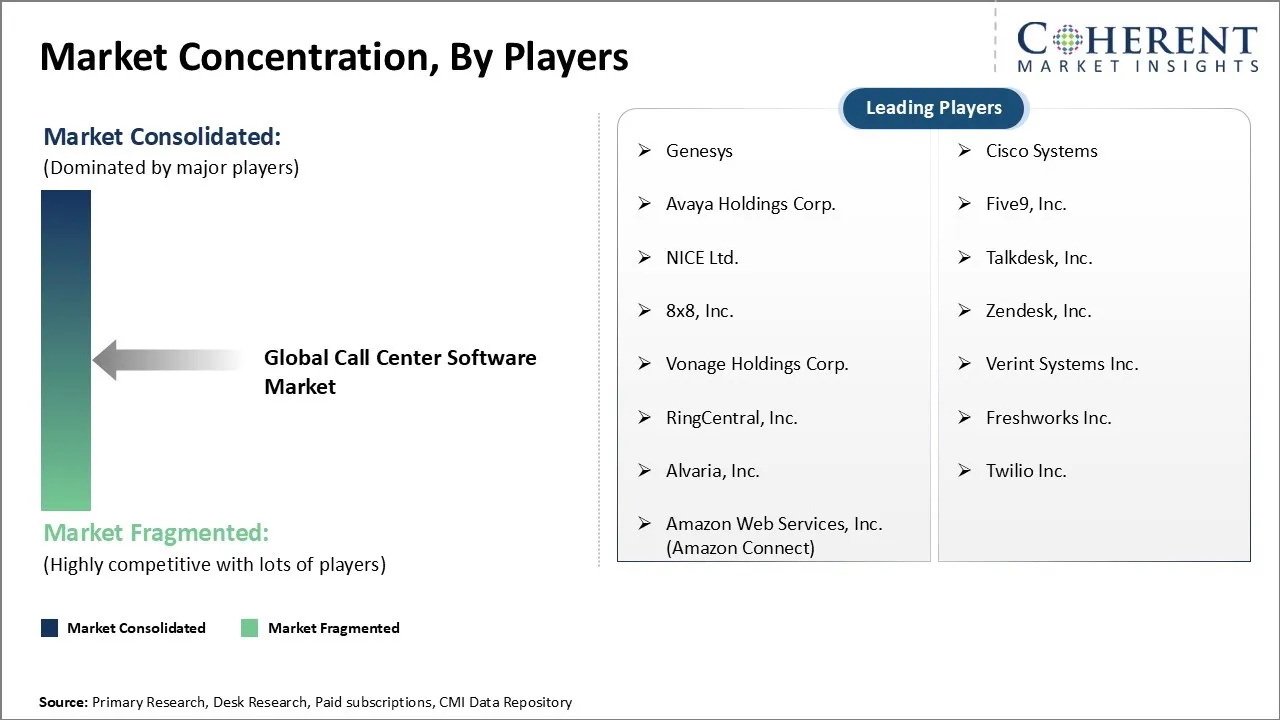
Key Developments:
- In February 2025, Zendesk, a leader in AI-powered service, signed a definitive agreement to acquire Local Measure, a provider of Contact Center as a Service (CCaaS) and advanced voice solutions and a long-time AWS partner. This acquisition is aimed to accelerate Zendesk’s expansion into larger, more complex service environments.
- In October 2024, Cisco, a technology company, unveiled new AI-powered innovations, including the Webex AI Agent, AI Agent Studio and Cisco AI Assistant features for Webex Contact Center. These AI solutions use advanced conversational intelligence and automation to enhance customer interactions, streamline issue resolution and improve overall customer satisfaction.
- In June 2024, Microsoft, a tech giant, introduced Microsoft Dynamics 365 Contact Center, a Microsoft Copilot-first contact center solution that delivers generative AI to every customer engagement channel.
- In November 2023, AWS, a provider of on-demand cloud computing platforms, added generative AI capabilities to Amazon Connect, powered by Large Language Models (LLMs) available through Amazon Bedrock
Top Strategies Followed by Global Call Center Software Market Players
- Established Players: At the top, established players like Genesys, NICE, Cisco, and Avaya are all-in on AI and cloud transformation. These giants are pouring resources into predictive analytics, real-time sentiment tracking, and scalable SaaS ecosystems to stay ahead of the curve—especially when courting large enterprise clients.
- For instance, Genesys launched its AI Experience Platform in 2024, allowing businesses to deploy self-learning bots and analyze customer sentiment across both voice and digital channels. Cisco, on the other hand, bolstered its capabilities through its acquisition of IMImobile, which opened the door to richer messaging integrations—think WhatsApp, Apple Business Chat, and beyond—making it easier for brands to meet customers where they already are.
- Mid-Level Players: Meanwhile, mid-sized players like Five9, Talkdesk, and 8x8 are playing a savvy game of specialization and scale. They are laser-focused on regional expansion and forging partnerships with cloud and AI leaders.
- Five9’s partnership with Google Cloud is a perfect example, bringing advanced virtual agents to mid-sized businesses that might not otherwise access this level of tech. Talkdesk is doing something similar—they recently launched their Healthcare Experience Cloud to tackle patient engagement and HIPAA compliance.
- Small-scale Players: Down at the grassroots level, smaller players like CallMiner, TCN, and EvaluAgent are carving out impressive niches by staying nimble and tuned into the needs of underrepresented segments. These companies emphasize affordability, modular design, and easy integration—perfect for SMEs or remote/hybrid contact centers.
- EvaluAgent, for example, recently released a performance management suite built specifically for hybrid teams. CallMiner is leaning heavily into real-time analytics, especially in sectors like healthcare, where being able to detect emotional tone and maintain compliance on calls is critical.
- Current Industry Events of 2026
- Market Size Estimation
- Regional Breakdown
- Competitive Landscape
- Customer Intelligence
- Segmental Analysis
- Pricing Analysis
- Key Market Drivers, Challenges & Future Trends
- Customized Insights Section
Market Report Scope
Call Center Software Market Report Coverage
| Report Coverage | Details | ||
|---|---|---|---|
| Base Year: | 2025 | Market Size in 2026: | USD 76.64 Bn |
| Historical Data for: | 2020 To 2024 | Forecast Period: | 2026 To 2033 |
| Forecast Period 2026 to 2033 CAGR: | 19.9% | 2033 Value Projection: | USD 227.70 Bn |
| Geographies covered: |
| ||
| Segments covered: |
| ||
| Companies covered: | Genesys, Cisco Systems, Avaya Holdings Corp., Five9, Inc., NICE Ltd., Talkdesk, Inc., 8x8, Inc., Zendesk, Inc., Vonage Holdings Corp., Verint Systems Inc., RingCentral, Inc., Freshworks Inc., Alvaria, Inc., Twilio Inc., and Amazon Web Services, Inc. (Amazon Connect) | ||
| Growth Drivers: |
| ||
| Restraints & Challenges: |
| ||
Market Dynamics
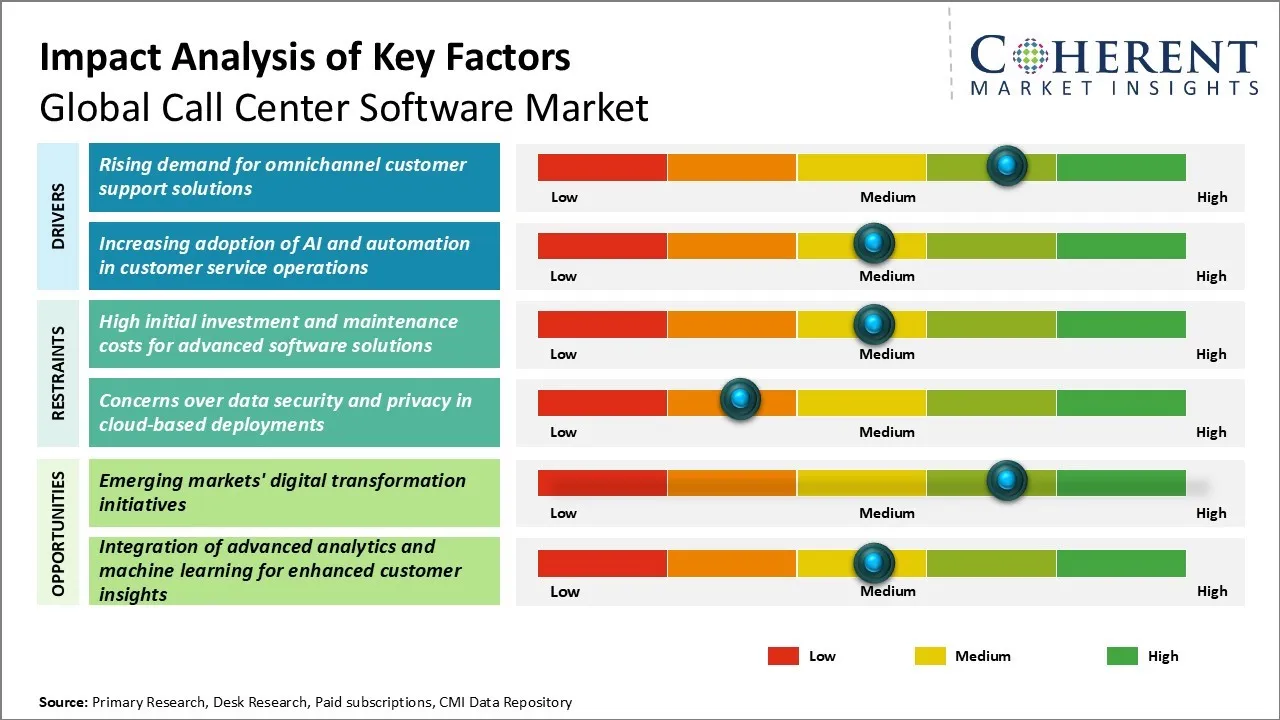
Global Call Center Software Market Driver - Rising demand for omnichannel customer support solutions
Today’s customers want it their way, whether that is via phone, email, chat, social media, or even WhatsApp. People want a seamless experience across channels, where they can switch between a mobile app and a website or jump from a chat to a phone call without repeating themselves.
This rising demand is driving businesses toward advanced call center software platforms that offer omnichannel support. Tools like IVR (Interactive Voice Response), CTI (Computer Telephony Integration), and ACD (Automatic Call Distribution) are now becoming a standard. Take Zendesk and Genesys, for example. They have built platforms that pull all these communication threads into a single, unified dashboard.
Global Call Center Software Market Opportunity - Emerging markets' digital transformation initiatives
Countries like India, Brazil, and Indonesia are rolling out major digital infrastructure projects. India’s "Digital India" initiative, for instance, is doing everything from improving broadband access to encouraging cloud adoption and modern IT services across industries.
This is where providers like Freshworks and Zoho come in. These companies—born in emerging markets—get the local challenges and speak the language (literally and figuratively). They’re offering affordable, scalable, and multilingual solutions that do not just work—they fit the market.
Analyst Opinion (Expert Opinion)
- The global call center software market is driven by increasing demand for omnichannel engagement, but also by the rapid adoption of cloud-based deployments. Enterprises are shifting to SaaS-based call center platforms to lower infrastructure costs and support remote or hybrid workforces—an operational shift accelerated by the post-COVID-19 workplace normalization.
- A notable evolution in the market is the rise of AI-powered functionalities in call center operations. Many enterprises have already integrated AI-based tools such as chatbots, sentiment analysis, predictive dialing, and real-time analytics into their contact center strategies. For instance, Talkdesk and Five9 have launched AI-native platforms like Talkdesk Autopilot and Five9 IVA, allowing brands to automate up to 70% of routine interactions, significantly reducing Average Handle Time (AHT) and improving First Call Resolution (FCR) rates.
- The competitive landscape remains moderately consolidated, with leading players investing in M&A and AI R&D to differentiate. For example, Zendesk’s acquisition of Local Measure and Intercom’s US$ 100 million push into AI development highlight the shift toward proactive, intelligent support capabilities. Still, the market allows space for mid-tier players and regional disruptors, especially those targeting niche industries like healthcare or travel with vertical-specific integrations.
Speak to the analyst
Want personalized insights?
Take the findings above to one of our principal consultants, or have the report rebuilt around the segments, geographies and competitors you actually track.
Market Segmentation
- Deployment Insights (Revenue, US$ Bn, 2021 - 2033)
- On-premise
- Cloud
- End-use Industry Insights (Revenue, US$ Bn, 2021 - 2033)
- IT & Telecom
- Consumer Goods & Retail
- BFSI
- Healthcare
- Government
- Travel & Hospitality
- Others
- Regional Insights (Revenue, US$ Bn, 2021 - 2033)
- North America
- U.S.
- Canada
- Latin America
- Brazil
- Argentina
- Mexico
- Rest of Latin America
- Europe
- Germany
- U.K.
- Spain
- France
- Italy
- Russia
- Rest of Europe
- Asia Pacific
- China
- India
- Japan
- Australia
- South Korea
- ASEAN
- Rest of Asia Pacific
- Middle East
- GCC Countries
- Israel
- Rest of Middle East
- Africa
- South Africa
- North Africa
- Central Africa
- North America
- Key Players Insights
- Genesys
- Cisco Systems
- Avaya Holdings Corp.
- Five9, Inc.
- NICE Ltd.
- Talkdesk, Inc.
- 8x8, Inc.
- Zendesk, Inc.
- Vonage Holdings Corp.
- Verint Systems Inc.
- RingCentral, Inc.
- Freshworks Inc.
- Alvaria, Inc.
- Twilio Inc.
- Amazon Web Services, Inc. (Amazon Connect)
Sources
Primary Research Interviews:
Stakeholders:
- Call Center Operations Managers and Supervisors (e.g., BPOs, in-house customer service teams)
- Cloud Communications Software Vendors (e.g., product managers from Twilio, 8x8, etc.)
- Customer Experience Consultants and Technology Integration Specialists
- IT Infrastructure Heads from Banking, Telecom, and E-commerce companies
- Regional SaaS Solution Providers and Channel Partners
- CX Technology Researchers and AI Ethics Experts
Databases:
- U.S. Bureau of Economic Analysis (BEA)
- Ministry of Electronics & IT (India)
- Global Telecom Industry Exchange (GTIX)
- Asia-Pacific Digital Transformation Index (AP-DTI)
- Latin American ICT Sector Development Report (LAICT-DR)
Magazines:
- Customer Experience Today
- Call Center Tech Review
- Digital CX World
- Enterprise Communication Insight
- AI in Operations Magazine
Journals:
- Journal of Customer Interaction Science
- AI and Machine Learning in Business Operations
- Telecom Innovation & Technology Journal
- Cloud Systems & Enterprise Architecture Quarterly
- Journal of Enterprise Software Research
Newspapers:
- Tech Business Herald
- Global IT & CX News Daily
- The Japan Times (Tech & Innovation Section)
- BusinessLine – Digital Economy Edition
- South China Morning Post – Innovation Weekly
Associations:
- Global Customer Contact Council (GCCC)
- International Association of Contact Center Professionals (IACCP)
- Unified Communications Alliance (UCA)
- Asia-Pacific Cloud Software Association (APCSA)
- North American AI in CX Consortium (NAACXC)
Public Domain Sources:
- U.S. Census Bureau
- EUROSTAT
- United Nations Conference on Trade and Development (UNCTAD)
- International Telecommunication Union (ITU)
- ResearchGate
Proprietary Elements:
- CMI Data Analytics Tool, Proprietary CMI Existing Repository of information for last 8 years
Get access to 250+ pages report
Every segment, forecast, competitor profile and data table behind the analysis above — available for instant download.
- ESOMAR Member
- ISO 9001:2015 Certified
- D-U-N-S Registered
- GDPR & CCPA Compliant
Missing comfort of reading report in your local language? Find your preferred language:
Transform your Strategy with Exclusive Trending Reports
Frequently Asked Questions
The global call center software market is estimated to be valued at US$ 76.64 billion in 2026 and is expected to reach US$ 227.70 billion by 2033.
The CAGR of the global call center software market is projected to be 19.9% from 2026 to 2033.
Rising demand for omnichannel customer support solutions and increasing adoption of AI and automation in customer service operations are the major factors driving the growth of global call center software market.
High initial investment and maintenance costs for advanced software solutions and concerns over data security and privacy in cloud-based deployments are the major factors hampering the growth of the global call center software market.
In terms of deployment, the on-premise segment is estimated to dominate the market revenue share in 2026.
Genesys, Cisco Systems, Avaya Holdings Corp., Five9, Inc., NICE Ltd., Talkdesk, Inc., 8x8, Inc., Zendesk, Inc., Vonage Holdings Corp., Verint Systems Inc., RingCentral, Inc., Freshworks Inc., Alvaria, Inc., Twilio Inc., and Amazon Web Services, Inc. (Amazon Connect) are the major players.
North America is expected to lead the global call center software market in 2026, holding a share of 38.7%.