

Art Funds Market Size and Forecast — 2026-2033
The Global Art Funds Market is estimated to be valued at US$ 888.2 Mn in 2026 and is expected to reach US$ 1,259.9 Mn by 2033, exhibiting a compound annual growth rate (CAGR) of 6.0% from 2026 to 2033.
Key Takeaways of the Global Art Funds Market:
- The public segment is expected to lead the market holding a share of 57.2% in 2026, owing to accessibility and transparency.
- Among application, the financial investment segment is projected to dominate with a share of 66.3% in 2026.
- North America is estimated to lead the market with a share of 43. 7% in 2026, owing to strong domestic demand. Asia Pacific, holding a share of 23.1% in 2026, is projected to be the fastest growing region, owing to rising awareness about cultural preservation and portfolio diversification.
Market Overview:
The global art funds market is gaining massive traction as more high-net-worth individuals (HNWIs) and institutions turn to alternative investments. Blue-chip works by artists like Warhol and Banksy are especially in demand, signaling investor confidence in the long-term value of culturally iconic pieces. Platforms like Masterworks are helping to democratize access, reporting impressive annualized returns of up to 10% on select collections. In short, art is no longer just for collectors—it’s becoming a credible financial play.
Current Events and Their Impact
Current Events | Description and its impact |
Geopolitical Conflicts and Cultural Destruction |
|
Regulatory Fragmentation in Major Markets |
|
Blockchain-Driven Market Democratization |
|
By Fund Type
Global Art Funds Market Insights by Fund Type – Accessibility and Transparency Drive Growth in Public Art Funds
Within the global art funds market, the Public segment is expected to contribute the largest share of 57.2% in 2026. This is primarily due to the accessibility and transparency associated with public funds. Unlike private funds which are restricted to accredited investors and have higher minimum investment requirements, public funds have no such barriers. This openness helps attract a broader investor base seeking to diversify their portfolios through alternative assets like art.
The transparency of public funds is another major attraction. Being publicly traded, they are subject to regular financial reporting and disclosure requirements. Investors always have visibility into the fund's holdings, valuations, performance metrics, and management fees. This level of transparency builds trust that investments are being properly managed and valued. In contrast, private funds operate with more flexibility which can sometimes obscure true performance figures from limited partners.
By Application
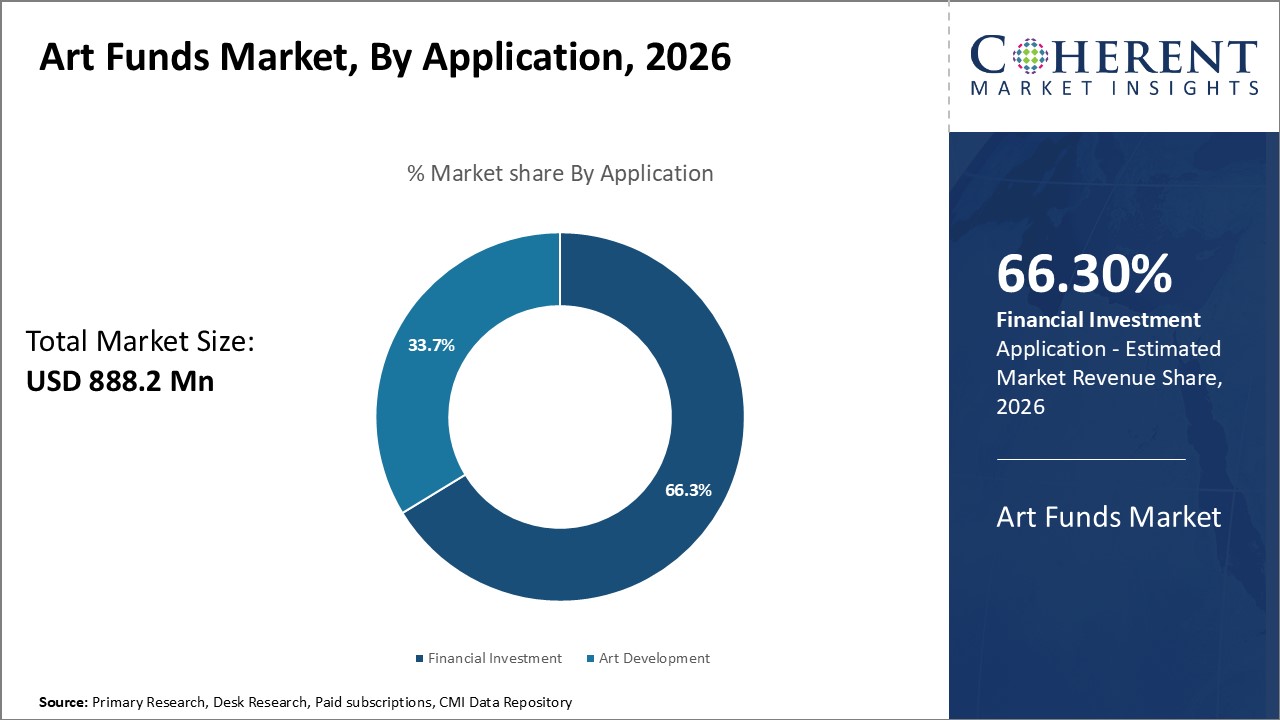
Global Art Funds Market Insights by Application – Art Emerges as an Alternative Asset for Financial Investment
Within the global art funds market in terms of application, the Financial Investment segment is expected to generate the largest demand, holding a share of 66.3% in 2026. Art has long proven to be an alternative asset that delivers returns uncorrelated to traditional markets like stocks and bonds. Recent auction records set by paintings from Picasso, Van Gogh, and others underscore the huge profit potential when buying and selling top quality artworks. Strong auction results help art maintain its appeal as a Stores of Value as well.
The development of online platforms like Apps hartSpace and Masterworks that fractionalize blue-chip artwork ownership into shares has further opened the doors to returns-driven art investment.
Role of Artificial Intelligence (AI)
Artificial Intelligence is quietly revolutionizing how art funds operate—making the market smarter, faster, and more data-driven. Platforms like Masterworks are already leveraging AI to analyze historical sales data, artist trajectories, and market sentiment to better predict the future value of artworks. This gives investors a much-needed analytical edge in a space that was traditionally guided by instinct and exclusivity.
Behind the scenes, AI also plays a key role in pricing and inventory optimization. Sotheby’s, for instance, now uses AI-powered tools to generate real-time price estimates, blending past auction results with current market trends.
Regional Insights
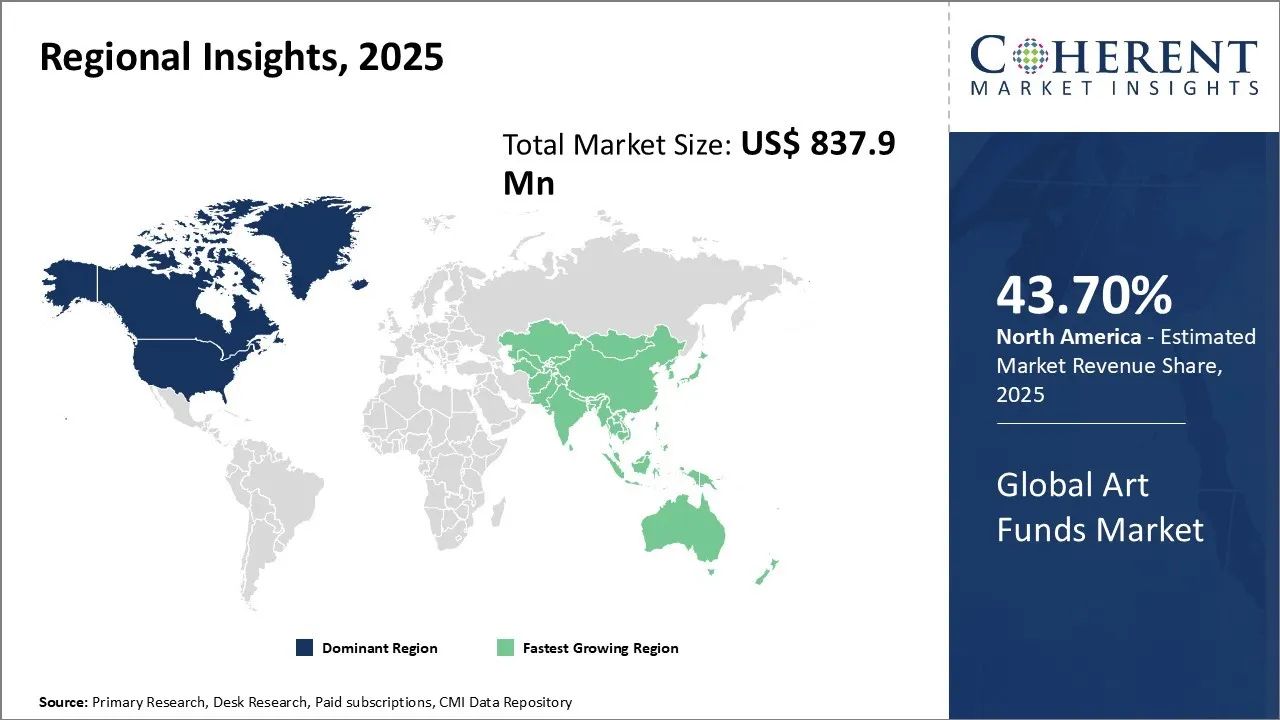
North America Art Funds Market Analysis and Trends
North America, holding a share of 43.7% in 2026, dominates the art funds market, attributed to strong domestic demand and growing wealth in countries like the U.S. With the presence of major art centers in the U.S. such as New York and Los Angeles, there is a flourishing community of art collectors, galleries and auction houses that fuel investments in artwork. Leading art funds such as Acquavella Contemporary Art Fund based in New York have raised significant capital over the years to acquire collections of renowned artists.
Asia Pacific Art Funds Market Analysis and Trends
The Asia Pacific region, holding a share of 23.1% in 2026, is expected to exhibit the fastest growth in the global art funds market driven by factors such as rising affluence, influence of cultural preservation, and opportunity for portfolio diversification. Countries like China and India that have seen tremendous economic development over the past decade now have a sizable population of uber-rich individuals willing to spend on luxury assets like art. Domestic art fairs in major cities of Asia Pacific have also boosted awareness and demand. For example, Art Stage Singapore which is one of the top art fairs in the region, has played a catalytic role in the expansion of art investing in Southeast Asia.
Art Funds Market Outlook for Key Countries
U.S. Art Funds Market Analysis and Trends
The U.S. art funds market is thriving on the back of robust economic conditions and the presence of high-net-worth investor base in cities like New York, Los Angeles, and San Francisco. Fund managers, such as Aquavella and Sinclair, are raising larger pools of capital from family offices and pension funds to back both emerging and established western and Chinese artists.
China Art Funds Market Analysis and Trends
China art funds market is witnessing exponential growth driven by patriotic sentiments among wealthy collectors and backing of government initiatives to promote domestic cultural industries. Homegrown firms like CAFA Art Museum have led fundraising to support young Chinese artists and preserve cultural heritage.
U.K. Art Funds Market Analysis and Trends
The U.K. continues to lead as a hub for Europe-based art funds, notably in London which is a premier auction house center. Managers like Cecily Brown Capital have focused on postwar and contemporary works looking to capitalize on rising valuations. Brexit impact remains to be closely watched.
India Art Funds Market Analysis and Trends
India art funds market is significantly smaller compared to mature markets but showcases promise, supported by a youthful population and initiatives to build private art institutions. Recent entries of regional asset managers in the space could help address the scarcity of avenues for investing in art in the country.
End User Feedback and Unmet Needs
End users, particularly high-net-worth individuals (HNWIs) and institutional investors, generally value the diversification and potential for high returns offered by art funds. They appreciate the ability to access alternative assets, especially blue-chip artworks, without the complexities of directly purchasing and managing physical pieces.
However, many report challenges related to the lack of liquidity in art investments, high transaction costs, and the complexity of valuation. Investors often struggle with understanding the true market value of art, as pricing can be subjective and affected by external factors like market trends and artist popularity. Additionally, there is a significant demand for more transparency in the investment process, including clearer pricing models and risk management strategies.
Users also express a need for user-friendly platforms with simplified onboarding processes, better market education on art investments, and improved liquidity options for easier exit strategies. Additionally, there is a call for unified analytics tools that can help investors better track the performance of their portfolios across different asset types, such as contemporary art, real estate, and other collectibles.
Market Players, Key Development, and Competitive Intelligence
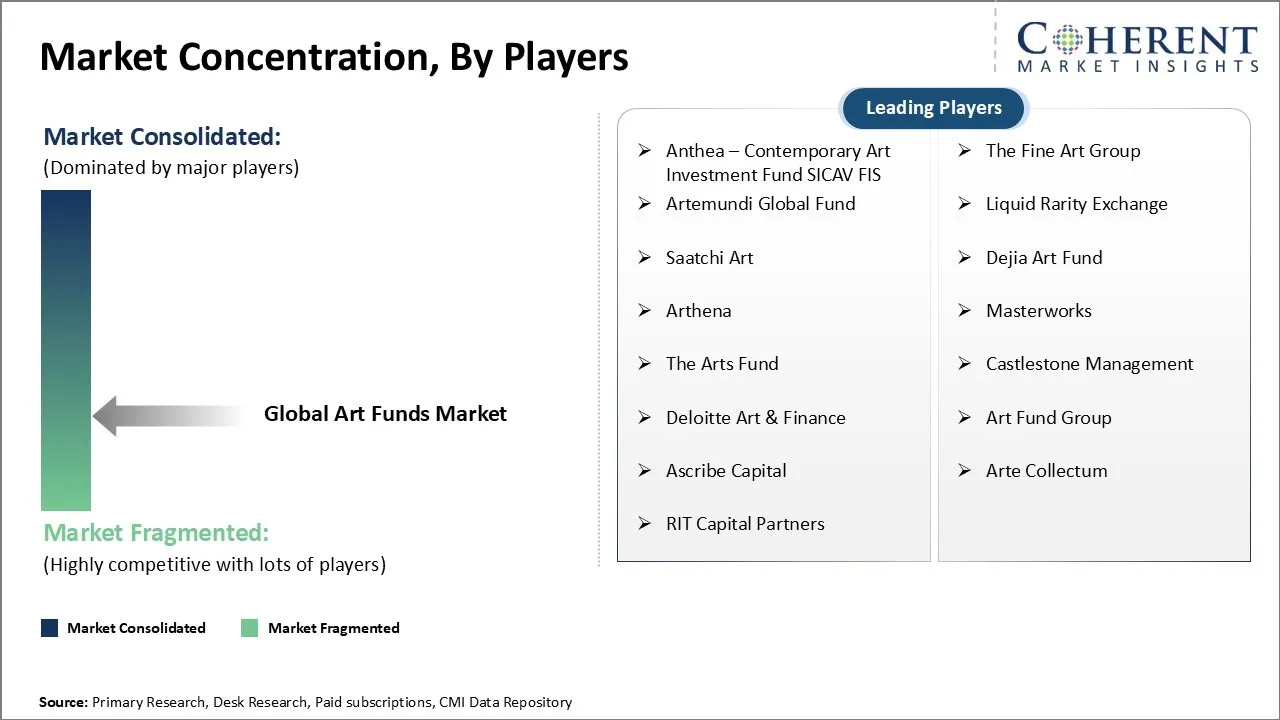
Key Developments:
- In March 2025, Arte Collectum II AB (publ), the second fund launched by Arte Collectum, a fund based in Stockholm, Sweden, made its first acquisition: Petroglyph Park: Sunset on the Escarpment (1987) by the Native American artist and activist, Ms. Jaune Quick-to-See Smith. The firm invests in works by women and other historically or geographically marginalized artists. Its first fund had raised US$ 20.8 million (€20 million) in 2022, with which it had bought 46 works by artists such as Ms. Olga de Amaral, Ms. Howardena Pindell, Ms. Wook-kyung Choi, and Ms. Michael (Corinne) West.
- In August 2024, RIT Capital Partners, an investment trust, disclosed a US$ 4.64 million (£3.5 million) collection of Old Masters and antiques at its London headquarters
- In July 2024, Jerwood Foundation, a U.K.-based independent grant-making foundation, awarded Art Fund, an independent membership-based charity, a total grant of US$ 532,686.7 (£402,000) over three years to launch Jerwood Art Fund Commissions. This move is aimed to enable museums and galleries to commission early to mid-career artists, working across a full range of artistic media and making practices.
- In April 2024, Sotheby’s, the auction house owned by telecom billionaire, Mr. Patrick Drahi, announced plans to borrow about US$ 500 million through bonds backed by personal loans made to art collectors. The auction house was the first to bring such an ABS-style product to public markets.
Top Strategies Followed by Global Art Funds Market Players
- Established Players: Established players like Masterworks and Artemundi are doubling down on data. They have embraced advanced technologies like AI to make more informed decisions around acquisitions, pricing, and timing. It is not just about buying beautiful paintings anymore—it is about treating art like a smart, strategic asset.
- Masterworks, for instance, has built an AI-driven platform that tracks the performance of blue-chip art and fractionalizes ownership into SEC-qualified shares. That’s a game-changer—it opens the door to investors who might not have tens of millions to drop on a Warhol but still want a piece of the action. Partnerships with big names like Sotheby’s also add serious credibility and access to high-end works.
- Mid-level Players: Mid-level players tend to be more agile and niche-focused. Companies like Arthena and Saatchi Art are exploring creative ways to connect investors with the next generation of talent and untapped markets.
- Arthena recently partnered with a real estate fund to offer a hybrid investment model—blending contemporary art with real estate exposure. It is a smart way to appeal to investors looking for diversified, alternative assets without going all-in on a single market.
- Small-scale Players: At the other end of the spectrum, smaller players are getting scrappy and inventive. Firms like Artory and Artfunds are working hard to lower the barriers to entry. Many of these platforms are built with newer investors in mind—people who might be intimidated by the high prices and perceived exclusivity of the traditional art world. They are using tools like blockchain to bring transparency to things like provenance and ownership history, which helps build trust.
- Artory, for example, uses blockchain to track a piece’s entire transaction history—making it easier for investors to know exactly what they are buying into. Meanwhile, Artfunds is leaning into ultra-accessibility, offering fractional shares in works by emerging artists, often at much lower buy-in points.
- Current Industry Events of 2026
- Market Size Estimation
- Regional Breakdown
- Competitive Landscape
- Customer Intelligence
- Segmental Analysis
- Pricing Analysis
- Key Market Drivers, Challenges & Future Trends
- Customized Insights Section
Market Report Scope
Art Funds Market Report Coverage
| Report Coverage | Details | ||
|---|---|---|---|
| Base Year: | 2025 | Market Size in 2026: | USD 888.2 Mn |
| Historical Data for: | 2020 To 2024 | Forecast Period: | 2026 To 2033 |
| Forecast Period 2026 to 2033 CAGR: | 6.0% | 2033 Value Projection: | USD 1,259.9 Mn |
| Geographies covered: |
| ||
| Segments covered: |
| ||
| Companies covered: | Anthea – Contemporary Art Investment Fund SICAV FIS, The Fine Art Group, Artemundi Global Fund, Liquid Rarity Exchange, Saatchi Art, Dejia Art Fund, Arthena, Masterworks, The Arts Fund, Castlestone Management, Deloitte Art & Finance, Art Fund Group, Ascribe Capital, Arte Collectum, and RIT Capital Partners | ||
| Growth Drivers: |
| ||
| Restraints & Challenges: |
| ||
Market Dynamics
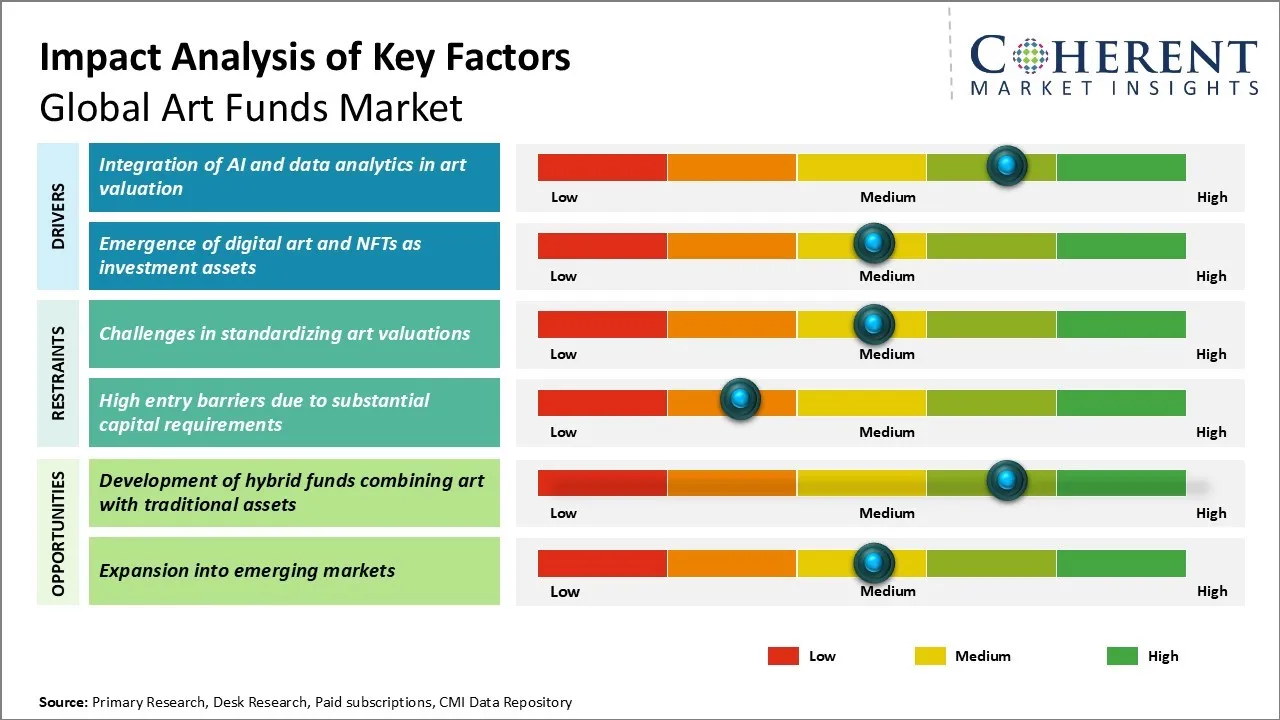
Global Art Funds Market Driver - Integration of AI and data analytics in art valuation
The increasing integration of artificial intelligence and data analytics is expected to be a key driver for the global art funds market going forward. As artworks and assets become more digitized, various aspects of art valuation such as provenance verification, authenticity testing, and risk analysis are increasingly being supplemented or taken over by AI-based tools and algorithms, such as Artory and Artnet Analytics. These tools analyze huge pools of data on traditional and digital artworks including price trends, artist profiles, and macroeconomic indicators to arrive at valuations.
The deployment of AI is also helping improve the transparency of art funds operations. By reducing subjective human errors and manual processes, AI integration is likely to make art valuation more scientific and help attract greater institutional investments into art funds over the long run.
Global Art Funds Market Opportunity - Development of hybrid funds combining art with traditional assets
One of the key opportunities for the global art funds market is the development of hybrid funds that combine investments in art with traditional assets like stocks and bonds. Such hybrid funds offer important benefits of diversification and ability to hedge inflation risk through art investments. They also allow smaller investors to participate in the relatively illiquid art markets. For example, Masterworks has created a platform for investing in blue-chip art alongside traditional asset classes, though the main focus is on artwork as an alternative investment.
Some fund managers have already launched innovative products mixing artwork, gold, real estate and stocks. As hybrid funds establish a proven track record of delivering steady returns with downside protection, they are likely to attract greater interest from family offices and High Net Worth Individuals seeking to diversify their portfolio. Standardization of valuation practices and growth in art-backed lending shall provide further fillip to the hybrid funds combining art with other investment classes.
Analyst Opinion (Expert Opinion)
- The global art funds market is expected to gain significant momentum as Ultra-high-net-worth Individuals (UHNWIs) increasingly diversify portfolios with alternative assets like art. According to Deloitte’s Art & Finance Report, 84% of wealth managers now advise clients to include art in their investment mix—a clear signal that art funds are being institutionalized as viable financial instruments.
- North America is likely to maintain dominance backed by firms like Masterworks, which alone has securitized over US$ 800 million worth of blue-chip artworks as of early 2024
- The Asia Pacific region is emerging as the fastest-growing market. The opening of institutions like the Shanghai Freeport and Hong Kong’s West Kowloon Cultural District has catalyzed both institutional and individual interest in art as a wealth vehicle.
- Ultimately, while the market’s fragmentation and capital intensity remain hurdles, the rising confluence of art, finance, and technology—evident in platforms like Arthena and Sotheby’s financial structuring of art-backed loans—is reshaping the sector.
Speak to the analyst
Want personalized insights?
Take the findings above to one of our principal consultants, or have the report rebuilt around the segments, geographies and competitors you actually track.
Market Segmentation
- Fund Type Insights (Revenue, US$ Mn, 2021 - 2033)
- Public
- Private
- Application Insights (Revenue, US$ Mn, 2021 - 2033)
- Financial Investment
- Art Development
- Regional Insights (Revenue, US$ Mn, 2021 - 2033)
- North America
- U.S.
- Canada
- Latin America
- Brazil
- Argentina
- Mexico
- Rest of Latin America
- Europe
- Germany
- U.K.
- Spain
- France
- Italy
- Russia
- Rest of Europe
- Asia Pacific
- China
- India
- Japan
- Australia
- South Korea
- ASEAN
- Rest of Asia Pacific
- Middle East
- GCC Countries
- Israel
- Rest of Middle East
- Africa
- South Africa
- North Africa
- Central Africa
- North America
- Key Players Insights
- Anthea – Contemporary Art Investment Fund SICAV FIS
- The Fine Art Group
- Artemundi Global Fund
- Liquid Rarity Exchange
- Saatchi Art
- Dejia Art Fund
- Arthena
- Masterworks
- The Arts Fund
- Castlestone Management
- Deloitte Art & Finance
- Art Fund Group
- Ascribe Capital
- Arte Collectum
- RIT Capital Partners
Sources
Primary Research Interviews:
Stakeholders:
- Art Fund Managers and Portfolio Strategists (e.g., Anthea, Masterworks, The Fine Art Group)
- High-Net-Worth Individuals (HNWIs) and Family Offices investing in alternative assets
- Art Advisors and Consultants (e.g., Deloitte Art & Finance, Artemundi)
- Curators and Auction House Executives (e.g., Sotheby’s, Christie’s)
- Museum Financial Directors and Acquisition Committees
- Art Law Specialists and Cultural Heritage Advisors
- Fintech Entrepreneurs in Art Fractionalization Platforms
Databases:
- Global Financial Transparency Initiative (GFTI)
- U.S. Bureau of Economic Analysis (BEA)
- APAC Wealth Insights Database
- The Global Alternative Investments Archive
- Oxford Art Market Registry
Magazines:
- Art Market Observer
- Wealth & Culture Review
- Canvas Capital Magazine
- Modern Collector’s Digest
Journals:
- Journal of Art Finance & Alternative Investments
- International Journal of Cultural Economics
- Arts & Markets Journal
- Journal of Private Wealth Management
Newspapers:
- The Art Newspaper
- Financial Daily International
- Global Investor Weekly
- The Art Gazette
Associations:
- International Art Market Association (IAMA)
- Association of Art Fund Managers (AAFM)
- Global Alliance for Cultural Investment (GACI)
- Art Basel Advisory Circle
- Fine Art Financial Advisors Council (FAFAC)
Public Domain Sources:
- U.S. Census Bureau
- EUROSTAT
- United Nations Conference on Trade and Development (UNCTAD)
- World Bank
- ResearchGate
Proprietary Elements:
- CMI Data Analytics Tool, Proprietary CMI Existing Repository of information for last 8 years
Get access to 250+ pages report
Every segment, forecast, competitor profile and data table behind the analysis above — available for instant download.
- ESOMAR Member
- ISO 9001:2015 Certified
- D-U-N-S Registered
- GDPR & CCPA Compliant
Missing comfort of reading report in your local language? Find your preferred language:
Transform your Strategy with Exclusive Trending Reports
Frequently Asked Questions
The global art funds market is estimated to be valued at US$ 888.2 Mn in 2026 and is expected to reach US$ 1,259.9 Mn by 2033.
The CAGR of the global art funds market is projected to be 6.0% from 2026 to 2033.
Integration of AI and data analytics in art valuation and emergence of digital art and NFTs as investment assets are the major factors driving the growth of the global art funds market.
Challenges in standardizing art valuations and high entry barriers due to substantial capital requirements are the major factor hampering the growth of the global art funds market.
In terms of fund type, the public segment is estimated to dominate the market revenue share in 2026.
Anthea – Contemporary Art Investment Fund SICAV FIS, The Fine Art Group, Artemundi Global Fund, Liquid Rarity Exchange, Saatchi Art, Dejia Art Fund, Arthena, Masterworks, The Arts Fund, Castlestone Management, Deloitte Art & Finance, Art Fund Group, Ascribe Capital, Arte Collectum, and RIT Capital Partners are the major players.
North America is expected to lead the global art funds market in 2026, holding a share of 43.7%.