

Wireless Power Transfer Market Size and Forecast — 2026-2033
The Global Wireless Power Transfer Market is estimated to be valued at US$ 18.96 Billion in 2026 and is expected to reach US$ 42.73 Billion by 2033, exhibiting a compound annual growth rate (CAGR) of 14.5% from 2026 to 2033.
Key Takeaways of the Global Wireless Power Transfer Market:
- The near-field power transfer segment is expected to lead the market holding a share of 89.4% in 2026, due to convenience and flexibility.
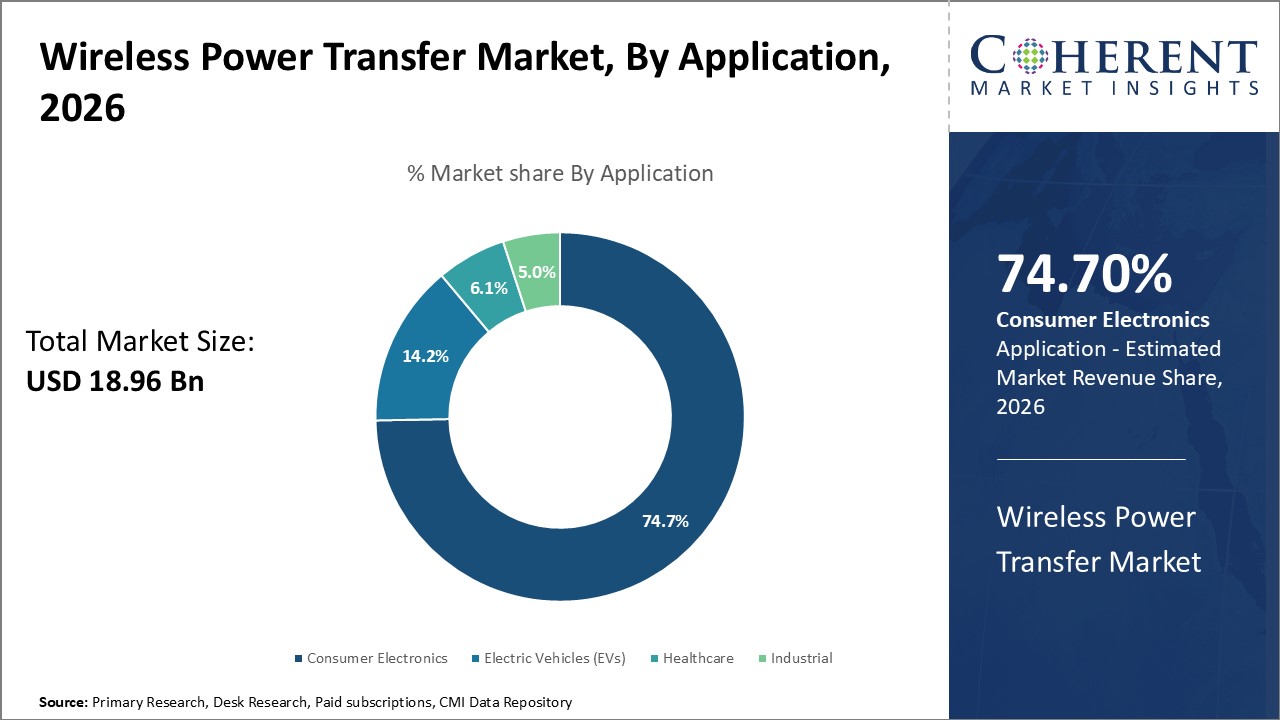
- Among application, the consumer electronics segment is projected to dominate with a share of 74.7% in 2026, owing to the increasing adoption of smartphone, tablets, and wearables.
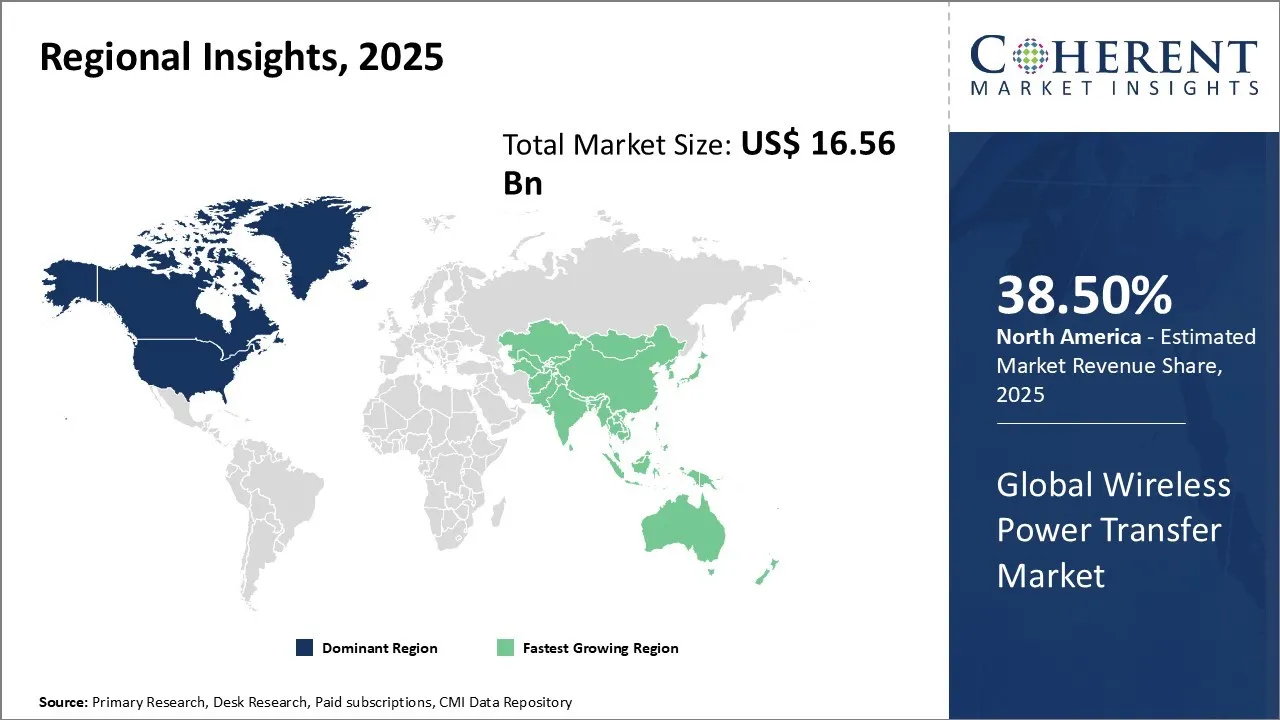
- North America is expected to lead the market with a share of 38. 5% in 2026, owing to strong research and development activities.
- Asia Pacific, holding a share of 29. 3% in 2026, is projected to be the fastest growing region, due to strong government support through initiatives such as Digital India.
Market Overview:
With wireless charging tech getting better and electric vehicles becoming more popular, the wireless power transfer market is gaining traction. There has been a growing trend in wireless charging for everyday gadgets like smartwatches and smartphones, which is helping push the technology forward across the globe. An instance is the introduction of the Qi2 wireless charging standard in 2024. Backed by big names like Apple, Samsung, and Anker, Qi2 brings in more efficient, magnetically aligned charging—making it easier and faster to power up the latest phones and wearables.
Current Events and Their Impact:
Current Events | Description and its impact |
Accelerated EV Charging Infrastructure Development in Asia Pacific |
|
Breakthrough Wireless Power Technologies Entering Commercialization |
|
Regulatory Standardization Push Across Key Markets |
|
By Technology
Global Wireless Power Transfer Market Insights by Technology – Convenience and Customization Drive the Demand for Near-field Wireless Power Transfer
The near-field power transfer segment, holding an expected share of 89.4% in 2026, is driven by its efficiency, convenience, and flexibility. Using inductive or magnetic resonance, it transfers power over short distances—ideal for consumer electronics and compact devices.
Smartphones were early adopters of wireless charging via Qi-standard inductive charging, allowing users to charge devices by simply placing them on a pad. Apple’s MagSafe and Samsung’s Wireless PowerShare have advanced this further, offering precise alignment and reverse charging.
Beyond phones, HP’s Spectre Folio laptop integrates wireless charging into its trackpad, while Medtronic uses near-field tech to recharge implantable medical devices non-invasively.
By Application
Global Wireless Power Transfer Market Insights by Application – Consumer Electronics Dominate the Demand for Integrated, Effortless Charging
The consumer electronics segment is expected to hold the largest share of 74.7% in the global wireless power transfer market in 2026. Smartphones were the first to lead the way, with Apple, Samsung, and Google adding wireless charging coils to their flagship devices. That momentum quickly spread to tablets, smartwatches, and wireless earbuds—like AirPods Pro and Galaxy Buds—building out a full ecosystem of wirelessly powered gadgets.
Accessories have helped take this even further. Brands like Anker offer multi-device charging stations, Nomad delivers sleek wireless pads, and IKEA has even embedded wireless chargers into its furniture—bringing seamless power into everyday life. Automakers are on board too, with models like the Tesla and Ford Mustang Mach-E featuring built-in wireless charging docks for phones, adding another layer of convenience for drivers.
Role of Artificial Intelligence (AI)
Artificial Intelligence (AI) is significantly transforming how wireless power transfer (WPT) solutions deliver efficiency and reliability. AI‑powered resonance‑tuning engines—such as WiTricity’s CoilAlign AI and Qualcomm Halo’s DynamicTune—integrate seamlessly with WPT transmitters to optimize coil alignment, resonant frequency, and power levels in real time based on vehicle position, device geometry, and thermal conditions.
These AI modules work independently of the core hardware controllers, allowing on‑the‑fly magnetic coupling adjustments across EVs, laptops, and medical implants without manual calibration. In the backend, AI enhances grid integration and predictive maintenance by analyzing usage patterns and equipment health; for example, in December 2024, WiTricity partnered with NVIDIA to deploy CoilAlign AI across Tokyo’s electric taxi fleet, boosting transfer efficiency by 15% and reducing misalignment losses by 20%.
Regional Insights
North America Wireless Power Transfer Market Analysis and Trends
North America is on track to lead the global wireless power transfer market, projected to hold a 38.5% share by 2026. North America is a hub of strong R&D activity, houses a mature electric vehicle ecosystem, and is experiencing smart investments in wireless charging infrastructure. Companies like WiTricity and Qualcomm Halo are exploring and providing cutting-edge wireless EV charging tech, while major automakers—including General Motors and Ford—are working on integrating these systems into their upcoming electric models.
Asia Pacific Wireless Power Transfer Market Analysis and Trends
The Asia Pacific region, holding a share of 29.3% in 2026, is expected to exhibit the fastest growth due to strong government support through initiatives, such as Digital India, and investments aimed at developing charging infrastructure and promoting the adoption of electric vehicles (EVs) in several countries. Countries like China and South Korea are leading the charge when it comes to developing wireless charging tech. In China, electric vehicle makers like BYD and NIO are already rolling out cars with built-in wireless charging systems. Over in South Korea, major players like Samsung and LG are doubling down on the technology too, putting serious investment into bringing wireless charging to a wide range of products—from smartphones and laptops to vehicles.
Wireless Power Transfer Market Outlook for Key Countries
U.K. Wireless Power Transfer Market Analysis and Trends
The U.K. is making big moves in wireless power transfer, owing to major infrastructure projects fueled by public-private partnerships. The government has set an ambitious goal: charging points every 20 miles along roads by 2035. That push is creating a real demand for both on-the-go and stationary wireless chargers, especially at fuel stations and busy commercial areas. On the tech side, U.K. companies like Ossia and PowerbyProxi are stepping up with some innovative solutions. Automakers like Nissan and BMW are also getting in on the action, now offering wireless charging as a standard feature in select EV models to meet the rising demand from drivers.
Germany Wireless Power Transfer Market Analysis and Trends
Germany wireless power transfer market continues to lead in Europe with strong manufacturing capabilities. Daimler has introduced wireless charging in Mercedes EQC, and Volkswagen is gearing up to include it in its upcoming ID.4 and ID.5 electric models. Meanwhile, wireless charging leader WiTricity is teaming up with major automakers to develop dynamic wireless charging systems—especially for commercial vehicles and buses. On the policy side, government support continues to drive EV adoption, with incentives for buyers and ongoing investment in charging infrastructure projects across the board.
China Wireless Power Transfer Market Analysis and Trends
China wireless power transfer market is dominated by local giants such as Xiaomi, Huawei, and Oppo that offer wireless charging as a key phone feature. Automakers like BYD offer wireless EV charging systems as an option. The government's "Made in China 2026" policy promotes indigenous innovation in next-generation technologies. Several cities feature contactless bus stops with wireless charging seats. The 'Green Transportation' initiative aims to install over 4,00,000 charging points by 2023 to boost EV sales.
U.S. Wireless Power Transfer Market Analysis and Trends
The U.S. wireless power transfer market is led by California with strong incentives and EV infrastructure build-out plans. Tesla utilizes in-house wireless technology for model 3 and upcoming vehicles. Ford will introduce wireless charging in the Mustang Mach-E. Powermat, Mojo Mobility and WiTricity are contributing WPT solutions across markets. The bipartisan infrastructure bill, passed by Congress in November 2021, allocated US$ 7.5 billion to develop 500,000 charging stations across highways to accelerate EV adoption.
End User Feedback and Unmet Needs
End users generally prefer the convenience of wireless power transfer, praising the hassle-free experience of charging devices without cables—whether it is simply placing a smartphone on a desk pad or parking an EV over a charging pad. However, there are still some common pain points. Many users mention the complicated installation processes, the high upfront costs of infrastructure, and the occasional issue of misalignment losses.
Small and medium-sized businesses—such as independent EV fleet operators or boutique electronics manufacturers—face unique challenges. These include expensive site preparation costs, a lack of in-house RF/coil-tuning expertise, and inconsistent industry standards. Users often ask for plug-and-play WPT systems that are easy to set up, clearer installation guides for contractors, and unified dashboards that make it easy to monitor charging efficiency and track device health across different hardware.
Market Players, Key Development, and Competitive Intelligence
Key Developments:
- In October 2024, Anker, an electronics manufacturer, unveiled its new MagGo Wireless Charging Station, a foldable and portable power solution, weighing just 6.9 oz
- In June 2024, Energous Corporation, a provider of wireless power network solutions, partnered with providers of IT systems and services, including Anukin, Ecobyte and Peak Technologies, to accelerate the adoption of its solutions worldwide
- In June 2023, Powermat partnered with Powercast, both providers of wireless charging solutions, to create long-range wireless power solutions with power ranging from SmartInductive to RF up to ft.
- In October 2022, TDK Corporation, an electronics corporation, launched a Qi-compliant planar wireless power coil, utilizing a new copper patterning technology. The Wireless Power Consortium (WPC) designated this new coil as MP-A28.
Top Strategies Followed by Global Wireless Power Transfer Market Players
- Established Players: Leading companies focus on patent portfolio expansion, strategic acquisitions, and active participation in global standard‑setting bodies to cement their market leadership.
- For example, Texas Instruments collaborated with BMW in August2024 on a series of inductive charging prototypes for next‑gen electric vehicles.
- Mid-level Players: Mid‑sized firms pursue regional roll‑outs, high‑visibility partnerships, and cost‑optimized WPT modules to expand their share.
- For instance, Powermat teamed up with Starbucks in 2023 to equip 300+ cafés across North America with wireless‑charging tables; Belkin launched its Boost↑ChargePRO multi‑device pad in February 2025, targeting premium smartphones, earbuds, and smartwatches with a single, elegantly styled platform.
- Small ‑scale Players: Smaller innovators differentiate through niche‑focused solutions, rapid prototyping support, and plug‑and‑play developer kits for specialized applications.
- Ossia showcased its Cota 2 wireless‑power module at the IoT Solutions World Congress 2024—enabling battery‑free sensor networks for smart buildings; Energous unveiled its WattUp Mid Field transmitter at CES 2025, capable of delivering power up to 3 meters for wearables and low‑power IoT devices.
- Current Industry Events of 2026
- Market Size Estimation
- Regional Breakdown
- Competitive Landscape
- Customer Intelligence
- Segmental Analysis
- Pricing Analysis
- Key Market Drivers, Challenges & Future Trends
- Customized Insights Section
Market Report Scope
Wireless Power Transfer Market Report Coverage
| Report Coverage | Details | ||
|---|---|---|---|
| Base Year: | 2025 | Market Size in 2026: | USD 18.96 Bn |
| Historical Data for: | 2020 To 2024 | Forecast Period: | 2026 To 2033 |
| Forecast Period 2026 to 2033 CAGR: | 14.5% | 2033 Value Projection: | USD 42.73 Bn |
| Geographies covered: |
| ||
| Segments covered: |
| ||
| Companies covered: | WiTricity, Qualcomm, Texas Instruments, Samsung Electronics, LG Electronics, Sony Corporation, Huawei Technologies, Xiaomi Corporation, Apple Inc., Panasonic Corporation, Toshiba Corporation, Powermat Technologies, Energizer Holdings, Belkin International, and Monolithic Power Systems | ||
| Growth Drivers: |
| ||
| Restraints & Challenges: |
| ||
Market Dynamics
Global Wireless Power Transfer Market Driver - Rising adoption of electric vehicles
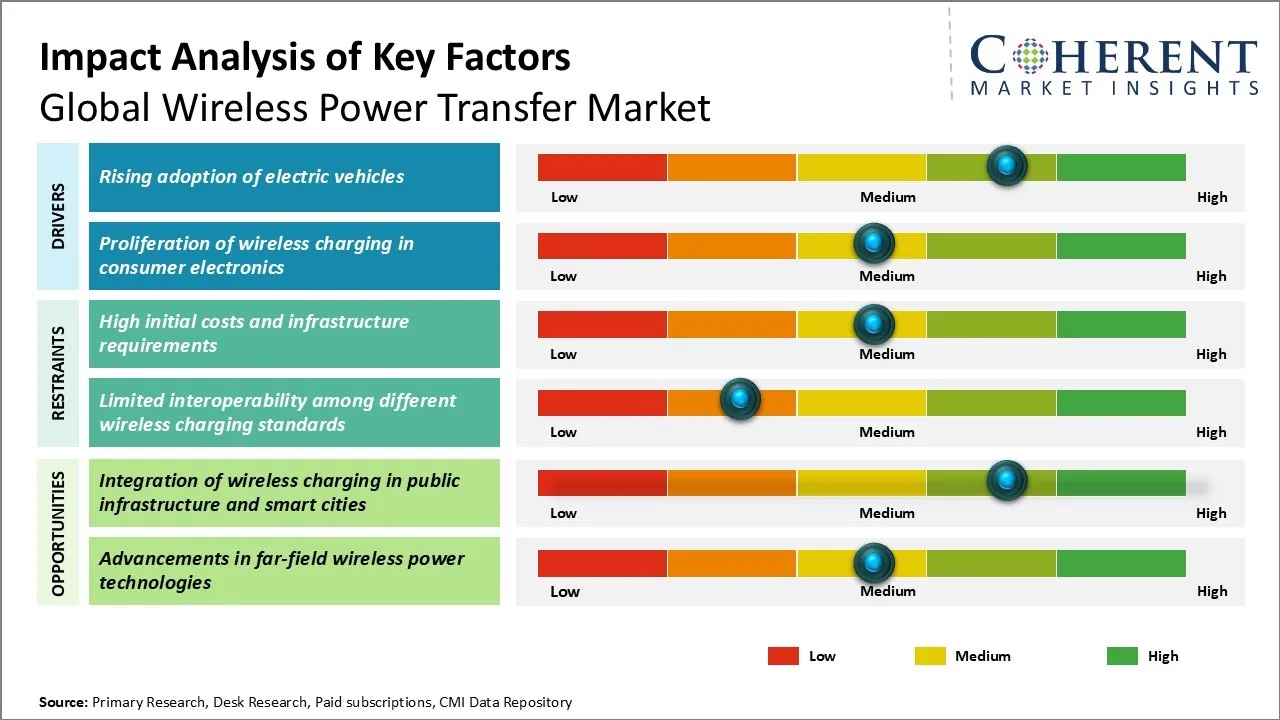
The rising adoption of electric vehicles across the globe is expected to drive the growth of the global wireless power transfer market during the forecast period. As electric vehicles are becoming more popular due to growing environmental concerns, the demand for wireless charging technology is surging. Wireless charging provides ease of use to electric vehicle users as it eliminates the need for plug-in charging. Automakers are focusing on incorporating wireless charging technology in upcoming electric vehicle models to offer convenience to drivers. Several electric vehicle models now offer wireless charging pads integrated into the vehicle for slow charging.
Moreover, governments in many countries are promoting the use of electric vehicles and setting targets to phase out combustion engine vehicles. For instance, in July 2021, the U.K. government announced it will ban the sale of new petrol and diesel cars from 2030 (with hybrids allowed until 2035). This is likely to further accelerate the adoption of electric vehicles and expand the wireless charging infrastructure worldwide. Thus, the demand for wireless power transfer systems from the automotive and infrastructure construction industries is estimated to rise significantly over the next few years.
Global Wireless Power Transfer Market Opportunity - Integration of wireless charging in public infrastructure and smart cities
The integration of wireless charging technology within public infrastructure and development of smart cities present key opportunities for the global wireless power transfer market. Many city planners and municipal authorities are encouraging installation of wireless EV charging stations at busy locations like airports, malls, and commercial districts. For instance, from May through August 2024 in the U.S., Dallas/Fort Worth International Airport’s Innovation and Planning teams hosted a series of five public EV‑charging demonstrations—one of which showcased ZiGGY’s autonomous robotic wireless charger in customer parking lots. This pilot tested next‑generation, cable‑free charging that can be controlled via a mobile app, marking one of the first deployments of robotic wireless charging at a major U.S. airport.
Similarly, wireless charging kiosks for mobile devices and laptops in public transport terminals can offer advantages. This would boost the adoption of wireless charging on a mass scale. Also, various smart city projects focusing on connected infrastructure provide a platform to incorporate wireless power requirements. If wireless charging point networks are included while designing smart infrastructure, it could accelerate the market's growth prospects.
Analyst Opinion (Expert Opinion)
- The wireless power transfer market will outpace traditional charging solutions over the forecast years. Beyond EVs and smartphones, new use cases in IoT sensor grids and smart furniture can be expected—for example, IKEA’s trial of Qi‑enabled tabletops in its Stockholm stores demonstrate how WPT can seamlessly integrate into everyday environments.
- High deployment costs and a fragmented standard landscape continue to impede broader adoption. A unified protocol—backed by major OEMs and standard bodies—can drive down unit costs and unlock economies of scale. Companies that lead or join a consortium for universal interoperability will gain a lasting competitive advantage.
- The coming wave of 6G‑enabled far‑field prototypes and AI‑driven alignment solutions promises to shift market dynamics. A flurry of strategic acquisitions are to be expected—smaller innovators with novel coil‑design IP (e.g., Ossia’s mid‑field modules) will become prime targets for established players seeking to expand into new application segments.
Speak to the analyst
Want personalized insights?
Take the findings above to one of our principal consultants, or have the report rebuilt around the segments, geographies and competitors you actually track.
Market Segmentation
- Technology Insights (Revenue, US$ Bn, 2021 - 2033)
- Near-field Power Transfer
- Far-field Power Transfer
- Application Insights (Revenue, US$ Bn, 2021 - 2033)
- Consumer Electronics
- Electric Vehicles (EVs)
- Healthcare
- Industrial
- Regional Insights (Revenue, US$ Bn, 2021 - 2033)
- North America
- U.S.
- Canada
- Latin America
- Brazil
- Argentina
- Mexico
- Rest of Latin America
- Europe
- Germany
- U.K.
- Spain
- France
- Italy
- Russia
- Rest of Europe
- Asia Pacific
- China
- India
- Japan
- Australia
- South Korea
- ASEAN
- Rest of Asia Pacific
- Middle East
- GCC Countries
- Israel
- Rest of Middle East
- Africa
- South Africa
- North Africa
- Central Africa
- North America
- Key Players Insights
- WiTricity
- Qualcomm
- Texas Instruments
- Samsung Electronics
- LG Electronics
- Sony Corporation
- Huawei Technologies
- Xiaomi Corporation
- Apple Inc.
- Panasonic Corporation
- Toshiba Corporation
- Powermat Technologies
- Energizer Holdings
- Belkin International
- Monolithic Power Systems
Sources
Primary Research Interviews:
Stakeholders:
- Consumer Electronics Manufacturers (e.g., Product Managers, Innovation Heads)
- Automotive OEMs and Tier-1 EV Suppliers (e.g., Charging Technology Leads)
- Industrial Wireless Solutions Integrators
- Smart Infrastructure Developers and Urban Planning Technologists
- Medical Device Manufacturers (especially implantable and wearable tech companies)
- Power Semiconductor Specialists and Engineers
Databases:
- Global Energy Transfer Registry (GETR)
- Smart Mobility & EV Global Stats (SMEGS)
- International Consumer Electronics Index (ICEI)
- Urban Tech Deployment Tracker (UTDT)
Magazines:
- Tech Grid Weekly – Power & Semiconductor Innovation
- PowerUp Digest – Wireless Energy Insights
- Modern Mobility Magazine – EV and Infrastructure Innovation
- Wireless World Journal – Emerging Wireless Trends
Journals:
- Journal of Wireless Energy Systems (JWES)
- Advanced Charging Technologies Journal (ACTJ)
- Energy Interface Engineering Review (EIER)
- Journal of Applied Magnetism and Power Transfer
Newspapers:
- The Energy Times – Global clean tech and transmission news
- Tech Horizons Daily – IoT, Consumer Electronics & Power Trends
- The Innovation Tribune – Focused on disruptive industrial technologies
- AsiaTech Chronicle – Electronics & Semiconductor Sector News
Associations:
- International Association for Wireless Energy (IAWE)
- Global EV Infrastructure Alliance (GEVIA)
- Consumer Electronics Innovation Board (CEIB)
- Wireless Charging Industry Consortium (WCIC)
- Far-Field Power Transfer Standards Council (FPTS)
Public Domain Sources:
- U.S. Department of Energy – Wireless Transmission Projects Database
- European Commission – Emerging Tech Observatory (ETO)
- United Nations Energy Division
- Global Electrification Index (GEI)
- ResearchBridge (academic & public tech paper repository)
Proprietary Elements:
- CMI Data Analytics Tool, Proprietary CMI Existing Repository of information for last 8 years
Get access to 250+ pages report
Every segment, forecast, competitor profile and data table behind the analysis above — available for instant download.
- ESOMAR Member
- ISO 9001:2015 Certified
- D-U-N-S Registered
- GDPR & CCPA Compliant
Missing comfort of reading report in your local language? Find your preferred language:
Transform your Strategy with Exclusive Trending Reports
Frequently Asked Questions
The global wireless power transfer market is estimated to be valued at US$ 18.96 Billion in 2026 and is expected to reach US$ 42.73 Billion by 2033.
The CAGR of the global wireless power transfer market is projected to be 14.5% from 2026 to 2033.
Rising adoption of electric vehicles and proliferation of wireless charging in consumer electronics are the major factors driving the growth of the global wireless power transfer market.
High initial costs and infrastructure requirements and limited interoperability among different wireless charging standards are the major factor hampering the growth of the global wireless power transfer market.
In terms of technology, the near-field power transfer segment is estimated to dominate the market revenue share in 2026.
WiTricity, Qualcomm, Texas Instruments, Samsung Electronics, LG Electronics, Sony Corporation, Huawei Technologies, Xiaomi Corporation, Apple Inc., Panasonic Corporation, Toshiba Corporation, Powermat Technologies, Energizer Holdings, Belkin International, and Monolithic Power Systems are the major players.
North America is expected to lead the global wireless power transfer market in 2026, holding a share of 38.5%.