

Internet of Everything (IoE) Market Analysis & Forecast: 2026-2033
Internet of Everything (IoE) Market is estimated to be valued at USD 1,852.04 Bn in 2026 and is expected to reach USD 5,047.68 Bn in 2033, exhibiting a compound annual growth rate (CAGR) of 15.4% from 2026 to 2033.
Key Takeaways
- By Component, the hardware segment is estimated to dominate the Internet of Everything (IoE) market with a 39.2% share in 2026.
- By Region, Asia Pacific is anticipated to lead the Internet of Everything market with a 35.0% share in 2026.
Market Overview
The global Internet of Everything (IoE) market is experiencing robust growth, driven by increasing connectivity across devices, people, processes, and data. Hardware components, including sensors and embedded systems, form the market’s backbone, enabling smart automation across industries. Smart cities and manufacturing lead the application sectors, reflecting rising demand for real-time insights and efficiency. Asia Pacific dominates regionally, supported by rapid digitization, expanding 5G infrastructure, and government-backed initiatives. Overall, IoE adoption is transforming industries through integrated intelligence, seamless connectivity, and data-driven decision-making.
Current Events and its Impact on the Internet of Everything (IoE) Market
Current Event | Description and its impact |
Proliferation of 5G and Edge Computing |
|
Global Push for Smart City Initiatives |
|
Rising Emphasis on IoE Cyber security |
|
Role of Emerging Technologies in the Internet of Everything (IoE) Market
Emerging technologies play a pivotal role in accelerating the growth and adoption of the Internet of Everything (IoE) market. Technologies such as 5G, artificial intelligence (AI), machine learning (ML), edge computing, and block chain are enabling more efficient, secure, and intelligent connectivity between people, processes, data, and devices.
5G networks offer ultra-low latency and high bandwidth, supporting real-time communication across massive IoE networks. AI and ML enhance decision-making by analysing vast datasets generated by connected systems, enabling predictive maintenance, automated processes, and smarter resource management.
Edge computing reduces dependence on cloud infrastructure by processing data closer to the source, improving response times and reducing bandwidth costs. Meanwhile, block chain ensures data security and integrity in decentralized IoE ecosystems. These technologies collectively enable the creation of intelligent, responsive, and scalable solutions across industries such as healthcare, manufacturing, logistics, and smart cities—positioning IoE as a foundation for future digital transformation.
- Current Industry Events of 2026
- Market Size Estimation
- Regional Breakdown
- Competitive Landscape
- Customer Intelligence
- Segmental Analysis
- Pricing Analysis
- Key Market Drivers, Challenges & Future Trends
- Customized Insights Section
Internet of Everything (IoE) Market Trends
- Increasing use of IoE backed devices
IoE backed devices like smartphones, laptops, tablets, smart wearable, etc. are increasingly growing in demand as the world is adopting to the world of technology. These devices are increasingly becoming the part of life for people with their integration and applications in all walks of life. As the use of these devices increases, the prospects of evolution of IoE would keep on expanding.
In June 5, 2025, Samsara, a key IoT (IoE) platform provider, posted a 31% year-over-year increase in Q1 revenue to USD 366.9 million, with annual subscription revenue at USD 1.54 billion, though cautious Q2 guidance caused shares to dip over 10% after hours
- Growth of 5G connectivity infrastructure
The primary premise on which the entire IoE ecosystem works is the inter-connectivity between devices, people, processes and data. This connectivity is in the form of Bluetooth, internet, Wi-Fi and other connectivity options. In the current scenario a significant part of the ecosystem relies on the connectivity of IoE devices through internet.
The penetration of internet services in the remotest part of the world and the introduction of the 5G spectrum in networking is a significant development when it comes to the IoE market. The 5G spectrum would provide high speed data transmission and would in-turn allow the devices to share data and communicate faster. Moreover, large chunks of data can be transferred with relative ease.
Challenges in the Internet of Everything (IoE) Market
- High prices related with access to 5G connectivity
The access to internet is now spreading even to the remote areas in developing countries like India, but the 5G network infrastructure is still not widely accessible for the users. The cost associated with gaining access to 5G services include the cost of owning a device that supports the 5G spectrum as well as the cost of 5G data services. Bothe these costs are a significant barrier in the wider adoption of 5G services. This slow growth in the adoption of 5G spectrum would also slow down the growth of the IoE expansion.
- Low awareness regarding IoE
IoE is still a growing phenomenon. The concept is rapidly evolving and incorporating speedy developments with the constant changes in technology. This nuance of the concept is the reason that the concept is not widely known to majority of the business verticals especially in the developing economies. The businesses in these regions are majorly unaware about the applications of IoE in improving the business processes and thus increasing the efficiency. This can be attributed to the factors like lag in the adoption of technology, regional imbalance, etc.
Opportunities in the Internet of Everything (IoE) Market
- Growing preference for enterprise mobility
Enterprise mobility is a relatively new concept which emphasizes on the ability of any business to mobilize its resources in order to provide flexibility to the employees in terms of operating. The latest trend of ‘work from home’ or ‘remote working’ which allows the employees to work from remote locations other than the company office is the example of enterprise mobility. This concept increases the demand for smart devices like laptops, tablets, etc. as well as the connectivity services.
Segmental Insights
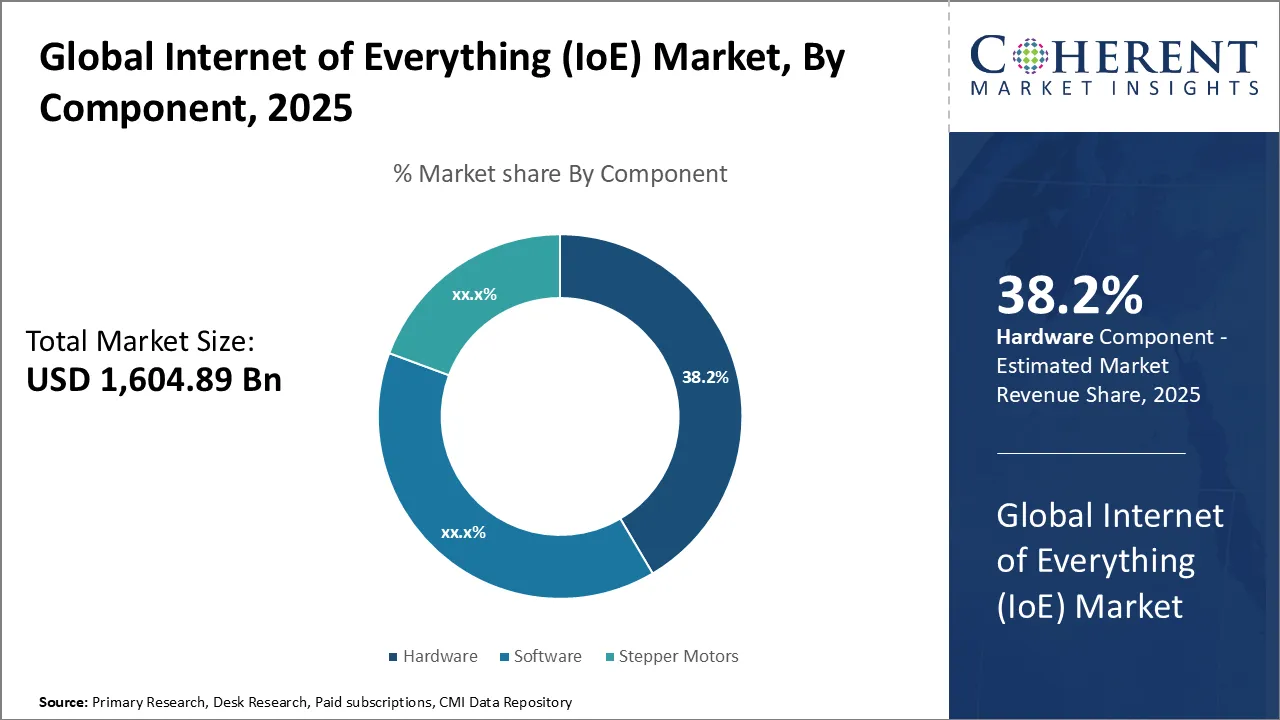
Internet of Everything (IoE) Market Insights, By Component
The hardware segment is estimated to dominate the Internet of Everything (IoE) market with a 39.2% share in 2026. This growth is driven by the increasing demand for smart sensors, RFID tags, embedded systems, and advanced connectivity modules essential for seamless interconnectivity across devices, people, processes, and data.
Rapid expansion of smart city projects, industrial automation, and connected healthcare infrastructures globally has amplified the need for robust hardware components. Furthermore, the shift toward edge computing and 5G is reinforcing hardware investment to support faster data transmission and real-time decision-making.
-market-by-end-user.webp "Internet of Everything (IoE) Market, By End-User")
Internet of Everything (IoE) Market Insights, By End-user
The manufacturing sector is expected to hold a substantial share of the IoE market in 2026. As industries embrace the Fourth Industrial Revolution, IoE is playing a pivotal role in enabling smart factories, predictive maintenance, and real-time production analytics.
Manufacturers are adopting interconnected systems to optimize workflows, reduce operational costs, and improve quality control through machine-to-machine (M2M) communication. The integration of IoE technologies is also helping enterprises transition toward more agile, responsive, and data-driven operations.
Regional Insights
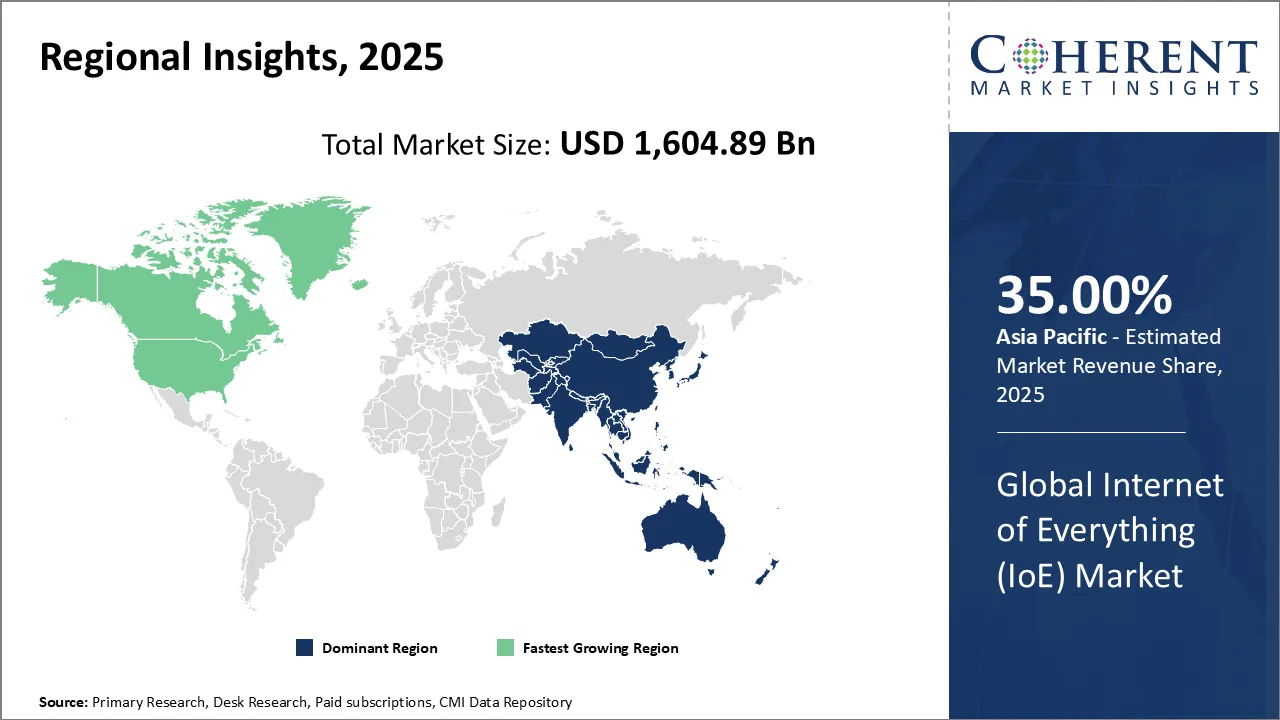
Asia Pacific Internet of Everything (IoE) Market Analysis and Trends
Asia Pacific is anticipated to lead the global Internet of Everything (IoE) market with a commanding 35.00% share in 2026. This regional dominance is primarily driven by accelerated digital transformation across major economies such as China, India, Japan, and South Korea. The widespread deployment of 5G infrastructure, coupled with the proliferation of smart devices and connected technologies, is fueling IoE adoption in sectors like manufacturing, transportation, energy, and healthcare.
Emerging smart city initiatives, digital government services, and industrial automation programs are also propelling market growth. Moreover, strong government support through favorable policies, subsidies, and technology development grants is enabling rapid IoT and AI integration across business operations. The presence of a large consumer base, increased internet penetration, and rising investments from global tech giants further solidify Asia Pacific’s position as the fastest-growing and most influential region in the IoE ecosystem.
Internet of Everything (IoE) Market Dominating Countries
China, Japan, India, and South Korea
China, Japan, India, and South Korea are the dominant players in the Asia Pacific Internet of Everything (IoE) market, collectively driving the region’s projected 35.0% share in 2026. China leads with aggressive investments in smart city projects, widespread 5G rollout, and a booming industrial IoT sector. The country’s push for digital infrastructure development and AI integration across sectors is central to its IoE leadership.
Japan complements this with advanced robotics, connected healthcare systems, and strong government support for digital transformation. India is emerging as a key growth engine with rapid digitalization, growing startup activity in IoT and AI, and widespread adoption of smart manufacturing and agriculture technologies.
South Korea adds to the dominance with cutting-edge ICT infrastructure, high IoT device penetration, and a proactive government agenda promoting smart industries. Together, these countries anchor the Asia Pacific region's growth trajectory in the global IoE landscape.
Market Report Scope
Internet of Everything (IoE) Market Report Coverage
| Report Coverage | Details | ||
|---|---|---|---|
| Base Year: | 2025 | Market Size in 2026: | USD 1,852.04 Bn |
| Historical Data for: | 2020 To 2024 | Forecast Period: | 2026 To 2033 |
| Forecast Period 2026 to 2033 CAGR: | 15.4% | 2033 Value Projection: | USD 5,047.68 Bn |
| Geographies covered: |
| ||
| Segments covered: |
| ||
| Companies covered: | IBM Corporation, Telefónica S.A., Cisco Systems Inc., Accenture plc, Vodafone Group plc, Apple Inc., Google Inc., Samsung Electronics Co. Ltd., and Hewlett-Packard Co. and others. | ||
| Growth Drivers: |
| ||
| Restraints & Challenges: |
| ||
Analyst Viewpoint – Internet of Everything (IoE) Market
- The global Internet of Everything (IoE) market is experiencing dynamic growth, driven by the accelerating convergence of devices, data, and intelligent systems across industries. Analysts highlight that the hardware segment remains a major contributor, backed by strong demand for sensors, connectivity modules, and embedded systems that form the backbone of interconnected environments in smart cities, industrial automation, and connected homes.
- Emerging technologies such as 5G, edge computing, and artificial intelligence are significantly enhancing IoE capabilities by enabling faster communication, localized data processing, and intelligent decision-making. Experts emphasize that these innovations are not only improving operational efficiency but also creating new revenue streams across sectors such as healthcare, manufacturing, and transportation.
- Asia Pacific is emerging as the dominant region, with analysts attributing its 35.0% market share in 2025 to rapid digital transformation, government-led smart infrastructure projects, and expanding industrial automation. Growth opportunities are also expanding in North America and Europe through enterprise IoE integration and cloud-based innovation.
Internet of Everything (IoE) Market: Key Development
- In April 2025, Ericsson and Supermicro signed an MoU to integrate 5G connectivity with Edge AI computing platforms, aiming to simplify deployment of intelligent IoE systems for enterprises in retail, manufacturing, and healthcare. This move addresses the growing enterprise demand for low-latency, pre‑validated solutions at the network edge, accelerating adoption of IoE-driven applications in critical environments.
- In March 2025, China Mobile rolled out 5G‑Advanced (Release 18) networks in Hangzhou in March 2025. This upgrade enhances support for high-speed, low-latency IoE devices and prepares the ground for large-scale ambient IoT and 6G applications across smart cities and industrial sectors in the Asia Pacific region.
- In November 2024, Barcelona implemented Edge AI-powered traffic cameras, analysed locally to optimize signal timings and reduce congestion. This real-world use of edge-based analytics showcases the practical benefits of IoE for urban infrastructure, setting a precedent for other smart cities.
Market Segmentation
- Global Internet of Everything (IoE) Market, By Component (Revenue, USD Bn, 2021 - 2033)
- Hardware
- Software
- IT Security Software
- Data Management Software
- Communication and Collaboration Software
- Software Analytics
- Others
- Stepper Motors
- Consulting
- Integration & Implementation
- Operation Management
- Repair & Maintenance
- Global Internet of Everything (IoE) Market, By End User Industry (Revenue, USD Bn, 2021 - 2033)
- BFSI
- Manufacturing
- Government
- IT & Telcom
- Retail
- Energy & Power
- Transportation & Logistics
- Others
- Global Internet of Everything (IoE) Market, By Region (Revenue, USD Bn, 2021 - 2033)
- North America
- U.S.
- Canada
- Latin America
- Brazil
- Argentina
- Mexico
- Rest of Latin America
- Europe
- Germany
- U.K.
- Spain
- France
- Italy
- Russia
- Rest of Europe
- Asia Pacific
- China
- India
- Japan
- Australia
- South Korea
- ASEAN
- Rest of Asia Pacific
- Middle East
- GCC Countries
- Israel
- Rest of Middle East
- Africa
- South Africa
- North Africa
- Central Africa
- Company Profiles
- Accenture Plc.
- Apple Inc.
- Cisco Systems Inc
- Google Inc.
- Hewlett-Packard Co.
- IBM Corporation
- Samsung Electronics Co. Ltd.
- Telefónica S.A
- Vodafone Group
- Others
Sources
The Stakeholders Consulted
- Smart device manufacturers and hardware suppliers
- IoT software platform developers and systems integrators
- Telecom operators and 5G infrastructure providers
- Edge computing and cloud service providers
- Regulatory and policy advisors focused on data security and smart infrastructure
- Government agencies promoting digital transformation and smart city development
- End-users across verticals such as manufacturing, healthcare, transportation, utilities, retail, and defense
Databases Opened
- International Telecommunication Union (ITU) – ICT Indicators Database
- World Bank Open Data – Digital Economy & Infrastructure Statistics
- OECD – Digital Economy Outlook and IoT Adoption Trends
- Ministry of Electronics & IT (India) – National IoT Policy and Reports
- European Commission – Smart Cities and IoT Reports
Magazines & Trade Publications
- IoT World Today
- IEEE Spectrum – Internet of Things & Edge Computing
- TechCrunch – IoT and Embedded Systems
- IndustryWeek – Digital Transformation & Industrial IoT
- CIO Review – IoT Solution Providers and Industry Trends
Scientific and Industry Journals
- IEEE Internet of Things Journal
- Sensors and Actuators A: Physical
- Journal of Network and Computer Applications
- Computer Networks
- ACM Transactions on Internet Technology
Newspapers & Media Outlets
- The Wall Street Journal – Technology & Innovation
- Bloomberg – Tech, Telecom, and Industrial Automation
- Reuters – Global Tech Policy and Infrastructure Trends
- The Economic Times – Digital India & Smart City Initiatives
- Business Standard – Emerging Technologies and Industrial Automation
Associations and Regulatory Bodies
- International Telecommunication Union (ITU)
- Institute of Electrical and Electronics Engineers (IEEE)
- National Institute of Standards and Technology (NIST), USA
- Department of Telecommunications (India)
- European Telecommunications Standards Institute (ETSI)
- Internet Society (ISOC)
Public Domain Sources
- U.S. Energy Information Administration (EIA) – Digital Infrastructure and Smart Grid Reports
- European Commission – Horizon Europe IoT and AI Projects
- International Renewable Energy Agency (IRENA) – Smart Energy Networks
- United Nations – Sustainable Development and Digital Inclusion Reports
- Global System for Mobile Communications Association (GSMA) – Mobile Economy and IoT Reports
Proprietary Research Elements
- CMI Data Analytics Tool
- Proprietary CMI Repository of Market Data (covering past 8 years)
- CMI Expert Interviews and Transcripts (focused on IoT, edge computing, and AI-enabled connectivity platforms)
Get access to 250+ pages report
Every segment, forecast, competitor profile and data table behind the analysis above — available for instant download.
- ESOMAR Member
- ISO 9001:2015 Certified
- D-U-N-S Registered
- GDPR & CCPA Compliant
Missing comfort of reading report in your local language? Find your preferred language:
Transform your Strategy with Exclusive Trending Reports
Frequently Asked Questions
The Internet of Everything (IoE) Market size is estimated to be valued at USD 1,852.04 Bn in 2026, and is expected to reach USD 5,047.68 Bn by 2033.
The Global Market is estimated to surpass USD 5,047.68 Bn by 2033.
Major players operating in the global Internet of Everything (IoE) market include Accenture Plc., Apple Inc., Cisco Systems Inc., Google Inc., Hewlett-Packard Co., IBM Corporation, Samsung Electronics Co. Ltd., Telefónica S.A, Vodafone Group and Others
Among the component hardware components account the highest share in 2026
Increasing use of IoE devices and growth of 5G connectivity are the key factors driving the growth of the market.