

Wireless Charging Market Size and Trends: 2026-2033
Wireless Charging Market is estimated to be valued at USD 13.21 Bn in 2026 and is expected to reach USD 56.58 Bn in 2033, exhibiting a compound annual growth rate (CAGR) of 23.1% from 2026 to 2033.
Key Takeaways
- By Component, the Transmitters segment is expected to lead the market with 41% share in 2026, due to high-value applications in automotive EV pads and consumer charging stations.
- Based on Technology, the Inductive Charging segment is expected to lead the market with 61% share in 2026, due to standardized protocols (like Qi) and widespread adoption in consumer electronics.
- Based on Application, the Consumer Electronics segment is expected to lead the market with 46% share in 2026, due to high adoption of smartphones, wearables, and tablets.
- Based on Region, Asia Pacific is set to lead the global wireless charging market with 29% share in 2026. While, North America is anticipated to be the fastest growing region.
Market Overview
Rising acceptance of wireless charging technology in the fields of consumer electronics, automotive, healthcare, and industry is driving the growth of the market. Wireless charging offers various advantages such as ease of use, safety, and elimination of wires, resulting in enhanced user experience. In addition, the innovations brought by inductive resonance charging are improving the efficiency and the ability to charge ranges of multiple devices. increased adoption in the electric vehicle market, as well as in the IoT and Wearable market, is driving the adoption of the wireless charging market as well.
Current Events and Its Impact on the Wireless Charging Market
Current Events | and its impact |
EU Regulatory Push for Universal Charging Standards |
|
US-China Technology Trade Tensions and Supply Chain Disruptions |
|
Smart Wireless Charging in the Wireless Charging Market
Smart wireless charging indicates a paradigm shift to the rising wireless charging market of 2025, together with intelligence, convenience, and efficiency.
Wireless charging, or "inductive charging," is referred to as the technology of transmitting wireless power to portable electronic gadgets using the electromagnetic induction principle, basically applying the principles of the transfer of electric power using an IPT process, abbreviated as "inductive power transfer," which makes use of the electromagnetic field created between two objects or entities, thereby transmitting or receiving electric power. Some of the other methods used in wireless charging include the receiver and transmitter modules and the principles of resonance charging and radio frequency technology.
For instance, in September 2025, Mophie launched new Qi2 wireless chargers capable of delivering faster wireless charging up to 15W for iPhones and Qi2-compatible Android devices. The new chargers emphasize efficiency, multi-device support, and broader compatibility.
- Current Industry Events of 2026
- Market Size Estimation
- Regional Breakdown
- Competitive Landscape
- Customer Intelligence
- Segmental Analysis
- Pricing Analysis
- Key Market Drivers, Challenges & Future Trends
- Customized Insights Section
Segmental Insights
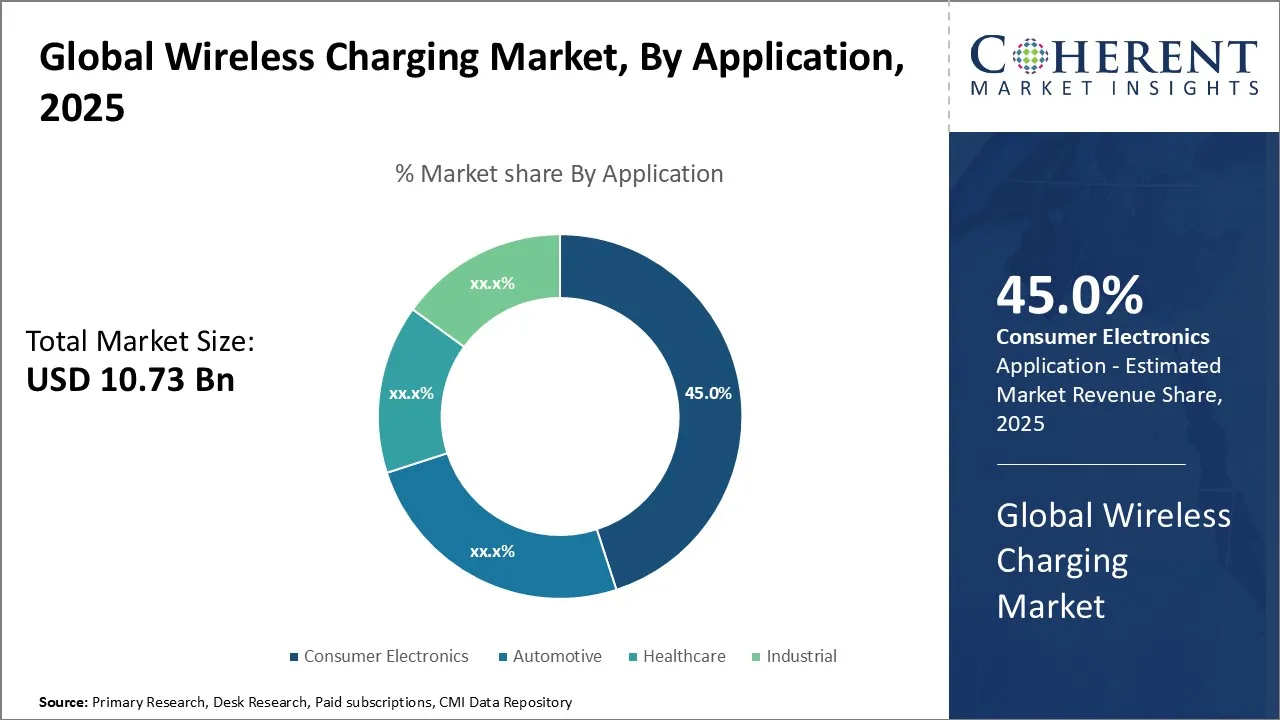
Wireless Charging Market Insights, By Application - Consumer Electronics Lead Due to High Adoption of Smartphones and Wearables
In terms of application, the consumer electronics segment contributes 46% of the market share in 2026. Smartphones, tablets, smartwatches, and earbuds are the primary users of wireless charging, driving mass adoption.
Wireless power transfer with convenient cable-less charging capability, multiple devices charging at once with charging pads, and intelligent applications can improve user experience and management of devices throughout their lifecycle. Consumer electronics product companies continue to include compatibility for wireless charging in their offerings and overall product lines.
For instance, in September 2025, Mophie launched a new line of Qi2 wireless chargers capable of fast charging multiple devices simultaneously, demonstrating the dominance of consumer electronics as a driver of wireless charging market growth.
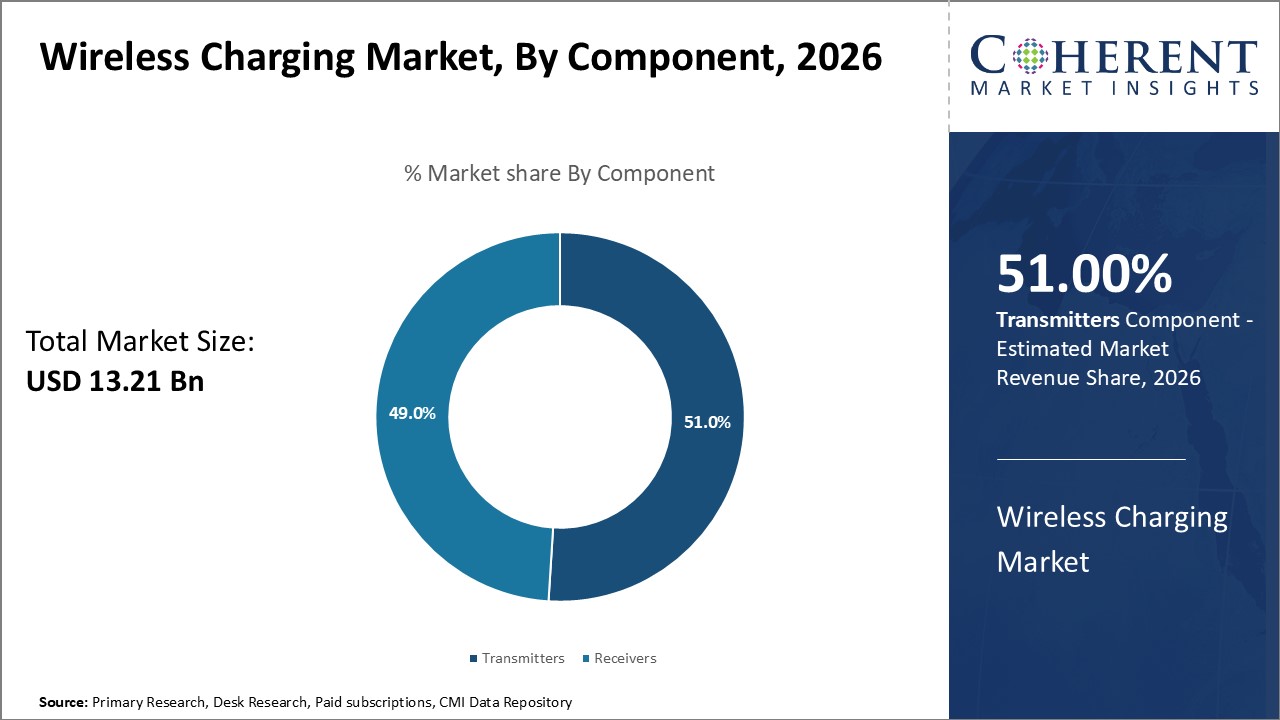
Wireless Charging Market Insights, By Component - Transmitters Lead Due to High-Value Applications in Automotive and Consumer Charging
In terms of component, the transmitters segment accounts for 41% of the market share in 2026. In an induction and resonant technology setup, transmitters play a significant role in the distribution of power supply in the wireless charging system. This is because the operation of the transmitters involves high-value technology related to the EV pad, charging station, or multi-device chargers used by consumers.
A transmitter is also an important component of next-generation wireless charging technology. As the demand for electric vehicles increases, wireless EV charging surfaces must have transmitters with advanced capabilities that can support higher power and larger distance. There is also greater demand for transmitters used in consumer electronics that support multiple devices and fast charging.
For instance, in September 2025, AUKEY launched the MagFusion Ark, a modular true wireless charging system that integrates multiple transmitters and supports charging up to six devices simultaneously. This innovation highlights the importance of transmitters in enabling scalable, convenient, and high-performance wireless power solutions.
Wireless Charging Market Insights, By Technology - Inductive Charging Leads Due to Standardization and Widespread Adoption
In terms of technology, the inductive charging segment contributes 61% of the market share in 2026. Inductive charging uses electromagnetic induction and leads the market for consumer electronics charging wherever there is a need for interoperability with a smartphone, wearable device, or a tablet computer.
The inductive charging system proves to be very efficient for Short Range Charging and has been used in automotive EV pads, medical equipment, and industrial tools. This technology has been preferred due to its safety and scalability for many wireless power transmissions.
For instance, in July 2025, the Wireless Power Consortium announced the Qi2 25W standard, enabling faster and more efficient inductive charging for both Apple and Android devices. This standard reinforces the leadership of inductive technology in the wireless charging ecosystem.
Regional Insights
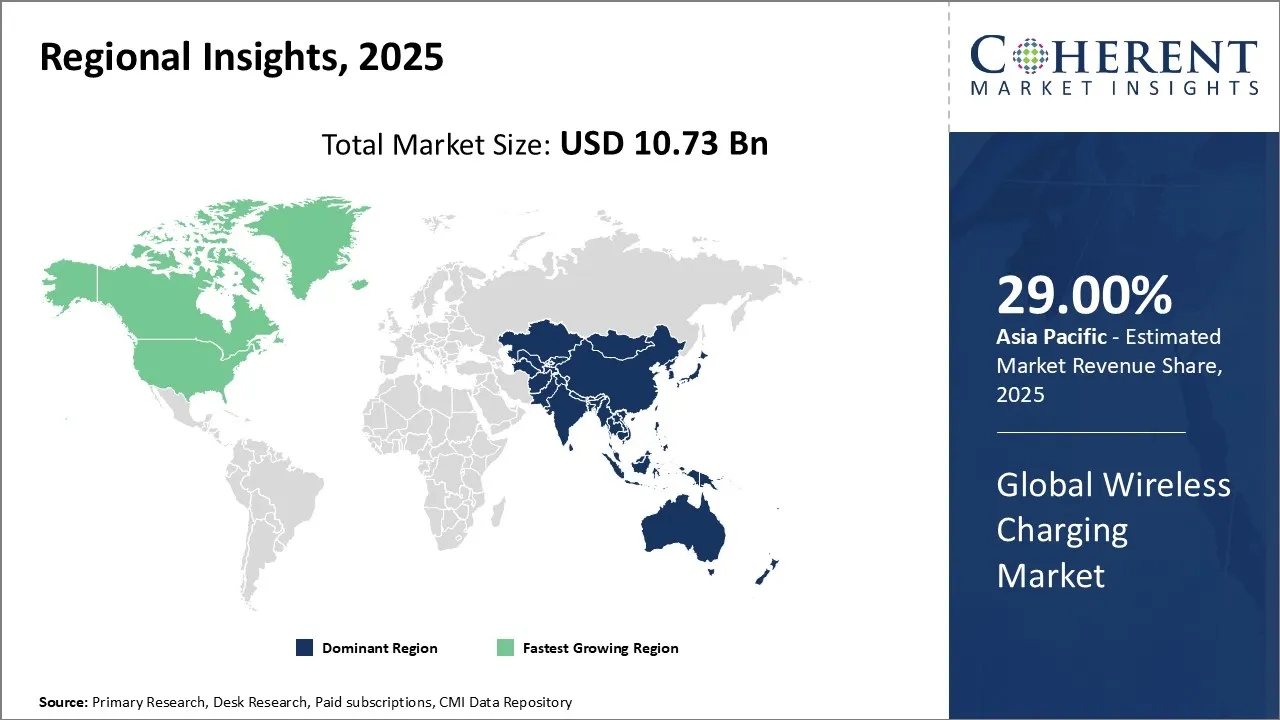
Asia Pacific Wireless Charging Market Analysis & Trends
The Asia Pacific market is anticipated to dominate the global wireless charging market with a share of 29% in 2026, largely due to the growing adoption of smartphones, wearable technology, and electric vehicles in nations like China, Japan, South Korea, and India. The Asia Pacific market has a considerable advantage as it houses an established production infrastructure, advanced electronics technology, and a consumer base receptive to the adoption of mobile and IoT devices. In addition to this, the Asia Pacific government is encouraging the adoption of EVs, leading to a subsequent increase in the number of wireless EV charging stations channeled throughout the region.
For instance, in September 2026, AUKEY launched the MagFusion Ark modular wireless charger in Asia Pacific, integrating multiple transmitters and supporting simultaneous charging of up to six devices. This innovation highlights the region’s leadership in advanced wireless charging solutions and its growing role in shaping the global market.
North America Wireless Charging Market Analysis & Trends
North America is expected to register the fastest growth in the global wireless charging market. The acceptance in consumer electronics, the automotive sector, and the healthcare sector has been the primary factor that has fueled this wireless charging industry in North America, especially in the US, where major consumer electronics and automotive giants are investing considerable amounts in the infrastructure for wireless charging. The emergence of superior research and development infrastructure, per capita income, and acceptance of smart and wireless products may all together drive the demand for wireless charging.
For instance, in September 2026, Mophie launched new Qi2 wireless chargers in North America, enabling fast and multi-device charging for smartphones and wearable devices. The launch demonstrates the growing market momentum and innovation in the North American wireless charging ecosystem.
Wireless Charging Market Outlook Country-Wise
U.S. Wireless Charging Market Trends
The U.S. wireless charging market is surging in the year 2026 because of the increasing adoption rate of smartphones, wearables, electric vehicles, and IoT devices. The reason for the accelerating adoption rate is the increasing preference for the ease of cable-less charging, as well as advances in inductive and resonant charging.
For instance, in December 2026, , IKEA launched an affordable and stylish collection of Qi2‑compatible wireless chargers under its VÄSTMÄRKE line. Starting at about USD 9–USD 24, these chargers support Qi2.0 fast wireless charging up to 15 W and include magnetic attachment compatibility for Apple and Android devices, making wireless charging more accessible and design‑friendly in American homes.
China Wireless Charging Market Trends
The wireless charging market of China is expected to grow vigorously in 2026 due to the wide diffusion of smartphones, wearable devices, and EVs along with strong capability in local manufacturing. Government support for intelligent infrastructure development and EV adoption, coupled with urbanization and rising disposable incomes, is accelerating the deployment of wireless charging pads, stations, and integrated solutions rapidly. Local brands concentrate their effort on the innovation related to wireless charging for multi-devices, modular, and high-power, which targets both domestic and international demands.
For instance, in September 2026, AUKEY launched the MagFusion Ark modular wireless charger in China, capable of charging up to six devices simultaneously with integrated transmitter and receiver technology. The launch underscores China’s leadership in advanced wireless charging innovation and its growing influence on the global market
Market Report Scope
Wireless Charging Market Report Coverage
| Report Coverage | Details | ||
|---|---|---|---|
| Base Year: | 2025 | Market Size in 2026: | USD 13.21 Bn |
| Historical Data for: | 2020 To 2024 | Forecast Period: | 2026 To 2033 |
| Forecast Period 2026 to 2033 CAGR: | 23.1% | 2033 Value Projection: | USD 56.58 Bn |
| Geographies covered: |
| ||
| Segments covered: |
| ||
| Companies covered: | Energizer Holding, Inc., PowerbyProxi, Pathronic AG, Qualcomm Technologies, Inc., ConvenientPower HK Limited, Powermat Technologies, WiTricity Corporation, Xiaomi Inc., Integrated Device Technology Inc., Leggett and Platt Inc., and Texas Instruments Inc. | ||
| Growth Drivers: |
| ||
| Restraints & Challenges: |
| ||
Wireless Charging Market Driver
Capability to charge multiple devices at the same time to drive market growth
The ability to charge multiple devices at the same time is a major factor in boosting the wireless charging market. This factor has been fueled by the increasing popularity of the usage of electronic devices. Consumers are normally in possession of various devices such as smartphones, smartwatches, headphones, and tablets, which in turn require periodic charging. The ability to charge more than one device at the same time presents a more convenient and organized way of charging, which eventually results in customer satisfaction. This has led to the invention of sophisticated wireless charging technology that has the ability to power more than one device at the same time. This has seen many firms in the wireless charging industry concentrate on developing universal and high-power wireless charging pads/stations that can support more than one device simultaneously.
Increasing usage of wireless chargers in consumer electronic devices
The growth in adoption of wireless chargers in consumer electronic devices is a major market driver in the global wireless charging market. As consumer electronics remain an indispensable part of modern life, the demand for convenient and easy-to-use charging solutions has seen an uptrend. The rising demand for wireless chargers provides an opportune time for innovative and advanced wireless charging solutions.
Wireless Charging Market Opportunities
Wireless charging for Electronic Vehicles
Wireless charging for electric vehicles is an enormous opportunity for the global wireless charging industry. With the increasing adoption of electrical vehicles due to the rising need for sustainable approaches to transportation, the need for efficient charging systems for electrical vehicles is increasing at a tremendous rate. Wireless charging technology is drastically changing the approach to electrical vehicles, as it not only provides convenient charging to electrical vehicles, eliminating the hassle of connecting wires, but also allows for smooth and fast charging. Moreover, the increasing need for convenient charging approaches is meets the rising adoption of electrical vehicles, as consumers also look forward to convenient approaches to charging their vehicles.
Analyst Opinion (Expert Opinion)
- The wireless charging market is undergoing a structural transformation driven by standardization and cross-industry integration. The consolidation around inductive and resonant charging protocols, exemplified by the widespread adoption of the Qi2 standard in both the U.S. and China, is reshaping device ecosystems and accessory designs. Consumer expectations are shifting toward seamless magnetic alignment, fast charging, and multi-device compatibility, making these features table stakes rather than premium differentiators.
- Automotive is emerging as an increasingly essential market-driving force as organizations are using wireless EV charging solutions in both fixed and dynamic configurations. These examples not only emphasize the ease of end-users but also the evolving nature of infrastructure development, as wireless solutions bypass the need for conventional charging stations. For consumer electronics, the wireless charging hub or the wireless charging station is an example of a wireless charging module in a consumer electronics device like a modular wireless charging hub as a multi-device charger.
- The emphasis on competitive advantage has shifted to include interoperability, energy efficiency, and integration. The brands focusing on compatibility, energy efficiency, and the ability to interoperate between different devices are distinguishing themselves in the competition. The firms that are not able to keep up with this new dynamic or are working with legacy solutions risk becoming obsolete because of the growing demand for seamless wireless power experiences.
- Eventually, the challenge in the wireless charging industry has shifted to providing technically sound, user-focused, and ecosystem-based solutions. Firms that specialize in multiple-device and multiple-industry solutions, ranging from consumer electronics to automotive industries, will be the pioneers in the next era of competition, while those who fail to adopt standardized, efficient, and versatile solutions could become obsolete.
Speak to the analyst
Want personalized insights?
Take the findings above to one of our principal consultants, or have the report rebuilt around the segments, geographies and competitors you actually track.
Wireless Charging Industry News
- In July 2025, Belkin, a major consumer electronics brand and Qi standard contributor, announced on its official press site that it has received Qi2 25W certification for its upcoming wireless charging products.
- In May 2025, Energous Wireless Power Solutions released its official first quarter 2025 results, reaffirming execution of its wireless power infrastructure strategy.
Market Segmentation
- Component Insights (Revenue, USD Bn & KT, 2026 - 2033)
- Transmitters
- Receivers
- Technology Insights (Revenue, USD Bn & KT, 2026 - 2033)
- Inductive Technology
- Resonance Charging Radio Frequency Technology
- Others
- Application Insights (Revenue, USD Bn & KT, 2026 - 2033)
- Consumer Electronics
- Automotive
- Healthcare
- Industrial
- Regional Insights (Revenue, USD Bn & KT, 2026 - 2033)
- North America
- U.S.
- Canada
- Latin America
- Brazil
- Argentina
- Mexico
- Rest of Latin America
- Europe
- Germany
- U.K.
- Spain
- France
- Italy
- Russia
- Rest of Europe
- Asia Pacific
- China
- India
- Japan
- Australia
- South Korea
- ASEAN
- Rest of Asia Pacific
- Middle East & Africa
- GCC Countries
- Israel
- Rest of Middle East & Africa
- North America
- Key Players Insights (Revenue, USD Bn, 2021 - 2033)
- Energizer Holding, Inc.
- PowerbyProxi
- Pathronic AG
- Qualcomm Technologies, Inc.
- ConvenientPower HK Limited
- Powermat Technologies
- WiTricity Corporation, Xiaomi Inc.
- Integrated Device Technology Inc.
- Leggett and Platt Inc.
- Texas Instruments Inc.
Sources
Primary Research Interviews from the following stakeholders
Stakeholders
- Interviews with wireless charging component manufacturers, transmitter/receiver OEMs, technology providers, automotive EV charging solution developers, consumer electronics brands, and healthcare device manufacturers across major regional markets.
Specific stakeholders
- Product managers and R&D heads at consumer electronics companies (e.g., Xiaomi, Samsung, Apple)
- Engineering and development teams at wireless power technology providers (e.g., Qualcomm, WiTricity, PowerbyProxi)
- Operations and production managers at transmitter/receiver module manufacturers (e.g., Texas Instruments, Integrated Device Technology, Powermat Technologies)
- Sustainability and circular economy leads at automotive and electronics associations (e.g., Wireless Power Consortium, Alliance to End Plastic Waste)
- Innovation and design engineers at EV and automotive OEMs integrating wireless charging pads (e.g., Tesla, BMW, BYD)
- Procurement and supply chain officers at healthcare device manufacturers using wireless charging (e.g., Philips Healthcare, Medtronic)
Databases
- United Nations Comtrade Database
- World Trade Organization (WTO) Trade Statistics
- Eurostat – Electrical and Electronics Equipment Data
- U.S. Census Bureau – Consumer Electronics & Electrical Components
- China Customs Statistics
- Directorate General of Commercial Intelligence and Statistics (DGCIS), India
- Japan External Trade Organization (JETRO)
- Korea Customs Service Data Portal
- U.S. Food and Drug Administration (FDA) – Medical Device & Electronics Compliance
- Indian Ministry of Commerce & Industry – Electrical & Electronics Export Data
- Environment Agency (UK) – E-Waste & Electronics Recycling Data
Magazines
- EE Times
- Electronics Weekly
- Power Electronics News
- Wireless Power Magazine
- Consumer Electronics Show Insights
- IEEE Spectrum (Wireless & Power Sections)
- TechRadar – Wireless Charging Section
- Recharge Magazine (Automotive & EV Charging)
- Mobile World Live – Mobile & Wireless Innovations
- Embedded Computing Design
Journals
- IEEE Transactions on Power Electronics
- Journal of Applied Physics (Electromagnetic Energy Transfer Section)
- Journal of Wireless Power Transfer
- Journal of Electrical Engineering & Technology
- Renewable and Sustainable Energy Reviews (Wireless Power & EV Charging)
- International Journal of Electrical Power & Energy Systems
- Progress in Electromagnetics Research
- Journal of Energy Storage & Wireless Systems
Newspapers
- The Wall Street Journal – Technology & Consumer Electronics
- The Economic Times – Electrical & Electronics Industry
- Business Standard – Automotive & Electronics
- Financial Times – Energy & Technology Reports
- Nikkei Asia – Tech & EV Innovations
- The Hindu Business Line – Consumer Electronics & Automotive
- South China Morning Post – Electronics & E-Mobility
- The Guardian – Technology & Sustainability
Associations
- Wireless Power Consortium (WPC)
- Institute of Electrical and Electronics Engineers (IEEE) – Power & Energy Society
- Consumer Technology Association (CTA)
- European Wireless Charging Association (EWCA)
- Society of Automotive Engineers (SAE) – EV Charging Section
- American Institute of Electrical Engineers (AIEE)
- China Electronics Standardization Institute (CESI) – Wireless Power Section
- Japan Electronics and Information Technology Industries Association (JEITA)
- Korea Electronics Association (KEA)
- Automotive Wireless Charging Alliance
Public Domain Sources
- U.S. Department of Energy (DOE) – Wireless Charging & EV Reports
- Ministry of Industry and Information Technology (MIIT), China – E-Mobility & Wireless Charging Policies
- European Commission – Wireless Power & EV Infrastructure Reports
- United Nations Environment Programme (UNEP) – E-Waste & Electronics Reports
- Central Pollution Control Board (CPCB), India – Electronic Waste Regulations
- Organisation for Economic Co-operation and Development (OECD) – Electronics Recycling & Sustainability Reports
- Japan Ministry of Economy, Trade and Industry (METI) – EV & Wireless Charging Guidelines
- U.S. Environmental Protection Agency (EPA) – Electronics Recycling Data
- Reserve Bank of India (RBI) – Electronics Sector Industrial Output Reports
- Department for Promotion of Industry and Internal Trade (DPIIT), India – Electronics Industry Initiatives
Proprietary Elements
- CMI Data Analytics Tool
- Proprietary CMI Existing Repository of information for last 8 years
*Definition: Wireless charging, also referred to as wireless power transfer (WPT), is the method of charging battery-operated devices like laptops, smartphones, and electric vehicles without using physical wired connections.
Get access to 250+ pages report
Every segment, forecast, competitor profile and data table behind the analysis above — available for instant download.
- ESOMAR Member
- ISO 9001:2015 Certified
- D-U-N-S Registered
- GDPR & CCPA Compliant
Missing comfort of reading report in your local language? Find your preferred language:
Transform your Strategy with Exclusive Trending Reports
Frequently Asked Questions
The Wireless Charging Market is estimated to be valued at USD 13.21 Bn in 2026, and is expected to reach USD 56.58 Bn by 2033.
The CAGR of the Wireless Charging Market is projected to be 23.1% from 2026 to 2033.
Major players operating in the market include Energizer Holding, Inc., PowerbyProxi, Pathronic AG, Qualcomm Technologies, Inc., ConvenientPower HK Limited, Powermat Technologies, WiTricity Corporation, Xiaomi Inc., Integrated Device Technology Inc., Leggett and Platt Inc., and Texas Instruments Inc.
Among application, the consumer electronics segment held the dominant position in the market in 2026, and is expected to retain its dominance throughout the forecast period.
Among regions, Asia Pacific held a dominant position in the market in 2026, and is expected to retain its dominance over the forecast period.