

Global Wireless Broadband Market Size and Forecast – 2026 To 2033
The global wireless broadband market is expected to grow from USD 185 Bn in 2026 to USD 490 Bn by 2033, registering a compound annual growth rate (CAGR) of 13.5% from 2026 to 2033. The global wireless broadband market is driven by the growing popularity of remote and hybrid work models. On May 12, 2026, Times of India reported that Deloitte India, KPMG India, EY India, Tata Motors, and Mercedes-Benz India are continuing or reviewing hybrid work policies while limiting non-essential travel and increasing digital collaboration. (Source: Times of India)
Key Takeaways of the Global Wireless Broadband Market
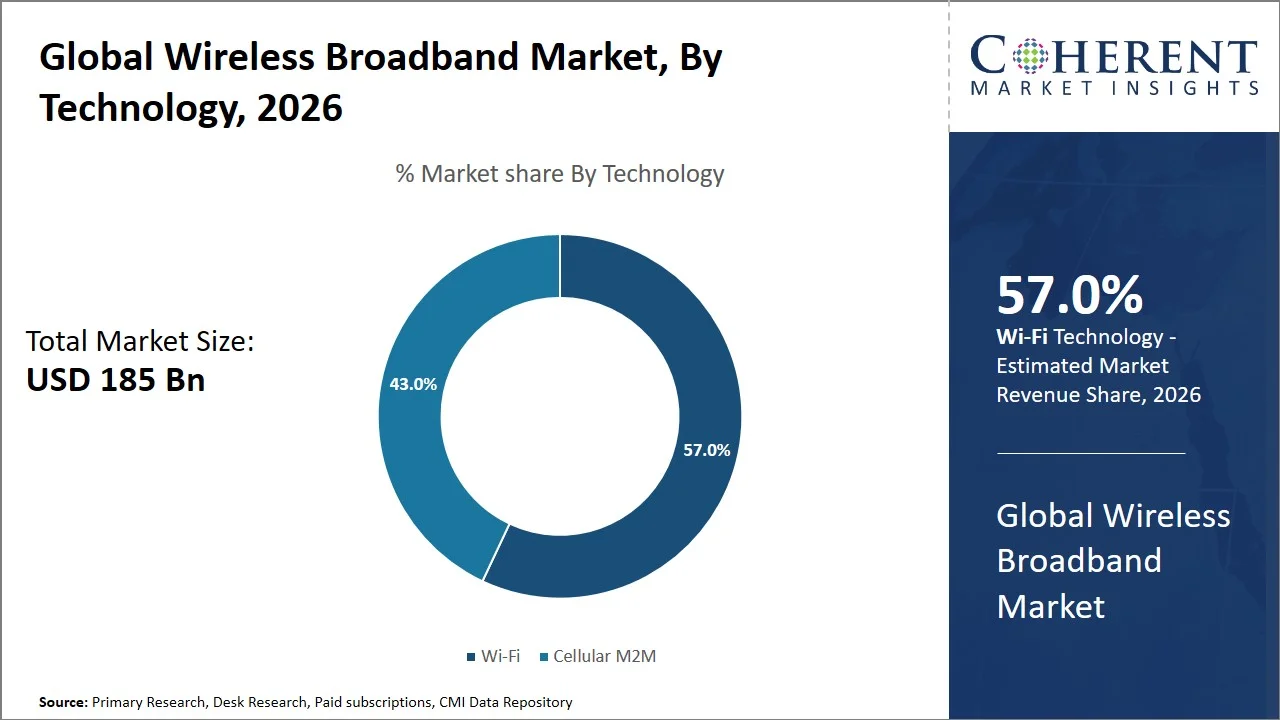
- The Wi-Fi segment is expected to account for 57.0% of the global wireless broadband market share in 2026. Growing integration of Wi-Fi for IoT and smart city deployments is driving the growth of the segment. On June 4, 2025, Ericsson announced the successful deployment of a private 5G network in the City of Istres, located in the South of France, marking a significant advancement in European urban innovation. (Source: Ericsson)
- The hardware segment is estimated to capture 44.0% of the market share in 2026. The growing need of hardware for 5G antenna systems paired with satellite broadband, used for surveillance and security operations is a key driver for the segment. On February 11, 2026, the European Commission proposed an EU-wide initiative to develop an AI-powered drone detection system using advanced 5G radio antennas, aimed at protecting airports, military facilities and other critical infrastructure. (Source: European Commission)
- The critical communication segment is estimated to capture 37.0% of the market share in 2026. Telecom operators and broadband service providers are increasingly prioritizing wide and uniform coverage in remote and dense areas, which is driving the need for critical communication. On October 24, 2025, AT&T replaced 40% of Nokia radios with Ericsson, added midband spectrum to 15,000 sites and first open RAN call made on commercial network. (Source: AT&T)
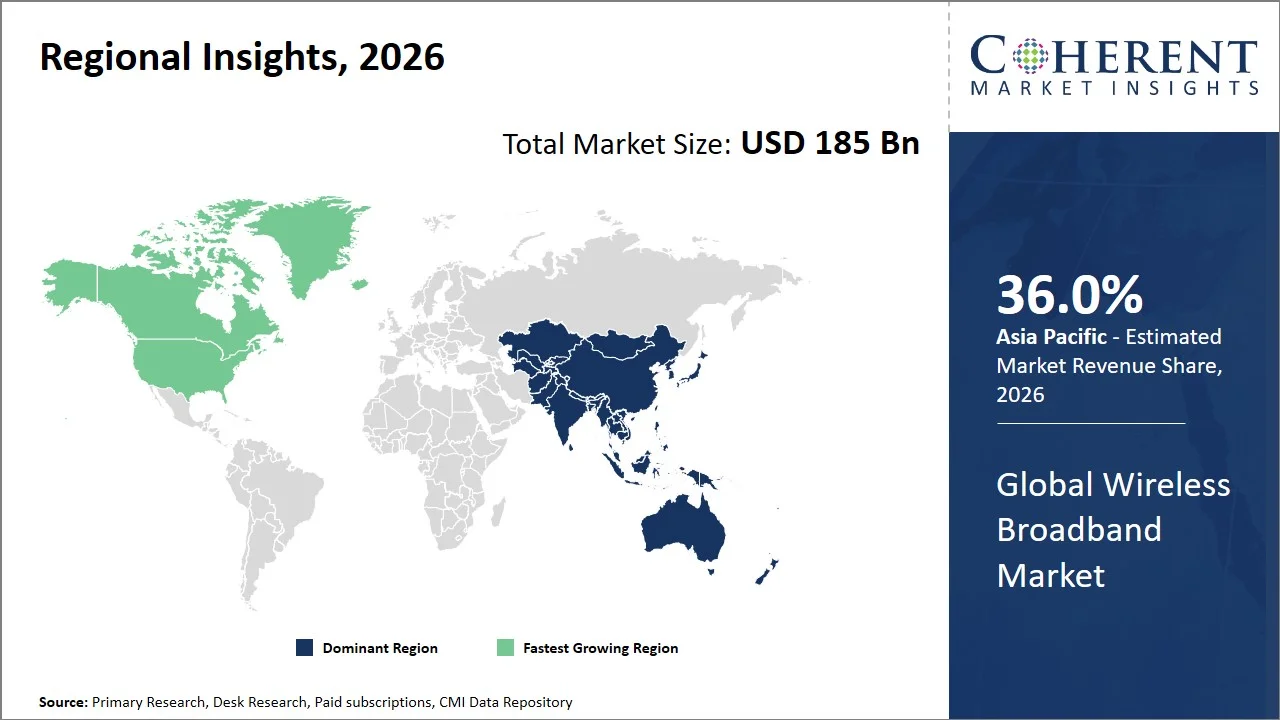
- Asia Pacific is expected to dominate the wireless broadband market in 2026 with a market share of 36.0%. A steady growth in enterprise private 5G networks is driving the growth of the wireless broadband market in Asia Pacific. On August 3, 2025, Bharat Sanchar Nigam Limited (BSNL) and Numaligarh Refinery Limited (NRL) signed a landmark Memorandum of Understanding (MoU) during the Industry 4.0 Workshop for CPSEs organized under the aegis of the Ministry of Finance in Guwahati. (Source: Press Information Bureau)
- North America is expected to account for 28.0% share in 2026 and is projected to record the fastest growth over the forecast period. Growing development of Multiple-Input Multiple-Output systems in the region is a major growth factor for the North America wireless broadband market. On February 26, 2025, Verizon, working with Ericsson and Qualcomm, achieved a record 480 Mbps uplink speed using Massive MIMO antenna systems and C-band spectrum. (Source: Ericsson)
- Expansion of 5G Fixed Wireless Access (FWA): The rapid deployment of 5G based Fixed Wireless Access (FWA) is one of the strongest growing trends. Telecom providers provide high-speed broadband to homes and businesses over 5G infrastructure networks without the need for fiber or cable infrastructure.
- Integration of Satellite and Terrestrial Networks: One of the primary trends is the integration of satellite internet with regular wireless broadband systems. Low Earth Orbit (LEO) satellite providers such as SpaceX (Starlink) are bringing global high-speed connection, especially to isolated and rural areas.
Segmental Insights
Why Does Wi-Fi Dominate the Global Wireless Broadband Market?
The Wi-Fi segment is expected to account for 57.0% of the global wireless broadband market share in 2026. Wi-Fi is also less expensive to deploy and run than cellular or fiber-based internet infrastructure. Its only requirement is a router and access point, making it very suited for homes, offices, schools and small companies. On August 8, 2025, EnGenius Technologies, Inc. announced the official launch and immediate availability of the ECW510 Wi-Fi 7 indoor access point. Expanding the company’s line of affordable Wi-Fi 7 access points, the ECW510 makes next-generation wireless networking even more accessible for small businesses. (Source: EnGenius)
- Current Industry Events of 2026
- Market Size Estimation
- Regional Breakdown
- Competitive Landscape
- Customer Intelligence
- Segmental Analysis
- Pricing Analysis
- Key Market Drivers, Challenges & Future Trends
- Customized Insights Section
Why is Hardware the Most Widespread Offering?
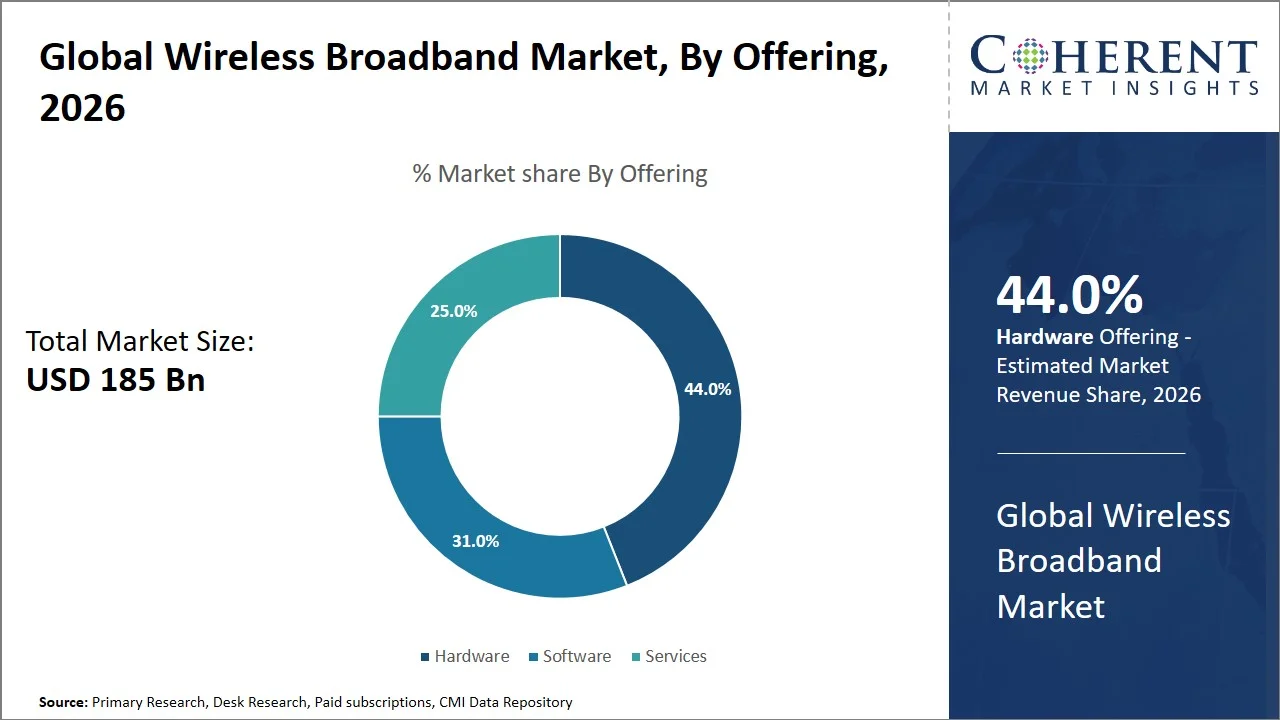
The hardware segment is expected to account for 44.0% of the global wireless broadband market share in 2026. Wireless broadband networks are built on hardware, such as routers, modems, antennas, base stations, and user devices. Connectivity is not software or services; it has physical infrastructure to transmit and receive signals. This makes hardware an essential part of every stage of the network, from telecom towers to end-user Wi-Fi devices, assuring its ubiquity across all markets. On February 12, 2025, Bharti Airtel awarded a contract to Nokia, and Qualcomm, focusing on the expansion of 5G Fixed Wireless Access (FWA) and Wi-Fi solutions to facilitate high-speed internet access to millions across India. (Source: Airtel)
Critical Communication Dominates the Global Wireless Broadband Market
The critical communication segment is expected to account for 37.0% of the global wireless broadband market share in 2026. Critical commuication dominates the market as it underpins several services including emergency response, public safety, defense, and utilities. These applications require ultra-reliable, low-latency, always-available connectivity, which wireless broadband networks (particularly sophisticated LTE/5G systems) are increasingly built to provide. The segment is witnessing significant and continual demand as governments and corporations give a lot of priority to these systems. On June 10, 2025, Nokia announced a partnership with Leonardo, a global leader in Aerospace, Defense, and Security, to deliver cutting-edge mission-critical services worldwide integrated into Nokia’s Core Enterprise Solutions. The solid collaboration strengthens Nokia’s leadership in secure and scalable private wireless connectivity for essential services like public safety and industrial segments such as energy and railways. (Source: Nokia)
Currents Events and their Impact
Current Events | Description and its Impact |
EU Digital Services Act (DSA) & Digital Markets Act (DMA) |
|
Broadband Equity, Access, and Deployment (BEAD) Program |
|
(Source: European Parliament, National Telecommunications and Information Administration)
Wireless Broadband Market Dynamics
Market Drivers
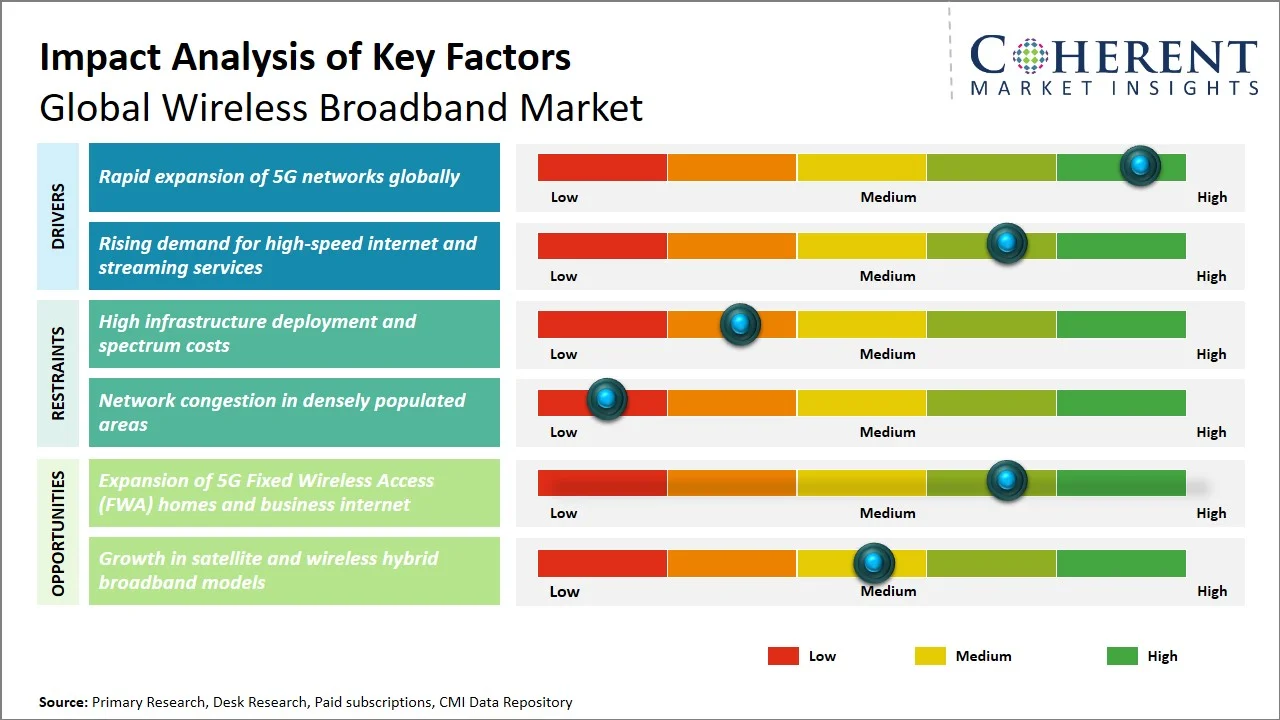
- Rapid expansion of 5G networks globally: Rapid expansion of 5G networks globally is one of the most important drivers of the wireless broadband industry. Telecom operators are rolling out 5G infrastructure at a very fast pace to suit the ever-expanding demand for ultra-speed internet, low latency and high capacity of network. This development is improving connectivity for applications like streaming, gaming, IoT and smart cities. As 5G coverage continues to grow in both urban and rural regions, it is significantly improving broadband accessibility and accelerating the shift toward advanced digital services worldwide. On March 10, 2026, AT&T announced an investment and spend of more than USD 250 billion in the future of U.S. advanced connectivity, building the high-speed networks and resilience required for the next era of innovation and economic growth. (Source: AT&T)
- Rising demand for high-speed internet and streaming services: The wireless broadband industry is primarily driven by the increasing demand for high-speed internet and streaming services. As applications such as video streaming, online gaming, video conferencing and cloud-based services proliferate, there is an acute demand for faster and more dependable internet connectivity. Consumers today expect smooth, buffer-free experiences across many devices, driving telecom carriers to enhance network capacity and speed. This trend towards increasing digital consumption is driving major acceleration of sophisticated wireless broadband technology deployment globally. On October 2, 2025, The Walt Disney Company expanded Hulu and ESPN integration into Disney+ during 2025 to support growing consumer demand for unified high-bandwidth streaming experiences. (Source: The Walt Disney Company)
Emerging Trends
- Rise of Open RAN and Network Virtualization: The industry is gradually moving towards Open RAN and virtualized network designs to lessen reliance on single-vendor equipment. Operators like Vodafone Group are already exploring and deploying such solutions to enhance flexibility and save infrastructure costs.
- AI-Driven Networks and Edge Computing Growth: Wireless broadband networks are becoming smarter with the advent of Artificial Intelligence (AI) and edge computing technology. AI is also being applied for real-time traffic management, predictive maintenance and network optimization to enhance service quality and reduce down time.
Regional Insights
Why is Asia Pacific a Strong Market for Wireless Broadband?
Asia Pacific is expected to account for a market share of 36.0% in 2026. Asia Pacific is the fastest expanding wireless broadband market in the world driven by aggressive 5G development and significant subscriber growth in countries like China, India, Japan and South Korea. As of 2025, the region had 39 commercial 5G networks, including 17 standalone 5G networks, with economies such as South Korea and Singapore already achieving mass-market 5G adoption. The region is also leading the way in 5G Fixed Wireless connectivity (FWA), with providers aggressively extending broadband connectivity beyond fiber networks. On November 13, 2025, Singtel was recognized in 2025 for advancing 5G enterprise and AI-driven network orchestration across Asia Pacific, including the deployment of 5G-Advanced capabilities for smart infrastructure and enterprise connectivity. The company is integrating multi-layer wireless broadband to support smart city and industrial IoT applications in Singapore. (Source: Singtel)
Why Does the North America Wireless Broadband Market Exhibit High Growth?
North America is projected to account for 28.0% of the global wireless broadband market and is expected to register the fastest growth. North America remains one of the most mature wireless broadband markets, driven mostly by 5G fixed wireless access (FWA) expansion by operators such as Verizon Communications and T-Mobile US. The region leads the world in the adoption of 5G-enabled FWA equipment, with 93% of FWA CPE shipments in 2025 being 5G-based. Heavy investment in residential broadband replacement services and workplace connection solutions is seeing increased wireless broadband penetration across suburban and rural locations in the U.S. and Canada. On November 17, 2025, AT&T announced that it has hit the 5G accelerator and deployed mid-band (3.45 GHz) spectrum from EchoStar to nearly 23,000 cell sites in a matter of a few weeks. (Source: AT&T)
Global Wireless Broadband Market Outlook for Key Countries
Why is China Emerging as a Major Hub in the Wireless Broadband Market?
China is the world leader in wireless broadband, with comprehensive 5G infrastructure and government-backed rollout projects. By the end of 2025, China had built around 4.84 million 5G base stations and more than 10 million advanced 5G users, and operated more than 64,000 enterprise private networks. Companies such as Huawei Technologies are investing substantially in 5G-Advanced and AI-integrated broadband infrastructure, and are propelling China’s leadership in industrial broadband and smart city connections.
Is the U.S. the Next Growth Engine for the Wireless Broadband Market?
The U.S. wireless broadband market is being altered by the rapid deployment of 5G Fixed Wireless Access as an alternative to cable broadband. Telecom companies are aggressively working to grow wireless home internet services into underserved, fiber-dark areas. Federal programs like the BEAD program also are boosting broadband infrastructure investment across rural America. The country is also a leader in 5G FWA device adoption, enterprise private networking, and edge-enabled broadband services for industrial use cases.
South Korea Wireless Broadband Market Analysis and Trends
South Korea is still one of the most sophisticated wireless broadband markets worldwide, with very high 5G penetration and national network coverage. It was one of the first countries to commercialize 5G worldwide and has 95% or more statewide coverage of 5G. Operators are looking at standalone 5G infrastructure, smart city deployments, cloud gaming, and ultra-low latency enterprise applications. South Korea is also a global testing ground for the latest broadband technologies, such as AI-enabled network optimization and immersive digital services.
India Wireless Broadband Market Analysis and Trends
India is one of the fastest expanding wireless broadband markets, with Reliance Jio and Bharti Airtel’s aggressive 5G deployment initiatives also playing a part. By 2025, 5G covered roughly 85% of India’s population, and 5G fixed wireless access (FWA) providers like Jio AirFiber were rapidly expanding internet connectivity in Tier-2 and Tier-3 cities. Jio alone crossed 9.5 million FWA connections, making India one of the largest FWA markets in the world. The country’s wireless broadband expansion is being fueled by reasonable data pricing, increased digital usage and government-led digital infrastructure efforts. (Source: Press Information Bureau)
Wireless Broadband Market - Average Broadband Speed and Latency
Region | Average Upload Speed | Average Download Speed | Average Latency |
Asia Pacific | 70–85 Mbps | 170–190 Mbps | 12–20 ms |
North America | 40–55 Mbps | 140–160 Mbps | 18–35 ms |
Europe | 50–65 Mbps | 145–165 Mbps | 14–18 ms |
Latin America | 25–35 Mbps | 80–95 Mbps | 22–35 ms |
Middle East | 30–40 Mbps | 90–110 Mbps | 20–30 ms |
Africa | 15–25 Mbps | 45–60 Mbps | 30–45 ms |
How is the Expansion of 5G Fixed Wireless Access (FWA) Homes and Business Internet Creating New Growth Opportunities in the Wireless Broadband Market?
The wireless broadband market is experiencing significant growth potential due to the rollout of 5G Fixed Wireless Access (FWA) to homes and businesses, offering high-speed internet without the need for costly fiber or cable infrastructure. Telecom providers are rolling out 5G FWA to swiftly expand internet service to suburban, rural and underserved areas where cable rollout is delayed or expensive. This is increasing broadband coverage to homes and businesses and enabling operators to acquire new users at a cheaper deployment cost. Reliance Jio AirFiber and Verizon Communications and T-Mobile US services are examples of how FWA is proving to be a compelling alternative to standard fixed-line broadband providers. On February 4, 2025, AT&T announced that it is extending its voice core relationship with Nokia in a multi-year expansion deal that will support the U.S. operator in delivering on its vision of securely providing customer-focused networks and automation that drive new services, faster deployment times, and operational efficiencies. (Source: Nokia)
Market Players, Key Development, and Competitive Intelligence
Key Developments
- On March 4, 2026, Huawei declared that its ultra-wideband (UWB) AAU series products won the GSMA GLOMO Best Mobile Network Infrastructure award for its UWB, multi-antenna, and energy-saving innovations in all-band evolution toward 5G.
- On February 17, 2026, Ericsson announced that it is introducing a new suite of radio, antenna, and AI RAN software solutions ahead of Mobile World Congress (MWC) 2026 in Barcelona, Spain. The new products will enable communications service providers (CSPs) to monetize AI devices with differentiated connectivity and launch new services.
Competitive Landscape
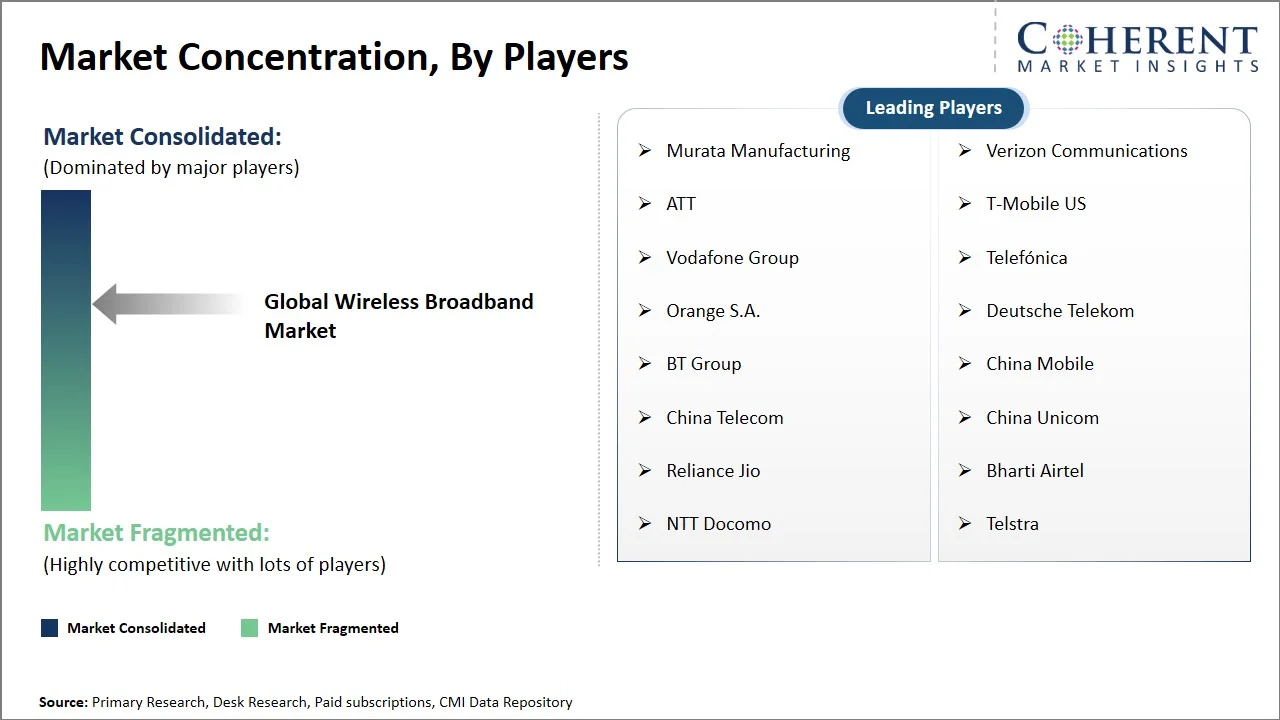
The global wireless broadband industry is highly competitive, with key telecom operators, network equipment providers, and technology companies focused on fast 5G deployment, fixed wireless access expansion, and network modernization initiatives. Telcos such as Verizon Communications, AT&T, China Mobile, Reliance Jio and Bharti Airtel are spending big on acquiring spectrum, developing standalone 5G networks, leveraging AI to optimize networks and extending broadband to rural areas. Strategic alliances, mergers, initiatives to adopt Open RAN and integrate satellite are also being sought broadly to expand service coverage globally and to strengthen market positioning.
Market Report Scope
Wireless Broadband Market Report Coverage
| Report Coverage | Details | ||
|---|---|---|---|
| Base Year: | 2025 | Market Size in 2026: | USD 185 Bn |
| Historical Data for: | 2020 To 2024 | Forecast Period: | 2026 To 2033 |
| Forecast Period 2026 to 2033 CAGR: | 13.50% | 2033 Value Projection: | USD 490 Bn |
| Geographies covered: |
| ||
| Segments covered: |
| ||
| Companies covered: | Murata Manufacturing, Verizon Communications, ATT, T-Mobile US, Vodafone Group, Telefónica, Orange S.A., Deutsche Telekom, BT Group, China Mobile, China Telecom, China Unicom, Reliance Jio, Bharti Airtel, NTT Docomo, and Telstra | ||
| Growth Drivers: |
| ||
| Restraints & Challenges: |
| ||
Analyst Opinion (Expert Opinion)
- Wireless broadband industry is projected to witness strong long-term growth on the back of accelerated digital transformation, increased internet consumption and rapid worldwide 5G adoption. Private enterprise networks, edge computing and AI-enabled telecom infrastructure investments are on the rise, as are 5G Fixed Wireless Access. Most subscriber growth is likely to come from emerging economies, where affordable broadband connectivity is becoming a national priority. On the other hand, issues associated with high infrastructure cost, cybersecurity concerns, and spectrum regulations are projected to remain major factors affecting market dynamics throughout the projection period.
- Extensive 5G commercialization, satellite terrestrial network convergence and the development of smart linked ecosystems are predicted to impact the future of the wireless broadband market. Opportunities are projected to be significant in industrial IoT, autonomous systems, smart cities, cloud gaming and immersive technologies that require ultra-low latency communication. 5G FWA adoption is anticipated to surge as telecom operators look for affordable alternatives to fiber rollout. In addition, the next several years are expected to see additional transformation of the global wireless broadband market with AI-driven autonomous network management and next generation technologies such as 6G research.
Speak to the analyst
Want personalized insights?
Take the findings above to one of our principal consultants, or have the report rebuilt around the segments, geographies and competitors you actually track.
Market Segmentation
- Technology Insights (Revenue, USD Billion, 2021 - 2033)
- Wi-Fi
- Cellular M2M
- Offering Insights (Revenue, USD Billion, 2021 - 2033)
- Hardware
- Software
- Services
- Application Insights (Revenue, USD Billion, 2021 - 2033)
- Critical Communication
- Remote Monitoring & Surveillance
- GPS
- Others
- Regional Insights (Revenue, USD Billion, 2021 - 2033)
- North America
- U.S.
- Canada
- Latin America
- Brazil
- Argentina
- Mexico
- Rest of Latin America
- Europe
- Germany
- U.K.
- Spain
- France
- Italy
- Russia
- Rest of Europe
- Asia Pacific
- China
- India
- Japan
- Australia
- South Korea
- ASEAN
- Rest of Asia Pacific
- Middle East
- GCC Countries
- Israel
- Rest of Middle East
- Africa
- South Africa
- North Africa
- Central Africa
- North America
Sources
Primary Research Interviews
- Wireless Network Infrastructure Providers
- Telecom Service Providers and Mobile Network Operators
- Wireless Equipment Manufacturers
- Technology Solution Providers and System Integrators
Magazines
- Wireless Week Magazine
- Mobile World Magazine
- Telecom Asia Magazine
- RCR Wireless News Magazine
Journals
- IEEE Wireless Communications Journal
- Journal of Network and Computer Applications
- Wireless Networks Journal
Associations
- Wireless Broadband Alliance (WBA)
- Global Mobile Suppliers Association (GSA)
- Cellular Telecommunications Industry Association (CTIA)
- International Association of Wireless Communications Vendors (IAWCV)
Public Domain Sources
- World Bank Open Data Portal
- Government Regulatory Authority Reports
- OECD Broadband Statistics
- United Nations Broadband Commission Reports
Proprietary Elements
- CMI Data Analytics Tool
- Proprietary CMI Existing Repository of information for last 10 years
Get access to 250+ pages report
Every segment, forecast, competitor profile and data table behind the analysis above — available for instant download.
- ESOMAR Member
- ISO 9001:2015 Certified
- D-U-N-S Registered
- GDPR & CCPA Compliant
Missing comfort of reading report in your local language? Find your preferred language:
Transform your Strategy with Exclusive Trending Reports
Frequently Asked Questions
The global wireless broadband market is expected to stand at USD 185 Bn in 2026 and is expected to reach USD 490 Bn by 2033.
The CAGR of the global wireless broadband market is projected to be 13.5% from 2026 to 2033.
Rapid expansion of 5G networks globally and rising demand for high-speed internet and streaming services are the major factors driving the growth of the global wireless broadband market.
High infrastructure deployment and spectrum costs and network congestion in densely populated areas are the major factors hampering the growth of the global wireless broadband market.
In terms of technology, the Wi-Fi segment is estimated to dominate the market revenue share in 2026.
Satellite broadband extends internet access to remote areas where terrestrial infrastructure is limited.
It supports connected infrastructure such as smart traffic systems, surveillance, and IoT-enabled utilities.