

North America Coaxial Cable Market Size and Share Analysis - 2026 To 2033
The North America coaxial cable market size is estimated to be valued at USD 5,862.7 Mn in 2026 and is projected to grow at a CAGR of 8.6% during the forecast period, reaching approximately USD 10,446.1 Mn by 2033. This strong growth is attributable to increasing deployment of high-speed broadband networks, rising investments in 5G infrastructure, and growing adoption of smart home and IoT devices. India is projected to surpass 1.1 billion 5G subscriptions by 2031, representing 81% of total mobile subscriptions.
Key Takeaways from the North America Coaxial Cable Market Report
- Video distribution is projected to lead the market with a share of 45% in 2026 due to high use of coaxial cables in cable television, CCTV surveillance, and broadband distribution networks for reliable video and data transmission. According to the National Cable & Telecommunications Association (NCTA), more than 91% of U.S. homes and businesses have access to gigabit-speed cable services, which mainly use Hybrid Fiber-Coaxial (HFC) networks, supporting reliable video transmission.
- CATV companies are slated to account for the largest market share of 31% in 2026 due to extensive Hybrid Fiber-Coaxial (HFC) networks and ongoing maintenance and upgrades. For instance, CableLabs reported that 98% of U.S. residential locations served by cable operators had access to 1 Gbps+ broadband over HFC networks by December 2024, showing the widespread adoption of HFC-based coaxial networks. On the other hand, internet Service Providers represent the fastest-growing end-user segment due to DOCSIS 3.1/4.0 deployments.
- The U.S. is expected to dominate the North American coaxial cable industry with a share of 78% in 2026, owing to its extensive broadband, cable television, telecommunications, and defense infrastructure. For example, DOCSIS 3.1 cable broadband is available to about 84% of U.S. households, highlighting the country's extensive coaxial cable infrastructure.
North America Coaxial Cable Market Overview
The North America coaxial cable market is expected to register steady growth during the forecast period. This is mostly due to rising adoption of high-speed broadband services, continued investments in cable network infrastructure, growing demand for reliable data transmission, and the expansion of 5G and hybrid fiber-coaxial (HFC) networks. In addition, the increasing use of coaxial cables in telecommunications, broadcasting, aerospace, defense, and industrial applications is supporting market expansion in the region.
Coaxial cable, also referred to as coax, is a type of electrical cable comprised of an inner conductor surrounded by a concentric conducting shield, with the two separated by a dielectric insulating material. It is a type of transmission line used to carry high-frequency electrical signals with low signal loss.
Rising demand for high-speed internet and increasing data consumption are creating a conducive environment for the growth of North America coaxial cable market. This is mainly due to increasing digital usage, including streaming services, online gaming, remote work, and cloud applications. More internet users and smart devices are also increasing bandwidth needs in homes and businesses. As a result, service providers are continuously upgrading last-mile connectivity infrastructure using coaxial cables.
Segmental Insights
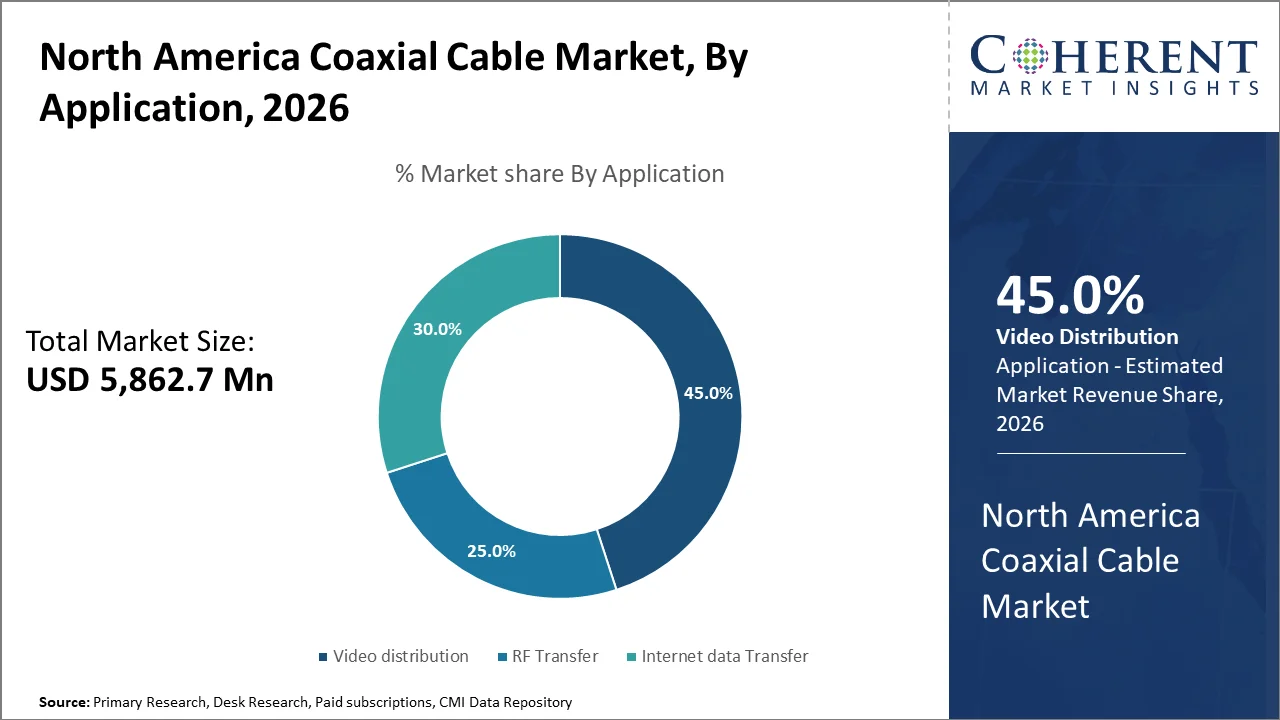
Which Application Holds the Largest Share in the North America Coaxial Cable Market?
Video Distribution Emerges as the Leading Application
According to Coherent Market Insights’ latest North America coaxial cable market analysis, video distribution segment is set to lead the market, accounting for a revenue share of 45% in 2026. This dominance can be attributed to continued demand for high-quality television broadcasting, cable TV services, satellite communications, and video surveillance systems across residential, commercial, and institutional sectors.
Coaxial cables remain the preferred choice for video transmission across North America. This is due to their superior signal integrity, low attenuation, excellent shielding against electromagnetic interference (EMI), and ability to deliver high-bandwidth video over long distances. Ongoing modernization of broadcasting infrastructure, expansion of digital cable networks, and increasing deployment of CCTV and security surveillance systems are expected to boost the target segment during the forecast period.
North America's video distribution segment benefits from the extensive installed base of Hybrid Fiber-Coaxial (HFC) infrastructure. According to the National Cable & Telecommunications Association (NCTA), cable broadband providers reach about 85% of U.S. homes and have invested over US$25 billion in network infrastructure in 2024. This investment continues to strengthen coaxial networks used for cable TV and video distribution.
- Current Industry Events of 2026
- Market Size Estimation
- Regional Breakdown
- Competitive Landscape
- Customer Intelligence
- Segmental Analysis
- Pricing Analysis
- Key Market Drivers, Challenges & Future Trends
- Customized Insights Section
Who Is the Leading End User of Coaxial Cables in North America?
CATV Companies Remain the Leading End Users of Coaxial Cables
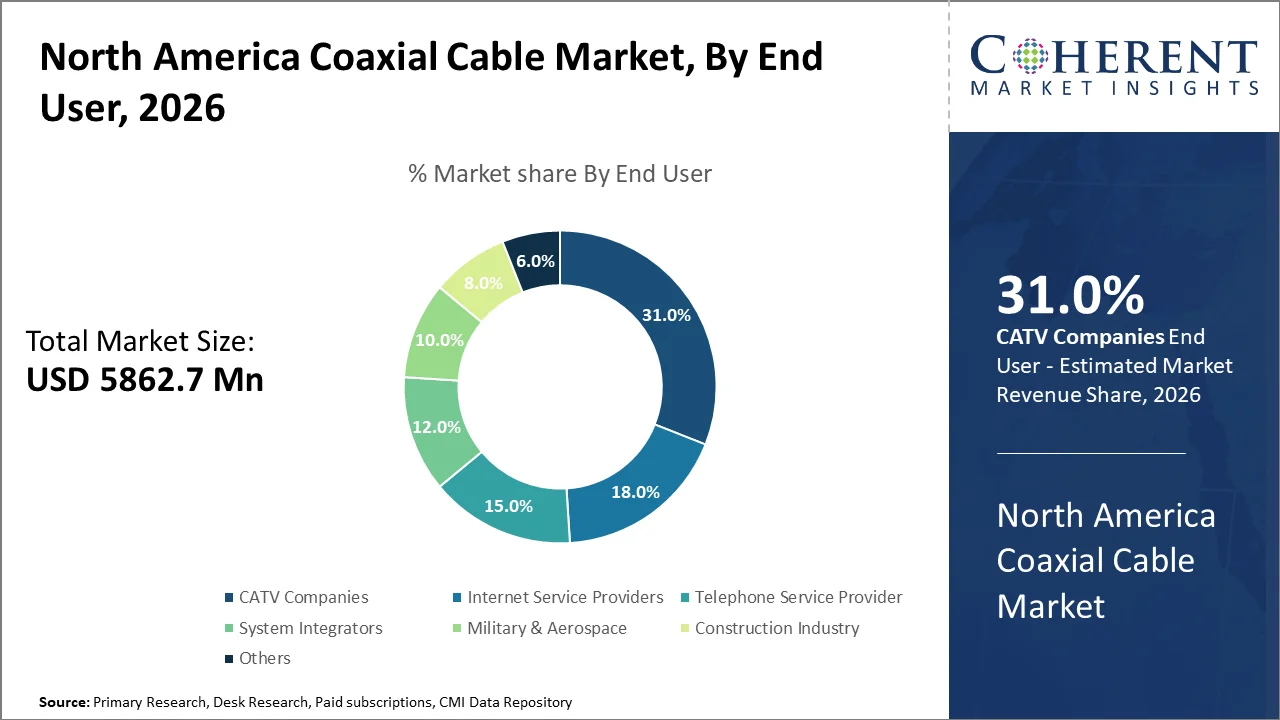
Based on end user, CATV companies are projected to remain the leading end users of coaxial cables, accounting for the largest market share of 31% in 2026. This is mostly due to increasing adoption of hybrid fiber-coaxial (HFC) networks for cable television and broadband internet services across North America.
Cable television operators continue to rely on coaxial cables for last-mile connectivity because they offer high bandwidth, excellent signal reliability, and cost-effective infrastructure upgrades compared to complete fiber replacements. The growing demand for high-speed internet, 4K/8K video streaming, video-on-demand services, and bundled communication packages has further encouraged CATV providers to modernize existing coaxial networks rather than replace them entirely.
North America Coaxial Cable Market Growth Drivers
Expansion of Broadband and Cable TV Infrastructure
Continued reliance on Hybrid Fiber-Coaxial (HFC) networks for broadband and television services is providing a strong impetus for the growth of coaxial cable market in North America. A large number of households in the U.S. and Canada still depend on coaxial-based cable internet and TV connections. Telecom operators continue to expand and upgrade existing cable networks rather than fully replacing them with fiber due to cost efficiency as well as existing infrastructure advantages. This trend creates strong demand for RG-6, RG-11, and related coaxial cables in residential deployments.
North America Coaxial Cable Market Opportunities
Rising Coaxial Cable Demand from Industrial Sectors
Increasing adoption of coaxial cables across defense, aerospace, and industrial applications is expected to create lucrative growth opportunities for the North America coaxial cable market during the forthcoming period. Coaxial cables are widely used in radar systems, avionics, and satellite communications due to their ability to support high-frequency, low-interference signal transmission.
In the defense sector, they are essential for secure military communication networks and electronic warfare systems that require reliable and rugged connectivity. In addition, industrial automation and machine-to-machine (M2M) communication systems are also expanding the use of high-performance coaxial cables. Expansion of these end-use sectors, which demand durable and high-bandwidth transmission solutions, is expected to support market expansion in the coming years.
North America Coaxial Cable Market Trends
Upgradation of Existing Networks with DOCSIS Technology
Continuous upgrade of hybrid fiber-coax (HFC) infrastructure using DOCSIS 3.1 and DOCSIS 4.0 standards is a key growth shaping trend in North America coaxial cable market. DOCSIS enables gigabit and multi-gigabit broadband speeds over existing coaxial access networks without requiring full fiber replacement.
Cable operators in the contemporary world are increasing network capacity through expanded spectrum utilization and advanced modulation techniques such as OFDM and OFDMA. This allows significantly higher downstream and upstream throughput, ensuring coaxial-based networks remain relevant in high-speed broadband environments.
Current Events and Their Impact on the North America Coaxial Cable Market
Current Event | Description and its Impact |
U.S. BEAD Program Expansion and Broadband Funding (2026) |
|
FCC Fully Funds 2026 E-Rate Broadband Requests |
|
North America Coaxial Cable Market Outlook – Country-wise
United States to Retain its Monopoly in the North America Coaxial Cable Industry
The U.S. is expected to lead the North America coaxial cable market, capturing a share of 78% in 2026. This dominance is attributable to its highly developed broadband infrastructure as well as rising demand from cable TV, internet services, 5G backhaul, and data center connectivity. Similarly, increasing investments in next-generation networks such as DOCSIS 4.0 upgrades and continuous expansion of high-speed internet coverage in rural areas are supporting market growth. For example, the U.S. government recently allocated USD 42.45 billion BEAD (Broadband Equity, Access, and Deployment) Program to expand high-speed broadband access nationwide, under the which is directly boosting demand for coaxial and hybrid fiber-coaxial networks.
Canada Set to Emerge as a Highly Lucrative Market for Coaxial Cable Manufacturers
Canada is expected to emerge as a highly remunerative pocket for manufacturers of coaxial cables during the forecast period. This is mostly due to rising broadband penetration, ongoing fiber-coax network upgrades, and expanding 5G deployment in urban and semi-urban regions. Government-backed rural connectivity expansion, which continues to rely on hybrid network infrastructure in many regions, is also boosting coaxial cable market growth in Canada. For instance, the Universal Broadband Fund provides CAD 3.225 billion to improve high-speed internet access across underserved areas, accelerating network upgrades and supporting coaxial cable demand in hybrid deployments.
Who are the Major Companies in the North America Coaxial Cable Market?
Some of the major players in North America coaxial cable market are Belden Inc., Alpha Wire, General Cable Corporation, L-Com Global Connectivity, LS Cable & System, Southwire, TE Connectivity Ltd, Nexans S.A., Amphenol Corporation, and Coleman Cable Inc.
Key Strategies Adopted by Industry Players
Top manufacturers of coaxial cables across North America are adopting various organic and inorganic strategies to boost their revenue as well as gain a competitive edge over the industry. These include new product launches, investments in R&D activities, partnerships, mergers, acquisitions, collaborations, and distribution agreements.
- In May 2025, Belden launched its 10GXM13 Category 6A cable. The cable is designed to support high-speed Ethernet networks with improved performance and smaller size.
- In April 2025, Micro-Coax launched a new website. The website was designed to improve access to its cable and connectivity solutions for customers.
Market Report Scope
North America Coaxial Cable Market Report Coverage
| Report Coverage | Details | ||
|---|---|---|---|
| Base Year: | 2025 | Market Size in 2026: | USD 5,862.7 Mn |
| Historical Data for: | 2020 To 2024 | Forecast Period: | 2026 To 2033 |
| Forecast Period 2026 to 2033 CAGR: | 8.6% | 2033 Value Projection: | USD 10,446.1 Mn |
| Geographies covered: |
| ||
| Segments covered: |
| ||
| Companies covered: | Belden Inc., Alpha Wire, General Cable Corporation, L-Com Global Connectivity, LS Cable & System, Southwire, TE Connectivity Ltd, Nexans S.A., Amphenol Corporation, and Coleman Cable Inc. | ||
| Growth Drivers: |
| ||
| Restraints & Challenges: |
| ||
Analyst Opinion (Expert Opinion)
- Strong broadband dependence is supporting the growth of the North America coaxial cable market. A large share of fixed broadband in North America still relies on cable networks using coaxial infrastructure. This sustains steady demand for coaxial cables for last-mile connectivity and network upgrades. Cable broadband remains the largest single fixed broadband technology in the US, accounting for a significant share of subscriptions according to FCC data.
- Streaming, gaming, applications in the clouds, and remote work continue to drive more traffic over the internet. The result is the upgrade of the present coaxial networks, which include DOCSIS 3.1 and DOCSIS 4.0, rather than the full overhaul of the network. This results in higher demand for coaxial cables.
- 5G rollout indirectly supports broadband infrastructure development. While fiber is the primary medium for 5G backhaul and midhaul networks, existing hybrid fiber-coax (HFC) systems remain widely used in cable broadband last-mile delivery. This supports continued relevance of coaxial infrastructure within legacy cable networks.
- A significant portion of North America’s cable infrastructure was built decades ago and is now undergoing performance upgrades and maintenance cycles. This creates consistent replacement demand for higher-quality coaxial cables rather than large-scale new deployment.
Speak to the analyst
Want personalized insights?
Take the findings above to one of our principal consultants, or have the report rebuilt around the segments, geographies and competitors you actually track.
Market Segmentation
- By Application Insights ( Revenue, USD Mn, 2021 - 2033)
- Video distribution
- RF Transfer
- Internet data Transfer
- By End User Insights ( Revenue, USD Mn, 2021 - 2033)
- CATV Companies
- System integrators
- Military & Aerospace
- Telephone service provider
- Internet service providers
- Construction industry
- Others
- By Region Insights ( Revenue, USD Mn, 2021 - 2033)
- U.S.
- Canada
Sources
Primary Research interviews
- Interviews with industry experts, network engineers, telecom infrastructure managers, broadband service providers, cable operators, and distribution channel partners across North America
Databases:
- U.S. Census Bureau data
- U.S. Energy Information Administration (EIA) datasets
- International Telecommunication Union (ITU) statistics
- World Bank Data
- OECD Broadband Statistics
- FCC (Federal Communications Commission) broadband deployment data
Magazines
- Lightwave
- Cablefax
- Communications Technology Magazine
- Broadband Communities Magazine
- Telephony Magazine
Journals
- IEEE Transactions on Communications
- Journal of Optical Communications and Networking
- Telecommunications Policy Journal
- International Journal of Communication Systems
Newspapers
- The Wall Street Journal
- The New York Times (technology section)
- Financial Times
- USA Today (technology/business coverage)
- The Globe and Mail (tech/infrastructure coverage)
Associations
- CTIA – The Wireless Association
- National Cable & Telecommunications Association (NCTA)
- Fiber Broadband Association
- IEEE Communications Society
- Telecommunications Industry Association (TIA)
Public Domain sources
- FCC reports and filings
- U.S. Department of Commerce publications
- Government broadband infrastructure reports
- Annual reports of telecom operators
- Open-access industry white papers
- Regulatory filings available in public domains
Proprietary Elements
- CMI Data Analytics Tool
- Proprietary CMI Existing Repository of information for last 10 years.
Get access to 250+ pages report
Every segment, forecast, competitor profile and data table behind the analysis above — available for instant download.
- ESOMAR Member
- ISO 9001:2015 Certified
- D-U-N-S Registered
- GDPR & CCPA Compliant
Missing comfort of reading report in your local language? Find your preferred language:
Transform your Strategy with Exclusive Trending Reports
Frequently Asked Questions
The North America Coaxial Cable Market is estimated to be valued at USD 5,862.7 Mn in 2026.
The North America Coaxial Cable Market value is expected to reach USD 10,446.1 Mn by 2033.
The North America Coaxial Cable Market is poised to exhibit a CAGR of 8.6% from 2026 to 2033.
Major growth factors include expansion of high-speed internet and growing popularity of interconnected home devices.
Video distribution is set to lead the market with a revenue share of 45% in 2026.
Some major companies in the North America Coaxial Cable Market include Belden Inc., Alpha Wire, General Cable Corporation, L-Com Global Connectivity, LS Cable & System, Southwire, TE Connectivity Ltd, Nexans S.A., Amphenol Corporation, and Coleman Cable Inc.
The United States is set to lead the North America coaxial cable industry with a share of 78% in 2026.