

IPTV Market Analysis and Forecast: 2026-2033
The IPTV Market is anticipated to grow at a CAGR of 16% with USD 100.3 Bn in 2026 and is expected to reach USD 283.4 Bn in 2033. The market is growing with the rising demand for personalized on-demand content, widespread consumption of high-speed internet, and the proliferation of smart TVs (By the end of 2026, global smart TV ownership is projected to exceed 1.1 billion households). Some of the main drivers include 5G rollout, shifting preferences toward OTT-like experiences (catch-up, cloud DVR), and increased investment in exclusive content.
Key Takeaways
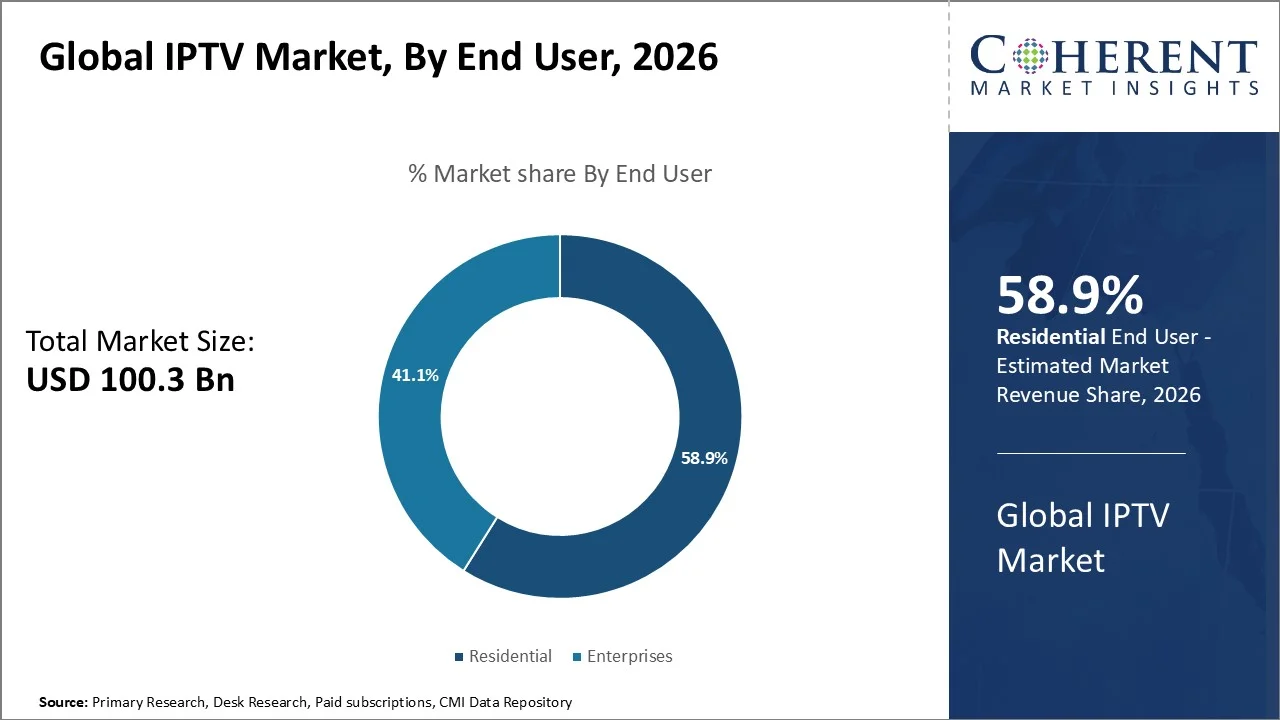
- On the basis of end user, the residential segment is projected to account for the largest share of 58.90% in 2026, due to the cost-effectiveness, on-demand content, and high-speed internet penetration. As per the ITU, almost three-quarters of the world’s population is online in 2025, showing the continued expansion of the addressable base for home video streaming and IPTV services.
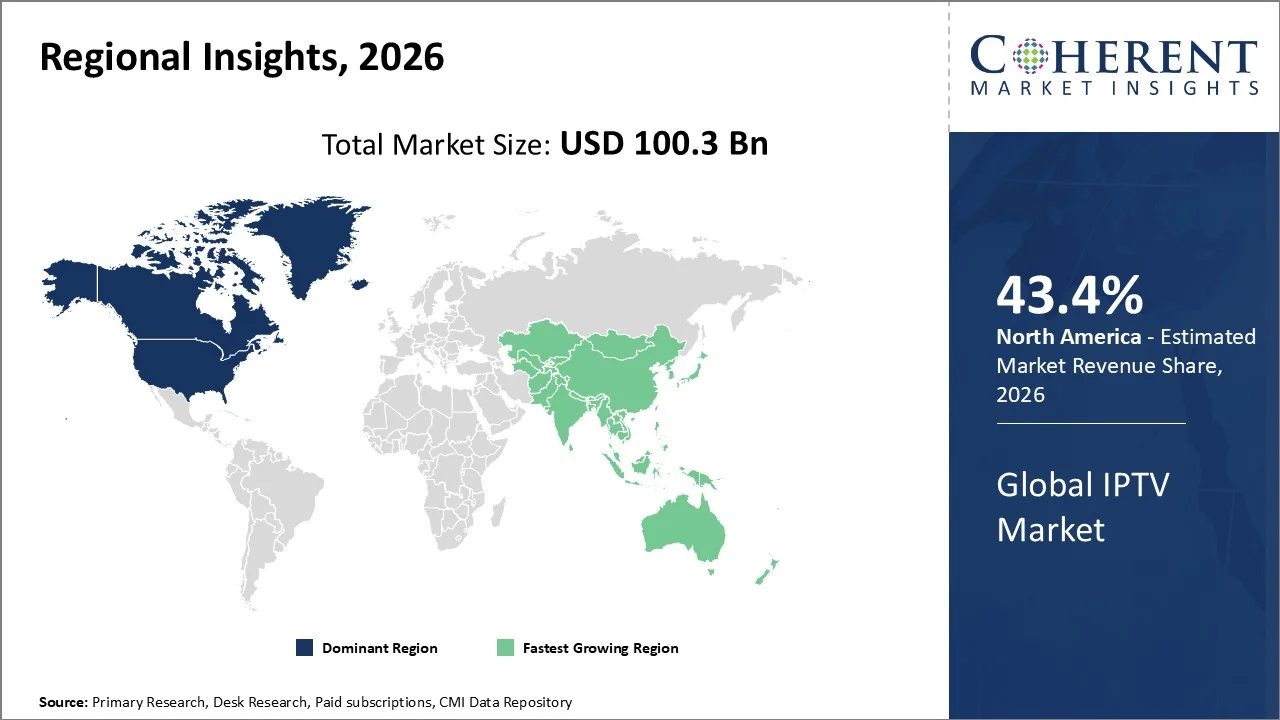
- North America is expected to acquire the dominant share of 43.4% in 2026, attributed to high-speed broadband, massive smart TV adoption, and aggressive bundling of services by major operators. According to the MTM Fall 2024 Adoption report, Canadian streaming-only households rose from 23% in 2023 to 29% in 2024, showing the broader transition in home video consumption that affects IPTV and adjacent pay-TV services.
Segmental Insights
Which End User segment dominates the market?
Residential segment accounts for the largest IPTV market share of 58.9% in 2026. The segment’s growth is primarily due to rising home broadband penetration, growing smart TV/device availability, and the strong shift of households toward app-based live TV and on-demand video consumption. In the United States, 91.2% of households had a broadband internet subscription in 2020 to 2022, according to the U.S. Census Bureau, creating a strong base for IPTV adoption in homes. The Census Bureau also reported that 95.5% of U.S. households had a computer. The NTIA noted that 72% of people lived in households with both fixed and mobile internet connections in 2023, thereby showcasing the multi-device environment which supports IPTV streaming in TVs, smartphones, and tablets.
The segment is also expanding in fast growing markets like India, where better internet access is making IPTV and connected TV services available to more people. India’s Ministry of Statistics and Programme Implementation reported that 83.3% of rural households and 91.6% of urban households had internet access within household premises in its 2025 telecom survey. In parallel, TRAI reported 944.12 million broadband subscribers in India at the end of March 2025. This underlines the scale of digital connectivity now supporting home video consumption. This combination of broader household internet access, rising connected-device usage, and consumer preference for flexible, personalized viewing continues to make residential users the core demand center for IPTV services.
Transition to On-Demand and Personalization is transforming the IPTV Industry in United States
Transition to on-demand and personalization is reshaping the IPTV industry in the United States by moving viewers away from fixed linear schedules toward flexible, user-controlled content access. The consumers nowadays prefer catch-up TV, cloud DVR, tailored recommendations, multi-screen viewing, as well as curated content bundles based on their varied preferences. This shift is prompting the IPTV providers to strengthen platform intelligence, improve user interfaces, and use viewing-data analytics to raise engagement and retention.
A relevant U.S. government-backed statistic comes from the Research by the Leichtman Research Group. The group reported that 83% of U.S. households subscribed to a top subscription
- Current Industry Events of 2026
- Market Size Estimation
- Regional Breakdown
- Competitive Landscape
- Customer Intelligence
- Segmental Analysis
- Pricing Analysis
- Key Market Drivers, Challenges & Future Trends
- Customized Insights Section
One Major Breakthrough in IPTV: Shift Toward AI-Powered Hyper-Personalized Streaming
One of the major breakthroughs in IPTV sector is the shift toward AI-powered hyper-personalized streaming. The platforms make use of viewing history, watch time, search behavior, device patterns, as well as contextual signals to deliver highly tailored content journeys. This means users are no longer delivered the same homepage or channel lineup. Instead, the AI helps surface tailored recommendations, reorder interfaces, predict preferred genres, improve content discovery, and support targeted promotions or ad insertion.
This is important in IPTV because the model combines live TV, catch-up TV, and on-demand content, thus creating a vast content pool which can overwhelm users without any intelligent personalization. The commercial value is stronger engagement, longer session times, and lower churn because viewers find relevant content faster and are more likely to stay within the platform ecosystem.
The FCC has also placed a greater emphasis on higher broadband performance standards, with 100/20 Mbps now used as the benchmark for advanced fixed broadband. This makes it easier to offer IPTV experiences that are data-rich, personalized.
Current Events and Their Impact on the IPTV Market
Current Event | Description and its Impact |
European Commission’s 2026 Review of the AVMSD (Audiovisual Media Services Directive) |
|
FCC Accessibility and Emergency Information Rule Changes Affecting Video Distributors (U.S.) |
|
IPTV Market Trends
- Rising demand for on-demand and time-shifted content is speeding up IPTV adoption, with consumers preferring flexible viewing as compared to fixed broadcast schedules. The IPTV platforms are benefiting from this shift by offering live TV, catch-up TV, as well as video-on-demand in one ecosystem.
- Connected TV usage is strengthening IPTV consumption across households. More viewers now access streaming content directly on television screens rather than only viewing on smartphones or laptops. This improves the relevance of IPTV apps, smart TV integrations, and hybrid set-top-box Ofcom reported that the share of YouTube viewing done via TV sets rose from 34% in 2023 to 41% in 2024, thereby underpinning stronger consumer preference for internet video on large-screen home devices.
- Broadband network expansion (subscriptions estimated at nearly 3 billion) is improving IPTV service accessibility and streaming quality, particularly for HD and multi-screen content delivery. The faster and more reliable fixed broadband aligns with the uninterrupted IPTV usage and also improves service adoption in both urban as well as semi-urban markets.
- Ad-supported and hybrid monetization models are gaining traction in IPTV. These models help operators attract price-sensitive users and diversify their revenue streams.
- Regulatory modernization is helping the growth of IPTV and connected TV ecosystems by recognizing online and on-demand delivery as crucial part of broadcasting infrastructure. In the UK, Ofcom noted in February 2026 that updated Media Act implementation allows public service broadcasters to use on-demand players and online services more actively for content delivery. Thus, supporting the long-term integration of IPTV within mainstream television distribution.
Regional Insights
Telecom Giants and Broadband Growth Secure North America's IPTV Leadership
North America accounts for 43.4% of the IPTV market in 2026. The region’s growth is backed by strong broadband infrastructure, high connected-household penetration, and continued investment by telecom as well as media operators in the U.S. and Canada. The region also benefits from cutting edge internet networks, widespread adoption of streaming-based television services, and strong consumer preference for personalized, on-demand content delivery. In addition, regulatory support for broadband expansion and the presence of major telecom as well as digital entertainment firms continue to strengthen the regional IPTV ecosystem.
The official product launches also continue to contribute to the regional growth. In May 2025, TELUS launched new entertainment bundles in Ontario and Quebec combining live TV with premium streaming platforms such as Netflix, Disney+, Amazon Prime, and Apple TV+. In January 2025 Such strong digital infrastructure, rising streaming-led viewing behavior, and ongoing operator-led platform launches are expected to assist North America’s continual leadership in the IPTV market in the coming years.
Asia Pacific IPTV Market Trends
The Asia Pacific region is poised to be as the fastest-growing region through 2026-2033, driven by rising broadband penetration, expanding fiber networks, and strong telecom-led bundling of TV, OTT, and high-speed internet services across major markets such as India, China, South Korea, and Southeast Asia. In India, the Telecom Regulatory Authority of India (TRAI) reported 1,028.61 million internet subscribers as of December 2025, and TRAI’s 2025 operator list shows a widening IPTV service base in the country, reflecting a stronger distribution ecosystem for IPTV offerings.
China is also strengthening the regional growth outlook, with official data showcasing that the country had 1.125 billion internet users and an internet penetration rate of 80.1% by the end of 2025. Thus, creating a massive addressable base for IPTV, connected TV, and interactive video services. In South Korea, IPTV remains a highly established platform. The government data cited by Yonhap showcased 21.41 million IPTV subscribers in the first half of 2025, thus accounting for 59.1% of total pay-TV subscribers.
For instance, in March 2025, . These services included linear TV, streaming apps, and Wi-Fi plans. Likewise, KT stated in its 2025 disclosures that growth in premium IPTV plans and subscriber additions continued to support media revenue, thereby underscoring the strength of advanced IPTV monetization in the Asia Pacific. These advancements are expected to speed up the IPTV market growth in the region throughout the forecast period of 2026-2033.
Transition to On-Demand Streaming and Broadband Expansion is accelerating the IPTV Market Demand in United States
The United States IPTV market is witnessing steady growth, supported by deep broadband penetration and the rapid shift toward internet-based video consumption. The U.S. Census Bureau reported that in 2023, nearly 126.3 million of the country’s 131.3 million households owned at least one computing device, while an official Census feature also noted that 83% of U.S. households subscribed to a leading subscription video-on-demand service in 2022. In parallel, the FCC stated that its Broadband Data Collection continues to show steady increases in locations with reported broadband coverage as of December 2024, strengthening the infrastructure base for IPTV and streaming services.
New innovations by major service providers are also underpinning competition in the market of the U.S. For example, in August 2025, DIRECTV officially released seven new Mix Channels on its streaming platform. This helped in enabling viewers to watch up to 4 live channels on one screen across devices like Roku, Fire TV, Android TV, Apple TV, and Samsung Tizen. This indicates the growing emphasis on flexible, app-based, and feature-rich television delivery in the U.S. market.
Japan IPTV Market Trends
Japan’s IPTV market is supported by the country’s advanced fixed-network base and continued convergence of telecom and digital entertainment services. According to the Statistical Handbook of Japan 2025, the country had 46 million fixed-broadband subscribers in 2022, thus making it one of the world’s largest broadband markets. Japan’s large senior population also supports demand for home-based digital entertainment, with the Cabinet Office reporting 36.25 million people aged 65 and over, accounting for 29.3% of the total population as of October 1, 2024.
Who are the Major Companies in IPTV Industry
Some of the major key players in IPTV are AT&T, Inc., ARRIS Group, Inc., Bharti Airtel Limited, MatrixStream Technologies, Inc., CenturyLink, Inc., Amino Technologies plc, Deutsche Telekom AG, Orange SA, Cisco Systems, Inc., and Broadcom Corporation.
Key News
- In September 2025, Indian IPTV has launched the MAG555 Android IPTV set top box for audiences in the United States. The device allows viewers to stream thousands of channels, movies, and shows on a regular television.
- In August 2025, Nokia announced that Netplus, one of India’s fastest-growing Internet Services Providers (ISPs), has deployed the latest 400G routing technology and software-defined access network (SDAN) platform from Nokia, to scale its high-speed broadband and IPTV services across Punjab and other cities.
Market Report Scope
IPTV Market Report Coverage
| Report Coverage | Details | ||
|---|---|---|---|
| Base Year: | 2025 | Market Size in 2026: | USD 100.3 Bn |
| Historical Data for: | 2020 To 2024 | Forecast Period: | 2026 To 2033 |
| Forecast Period 2026 to 2033 CAGR: | 16% | 2033 Value Projection: | USD 283.4 Bn |
| Geographies covered: |
| ||
| Segments covered: |
| ||
| Companies covered: | AT&T, Inc., ARRIS Group, Inc., Bharti Airtel Limited, MatrixStream Technologies, Inc., CenturyLink, Inc., Amino Technologies plc, Deutsche Telekom AG, Orange SA, Cisco Systems, Inc., and Broadcom Corporation. | ||
| Growth Drivers: |
| ||
| Restraints & Challenges: |
| ||
Analyst Opinion
- The IPTV market is driven by the growing adoption of on-demand streaming services and broadband expansion. The shift from traditional cable to internet-based TV is a direct response to evolving consumer preferences for flexible, personalized viewing experiences. By 2026, the U.S. Census Bureau projects that over 80% of U.S. households will have access to at least one internet streaming service, showcasing a steady increase from 60% in 2021.
- The increasing incorporation of 5G technology and high-speed internet is also propelling IPTV demand. The Federal Communications Commission (FCC) reports that, as of 2024, 93% of Americans have access to broadband with download speeds of 25 Mbps or higher. Thus, substantially supporting the infrastructure necessary for seamless IPTV delivery.
- The streaming platforms are now incorporating cutting edge AI and machine learning technologies, thereby enhancing content recommendation systems and improving user engagement. As of 2025, Netflix reported 40% higher viewer engagement with its AI-powered personalization, thus helping the company expand its subscriber base to more than 225 million globally. This trend underpins continual growth in IPTV adoption as well as the increasing preference for content delivered via internet protocol.
Speak to the analyst
Want personalized insights?
Take the findings above to one of our principal consultants, or have the report rebuilt around the segments, geographies and competitors you actually track.
IPTV Market Segmentation
- By End User (Revenue, USD Bn, 2021-2033)
- Enterprises
- Small Enterprise
- Medium Enterprise
- Large Enterprise
- Residential
- Global IPTV Market, By Region: (Revenue, USD Bn, 2021-2033)
- North America
- U.S.
- Canada
- Latin America
- Brazil
- Mexico
- Argentina
- Rest of Latin America
- Europe
- Germany
- U.K.
- France
- Italy
- Spain
- Russia
- Rest of Europe
- Asia Pacific
- China
- India
- Japan
- Australia
- South Korea
- ASEAN
- Rest of Asia Pacific
- Middle East
- GCC
- Israel
- Rest of Middle East
- Africa
- South Africa
- Central Africa
- North Africa
- North America
Sources
Primary Research Interviews
- IPTV Service Providers
- Telecom Operators Offering IPTV Services
- Middleware and IPTV Platform Providers
- Set-Top Box Manufacturers
- Content Delivery Network (CDN) Providers
- OTT and Video Technology Consultants
- Broadband Infrastructure Providers
- Others
Databases
- Bloomberg Terminal
- Thomson Reuters Eikon
- Euromonitor International
- Others
Magazines
- Broadcasting & Cable
- TVBEurope
- Digital TV Europe
- Broadband TV News
- Advanced Television
- Others
Journals
- International Journal of Digital Multimedia Broadcasting
- IEEE Transactions on Broadcasting
- Journal of Media Business Studies
- Telecommunications Policy
- International Journal of Communication Systems
- Others
Newspapers
- Financial Times
- The Wall Street Journal
- Reuters
- Bloomberg News
- The Economic Times
- Others
Associations
- Broadband Forum
- Digital TV Group (DTG)
- Society of Cable Telecommunications Engineers (SCTE)
- GSMA
- International Telecommunication Union (ITU)
- Others
Public Domain Sources
- International Telecommunication Union (ITU)
- Federal Communications Commission (FCC)
- European Commission – Digital Economy and Society
- Ofcom
- World Bank Open Data
- Others
Proprietary Elements
- CMI Data Analytics Tool
- Proprietary CMI Existing Repository of Information for the Last 8 Years
Get access to 250+ pages report
Every segment, forecast, competitor profile and data table behind the analysis above — available for instant download.
- ESOMAR Member
- ISO 9001:2015 Certified
- D-U-N-S Registered
- GDPR & CCPA Compliant
Missing comfort of reading report in your local language? Find your preferred language:
Transform your Strategy with Exclusive Trending Reports
Frequently Asked Questions
The IPTV Market is expected to reach USD 283.4 Bn in 2033.
Major players operating in the global IPTV Market include AT&T, Inc., ARRIS Group, Inc., Bharti Airtel Limited, MatrixStream Technologies, Inc., CenturyLink, Inc., Amino Technologies plc, Deutsche Telekom AG, Orange SA, Cisco Systems, Inc., and Broadcom Corporation.
The high content licensing costs, and the need for high-speed, stable internet infrastructure are the key factors hampering growth of the Market.
Rising demand for Video-on-Demand (VoD), high-speed internet proliferation, and the shift from traditional cable to personalized, interactive streaming services is boosting demand for IPTV services.
The IPTV Market is anticipated to grow at a CAGR of 16% between 2026 and 2033.
Among regions, North America is expected to account for a largest market share in the global IPTV Market over the forecast period.