

Set-Top Boxes Market Analysis and Forecast: (2026-2033)
The Set-Top Boxes Market size is anticipated to grow at a CAGR of 5.1% with USD 23.5 Bn in 2026 and is expected to reach USD 34.0 Bn in 2033. The growth is driven by the surging demand for high-definition (HD/4K) content, rapid expansion of OTT and streaming services (6 billion people using internet globally), and government-mandated digitization.
Key Takeaways
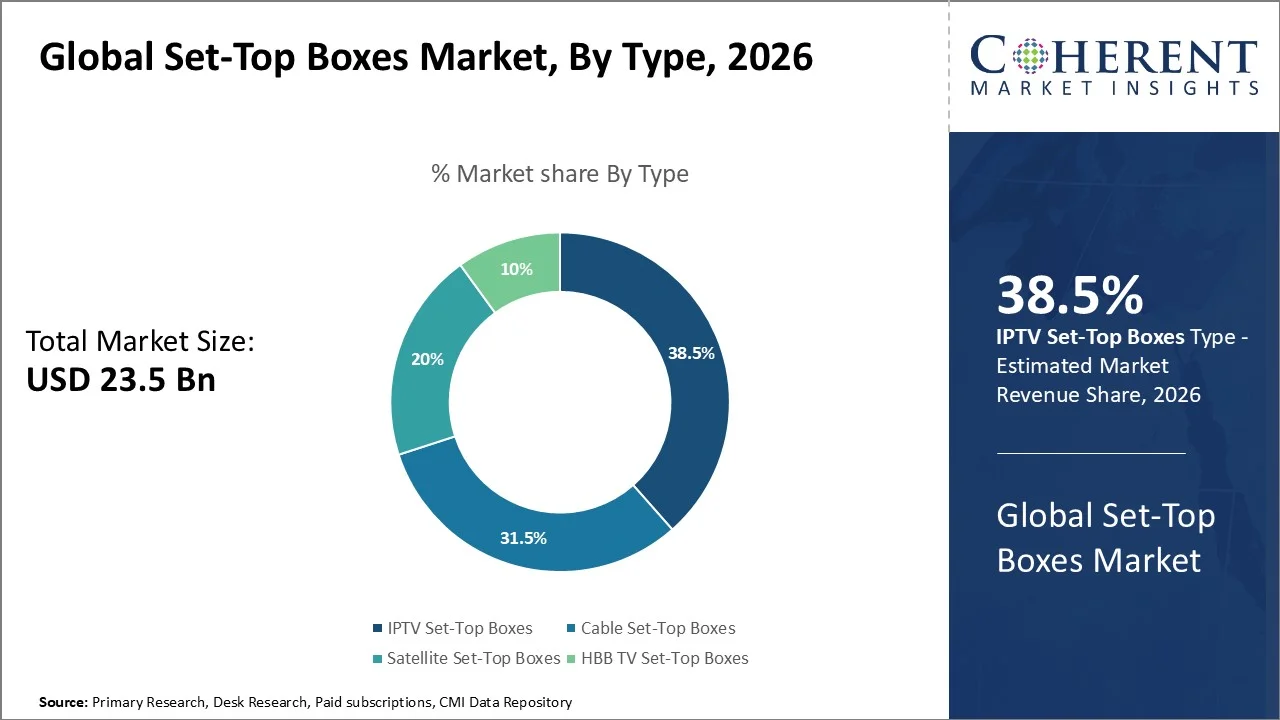
- IPTV Set-Top Boxes is expected to account the largest share of 38.5% in 2026, as consumer preferences shift toward internet‑based TV delivery. State-owned companies are aggressively promoting IPTV services, with BSNL introducing a premium pack featuring over 450 live TV channels and 25+ OTT platforms.
- High-Definition Set-Top Boxes will dominate with 80.2% in 2026, because digital television broadcasting standards (such as ATSC, DVB‑T/T2, ISDB‑T and others) deliver HD and higher resolution content as the standard for free‑to‑air and pay‑TV services.
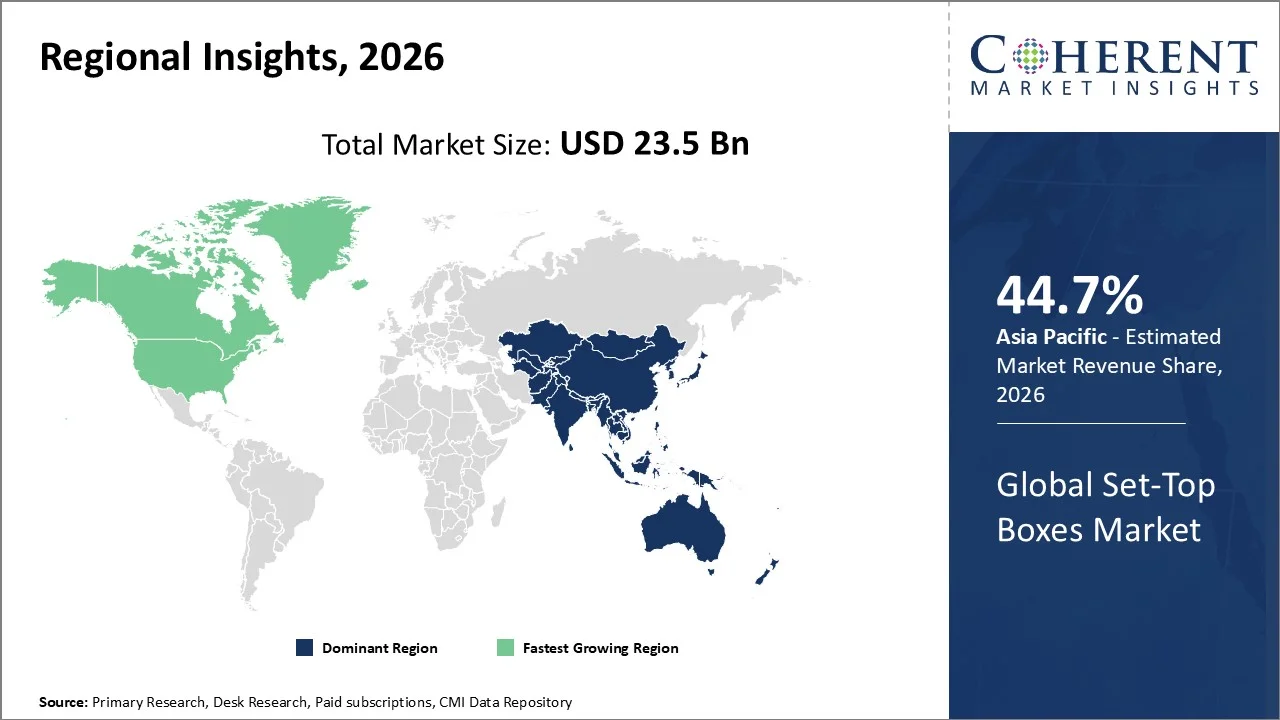
- Asia Pacific is expected to acquire the dominant share of 44.7% in 2026, attributed to sheer number of households with TV access. For example, in India alone over 230 million television households connect to broadcasting platforms.
Segmental Insights
Why is IPTV Set-Top Boxes Acquiring the Highest Share in the Market?
IPTV Set-Top Boxes is projected to account for the largest set-top boxes market share of 38.5% in 2026. The leadership is mainly attributed to the growing demand for internet-based television services (44.8% of U.S. TV viewership in May 2025). Thus, providing greater flexibility, personalization, and content variety compared to traditional cable or satellite-based services.
A main driver to this growth is the rising implementation of fiber optic broadband networks. This allows high-speed internet needed for streaming high-quality IPTV content. The global fiber broadband connections are anticipated to grow at a considerable CAGR from 2023 to 2026. This will directly increase the demand for IPTV services. The demand for IPTV Set-Top Boxes to provide enhanced streaming experiences is expected to increase as more households adopt fiber broadband. Moreover, the ongoing trend of cord-cutting is leading more consumers to shift toward IPTV services.
In addition, this trend of cord-cutting is encouraging even more consumers to choose IPTV services. The U.S. alone saw 6.7 million cable TV customers canceling subscriptions in 2025, with several turning to IPTV and OTT content services for a more cost-effective and convenient alternative.
- Current Industry Events of 2026
- Market Size Estimation
- Regional Breakdown
- Competitive Landscape
- Customer Intelligence
- Segmental Analysis
- Pricing Analysis
- Key Market Drivers, Challenges & Future Trends
- Customized Insights Section
High-Definition Set-Top Boxes holds the Largest Market Share
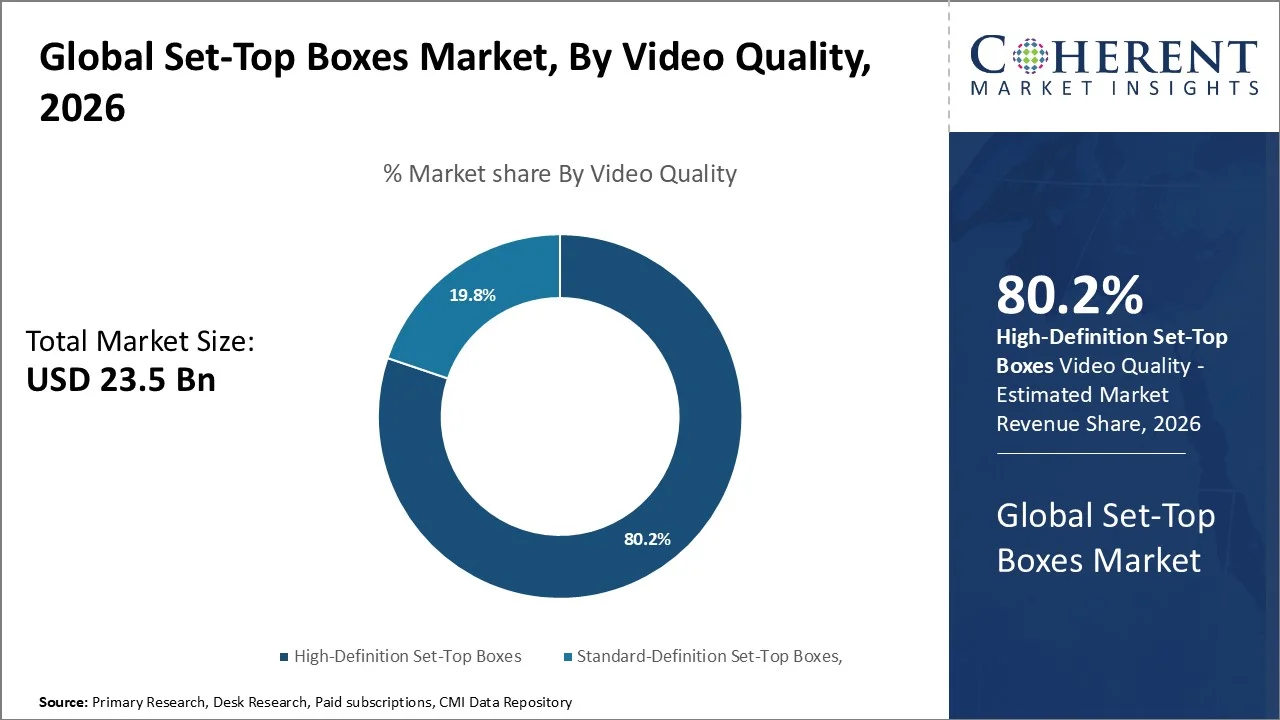
Based on video quality, high-definition set-top boxes is poised to dominate the market and accounts for a considerable 80.2% share in 2026. The segment’s growth is mainly due by the increasing consumer demand for superior video quality coupled with enhanced viewing experiences. The rise in subscriptions to HD video streaming services is also linked to the rise in HD TV content and the shift to streaming platforms, which prioritizes high-quality visuals for a better user experience.
The global preference for HD content is in line with the rise of high-speed broadband networks, which make it possible to stream high-definition programming without any problems. Global subscriptions for HD video streaming services are expected to grow by over 10% annually, reaching more than 1 billion subscriptions by 2026.
In addition, the growing trend of cord-cutting in favor of internet-based content delivery has constituted to the increased demand for high-definition STBs. Consumers are progressively looking for cost-effective, high-quality content, with major cable providers like Comcast and Charter Communications incorporating HD and 4K streaming as part of their bundles.
Shift Toward Streaming and OTT Integration is transforming the Set-Top Boxes Industry in United States
Consumers are shifting away from traditional cable services in favor of OTT services like Netflix, Hulu, Amazon Prime Video, and Disney+. This change is pushing STB makers to come up with new ideas so that their devices can easily access both live TV and streaming content. This allows them to deliver greater flexibility and convenience to users.
In response to this demand, the STB manufacturers are coming up with hybrid devices which incorporate internet-based streaming services alongside traditional TV broadcasts, thus creating a unified platform for consumers. These hybrid STBs allow for a wider range of content options.
For instance, in 2026, major providers like Comcast and Verizon are putting a greater emphasis to combat cord-cutting by integrating OTT streaming services directly in their Set-Top Box (STB) offerings. Comcast is enhancing its StreamSaver bundle (Peacock, Netflix, Apple TV+) and the Xumo Stream Box to centralize content. While Verizon is utilizing its +play platform to bundle services like Disney+, Hulu, and ESPN+ within its Fios TV+ ecosystem. This shift toward streaming is transforming the way content is consumed. It also showcases how STBs are marketed and delivered, with a greater focus on software-driven functionalities and enhanced connectivity, thereby simplifying access for consumers without the need for multiple devices.
Adoption of Cloud-Based Set-Top Boxes: A Key Advancement in Set-Top Box Technology
A major breakthrough in STB market is the emergence and widespread incorporation of cloud-based Set-Top Boxes (over 240 million households globally). This new technology allows for content to be streamed directly from the cloud. This removes the requirement for large hardware and storage components inside the device.
The cloud-based STBs utilize a software-centric model, with the hardware serving merely as a delivery platform. This new technology makes it possible for streaming service providers to offer more flexible, on-demand content, make personalization better, and use less physical infrastructure. The consumers benefit from better user experiences, faster content loading times, along with the ability to access content across multiple devices without the constraints of limitations as in traditional set-top boxes.
The firms like Roku, Amazon Fire TV, and Apple TV have incorporated cloud capabilities into their offerings. This makes the user interface (UI) easier to use, helps people find new content, and lets OTT services work together. In addition, these cloud-based solutions are paving the way for 5G-enabled STBs, thus promising ultra-fast streaming along with more interactive features for future generations of television viewing.
Current Events and Their Impact on the Set-Top Boxes Market
Current Event | Description and its Impact |
Government Policies on 5G Deployment in the U.S. (2026) |
|
FCC's Action on Set-Top Box Integration and Consumer Choice (2026) |
|
Set-Top Boxes Market Trends
- The growing demand for High-Definition (HD) and 4K content is propelling the adoption of HD as well as Ultra High-Definition (UHD) set-top boxes. With the rise in streaming platforms, consumers are progressively looking for higher-quality video and audio experiences, thereby boosting the demand for innovative set-top box technologies.
- Integration of smart features like voice control, artificial intelligence (AI), as well as personalized content recommendations is enhancing the consumer experience. Voice-enabled remote controls, supported by AI-driven content curation, are becoming key features in set-top box offerings.
- The transition from traditional cable TV to IPTV (Internet Protocol Television) set-top boxes continues to gain momentum, with more consumers opting for internet-based TV services. This shift is owing to the increasing availability of high-speed internet alongside the convenience of on-demand content.
- The global aging population is impacting the set-top box market with older consumers gradually adopting state of the art set-top boxes for a better viewing experiences. According to WHO, as of 2026, it is estimated that more than 25% of the global population will be over the age of 60, therefore leading to greater demand for user-friendly, customizable set-top box solutions with easy navigation and accessibility features.
- The government initiatives and regulatory changes like the mandatory digital migration in several regions, are expanding the set-top box market. In India, the government’s push for digitizing cable TV has seen a rise in set-top box adoption, with more than 200 million set-top boxes distributed by 2025, as reported by the Ministry of Information and Broadcasting in India. This policy-driven growth is especially prominent in rural and semi-urban areas, where digital services are expanding rapidly.
Regional Insights
Asia Pacific Set-Top Box Market Leadership Driven by Government Initiatives and Technological Advancements
Asia Pacific is set to account for the leading position in the Set-Top Boxes Market. The region occupies a substantial 44.7% share in 2026. The growth is mainly driven by rapid digital migration and increasing demand for internet-based TV services. The governments in the region are continually pushing for the use of digital television, so set-top boxes are likely to be widely used, especially in rural and semi-urban areas. India, in particular, leads the charge with its mandated digital switch-over, thus contributing to the substantial growth in the market. The Indian government has reported that nearly 65 million set-top boxes have been distributed under the Digital India program till date.
The new technological advancements in set-top boxes also constitute to this growth. Following these trends, Tata Sky (now Tata Play) released an upgraded satellite set-top box in August 2025 which could stream and view content in 4K ultra-high-definition. Thus responding to the growing demand for better streaming and viewing experiences. This move is expected to enhance market dynamics further as the region embraces superior viewing options. Moreover, the increasing number of smart TVs with integrated set-top box capabilities is reducing the demand for traditional standalone boxes, eventually contributing to market evolution.
The government-driven initiatives like China’s ambitious rollout of 5G and Vietnam's National Broadcasting Digitalization Strategy, are also facilitating the adoption of smart TV solutions as well as internet-based television. Also, Vietnam has a potential USD 1.5 billion investment from SpaceX for Starlink satellite internet. As of October 2024, 88.7% of mobile subscribers in Vietnam used smartphones, and 82.3% of households had broadband fiber optic internet. These initiatives are expected to increase consumer access to digital content, thus boosting the demand for set-top boxes in the region.
North America Set-Top Boxes Market Trends
The North America region is poised to be as the fastest-growing region through 2026-2033. The region’s growth is owing to an increased demand for cutting edge TV technologies and higher penetration of digital services. The growth is also attributed to the rapid adoption of 4K and UHD content, as well as the ongoing shift toward IPTV services. In the U.S., there are over 90 million households with access to digital television services, with nearly 55% of them relying on set-top boxes for cable or satellite viewing.
In addition to this, North America is leading in technological innovations which contribute to the market's growth. For example, in October 2025, the FCC (Federal Communications Commission) approved a new set-top box standard that assists in improving compatibility with 5G networks, thus allowing for allowing faster as well as more efficient streaming capabilities. This standard is set to speed up the integration of next-generation technologies, thus benefiting consumers and service providers alike. Moreover, U.S. firms like Comcast and Charter Communications have recently introduced next-gen 8K-compatible set-top boxes that cater to the growing demand for ultra-high-definition content. These innovations are expected to propel the set‑top boxes market growth in the region.
Growing Digital TV Adoption Accelerates Set ‑Top Boxes Market Demand in India
India’s Set‑Top Boxes Market is witnessing strong expansion. This is mainly driven by rapid digital TV adoption and widespread broadcasting infrastructure. As per the Press Information Bureau (PIB), India, thus showcasing the extensive base for set‑top box deployment nationwide. In addition, over 49, thus indicating public broadcaster initiatives to expand access to digital TV services.
The growth is also backed by the mandatory digitization of cable TV services, which requires set‑top boxes for accessing pay content and has led to proliferation of digital addressable systems across urban and rural regions. According to the Telecom Regulatory Authority of India (TRAI), India has around 845 multithereby underscoring the extensive distribution ecosystem supporting set‑top box adoption.
U.S. Set-Top Boxes Market Trends
The U.S. Set-Top Boxes Market is poised for steady growth over the coming years. The growth is driven by increasing demand for high-definition content and the digitalization of TV services. As of 2026, more than 90% of United States households are equipped with digital TV. The set-top boxes continue to be integral to accessing premium cable, satellite, as well as streaming services. The demand is also speeded up by a shift toward OTT platforms, with 87% of households subscribing to some form of cable or satellite TV in 2026, as per the Digital TV Research.
In addition to this, the government’s regulatory push for NextGen TV (ATSC 3.0), designed to provide ultra-high-definition broadcast services, is propelling technological adoption and expanding the scope of set-top boxes. By 2026, it is estimated that over 75% of households in the US are set to have access to ATSC 3.0 broadcast services, thereby enabling the transition to 4K and beyond.
Who are the Major Companies in Set-Top Boxes Industry
Some of the major key players in Set-Top Boxes Industry are Humax Co., Ltd., Sagemcom SAS, Huawei Technologies Co., Ltd., Kaonmedia Co. Ltd., Technicolor SA, EchoStar Corporation, ADB (Advanced Digital Broadcast) SA, ARRIS Group, Inc., Apple, Inc., and Samsung Electronics Co. Ltd.
Key News
- In February 2026, SK Broadband launched its 'Welcome! TVterior' promotion, which ran through April 2026. It aimed at targeting new customers who signed up for its AI 5 set-top box and Giga WiFi 7. The promotion offered benefits like free IPTV dispatch fees, Naver Pay gifts regardless of contract length, and discounted security package fees with a three-year contract.
- In January 2026, Telenor is working with KAON and ADB to introduce the T-We Boks III to the Norwegian market. It is a next-generation set-top box (STB) that integrates cutting edge technology, eco-friendly design, as well as an enhanced entertainment experience for households in Norway.
- In Novemeber 2025, Austrian IPTV service provider Ocilion has released a new generation of its white-label IPTV platform. The firm has introduced a redesigned user interface (UI6) along with the P610 set-top box based on Google’s Android TV Operator Tier.
Market Report Scope
Set-Top Boxes Market Report Coverage
| Report Coverage | Details | ||
|---|---|---|---|
| Base Year: | 2025 | Market Size in 2026: | USD 23.5 Bn |
| Historical Data for: | 2020 To 2024 | Forecast Period: | 2026 To 2033 |
| Forecast Period 2026 to 2033 CAGR: | 5.1% | 2033 Value Projection: | USD 34.0 Bn |
| Geographies covered: |
| ||
| Segments covered: |
| ||
| Companies covered: | Humax Co., Ltd., Sagemcom SAS, Huawei Technologies Co., Ltd., Kaonmedia Co. Ltd., Technicolor SA, EchoStar Corporation, ADB (Advanced Digital Broadcast) SA, ARRIS Group, Inc., Apple, Inc., and Samsung Electronics Co. Ltd. | ||
| Growth Drivers: |
| ||
| Restraints & Challenges: |
| ||
Analyst Opinion
- Set-top boxes remain relevant because TV access is becoming more connected, not less. The category is no longer limited to basic cable or satellite reception; it is increasingly tied to hybrid viewing across live TV, IPTV, catch-up content, and app-based streaming. That matters because connectivity keeps expanding: the ITU estimates 6.0 billion people, or 74% of the global population, were using the Internet in 2025, while fixed-broadband subscriptions grew at an average 5.2% annually over the last five years. As more households gain stable broadband, the installed base shifts toward smarter, software-led boxes rather than disappearing outright.
- The market is supported by a very large active television household base, especially in transition markets where broadcast and connected TV coexist. For example, India’s telecom regulator noted 193 million television households in 2025, spanning cable, DTH, HITS, free TV services, and connected TV; the same consultation paper also cited around 102 million connected-TV households and 64 million DD Free Dish households from industry-referenced market data. In the UK, Ofcom reported that 86% of primary TV sets in use at the end of 2023 could be used to watch TV online, showing that connected viewing is already mainstream. This means set-top boxes continue to serve as an important bridge between traditional distribution and internet-delivered television.
- Future growth is likely to come from replacement and upgrade cycles rather than from old-style decoder demand alone. FCC materials for the 2026 Communications Marketplace Report show that the video ecosystem is converging: MVPDs, vMVPDs, and FAST services are increasingly treated as part of the same multichannel video landscape, while app-based viewing has reduced reliance on legacy rental boxes. At the same time, Ofcom’s 2026 connected-TV audience research found that set-top-box users still skew toward live and bundled channel viewing, especially for premium content such as sports. Taken together, this suggests the market will grow through IPTV boxes, Android TV/operator boxes, 4K/voice-enabled upgrades, and hybrid broadcast-plus-streaming devices, particularly where households still want managed live-TV access with OTT convenience.
Speak to the analyst
Want personalized insights?
Take the findings above to one of our principal consultants, or have the report rebuilt around the segments, geographies and competitors you actually track.
Set-Top Boxes Market Segmentation
- By Type (Revenue, USD Bn, 2026-2033)
- Cable Set-Top Boxes
- Satellite Set-Top Boxes
- IPTV Set-Top Boxes
- HBB TV Set-Top Boxes
- By Video Quality (Revenue, USD Bn, 2026-2033)
- Standard-Definition Set-Top Boxes
- High-Definition Set-Top Boxes
- Global Set-Top Boxes Market, By Region (Revenue, USD Bn, 2026-2033)
- North America
- U.S.
- Canada
- Latin America
- Brazil
- Mexico
- Argentina
- Rest of Latin America
- Europe
- Germany
- U.K.
- France
- Italy
- Spain
- Russia
- Rest of Europe
- Asia Pacific
- China
- India
- Japan
- Australia
- South Korea
- ASEAN
- Rest of Asia Pacific
- Middle East
- GCC
- Israel
- Rest of Middle East
- Africa
- South Africa
- Central Africa
- North Africa
- North America
Sources
Primary Research Interviews
- Set-Top Box Manufacturers
- IPTV Service Providers
- OTT Streaming Platforms
- Cable and Satellite TV Providers
- Consumer Electronics Retailers
- Content Delivery Network Providers
- Broadcast Equipment Suppliers
- Media and Telecom Industry Experts
- Others
Databases
- Bloomberg Terminal
- Thomson Reuters Eikon
- IHS Markit
- Euromonitor International
- Others
Magazines
- Broadcasting & Cable Magazine
- Television Broadcast Magazine
- Set-Top Box News
- Digital TV Europe
- TV Technology
- Satellite TV Magazine
- Multichannel News
- Other Technology Publications
- Others
Journals
- Journal of Digital Media & Policy
- Journal of Broadcast Engineering
- IEEE Transactions on Consumer Electronics
- International Journal of Digital Television
- Journal of Media Economics
- Journal of Telecommunications and Digital Media
- Others
Newspapers
- Financial Times
- The Wall Street Journal
- Reuters
- The New York Times (Technology Section)
- The Guardian (Tech)
- Bloomberg News
- Others
Associations
- National Cable & Telecommunications Association (NCTA)
- Consumer Technology Association (CTA)
- European Broadcasting Union (EBU)
- Digital TV Group (DTG)
- CableLabs
- International Telecommunication Union (ITU)
- Others
Public Domain Sources
- U.S. Federal Communications Commission (FCC)
- International Telecommunication Union (ITU)
- European Commission – Digital Agenda
- National Communications Commission (NCC) – Nigeria
- UK Department for Digital, Culture, Media, and Sport (DCMS)
- World Bank Open Data
- National Telecommunications and Information Administration (NTIA)
- Others
Proprietary Elements
- CMI Data Analytics Tool
- Proprietary CMI Existing Repository of Information for the Last 8 Years
Get access to 250+ pages report
Every segment, forecast, competitor profile and data table behind the analysis above — available for instant download.
- ESOMAR Member
- ISO 9001:2015 Certified
- D-U-N-S Registered
- GDPR & CCPA Compliant
Missing comfort of reading report in your local language? Find your preferred language:
Transform your Strategy with Exclusive Trending Reports
Frequently Asked Questions
The Set-Top Boxes Market is expected to reach USD 34.0 Bn in 2033.
Major players operating in the global Set-Top Boxes Market include Humax Co., Ltd., Sagemcom SAS, Huawei Technologies Co., Ltd., Kaonmedia Co. Ltd., Technicolor SA, EchoStar Corporation, ADB (Advanced Digital Broadcast) SA, ARRIS Group, Inc., Apple, Inc., and Samsung Electronics Co. Ltd.
The rapid growth of streaming services (OTT) and the widespread adoption of smart TVs with built-in apps are the key factors hampering growth of the market.
The surging demand for 4K/high-definition (HD) content, rapid expansion of Over-the-Top (OTT) streaming services, and the integration of smart/Android-based functionality is boosting demand for set-top boxes.
The Set-Top Boxes Market is anticipated to grow at a CAGR of 5.1% between 2026 and 2033.
Among regions, Asia Pacific is expected to account for a largest market share in the global Set-Top Boxes Market over the forecast period.