

Global Broadcasting Solutions Market Size and Forecast – 2026 - 2033
The Global Broadcasting Solutions Market is estimated to be valued at USD 11.35 Bn in 2026 and is expected to reach USD 21.98 Bn by 2033, exhibiting a compound annual growth rate (CAGR) of 9.9% from 2026 to 2033.
Key Takeaways of the Broadcasting Solutions Market
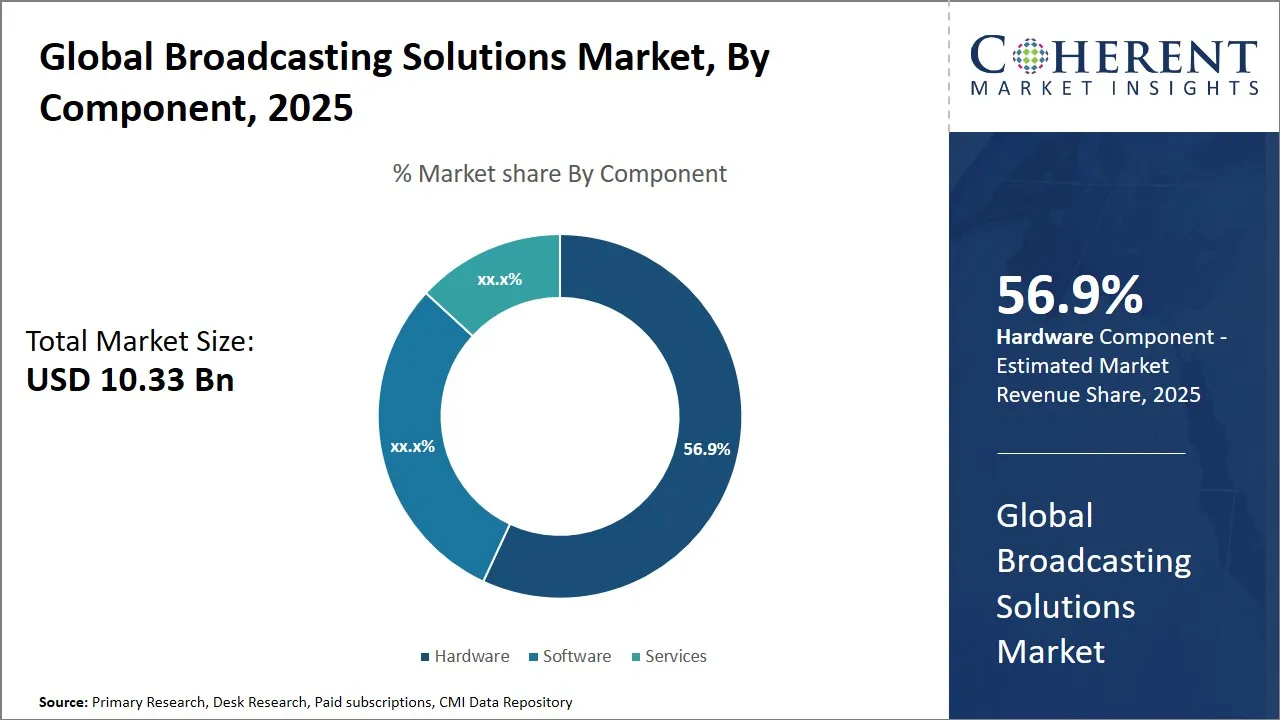
- The hardware segment leads the market holding an estimated share of 57.9 % in 2026.
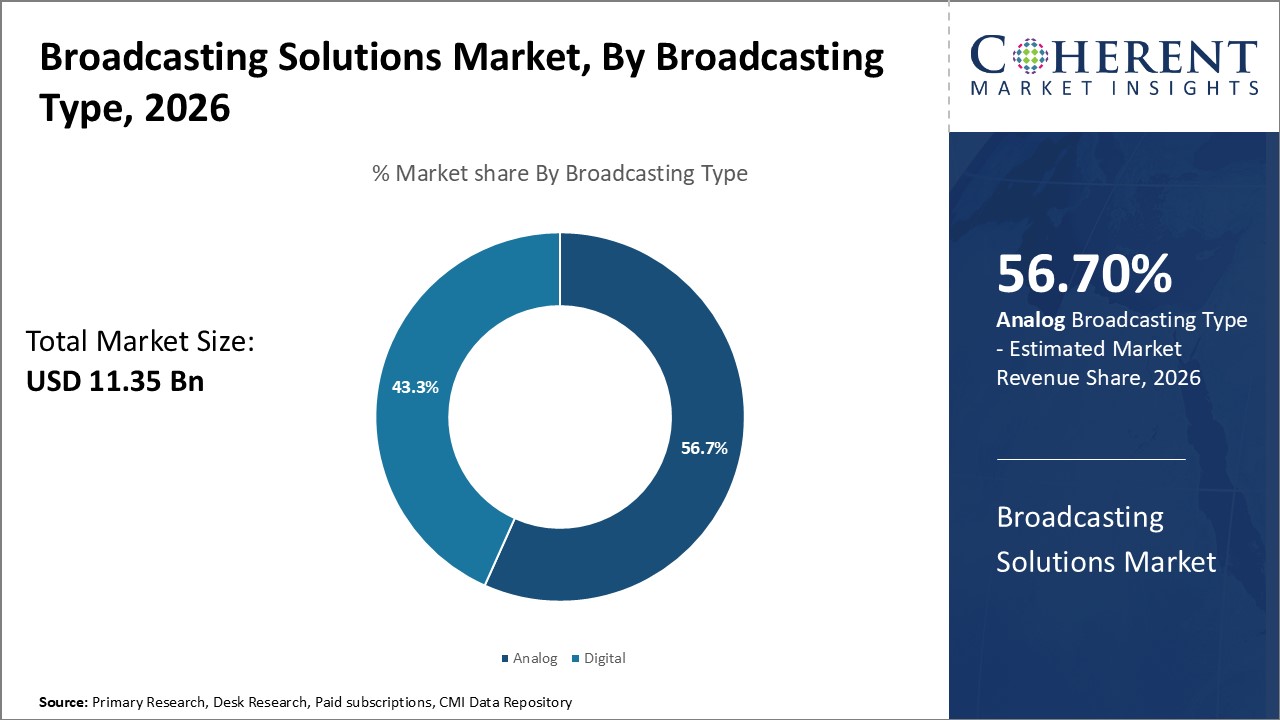
- The analog segment leads the market holding an estimated share of 56.7 % in 2026.
- The television segment leads the market holding an estimated share of 47.5 % in 2026.
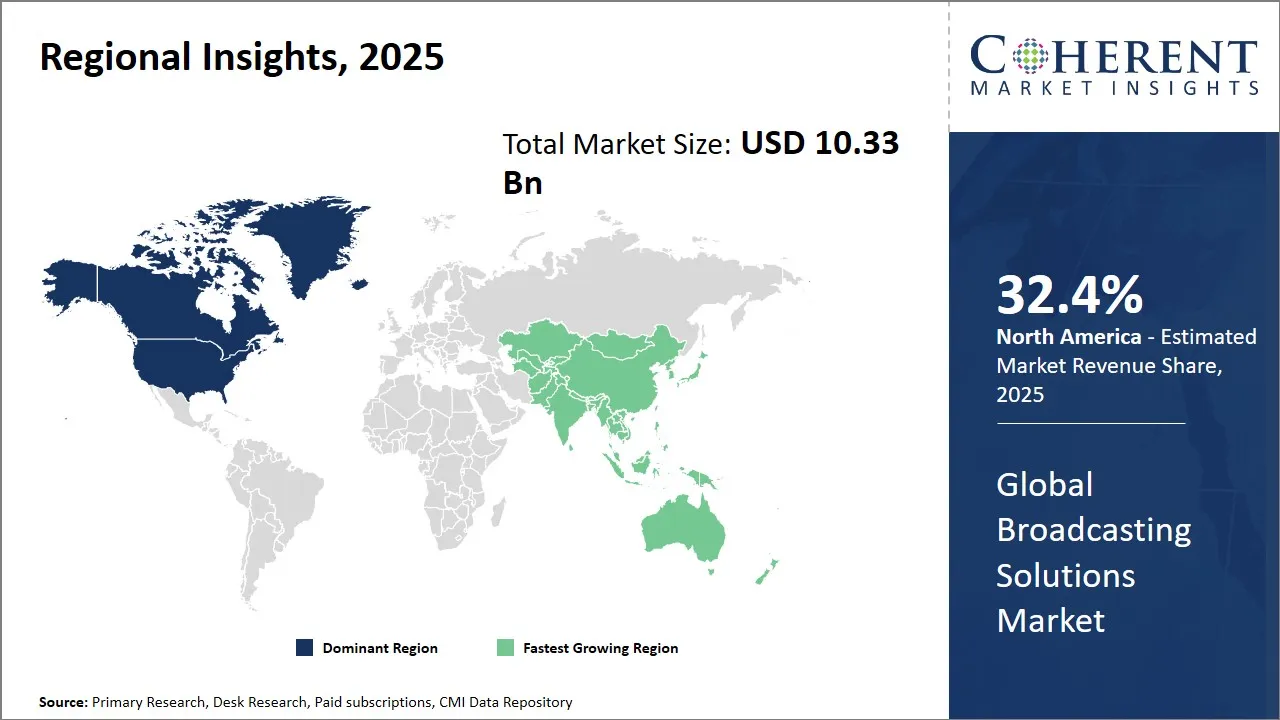
- North America is estimated to lead the market with a share of 32.4 % in 2026.
- Asia Pacific, holding a share of 22% in 2026, is projected to be the fastest growing region.
Market Overview
The market is seeing a move towards cloud-based broadcasting and the integration of AI and machine learning to improve content delivery and audience engagement. Also, the rise in over-the-top (OTT) services and the increasing consumption of personalized content are fueling the demand for broadcasting solutions. These trends, coupled with growing investments in infrastructure upgrades, are expected to add to market expansion over the coming years.
Current Events and Its Impact
Current Events | Description and its impact |
Geopolitical and Trade Developments |
|
Technological and Regulatory Shifts |
|
Segmental Insights
- Current Industry Events of 2026
- Market Size Estimation
- Regional Breakdown
- Competitive Landscape
- Customer Intelligence
- Segmental Analysis
- Pricing Analysis
- Key Market Drivers, Challenges & Future Trends
- Customized Insights Section
Global Broadcasting Solutions Market Insights, By Component – Hardware Leads Owing to the Escalating Demand for Advanced Broadcasting Infrastructure
The hardware segment, holding a share of 57.9% in 2026, is expected to dominate the global broadcasting solutions market. Broadcasting hardware includes transmitters, antennas, receivers, and set-top boxes. The rising demand for high-quality broadcasting services has created a rise in investments for upgrading broadcasting infrastructure, adding to the growth of the hardware segment.
The fast technological advancements in broadcasting equipment create the need for newer and more sophisticated hardware that can handle complex signal processing. Also, the popularity of internet-enabled smart devices and connected televisions have added to the demand for versatile hardware.
Moreover, regulatory mandates and government initiatives in various regions, aimed at expanding broadcasting coverage and improving national communication infrastructures, contribute significantly to hardware adoption. For example, policies supporting the digital switchover process and spectrum reallocation impact hardware requirements for broadcasters are pushing them to acquire new transmission equipment and distribution devices. The increasing number of live broadcasts, particularly in sports and entertainment sectors, places heavy reliance on reliable and scalable broadcasting hardware to ensure real-time content delivery without lag or interruption.
Global Broadcasting Solutions Market Insights, By Broadcasting Type - Analog Leads Because of Ongoing Prevalence in Developing Regions
The analog segment, holding a share of 56.7% in 2026, is projected to continue to retain a substantial share of the global broadcasting solutions market. Analog transmission infrastructure tends to be less expensive to install and maintain compared to digital alternatives. For broadcasters and governments operating within budget constraints, analog solutions provide an affordable and practical means to deliver television and radio content across large, dispersed populations. Additionally, analog broadcasting’s compatibility with older receiving devices is a significant driver of its continued use. Many consumers in emerging markets own televisions and radios that are tailored to receive analog signals.
Geographical and infrastructural challenges also play a role. In remote and rural areas where laying down advanced digital transmission networks is technically complex and economically unviable, analog broadcasting remains the preferred solution to maintain communication channels and public information dissemination. Moreover, governments and regulatory bodies in certain countries have extended timelines for the digital switchover, recognizing the socio-economic challenges faced by their populations in adopting digital infrastructure.
The resilience of analog broadcasting is also linked to the steady demand for radio broadcasting. Analog radio, in particular, continues to be a vital medium for mass communication, especially in regions where radio remains a primary source of news, entertainment, and emergency information. However, it is important to note that while analog broadcasting maintains a strong foothold, the segment is expected to coexist alongside digital solutions as hybrid broadcasting approaches gain traction.
Global Broadcasting Solutions Market Insights, By Application – Television Broadcasting Leads Driven by Expanding Content Demand and Technological Advancements
The television segment, commanding an estimated 47.5% share of the global broadcasting solutions market in 2026, continues to lead due to its vast audience base, high advertising value, and constant technological evolution. Television remains the cornerstone of mass communication, supported by rising investments in high-definition (HD), 4K, and IP-based broadcasting infrastructure.
A notable example is BBC’s 2026 initiative to expand its IP-based broadcast delivery, enabling hybrid operations that integrate live TV with digital streaming for a unified viewer experience. Such transitions illustrate the industry’s move toward hybrid broadcast-broadband models that combine traditional TV reach with digital interactivity.
Emerging markets further bolster the segment’s dominance through expanding free-to-air (FTA) and satellite TV access, while developed regions are adopting cloud-enabled and remote production systems for greater efficiency. Despite the growth of OTT streaming, television broadcasting continues to thrive by embracing digital integration and maintaining its relevance across global audiences.
Impact of AI on the Broadcasting Solutions Market
Artificial Intelligence (AI) is fundamentally reshaping the broadcasting solutions market by automating critical workflows, enhancing content personalization, and improving operational efficiency. Broadcasters are increasingly leveraging AI for real-time captioning, automated language translation, metadata tagging, content moderation, and audience behavior analysis. These capabilities reduce human error, speed up production cycles, and allow broadcasters to deliver more targeted and adaptive content experiences.
For instance, Sinclair Broadcast Group has integrated AI into its newsroom operations to automate news transcription and multilingual subtitling across its affiliate stations. AI-powered recommendation engines also help media companies increase viewer retention by tailoring content to user preferences—particularly valuable for OTT and IPTV platforms.
Regional Insights
North America Broadcasting Solutions Market Analysis and Trends
North America, holding a share of 32.4% in 2026, is expected to dominate the global broadcasting solutions market. The region sees a huge presence of big industry players like Cisco Systems, Dolby Laboratories, and Harmonic Inc., which innovate in broadcast infrastructure, content delivery, and IP-based broadcasting solutions. Grass Valley leads North America’s cloud broadcast revolution with GV AMPP, its cloud-native live production platform. It helps broadcasters manage video switching, replay, and playout from remote or virtual control rooms.
Favorable government policies for digital transition, extensive broadband penetration, and huge investments in 5G networks add to the region's leadership. Moreover, strong collaboration among content creators, distribution networks, and technology vendors creates a robust trade environment conducive to sustained growth.
Asia Pacific Broadcasting Solutions Market Analysis and Trends
The Asia Pacific, holding an estimated share of 22% in 2026, sees the fastest growth in the broadcasting solutions market because of fast digitization, increasing urbanization, and a burgeoning middle-class consumer base demanding diverse content consumption options. Governments across countries like India, China, and Southeast Asian nations have initiated supportive regulatory frameworks and free-trade agreements that facilitate technology transfer and infrastructure investment.
Sony has been adding AI capabilities into its broadcast camera systems, particularly with auto-framing and tracking features in models like the BRC‑AM7 PTZ camera and handheld cameras like the PXW‑Z200 and HXR‑NX800. The presence of dynamic local and multinational companies like Huawei and ZTE add to competitive innovation, particularly in next-generation broadcast solutions including OTT platforms and cloud-based broadcasting.
Global Broadcasting Solutions Market Outlook for Key Countries
U.S. Broadcasting Solutions Market Analysis and Trends
The market in the U.S. leads because of its advanced digital infrastructure and early adoption of cutting-edge broadcasting technologies. Key players like Cisco Systems, Harmonic Inc., and AT&T make scalable IP-based broadcast solutions, improve content delivery networks, and investing a lot in cloud and edge computing. The country’s regulatory landscape promotes innovation through spectrum allocation reforms and supports broadcast modernization efforts, solidifying its critical position globally.
China Broadcasting Solutions Market Analysis and Trends
China broadcasting solutions market growth grows because of strategic government initiatives aiming to accelerate media digitization and smart broadcasting technologies. Dominant companies like Huawei and ZTE lead advancements in 5G network infrastructure and IP broadcast solutions, making possible better content distribution capabilities. The government’s push for “Internet Plus” and digital economy fosters huge investments in OTT content and interactive broadcasting, making China a hub for new broadcast technologies in Asia Pacific.
India Broadcasting Solutions Market Analysis and Trends
India continues to lead in broadcast market expansion because of its huge consumer base and fast digital adoption rates. Indian companies and multinationals like Technicolor and Grass Valley collaborate to provide localized solutions made for regional language content and different consumer preferences. Government policies that support rural broadband expansion and digital literacy programs add to market penetration. The rise of digital streaming platforms also makes demand for advanced broadcasting systems.
Germany Broadcasting Solutions Market Analysis and Trends
Germany broadcasting solutions market sees a strong industrial base and strict regulatory standards that add to quality and innovation in broadcasting solutions. Companies such as Rohde & Schwarz and Ericsson consistently deliver high-performance equipment and end-to-end broadcast infrastructure catering to linear TV and streaming services. Supportive EU policies on digital media interoperability and spectrum management further elevate Germany as a center for broadcasting technology development within Europe.
Brazil Broadcasting Solutions Market Analysis and Trends
Brazil broadcasting solutions market sees increasing investments in digital terrestrial television and mobile broadcasting infrastructure. Players like NET Serviços and Globosat dominate content distribution. They join hands with technology providers like Sony and Avid to improve broadcasting capabilities. The Brazilian government’s focus on improving regional coverage and digital inclusion adds to market participation and technological adoption, making Brazil an important market in Latin America.
Market Players, Key Development, and Competitive Intelligence
Key Developments
- On July 10, 2025, Grass Valley and Daktronics made a technology partnership that joins Grass Valley’s live production expertise with Daktronics’ leadership in large-scale LED displays. Together, they aim to deliver fully integrated, end-to-end solutions that improve content creation, production efficiency, and real-time presentation for sports and entertainment venues.
- On July 8, 2025, Triveni Digital, a player in ATSC 1.0 and 3.0 service delivery, data broadcasting, and quality assurance solutions, launched the NEXTGEN TV Innovation Partnership Program. This program provides access to advanced ATSC 3.0 solutions, adds to collaboration, and helps stations get the full benefits of NEXTGEN TV, including enhanced video and audio capabilities, public safety communication, smart city applications, and the Broadcast Positioning System (BPS).
- In June 2025, Wowza acquired AVA Intellect, a startup specializing in intelligent and embedded agent technology for video platforms. AVA’s co-founder Mr. Mike Vitale joins Wowza as Head of Intelligence, accelerating Wowza’s shift toward an AI-first product strategy.
- In May 2025, LiveU, the global leader in live IP-video contribution, production and distribution solutions, announced the closing of its acquisition of Actus Digital’s business and technology. Actus Digital became Actus Digital, a LiveU Company, operating as an independent sister brand to LiveU.
Top Strategies Followed by Broadcasting Solutions Market Players
- Established industry players lead the market by investing a lot in research and development (R&D) to innovate high-performance products that meet the evolving needs of broadcasters and content providers.
- At NAB Show 2025, MediaKind showcased new versions of its MK.IO platform and Aquila Live edge-enabled streaming capabilities, developed through extensive R&D.
- Mid-level market participants get competitive edge by focusing on cost-effective broadcasting solutions that offer a balance between quality and affordability—a critical factor for price-sensitive customers, particularly in developing regions or small to medium broadcasters.
- PlayBox Neo launched the Neo-20 series in 2025, a budget-friendly all-in-one playout and graphics automation system. Designed for smaller TV stations and digital channels, it provides cloud and on-prem options.
- Small-scale players in the broadcasting solutions market use a niche-focused strategy to remain competitive with larger competitors.
- Open Broadcast Systems (UK), a niche IP broadcast hardware company, partnered with Webbing (Israel) in 2025 to integrate global 5G connectivity into broadcast encoders—enabling portable, high-reliability live streaming for field journalists and disaster coverage teams.
Market Report Scope
Broadcasting Solutions Market Report Coverage
| Report Coverage | Details | ||
|---|---|---|---|
| Base Year: | 2025 | Market Size in 2026: | USD 11.35 Bn |
| Historical Data for: | 2020 To 2024 | Forecast Period: | 2026 To 2033 |
| Forecast Period 2026 to 2033 CAGR: | 9.9% | 2033 Value Projection: | USD 21.98 Bn |
| Geographies covered: |
| ||
| Segments covered: |
| ||
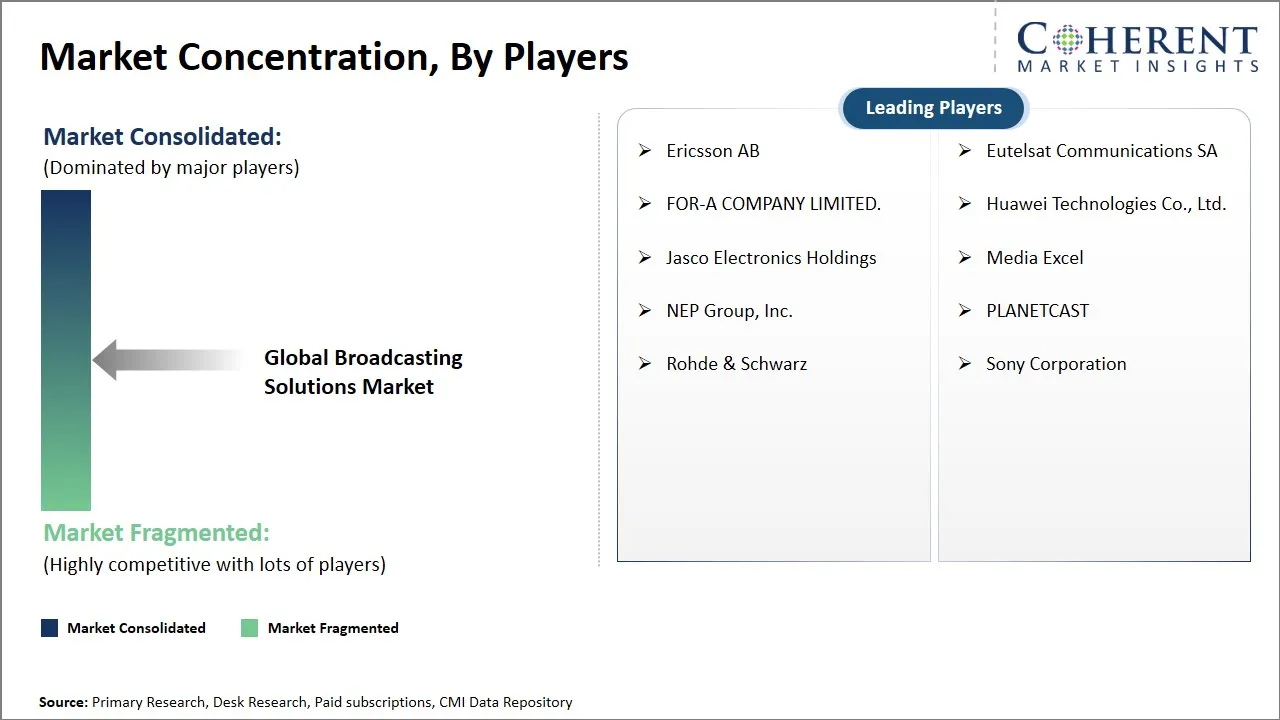
| Companies covered: | Ericsson AB, Eutelsat Communications SA, FOR-A COMPANY LIMITED, Huawei Technologies Co., Ltd., Jasco Electronics Holdings, Media Excel, NEP Group, Inc., PLANETCAST, Rohde & Schwarz, and Sony Corporation | ||
| Growth Drivers: |
| ||
| Restraints & Challenges: |
| ||
Market Dynamics
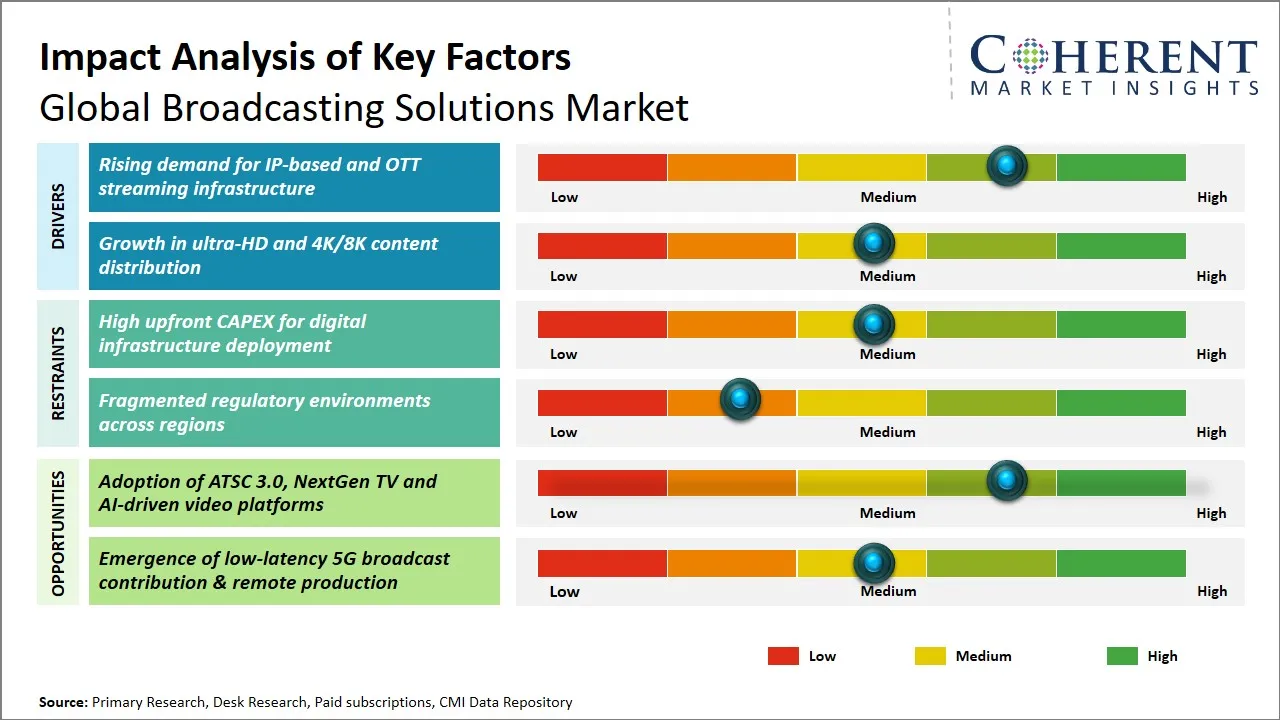
Global Broadcasting Solutions Market Driver – Rising Demand for IP ‑ Based and OTT Streaming Infrastructure
The broadcasting industry is undergoing a significant transformation fueled by the increasing consumer preference for internet protocol (IP)-based delivery and over-the-top (OTT) streaming services. Traditional broadcast methods are gradually giving way to more flexible, scalable, and cost-efficient IP-centric infrastructure, which allows content providers to reach global audiences effortlessly while offering personalized viewing experiences.
As internet penetration grows and smart devices become more common, viewers are shifting towards on-demand and multi-platform content consumption. In April 2025, NEP Group, a big global production services provider, expanded its Total Facility Control (TFC) IP platform to support large-scale IP-based remote productions for sports and entertainment events.
Global Broadcasting Solutions Market Opportunity – Adoption of ATSC 3.0, NextGen TV, and AI-Driven Video Platforms
ATSC 3.0, also known as NextGen TV, is a major upgrade from traditional broadcasting standards, joining over-the-air broadcasting with broadband, enabling enhanced picture and sound quality, interactive features, and targeted advertising. This broadcasting standard supports 4K Ultra HD resolution, immersive audio, and improved signal reliability, which improves the viewer experience. In July 2025, Sinclair Broadcast Group accelerated its ATSC 3.0 rollout across 42 U.S. markets, enabling advanced capabilities like interactive content, hyper-localized emergency alerts, and datacasting.
The use of AI technologies also adds to market growth by enabling personalized content recommendations, automated content tagging, efficient ad targeting, and real-time analytics, all of which improve operational efficiencies for broadcasters and increase viewer engagement.
Analyst Opinion (Expert Opinion)
- The shift from SDI to IP infrastructure is no longer a transition—it’s an industry standard in the making. With cloud-native platforms like Grass Valley’s AMPP and NEP’s TFC gaining traction, broadcasters are reimagining live production as fully virtualized and geographically untethered. This not only reduces infrastructure costs but also accelerates time-to-air for live events and pop-up channels. The result is a more agile, scalable, and decentralized content ecosystem.
- Artificial Intelligence is no longer limited to metadata tagging or compliance checks—it’s driving content personalization, real-time subtitling, and even automated highlight creation in live sports. Companies like Scripps and Sinclair are embedding AI into ATSC 3.0 and OTT platforms, using it to tailor local news delivery and improve multilingual accessibility. This trend indicates a future where AI becomes the invisible layer powering both production and viewer experience.
- The convergence of ATSC 3.0 broadcast standards and 5G connectivity is creating a new hybrid broadcasting model that combines terrestrial and IP delivery. Broadcasters can now deliver personalized, data-rich content while simultaneously exploring edge distribution through 5G-enabled mobile units. This opens doors for highly targeted advertising and emergency alerting systems.
Speak to the analyst
Want personalized insights?
Take the findings above to one of our principal consultants, or have the report rebuilt around the segments, geographies and competitors you actually track.
Market Segmentation
- Component Insights (Revenue, USD Bn, 2021 - 2033)
- Hardware
- Software
- Services
- Broadcasting Type Insights (Revenue, USD Bn, 2021 - 2033)
- Analog
- Digital
- Application Insights (Revenue, USD Bn, 2021 - 2033)
- Radio
- Television
- IPTV
- Regional Insights (Revenue, USD Bn, 2021 - 2033)
- North America
- U.S.
- Canada
- Latin America
- Brazil
- Argentina
- Mexico
- Rest of Latin America
- Europe
- Germany
- U.K.
- Spain
- France
- Italy
- Russia
- Rest of Europe
- Asia Pacific
- China
- India
- Japan
- Australia
- South Korea
- ASEAN
- Rest of Asia Pacific
- Middle East
- GCC Countries
- Israel
- Rest of Middle East
- Africa
- South Africa
- North Africa
- Central Africa
- North America
- Key Players Insights
- Ericsson AB
- Eutelsat Communications SA
- FOR-A COMPANY LIMITED
- Huawei Technologies Co., Ltd.
- Jasco Electronics Holdings
- Media Excel
- NEP Group, Inc.
- PLANETCAST
- Rohde & Schwarz
- Sony Corporation
Sources
Primary Research Interviews
Stakeholders
- Broadcast Engineers and Operations Managers (e.g., from public and private networks)
- System Integrators and Technical Directors (e.g., live event and sports broadcasters)
- OTT and IPTV Platform Heads (e.g., technical leads at regional and global streaming services)
- IP Equipment Manufacturers and Distributors (e.g., encoder, switch, and modulator vendors)
- Media Technology Consultants and Workflow Architects
- AI Video Analytics Providers and Software Developers
Databases
- International Broadcasting Union Data Hub
- U.S. Federal Communications Commission (FCC) Open Database
- Asia-Pacific Media Infrastructure Registry (AP-MIR)
- North American Digital Media Archives (NADMA)
Magazines
- Broadcast Integration Monthly
- Live Production World
- OTT Infrastructure Digest
- Signal Flow & Spectrum Weekly
Journals
- Journal of Broadcast Technology and Innovation
- IP Video and Networked Media Systems Journal
- Journal of NextGen Broadcasting Standards
- AI in Media & Communication Technologies Journal
Newspapers
- The Broadcast Herald (Global Edition)
- Media & Technology Observer (North America)
- Asia-Pacific Broadcast Chronicle
- The Digital Media Times (EU/UK Edition)
Associations
- Global Broadcast Equipment Manufacturers Association (GBEMA)
- International Federation for OTT Delivery Standards (IFODS)
- North American Society of Broadcast Engineers (NASBE)
- Asia-Pacific Streaming Alliance (APSA)
- European NextGen Media Council (ENMC)
Public Domain Sources
- U.S. Census Bureau
- EUROSTAT
- United Nations Economic and Social Commission for Asia and the Pacific (UNESCAP)
- World Bank
- ResearchGate
Proprietary Elements
- CMI Data Analytics Tool, Proprietary CMI Existing Repository of information for last 8 years
Get access to 250+ pages report
Every segment, forecast, competitor profile and data table behind the analysis above — available for instant download.
- ESOMAR Member
- ISO 9001:2015 Certified
- D-U-N-S Registered
- GDPR & CCPA Compliant
Missing comfort of reading report in your local language? Find your preferred language:
Transform your Strategy with Exclusive Trending Reports
Frequently Asked Questions
The global broadcasting solutions market is estimated to be valued at USD 11.35 billion in 2026 and is expected to reach USD 21.98 billion by 2033.
The CAGR of global broadcasting solutions market is projected to be 9.9% from 2026 to 2033.
Rising demand for IP‑based and OTT streaming infrastructure and growth in ultra‑HD and 4K/8K content distribution are the major factors driving the growth of the global broadcasting solutions market.
High upfront CAPEX for digital infrastructure deployment and fragmented regulatory environments across regions are the major factors hampering the growth of the global broadcasting solutions market.
In terms of component, hardware is estimated to dominate the market revenue share in 2026.
Broadcasting solutions refer to the technologies, equipment, and software used to capture, process, transmit, and distribute audio-visual content via television, radio, or internet-based platforms.
ATSC 3.0, also known as NextGen TV, is the latest broadcasting standard offering higher video quality, interactive features, and personalized content delivery, revolutionizing terrestrial broadcasting.