

Computational Fluid Dynamics Market Size and Forecast — 2026-2033
Overview
Computational fluid dynamics is a branch of fluid machines which helps to calculate and analyses the flow of liquid and gas. Computational fluid dynamics works on the Navier Stokes equations which describes about single phase fluid flow. With the combination of physics, applied mathematics and computational software the Computational fluid dynamics predicts the effect of liquid and gas on the object.
The growth in automotive industry creates substantial opportunities for the computational fluid dynamics market as well. A major challenge hindering the market growth in aerospace & defense industry is the relatively slow adoption of cloud-based solutions due to data security and privacy issues because of hacking and various other attacks on cloud infrastructure. In spite of the fact that a couple of venders are providing the cloud-based model, various end users are unwilling to purchase it. Moreover, customers prefer using open source CFD software rather than spending huge amount on purchasing commercial licenses. The above said factor is also expected to restrain the market growth over the forecast period.
Computational Fluid Dynamics Market Size and Forecast – 2026 – 2033
The Computational Fluid Dynamics Market size is estimated to be valued at USD 10.61 billion in 2026 and is expected to reach USD 19.90 billion by 2033, exhibiting a compound annual growth rate (CAGR) of 9.4% from 2026 to 2033.
Key Takeaways
The software segment under Product Type dominates with over 55% market share primarily due to increasing investments in digital design and simulation tools from automotive and aerospace industries.
The cloud-based deployment model is the fastest growing, driven by demand for flexible, scalable access to CFD software in emerging economies and SMEs.
North America commands the largest market share given its strong aerospace and automotive base, stringent emissions regulations, and higher R&D investments fostering advanced CFD adoption.
Asia Pacific is the fastest-growing region with a CAGR exceeding 11%, fueled by expanding manufacturing capabilities, government support for smart factories, and increasing use of CFD in energy and infrastructure projects.
Computational Fluid Dynamics Market – Segmentation Analysis
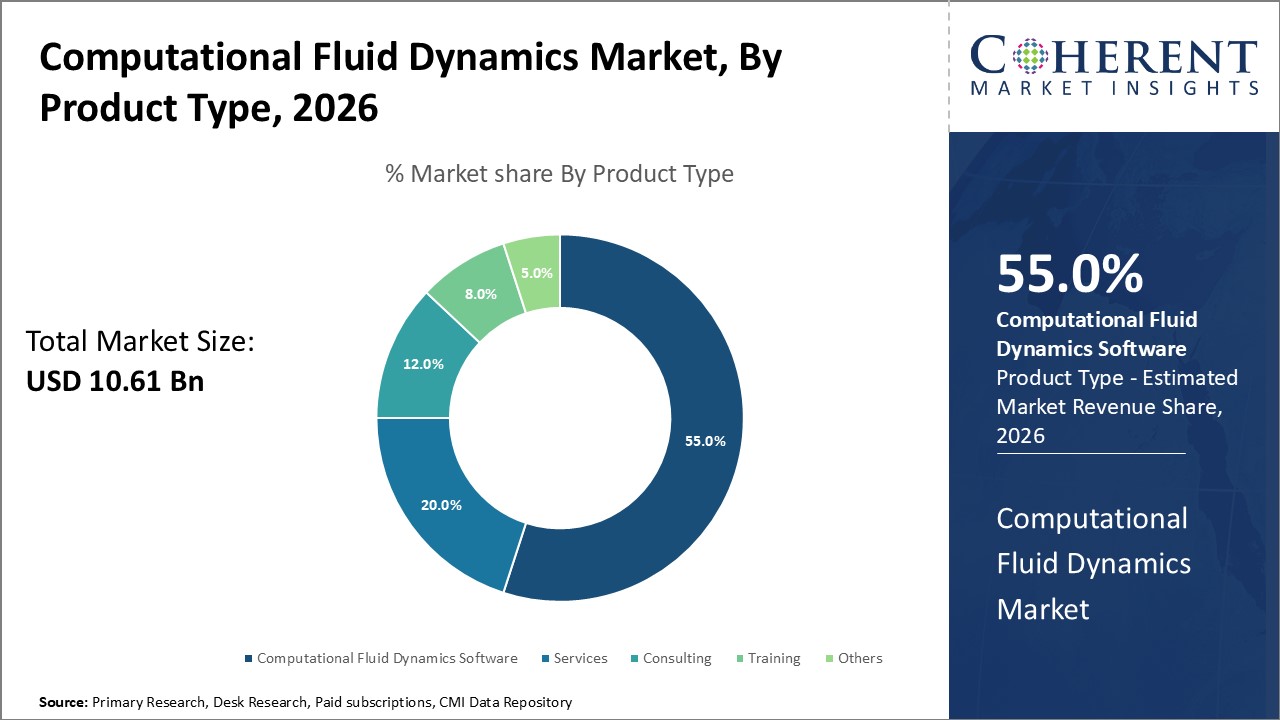
Computational Fluid Dynamics Market Insights, By Product Type
In terms of product type, the market is segmented into Computational Fluid Dynamics Software (market share 54%), Services, Consulting, Training, and Others. The Computational Fluid Dynamics Software segment dominates the market share, primarily due to rapid digital transformation across major industries and continuous investment in software innovation. The presence of scalable, cloud-deployable software platforms enhances accessibility and caters to a broader user base.
Computational Fluid Dynamics Market Insights, By Deployment Mode
For deployment mode, the market segments include On-Premise, Cloud-Based (fastest growing segment), Hybrid, and Others. On-Premise solutions hold a significant market share due to established infrastructure in large enterprises preferring in-house control over sensitive simulations.
Computational Fluid Dynamics Market Insights, By End-User Industry
In the end-user industry segmentation, the market is divided into Aerospace & Defense, Automotive & Transportation (leading segment), Energy & Power, Chemical & Pharmaceuticals, Electronics, Construction, and Others. Automotive & Transportation captures the largest market share owing to increasing implementation of CFD solutions for electric vehicle battery thermal management, internal combustion engine optimization, and aerodynamics. Aerospace & Defense closely follows, propelled by demands for lightweight structures and fuel-efficient designs.
Computational Fluid Dynamics Market Insights, By Geography
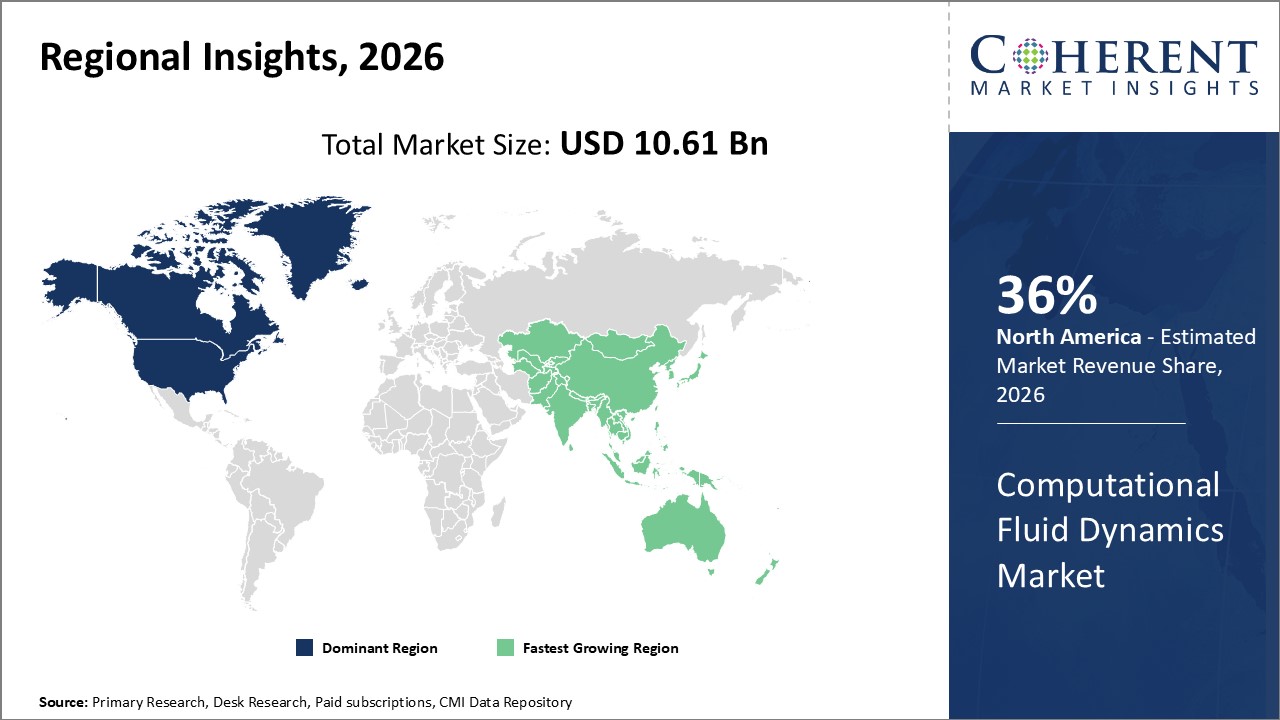
North America Computational Fluid Dynamics Market Analysis and Trends
In North America, the dominance in the Computational Fluid Dynamics market stems from the presence of numerous aerospace and automotive market players, extensive R&D expenditure, and supportive government policies including regulations targeting fuel efficiency and emissions reduction. The U.S. accounts for approximately 36% market share in 2026, driven by federal investments in defense projects and next-gen aviation technologies.
Asia Pacific Computational Fluid Dynamics Market Analysis and Trends
Meanwhile, the Asia Pacific exhibits the fastest growth with a CAGR exceeding 11%, supported by rapid industrialization, increasing manufacturing and energy sector investments, and escalating adoption of advanced simulation technologies in China, India, and Japan. Government incentives focused on smart manufacturing further bolster market expansion.
Computational Fluid Dynamics Market Outlook for Key Countries
United States Computational Fluid Dynamics Market Analysis and Trends
The USA maintains a leading position due to a mature aerospace sector and strong automotive R&D initiatives. Major U.S. players including ANSYS Inc. and Altair Engineering continue to enhance simulation software capabilities, focusing on cloud deployment to serve global clients. High defense spending and stringent emission mandates have contributed to the market’s robust revenue growth, fueling adoption in renewable energy projects and electric vehicle design.
India Computational Fluid Dynamics Market Analysis and Trends
India’s Computational Fluid Dynamics market is witnessing accelerated adoption led by expanding automotive and renewable energy projects. Local and international market companies are actively targeting smart city development initiatives that demand sophisticated fluid dynamics analysis. The growing startup ecosystem leveraging cloud-based CFD solutions coupled with government efforts to support digital infrastructure underpins one of the highest regional growth rates globally.
Analyst Opinion
The rise in demand for CFD software in aerospace and automotive sectors underscores production capacity and technological innovation as key supply-side indicators. For example, aerospace manufacturers reported a 16% increase in CFD software utilization during 2025, primarily driven by the need to design more fuel-efficient and aerodynamically optimized aircraft. This trend marks a direct influence on market size expansion.
On the demand side, growth in renewable energy and HVAC applications has fueled imports of advanced CFD tools. The wind energy sector increased its simulation software spend by nearly 19% in 2025, driven by offshore wind farm projects requiring precise fluid flow analysis. This growing use case diversifies end-user demand and adds depth to market revenue streams.
Price dynamics show a moderate reduction owing to competitive software bundles and open-source initiatives, enabling smaller enterprises to access CFD tools. In 2026, small and medium-sized players adopted lower-cost CFD platforms, contributing to increased market penetration across emerging economies.
Micro-indicators such as the growing number of patent filings—over 220 new CFD-related patents were recorded in 2025—reflect intensive R&D efforts. This patent activity often translates to novel functionalities that fuel market growth and keeps competitive pressure high among market players.
- Current Industry Events of 2026
- Market Size Estimation
- Regional Breakdown
- Competitive Landscape
- Customer Intelligence
- Segmental Analysis
- Pricing Analysis
- Key Market Drivers, Challenges & Future Trends
- Customized Insights Section
Market Scope
| Report Coverage | Details | ||
|---|---|---|---|
| Base Year: | 2025 | Market Size in 2026: | USD 10.61 billion |
| Historical Data for: | 2020 To 2024 | Forecast Period: | 2026 To 2033 |
| Forecast Period 2026 to 2033 CAGR: | 9.4% | 2033 Value Projection: | USD 19.90 billion |
| Geographies covered: |
| ||
| Segments covered: |
| ||
| Companies covered: | ANSYS Inc., Siemens Digital Industries Software, Dassault Systèmes SE, Autodesk, Inc., Altair Engineering, Inc., ESI Group, COMSOL, Inc., Flow Science, Inc., CoreTech System Co., Ltd., and NUMECA International. | ||
| Growth Drivers: |
| ||
Growth factors
Growth in automotive and aerospace industries data-backed digitization initiatives notably steer market growth. Automotive manufacturers, for instance, utilized CFD to reduce carbon emissions by optimizing engine combustion efficiency, leading to an 11% adoption uplift in 2025. Increasing energy efficiency regulations globally have increased investments in renewable sectors that rely heavily on CFD for turbine design and fluid dynamics optimization. Moreover, technological progress in cloud computing facilitates accessibility to CFD offerings for SMEs, boosting the market scope in developing economies. Rising industrial automation and integration with AI-driven analytics have also enhanced operational efficiencies, making CFD indispensable for real-time decision-making and further catalyzing market dynamics.
Computational Fluid Dynamics Market Development
- In May 2026, nTop has launched a new computational fluid dynamics (CFD) solutions designed to eliminate bottlenecks in the simulation process. The startup has released nTop Fluids in the hopes of enabling engineers to iterate more effectively. It comes after Cloudfluid was acquired earlier this year.
Market Trends
The Computational Fluid Dynamics market is increasingly incorporating artificial intelligence and machine learning algorithms to accelerate simulation accuracy. In 2025, leading aerospace manufacturers reported up to 26% faster simulation times using AI-aided CFD solvers. Cloud-based deployment models have also surged, accounting for over 36% of new software licensing in 2026, driven by enterprises seeking flexible usage and collaboration capabilities. Multi-physics simulation integration is becoming dominant, combining CFD with thermal and structural analyses to improve system-level design decisions, especially in electronics and energy sectors where coupled physics impact performance critically. This multi-disciplinary approach is setting new industry standards and redefining business growth models. Real-life implementations by Siemens and Dassault Systèmes underpin these advancements, illustrating how market companies are pivoting towards expansive technological integration.
Key Players
ANSYS Inc.
Siemens Digital Industries Software
Dassault Systèmes SE
CD-adapco (Siemens PLM Software)
Autodesk, Inc.
Altair Engineering, Inc.
ESI Group
COMSOL, Inc.
Flow Science, Inc.
CoreTech System Co., Ltd.
Competitive strategies observed include acquisitions aimed at expanding portfolios, such as Siemens Digital Industries Software’s integration of CD-adapco, resulting in enhanced simulation offerings that strengthened its market share by approximately 7% in 2025. Similarly, Dassault Systèmes has focused on cloud deployment expansions to capture emerging markets, achieving over 21% revenue growth in cloud-based CFD solutions during 2026.
Computational Fluid Dynamics Market Future Outlook
The market for computational fluid dynamics (CFD) has a very bright future ahead of it, with steady and strong growth anticipated over the next ten years. Advanced simulation technologies, which provide engineering applications in sectors like aerospace, automotive, energy, and healthcare with previously unheard-of efficiency and precision, are the driving force behind the expansion. By combining artificial intelligence, cloud computing, and GPU acceleration, CFD innovation is speeding and a greater number of people and organizations may now access advanced simulation tools.
The usage of CFD is expanding beyond its typical applications to new fields including electronics, biomedical research, and renewable energy modelling as firms continue to prioritize efficiency, sustainability, and optimum product design. While academic institutions and research organizations encourage future talent and research in the sector, the shift to cloud-based platforms and open-source solutions is encouraging collaboration and reducing obstacles to entrance. Notwithstanding obstacles such simulation complexity and the requirement for specialist knowledge, CFD is positioned as a crucial tool in next-generation engineering and design processes due to growing computing power and the focus on digital transformation.
Historical Analysis
Computational Fluid Dynamics (CFD) evolved from experimental and analytical methods to become an essential tool for simulating and analysing fluid behaviour across diverse industries. Its origins traced back to early numerical approaches in the mid-20th century, with practical advancements accelerated during the 1970s as computing technology made more complex calculations feasible. By the 1980s, visualization tools enabled engineers to interpret 3D simulation results effectively, enhancing analysis and communication.
The 1990s saw parallel computing expand the possibilities for larger and more intricate simulations, and by the 2000s, cloud and high-performance computing democratized access and increased scalability for all types of organizations. Over the decades, CFD played a crucial role in aerospace, automotive, energy, and many other fields, supporting design optimization, safety improvements, and efficiency enhancements. Its historical trajectory reflected continuous innovation in algorithms, software, and computing infrastructure, leading to ever-increasing adoption and more sophisticated applications worldwide.
Sources
Primary Research interviews:
Oil & Gas Reservoir Modeling Experts
HVAC & Energy Systems Engineers
Academic Professors in Fluid Dynamics & Mechanical Engineering
Databases:
Web of Science
arXiv (Fluid Dynamics Section)
ASME Digital Collection
Magazines:
Mechanical Engineering Magazine (ASME)
Offshore Engineer
Oil & Gas Engineering
Journals:
International Journal of Heat and Fluid Flow
Computers & Fluids
Physics of Fluids
Journal of Fluids Engineering (ASME)
Newspapers:
Financial Times (Industry & Technology section)
The Wall Street Journal (Tech & Industry)
The Hindu BusinessLine (Technology & Energy)
Associations:
Society of Automotive Engineers (SAE International)
International Association for Computational Mechanics (IACM)
European Community on Computational Methods in Applied Sciences (ECCOMAS)
Get access to 250+ pages report
Every segment, forecast, competitor profile and data table behind the analysis above — available for instant download.
- ESOMAR Member
- ISO 9001:2015 Certified
- D-U-N-S Registered
- GDPR & CCPA Compliant
Missing comfort of reading report in your local language? Find your preferred language:
Transform your Strategy with Exclusive Trending Reports
Frequently Asked Questions
Leading companies include ANSYS Inc., Siemens Digital Industries Software, and Dassault Systèmes SE, which collectively capture significant market share through continuous product innovation and strategic expansions.
The market is expected to grow from USD 10.61 billion in 2026 to USD 19.90 billion by 2033, at a CAGR of 9.4%, driven by increasing adoption across aerospace, automotive, and energy sectors.
The automotive and transportation segments present the largest growth opportunities owing to stringent emission standards and focus on electric vehicle design optimization.
Integration of AI and cloud-based platforms will continue to expand, enhancing computational efficiencies and enabling real-time simulation-driven decision-making.
The market features intense competition with companies emphasizing technological innovations and cloud adoption while managing market restraints such as high costs and complexity in software deployment.
Strategies include acquisitions to broaden portfolios, partnerships for cloud service delivery, and investment in R&D to integrate emerging technologies for sustaining competitive advantages.