

Open Source Services Market Size and Share Analysis- 2026 To 2033
The Open Source Services Market size is anticipated to grow at a CAGR of 14.3% with USD 45 Bn in 2026 and is expected to reach USD 115 Bn in 2033. The primary drivers are defined by rising enterprise adoption of open-source software, increasing cloud-native modernization, growing demand for cost-efficient IT infrastructure, and rising need for vendor-neutral platforms. Some of the other factors include increasing use of Linux, Kubernetes, open databases, DevOps tools, AI frameworks, cybersecurity hardening, compliance support, migration services, and managed open-source support. According to OpenLogic’s 2026 State of Open Source findings, 98% of organizations increased or maintained OSS use in the last 12 months, thereby reinforcing demand for open source services.
Key Takeaways
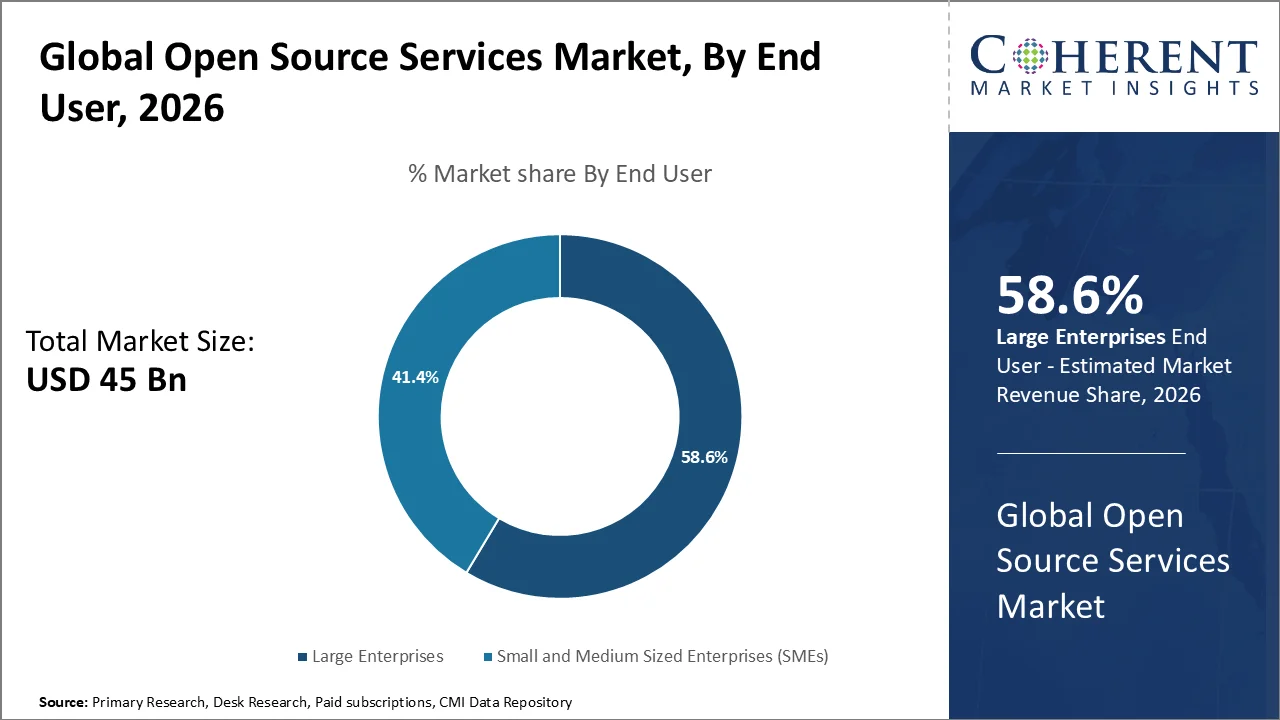
- The large enterprises segment is likely to dominate the market with 58.6% in 2026. The segment’s growth is owing to its high dependence on open-source platforms for cloud migration, application modernization, cybersecurity, DevOps, and infrastructure optimization.
- The managed services segment is set to lead with 34.2% in 2026. The segment’s growth is owing to the rising need for continual monitoring, patch management, migration support, compliance maintenance, and 24/7 technical assistance in Linux, Kubernetes, databases, middleware, and cloud-native platforms. More than 60% of organizations using open-source software are dependent on managed service providers for critical support as well as maintenance.
- The Banking, Financial Services & Insurance (BFSI) segment is set to lead with 24.2% in 2026. The segment’s growth is owing to the growing use of open-source software for digital banking platforms, risk analytics, data engineering, payment systems, AI/ML workloads, and secure application development. FINOS notes that financial services organizations are now moving from passive adoption to strategic open-source integration.
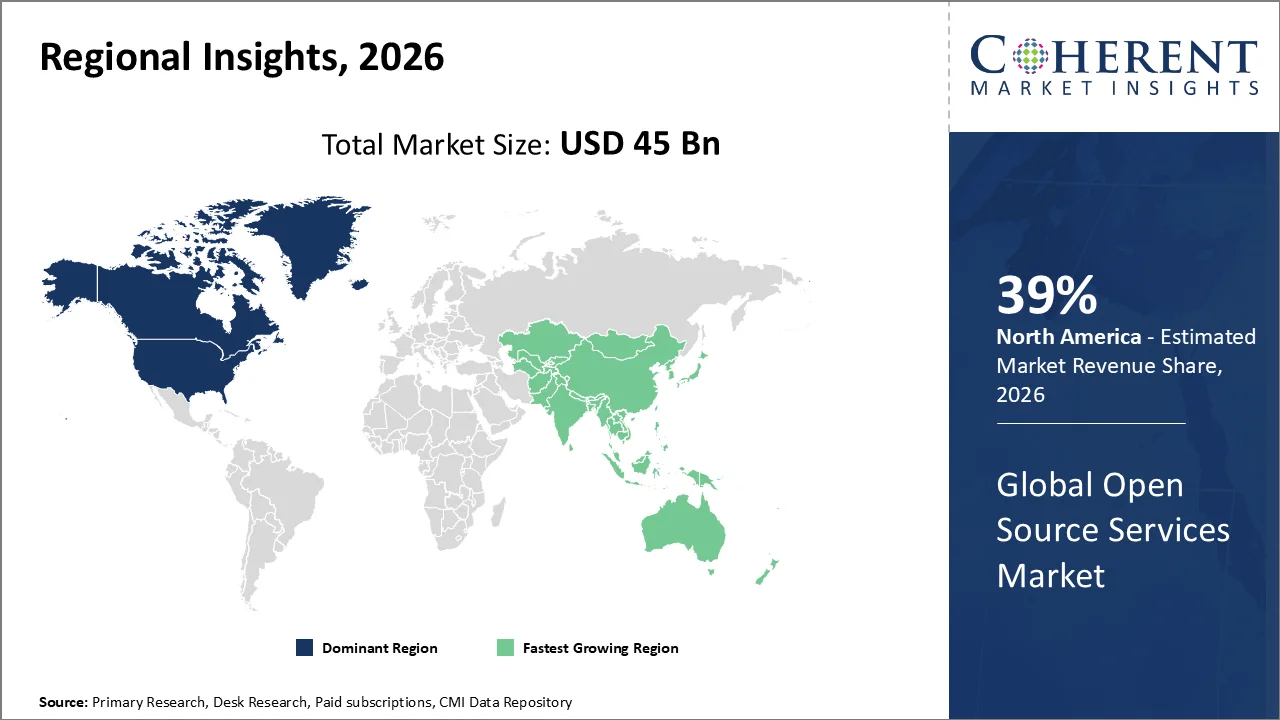
- North America is expected to acquire the prominent share of 39% in 2026. The region’s growth is owing to the strong enterprise cloud adoption, presence of major open-source service providers, mature DevOps culture, high cybersecurity spending, and rapid adoption of hybrid-cloud and AI workloads. Open Source Initiative’s 2026 report also highlights vendor lock-in concerns as a major adoption driver in North America.
Segmental Insights
Why is Large Enterprises Acquiring the Largest Share?
On the basis of end user, the large enterprises segment is projected to account for the largest Open Source Services Market share of 58.6% in 2026. The segment’s growth is owing to its extensive IT infrastructure and the need to manage complex open-source software (OSS) ecosystems across multiple business units. Large enterprises, typically employing more than 10,000 staff, face higher operational complexity, thus requiring dedicated resources for OSS maintenance, compliance, as well as security.
According to industry surveys, these enterprises are 2.4 times more likely to establish an Open Source Program Office (OSPO) compared to smaller organizations, thereby reflecting their proactive approach to governance and risk mitigation.
In addition, nearly 39% of large enterprises report challenges in meeting internal service level agreements (SLAs) for vulnerability remediation, thereby propelling the adoption of specialized managed services, consulting, and implementation support.
In May 2026, IBM and Red Hat launched the Project Lightwell, a USD 5 billion AI-driven platform that centralizes secure OSS maintenance and patching, thereby specifically targeting large enterprise OSS portfolios.
- Current Industry Events of 2026
- Market Size Estimation
- Regional Breakdown
- Competitive Landscape
- Customer Intelligence
- Segmental Analysis
- Pricing Analysis
- Key Market Drivers, Challenges & Future Trends
- Customized Insights Section
Managed Services hold the Largest Market Share
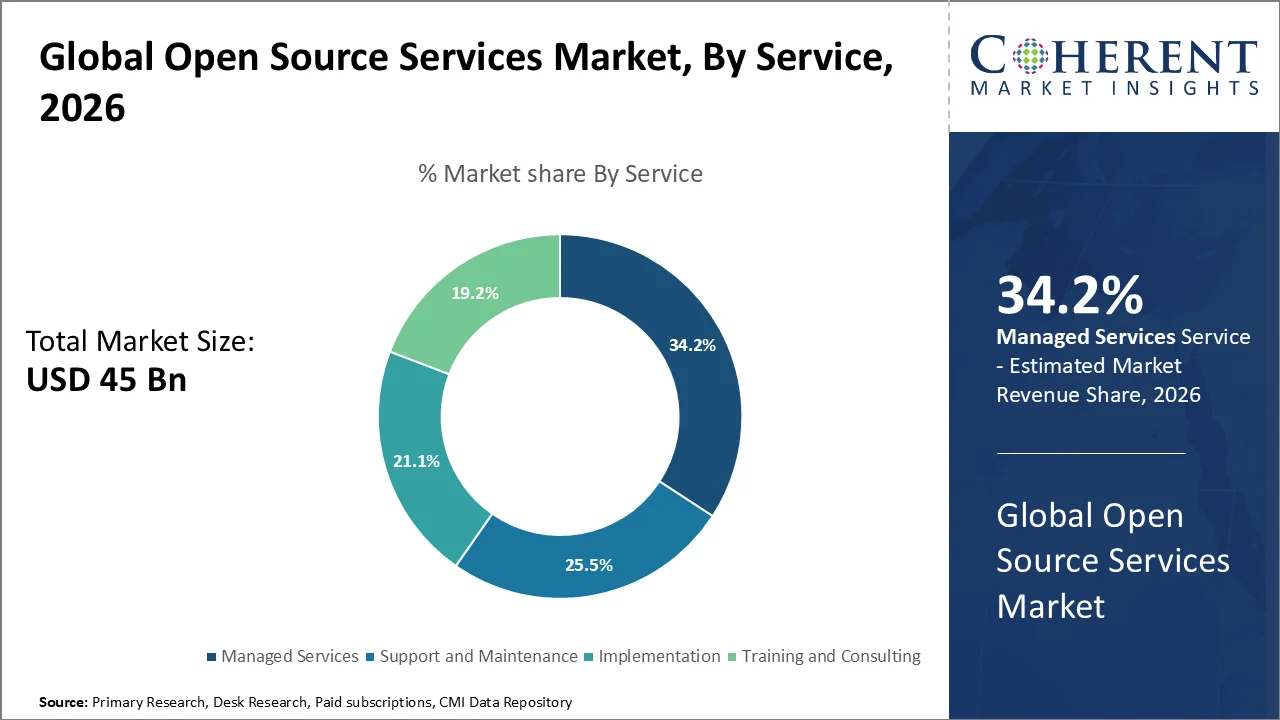
On the basis of service, the managed services segment lead with a major 34.2% share in 2026. The growth is owing to the widespread internal technical talent shortages and rising secure-by-design compliance requirements.
The Linux Foundation’s State of Tech Talent Report shows that 40% of companies are understaffed in compliance roles, and 57% lack sufficient capacity to secure and maintain open-source environments. This gap is creating a strong demand for managed services, thereby allowing the enterprises to outsource critical tasks like Day-2 operational maintenance, vulnerability patching, and security management.
In April 2026, Cognizant announced its acquisition of Astreya, a global AI-first IT managed services provider, enhancing Cognizant’s AI infrastructure, production-grade AI operations, and enterprise-scale managed services capabilities across 35+ countries.
Market Drivers
Shift to Cloud-Native & DevOps is Transforming the Open Source Services Market in the US
The shift toward cloud-native architectures and DevOps practices is significantly transforming the open source services market in the United States by driving efficiency, scalability, and faster innovation cycles. Organizations are adopting microservices, containerization, and orchestration platforms like Kubernetes to streamline development and deployment processes.
According to the U.S. Bureau of Economic Analysis (BEA), the annual software investments reached approximately USD 490 billion, with open-source software (OSS) forming a foundational layer for both public as well as private sector applications.
The studies by the National Institutes of Health (NIH) indicate that transitioning from proprietary systems to open-source platforms can yield up to 87% of cost savings for specialized implementations.
In May 2023, NIST, DoC, and Tetrate hosted the Fourth Annual Multi-Cloud Conference, focusing on Zero Trust Architecture for cloud-native applications, service mesh security, supply chain protection, and hands-on training with Istio, Kubernetes, and identity-centric access controls.
Open Source AI and GenAI Platforms Moving into Enterprise Production: A Major Breakthrough in the Open Source Services Market
Open-source AI and GenAI platforms are propelling substantial growth in the Open Source Services Market. It allows the enterprises to adopt advanced AI solutions with lower costs and higher flexibility. The modular, transparent, and collaborative nature of the services accelerates innovation, reduces vendor lock-in, and supports scalable deployments. The growing ecosystem of open-source projects and enterprise-ready tools is creating new opportunities for businesses to integrate AI at scale across industries.
According to the Stanford HAI 2026 AI Index, more than 5.6 million open-source AI projects exist on GitHub and Hugging Face, thereby reflecting a threefold growth since 2023 and highlighting robust global adoption. In India, a Competition Commission of India (CCI) study reports that 76% of AI startups utilize open-source technologies, driven by cost efficiency, transparency, and adaptability.
In June 2025, EPAM Systems, Inc. released the DIAL 3.0, an open-source GenAI enterprise platform enhancing AI adoption. The modular platform strengthens the innovation speed, long-term control, interoperability, and responsible governance, thereby reflecting EPAM’s vision for scalable, enterprise-level AI solutions.
Current Events and Their Impact on the Open Source Services Market
Current Event | Description and its Impact |
EU Cyber Resilience Act Strengthens Open-Source Software Compliance
|
|
U.S. Federal Software Supply Chain Policy Increases SBOM and Security Assurance Needs |
|
Open Source Services Market Trends
- Rising enterprise adoption of open source platforms reduces vendor lock-in, lowers software licensing costs, and improves deployment flexibility in cloud and hybrid IT environments.
- Cloud-native modernization is increasing the demand for Kubernetes, containerization, DevOps automation, observability, as well as managed open source support services.
- Growing use of open source AI frameworks and developer tools is boosting the demand for consulting, integration, model customization, governance, and lifecycle management services.
- Rising software supply chain security risks are propelling the demand for vulnerability scanning, secure patching, SBOM management, license compliance, and open source risk assessment services. In 2026, Black Duck reported that nearly 86% of audited codebases contained vulnerabilities, while about 91% contained outdated open source components.
- Regulatory focus on secure software development is strengthening the enterprise spending on open source governance. The EU Cyber Resilience Act and SBOM guidance from NSA/CISA are encouraging organizations to document third-party components, improve transparency, and adopt secure-by-design practices.
Regional Insights
North America Dominates Owing to the Mature Enterprise Adoption and Open-Source Commercialization
The North America region accounts for 39% of the market share in 2026. The region’s growth is owing to a mature enterprise adoption, strong digital transformation programs, and active venture-capital investment in commercial open-source startups. Enterprises across the region are increasingly using open-source platforms for cloud migration services, DevOps, cybersecurity, database modernization, and AI-enabled application development.
The recent surveys indicate that nearly 40% of organizations contribute to public open-source projects, thereby showing the deeper participation beyond basic software usage. In addition, SBOM generation among large enterprises has reached 39%, thereby reflecting a stronger focus on software supply-chain transparency and compliance.
In June 2025, Snowflake acquired Crunchy Data for USD 250 million, integrating the open-source PostgreSQL provider into its ecosystem to strengthen cloud-native data processing and launch Snowflake Postgres, supporting enterprise demand for scalable open-source database services.
Asia Pacific Open Source Services Market Trends
Asia Pacific is expected to witness strong growth in Open Source Services Market over the forecast period. The region’s growth is owing to the government-backed digital transformation, rising public-sector OSS adoption, and expanding developer ecosystems across China, Japan, and Singapore.
The Singapore Open Government Products organization’s repositories show 128 openreflecting active externally‑collaborative development that drives demand for related services such as integration, documentation, and support.
Japan is also strengthening public-sector OSS adoption, as IPA’s 2025 government OSS survey identified 22 Japanese government-related GitHub organizations and 626 repositories, creating demand for governance, compliance, repository management, and technical support.
In April 2026, Japan’s Digital Agency released the source code and materials for its Government AI “GENAI” as OSS, enabling local governments to build secure generative AI environments and supporting service opportunities around deployment and implementation.
Adoption of Open Source Software and Supportive Policy Frameworks are Accelerating the Market in United States
The U.S. Open Source Services Market is experiencing robust growth. The growth is driven by federal adoption of open-source software and supportive policy frameworks which increase the demand for integration, professional services, and ongoing support. According to Data.gov, the U.S. government’s open data catalog hosts 359,412 datasets, many of which rely on open-source tools and APIs that require maintenance, customization, and expert implementation.
The General Services Administration’s new Open Source Software Policy, effective January 2026, mandates an open-first approach to encourage collaboration and broader vendor participation. This policy facilitates easier engagement for service providers, thereby creating opportunities for open-source consulting, deployment, and technical support in federal projects.
China Open Source Services Market Trends
China’s Open Source Services Market is expanding through strong governmental support and strategic investments. Beijing’s Open Source Ecosystem Implementation Plan (2026–2028) aims to deploy 100 industry-specific open-source large models by 2028 and develop 10 internationally influential projects, with at least five in AI. Shanghai targets incubating over 200 high-quality projects and building a developer community exceeding 3 million by 2027, thereby stimulating the open-source services demand.
In November 2025, China Software International, Shenzhen Kaihong, and Easway Computing partnered to develop a dual open-source Hongmeng+RISC-V ecosystem, integrating chips, operating systems, and applications.
Who are the Major Companies in Open Source Services Industry
Some of the major key players in Open Source Services Market are Red Hat, Inc., Accenture PLC, Asysco, Bell Integrator, Inc., Capgemini SE, Cognizant, Fujitsu Ltd, Wipro Ltd., IBM Corporation, Infosys, Macrosoft Inc., Micro Focus International plc., Tech Mahindra, UST Global, Cisco Systems, Inc., Atos Information Technology Incorporated, HCL Technologies Ltd, HPE, and Oracle Corporation.
Key News
- In April 2026, RISE, under the Linux Foundation, launched free RISC-V GitHub Runners to support open-source projects with continuous integration on real RISC-V hardware. The service helps developers build, test, and validate RISC-V software without relying on emulation or costly hardware.
- In January 2026, Vybe Guide launched as an AI-powered open source discovery platform, offering a curated database of over 50,760 projects to assist developers in finding tools for AI-assisted and natural language–driven “vibe coding.” The platform supports the growing trend of AI-generated code, increasingly adopted by startups and developers worldwide.
Market Report Scope
Open Source Services Market Report Coverage
| Report Coverage | Details | ||
|---|---|---|---|
| Base Year: | 2025 | Market Size in 2026: | USD 45 Bn |
| Historical Data for: | 2020 To 2024 | Forecast Period: | 2026 To 2033 |
| Forecast Period 2026 to 2033 CAGR: | 14.3% | 2033 Value Projection: | USD 115 Bn |
| Geographies covered: |
| ||
| Segments covered: |
| ||
| Companies covered: | Red Hat, Inc., Accenture PLC, Asysco, Bell Integrator, Inc., Capgemini SE, Cognizant, Fujitsu Ltd, Wipro Ltd., IBM Corporation, Infosys, Macrosoft Inc., Micro Focus International plc., Tech Mahindra, UST Global, Cisco Systems, Inc., Atos Information Technology Incorporated, HCL Technologies Ltd, HPE, and Oracle Corporation. | ||
| Growth Drivers: |
| ||
| Restraints & Challenges: |
| ||
Analyst Opinion
- Open Source Services Market is driven by enterprise need for flexibility, security, and faster modernization. Linux Foundation states open source improves productivity for 86%, reduces vendor lock-in for 84%, and lowers ownership costs for 84%, making consulting, integration, and managed support critical for enterprises.
- Open source is now business-critical infrastructure, not just free software. In production environments, nearly 71% of organizations expect support response times of less than 12 hours, 53% expect long-term support guarantees, and 47% expect rapid security patching, thereby strengthening the demand for professional support services.
- Cloud-native, AI, and Kubernetes adoption are increasing the service requirements. Red Hat found 62% use enterprise open source for IT infrastructure modernization and 54% for digital transformation, while GitHub reported more than 1.1 million public repositories using LLM SDKs in 2025, thereby expanding the demand for implementation, governance, DevOps, and security advisory services.
Speak to the analyst
Want personalized insights?
Take the findings above to one of our principal consultants, or have the report rebuilt around the segments, geographies and competitors you actually track.
Market Segmentation
- By End User (Revenue, USD Bn, 2021-2033)
- Small and Medium Sized Enterprises (SMEs)
- Large Enterprises
- By Service (Revenue, USD Bn, 2021-2033)
- Managed Services
- Support and Maintenance
- Training and Consulting
- Implementation
- By Industry (Revenue, USD Bn, 2021-2033)
- Banking, Financial Services & Insurance (BFSI)
- Government
- IT & Telecom
- Manufacturing
- Healthcare & Life Sciences
- Retail
- Others
- By Region (Revenue, USD Bn, 2021-2033)
- North America
- U.S.
- Canada
- Latin America
- Brazil
- Mexico
- Argentina
- Rest of Latin America
- Europe
- Germany
- U.K.
- France
- Italy
- Spain
- Russia
- Rest of Europe
- Asia Pacific
- China
- India
- Japan
- Australia
- South Korea
- ASEAN
- Rest of Asia Pacific
- Middle East
- GCC
- Israel
- Rest of Middle East
- Africa
- South Africa
- Central Africa
- North Africa
- North America
Sources
Primary Research Interviews
- Open Source Software Service Providers
- Open Source Consulting Firms
- System Integrators & Implementation Partners
- Cloud & DevOps Solution Providers
- Enterprise IT Heads & CIOs
- Open Source Security & Compliance Consultants
- Managed Service Providers
- Others
Databases
- Bloomberg Terminal
- Thomson Reuters Eikon
- S&P Global Market Intelligence
- Gartner
- IDC
- Crunchbase
- D&B Hoovers
- Others
Magazines
- The New Stack
- InfoWorld
- Linux Magazine
- CIO Magazine
- SDxCentral
- Computer Weekly
- Others
Journals
- Journal of Open Source Software
- IEEE Software
- ACM Transactions on Software Engineering and Methodology
- Empirical Software Engineering Journal
- Information and Software Technology Journal
- Journal of Systems and Software
- Others
Newspapers
- Financial Times
- The Wall Street Journal
- Reuters
- Bloomberg News
- The Economic Times
- Business Standard
- Others
Associations
- The Linux Foundation
- Open Source Initiative (OSI)
- Cloud Native Computing Foundation (CNCF)
- Apache Software Foundation
- Eclipse Foundation
- Open Source Security Foundation (OpenSSF)
- Others
Public Domain Sources
- European Commission – Open Source Observatory (OSOR)
- U.S. General Services Administration – Open Source Policy
- National Institute of Standards and Technology (NIST)
- World Bank Open Data
- OECD Digital Economy Outlook
- GitHub Octoverse
- Others
Proprietary Elements
- CMI Data Analytics Tool
- Proprietary CMI Existing Repository of Information for the Last 8 Years
Get access to 250+ pages report
Every segment, forecast, competitor profile and data table behind the analysis above — available for instant download.
- ESOMAR Member
- ISO 9001:2015 Certified
- D-U-N-S Registered
- GDPR & CCPA Compliant
Missing comfort of reading report in your local language? Find your preferred language:
Transform your Strategy with Exclusive Trending Reports
Frequently Asked Questions
The Open Source Services Market is expected to reach USD 115 Bn in 2033.
Major players operating in the global Open Source Services Market include Red Hat, Inc., Accenture PLC, Asysco, Bell Integrator, Inc., Capgemini SE, Cognizant, Fujitsu Ltd, Wipro Ltd., IBM Corporation, Infosys, Macrosoft Inc., Micro Focus International plc., Tech Mahindra, UST Global, Cisco Systems, Inc., Atos Information Technology Incorporated, HCL Technologies Ltd, HPE, and Oracle Corporation.
The concerns over security vulnerabilities and malware exposure, the shortage of skilled professionals required to manage and integrate complex ecosystems, and the lack of standardized vendor support or formal service level agreements (SLAs) are the key factors hampering growth of the market.
The rising cloud adoption, enterprise digital transformation, increasing demand for cost-effective software, growth of DevOps and Kubernetes, cybersecurity requirements, and wider use of open-source tools in AI and data analytics is boosting the demand for Open Source Services.
The Open Source Services Market is anticipated to grow at a CAGR of 14.3% between 2026 and 2033.
Among regions, North America is expected to account for a largest market share in the global Open Source Services Market over the forecast period.
Enterprises are adopting open-source services to reduce software licensing costs, avoid vendor lock-in, improve flexibility, accelerate innovation, and customize solutions according to business needs.