

Unmanned Ground Vehicle Market Size and Forecast: 2026 to 2033
Unmanned Ground Vehicle Market is estimated to be valued at USD 2,702.4 Mn in 2026 and is expected to reach USD 6,345.8 Mn in 2033, exhibiting a compound annual growth rate (CAGR) of 13.0% from 2026 to 2033.
Key Takeaways
- By Mobility Type, Wheeled hold the largest market share in 2026 owing to its rapid technological advances in robotics, AI & sensors.
- By Mode of Operation, Tele-Operated expected to hold largest market share in 2026 owing to the safety & risk‑avoidance in hazardous.
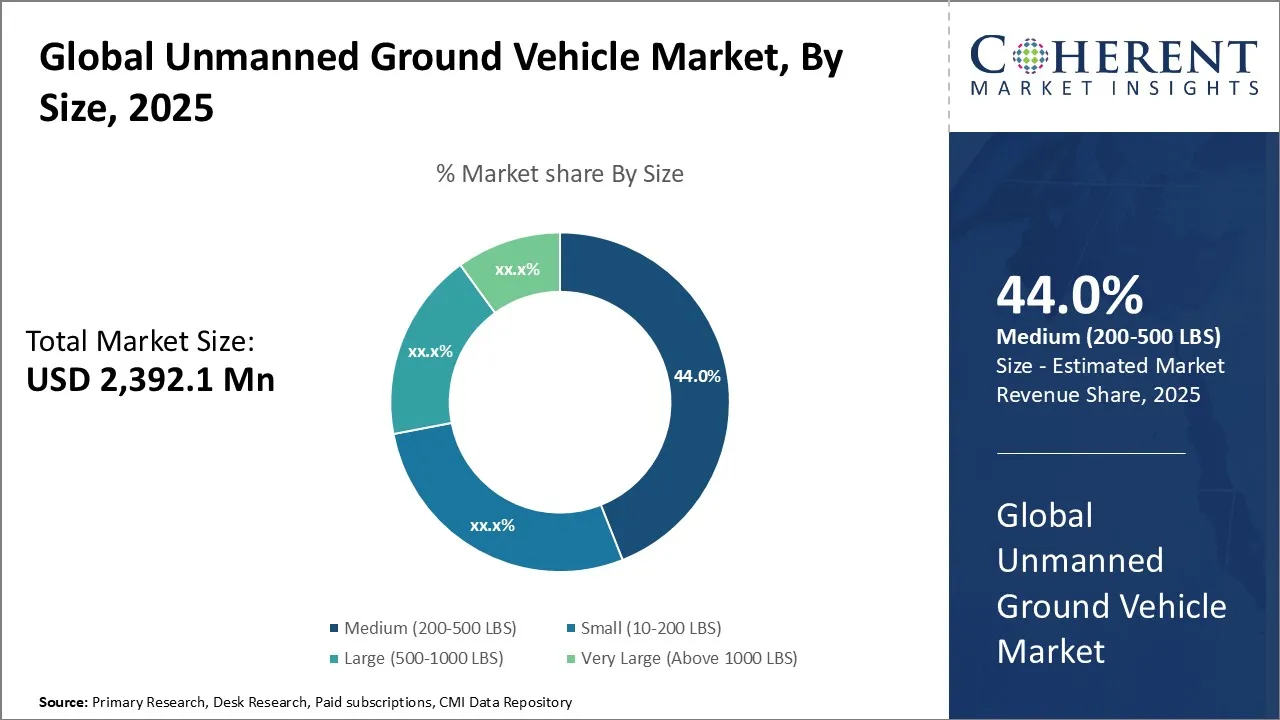
- By Size, Medium (200-500 LBS) acquired the prominent market share of 45% in 2026 owing to the balance between deployability and capability.
- By System, Payloads dominates the overall market share in 2026 owing to the defense modernization & multi‑mission requirements.
- By End User, Defense and Security hold the largest market share in 2026 owing to its rising defense modernization & increased military spending.
- By Region, North America dominates the overall market with an estimated share of 35% in 2026 owing to the high defense & security spending and military modernization.
Market Overview
The Unmanned Ground Vehicle (UGV) market is rapidly expanding as defense forces modernize, technology advances, and industries adopt UGVs across military, security, industrial, and commercial applications. UGVs enhance operations by performing reconnaissance, surveillance, logistics support, and hazardous tasks while keeping personnel safe. Developers are improving autonomous navigation, sensor integration, and modular payload systems to boost versatility and efficiency. Organizations increasingly rely on UGVs for risk reduction, remote operation, and multi-mission capabilities, making them vital assets in contemporary defense and industrial operations.
Current Events and Its Impact on the Unmanned Ground Vehicle Market
Current Events | Description and its impact |
Geopolitical Tensions and Defense Spending |
|
Technological Advancements and Integration |
|
Regulatory and Ethical Framework Developments |
|
Segmental Insights
- Current Industry Events of 2026
- Market Size Estimation
- Regional Breakdown
- Competitive Landscape
- Customer Intelligence
- Segmental Analysis
- Pricing Analysis
- Key Market Drivers, Challenges & Future Trends
- Customized Insights Section
Unmanned Ground Vehicle Market Insights, By Size - Medium (200-500 LBS) contribute the highest share of the market owing to its balanced payload capacity, endurance and mobility
Medium (200-500 LBS) acquired the prominent market share of 45% in 2026. Users increasingly adopt medium-sized Unmanned Ground Vehicles (200–500 lbs) for their balanced payload capacity, mobility, and endurance, which make them versatile across multiple missions. They transport advanced sensors, manipulators, or cargo while remaining easy to deploy. Defense, security, industrial, and disaster-response teams rely on them to conduct reconnaissance, inspection, logistics, and surveillance tasks efficiently. Ongoing advancements in modular payloads, autonomous navigation, and power systems actively improve their adaptability, cost-effectiveness, and operational performance across a wide range of applications.
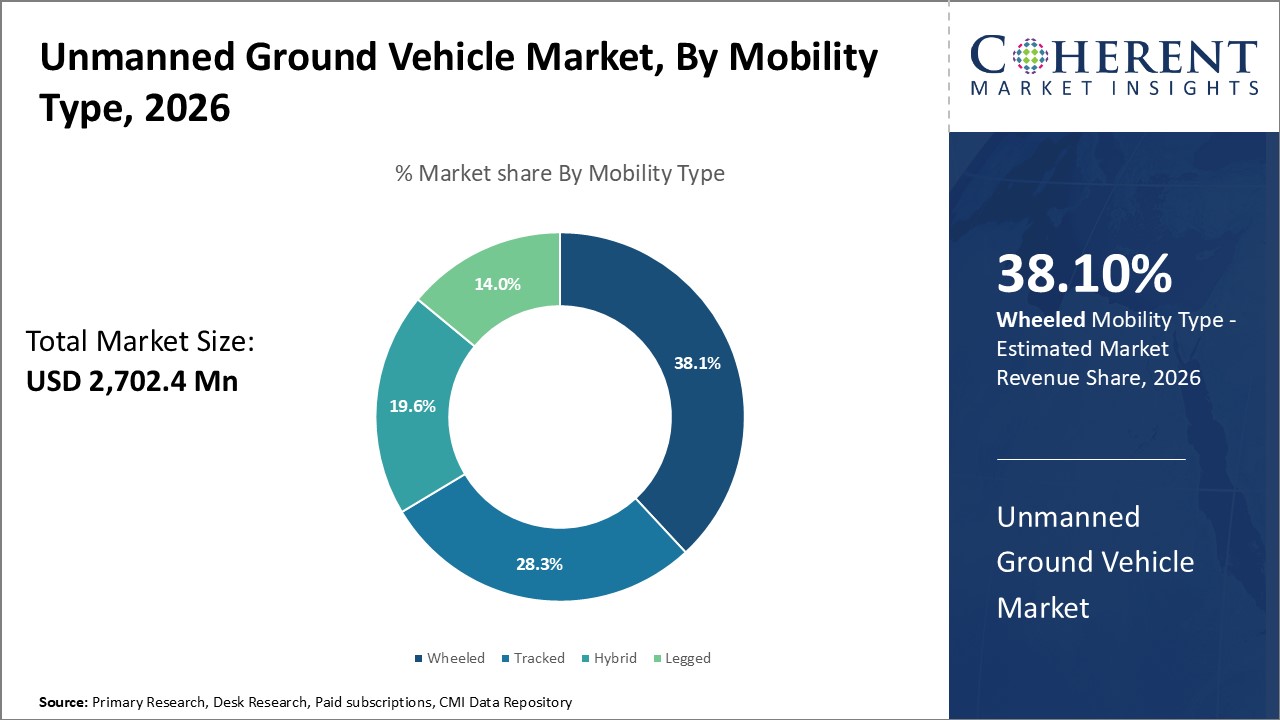
Unmanned Ground Vehicle Market Insights, By Mobility Type - Wheeled contribute the highest share of the market owing to its energy efficiency & lower operating cost
Wheeled Unmanned Ground Vehicles (UGVs) are gaining traction because they deliver high energy efficiency, lower maintenance requirements, and faster mobility on paved or semi-paved surfaces. Their simple mechanical design allows operators to run them cost-effectively and deploy them easily, making them ideal for commercial, industrial, and urban tasks such as logistics, surveillance, and infrastructure inspection. Advancements in sensors, autonomous systems, and navigation technologies further boost their versatility, while growing demand for automation and robotics in civilian and defense sectors drives their adoption. For instance, in October 2025, Milrem Robotics has launched the Havoc 8×8 combat unmanned ground vehicle (UGV), the largest wheeled combat vehicle produced by the Estonia-based Edge Group subsidiary.
Unmanned Ground Vehicle Market Insights, By Mode of Operation - Tele-Operated contribute the highest share of the market owing to its proven reliability & human-in-the-loop control
Organizations increasingly adopt tele-operated Unmanned Ground Vehicles (UGVs) because they allow human-in-the-loop control in hazardous or unpredictable environments, ensuring safety and precise operations. Operators rely on them for tasks such as reconnaissance, explosive ordnance disposal, surveillance, and disaster response, where real-time judgment is essential. Advances in secure communications, remote-control systems, and modular payload integration expand their capabilities. Rising demands for automation, risk mitigation, and flexible mission performance in defense, security, and industrial applications actively drive the deployment of tele-operated UGVs.
Unmanned Ground Vehicle Market Insights, By System - Payloads contribute the highest share of the market owing to its payloads define the mission‑capabilities
Organizations increasingly drive demand for payloads in Unmanned Ground Vehicles (UGVs) because they enable versatile, mission-specific capabilities. By equipping UGVs with sensors, cameras, manipulators, communication modules, and cargo systems, operators perform defense, industrial, and disaster-response tasks safely and efficiently. Advances in modular designs, compact sensors, and autonomous integration actively enhance UGV functionality and adaptability. Users rely on payload-equipped UGVs to conduct reconnaissance, inspection, surveillance, hazardous-material handling, and logistics, making these vehicles essential for flexible and cost-effective operations. For instance, in December 2025, Milrem Robotics, a global leader in robotics and autonomous systems, will unveil ARCOS at DSEI 2025. This next-generation software suite enables synchronized control, mission planning, and real-time management of multiple UGVs and their payloads, transforming how operators handle robotic fleets in the field.
Unmanned Ground Vehicle Market Insights, By End User - Defense & Security contribute the highest share of the market owing to its rising defense budgets & military modernization programs
Defense and security forces increasingly adopt Unmanned Ground Vehicles (UGVs) to carry out high-risk operations safely and efficiently. They deploy UGVs for reconnaissance, surveillance, explosive ordnance disposal, border security, and logistics in hazardous or hostile environments, minimizing personnel risk. Advances in autonomous systems, sensors, communications, and modular payloads actively enhance UGV capabilities. Growing demands for mission versatility, rapid deployment, and automation in modern defense and security operations continue to drive global adoption of these vehicles. For instance, in May 2025, Spanish defense firm EM&E Group unveiled the aunav.BEST, a medium-sized, multi-role UGV, at FEINDEF 2025 in Madrid. The vehicle performs reconnaissance, surveillance, EOD/C-IED tasks, CBRN assessment, logistical support, casualty evacuation, and can operate as a weapon platform.
Role of AI in Unmanned Ground Vehicle Market
Artificial intelligence (AI) is revolutionizing the unmanned ground vehicle (UGV) market by enabling autonomous navigation, real-time decision-making, and advanced sensor fusion. AI equips UGVs to quickly analyze complex environments, navigate around obstacles, and carry out missions with minimal human input, improving efficiency and safety. In defense, logistics, and industrial sectors, AI allows UGVs to conduct reconnaissance, transport supplies, and handle hazardous tasks more effectively. This AI integration is transforming UGVs from remote-controlled devices into semi-autonomous frontline assets.
In April 2025, Overland AI unveiled ULTRA, its new uncrewed tactical ground platform. The Seattle company describes ULTRA as a fully autonomous, easily configurable system built around its OverDrive software, SPARK hardware architecture, and modular payload options—including UAS and counter-UAS capabilities.
Regional Insights
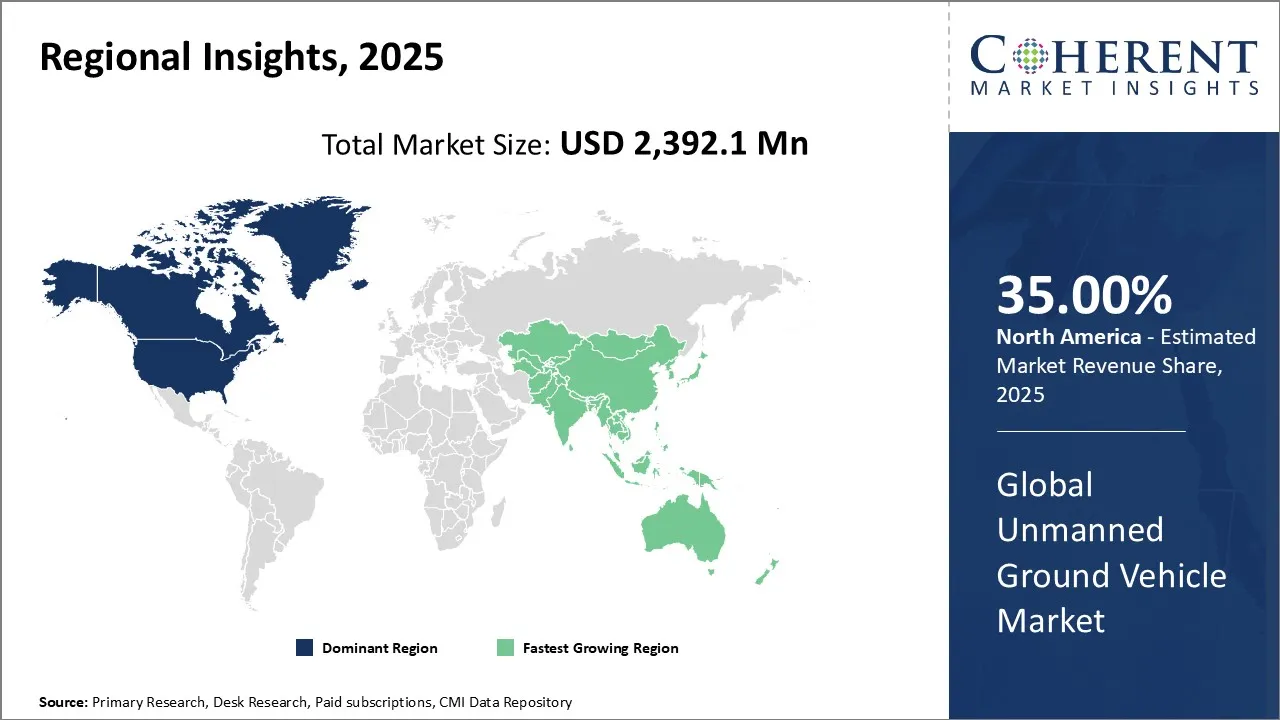
North America Unmanned Ground Vehicle Market Trends
North America dominates the overall market with an estimated share of 35% in 2026. The United States drives the North American unmanned ground vehicle (UGV) market, maintaining its global leadership through robust defense budgets, advanced robotics expertise, and established manufacturers. Industries are increasingly adopting UGVs beyond military use, deploying them in logistics, agriculture, mining, and industrial automation to enhance safety and efficiency through remote and autonomous operations. Technological innovations, including AI-powered navigation, sensor integration, and modular designs, are enhancing performance and enabling flexible deployment. However, high production and maintenance costs, along with limited platform standardization, continue to challenge the market. For instance, The Javelin Joint Venture team, a collaboration between Raytheon and Lockheed Martin, launched Javelin missiles from a Kongsberg remote launcher mounted on a Titan UGV developed by QinetiQ North America and Milrem Robotics.
Asia Pacific Unmanned Ground Vehicle Market Trends
The Asia Pacific region is rapidly adopting unmanned ground vehicles (UGVs) across defense, security, and industrial sectors. Companies and governments are investing heavily in advanced robotics, artificial intelligence, and autonomous technologies, driving innovations in UGV capabilities such as surveillance, logistics, and combat support. Organizations are increasingly deploying unmanned solutions to boost operational efficiency and minimize human risk. Governments and private firms are collaborating to accelerate development, while advancements in sensors, navigation systems, and payload integration continue to transform the region’s UGV market.
India has initiated a development project for an Extra Large Unmanned Underwater Vehicle (XLUUV) to address delays in acquiring six locally built diesel-electric submarines with air-independent propulsion.
United States Unmanned Ground Vehicle Market Trends
The United States is rapidly expanding the use of unmanned ground vehicles (UGVs) across defense, security, and select civilian sectors. The U.S. Department of Defense and other government agencies are actively investing in developing UGVs for surveillance, reconnaissance, explosive‑ordnance disposal, and logistics support. Advances in artificial intelligence, autonomous navigation, sensor fusion, and modular payload integration are actively enhancing UGV capabilities and mission flexibility. At the same time, organizations are increasingly employing UGVs for non‑military purposes such as disaster response, industrial operations, and remote inspections, broadening their applications nationwide. For instance, in November 2026, A US firm launched FireAnt, a compact UGV that detects, tracks, and engages heavy armored vehicles like tanks, operating in coordinated groups under a single human operator.
China Unmanned Ground Vehicle Market Trends
China is rapidly deploying unmanned ground vehicles (UGVs) across military, industrial, and commercial sectors. The government actively invests in defense‑grade UGVs and uses them for border surveillance, combat support, and missions in hazardous or difficult terrains. Simultaneously, domestic industries are adopting UGVs for mining, agriculture, logistics, and remote inspections, applying advances in AI, autonomous navigation, sensor fusion, and modular payload systems to boost efficiency and safety. This combined effort by the state and industry is strengthening China’s leadership in UGV innovation and deployment
End-user Feedback and Unmet Needs in the Unmanned Ground Vehicle Market
- Defense and Military Requirements: End-users in defense demand UGVs with enhanced mobility, payload capacity, and ruggedness for combat and reconnaissance missions. Operators seek improved real-time communication, autonomous navigation in complex terrains, and better integration with existing military systems. Current gaps include durability under extreme conditions and extended operational endurance.
- Industrial and Commercial Applications: Industrial users require UGVs that optimize efficiency in logistics, mining, and agriculture. Feedback highlights the need for precise automation, flexible payload options, and easy maintenance. Challenges include adapting to dynamic work environments, interoperability with other machines, and affordability, which limits broader deployment in commercial and industrial operations.
- Safety and Human-Machine Interaction: End-users emphasize UGVs that minimize human risk while ensuring intuitive controls and monitoring. Current limitations include insufficient obstacle detection, complex user interfaces, and limited fail-safe mechanisms. Operators seek UGVs capable of safely collaborating with humans in hazardous or crowded environments, enhancing both productivity and operational security.
Unmanned Ground Vehicle Market Trend
Advances in Autonomous Navigation & Sensing
UGV systems increasingly incorporate advanced sensors (LiDAR, radar, cameras), AI-driven perception and autonomous navigation software — enabling vehicles to traverse complex terrain, avoid obstacles, and operate with minimal human intervention. This technological progress expands UGV use beyond simple tele‑operation, enabling roles in surveillance, reconnaissance, and hazardous‑environment operations where precision and reliability are critical. Improved autonomy and situational awareness make UGVs viable in more varied and demanding settings across defense, industrial, and commercial sectors.
Expansion from Military to Industrial and Commercial Applications
While military and defense remain core markets, UGV adoption is spreading into industrial sectors like mining, logistics, agriculture, infrastructure inspection, and disaster response. Industries value UGVs for handling dangerous tasks, improving efficiency, and reducing human exposure to risk. This diversification means UGVs are no longer niche defense tools: they’re evolving into multi‑purpose platforms serving broader commercial demands — from automating material handling to performing remote inspections in hazardous industrial environments.
Unmanned Ground Vehicle Market Opportunity
Broader Industrial & Commercial Adoption Beyond Defense
UGVs now have strong potential beyond military use — industries such as mining, agriculture, logistics, construction and utilities increasingly need automated, safe, and efficient operations. UGVs can handle hazardous material transport, remote inspections, soil analysis, precision farming, warehouse logistics, and infrastructure maintenance. This shift reduces reliance on manual labor, lowers workplace risks, and boosts productivity, making UGVs attractive tools for firms seeking automation and cost‑effective solutions in demanding environments.
Market Report Scope
Unmanned Ground Vehicle Market Report Coverage
| Report Coverage | Details | ||
|---|---|---|---|
| Base Year: | 2025 | Market Size in 2026: | USD 2,702.4 Mn |
| Historical Data for: | 2020 To 2024 | Forecast Period: | 2026 To 2033 |
| Forecast Period 2026 to 2033 CAGR: | 13.0% | 2033 Value Projection: | USD 6,345.8 Mn |
| Geographies covered: |
| ||
| Segments covered: |
| ||
| Companies covered: | Northrop Grumman Corporation, BAE Systems, Lockheed Martin Corporation, Clearpath Robotics Inc., John Bean Technologies Corporation, ECA Group, Israel Aerospace Industries Ltd., Endeavor (Now a part of FLIR system), Harris Corporation, and General Dynamics | ||
| Growth Drivers: |
| ||
| Restraints & Challenges: |
| ||
Unmanned Ground Vehicle Market News
- In October 2025, Miami-Dade County debuted the nation’s first autonomous patrol vehicle, the Police Unmanned Ground Vehicle (PUG) Patrol Partner, in a pilot program developed by Policing Lab in partnership with the Miami-Dade Sheriff’s Office (MDSO).
- In August 2025, The USMC procured Amphibious UGVs from Greensea IQ to support the LEON system, enhancing mine countermeasure and subsea threat mitigation in littoral operations.
- In August 2025, ARX Robotics, a European defense-tech firm, launched Combat Gereon, its first combat-capable UGV, designed to enhance soldier safety by handling dangerous frontline tasks.
Analyst Opinion (Expert Opinion)
- The medium-class UGV segment (approximately 401–2,500 lb) has emerged as the backbone of the global market, capturing approximately 42.7% of revenue. This dominance reflects the optimal balance these UGVs offer between payload capacity, mobility, and adaptability, enabling a single platform to perform reconnaissance, logistics, supply transport, or light combat support depending on the payload. In volatile conflict zones and rugged terrain, this versatility renders them more practical than bulky heavy-duty platforms or fragile small-scale robots.
- The increasing adoption of tracked mobility systems—accounting for nearly half of market revenue—demonstrates alignment with operational requirements. Tracked UGVs provide superior traction and terrain-handling capabilities, essential for rubble-strewn urban battlefields, mine-laden zones, and off-road industrial sites. Their resilience under hostile or unstable ground conditions has driven procurement agencies, both defense and disaster response, to favor tracked platforms over wheeled or hybrid designs.
- Technological advancements have further accelerated market growth. In 2023, over 65% of newly deployed UGV units incorporated AI-driven navigation and sensor fusion modules, enabling sub-second path planning and obstacle avoidance with nearly 98% accuracy. This advancement significantly reduces operator workload and facilitates effective remote deployment in high-risk environments, transforming UGVs from remote-controlled support tools into semi-autonomous frontline assets.
- Real-world operations illustrate this transition. In February 2025, the armed forces of one conflict zone nation deployed robotic ground vehicles for mine clearing, reconnaissance, and frontline logistics, signaling that UGVs are entering mainstream combat and operational use. These deployments confirm that unmanned ground systems are evolving from experimental technology into integral force multipliers, with value now rooted in demonstrated capability rather than conceptual potential.
Speak to the analyst
Want personalized insights?
Take the findings above to one of our principal consultants, or have the report rebuilt around the segments, geographies and competitors you actually track.
Market Segmentation
- Global Unmanned Ground Vehicle Market, By Mobility Type
- Wheeled
- Tracked
- Hybrid
- Legged
- Global Unmanned Ground Vehicle Market, By Mode of Operation
- Tele-Operated
- Autonomous
- Global Unmanned Ground Vehicle Market, By Size
- Small (10-200 LBS)
- Medium (200-500 LBS)
- Large (500-1000 LBS)
- Very Large (Above 1000 LBS)
- Global Unmanned Ground Vehicle Market, By System
- Payloads
- Navigation and Control System
- Power System
- Others
- Global Unmanned Ground Vehicle Market, By End User
- Defense and Security
- Commercial
- Regional Insights (Revenue, USD Mn, 2021 - 2033)
- North America
- U.S.
- Canada
- Latin America
- Brazil
- Argentina
- Mexico
- Rest of Latin America
- Europe
- Germany
- U.K.
- Spain
- France
- Italy
- Russia
- Rest of Europe
- Asia Pacific
- China
- India
- Japan
- Australia
- South Korea
- ASEAN
- Rest of Asia Pacific
- Middle East
- GCC Countries
- Israel
- Rest of Middle East
- Africa
- South Africa
- North Africa
- Central Africa
- North America
- Key Players Insights
- Northrop Grumman Corporation
- BAE Systems
- Lockheed Martin Corporation
- Clearpath Robotics Inc.
- John Bean Technologies Corporation
- ECA Group
- Israel Aerospace Industries Ltd.
- Endeavor (Now a part of FLIR system)
- Harris Corporation
- General Dynamics
Sources
Primary Research interviews
- Interviews with defense technology experts, UGV manufacturers, and robotics engineers
- Discussions with military procurement officers and autonomous systems specialists
- Insights from academic researchers in robotics and artificial intelligence
Databases
- IEEE Xplore Digital Library
- Scopus
- US Department of Defense technology databases
- NATO Science and Technology Organization (STO) database
Magazines
- Robotics Business Review
- Military & Aerospace Electronics
- Jane’s Defence Weekly
- Autonomous Systems Magazine
Journals
- Journal of Field Robotics
- Robotics and Autonomous Systems
- International Journal of Advanced Robotic Systems
- Defense Technology Journal
Newspapers
- The New York Times (Technology Section)
- The Guardian (Science and Technology Section)
- Defense News
- The Washington Post (Defense Section)
Associations
- Association for Unmanned Vehicle Systems International (AUVSI)
- Institute of Electrical and Electronics Engineers (IEEE) Robotics & Automation Society
- International Society of Automation (ISA)
Public Domain sources
- U.S. Department of Defense reports and press releases
- NATO publications on autonomous ground systems
- Patent filings on unmanned ground vehicle technologies
- Open-access research articles on robotics and UGVs
Proprietary Elements
- CMI Data Analytics Tool
- Proprietary CMI Existing Repository of information for last 8 years
Get access to 250+ pages report
Every segment, forecast, competitor profile and data table behind the analysis above — available for instant download.
- ESOMAR Member
- ISO 9001:2015 Certified
- D-U-N-S Registered
- GDPR & CCPA Compliant
Missing comfort of reading report in your local language? Find your preferred language:
Transform your Strategy with Exclusive Trending Reports
Frequently Asked Questions
The Unmanned Ground Vehicle Market is estimated to be valued at USD 2,702.4 Mn in 2026, and is expected to reach USD 6,345.8 Mn by 2033.
The CAGR of the Unmanned Ground Vehicle Market is projected to be 13.0% from 2026 to 2033.
Increasing modernization and expenditure on defense industry and rise in capital investment for robotics technologies are fuelling the growth of market.
The Medium (200-500 LBS) segment is the leading component segment in the market.
Need for developing reliable systems for critical missions and navigating through unmanned regions and complexity of UGVs are the major factors restraining growth of the market.
Northrop Grumman Corporation, BAE Systems, Lockheed Martin Corporation, Clearpath Robotics Inc., John Bean Technologies Corporation, ECA Group, Israel Aerospace Industries Ltd., Endeavor (Now a part of FLIR system), Harris Corporation, and General Dynamics