

Entertainment Robots Market Size and Forecast — 2026 - 2033
The Global Entertainment Robots Market size is estimated to be valued at USD 2.8 billion in 2026 and is expected to reach USD 7.1 billion by 2033, exhibiting a compound annual growth rate (CAGR) of 14.8% from 2026 to 2033.
Overview
The Entertainment Robots market offers a diverse range of products designed to engage, educate, and entertain users across age groups and settings. Key product categories include humanoid robots, which interact through speech, gestures, and facial expressions, and animal-inspired robots that mimic pets for companionship and amusement. Educational entertainment robots combine learning and play, integrating STEM concepts with interactive experiences. Robotic toys and gaming robots provide immersive play and virtual reality integration, enhancing user engagement. Advanced robotic platforms feature AI-driven personalization, voice recognition, and motion sensors, enabling adaptive responses. Continuous innovation focuses on interactivity, connectivity, and lifelike design to expand adoption in homes, theme parks, and educational institutions.
Key Takeaways
Humanoid robots dominate the Entertainment Robots Market, capturing approximately 38% of the market share due to their versatile applications in entertainment and user interaction.
Theme parks are the leading application area, driving growth through immersive experiences and accounting for 35% of total market revenue.
AI-enabled technology is the fastest-growing subsegment, with 42% adoption accelerating product development and market expansion.
North America retains regional dominance, supported by advanced technological infrastructure, favorable regulations, and strong consumer demand, representing over 35% of the global market share.
Asia Pacific exhibits the fastest CAGR, driven by rapid urbanization, rising disposable incomes, and increased investments in robotics innovation.
Europe’s mature market shows steady growth, fueled by the integration of entertainment robotics across commercial and public spaces.
Entertainment Robots Market Segmentation Analysis
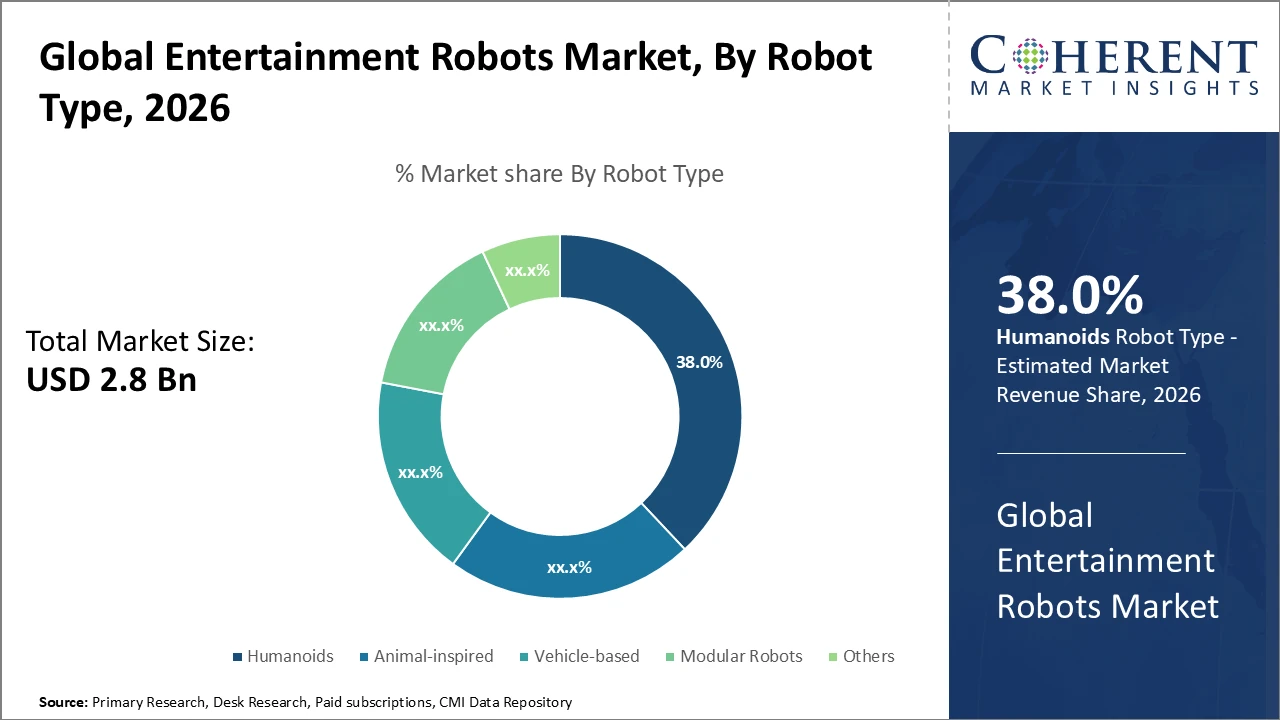
Entertainment Robots Market Insights, By Robot Type
Humanoid robots dominate the Entertainment Robots market due to their versatility across applications, ranging from theme parks to home entertainment, securing their leading position. Their human-like interaction capabilities meet growing consumer demand for lifelike robots, enhancing engagement and user experience. Animal-inspired robots are the fastest-growing subsegment, fueled by educational and therapeutic applications appealing to children and young users. Vehicle-based robots, commonly deployed in theme park animatronics and retail logistics, maintain a moderate market presence. Modular robots are gaining traction for their customizable architectures, enabling personalized experiences. Other robot types address niche applications with emerging demand and potential growth.
Entertainment Robots Market Insights, By Application
Theme parks dominate the Entertainment Robots market, driven by significant investments in enhancing guest experiences and the widespread integration of interactive robots, accounting for over one-third of total revenue. The fastest-growing subsegment is home entertainment, expanding rapidly as consumers adopt AI-enabled robots for personal amusement, particularly amid increasing remote lifestyles. Retail and commercial applications are gradually growing, emphasizing customer engagement and personalized shopping experiences. The education segment maintains steady growth, supported by STEM-focused initiatives and interactive learning adoption. Other applications, including exhibitions and fairs, show limited but promising uptake, indicating emerging opportunities in niche entertainment sectors.
Entertainment Robots Market Insights, By Technology
AI-enabled robots lead the Entertainment Robots market, driven by their advanced adaptability and interactivity, which are shaping next-generation entertainment experiences. Their rapid growth is fueled by improvements in natural language processing and sensory integration, significantly enhancing user engagement. Remote-controlled robots maintain a stable presence in simpler applications, while autonomous robots are increasingly preferred for self-operational capabilities, especially in theme park environments. Hybrid models that combine remote control with autonomous functionality are gaining traction, offering both flexibility and operational efficiency. Other emerging technologies include experimental platforms that enable novel user experiences, expanding the future scope of the market.
Entertainment Robots Market Trends
The industry is increasingly adopting AI-driven interactive robots, highlighted by the 2025 launch of autonomous entertainment robots with real-time adaptive learning capabilities by leading companies.
These AI-enabled developments have expanded market applications beyond traditional amusement parks into retail and educational environments, boosting revenue potential.
Customized modular robots are gaining prominence, allowing users to tailor devices for specific entertainment experiences.
Asia Pacific markets have shown significant uptake of modular and AI-driven robots, reflecting rising consumer interest and technological adoption since 2024.
Overall trends indicate a shift toward personalization, interactivity, and cross-sector integration in the Entertainment Robots market.
Entertainment Robots Market Insights, By Geography
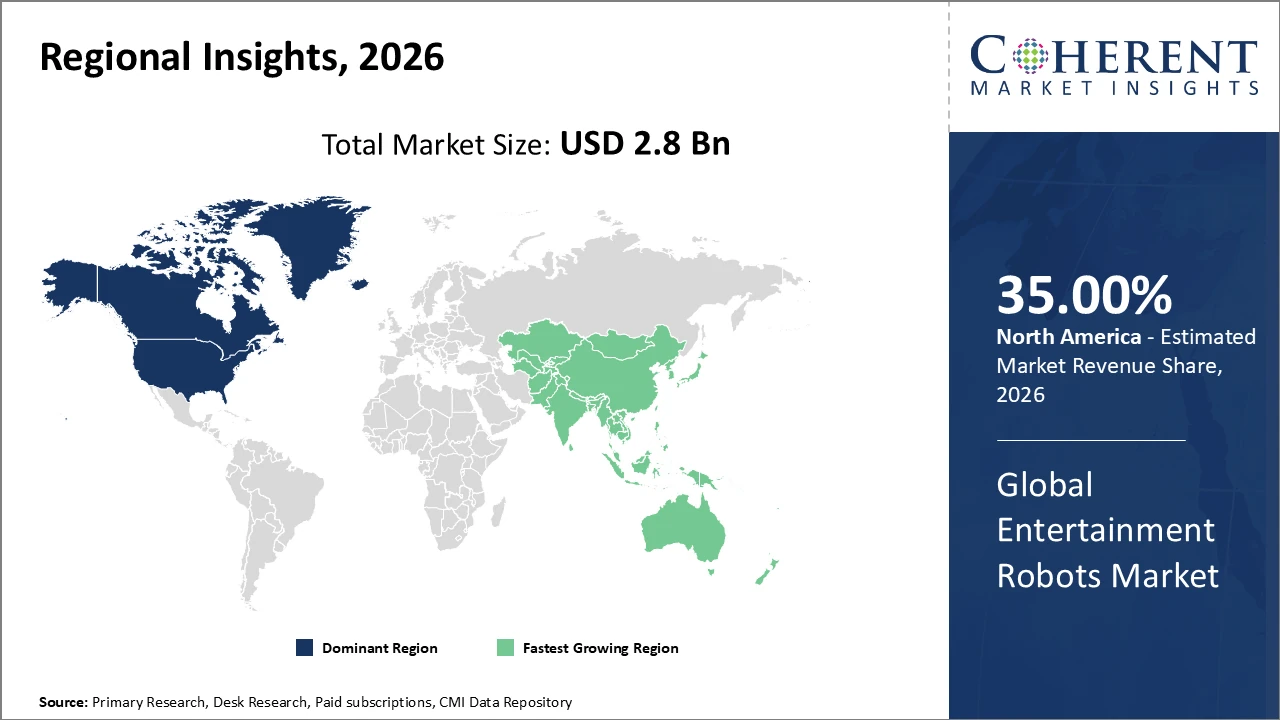
North America Entertainment Robots Market Analysis and Trends
In North America, the Entertainment Robots market is dominated by a mature technological ecosystem, high consumer spending on advanced entertainment solutions, and supportive government policies promoting robotics research and innovation. The U.S. market accounts for over 28% of the global industry share, driven by strong adoption in theme parks, retail, and educational sectors. Leading companies such as Boston Dynamics and Sony have strengthened their presence through strategic partnerships and significant contracts with amusement parks and learning institutions. Continuous investment in AI, autonomous functionalities, and interactive robotics further reinforces North America’s leadership position, supporting market expansion and revenue growth.
Asia Pacific Entertainment Robots Market Analysis and Trends
Asia Pacific demonstrates the fastest growth in the Entertainment Robots market, with a CAGR exceeding 16% between 2026 and 2033. This growth is driven by rapid urbanization, increasing adoption of robotics in entertainment, education, and leisure sectors, and supportive government incentives in countries such as China, Japan, and South Korea. Rising disposable incomes and growing interest in interactive technologies further fuel demand. Companies like Ubtech Robotics and SoftBank Robotics have intensified market penetration strategies, leveraging local partnerships, infrastructure improvements, and tailored product offerings. These factors collectively position Asia Pacific as a high-growth region in the global entertainment robotics landscape.
Entertainment Robots Market Outlook for Key Countries
USA Entertainment Robots Market Analysis and Trends
The USA’s Entertainment Robots market is supported by a strong R&D ecosystem and substantial investments from private and public sectors. Leading companies, including Boston Dynamics and Sony, have introduced advanced humanoid and AI-enabled robots for theme parks, education, and consumer applications. In 2025, the market experienced a 22% year-over-year growth, driven by rising demand for immersive experiences and automation integration. Favorable regulations, coupled with high consumer readiness for robotic entertainment, continue to propel adoption. Continuous innovation in AI, interactive features, and autonomous functionalities further strengthens market expansion, positioning the U.S. as a dominant region in the global Entertainment Robots industry.
Germany Entertainment Robots Market Analysis and Trends
Germany’s Entertainment Robots market demonstrates steady growth, supported by advanced technological infrastructure, high consumer spending on robotics, and strong integration in commercial and educational sectors. The country benefits from robust R&D initiatives and collaborations between robotics firms and research institutions, fostering innovation in AI-enabled and humanoid robots. Theme parks, museums, and educational facilities drive adoption, while modular and customizable robots are gaining traction among consumers seeking personalized experiences. Increasing interest in interactive learning and entertainment, coupled with government incentives for automation and robotics development, positions Germany as a key European market. Continued investment in AI and automation technologies ensures sustained revenue growth and market expansion.
Analyst Opinion
Supply-side scalability has driven growth in the Entertainment Robots market, with production capacity enhancements by leading manufacturers leading to an estimated 20% year-on-year output increase in 2025. This expansion enabled more competitive pricing strategies for emerging regional markets and coincided with a 15% reduction in average unit costs, improving accessibility.
Demand-side dynamics show accelerated adoption in educational and theme park sectors, driven by STEM-based learning tools and visitor engagement solutions. In 2024, educational institutions in North America and Europe increased procurement by 30%, boosting market share in these verticals.
Advances in autonomous navigation and voice recognition have strengthened product differentiation, exemplified by 2026 launches of interactive robots with multimodal AI, which increased user engagement time by 25%, driving revenue growth.
Nano-scale technological improvements, including miniaturized sensors and improved power efficiency, supported a 10% rise in portable entertainment robots in 2025, opening new household and personal entertainment applications and broadening market scope.
- Current Industry Events of 2026
- Market Size Estimation
- Regional Breakdown
- Competitive Landscape
- Customer Intelligence
- Segmental Analysis
- Pricing Analysis
- Key Market Drivers, Challenges & Future Trends
- Customized Insights Section
Market Scope
| Report Coverage | Details | ||
|---|---|---|---|
| Base Year: | 2025 | Market Size in 2026: | USD 2.8 billion |
| Historical Data for: | 2020 To 2024 | Forecast Period: | 2026 To 2033 |
| Forecast Period 2026 to 2033 CAGR: | 14.8% | 2033 Value Projection: | USD 7.1 billion |
| Geographies covered: |
| ||
| Segments covered: |
| ||
| Companies covered: | Boston Dynamics, Sony Corporation, Anki, Inc., RoboDynamics, Fetch Robotics, Blue Frog Robotics, Ubtech Robotics, PAL Robotics, KUKA AG, Robotis Inc. | ||
| Growth Drivers: |
| ||
Entertainment Robots Market Growth Factors
The global Entertainment Robots market is driven by rising consumer demand for immersive and interactive experiences, fueling growth across multiple segments. Investments in AI, machine learning, and advanced sensor technologies enable sophisticated product offerings tailored to diverse applications. Government initiatives promoting automation and robotics in education have accelerated adoption in academic environments, expanding market reach. Additionally, integrating robots into theme parks and retail spaces enhances entertainment value and customer engagement, creating new revenue streams. Combined, these factors are strengthening business growth strategies, particularly in North America and Asia Pacific, positioning the market for sustained expansion through 2033.
Entertainment Robots Market Development
In February 2025, Ubtech Robotics launched a new line of AI-enabled humanoid robots designed for home entertainment and educational applications, featuring advanced voice recognition and interactive learning capabilities. This development expanded the company’s consumer base and reinforced its market presence in Asia Pacific.
Key Players
Leading Companies of the Market
Boston Dynamics
Sony Corporation
Ubtech Robotics
Anki, Inc.
KUKA AG
Robotis Inc.
RoboDynamics
Fetch Robotics
Blue Frog Robotics
PAL Robotics
Competitive strategies in the Entertainment Robots market have centered on product innovation, strategic partnerships, and expansion into emerging markets. For instance, Sony’s collaboration with major entertainment conglomerates allowed the company to launch robots integrated into theme park experiences, driving a 12% revenue increase in 2025. Similarly, Boston Dynamics emphasized robotic agility and advanced human-interaction features, securing new commercial contracts across Europe and North America. These initiatives have strengthened brand value, expanded market reach, and reinforced leadership positions. Overall, such strategies highlight the importance of innovation and collaboration in capturing market share and sustaining growth in the competitive entertainment robotics landscape.
Entertainment Robots Market Future Outlook
The Entertainment Robots market is poised for strong growth, driven by ongoing advancements in AI, machine learning, and sensor technologies that enhance interactivity and user engagement. Increasing adoption across theme parks, retail, education, and home entertainment sectors will continue to expand market opportunities. Emerging trends include autonomous navigation, modular robotics, and personalized AI-driven experiences, which are expected to reshape consumer expectations. Investment in regional expansion, particularly in Asia Pacific and North America, will accelerate market penetration. Sustainability and energy-efficient designs are also gaining focus. Collectively, these developments indicate a robust future outlook, with rising demand and technological innovation sustaining revenue growth through 2033.
Entertainment Robots Market Historical Analysis
The Entertainment Robots market has witnessed steady growth over the past decade, driven by technological advancements in robotics, AI, and sensor integration. Early adoption focused on theme parks and exhibition spaces, where animatronics and humanoid robots enhanced visitor experiences. Between 2018 and 2023, increasing consumer interest in interactive and educational robotics, coupled with declining production costs, expanded applications into home entertainment and retail sectors. Key players invested in R&D to improve mobility, voice recognition, and interactivity, fostering product differentiation. Government support for automation in education and commercial adoption further accelerated market expansion. These historical trends laid the foundation for robust growth in the 2026–2033 forecast period.
Sources
Primary Research Interviews:
Robotics manufacturers and developers specializing in entertainment robots
Theme park operators and amusement facility managers
Educational institutions integrating robotics into STEM programs
Robotics consultants and AI specialists
Magazines:
IEEE Spectrum – Robotics & AI Developments
Popular Mechanics – Consumer Robotics and Entertainment Applications
TechCrunch – Robotics Startups and Industry News
Journals:
International Journal of Robotics Research – Entertainment Robotics Studies
Robotics and Autonomous Systems Journal – AI-driven Robotics Applications
Journal of Intelligent & Robotic Systems – Interactive Robotics Research
Entertainment Computing – Robotics in Leisure and Education
Newspapers:
The Wall Street Journal – Robotics & Technology Developments
Financial Times – Automation and Robotics Market Insights
Reuters – Robotics Industry News
Bloomberg – Robotics and AI Trends
Nikkei Asia – Robotics and Technology Innovation
Associations:
Robotics Industries Association (RIA)
International Federation of Robotics (IFR)
Association for Advancing Automation (A3)
Get access to 250+ pages report
Every segment, forecast, competitor profile and data table behind the analysis above — available for instant download.
- ESOMAR Member
- ISO 9001:2015 Certified
- D-U-N-S Registered
- GDPR & CCPA Compliant
Missing comfort of reading report in your local language? Find your preferred language:
Transform your Strategy with Exclusive Trending Reports
Frequently Asked Questions
Leading players include Boston Dynamics, Sony Corporation, and Robotis Inc., recognized for their innovative product lines, advanced AI capabilities, and strategic expansion into global markets.
The market is projected to reach USD 7.1 billion by 2033, expanding at a CAGR of 14.8% from 2026 to 2033, driven by rising demand for immersive and interactive robotic experiences.
Theme Parks represent the largest growth opportunity, fueled by investments in interactive attractions, AI-enabled robots, and immersive guest experiences.
Trends include increasing AI autonomy, enhanced interactivity, modular and customizable robotics, and expansion into retail, education, and home entertainment sectors.
Competition focuses on technological innovation, product differentiation, and regional penetration, while challenges include high R&D costs, integration complexity, and scalability limitations.
Common strategies include collaborations with entertainment and educational institutions, aggressive product development, modular and AI-enabled solutions, and localization to capture emerging regional markets.