

Li-Air Battery Market Size and Forecast – 2026 to 2033
The Li-Air Battery Market is anticipated to grow at a CAGR of 20.4% with USD 88.6 Bn share in 2026 and is expected to reach USD 371.4 Bn in 2033. The Li-Air battery market grows as consumers and industries demand higher energy density, longer-range electric vehicles, lightweight energy storage, and greater renewable-energy integration. India’s electric car sales rose 25.3% month-on-month to 20,616 units in February 2026.
Key Takeaways
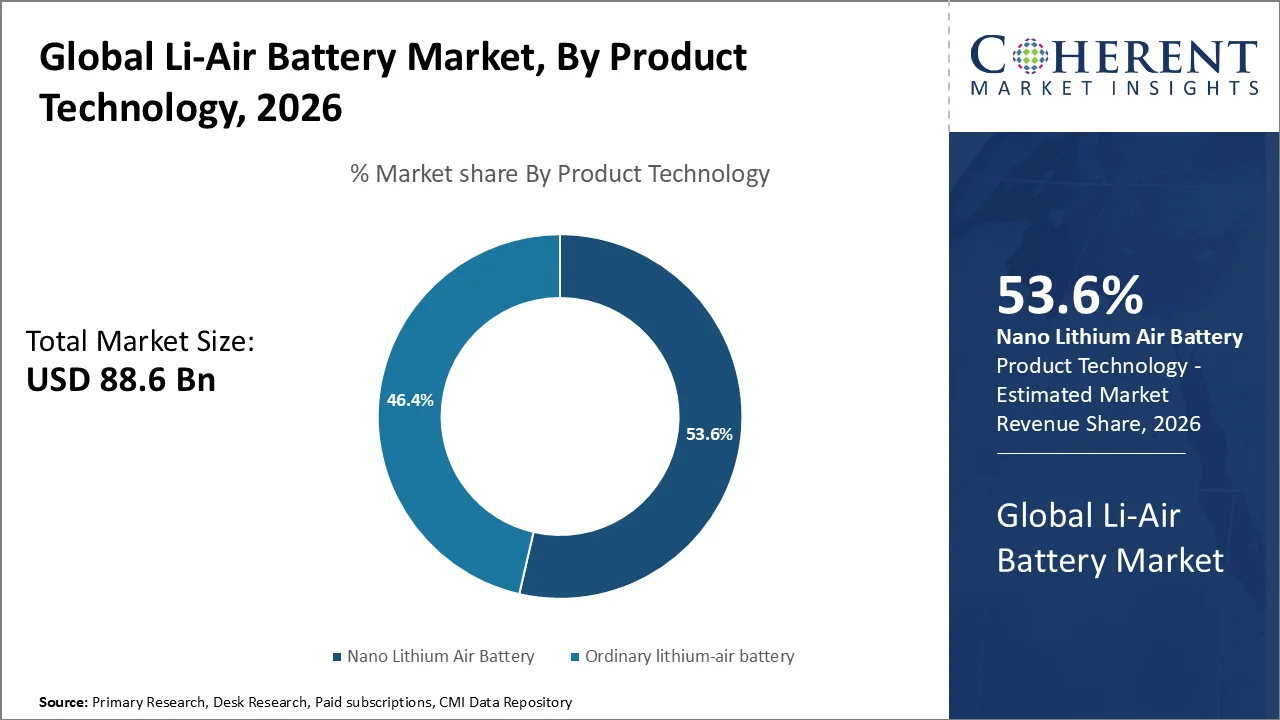
- Nano Lithium Air Battery hold the largest market share of 53.6% in 2026 owing to the demand for ultra-high energy density.
- Automotive expected to hold largest market share of 42.7% in 2026 owing to the growing adoption of electric vehicles (EVs). Global electric car sales surpassed 20 million units in 2025.
- North America is expected to acquire the dominant share of 41.6% in 2026 owing to its strong battery R&D ecosystem.
Current Events and Their Impact on the Li-Air Battery Market
Current Event | Description and its Impact |
U.S. Government Support for Lithium-Air Battery Research
|
|
EU Batteries Regulation Introduces Mandatory Recycling-Efficiency Targets
|
|
Segmental Insights
- Current Industry Events of 2026
- Market Size Estimation
- Regional Breakdown
- Competitive Landscape
- Customer Intelligence
- Segmental Analysis
- Pricing Analysis
- Key Market Drivers, Challenges & Future Trends
- Customized Insights Section
Why is Nano Lithium Air Battery Acquiring the Largest Market Share?
Nano Lithium Air Battery hold the largest market share of 53.6% in 2026. The nano lithium-air battery market is driven by rising demand for lightweight, high-energy-density energy-storage solutions, especially in electric vehicles and advanced electronics. Researchers use nanostructured materials such as graphene, carbon nanotubes, nanofibers, and nanocatalysts to increase electrode surface area, improve conductivity and oxygen transport, enhance catalytic activity, and manage lithium peroxide discharge products. These innovations improve energy efficiency, capacity, cycling stability, and rate capability, while advances in nanoengineered cathodes and electrolytes help overcome key technical challenges in Li-air batteries.
Automotive expected to hold largest market share
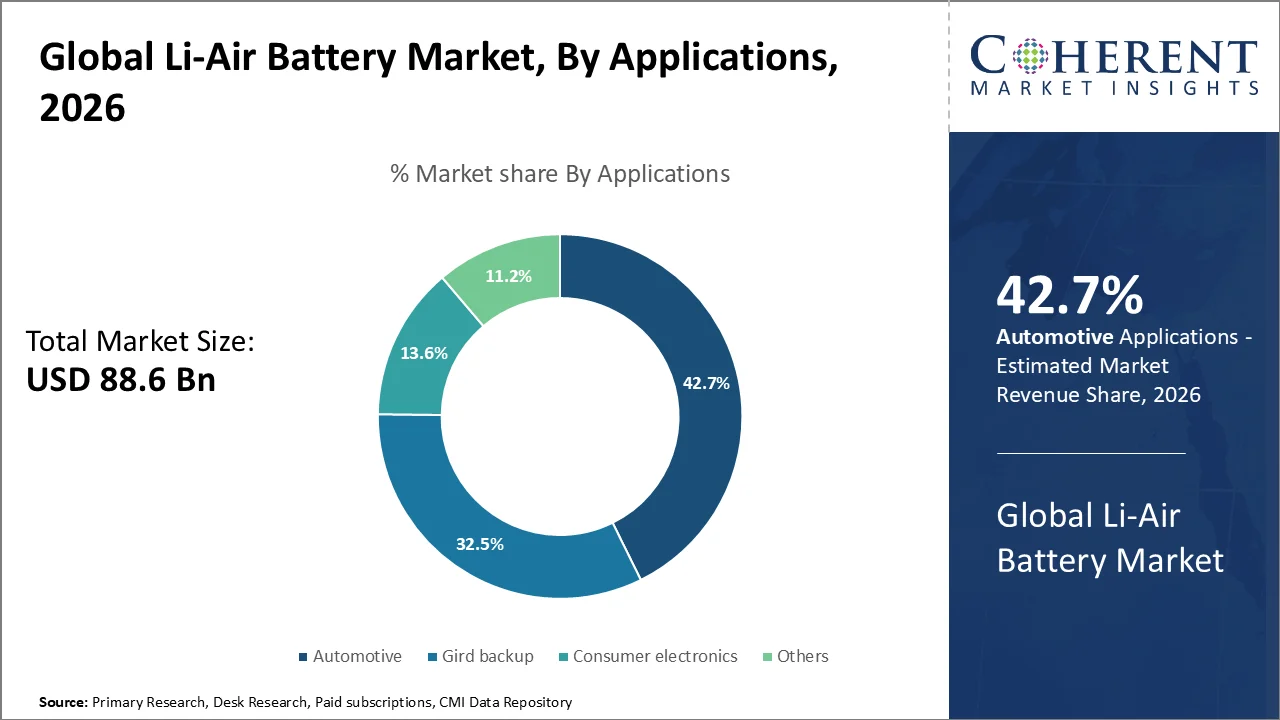
Automotive expected to hold largest market share of 42.7% in 2026 owing to the potential for very high theoretical energy storage. The automotive segment of the Li-Air Battery Market is driven by increasing demand for long-range electric vehicles, lightweight battery systems, and higher energy density. Automakers and battery developers are exploring Li-air technology because its high theoretical energy density could extend driving range while reducing battery weight. Ongoing advances in electrolytes, catalysts, and electrode materials are improving battery performance and addressing technical challenges. The growing focus on next-generation EV batteries and improved vehicle efficiency further strengthens the potential adoption of Li-air technology in automotive applications. For instance, Mexico has introduced a domestically developed EV as EV adoption accelerates rapidly across emerging markets in Africa, Asia, and Latin America. However, Chinese manufacturers continue to dominate EV production in these regions.
Li-Air Battery Market Trends
- Growing interest in high-energy-density battery technologies drives Li-air battery development, as manufacturers and researchers seek technologies that can potentially provide substantially greater energy density than conventional lithium-ion batteries. The U.S. Department of Energy reported in June 2025 that a newly developed rechargeable lithium-air battery design demonstrated a potential energy-density advantage of up to four times that of conventional lithium-ion batteries. This remains a research-stage result and should not be interpreted as commercially achieved Li-air energy density.
- Greater focus on sustainable and efficient energy storage is increasing the importance of lifecycle considerations for future Li-air batteries. In the EU, the Batteries Regulation establishes progressively stricter requirements for battery recycling efficiency, including a 65% minimum recycling efficiency for lithium-based batteries from 31 December 2025 and 70% from 31 December 2030. This creates a future regulatory consideration for Li-air developers seeking to commercialize batteries in the EU.
Regional Insights
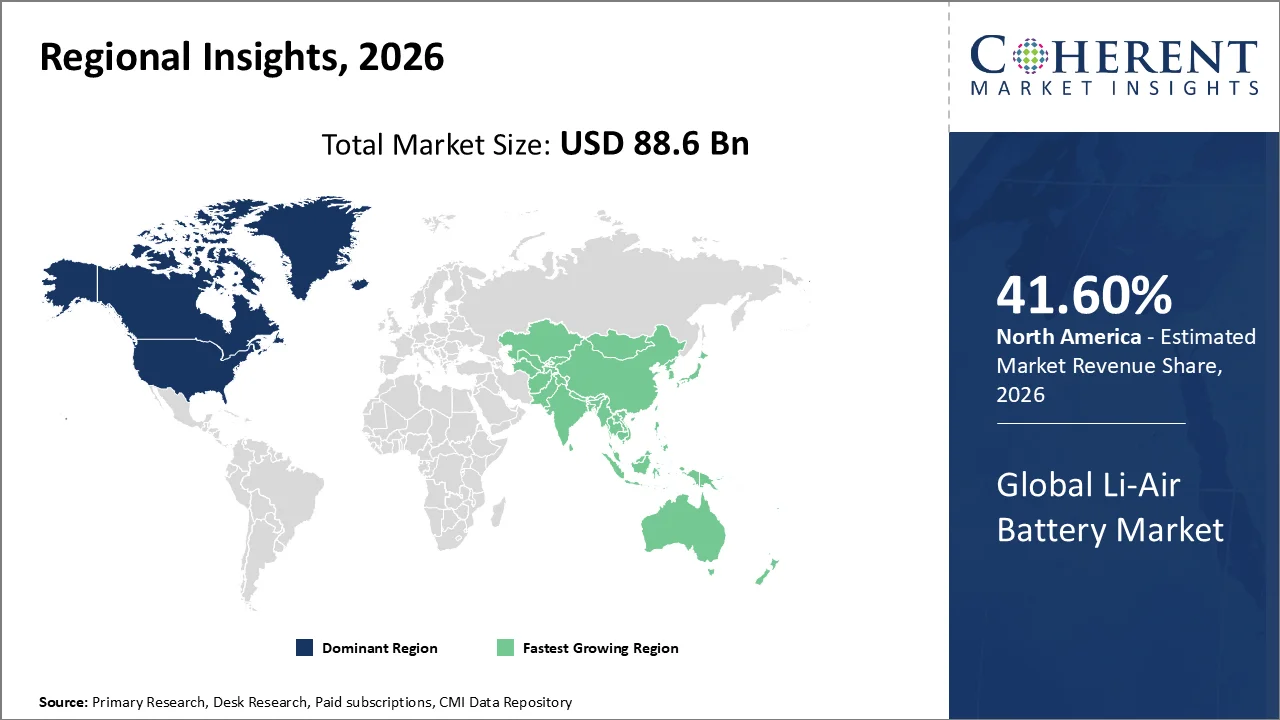
North America dominates owing to focus on domestic and secure battery supply chains
North America is expected to acquire the dominant share of 41.6% in 2026. The North American Li-Air Battery Market benefits from increasing electric vehicle adoption, growing demand for lightweight, high-energy-density batteries, and strong investment in next-generation battery research. Automotive manufacturers, battery companies, and research institutions across the region are advancing electrode, electrolyte, catalyst, and solid-state technologies. Investments in domestic battery production, renewable energy storage, and clean transportation further create market opportunities. Government initiatives supporting advanced energy technologies, combined with a strong research ecosystem, continue to accelerate Li-air battery innovation and potential commercialization. For instance, in July 2026, Maersk launched a dedicated lithium-ion battery ground freight service across North America, strengthening its dangerous-goods logistics network.
Asia Pacific Li-Air Battery Market Trends
The Asia Pacific Li-Air Battery Market benefits from rising electric vehicle adoption, growing demand for high-energy-density batteries, and increased investment in advanced energy storage technologies. China, Japan, and South Korea are strengthening research and development efforts to improve lithium-air chemistry, cathode catalysts, electrolytes, and battery durability. Governments are promoting clean transportation, renewable energy integration, and domestic battery manufacturing, creating new market opportunities. In June 2026, the Union Cabinet, chaired by Prime Minister Narendra Modi, approved a two-year scheme to curb air pollution in Delhi-NCR and promote cleaner mobility. Expanding electronics and energy-storage sectors, supported by well-established battery supply chains, further drive the development and adoption of Li-Air batteries across the region. For instance, Air Energy launched to accelerate the commercialization of solid-state lithium-air battery technology, bringing the emerging chemistry closer to commercial deployment.
United States Li-Air Battery Market Trends
The United States Li-Air battery market benefits from growing demand for high-energy-density storage in electric vehicles, aerospace, defense, and grid applications. Researchers and industry players pursue Li-Air technology because its potential for higher energy density than conventional lithium-ion batteries could enable longer-range transportation and electric aviation. U.S. government programs, domestic battery manufacturing initiatives, and investments in advanced materials accelerate research and innovation. The expansion of renewable energy and demand for reliable grid storage further strengthen market opportunities, while research institutions and technology companies advance commercialization. For instance, Lexus introduced the eighth-generation ES in the U.S., debuting battery-electric variants with a 74.7 kWh lithium-ion battery. The ES 350e delivers 165 kW through a single motor, while the AWD ES 500e uses dual motors to produce 252 kW.
Japan Li-Air Battery Market Trends
Japan’s Li-Air battery market benefits from the country’s strong research and development capabilities, growing demand for high-energy-density batteries, and commitment to next-generation energy storage solutions. Government initiatives supporting advanced battery technologies and carbon neutrality stimulate investment and innovation. Research institutions actively develop Li-Air batteries for electric vehicles, drones, aerospace, and other high-performance applications. Japan’s well-established automotive and electronics sectors support commercialization, while advances in materials science and collaboration among universities, technology companies, and manufacturers further strengthen the domestic Li-Air battery ecosystem.
Who are the Major Companies in Li-Air Battery Industry
Some of the major key players in Li-Air Battery are PolyPlus Battery Company, IBM, Toyota Motor Corporation, Panasonic Holdings Corporation, Tesla, Sion Power, Mullen Technologies, Lithium Air Industries, Samsung SDI and LG Energy Solution.
Key News
- In October 2025, the International Air Transport Association (IATA) launched its “Travel Smart with Lithium Batteries” campaign to help travelers safely carry phones, laptops, power banks, and other lithium-powered devices on flights.
Market Report Scope
Li-Air Battery Market Report Coverage
| Report Coverage | Details | ||
|---|---|---|---|
| Base Year: | 2025 | Market Size in 2026: | USD 88.6 Bn |
| Historical Data for: | 2020 To 2024 | Forecast Period: | 2026 To 2033 |
| Forecast Period 2026 to 2033 CAGR: | 20.4% | 2033 Value Projection: | USD 371.4 Bn |
| Geographies covered: |
| ||
| Segments covered: |
| ||
| Companies covered: | PolyPlus Battery Company, IBM, Toyota Motor Corporation, Panasonic Holdings Corporation, Tesla, Sion Power, Mullen Technologies, Lithium Air Industries, Samsung SDI and LG Energy Solution. | ||
Analyst Opinion
- Li-Air technology is not a conventional battery upgrade; it is a range-extension bet. Its theoretical specific energy reaches about 3,500 Wh/kg, far above conventional lithium-ion chemistry. Recent research has already demonstrated a Li-Air electrode delivering 1,716 Wh/kg at the electrode level, showing that the theoretical advantage is beginning to translate into measurable laboratory performance.
- The biggest market catalyst is the industry’s ability to solve power-output limitations. Historically, Li-Air’s extraordinary energy density came with weak power performance because oxygen transport and sluggish reaction kinetics restricted practical operation. In 2025, NIMS and Seikei University reported a tenfold increase in output current using a highly porous carbon-nanotube electrode, with sufficient power to support hovering in small drones. In my view, this is more commercially meaningful than another theoretical energy-density record because it directly addresses the technology’s most important weakness.
- Scale-up, not chemistry alone, will determine whether Li-Air becomes commercially relevant. Most reported Li-Air cells historically had capacities of 0.01 Wh or less, highlighting the enormous gap between laboratory demonstrations and usable battery systems. NIMS and Toyo Tanso subsequently demonstrated a 1-Wh-class stacked Li-Air cell and produced electrodes measuring 10 cm × 10 cm or larger. This progression a critical validation point: the market will accelerate only when developers can repeatedly manufacture larger cells while retaining performance, durability, and safety.
- The technology remains high-risk. Oxygen-related side reactions, lithium-anode instability, electrolyte degradation, cathode clogging, and high charge overpotential remain fundamental obstacles. However, recent research has demonstrated a lithium-oxygen battery operating for approximately 2,585 cycles over 5,170 hours under controlled conditions. The Li-Air has moved beyond being purely a theoretical “ultimate battery,” but commercialization will depend on proving comparable durability under realistic operating conditions and ambient-air environments.
Speak to the analyst
Want personalized insights?
Take the findings above to one of our principal consultants, or have the report rebuilt around the segments, geographies and competitors you actually track.
Market Segmentation
- By Product technology (Revenue, USD Bn, 2021-2033)
- Nano Lithium Air Battery
- Ordinary lithium-air battery
- By Applications (Revenue, USD Bn, 2021-2033)
- Automotive
- Gird backup
- Consumer electronics
- Others
- By Region (Revenue, USD Bn, 2021-2033)
- North America
- U.S.
- Canada
- Latin America
- Brazil
- Mexico
- Argentina
- Rest of Latin America
- Europe
- Germany
- U.K.
- France
- Italy
- Spain
- Russia
- Rest of Europe
- Asia Pacific
- China
- India
- Japan
- Australia
- South Korea
- ASEAN
- Rest of Asia Pacific
- Middle East
- GCC
- Israel
- Rest of Middle East
- Africa
- South Africa
- Central Africa
- North Africa
- North America
Sources
Primary Research interviews
- Battery technology researchers and principal investigators specializing in lithium-air and lithium-oxygen batteries
- Battery-material scientists working on lithium-metal anodes, air cathodes, electrolytes, and catalysts
- Researchers and technical experts from universities and national laboratories
- Interviews with battery cell developers, materials suppliers, and advanced energy-storage technology specialists
- Discussions with experts involved in electric aviation, drones, and next-generation mobility applications
Databases
- U.S. Department of Energy (DOE) research and technology databases
- National Institute of Materials Science (NIMS) research repositories
- PubMed and National Library of Medicine databases
- ScienceDirect
- Web of Science
- Scopus
- Google Scholar
- Crossref and DOI databases
Magazines
- IEEE Spectrum
- Chemistry World
- Materials Today
- Battery Power Online
- Advanced Energy Materials news and technology coverage
- ScienceDaily — battery and energy-storage research coverage
Journals
- Nature Energy
- Nature
- Advanced Materials
- Materials Horizons
- ACS Nano
- Chemical Reviews
- ACS Applied Energy Materials
- Nano Letters
- Journal of Power Sources
- Energy & Environmental Science
- Electrochimica Acta
- Journal of Materials Chemistry A
Newspapers
- The New York Times
- The Guardian
- Financial Times
- The Wall Street Journal
- Nikkei Asia
- The Japan Times
- The Economic Times
- The Hindu
- Reuters
Associations
- International Energy Agency (IEA)
- International Electrotechnical Commission (IEC)
- Institute of Electrical and Electronics Engineers (IEEE)
- Electrochemical Society (ECS)
- Materials Research Society (MRS)
- International Battery Association (IBA)
- Battery Association of Japan (BAJ)
Public Domain sources
- U.S. Department of Energy
- Argonne National Laboratory
- National Institute of Materials Science (NIMS), Japan
- Japan Science and Technology Agency (JST)
- National Renewable Energy Laboratory (NREL)
- National Institute of Standards and Technology (NIST)
- European Commission
- International Energy Agency (IEA)
- PubMed
- Crossref
- Government-funded university research repositories
Proprietary Elements
- CMI Data Analytics Tool
- Proprietary CMI Existing Repository of information for last 10 years
Get access to 250+ pages report
Every segment, forecast, competitor profile and data table behind the analysis above — available for instant download.
- ESOMAR Member
- ISO 9001:2015 Certified
- D-U-N-S Registered
- GDPR & CCPA Compliant
Missing comfort of reading report in your local language? Find your preferred language:
Transform your Strategy with Exclusive Trending Reports
Frequently Asked Questions
The Li-Air Battery Market is anticipated to grow at a CAGR of 20.4% with USD 88.6 Bn in 2026 and is expected to reach USD 371.4 Bn in 2033.
The market is primarily driven by Li-Air batteries’ exceptionally high theoretical energy density, which has been estimated at around 3,505 Wh/kg for non-aqueous systems.
Electric vehicles remain a major target application, while electric aviation, drones, aerospace systems, and long-duration energy storage represent potentially attractive applications where weight reduction and high specific energy provide a strong advantage.
The principal challenge is converting theoretical energy density into reliable, practical cell performance.
Real-world air contains water vapor, carbon dioxide, and nitrogen, which can trigger unwanted chemical reactions and interfere with oxygen electrochemistry.
Li-Air has a theoretical specific energy roughly three to five times higher than conventional battery technologies, creating the possibility of significantly greater driving range or reduced battery weight.