

Global 3D Reconstruction Market Size and Share Analysis – Growth Trends and Forecasts (2026-2033)
3D Reconstruction Market is estimated to be valued at USD 1,301.0 Mn in 2026 and is expected to reach USD 2,273.4 Mn in 2033, exhibiting a compound annual growth rate (CAGR) of 8.3% from 2026 to 2033.
Key Takeaways
- Based on Type of Construction, Services segment is expected to dominate the global market with 75.8% market share.
- Asia Pacific is anticipated to 36.0% shares in the global 3D reconstruction market during the forecast period.
Market Overview
The global market for 3D reconstruction is witnessing strong growth due to rising demand in industries like architecture, gaming, preservation of cultural heritage, healthcare, and autonomous systems. The trend is driven primarily by advancements in technology in the forms of AI, photogrammetry, LiDAR, and real-time rendering, which are revolutionizing how real-world objects and surroundings are captured, processed, and visualized. The demand for high-fidelity digital twins and immersive virtual and augmented reality experiences is also driving adoption.
Current Events and Its Impact
Current Events | Description and its impact |
Adoption of Gaussian Splatting in 3D Reconstruction |
|
Matterport Launches Upgraded Pro3 Camera for Enhanced 3D |
|
Pricing Analysis
3D reconstruction solutions' pricing differs according to deployment models, with cloud-based offerings becoming popular due to their scalability and affordability. The offerings tend to be on subscription-based pricing models, allowing flexibility for the users. On the other hand, on-premise offerings come with higher initial expenses for hardware as well as software but can have cost benefits in the long run for large corporations with large processing requirements.
Software is the biggest revenue-generating sector, with more than 70% of the market share because of increasing usage in industries such as construction, healthcare, and gaming. High computational expenses and the necessity to use specialized hardware could be price hindrances for smaller organizations.
The market for 3D reconstruction is changing through technological developments and varied pricing strategies, serving a broad sector of industries. With increasing usage of cloud-based solutions and better integration of AI, the market is set to remain on the rise and innovate even further.
- Current Industry Events of 2026
- Market Size Estimation
- Regional Breakdown
- Competitive Landscape
- Customer Intelligence
- Segmental Analysis
- Pricing Analysis
- Key Market Drivers, Challenges & Future Trends
- Customized Insights Section
Role of Artificial Intelligence (AI)
Artificial Intelligence (AI) is transforming the 3D reconstruction industry by accelerating the speed, precision, and scalability of producing three-dimensional models from actual world data. Algorithms based on artificial intelligence, especially those based on neural networks, make it possible to convert 2D pictures or video into high-resolution 3D models. Neural rendering is the term used for this conversion, which creates photorealistic 3D scenes with great speed, which is important for use in virtual reality (VR), gaming, and digital twins.
In industries such as healthcare, AI improves medical imaging by reconstructing intricate anatomy from scans, which makes diagnostics and surgical planning better. In the same way, in city planning, AI-based 3D mapping assists in the creation of smart cities by providing precise models for infrastructure planning and environmental monitoring.
The incorporation of AI also simplifies workflows by automating processes like object detection and elimination, lessening human intervention and processing time. In addition, AI's capacity to learn from large datasets enhances the accuracy of 3D reconstructions, which becomes more trustworthy for different applications. With the evolution of AI, the application of AI in the 3D reconstruction industry is set to grow, fueling innovation and efficiency in various industries.
Global 3D Reconstruction Market Drivers
- Rise in adoption of 3D technology in maintenance to boost the market growth
The adoption of 3D technology for maintenance of museums and cultural heritage, construction applications, and industrial applications is increasing rapidly replacing the traditional approach. Cultural heritage can be preserved digitally; however, it can be challenging process for 3D reconstruction.
Cultural heritage objects and cultural heritage sites are different from each other and it requires maximized implementation of the 3D reconstruction. With the use of 3D reconstruction based on aerial image, sensitive sculptures can be reconstructed with high accuracy. Thus, the rapidly growing adoption of 3D technology in maintenance is driving the growth of the global 3D reconstruction market during the forecast period.
- Technological developments in cameras to propel the market growth
The demand for 3D content for computer graphics, communication, and VR has increased in recent years, which changing the requirements. The systems for construction of 3D models that are currently being used are created around specialized hardware, due to which, its cost increases and it does not always cater needs for its new applications.
Camera calibration offers extrinsic and intrinsic parameters, and without it no algorithm arrangements work at in the level. With increase in technological advancements in cameras, the applications of 3D construction will be increasing in the future and this is expected to augment growth of the global 3D reconstruction market during the forecast period.
Global 3D Reconstruction Market Opportunities
Increasing use 3D reconstruction technology in the entertainment industry is likely to bring in multiple opportunities in the global 3D reconstruction market during the forecast period. The use of 3D reconstruction is increasing in this industry for theatrical films and video games. As the popularity of gaming is increasing all over the world among children and young adults, technological developments are also growing in this particular field. Thus, the use of 3D reconstruction is increasing in the entertainment industry, which in turn is likely to benefit the players in the global 3D reconstruction market.
Growing popularity of 3D reconstruction in healthcare industry is projected to generate growth opportunities in the global 3D reconstruction market over the forecast period. 3D reconstruction technology offers several benefits such as its multi-view capability.
3D reconstruction for medical image analysis increases accuracy and helps in planning, simulating, and direction of medical treatments. Moreover, use of 3D reconstruction also benefits detecting diseases with deep tissue origins. Thus, popularity of 3D reconstruction in increasing in healthcare industry, which is further expected to drive growth of the global 3D reconstruction market during the forecast period.
Global 3D Reconstruction Market Trends
- Increasing focus of market players on leveraging AI expertise and experience in healthcare sector is a major trend
In healthcare industry, medical imaging applications rely on 2D imaging for delivering necessary information. 3D reconstruction working on top of the neural network can find it challenging to gather data from the 2D images, as it represents difficulties in dimensional enlargement for differential layer. Thus, several companies in the market are trying to leverage their AI expertise and experience in healthcare sector in order to create breakthrough solutions.
For instance, in March 2020, RSIP Vision, offers field-tested software solutions, had announced the development of AI-based solution for 3D reconstruction of knees from 2D X-ray images.
- Demand for 3D reconstruction software is a recent trend in the market
The use of 3D printing technology is increasing in several applications, as the technological development along with product innovations continues to increase. This in turn is resulting into growing adoption of several 3D reconstruction software solutions for multi-view images.
Applications such as manufacturing, cultural heritage, healthcare, GIS applications, and media and entertainment make use of 3D reconstruction software solutions. Thus, the demand for these solutions is increasing all over the world, which is a growing trend in the global 3D reconstruction market.
Segmental Insights
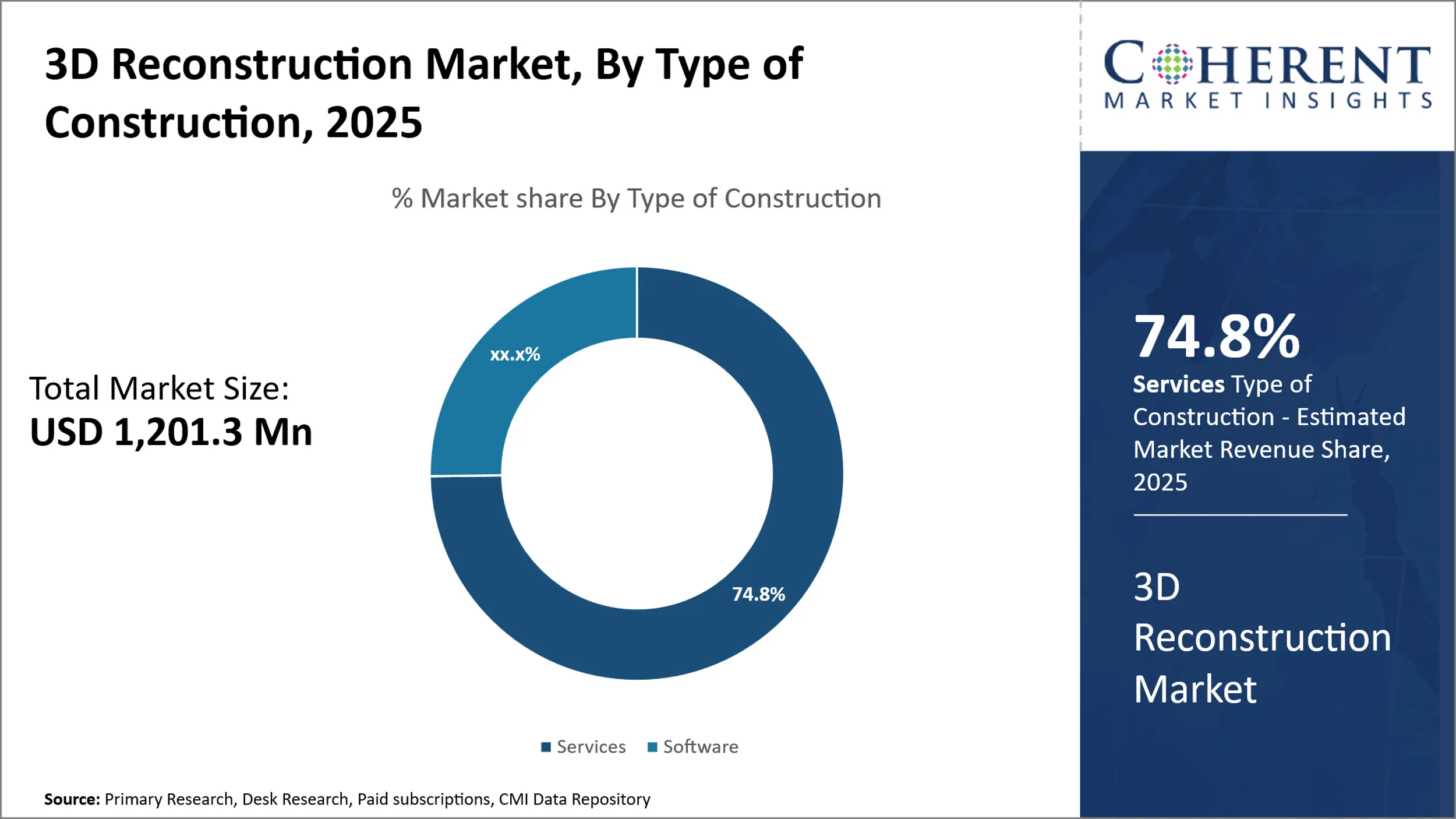
Global 3D Reconstruction Market Insights, by Type of Construction
Based on Type of Construction, the market is segmented into Software, and Services. Out of which, Services segment is expected to dominate the global market owing to the growing use of 3D reconstruction services across several sectors such as medical and cultural heritage. These services come under professional services and managed services. Most of these managed services are integrated with the cloud service, where servers of experts are connected with the system and professional service of user.
Software is also expected to witness significant growth in the near future and this is attributed to the growing adoption reconstruction software solutions for multi-view images. This is due to increasing technological developments and product innovations, the 3D printing technology is being used in several applications. The 3D reconstruction software solutions are being used in applications such as cultural heritage, GIS applications, manufacturing, media and entertainment, and healthcare.
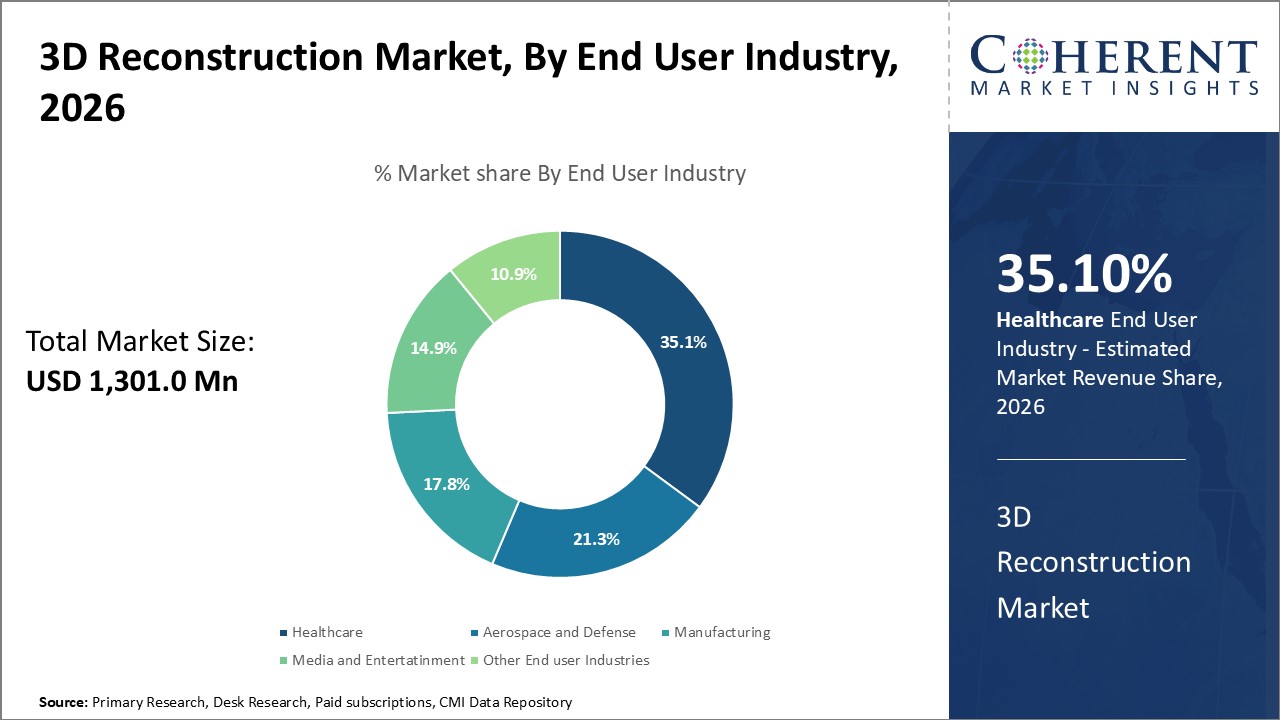
Global 3D Reconstruction Market Insights, by End User Industry
Based on End User Industry, the market is segmented into Media and Entertainment, Aerospace and Defense, Manufacturing, Healthcare, and Other End user Industries. Out of which Healthcare is expected to dominate the global market over the forecast period. Thus, market players are focused on creating novel solutions that cater all requirements for the industry. This in turn is expected to drive growth of this segment in the near future.
The market for 3D reconstruction is being driven by the manufacturing industry because manufacturers have a strong need for precise and detailed 3D models of physical objects. Reverse engineering involves using 3D reconstruction to create digital models of physical objects that can be used to reproduce or modify them.
Regional Insights
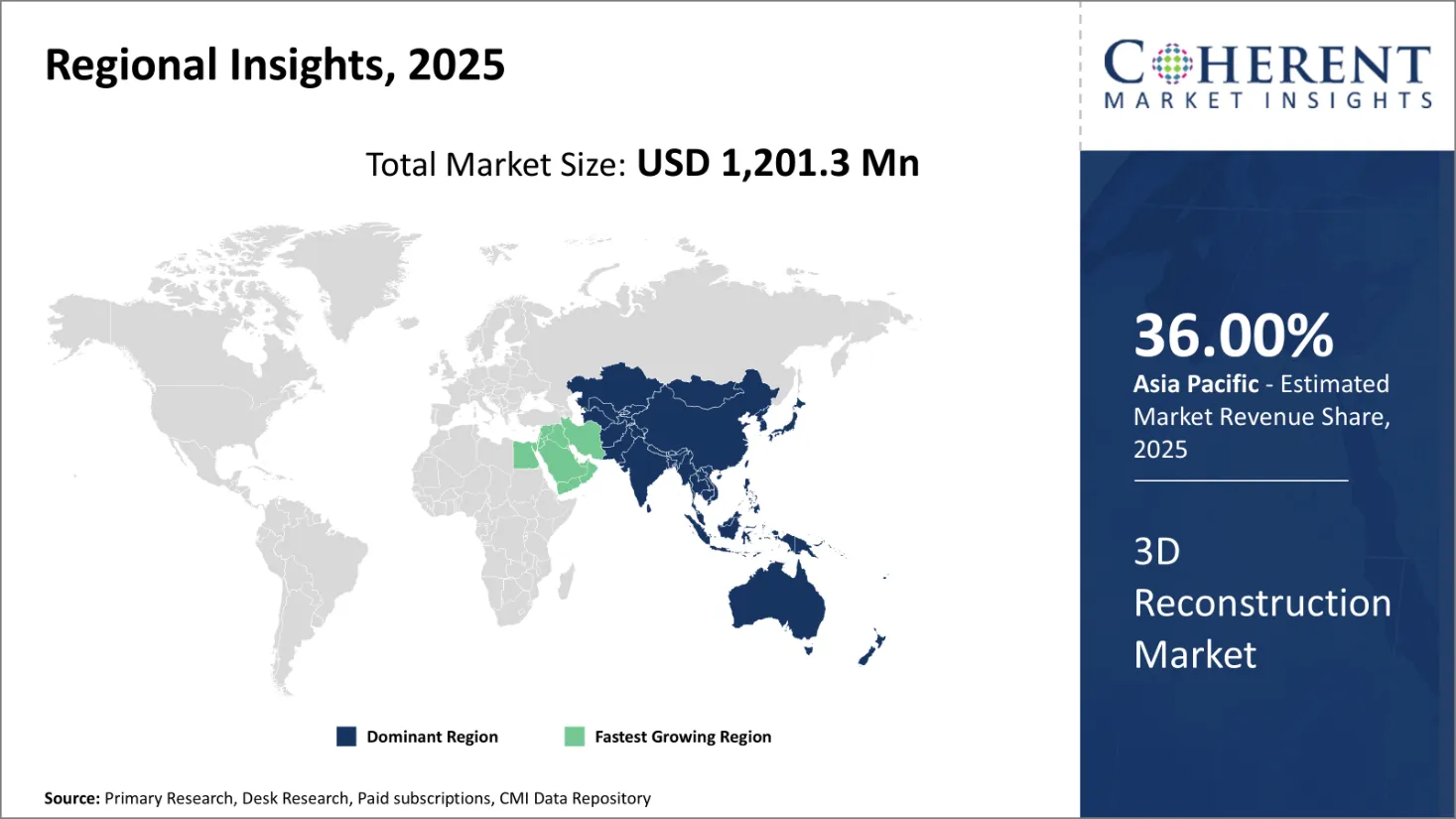
Global 3D Reconstruction Market: Regional Insights
Asia Pacific is anticipated to show robust growth in the global 3D reconstruction market during the forecast period. This is owing to rise in adoption of novel technology in the construction industry. Countries like China are undertaking large amount of construction projects that are becoming the basis of the modern urban environment of the country. Middle East and Africa are the following nations after Asia Pacific with the CAGR of 8.69% in the forecast period.
Global 3D Reconstruction Market Dominating Countries
United States 3D Reconstruction Market Analysis and Trend
The U.S. is at the forefront of the global 3D reconstruction market owing to its robust technology environment and high presence of major players across industries like aerospace, defense, healthcare, and entertainment. Extensive R&D investment, broad penetration of 3D imaging in forensics and construction, and 3D modelling usage in virtual reality and gaming continue to fuel market leadership.
China 3D Reconstruction Market Analysis and Trend
China is also growing fast in the 3D reconstruction market, driven by its surging construction, manufacturing, and city planning industries. Support for smart cities and smart infrastructure from the government has generated growing demand for digital mapping and models. AI-powered 3D reconstruction solutions are also being invested in by local tech firms, particularly for surveillance and robotics.
Germany 3D Reconstruction Market Analysis and Trend
Germany dominates the European 3D reconstruction industry with its robust industrial might and dominance of precision engineering and auto design. Germany's focus on Industry 4.0 has accelerated the deployment of 3D reconstruction in machine vision, quality inspection, and digital twin use cases in factory floors.
Market Report Scope
3D Reconstruction Market Report Coverage
| Report Coverage | Details | ||
|---|---|---|---|
| Base Year: | 2025 | Market Size in 2026: | USD 1,301.0 Mn |
| Historical Data for: | 2020 To 2024 | Forecast Period: | 2026 To 2033 |
| Forecast Period 2026 to 2033 CAGR: | 8.3% | 2033 Value Projection: | USD 2,273.4 Mn |
| Geographies covered: |
| ||
| Segments covered: |
| ||
| Companies covered: | Quorum Technologies Inc., Pix4D SA, Photometrix Ltd., Koninklijke Philips NV, Agisoft LLC, PhotoModeler Technologies, Intel Corporation, Faro Technologies Inc., Autodesk Inc., General Electric Company, and Vi3Dim Technologies | ||
| Growth Drivers: |
| ||
| Restraints & Challenges: |
| ||
Global 3D Reconstruction Market: Key Developments
- In 2024, Matterport introduced a new model of its Pro3 3D camera, improved in terms of resolution and scan speed. This helped real estate developers and construction companies to build more precise digital twins of buildings, enabling virtual walkthroughs, remote inspections, and better facility management.
- In 2025, Zivid launched the Zivid 2+ R-series 3D cameras especially for robotic automation systems. These cameras offer more advanced depth sensing and are optimized for reconstructing complex and reflective surfaces, which can improve robotic pick-and-place operations' performance in manufacturing.
Analyst View
- The 3D reconstruction market is witnessing transformative growth driven by advancements in artificial intelligence and machine learning, which enhance automation and precision in model generation across industries. These technologies enable real-time data processing and predictive analytics, particularly in healthcare for surgical planning and diagnostic imaging, while supporting autonomous systems in automotive and smart city applications. The proliferation of LiDAR, photogrammetry, and 3D scanning technologies further accelerates adoption, offering high-fidelity spatial mapping for construction, heritage preservation, and media production.
- Demand for immersive digital experiences in entertainment and education is pushing innovation, with virtual reality simulations and interactive learning tools relying heavily on 3D reconstruction. Additionally, industries like manufacturing and logistics increasingly adopt digital twin technologies to optimize operations and reduce prototyping costs. The shift toward cloud-based solutions lowers entry barriers for small and medium enterprises, fostering broader market participation.
- High computational costs and infrastructure requirements limit scalability for resource-constrained organizations. Data privacy concerns and regulatory ambiguities, especially in healthcare and geospatial applications, create adoption hurdles. Technical complexities in integrating multi-source data and achieving interoperability across platforms also pose challenges
Speak to the analyst
Want personalized insights?
Take the findings above to one of our principal consultants, or have the report rebuilt around the segments, geographies and competitors you actually track.
Market Segmentation
- Global 3D Reconstruction Market, By Type of Construction Solution (Revenue, USD Mn, 2021 - 2033)
- Software
- Services
- Global 3D Reconstruction Market, By End User Industry (Revenue, USD Mn, 2021 - 2033)
- Media and Entertainment
- Aerospace and Defense
- Manufacturing
- Healthcare
- Other End user Industries
Regional Insights (Revenue, USD Mn, 2021 - 2033)
- North America
- U.S.
- Canada
- Latin America
- Brazil
- Argentina
- Mexico
- Rest of Latin America
- Europe
- Germany
- U.K.
- Spain
- France
- Italy
- Russia
- Rest of Europe
- Asia Pacific
- China
- India
- Japan
- Australia
- South Korea
- ASEAN
- Rest of Asia Pacific
- Middle East
- GCC Countries
- Israel
- Rest of Middle East
- Africa
- South Africa
- North Africa
- Central Africa
- North America
- Company Profiles
- Pix4D SA
- Photometrix Ltd
- Koninklijke Philips NV
- Agisoft LLC
- PhotoModeler Technologies
- Intel Corporation
- Faro Technologies Inc.
- Autodesk Inc.
- General Electric Company
- Vi3Dim Technologies
- Quorum Technologies Inc.
Sources
Primary Research Interviews
- Industry Experts in 3D Scanning & Modelling Solutions
- Automotive & Aerospace Engineering Leaders
- Healthcare VR/AR Technology Developers
- Government Infrastructure Project Managers
- Others
Magazines
- 3D Printing Industry Magazine
- IEEE Spectrum (Emerging Technologies Section)
- Healthcare IT Today (VR/AR Applications)
- Others
Journals
- International Journal of Computer Vision (3D Modelling Studies)
- Journal of Digital Imaging (Medical Reconstruction Focus)
- Automation in Construction (Infrastructure Scanning Applications)
- Others
Newspapers
- The Financial Times (Technology & Innovation Section)
- The New York Times (Advanced Manufacturing Coverage)
- The Wall Street Journal (Market Growth Analysis)
- Others
Associations
- International Society for Photogrammetry and Remote Sensing (ISPRS)
- 3D Scanning Professionals Association
- Augmented Reality for Enterprise Alliance (AREA)
- Others
Public Domain Sources
- U.S. Patent & Trademark Office (3D Tech Patents)
- GlobalGrowthInsights.com Industry Analysis
- CoherentMarketInsights.com Market Data
- Others
Proprietary Elements
- CMI Data Analytics Tool
- Proprietary CMI Existing Repository of Information for Last 8 Years
*Definition: 3D Reconstruction is a type of computer-based image processing technique used to create a virtual model of an object in three-dimensional space. This can be done in a variety of ways, including the use of two-dimensional photographs or the scanning of an actual object.
Get access to 250+ pages report
Every segment, forecast, competitor profile and data table behind the analysis above — available for instant download.
- ESOMAR Member
- ISO 9001:2015 Certified
- D-U-N-S Registered
- GDPR & CCPA Compliant
Missing comfort of reading report in your local language? Find your preferred language:
Transform your Strategy with Exclusive Trending Reports
Frequently Asked Questions
The 3D Reconstruction Market size is estimated to be valued at USD 1,301.0 Mn in 2026, and is expected to reach USD 2,273.4 Mn by 2033.
The CAGR of the global Market is projected to be 8.3% from 2026 to 2033.
Rise in adoption of 3D technology in maintenance and technological developments in cameras are fuelling the market.
The Services segment is the leading component segment in the market.
Shortage of skilled or experienced workforce and high cost of 3D reconstruction solutions are the major factors restraining growth of the market.
Quorum Technologies Inc., Pix4D SA, Photometrix Ltd., Koninklijke Philips NV, Agisoft LLC, PhotoModeler Technologies, Intel Corporation, Faro Technologies Inc., Autodesk Inc., General Electric Company, and Vi3Dim Technologies.