

Healthcare Information Technology Services Market Size and Forecast — 2026 - 2033
The Global Healthcare Information Technology Services Market size is estimated to be valued at USD 96.4 billion in 2026 and is expected to reach USD 163.7 billion by 2033, exhibiting a compound annual growth rate (CAGR) of 8.2% from 2026 to 2033.
Overview
Healthcare information technology services encompass digital solutions that support the management, storage, exchange, and analysis of healthcare data across clinical and administrative settings. These services include system implementation, cloud hosting, cybersecurity, interoperability solutions, data analytics, and IT consulting tailored to healthcare organizations. The products enable secure electronic health record management, clinical decision support, telehealth infrastructure, and healthcare workflow optimization. They are used by hospitals, clinics, insurers, and healthcare networks to improve operational efficiency, data security, and continuity of care.
Key Takeaways
The Managed IT Services segment accounts for the largest market share, driven by broad deployments across hospitals and clinics for operational resilience.
Telehealth services as a technology subsegment are among the fastest-growing, fueled by rising virtual care adoption.
From a regional standpoint, North America leads the healthcare information technology services industry share, accounting for approximately 42% of market revenue, largely due to established infrastructure and investment.
Asia Pacific is the fastest-growing region with a CAGR surpassing 10%, attributed to expanded digital healthcare infrastructure and favorable government policies promoting market growth.
Healthcare Information Technology Services Market Segmentation Analysis
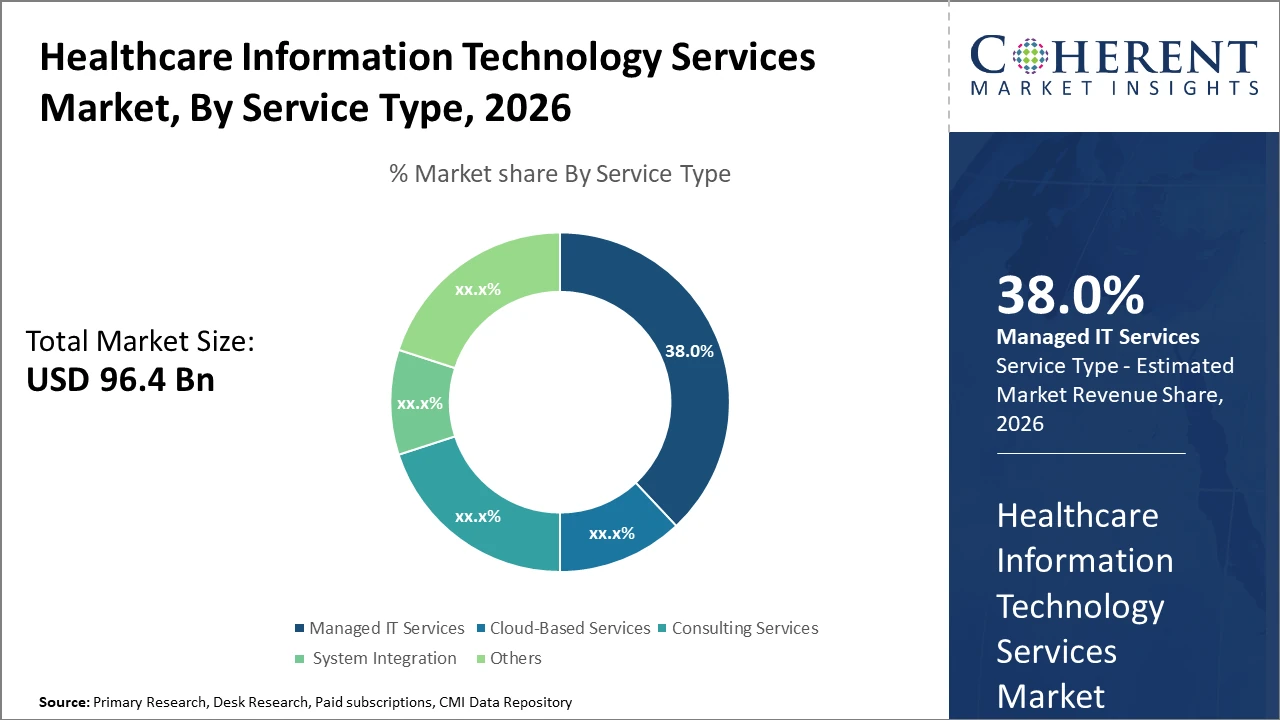
Healthcare Information Technology Services Market Insights, By Service Type
Managed IT Services hold primacy due to the critical demand by healthcare providers for 24/7 system uptime, network management, and infrastructure support, ensuring seamless operation of healthcare delivery systems. Recent adoption trends show that nearly 60% of hospitals in North America rely on managed services to cut operational costs and improve system reliability.
Cloud-Based Services are the fastest-growing subsegment, driven by scalable storage solutions addressing the massive data generated from diagnostic imaging and EHRs. This segment benefits from rising cloud adoption rates exceeding 45% in 2024, supported by lower capital expense and enhanced remote access capabilities. Consulting Services provide strategic IT implementation advice but represent a smaller slice of market share. System Integration services ensure interoperability between legacy systems and new digital platforms, critical for data consistency but growing more slowly due to complexity.
Healthcare Information Technology Services Market Insights, By End-User
Hospitals & Clinics command dominance due to continuous IT systems upgrades driven by regulatory mandates and patient volume management. For example, over 80% of mid to large hospitals in Europe increased IT spending in 2024, favoring EHR optimization and cybersecurity. Pharmaceuticals & Biotechnology represent the fastest-growing subsegment owing to the increasing use of IT services for clinical trials management, supply chain optimization, and drug safety monitoring. Digital transformation efforts in drug R&D showcased a 25% rise in IT budget allocations in 2024. Payers & Insurers utilize IT for claims processing and fraud detection but have moderate market shares. Diagnostic Centers focus on integrating advanced imaging IT systems with data analytics but remain niche.
Healthcare Information Technology Services Market Insights, By Technology
EHR systems are foundational to healthcare IT, accounting for the majority of spending by providers. In 2024, EHR penetration rates surpassed 85% in developed markets, driving consistent demand for upgrade and integration services. Telehealth/Telemedicine is the fastest-growing technology subsegment, accelerated by the surge of virtual healthcare visits rising above 1 billion annually post-pandemic. The convenience and cost efficiency of telehealth have triggered extensive service expansions and investments. Big Data & Analytics enable population health management and predictive modeling, crucial for personalized medicine initiatives, reflected by a 20% compound growth in analytics-driven projects in 2024. Cybersecurity is vital to safeguarding patient data, with breach mitigation investments rising 15% year-over-year due to escalating cyber threats.
Healthcare Information Technology Services Market Trends
The Healthcare Information Technology Services market trend indicates rapid adoption of AI and machine learning algorithms for predictive analytics and patient management.
For example, a major U.S.-based hospital network implemented AI-assisted patient triaging systems in 2024, reducing wait times by 18%.
Blockchain technology is emerging as a disruptive force by enabling secure and transparent patient data sharing across institutions, with pilot programs in Germany and the U.K. demonstrating a 25% enhancement in data integrity.
Additionally, growing demand for telehealth services accelerated during 2023 and remains a critical growth driver, supported by advances in 5G connectivity enabling real-time virtual consultations.
Healthcare Information Technology Services Market Insights, By Geography
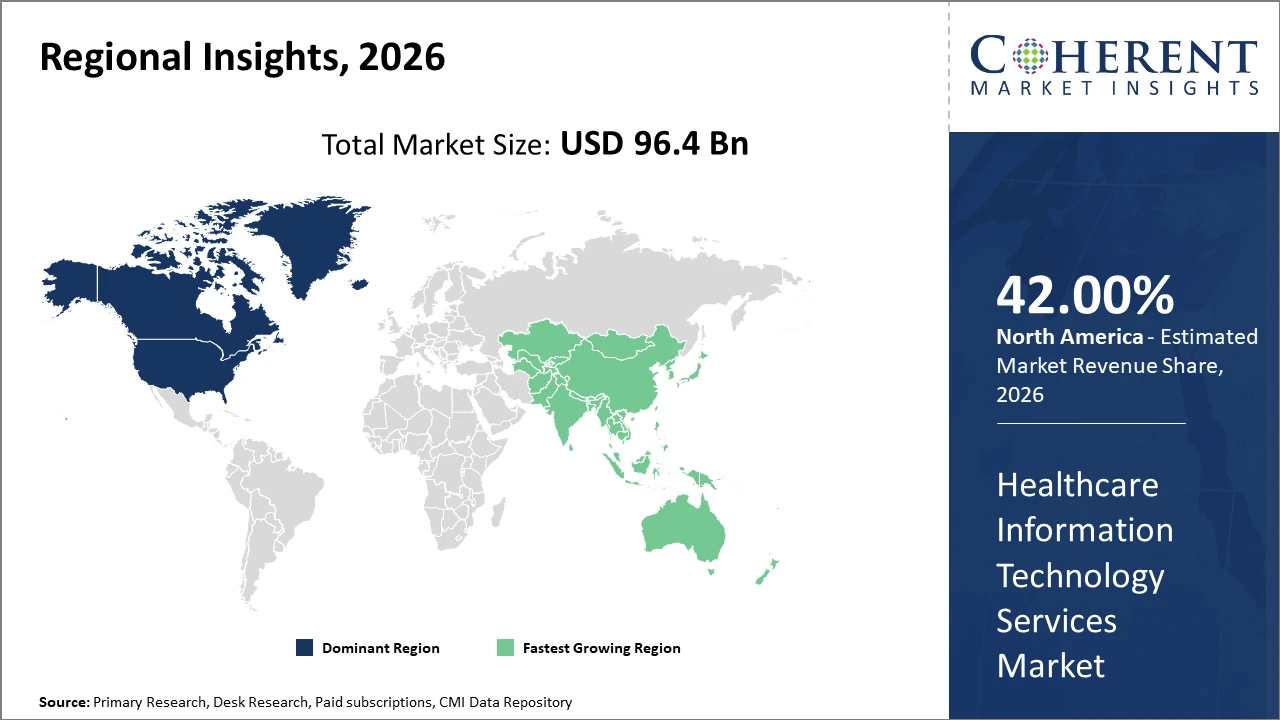
North America Healthcare Information Technology Services Market Analysis and Trends
In North America, the dominance in the Healthcare Information Technology Services market stems from advanced healthcare IT infrastructure, significant government investments, and widespread adoption of digital health solutions. This region commands about 42% market share due to favorable reimbursement policies, a robust ecosystem of healthcare technology companies, and high penetration of EHR systems. Major market players headquartered here have driven substantial innovation and competitive intensity.
Asia Pacific Healthcare Information Technology Services Market Analysis and Trends
Meanwhile, the Asia Pacific exhibits the fastest growth, with a CAGR exceeding 10%, spearheaded by expanding digitization initiatives in countries like India and China. Government-led healthcare modernization efforts, rising healthcare awareness, and increasing private sector participation have collectively propelled market growth. The introduction of national electronic health records and growing telemedicine services are key contributors.
Healthcare Information Technology Services Market Outlook for Key Countries
USA Healthcare Information Technology Services Market Analysis and Trends
The USA’s Healthcare Information Technology Services market is a global front-runner, backed by a vast network of hospitals investing heavily in IT infrastructure. With over 75% of hospitals transitioning to cloud-based IT solutions by 2024, the demand for managed IT services surged, elevating market revenue substantially. Companies like Cerner and Epic Systems have been instrumental in developing scalable EHR and telehealth solutions, facilitating efficient chronic care management and compliance with stringent regulatory requirements such as HIPAA.
India Healthcare Information Technology Services Market Analysis and Trends
India's healthcare IT services market is rapidly expanding, supported by government initiatives like the National Digital Health Mission launched in 2023. The adoption of telemedicine, accelerating at over 15% annually, coupled with partnerships between IT service providers and hospitals, is transforming healthcare delivery in both rural and urban areas. With local technology firms increasingly collaborating with multinational companies, the market is poised for substantial growth, driven by rising internet penetration and healthcare expenditure.
Analyst Opinion
The rise in healthcare digitization is a crucial demand-side indicator impacting market size. For instance, in 2024, over 70% of U.S. hospitals had implemented electronic health records (EHR) systems, pushing the adoption of IT service solutions. Similarly, the increase in telehealth consultations, which reached approximately 1.2 billion visits globally in 2025, exemplifies growing market revenue potential.
On the supply side, enhanced cloud computing infrastructure expands the market scope by offering scalable and secure solutions. Cloud-based healthcare IT services accounted for nearly 45% of total market revenue in 2024, reflecting providers’ preference for flexible and cost-effective deployment models.
Micro-indicators such as rising cybersecurity investments also affect market dynamics. With healthcare data breaches rising by 15% year-over-year in 2024, IT service providers are increasingly prioritizing robust cybersecurity frameworks, which is a significant growth strategy influencing market share.
The increasing regulatory frameworks worldwide, such as HIPAA in the U.S. and GDPR in Europe, emphasize compliance services. Healthcare IT service companies have reported a 25% revenue increase linked explicitly to regulatory compliance solutions in recent years, indicating strong demand-side momentum.
- Current Industry Events of 2026
- Market Size Estimation
- Regional Breakdown
- Competitive Landscape
- Customer Intelligence
- Segmental Analysis
- Pricing Analysis
- Key Market Drivers, Challenges & Future Trends
- Customized Insights Section
Market Scope
| Report Coverage | Details | ||
|---|---|---|---|
| Base Year: | 2025 | Market Size in 2026: | USD 96.4 billion |
| Historical Data for: | 2020 To 2024 | Forecast Period: | 2026 To 2033 |
| Forecast Period 2026 to 2033 CAGR: | 8.2% | 2033 Value Projection: | USD 163.7 billion |
| Geographies covered: |
| ||
| Segments covered: |
| ||
| Companies covered: | Meditech, Infosys Limited, NTT Data Corporation, Fujitsu, Siemens Healthineers, Accenture, HCL Technologies, Medtronic, Samsung SDS Healthcare, Oracle Health Sciences | ||
| Growth Drivers: |
| ||
Healthcare Information Technology Services Market Growth Factors
Key drivers include the escalating adoption of telehealth services, prompted by a 40% CAGR in telemedicine utilization during 2023-2025, which demands scalable IT infrastructure. The surge in chronic disease prevalence globally necessitates advanced data management, driving increased investments in electronic health records and analytics solutions. Regulatory compliance and data security demands have escalated with rising cyber threats, leading to robust demand for specialized cybersecurity healthcare IT services. Lastly, government initiatives in developing economies to digitize healthcare systems are fostering rapid market growth in the Asia Pacific and the Middle East regions.
Healthcare Information Technology Services Market Development
In December 2025, AIdMD Technologies launched its AIdMD AI-Powered Clinical Platform in the United States, introducing an intelligent software solution designed to reduce administrative workload across healthcare settings. The platform supports automated clinical documentation, AI-assisted decision support, and workflow optimization, enabling clinicians to spend more time on patient care while improving accuracy, compliance, and operational efficiency.
In May 2025, Smarter Technologies announced the launch of the industry’s first AI-powered revenue management platform, integrating technologies from Access Healthcare, SmarterDx, and Thoughtful.ai. The unified solution is designed to optimize hospital administrative and revenue cycle workflows by automating coding, prior authorizations, and claims management, helping healthcare providers reduce denials, improve cash flow, and lower operational costs.
In June 2025, Simplify Healthcare introduced Xperience1™, an AI-powered benefits inquiry platform aimed at simplifying interactions between health plan members and providers. The platform leverages a specialized health-literacy AI model to deliver accurate, easy-to-understand benefit information, reducing call center volumes, minimizing confusion, and improving member experience across complex insurance ecosystems.
Key Players
Leading Companies of the Market
Meditech
Infosys Limited
NTT Data Corporation
Fujitsu
Siemens Healthineers
Accenture
HCL Technologies
Medtronic
Samsung SDS Healthcare
Oracle Health Sciences
Competitive strategies across leading companies include strategic alliances and acquisitions. For example, a major healthcare IT service provider’s acquisition of a cloud analytics startup in 2024 resulted in a 30% revenue uplift over the following year by expanding AI-driven analytics capabilities. Others focus on joint ventures with regional healthcare providers to enhance customized digital solutions, improving local market penetration and operational efficiency.
Healthcare Information Technology Services Market Future Outlook
The HIT services market is poised for significant expansion as healthcare organizations pursue digital maturity and value-based care models. Cloud-native solutions, data interoperability standards such as FHIR (Fast Healthcare Interoperability Resources), and API-driven architectures will become core elements of healthcare IT ecosystems. Services that support secure data exchange, real-time analytics, predictive modeling, and patient-centric applications will be in high demand. Cybersecurity services will remain crucial as health data becomes a prime target for malicious actors. Additionally, the integration of artificial intelligence to support clinical decision-making, workflow automation, and population health management will create new service opportunities. Global healthcare systems, particularly in emerging economies, are expected to invest heavily in IT services to improve outcomes, reduce costs, and extend care access.
Healthcare Information Technology Services Market Historical Analysis
The healthcare information technology (HIT) services market grew out of early digitization efforts in the 1970s and 1980s, when hospitals began using basic computer systems to manage patient records and billing. The adoption of electronic health records (EHRs) in the 1990s and 2000s marked a watershed moment, as providers recognized the benefits of digital workflows for improving coordination and reducing errors. However, early HIT implementations were often fragmented and lacked interoperability, leading to inefficiencies and siloed data. Government incentive programs such as the HITECH Act in the United States accelerated adoption by linking reimbursement to meaningful use of EHRs. As healthcare systems expanded, so did the complexity of IT environments, necessitating services that could support integration, cybersecurity, data analytics, and compliance. Cloud computing, mobile health technologies, and patient engagement platforms further expanded the HIT services landscape, requiring new approaches to infrastructure management, application development, and support services.
Sources
Primary Research Interviews:
Hospital CIOs
Health IT consultants
Software vendors
System integrators
Databases:
CMS Health IT Data
HIMSS Analytics
Statista Healthcare IT
OECD Digital Health Reports
World Bank Health Data
Magazines:
Healthcare IT News
Modern Healthcare
HealthTech Magazine
Becker’s Health IT
CIO Healthcare
Journals:
Journal of the American Medical Informatics Association
BMJ Health & Care Informatics
International Journal of Medical Informatics
Journal of Digital Health
Applied Clinical Informatics
Newspapers:
The Wall Street Journal (Healthcare)
Financial Times (Technology)
Reuters Health
The Guardian (Health)
Bloomberg Technology
Associations:
HIMSS
American Medical Informatics Association
Digital Medicine Society
Healthcare Information and Management Systems Society
American Hospital Association
Get access to 250+ pages report
Every segment, forecast, competitor profile and data table behind the analysis above — available for instant download.
- ESOMAR Member
- ISO 9001:2015 Certified
- D-U-N-S Registered
- GDPR & CCPA Compliant
Missing comfort of reading report in your local language? Find your preferred language:
Transform your Strategy with Exclusive Trending Reports
Frequently Asked Questions
Dominant players include Cerner Corporation, Epic Systems Corporation, and Allscripts Healthcare Solutions, known for their extensive service portfolios and innovation in IT infrastructure across key regions.
The market is expected to grow from USD 96.4 billion in 2026 to USD 163.7 billion by 2033, reflecting robust demand and ongoing technology adoption.
Hospitals and clinics hold the largest segment due to their continuous need to upgrade IT infrastructure and comply with regulatory mandates.
Trends will increasingly focus on AI-driven analytics, blockchain for interoperability, and integration of IoMT devices, reshaping the healthcare IT ecosystem.
The competitive landscape is concentrated with key players adopting strategic acquisitions and technology partnerships, while challenges include stringent regulatory environments and cybersecurity threats.
Strategies such as mergers and acquisitions, regional collaborations, and expansion of cloud-based service offerings are prevalent to capture increased market share and enhance service portfolios.