

Healthcare Facilities Management Market Size and Trends
Healthcare Facilities Management Market is estimated to be valued at USD 5,07,811.9 Mn in 2026 and is expected to reach USD 11,87,300.0 Mn in 2033, exhibiting a compound annual growth rate (CAGR) of 13.1% from 2026 to 2033.
Key Takeaways of the Healthcare Facilities Management Market
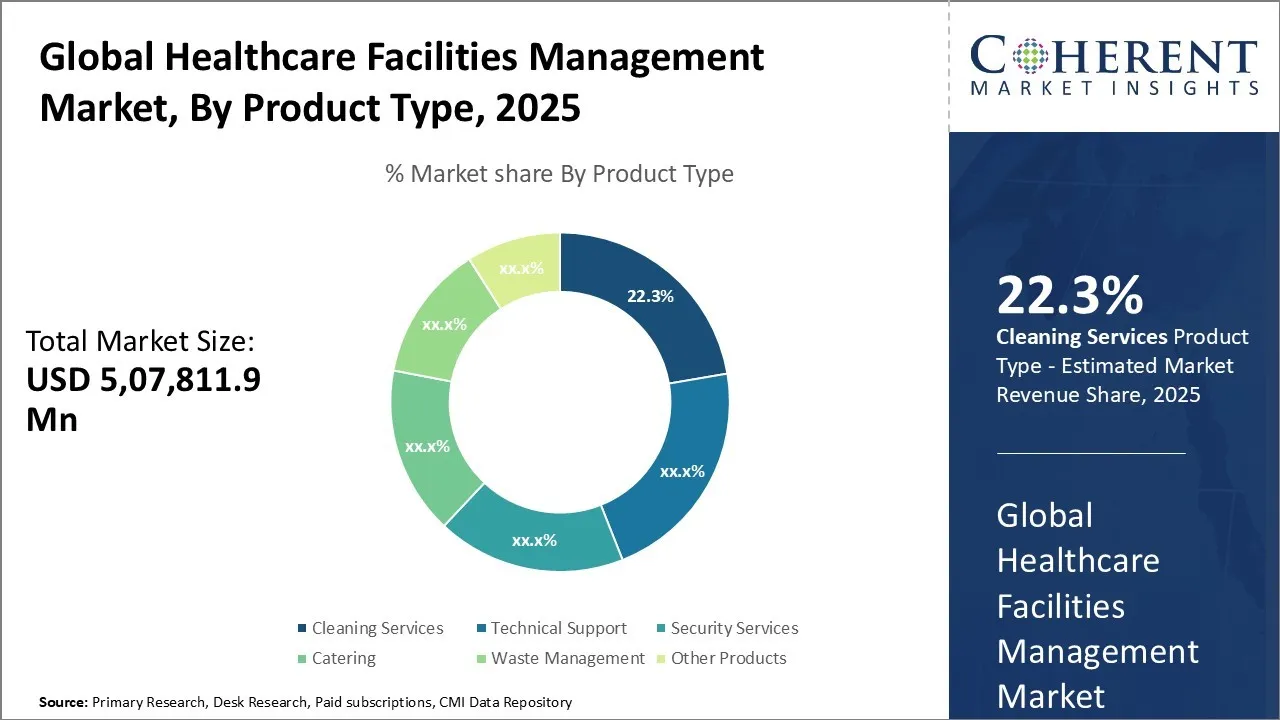
- Based on Product Type, the Cleaning Services segment leads the market holding an estimated share of 23.3% in 2026, due to their critical role in maintaining hygiene, ensuring patient safety, and preventing the spread of infections.
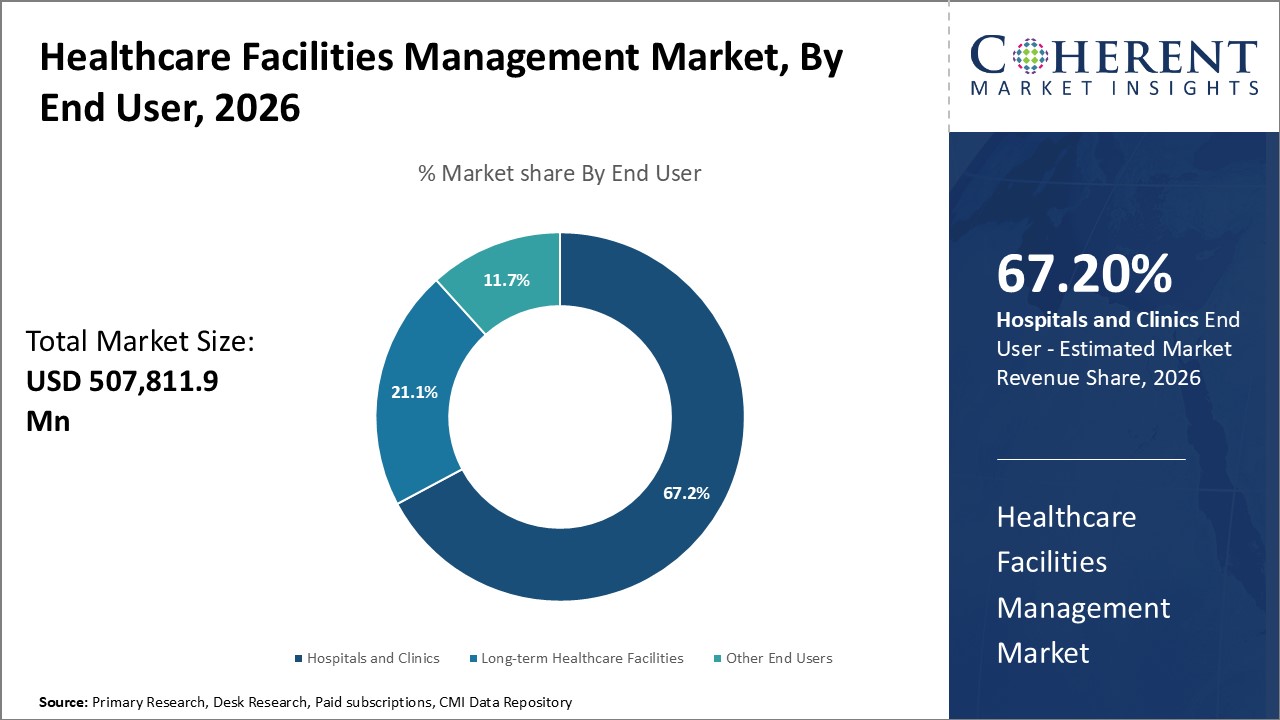
- Based on End User, the Hospital and Clinics segment is projected to dominate with the largest share in 2026, due to several critical operational and regulatory needs.
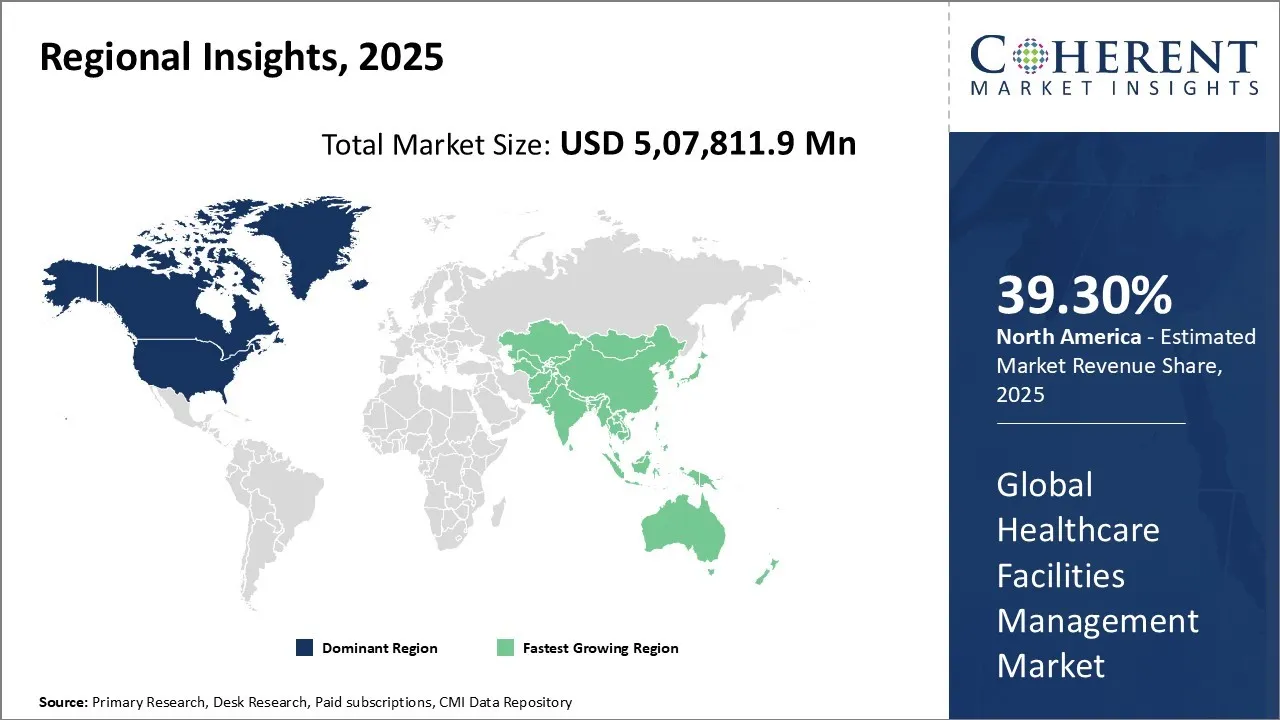
- Based on Region, North America is estimated to lead the market with a 39.3% in 2026. While, Europe is projected to be the fastest growing region during the forecast period.
Market Overview
The global healthcare facilities management market is growing steadily due to the rising burden of chronic diseases, increasing healthcare expenditures, and the expansion of medical tourism. Hospitals and clinics are adopting facility management solutions to enhance operational efficiency, patient safety, and compliance. Countries attracting international patients are investing in modern infrastructure, further boosting healthcare facilities management market demand.
Current Events and Its Impact
Current Event | Description and Its Impact |
Regulatory Compliance and Quality Standards Evolution |
|
Digital Health Technology Integration and Cybersecurity Concerns |
|
Patent Analysis
Patent activity in healthcare facilities management is concentrated around smart tracking, predictive analytics, and facility planning. Patents like US12009092 enable assets to act as real-time data sensors, while US8666771 and WO2018172971 focus on simulation and analytics platforms for planning and decision support.
Workflow-focused patents such as US11995592 use OCR and mapping for optimizing staff movement and service delivery. The U.S., EU, and China lead in filings, especially in AI- and IoT-enabled facility systems. These patents form the foundation of future-ready, data-driven healthcare facilities management platforms.
- Current Industry Events of 2026
- Market Size Estimation
- Regional Breakdown
- Competitive Landscape
- Customer Intelligence
- Segmental Analysis
- Pricing Analysis
- Key Market Drivers, Challenges & Future Trends
- Customized Insights Section
Segmental Insights
Healthcare Facilities Management Market Insights, By Product Type
Cleaning Service Holds the Dominant Share as it Maintain Hygiene & Ensure Patient Safety
In terms of product type, the cleaning service is expected to command the largest share of 23.3% in the global healthcare facilities management market in 2026, due to its critical role in maintaining hygiene, ensuring patient safety, and preventing the spread of infections. Hospitals and clinics must maintain strict cleanliness to prevent hospital-acquired infections (HAIs) such as MRSA or C. difficile. Regular and specialized cleaning help reduce microbial load and ensure a safe environment for both patients and staff. Healthcare facilities are required to meet sanitation standards set by health authorities (e.g., WHO, CDC, NABH). Cleaning services must follow protocols using approved disinfectants and techniques, making them essential to regulatory compliance. Emergency rooms, ICUs, and outpatient clinics experience constant footfall, requiring frequent cleaning of surfaces, beds, equipment, and restrooms to prevent cross-contamination and ensure cleanliness around the clock.
In May 2025, Clorox Professional (CloroxPro) signed a new multi-year contract with Vizient, the U.S.’s largest healthcare performance improvement firm. The agreement will expand CloroxPro’s product offerings, featuring Clorox Healthcare, Clorox EcoClean, Pine‑Sol, and more to Vizient’s extensive network of hospitals and healthcare systems. The integration aims for seamless deployment of trusted cleaning and disinfecting solutions across Vizient members.
Healthcare Facilities Management Market Insights, By End User
Hospital and Clinics Acquires the Largest Share owing to Critical Operational and Regulatory Needs
In terms of end users, the hospital and clinics segment are expected to hold the highest market share in 2026, due to several critical operational and regulatory needs. Hospitals require rigorous cleaning, waste disposal, and infection control protocols. Facilities management ensures sanitation, minimizes risks of hospital-acquired infections (HAIs), and improves patient outcomes. Healthcare institutions must adhere to strict health, safety, and environmental standards. Facilities management teams help maintain compliance with regulations like NABH, JCI, and OSHA through regular audits, documentation, and preventive maintenance. From HVAC systems to critical medical equipment, efficient facility operations are essential. Facilities management ensures the uninterrupted functioning of infrastructure, reducing downtime and enhancing care delivery.
In June 2025, FV Hospital in Vietnam convened over 150 experts, including speakers from Thomson Medical, Siemens Singapore, and Technecon India, for a symposium on healthcare facility management. Topics ranged from smart infrastructure planning and low‑cost maintenance to robotics, AI diagnostics, telemedicine, and digital pathology.
Regional Insights
North America Healthcare Facilities Management Market Analysis & Trends
North America is expected to gain the highest share of 39.30% in the market in 2026, owing to the rise in prevalence of chronic and infectious diseases, the rise in the number of hospitals, increasing hospital admissions, and robust healthcare infrastructure in the region. For instance, according to the American Hospital Association’s (AHA’s) statistics published in 2026, there are around 6,093 active hospitals in the United States, servicing over 34 million patient admissions annually. This substantial healthcare capacity demands robust facility management ranging from HVAC and sanitation to equipment upkeep and cybersecurity to ensure safe, efficient, and uninterrupted care delivery.
For example, a 2024 survey by the American Society for Health Care Engineering revealed that 80% of hospital facilities managers cite aging infrastructure as a top concern, with 58% pointing to funding and staffing challenges. These findings highlight the urgent need for comprehensive facility management solutions, including preventive maintenance, digital asset management, and AI-enabled monitoring systems, to keep critical hospital infrastructure operational and safe.
Such demand has translated into significant growth in the healthcare facilities management market size, as hospitals and health systems increasingly invest in outsourced facility services and integrated management platforms. These investments are driven by aging facilities, patient safety priorities, and mounting operational pressures, positioning North America as the largest and most mature market for healthcare facilities management services globally.
Europe Healthcare Facilities Management Market Analysis & Trends
Europe is expected to exhibit the fastest growth in the global healthcare facilities management market, which is experiencing dynamic growth, driven by expansions in hospitals, rising chronic and infectious disease rates, and increased healthcare spending. The region is undergoing a wave of modernization aimed at boosting capacity and introducing "smart hospital" features such as AI-powered monitoring, IoT asset tracking, and digital patient controls. A prime example is the UK’s Hull University Teaching Hospitals NHS Trust, which has implemented RFID tracking for 70,000 devices and is saving approximately 35 staff hours per person each year. Similarly, Germany is channeling €248 million into enhancing clinics across Baden-Württemberg, upgrading logistics centers and regional hospitals with advanced facility systems to improve patient care and operational efficiency.
These real-world projects reflect a broader trend: governments and healthcare institutions are investing heavily in facility management technologies ranging from building automation to digital service integration, to ensure hospitals are scalable, sustainable, and patient-focused. This architectural and technological shift is fueling strong healthcare facilities management market growth, particularly in Europe’s fastest-evolving healthcare corridors.
Healthcare Facilities Management Market Outlook Country-Wise
The U.S. Healthcare Facilities Management Market Trends
The United States is a leading market for healthcare facilities management due to its advanced healthcare infrastructure, high hospitalization rates, and strict compliance with regulations like OSHA and HIPAA. Hospitals prioritize services like sanitation, HVAC maintenance, and energy-efficient upgrades to meet growing operational demands.
To improve efficiency and patient safety, many U.S. hospitals are adopting AI and IoT-based facility management systems. These technologies enable real-time monitoring of energy use, predictive maintenance, and asset tracking. As a result, U.S. healthcare providers are streamlining operations while enhancing sustainability and regulatory compliance.
Germany Healthcare Facilities Management Market Trends
Germany is seeing strong demand for healthcare facilities management due to its aging population, vast hospital network, and major public investments in infrastructure. The country is focusing on smart hospitals, logistics optimization, and achieving green building certifications to improve efficiency and sustainability.
In 2024, the German government allocated €248 million to upgrade hospitals in Baden-Württemberg, supporting modernization and integration of advanced facility systems. These efforts reflect Germany’s push for more efficient, digital, and eco-friendly healthcare operations.
Market Report Scope
Healthcare Facilities Management Market Report Coverage
| Report Coverage | Details | ||
|---|---|---|---|
| Base Year: | 2025 | Market Size in 2026: | USD 5,07,811.9 Mn |
| Historical Data for: | 2020 To 2024 | Forecast Period: | 2026 To 2033 |
| Forecast Period 2026 to 2033 CAGR: | 13.1% | 2033 Value Projection: | USD 11,87,300.0 Mn |
| Geographies covered: |
| ||
| Segments covered: |
| ||
| Companies covered: | Cushman & Wakefield, Tenon Group, Apollo Sindoori, Compass Group PLC, Sodexo, Serco Group PLC, OCS Group, Jones Lang LaSalle, ISS World Services AS, Ecolab Inc., ABM Industries Inc., Aramark Corporation, Vanguard Resources Inc., and Medxcel Facilities Management, among others | ||
| Growth Drivers: |
| ||
| Restraints & Challenges: |
| ||
Global Healthcare Facilities Management Market Drivers
Rise in burden of chronic diseases to augment market growth
One of the key factors expected to augment growth of the global healthcare facilities management market over the forecast period is the increase in prevalence or incidence of chronic disease, such as cardiovascular disease, cancer, diabetes, and/or age-related dementia, across the globe. Patients with chronic conditions are heavy users of the health services. According to the Centers for Disease Control and Prevention (CDC), more than 877,500 people in the U.S. die of heart disease or stroke every year, that’s one-third of all deaths. These diseases take an economic toll, as well, cost health care system USD 216 billion per year. This in turn is expected to increase demand/use of healthcare facility management services or solutions worldwide.
Need for healthcare facility management to drive market growth
Another factor which is driving the growth of the global healthcare facilities management market is the increase in demand for or adoption of healthcare facility management services or solutions. Healthcare facilities management services or solutions are required to support the hospital’s staff. For example, cleaning services, catering, and waste management are in high demand from facilities that house individuals with chronic diseases. Chronic diseases such as heart disease, cancer, and diabetes are the leading causes of death and disability worldwide. In January 2023, The National Health Authority of India planned to release a hospital management information system for private clinics and small health facilities in the country.
Global Healthcare Facilities Management Market Opportunities
Growth in healthcare expenditures worldwide is expected to offer significant growth opportunities for players in the global healthcare facilities management market. For instance, the past few years have seen a tremendous increase in healthcare expenditure in developed and developing countries. The healthcare sector is growing due to its strengthening coverage, services, and rise in expenditure by both public and private players.
Increasing medical tourism is expected to offer significant growth opportunities for players in the healthcare facilities management market. For instance, medical tourism is becoming very popular around the world as people are realizing the quality of healthcare services available abroad. It has also gained widespread acceptance over the years. In August 2022, the Government of India listed ten airports; such as Mumbai, Delhi, Bengaluru, Chennai, Hyderabad, Visakhapatnam, Kolkata, Guwahati, Kochi, and Ahmedabad, to feature special desks, a multi-lingual portal, and simplified visa norms for incoming international passengers visiting India for medical purposes.
Global Healthcare Facilities Management Market Trends
Rise in focus on facility management is a recent trend
Healthcare facilities management is expected to grow at a rapid pace over the forecast period due to rapid privatization of medical care in developing countries, as well as increasing trend towards outsourcing facilities management services/solutions. The healthcare sector is capitalizing on the growing consumer desire for quick, convenient healthcare services available round the clock. This is one area where facilities management providers can offer their services or solutions. This trend is expected to continue during the forecast period.
Need for waste management is another trend
The management of healthcare waste requires increased attention and diligence to avoid adverse health outcomes associated with poor practice, including exposure to infectious agents and toxic substances. The waste may compromise patient care quality, spread infectious diseases, and may increase environmental pollution. Such high medical waste is expected to contribute to the demand for waste management services or solutions, thereby contributing to the growth of the market. This trend is also expected to continue over the forecast period.
Analyst Opinion (Expert Opinion)
The healthcare facilities management market value is undergoing a fundamental transformation, not in size, but in strategic relevance. The role of facilities management in hospitals and healthcare institutions has shifted from being a cost center to a pivotal driver of clinical efficiency, patient safety, and sustainability outcomes. This is no longer about maintaining HVAC systems or janitorial oversight; HFM now directly impacts care delivery, compliance, and strategic resilience.
One of the most underestimated levers in this market is energy and infrastructure optimization. According to the U.S. Department of Energy, healthcare facilities are among the most energy-intensive commercial buildings, consuming an average of 234 kBtu per square foot. Progressive health systems such as Kaiser Permanente have managed to reduce energy consumption by over 10% across their portfolio using integrated building management systems and predictive maintenance protocols.
Another emerging focal point is clinical environment risk management. Studies published by the World Health Organization note that nearly 15% of hospital-acquired infections can be attributed to deficiencies in environmental hygiene. Facilities management providers that incorporate AI-enabled infection tracking and real-time air quality monitoring are positioning themselves as indispensable partners in clinical governance. For instance, hospitals using automated UV-C disinfection systems have reported up to a 30% reduction in high-touch surface contamination, reinforcing the convergence between FM and infection control.
The maturity of digitally integrated facilities is also worth scrutinizing. In markets like Germany and the UK, smart hospital pilots are moving beyond patient-focused IoT and into the realm of machine-learning-based asset tracking, space utilization forecasting, and energy control. The Asklepios Klinik Barmbek in Hamburg is an illustrative case, using a digital twin model to pre-emptively manage equipment failure and reduce downtime in critical areas like radiology suites.
Speak to the analyst
Want personalized insights?
Take the findings above to one of our principal consultants, or have the report rebuilt around the segments, geographies and competitors you actually track.
Key Developments
- In June 2025, the Adani Group announced INR 8,000 crore investment in integrated healthcare and skill development projects. A total of INR 6,000 crore will be allocated to launch two flagship Adani Health Cities in Ahmedabad and Mumbai. These campuses, each featuring 1,000‑bed multi‑speciality hospitals, medical colleges, research hubs, wellness zones, and AI‑capable systems, are being developed in partnership with the Mayo Clinic.
- In June 2025, Kardham Digital unveiled Smart Hospital, a comprehensive smart-building and workplace solution designed to accelerate the digital transformation of healthcare facilities. This turnkey platform integrates energy management, cyber‑security, and seamless navigation for staff, patients, and visitors.
- In March 2025, The Government of India is significantly expanding healthcare infrastructure through multiple initiatives, the Health Minister informed the Lok Sabha. Under the National Health Mission (NHM), the government offers technical and financial support, including incentives both monetary and non‑monetary to attract doctors and health workers to rural and challenging areas. The Pradhan Mantri Ayushman Bharat Health Infrastructure Mission (PM‑ABHIM) is enlarging Health & Wellness Centres, adding critical-care beds in district hospitals, and establishing Block Public Health Units in high-priority states.
- In February 2025, Sodexo India unveiled a state-of-the-art Healthcare Technology Management (HTM) facility in Sector V, Kolkata, spanning 6,700 sq ft. The new centre houses six specialized labs capable of maintaining up to 500,000 biomedical devices across West Bengal.
Market Segmentation
- Global Healthcare Facilities Management Market, By Product Type (Revenue, USD Mn, 2021 - 2033)
- Waste Management
- Security Services
- Catering Services
- Cleaning Services
- Technical Support Services
- Other Product Types
- Global Healthcare Facilities Management Market, By End User (Revenue, USD Mn, 2021 - 2033)
- Hospitals and Clinics
- Long-term Healthcare Facilities
- Other End Users
- Global Healthcare Facilities Management Market, By Geography (Revenue, USD Mn, 2021 - 2033)
- North America
- U.S.
- Canada
- Latin America
- Brazil
- Argentina
- Mexico
- Rest of Latin America
- Europe
- Germany
- U.K.
- Spain
- France
- Italy
- Russia
- Rest of Europe
- Asia Pacific
- China
- India
- Japan
- Australia
- South Korea
- ASEAN
- Rest of Asia Pacific
- Middle East
- GCC Countries
- Israel
- Rest of Middle East
- Africa
- South Africa
- North Africa
- Central Africa
- North America
- Key Companies Insights (Revenue, USD Mn, 2021 - 2033)
- Cushman & Wakefield
- Tenon Group
- Apollo Sindoori
- Compass Group PLC
- Sodexo
- Serco Group PLC
- OCS Group
- Jones Lang LaSalle
- ISS World Services AS
- Ecolab Inc.
- ABM Industries Inc.
- Aramark Corporation
- Vanguard Resources Inc.
- Medxcel Facilities Management
Sources
Primary Research Interviews from the following stakeholder
Stakeholders
- Interviews with hospital administrators, facility managers, infection control heads, energy efficiency consultants, procurement directors, and digital transformation leads across global healthcare networks.
Specific stakeholders
- FM and operations heads at multi-specialty hospitals and tertiary care centers
- Procurement and IT infrastructure managers at hospital chains
- Biomedical engineers and sustainability officers at specialty clinics and diagnostic centers
- Architectural planners and MEP consultants involved in hospital retrofitting and green healthcare infrastructure
- Environmental services (EVS) leads and sanitation technology experts at healthcare campuses
- Vendors and system integrators of CAFM, CMMS, and building automation solutions for healthcare
Databases
- World Health Organization (WHO) Health Infrastructure Statistics
- Healthcare Facilities Management Association (HFMA) – Infrastructure Data Repository
- Ministry of Health and Family Welfare (MoHFW), India – Hospital Infrastructure Data
- U.S. Centers for Medicare & Medicaid Services (CMS) Facility Data
- OECD Health Statistics
- Eurostat – Healthcare Facility Indicators
- Japan Ministry of Health, Labour and Welfare (MHLW)
- National Health Services (NHS) Digital – Estates and Facilities Statistics
Magazines
- Health Facilities Management (HFM)
- Healthcare Design Magazine
- Building Better Healthcare
- Medical Construction & Design (MCD)
- Facility Executive – Healthcare Facilities
- Smart Buildings Magazine
- Health Estate Journal
- Environment of Care News
Journals
- Journal of Healthcare Engineering
- International Journal of Health Planning and Management
- Healthcare Facilities (Emerald Publishing)
- Energy and Buildings – Special Issues on Healthcare
- Journal of Hospital Administration
- Journal of Infection Prevention – Built Environment Focus
- Journal of Facility Management Education and Research
Newspapers
- Financial Times – Global Healthcare Infrastructure Reports
- The Hindu Business Line – Health Infra and Hospital Services
- The Economic Times – Hospital Operations and Digitization
- New York Times – Health Section Hospital Facility Developments
- South China Morning Post – Health and Infrastructure
- The Guardian – Health Services and NHS Infrastructure
- Nikkei Asia – Japan Health System Infrastructure
Associations
- American Society for Health Care Engineering (ASHE)
- International Facility Management Association (IFMA) – Healthcare Council
- Global Green and Healthy Hospitals (GGHH)
- Association for the Advancement of Medical Instrumentation (AAMI)
- Indian Green Building Council (IGBC) – Healthcare Rating System
- Facility Guidelines Institute (FGI)
- German Hospital Federation (DKG) – Infrastructure and Operations
- Canadian Healthcare Engineering Society (CHES)
Public Domain Sources
- U.S. Department of Health and Human Services (HHS)
- Ministry of Health (Government of UAE, Singapore, UK, Australia)
- NITI Aayog – Healthcare Infrastructure Reports
- European Commission – Health and Digital Transformation Reports
- India Investment Grid – Hospital and Healthcare Projects
- Reserve Bank of India (RBI) – Healthcare Investment Analytics
- World Bank – Healthcare Infrastructure Investment Reports
- United Nations Department of Economic and Social Affairs (UN DESA) – Hospital Resilience Reports
Proprietary Elements
- CMI Data Analytics Tool, and Proprietary CMI Existing Repository of information for last 8 years
Get access to 250+ pages report
Every segment, forecast, competitor profile and data table behind the analysis above — available for instant download.
- ESOMAR Member
- ISO 9001:2015 Certified
- D-U-N-S Registered
- GDPR & CCPA Compliant
Missing comfort of reading report in your local language? Find your preferred language:
Transform your Strategy with Exclusive Trending Reports
Frequently Asked Questions
The Healthcare Facilities Management Market is estimated to be valued at USD 5,07,811.9 Mn in 2026, and is expected to reach USD 11,87,300.0 Mn by 2033.
The CAGR of the Healthcare Facilities Management Market is projected to be 13.1% from 2026 to 2033.
Increase in prevalence or incidence of chronic disease and increase in demand for or adoption of healthcare facility management services or solutions is fueling the market.
The cleaning service segment is the leading product type segment in the market.
Lack of investment in facility management and gap between providers and payers are major factors restraining market.
Major players operating in the market are Cushman & Wakefield, Tenon Group, Apollo Sindoori, Compass Group PLC, Sodexo, Serco Group PLC, OCS Group, Jones Lang LaSalle, ISS World Services AS, Ecolab Inc., ABM Industries Inc., Aramark Corporation, Vanguard Resources Inc., and Medxcel Facilities Management, among others.
It directly affects patient safety, clinical outcomes, infection control, and 24/7 critical operations—making precision and responsiveness non-negotiable.