

Intelligent Lighting Controls Market Size and Forecast — 2026-2033
Global intelligent lighting controls market is estimated to be valued at USD 19.72 Bn in 2026 and is expected to reach USD 56.55 Bn by 2033, growing at a compound annual growth rate (CAGR) of 19.2% from 2026 to 2033.
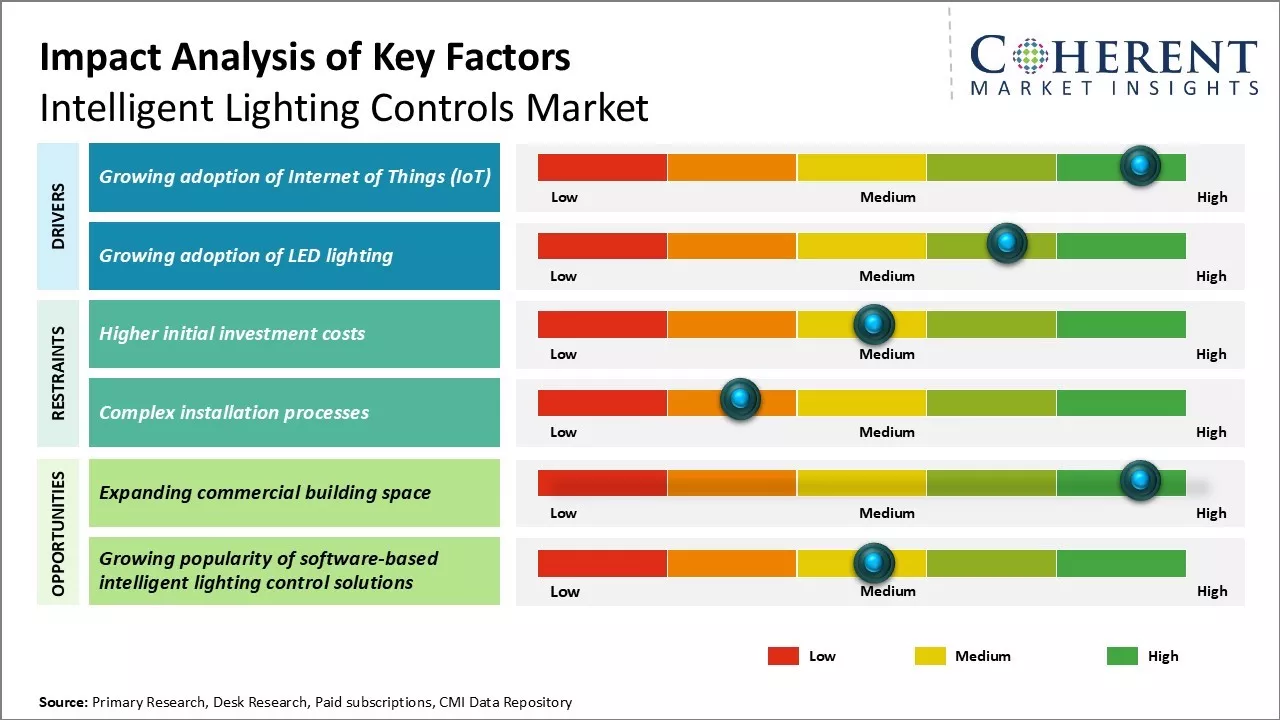
Lighting controls enable various advantages like energy savings, flexibility, and operational cost reduction attracting various end-users to adopt smart lighting solutions. The market is expected to witness significant growth due to rising awareness about energy savings with the use of intelligent lighting systems. Government policies and regulations toward use of energy efficient lighting is also pushing the market growth. Advancements in wireless communication technologies along with integration of lighting controls with various smart home and building automation systems will further provide impetus to the intelligent lighting controls market expansion during the forecast period.
Insights, By Type
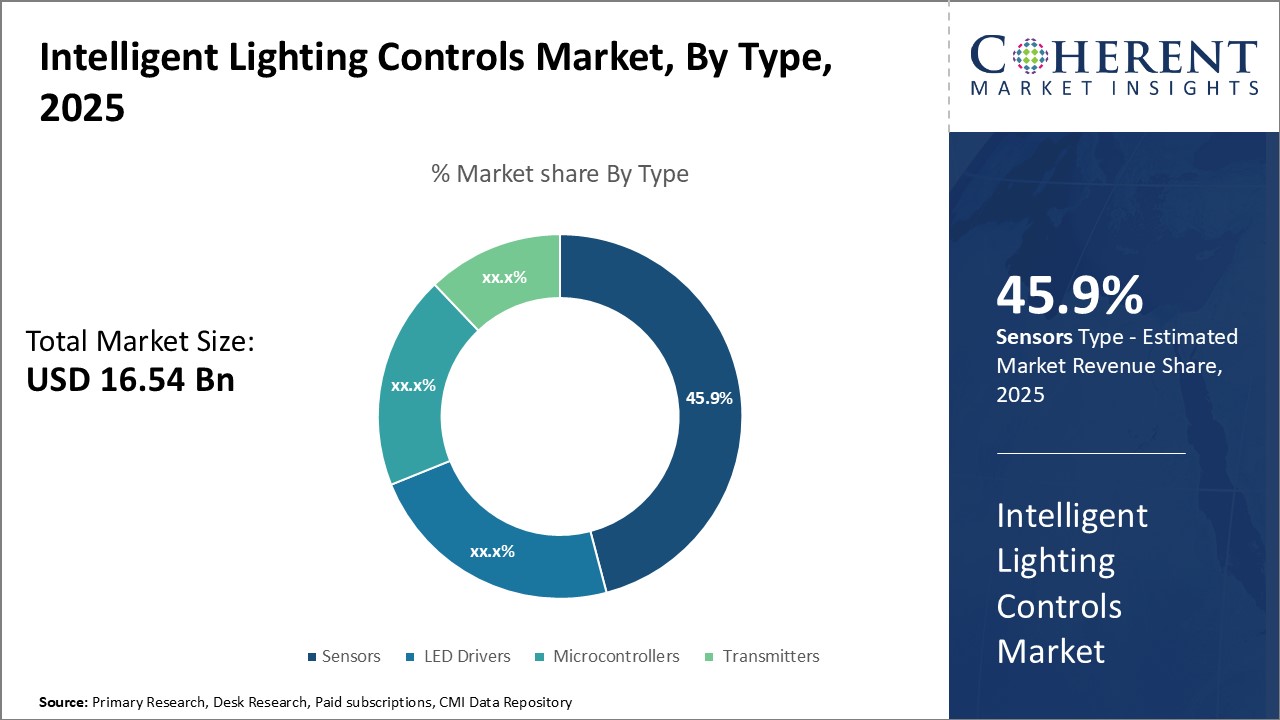
Insights, By Type, Intelligent Recognition Boosts Sensor Sales
By Type, Sensors are expected to contribute highest share of 46.9% in 2026 due to their ability to recognize and interpret environments. Sensors play a vital role in intelligent lighting by automatically adjusting light based on occupancy and ambient conditions. Motion sensors detect movement and turn lights on or off accordingly, helping conserve energy. Daylight sensors measure natural light levels and dim artificial lights when sufficient sunlight is available. Over time, sensors have gained intelligence through advanced recognition technologies.
Insights, By Connectivity
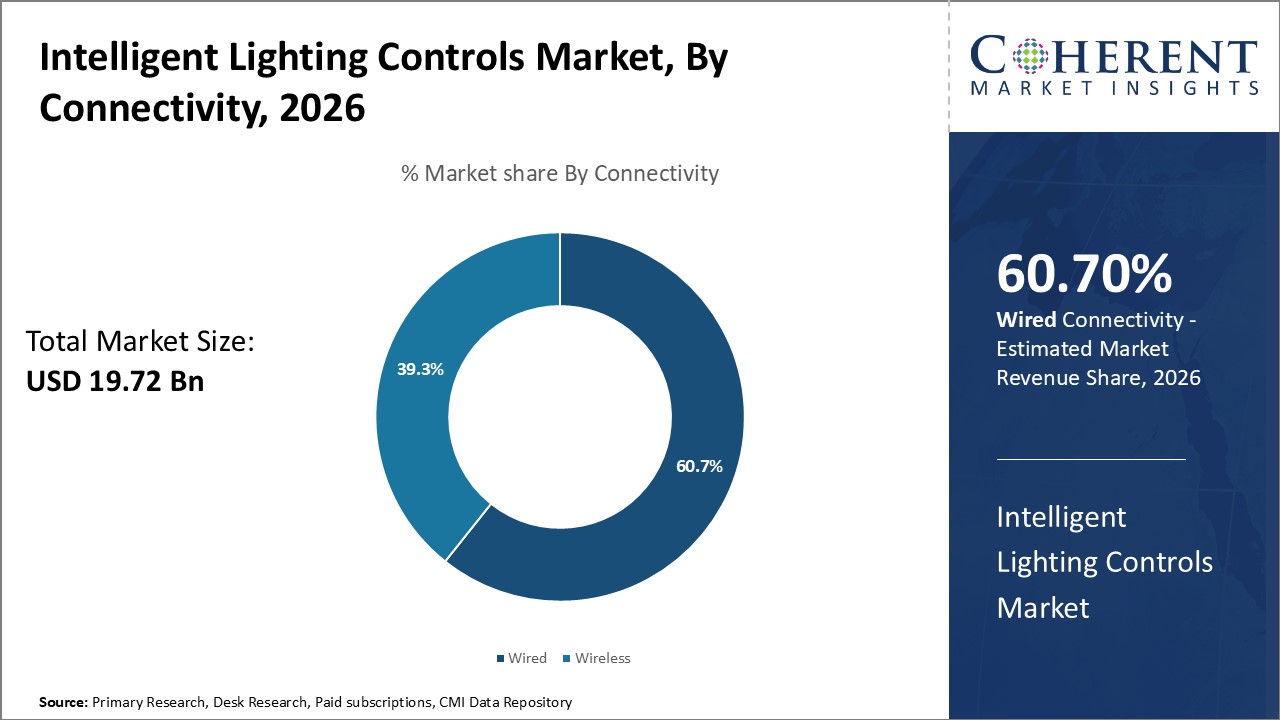
Insights, By Connectivity, Wired Dominates on Performance Reliability
By Connectivity, Wired segment contributes the highest share of 60.7% in 2026 due to its reliable performance. Wired systems deliver robust, uninterrupted connections essential for mission critical facilities. Hospitals, laboratories, and industrial sites depend on hardwired controls for lighting that directly impacts productivity, compliance, and safety. Wireless technologies still experience occasional interference and interruptions that risk non-compliance or safety.
Insights, By Application
Insights, By Application, Smart Cities Drive Adoption in Public Infrastructure
By Application, Smart Cities contributes the highest share of 43.8% in 2026 due to rapid investments modernizing public infrastructure with intelligent lighting. Smart city initiatives aim to enhance liveability, sustainability, and services through connected technology. Intelligent lighting serves as a foundational network accelerating other smart apps ranging from waste management to emergency response. Since streetlights already blanket cities, controls retrofitted onto their infrastructure create an instant IoT fabric.
Regional Insights
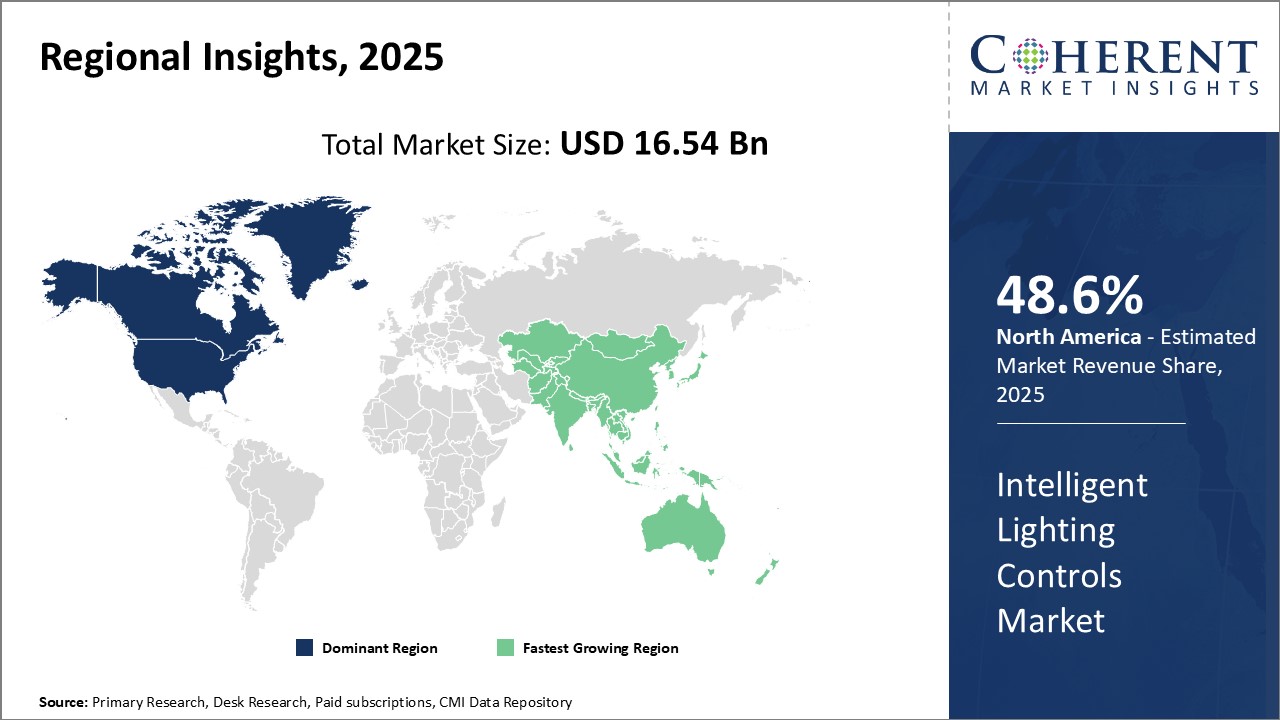
Dominating Region: North America
North America dominates the intelligent lighting controls market with a projected market share of 48.6% in 2026. The growth can be attributed to strong governmental initiatives promoting energy efficiency and green building projects. Major cities have implemented smart city plans involving installation of intelligent street lighting networks. Presence of global leaders in this space such as Cree and Acuity Brands has created a robust supply chain and technology ecosystem in the region.
Fastest-growing Region: Asia Pacific
The Asia Pacific region is expected to exhibits the fastest growth and account for 32.9% in 2026 due to the adoption of intelligent lighting solutions. Governments of developing countries are focusing on infrastructure development and upgrading conventional lighting systems. A burgeoning middle class has increased disposable incomes in the region, lifting demand for energy-efficient, connected home automation products. Local players in Japan, China and India have emerged as innovative forces offering competitive pricing.
Intelligent Lighting Controls Market Outlook for Key Countries
Rise in Consumer Demand for Energy Efficiency
The US market benefits from a highly structured building standards framework driving retrofits and new construction projects. Leaders like Hubbell and Cooper provide diverse portfolios matching all application sizes. The US intelligent lighting controls market is being significantly impacted by growing consumer demand for energy efficiency and convenience. As people have sought ways to reduce their electricity bills amid economic uncertainty, intelligent lighting systems offering automated controls and sensors have become increasingly attractive.
Rise in Smart City Projects Encourages Demand for Intelligent Lighting Solutions in China
China's market continues to expand on the back of massive smart city projects and growth in commercial real estate. Domestic brands including TCL and Mingrui leverage low-cost manufacturing expertise. The smart home revolution has also boosted demand for intelligent lighting controls among homeowners. As more consumers purchase smart home devices like voice assistants, security cameras and thermostats, they expect lighting to be connected and integrated within the smart home ecosystem. This has led to a proliferation of affordable WiFi enabled bulbs and switches on the market that allow remote and automated control of light levels from smartphones.
IoT Initiatives and Technological Advances Improves Market Conditions
German firms connect intelligent lighting to Industrial IoT initiatives, making solutions from Osram and Schneider Electric preferred across European factories and warehouses. The Germany intelligent lighting controls market witnessed a significant shift driven by both policy changes and technological advancements. Federal Government in Germany has implemented new regulations and standards to promote energy efficiency and reduce carbon emissions.
Government Initiatives and Rise in Dependency on Renewable Energy
India continues to lead in terms of potential for market growth, supported by government initiatives on renewable energy adoption and modernization of infrastructure. The smart home market in India is also growing rapidly with increasing sales of devices such as smart bulbs, switches, plugs and light controllers that integrate with virtual assistants. Major companies like Amazon, Flipkart and Reliance Digital have started offering these compatible lighting solutions.
Focus on Energy Efficient Solutions
Japan's market sees positive impact of partnerships between local players like NEC and Panasonic with technology firms focused on AI-enabled lighting control applications. The uptake of intelligent lighting controls is steadily growing in Japan, driven by rising awareness of energy efficiency and sustainability. Building operators and facilities managers are increasingly recognizing that intelligent lighting solutions can optimize energy usage and reduce costs through automatic adjustments based on behaviors, occupancy, and ambient light levels. For example, a major pharmaceutical corporation in Tokyo recently invested in a lighting control system that automatically dims lights in empty offices and conference rooms.
Market Players, Key Development, and Competitive Intelligence
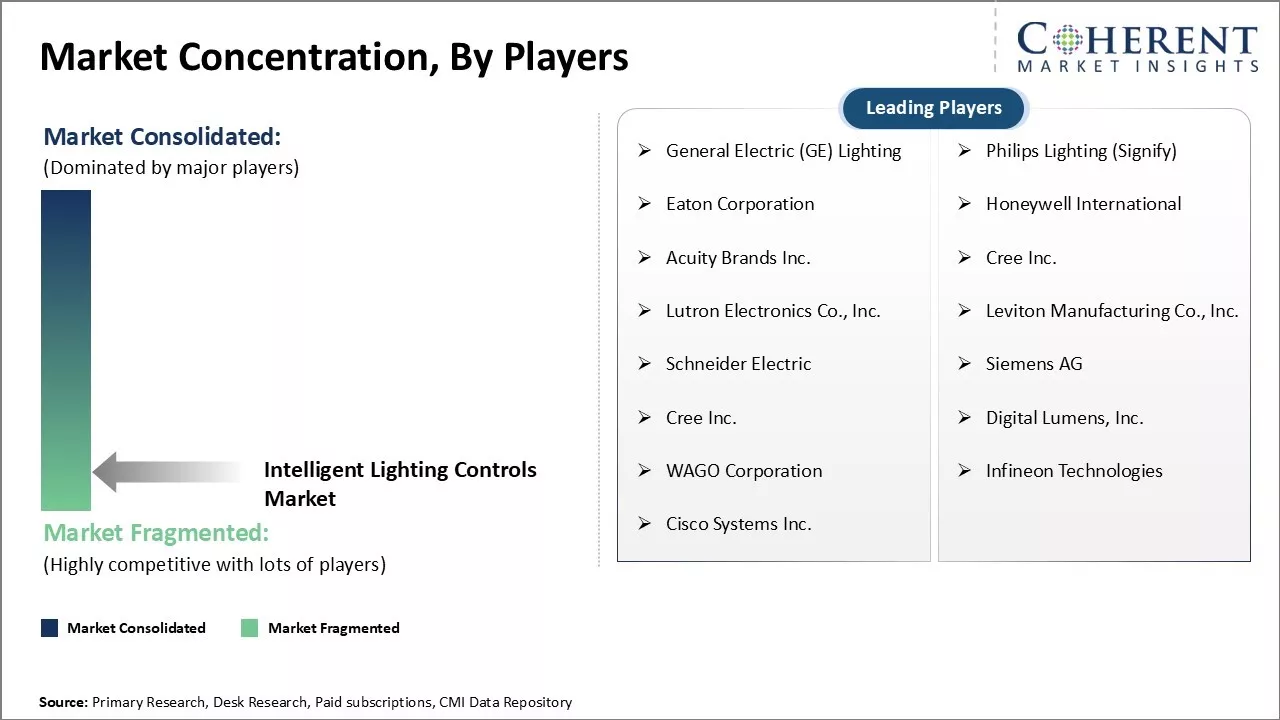
Top Strategies Followed by Intelligent Lighting Controls Market Players
- Established Players: Established players in the intelligent lighting controls market focus extensively on research and development to introduce cutting-edge technologies and innovative products. Companies such as Philips, Schneider Electric, and OSRAM invest over 5% of their annual revenue in R&D initiatives aimed at developing smart sensors, IoT integration, and AI-powered lighting solutions. They also form strategic partnerships with leading technology providers and OEMs to gain access to advanced capabilities and solidify their presence across product categories. Furthermore, major players look to expand their global distribution networks through acquisitions and new facilities and offices. This allows them to reach international markets and customers more effectively.
- Mid-level Players: Mid-level companies in the space differentiate themselves by providing quality and cost-effective lighting control systems targeted towards price-sensitive segments. They collaborate with local partners to bolster production abilities and streamline supply chain operations, making intelligent lighting solutions more affordable. Some medium players also form technology alliances that help enhance their expertise in areas like IoT platforms, cloud services, and predictive maintenance solutions. This enables them to narrow the technology gap with industry giants.
- Small Players: Small-scale intelligent lighting control providers focus on niche markets and applications. Some target specific verticals like healthcare, horticulture, or architectural lighting with specialized product attributes. Others leverage the latest technologies such as RF mesh networks, BLE connectivity, or machine learning to bring innovative functions and services. These startups also partner with local system integrators, distributors, or lighting OEMs for market access and visibility during initial growth phases.
Emerging Startups in the Intelligent Lighting Controls Market
- Innovation: Several startups are contributing innovative technologies and solutions that could influence future industry trends. Companies like Helix and Anthropic develop advanced computer vision and AI technologies that enable context-aware lighting and enhanced energy management.
- Sustainability- Other startups bring sustainable dimension to intelligent lighting - companies such as GreenerLamp offer LED tubes made from recycled plastic waste that reduce carbon footprint.
- Niche Specialization- Those focusing on niche markets include Lumistella providing smart lighting upgrades for vintage fixtures through IoT retrofits. Carelite develops lighting solutions tailored for elderly care facilities with features like remote monitoring and emergency alerts. These startups address unique customer needs not met by bigger players through diversified product portfolios.
- Some new ventures in the space collaborate with institutions and corporations to drive further innovation. For example, QuarkLab partners with research organizations on developing lighting as a medical therapy. Glide works with architecture firms to deploy interactive, data-driven lighting designs in offices and public spaces. Such partnerships help startups escalate technological boundaries as well as find real-world applications for their offerings.
- Current Industry Events of 2026
- Market Size Estimation
- Regional Breakdown
- Competitive Landscape
- Customer Intelligence
- Segmental Analysis
- Pricing Analysis
- Key Market Drivers, Challenges & Future Trends
- Customized Insights Section
Market Report Scope
Intelligent Lighting Controls Market Report Coverage
| Report Coverage | Details | ||
|---|---|---|---|
| Base Year: | 2025 | Market Size in 2026: | USD 19.72 Bn |
| Historical Data for: | 2020 To 2024 | Forecast Period: | 2026 To 2033 |
| Forecast Period 2026 to 2033 CAGR: | 19.2% | 2033 Value Projection: | USD 56.55 Bn |
| Geographies covered: |
| ||
| Segments covered: |
| ||
| Companies covered: | General Electric (GE) Lighting, Philips Lighting (Signify), Eaton Corporation, Honeywell International, Acuity Brands Inc., Cree Inc., Lutron Electronics Co., Inc., Leviton Manufacturing Co., Inc., Schneider Electric, Siemens AG, Cree Inc., Digital Lumens, Inc., WAGO Corporation, Infineon Technologies, Cisco Systems Inc. | ||
| Growth Drivers: |
| ||
| Restraints & Challenges: |
| ||
Market Dynamics
Market Driver - Growing Adoption of Internet of Things (IoT)
The integration of various electronics and devices with internet connectivity has been on the rise in recent years. More and more everyday appliances and fixtures are being equipped with sensors and capabilities to connect to the internet and networks. Lighting systems have not remained untouched by this trend of growing interconnectivity. The adoption of intelligent lighting controls that can integrate various lights within a building or premises on a network has seen a massive boost with the proliferation of IoT technologies.
Market Challenge - Higher Initial Investment Costs Challenges Market Growth
One of the key challenges faced by the intelligent lighting controls market is the higher initial investment costs involved in upgrading to intelligent lighting solutions. While intelligent lighting systems provide long term savings through reduced energy costs, the upfront capital expenditure required for installing sensors, controllers and software can be prohibitive for many potential customers. This is a significant barrier especially in cost-sensitive markets and developing economies. Additionally, lack of awareness about long term benefits also limits wide acceptance of these systems currently. However, as technology matures and costs start declining, this challenge is expected to be significantly reduced in the coming years.
Market Opportunity- Opportunities for Intelligent Lighting Controls Market
The market for intelligent lighting controls is expected to witness significant opportunities owing to the expanding commercial building space across the globe. With growing construction of offices, retail stores, hospitals and other commercial infrastructure especially in developing economies, there will be a rising demand for energy efficient lighting solutions in such facilities. Intelligent lighting controls provide an optimal way to reduce power consumption and carbon footprint of commercial buildings. As quality and performance of intelligent lighting products keep improving while being cost-effective, more builders and facility managers are expected to incorporate such systems in new projects as well as retrofitting existing spaces. This will translate into expanding market demand and growth prospects over the coming years.
Analyst Opinion (Expert Opinion)
Key Takeaways from Analyst
The rising awareness about energy conservation and carbon footprint reduction is compelling both commercial and residential end-users to adopt smart and wireless lighting control systems. Furthermore, the increasing penetration of IoT and connectivity along with declining costs of networking technologies will pave the way for wider adoption of intelligent lighting control infrastructure across buildings.
However, high initial installation costs could limit the demand from price-sensitive customers. Also, the lack of common standards for protocols and lack of awareness remains important challenges for growth. The residential sector, especially in developing countries, may see slower adoption compared to commercial sector. Nevertheless, initiatives towards smart city development and new building codes mandating energy efficient solutions are anticipated to drive future demand.
Among regions, North America currently dominates the intelligent lighting controls space driven by robust infrastructure and early technology adoption. Europe and Asia Pacific are also strong markets fueled by urbanization, smart city plans, government support for energy efficiency programs. The emerging economies of Asia Pacific are witnessing highest future growth led by China owing to rapid infrastructure development, rising affluence, and the Chinese government's increasing focus on sustainable development through energy savings programs.
Speak to the analyst
Want personalized insights?
Take the findings above to one of our principal consultants, or have the report rebuilt around the segments, geographies and competitors you actually track.
Market Segmentation
- By Type Insights (Revenue, USD Bn, 2021 - 2033)
- Sensors
- LED Drivers
- Microcontrollers
- Transmitters & Receivers
- Others
- By Connectivity Insights (Revenue, USD Bn, 2021 - 2033)
- Wired
- Wireless
- By Application Insights (Revenue, USD Bn, 2021 - 2033)
- Smart Cities
- Manufacturing
- Automotive
- Media & Entertainment
- Residential
- Others
- Regional Insights (Revenue, USD Bn, 2021 - 2033)
- North America
- U.S.
- Canada
- Latin America
- Brazil
- Argentina
- Mexico
- Rest of Latin America
- Europe
- Germany
- U.K.
- Spain
- France
- Italy
- Russia
- Rest of Europe
- Asia Pacific
- China
- India
- Japan
- Australia
- South Korea
- ASEAN
- Rest of Asia Pacific
- Middle East
- GCC Countries
- Israel
- Rest of Middle East
- Africa
- South Africa
- North Africa
- Central Africa
- North America
- Key Players Insights
- General Electric (GE) Lighting
- Philips Lighting (Signify)
- Eaton Corporation
- Honeywell International
- Acuity Brands Inc.
- Cree Inc.
- Lutron Electronics Co., Inc.
- Leviton Manufacturing Co., Inc.
- Schneider Electric
- Siemens AG
- Digital Lumens, Inc.
- WAGO Corporation
- Infineon Technologies
- Cisco Systems Inc.
Get access to 250+ pages report
Every segment, forecast, competitor profile and data table behind the analysis above — available for instant download.
- ESOMAR Member
- ISO 9001:2015 Certified
- D-U-N-S Registered
- GDPR & CCPA Compliant
Missing comfort of reading report in your local language? Find your preferred language:
Transform your Strategy with Exclusive Trending Reports
Frequently Asked Questions
The Intelligent Lighting Controls Market is estimated to be valued at USD 19.72 Bn in 2026, and is expected to reach USD 56.55 Bn by 2033.
The CAGR of the Intelligent Lighting Controls Market is projected to be 19.2% from 2026 to 2033.
Growing adoption of Internet of Things (IoT) and Growing adoption of LED lighting are the major factor driving the growth of Intelligent Lighting Controls Market.
Higher initial investment costs and complex installation processes are the major factor hampering the growth of Intelligent Lighting Controls Market.
In terms of Type, Sensors are estimated to dominate the market revenue share in 2026.
General Electric (GE) Lighting, Philips Lighting (Signify), Eaton Corporation, Honeywell International, Acuity Brands Inc., Cree Inc., Lutron Electronics Co., Inc., Leviton Manufacturing Co., Inc., Schneider Electric, Siemens AG, Cree Inc., Digital Lumens, Inc., WAGO Corporation, Infineon Technologies, Cisco Systems Inc. are the major players.
Asia Pacific is expected to lead the Intelligent Lighting Controls Market in 2026.