

Software Defined Storage Market Size and Forecast – 2026 to 2033
The Software Defined Storage Market is anticipated to grow at a CAGR of 9.1% with USD 14.8 Bn share in 2026 and is expected to reach USD 26.2 Bn in 2033. Rising data volumes, increasing cloud adoption, expanding virtualization, and the growing demand for scalable and cost-efficient storage solutions drive the Software-Defined Storage market. By 2024, global data volume reached 149 zettabytes, driven by the accelerating digitization of worldwide activities.
Key Takeaways
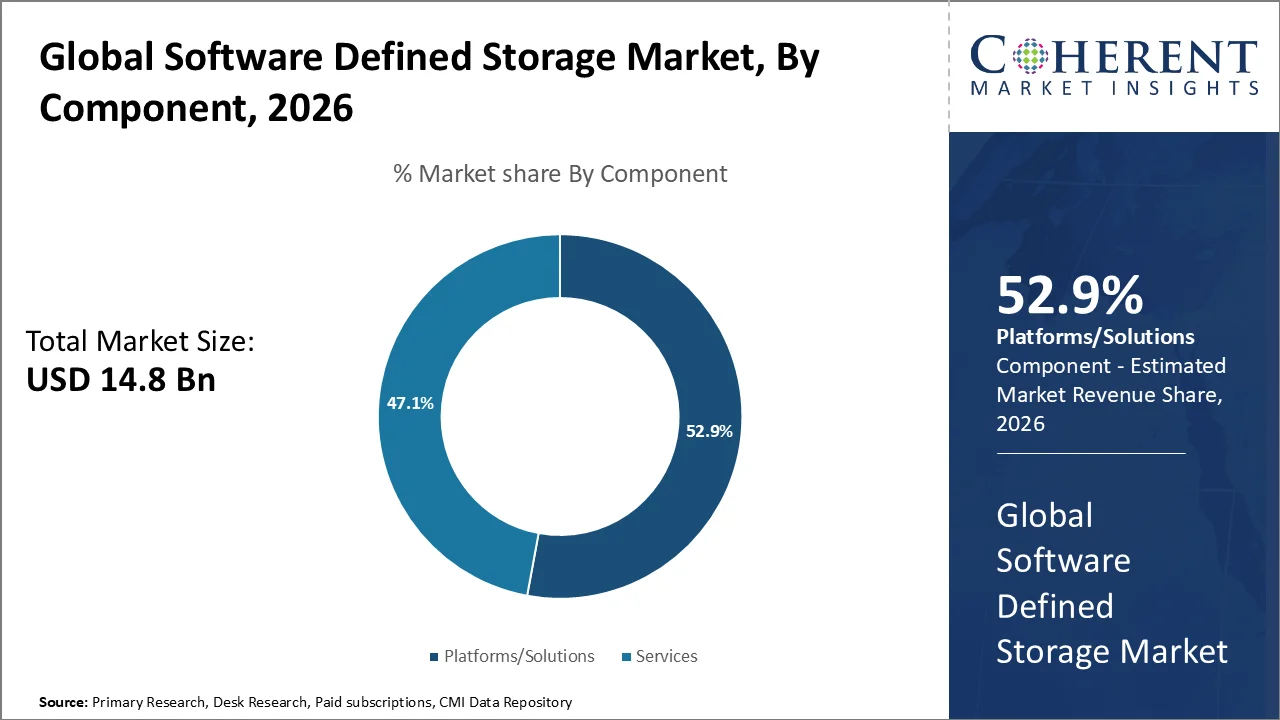
- Platforms/Solutions hold the largest market share of 52.9% in 2026 owing to its explosive growth of enterprise data.
- Surveillance expected to hold largest market share of 43.3% in 2026 owing to the rapid growth of video surveillance data.
- Small and Medium Enterprises (SMES) acquired the prominent market share of 53.3% in 2026 owing to its cost-effective storage infrastructure.
- Healthcare captures the largest market share of 33.6% in 2026 owing to the increasing adoption of electronic health records (EHRs). According to an article published by the National Institutes of Health, New Zealand has achieved an EHR adoption rate of 97%.
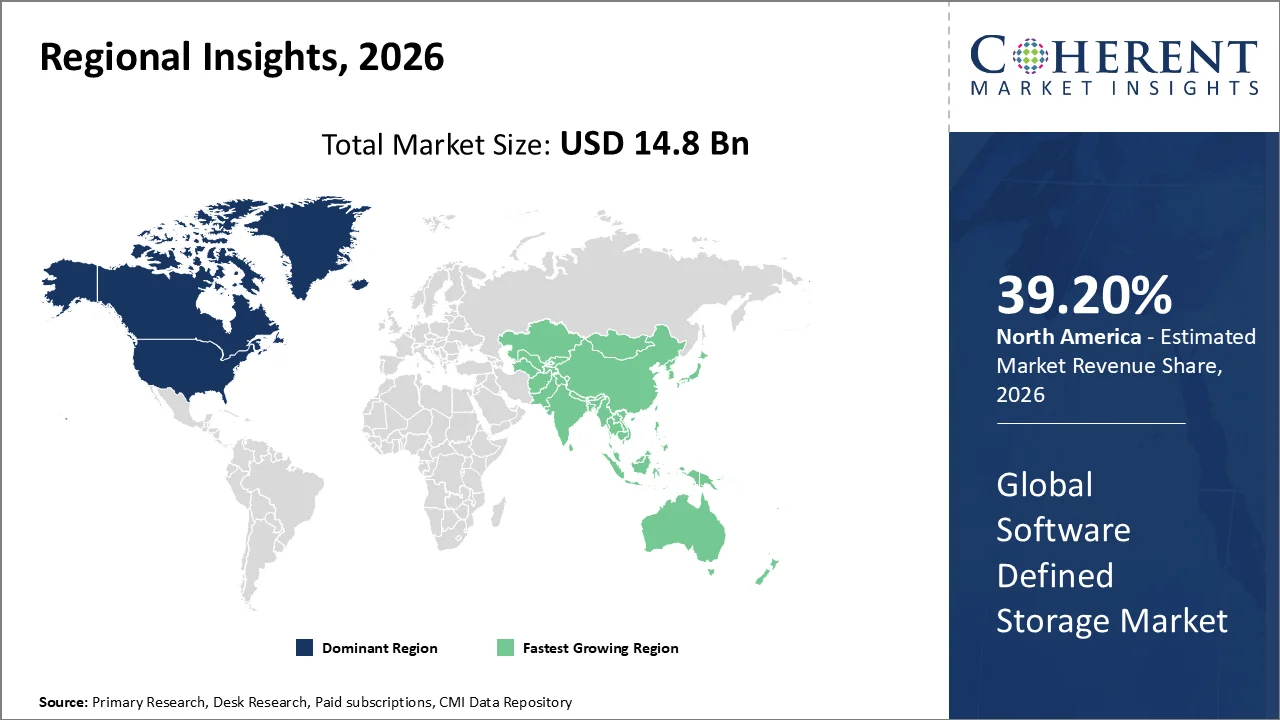
- North America is expected to acquire the dominant share of 39.2% in 2026 owing to its advanced cloud and data center infrastructure.
Current Events and Their Impact on the Software Defined Storage Market
Current Event | Description and its Impact |
U.S.–China Semiconductor Export Controls |
|
EU Data Act Cloud Portability Rules |
|
Segmental Insights
- Current Industry Events of 2026
- Market Size Estimation
- Regional Breakdown
- Competitive Landscape
- Customer Intelligence
- Segmental Analysis
- Pricing Analysis
- Key Market Drivers, Challenges & Future Trends
- Customized Insights Section
Why is Platforms/Solutions Acquiring the Largest Market Share?
Platforms/Solutions hold the largest market share of 52.9% in 2026. Enterprises are driving demand for Platforms/Solutions in the Software-Defined Storage market by seeking scalable, flexible, and cost-efficient storage infrastructure. Organizations are increasingly adopting hybrid and multi-cloud environments while managing rising volumes of unstructured data and expanding AI, analytics, and cloud-native applications. Businesses are also implementing centralized storage management, automation, disaster recovery, and hardware-independent solutions to improve operational efficiency. Furthermore, companies are accelerating the adoption of hyper-converged infrastructure and containerized workloads, which continues to boost the demand for advanced SDS platforms and solutions. For instance, Supermicro, Inc., a total IT solution provider for AI, cloud, storage, and 5G/edge, unveiled the CNode-X Solution with VAST Data. The highly integrated, rapidly deployable AI data platform combines the VAST AI Operating System, including InsightEngine and Database, with NVIDIA models, microservices, and libraries, along with Supermicro GPU and storage servers to deliver a complete AI infrastructure stack for fast enterprise AI deployment.
Surveillance expected to hold largest market share
Surveillance expected to hold largest market share of 43.3% in 2026 owing to the high availability and continuous recording requirements. Organizations drive the Surveillance segment in the Software-Defined Storage market as video surveillance data from IP cameras, smart city initiatives, and public safety systems rapidly expands. They adopt scalable and cost-efficient storage solutions to handle high-resolution video and extended retention requirements. Businesses increasingly deploy AI-powered video analytics, facial recognition, and real-time monitoring, which increases the need for high-performance storage infrastructure. They also implement centralized management, disaster recovery, continuous recording, and hybrid cloud-based surveillance systems, further accelerating the adoption of software-defined storage solutions. For instance, Synology, a Taiwanese personal cloud storage provider, unveiled two additional products following the BeeStation Plus. The company plans to launch the PAS7700 active-active NVMe storage system and C2 Surveillance, a new Video Surveillance as a Service (VSaaS) solution.
Government and investigative agencies must store CCTV recordings for at least 6 to 18 months, depending on the use case and applicable directive.
Small and Medium Enterprises (SMES) acquired the prominent market share
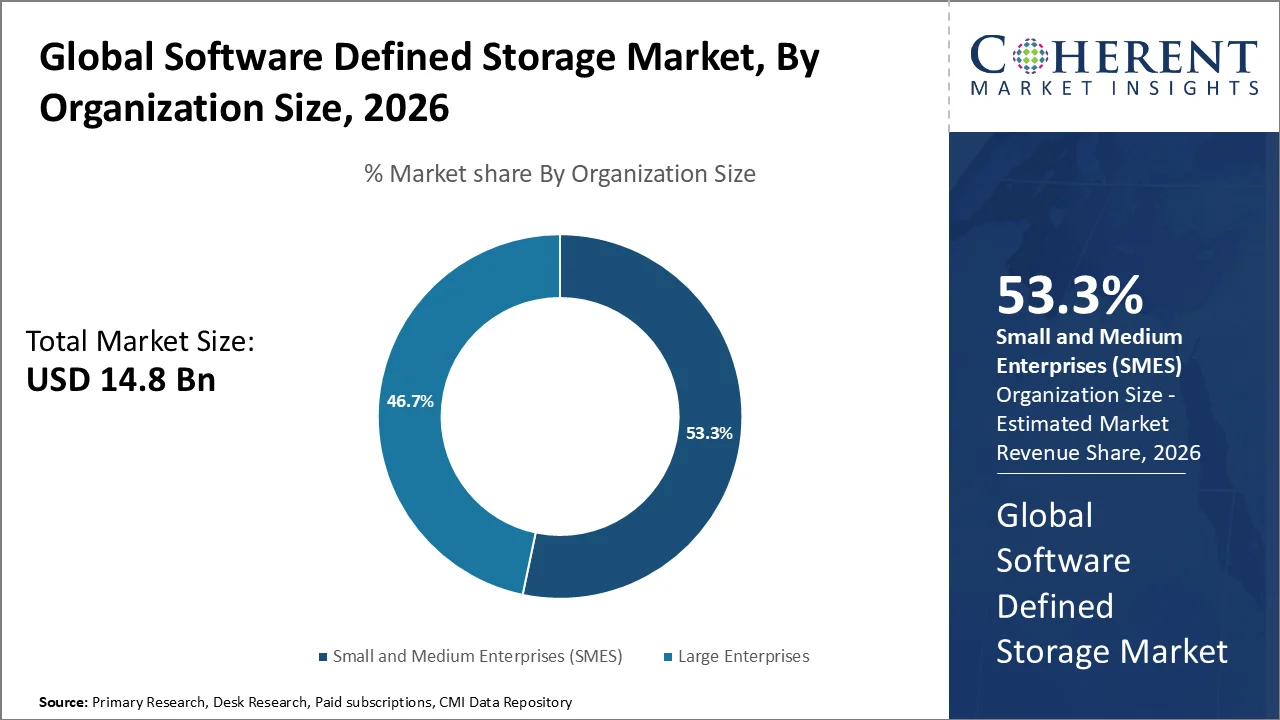
Small and Medium Enterprises (SMES) acquired the prominent market share of 53.3% in 2026. Small and medium enterprises actively drive the Software-Defined Storage market by adopting cost-effective and scalable storage solutions that reduce reliance on expensive hardware. They increasingly shift toward cloud-based and hybrid IT environments to support digital operations and remote work requirements. SMEs manage growing volumes of business application data while seeking simplified storage management and automation to reduce IT complexity. They respond to rising cybersecurity concerns by implementing backup, replication, and disaster recovery features. Additionally, they adopt hyper-converged infrastructure and subscription-based models to enhance flexibility and operational efficiency.
Which Application segment dominates the market?
Healthcare captures the largest market share of 33.6% in 2026. The healthcare sector drives the Software-Defined Storage market by generating large volumes of data from electronic health records, medical imaging, telemedicine, and wearable devices. Healthcare providers adopt scalable storage solutions to efficiently manage and secure patient information. They increasingly use AI-driven diagnostics, genomics, and data analytics, which further increases storage demands. Organizations implement software-defined storage to ensure data security, regulatory compliance, backup, and disaster recovery. Additionally, they expand cloud-based healthcare systems and prioritize uninterrupted access to critical data, which accelerates the adoption of SDS solutions.
Software Defined Storage Market Trends
- Rising adoption of hybrid and multi‑cloud environments drives demand for flexible and scalable software‑defined storage solutions across enterprises.
Over 90% of enterprises now report using a hybrid cloud strategy, and 80% are leveraging multi‑cloud architectures, with SDS increasingly chosen to unify storage across on‑premises and cloud tiers. - Organizations increasingly adopt AI‑driven automation and analytics in storage systems to optimize performance, improve efficiency, and reduce operational complexity.
By 2026, over 60% of storage environments are expected to apply AI/ML‑driven storage analytics for predictive capacity planning, automated tiering, and anomaly detection, versus under 30% in 2022. - Growing cybersecurity threats and ransomware attacks push enterprises to adopt SDS‑based backup, replication, encryption, and disaster recovery solutions for stronger data protection.
Ransomware incidents targeting enterprise storage environments increased by 92% between 2022 and 2024, driving higher investment in immutable snapshots, replication, and encryption features built into SDS platforms.
Regional Insights
North America dominates owing to high volume of enterprise data generation
North America is expected to acquire the dominant share of 39.20% in 2026. Rapid data growth from cloud computing, IoT, and enterprise digital transformation drives the Software Defined Storage market in North America. Organizations adopt SDS to gain greater flexibility, scalability, and cost efficiency than traditional hardware-based storage systems offer. Demand for hybrid and multi-cloud setups increases the need for centralized data management and disaster recovery solutions. Additionally, the strong presence of leading technology firms and a highly advanced IT infrastructure further support and accelerate market growth in the region. About 64% of survey respondents report that their organizations have deployed software-defined solutions, and 85% say they are progressing toward adopting software-defined data centers (SDDCs).
Asia Pacific Software Defined Storage Market Trends
Enterprises across Asia Pacific actively drive the software defined storage market as they undergo rapid digital transformation and manage growing data volumes. They increasingly adopt cloud-based systems and shift toward flexible, scalable storage models to support hybrid and multi-cloud setups. Industries such as BFSI, IT, telecom, and healthcare actively boost demand. Companies integrate AI-driven analytics, automation, and stronger security features to improve efficiency. At the same time, expanding 5G networks and edge computing infrastructure actively encourage the use of distributed and software defined storage solutions across the region.
United States Software Defined Storage Market Trends
The United States Software Defined Storage market is growing strongly as organizations rapidly transform digitally and adopt cloud computing while seeking more scalable and flexible data management solutions. Enterprises are replacing traditional storage systems with software-defined architectures to enhance efficiency, agility, and cost optimization. Increasing volumes of unstructured data, the expansion of hyperscale data centers, and the integration of AI with hybrid cloud environments continue to drive adoption. Large enterprises and cloud service providers lead this shift, while ongoing innovation in virtualization, automation, and infrastructure modernization shapes market growth and competition. For instance, Dell Technologies introduces new private cloud infrastructure solutions that help organizations manage traditional and modern workloads more efficiently, securely, and quickly.
China Software Defined Storage Market Trends
The China Software Defined Storage (SDS) market is undergoing rapid transformation as digital infrastructure expands and enterprises increasingly adopt cloud computing. China’s data center capacity has grown sharply, with total commissioned IT load exceeding 400 MW in major clusters by 2025, reflecting strong demand for scalable storage architectures. Organizations are moving away from traditional block and SAN systems and embracing software‑defined architectures to enhance scalability, flexibility, and operational efficiency. Rising volumes of unstructured data — expected to account for more than 85% of enterprise data in China by 2026 — coupled with expanding AI/ML workloads and wider use of hybrid and multi‑cloud environments, are driving accelerated SDS adoption.
Who are the Major Companies in Software Defined Storage Industry
Some of the major key players in Software Defined Storage are Dell, EMC Corporation, Fujitsu Ltd., Hewlett Packard Enterprise Development LP, International Business Machines Corporation, Citrix Systems Inc., Netapp, Inc., Seagate Technology, Vmware Inc., and Western Digital Corporation.
Key News
- In March 2026, StorPool Storage launched StorPool One, a fully integrated KVM-based cloud platform delivering enterprise-grade performance and reliability while helping organizations control infrastructure costs.
Market Report Scope
Software Defined Storage Market Report Coverage
| Report Coverage | Details | ||
|---|---|---|---|
| Base Year: | 2025 | Market Size in 2026: | USD 14.8 Bn |
| Historical Data for: | 2020 To 2024 | Forecast Period: | 2026 To 2033 |
| Forecast Period 2026 to 2033 CAGR: | 9.1% | 2033 Value Projection: | USD 26.2 Bn |
| Geographies covered: |
| ||
| Segments covered: |
| ||
| Companies covered: | Dell, EMC Corporation, Fujitsu Ltd., Hewlett Packard Enterprise Development LP, International Business Machines Corporation, Citrix Systems Inc., Netapp, Inc., Seagate Technology, Vmware Inc., and Western Digital Corporation | ||
Analyst Opinion
- The Software Defined Storage (SDS) market is fundamentally driven by an unavoidable data explosion rather than incremental IT upgrades. Global data creation is expected to reach over 180 zettabytes annually, forcing enterprises to abandon rigid, hardware-centric storage models in favor of software-defined architectures that can dynamically scale across distributed environments.
- Enterprise adoption is also being shaped by hyperscale infrastructure dominance. For example, major cloud providers such as Amazon Web Services and Microsoft Azure operate data centers that each manage millions of storage nodes, relying heavily on SDS principles to automate provisioning, balance workloads, and eliminate manual storage management bottlenecks at scale.
- The shift toward SDS is further reinforced by real-world enterprise pain points in data-heavy industries. In sectors like banking and healthcare, unstructured data already accounts for more than 80% of total data assets, making traditional storage economically inefficient and operationally slow. SDS adoption in these environments is driven by its ability to support policy-based automation, rapid recovery, and seamless integration with AI and analytics workloads, which legacy systems cannot efficiently handle.
Speak to the analyst
Want personalized insights?
Take the findings above to one of our principal consultants, or have the report rebuilt around the segments, geographies and competitors you actually track.
Market Segmentation
- By Component (Revenue, USD Bn, 2021-2033)
- Platforms/Solutions
- Services
- By Storage Usage (Revenue, USD Bn, 2021-2033)
- Surveillance
- Data-Backup and Disaster-Recovery
- Storage Provisioning and High Availability
- Others
- By Organization Size (Revenue, USD Bn, 2021-2033)
- Small and Medium Enterprises (SMES)
- Large Enterprises
- By Application (Revenue, USD Bn, 2021-2033)
- Education
- Telecom and Ites
- Logistics and Warehouse
- Healthcare
- Media and Entertainment
- Banking
- Financial Services
- Insurance (BFSI)
- Others
- By Region (Revenue, USD Bn, 2021-2033)
- North America
- U.S.
- Canada
- Latin America
- Brazil
- Mexico
- Argentina
- Rest of Latin America
- Europe
- Germany
- U.K.
- France
- Italy
- Spain
- Russia
- Rest of Europe
- Asia Pacific
- China
- India
- Japan
- Australia
- South Korea
- ASEAN
- Rest of Asia Pacific
- Middle East
- GCC
- Israel
- Rest of Middle East
- Africa
- South Africa
- Central Africa
- North Africa
- North America
Sources
Primary Research Interviews
- IT infrastructure managers in enterprise organizations
- Cloud architects and DevOps engineers
- Data center operators and storage administrators
- CIOs and CTOs from mid-to-large enterprises
- System integrators and managed service providers
- Storage hardware and software vendors (product managers, solution architects)
Databases
- Government statistical databases (ICT and digital economy datasets)
- Open technical repositories and institutional data archives
- University and research institution data libraries
- Patent databases related to storage technologies and virtualization
- Company financial filings and annual reports databases
Magazines
- Enterprise IT infrastructure magazines
- Cloud computing and virtualization-focused publications
- Data center technology magazines
- Cybersecurity and data management magazines
- Computer systems and networking industry magazines
Journals
- Peer-reviewed computer science journals
- Distributed systems and cloud computing research journals
- Storage systems and data engineering journals
- IEEE and ACM publications on distributed storage and infrastructure
- Academic journals on information systems and enterprise IT
Newspapers
- Leading business newspapers covering technology developments
- Financial newspapers reporting on enterprise IT investments
- National newspapers with dedicated technology sections
- Digital technology news sections of mainstream media outlets
Associations
- Cloud computing and virtualization industry associations
- Data center and IT infrastructure professional associations
- Open-source software communities and foundations
- Enterprise IT standards and interoperability organizations
- Networking and storage technology user groups
Public Domain Sources
- Government open data portals and digital economy reports
- Open-source project documentation and repositories
- Technical whitepapers published by enterprises and universities
- Conference proceedings from publicly accessible academic events
- Regulatory filings and publicly available compliance documents
- Technology standards documentation (e.g., storage and networking protocols)
Proprietary Elements
- CMI Data Analytics Tool
- Proprietary CMI Existing Repository of information for last 10 years
Get access to 250+ pages report
Every segment, forecast, competitor profile and data table behind the analysis above — available for instant download.
- ESOMAR Member
- ISO 9001:2015 Certified
- D-U-N-S Registered
- GDPR & CCPA Compliant
Missing comfort of reading report in your local language? Find your preferred language:
Transform your Strategy with Exclusive Trending Reports
Frequently Asked Questions
Software Defined Storage is a data storage architecture that separates storage software from underlying hardware, enabling centralized management, flexibility, and automation across storage resources.
Demand is driven by explosive data growth, with global data creation exceeding 180 zettabytes annually, along with increasing adoption of cloud computing, AI workloads, and hybrid IT environments.
Banking, healthcare, IT & telecom, and media industries are leading adopters due to their high dependence on unstructured data and need for scalable storage infrastructure.
SDS enables high-speed data access, scalable architecture, and policy-based automation, which are critical for handling large-scale AI training datasets and real-time analytics processing.
Traditional storage systems struggle with scalability and cost efficiency. SDS offers better flexibility, automation, and integration with cloud environments, reducing operational complexity.