

Storage Area Network (SAN) Market Analysis & Forecast: 2026-2033
Storage Area Network (SAN) market size is estimated to be valued at USD 20.54 Bn in 2026 and is expected to reach USD 30.27 Bn in 2033, exhibiting a compound annual growth rate (CAGR) of 5.7% from 2026 to 2033.
Key Takeaways
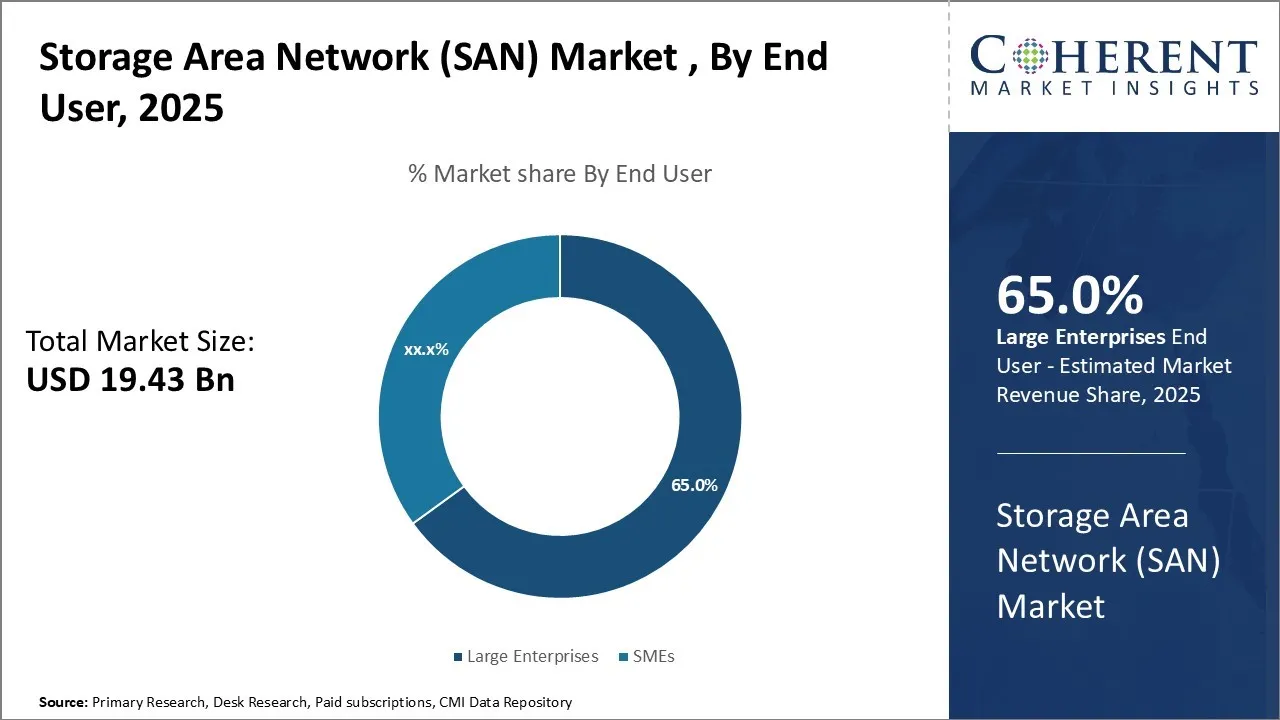
- By End User, the Large Enterprises segment is expected to continue dominating the SAN market outlook with a significant 66% share in 2026, driven by their growing need for scalable, high-performance storage solutions to manage massive data volumes.
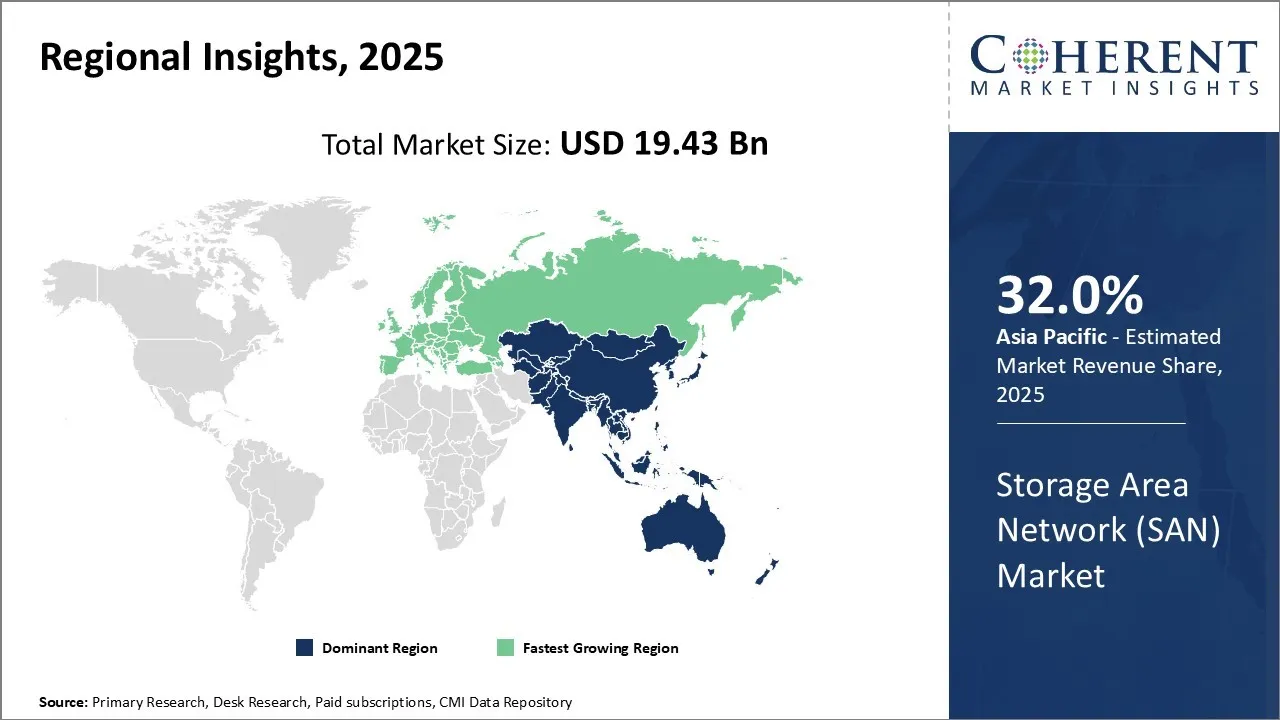
- Regionally, Asia Pacific is projected to lead the global SAN Market, capturing around 32.0% market share in 2026, due to rapid digital transformation, increasing adoption of cloud infrastructure, and expanding data center investments across emerging economies.
Market Overview
SANs are highly sophisticated and costly pieces of storage system that are relatively complicated and propriety. Moreover, SANs are characterized as being virtually failure-proof. However, major outages and performance failures in the cloud in recent times have been related to failures of SANs or significant degradation in system performance. Since the nature of SAN is complex and prosperous, whenever there is a failure in SAN architecture, there will be a major complex problem for the organization.
Furthermore, outages due to SAN failures are measured in hours and now minutes, which leads to such drawbacks of SANs and to leverage the cloud as a high performance, reliable, and resilient storage option, various enterprises are shifting beyond storage area network. This, in turn, is restraining growth of the global SAN market.
Current Events and Its Impact on the Storage Area Network (SAN) Market
Event | Description and Impact |
Geopolitical Tensions in Global Tech Trade |
|
Technological Advancements Driving Infrastructure Shifts |
|
Economic Policy Changes |
|
Role of AI in the Storage Area Network (SAN) Market
The integration of artificial intelligence (AI) into SAN solutions is transforming how organizations manage data by significantly improving operational efficiency, scalability, and security. AI-driven SAN systems now offer advanced security features, such as real-time ransomware detection, by analyzing access patterns to pre-emptively block suspicious behavior without manual intervention.
In 2025, Lenovo introduced 21 new ThinkSystem and ThinkAgile SAN models equipped with machine learning algorithms that automate data placement, capacity forecasting, and anomaly detection, thereby reducing manual workload and operational costs.
- Current Industry Events of 2026
- Market Size Estimation
- Regional Breakdown
- Competitive Landscape
- Customer Intelligence
- Segmental Analysis
- Pricing Analysis
- Key Market Drivers, Challenges & Future Trends
- Customized Insights Section
Segmental Insights
Storage Area Network (SAN) Market Insights, By End User
By end user, the Large Enterprises segment is projected to dominate the global SAN Market demand, accounting for approximately 66% of the share in 2026. This dominance is driven by the increasing demand for scalable, high-performance storage systems to manage massive and complex data workloads, especially in sectors such as finance, healthcare, telecommunications, and media. Large enterprises are also prioritizing secure, centralized storage to support business continuity, regulatory compliance, and digital transformation strategies.
The Small and Medium Enterprises (SMEs) segment, while representing a smaller portion of the market, is witnessing steady growth due to the broader adoption of virtualization, cloud integration, and affordable SAN solutions tailored for mid-sized IT environments.
For instance, in 2024, several SAN providers such as Dell Technologies and HPE launched SME-focused SAN offerings with subscription-based pricing models and AI-driven management capabilities. These innovations helped SMEs streamline storage operations while reducing total cost of ownership, contributing to a notable rise in adoption across Asia Pacific and North America.
Regional Insights
Asia Pacific SAN Market Analysis and Trends
Asia Pacific is projected to lead the global SAN Market growth in 2026, capturing approximately 32.0% of the total market share. This dominance is attributed to rapid digital transformation, increasing adoption of cloud infrastructure, and expanding data center investments across emerging economies such as India, China, and Southeast Asian countries.
In 2024, companies in the region increasingly focused on cost optimization by shifting from capital expenditures (CapEx) to operational expenditures (OpEx), fueling demand for IT infrastructure outsourcing. The rise of big data, cloud computing, and bring-your-own-device (BYOD) strategies further complicated internal data management, leading more enterprises to depend on third-party providers for secure and efficient SAN solutions.
North America SAN Market Analysis and Trends
North America continues to remain a significant contributor to the global SAN Market trend in 2026, backed by strong enterprise IT ecosystems, early cloud adoption, and growing reliance on high-performance storage solutions. The U.S. leads the region with ongoing investments in AI-driven data storage platforms and robust demand from finance, healthcare, and media sectors.
In 2024, key players in the U.S. upgraded their SAN infrastructure to support next-gen applications like edge computing and real-time analytics, further solidifying the region’s position in the global market.
Europe SAN Market Analysis and Trends
Europe is expected to witness steady growth in the SAN Market through 2026, driven by stringent data protection regulations, data localization laws, and increased spending on enterprise storage modernization. Countries such as Germany, the UK, and the Netherlands are advancing hybrid and all-flash SAN deployments to meet evolving compliance and performance needs.
In 2024, several European organizations adopted quantum-ready SAN technologies and green data storage solutions, aligning with both regulatory and sustainability goals.
SAN Market Dominating Countries
India SAN Market Analysis and Trends
India stands out as a high-growth market in the Asia Pacific SAN landscape, owing to accelerated digitalization and government-led data localization initiatives. In 2024, the surge in cloud-native startups and the expansion of digital public infrastructure drove demand for scalable SAN systems. Strategic partnerships between global hyperscalers and domestic data center providers are also playing a crucial role in reshaping India’s enterprise storage environment.
China SAN Market Analysis and Trends
China continues to be a major player in the Asia Pacific SAN Market, supported by its rapidly growing cloud services industry and aggressive data center expansion. In 2024, local tech giants increased investments in SAN-based infrastructure to manage massive volumes of data generated by AI, IoT, and smart city applications. Government support for digital infrastructure and 5G rollout further bolstered market momentum.
Market Report Scope
Storage Area Network (SAN) Market Report Coverage
| Report Coverage | Details | ||
|---|---|---|---|
| Base Year: | 2025 | Market Size in 2026: | USD 20.54 Bn |
| Historical Data for: | 2020 To 2024 | Forecast Period: | 2026 To 2033 |
| Forecast Period 2026 to 2033 CAGR: | 5.7% | 2033 Value Projection: | USD 30.27 Bn |
| Geographies covered: |
| ||
| Segments covered: |
| ||
| Companies covered: | IBM Corporation, Brocade Communications Systems, Inc., Dell Inc., QLogic Corporation, Citrix Systems, Inc., Hitachi Data Systems, NetApp, Inc., Hewlett-Packard Company, DataCore Software, NEC Corporation, Nutanix, and Cisco Systems, Inc. | ||
| Growth Drivers: |
| ||
| Restraints & Challenges: |
| ||
Market Driver
- Rising demand for efficient backup operations
Previously, in a conventional approach, local area network (LAN) was used for data backup and restore functions that are particularly slow and significantly impact the efficiency of the whole operation. On the contrary, in the SAN approach, data moves smoothly across the SAN to tape devices as it does not utilize critical server I/O or CPU resources.
Several issues can be improved with the integration of high-performance backup and restore capabilities with data availability and device sharing. This includes performance degradation, extended downtime periods, and shrinking backup windows. However, an increase in the overall server efficiency with server-less backup offered by SAN architecture is fueling the adoption of SAN across various verticals. Thus, these factors are expected to drive the market growth in the near future.
Market Opportunity
- Rising penetration of e-commerce websites
The growing proliferation of e-commerce websites has increased the adoption of online channels among consumers. These e-Commerce applications are highly resource-intensive, owing to the number of requests that are processed simultaneously per second. Thousands of customers visit, make orders, and pay per second, and all this information is needed to be stored in the database for later retrieval. SANs are being used to store information about high-traffic databases, due to high performance and rapid I/O characteristics.
Analyst Viewpoint
- The outlook for the global Storage Area Network (SAN) market remains positive, driven by growing demand for efficient, high-performance, and scalable data storage solutions. With businesses generating unprecedented volumes of data, SANs play a critical role in ensuring reliable data access, centralized management, and robust disaster recovery.
- Despite strong growth potential, the market faces challenges. High upfront costs and complex infrastructure management limit adoption among small and mid-sized enterprises. Furthermore, the growing popularity of cloud storage and hyper-converged infrastructure is creating competitive pressure on traditional SAN models.
Recent Developments
- In March 2025, Hewlett Packard Enterprise (HPE) expanded its partnership with Kyndryl Holdings to deliver AI-optimized SAN solutions. This collaboration focuses on providing predictive analytics and automated maintenance features to enhance storage efficiency and reliability.
- In May 2025, NetApp launched the ASA A-series, a block-only SAN system designed to meet the growing demand for dedicated block storage solutions. The new series offers improved scalability and performance for organizations with intensive data workloads.
Market Segmentation
- Global Storage Area Network (SAN) Market, By Component (Revenue, USD Bn, 2021 - 2033)
- Software
- Hardware
- Service
- Consulting
- System Integration
- Support & Maintenance
- Global Storage Area Network (SAN) Market, By SAN Type (Revenue, USD Bn, 2021 - 2033)
- Virtual SAN
- Conventional SAN
- Global Storage Area Network (SAN) Market, By Technology (Revenue, USD Bn, 2021 - 2033)
- FibreChannel (FC)
- FibreChannel Over Ethernet (FCOE)
- InfiniBand
- iSCSI Protocol
- Global Storage Area Network (SAN) Market, By End-User (Revenue, USD Bn, 2021 - 2033)
- SMEs
- Large Enterprises
- Global Storage Area Network (SAN) Market, By Verticals (Revenue, USD Bn, 2021 - 2033)
- BFSI
- Retail and e-Commerce
- IT and Telecommunication
- Energy and Utility
- Government Offices and Education
- Aerospace and Defense
- Healthcare
- Manufacturing
- Others (Transportation and Logistics)
- Global Storage Area Network (SAN) Market, By Region (Revenue, USD Bn, 2021 - 2033)
- North America
- U.S.
- Canada
- Latin America
- Brazil
- Argentina
- Mexico
- Rest of Latin America
- Europe
- Germany
- U.K.
- Spain
- France
- Italy
- Russia
- Rest of Europe
- Asia Pacific
- China
- India
- Japan
- Australia
- South Korea
- ASEAN
- Rest of Asia Pacific
- Middle East
- GCC Countries
- Israel
- Rest of Middle East
- Africa
- South Africa
- North Africa
- Central Africa
- North America
- Company Profiles
- Brocade Communications Systems, Inc.
- Cisco Systems, Inc.
- Citrix Systems, Inc.
- DataCore Software
- Dell Inc.
- Hewlett-Packard Company
- Hitachi Data Systems
- IBM Corporation
- NEC Corporation
- NetApp, Inc.
- Nutanix
- QLogic Corporation
Sources
Primary Research Interviews
- CIOs and IT Managers
- Storage System Administrators
- Network Engineers
- Data Center Managers
- Others
Magazines
- Storage Magazine
- Network Computing Magazine
- InfoStor Magazine
- IT Pro Today
- Others
Journals
- Journal of Network and Computer Applications
- IEEE Transactions on Parallel and Distributed Systems
- Journal of Systems and Software
- Others
Newspapers
- The Wall Street Journal
- The New York Times
- Financial Times
- The Economic Times
- Others
Associations
- Storage Networking Industry Association (SNIA)
- Fibre Channel Industry Association (FCIA)
- Others
Public Domain Sources
- National Institute of Standards and Technology (NIST)
- Cisco Annual Internet Report
- Others
Proprietary Elements
- CMI Data Analytics Tool
- Proprietary CMI Existing Repository of information for last 8 years
*Definition: A SAN consists of a communication infrastructure that provides physical connections, allowing any device to bridge across the network using interconnected elements, such as switches and directors.
Get access to 250+ pages report
Every segment, forecast, competitor profile and data table behind the analysis above — available for instant download.
- ESOMAR Member
- ISO 9001:2015 Certified
- D-U-N-S Registered
- GDPR & CCPA Compliant
Missing comfort of reading report in your local language? Find your preferred language:
Transform your Strategy with Exclusive Trending Reports
Frequently Asked Questions
The Storage Area Network (SAN) Market is estimated to be valued at USD 20.54 Bn in 2026, and is expected to reach USD 30.27 Bn by 2033.
The global market is estimated to surpass USD 30.27 Bn by 2033.
Major players operating in the market include IBM Corporation, Brocade Communications Systems, Inc., Dell Inc., QLogic Corporation, Citrix Systems, Inc., Hitachi Data Systems, NetApp, Inc., Hewlett-Packard Company, DataCore Software, NEC Corporation, Nutanix, and Cisco Systems, Inc.h
Among end user, the large enterprises segment held the dominant position in the market in 2026, and is expected to retain its dominance throughout the forecast period.
Increasing expenditure on IT infrastructure is one of the major factors that is expected to propel market growth over the forecast period.
The CAGR of the global Market is projected to be 5.7% from 2026 to 2033.