

Storage Systems Market Size and Trends – (2026-2033)
The global storage systems market is estimated to be valued at USD 74.70 Bn in 2026 and is expected to reach USD 145.55 Bn by 2033, growing at a compound annual growth rate (CAGR) of 10.0% from 2026 to 2033.
Key Takeaways of the Storage Systems Market
- By deployment, on-premise deployment segment is expected to account for the highest share of the storage systems market with Storage Systems Market 59.9% of revenues in 2026, driven by control, security, and compliance needs.
- By storage system, Direct Attached Storage (DAS) segment is expected to account for the highest share of the storage systems market with 35.20% of revenues in 2026, dominates for its speed, simplicity, and workload optimization.
- By application, BFSI (Banking, Financial Services, and Insurance) is expected to account for the highest share of the storage systems market with 31.23% of revenues in 2026, driven by strict regulations and critical data needs.
- By region, Asia Pacific is expected to account for 39.2% revenue share, dominating the storage systems market through the forecast period. While, North America is anticipated to be the fastest growing region.
Market Overview
The storage systems market has been witnessing steady growth over the past few years driven by increasing demand for large-scale data storage from various end-use industries such as BFSI, IT, and telecommunication among others.
Current Events and Its Impacts on the Storage Systems Market
Current Event | Description and its Impact |
Artificial Intelligence and Machine Learning Market Expansion |
|
Cybersecurity Threats and Ransomware Proliferation |
|
How is Technology Evolving the Storage System Market?
- AI-driven storage optimization: By 2030, 40% of enterprise storage systems will use AI/ML for predictive scaling and automated tiering.
- NVMe adoption: NVMe-based storage is projected to grow, reducing latency by up to 10x compared to SATA/SAS.
- Quantum storage research: Though experimental, quantum-based storage could achieve 100x higher density than current flash memory by 2040.
- Current Industry Events of 2026
- Market Size Estimation
- Regional Breakdown
- Competitive Landscape
- Customer Intelligence
- Segmental Analysis
- Pricing Analysis
- Key Market Drivers, Challenges & Future Trends
- Customized Insights Section
Segmental Insights
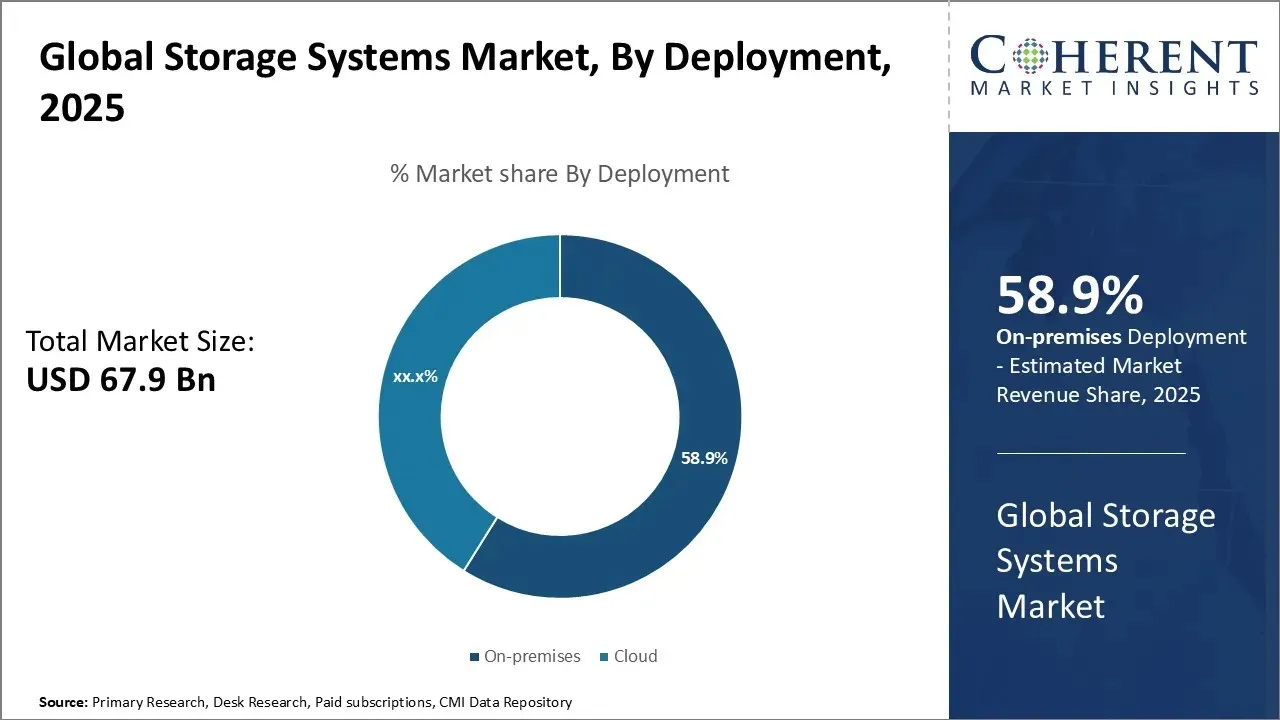
Storage Systems Market Insights, By Deployment - Convenience and Control Drive Adoption of On-premises Storage
In terms of deployment, on-premises is projected to contribute 59.9% share of the storage systems market in 2026, owning to businesses preferring the convenience and control that on-premises storage provides. With on-premises storage systems, companies own and manage the storage infrastructure located within their facilities. This allows them full control over their data and how it is managed and secured.
On-premises storage also provides businesses peace of mind in knowing their critical data is securely located on local hardware that they have direct access to. This is preferable for many companies dealing with sensitive intellectual property, financial information, or who operate in regulated industries. The upfront costs may be higher compared to cloud, but on-premises provides desired levels of convenience, customization and security that cloud cannot replicate, cementing its top position in the deployment segment.
For instance, in November 2025, Hitachi Vantara revealed its Virtual Storage Platform One Block High End, an all-flash NVMe solution made for workloads that are very important. The system supports hybrid deployments on-premises and in the cloud, and it can handle up to 50 million IOPS with advanced cyber-resilience. This helps businesses speed up their AI, analytics, and digital transformation projects.
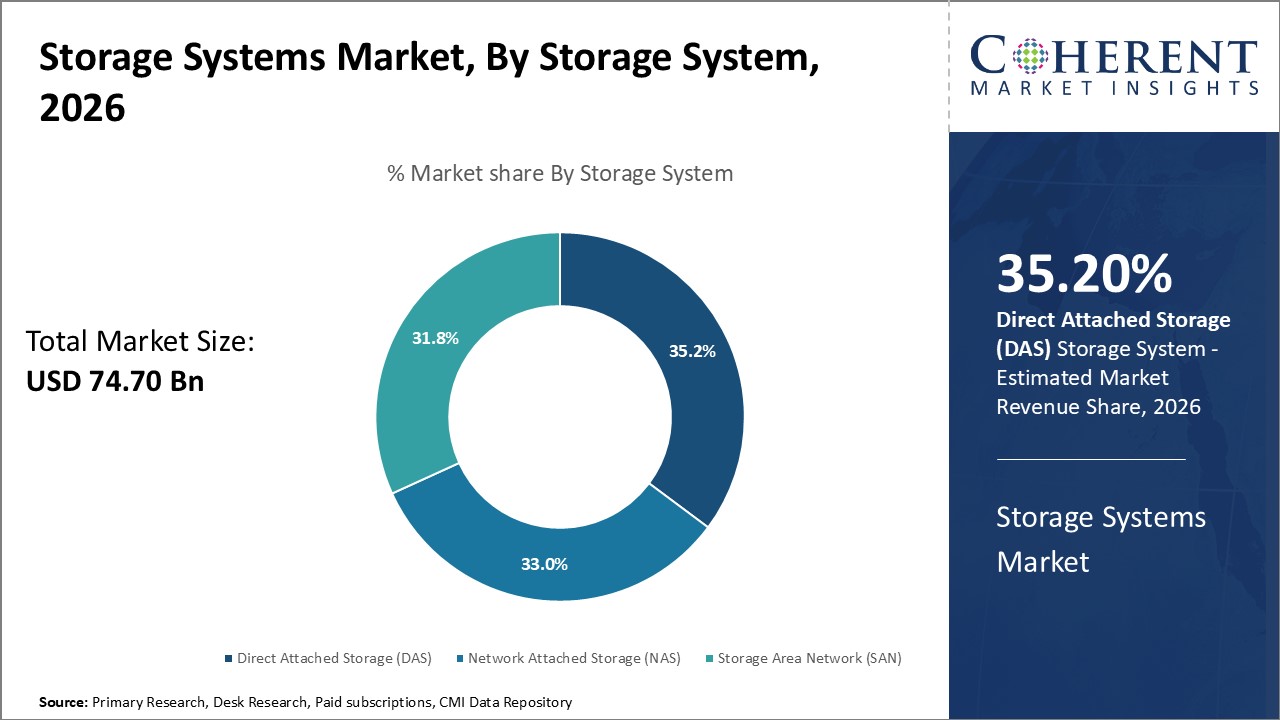
Storage Systems Market insights, By Storage System - Direct Connectivity and Optimization Drives DAS Adoption
In terms of storage system, direct attached storage (DAS) is projected to contribute 35.20% share of the storage systems market in 2026. DAS provides a simple, straightforward solution that appeals to many businesses through its direct connectivity between servers and storage. With DAS, storage disks are in close proximity and directly wired to the servers they support. This architecture results in faster data access times and higher performance due to the absence of networking bottlenecks. It also avoids single points of failure.
DAS storage is ideal for optimization of specialized workloads like database transactions and analytical processing that benefit from low latency and direct server access. Use of standard interface protocols also makes DAS interoperability high. Together, the direct connectivity and optimization abilities of DAS have made it the preferred storage system type among businesses.
For instance, in October 2025, The F2-210 NAS is a cloud network storage device for home and small office users that TerraMaster has just released. It has an ARM V8 dual-core processor and supports secure data backup, remote access, cloud sync, and 4K video transcoding. It offers affordable private cloud storage with advanced encryption and multimedia features.
Storage Systems Market Insights, By Application - Critical Functions and Regulation Drive BFSI Demand
In terms of application, the BFSI sector is projected to contribute 31.23% share to the global storage systems market in 2026. This is due to the critical nature of storage in BFSI operations and compliance with stringent regulatory policies. Financial institutions rely heavily on rapid and constant access to customer records, transactions, and sensitive financial data to perform time-sensitive functions like trading, settlements, loans processing, and fraud detection. Downtime and data loss risks are simply not acceptable.
Additionally, the sector contends with strict privacy regulations around the world governing how consumer financial information must be safeguarded. BFSI companies therefore prioritize storage solutions offering high availability, scalability, data protection and security controls to meet regulatory mandates. Their heightened requirements have made BFSI the largest adopter of scalable, resilient storage infrastructure to support risk management and regulatory compliance.
For instance, in May 2025, the Reserve Bank of India started a cloud storage service to keep financial data in India. The goal of the initiative is to improve data security, sovereignty, and compliance for banks and other financial institutions. This will make sure that sensitive information is kept in the country and that the banking sector is able to meet its regulatory requirements
Regional Insights
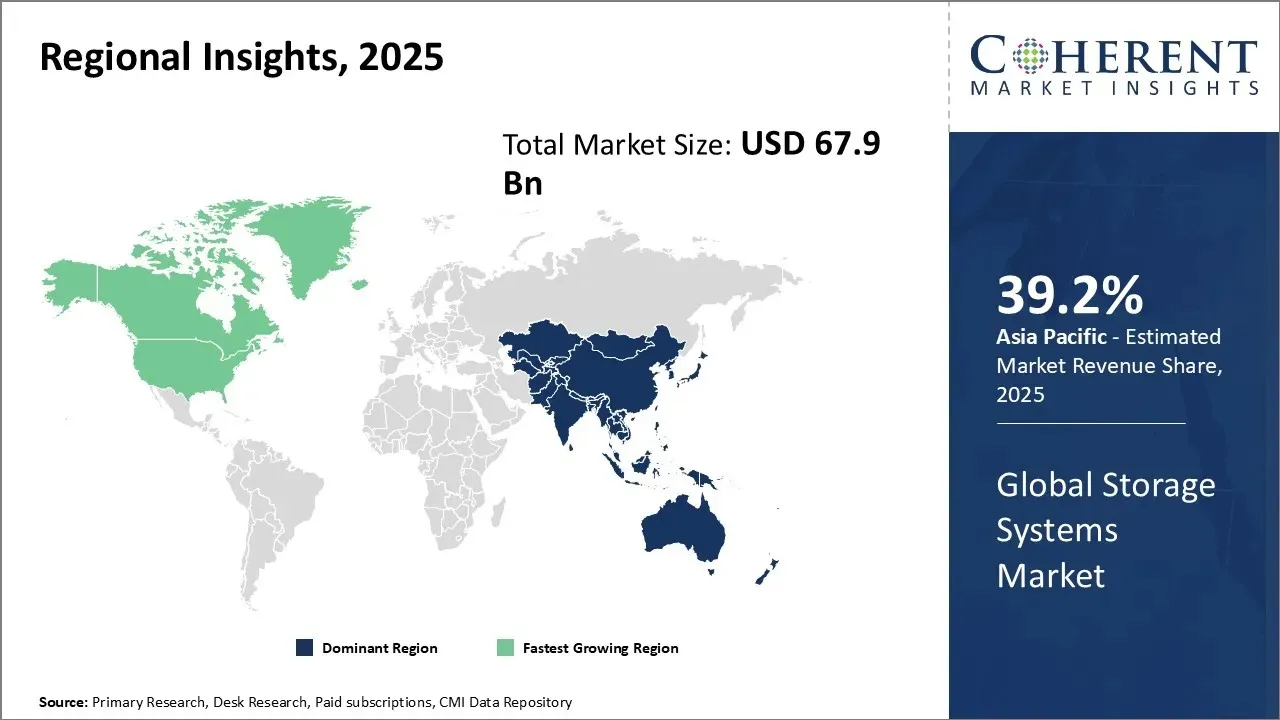
Asia Pacific Emerges as Storage Powerhouse with Expanding Market Share
The Asia Pacific region exhibits dominance with 39.2% share in 2026 and is expected to witness significant market expansion in the coming years. Increased investments in data center construction, growing utilization of cloud services, and rising spend on digital transformation initiatives by companies are fueling the demand for storage solutions across major countries like China, India, and others.
For instance, in December 2026, Malaysia opened its first large battery energy storage system in Sabah, Borneo. It has a capacity of 100MW/400MWh. The project improves grid stability, renewable integration, and energy resilience. It is an important advancement forward in the country's clean energy transition and will help build a sustainable power infrastructure for future growth and reliability.
North America Storage Systems Market Analysis & Trends
Growth of North America in the storage systems market is observed at the fastest rate, which can be attributed to the strong foothold of prominent tech companies in the region. An advanced digital infrastructure, rapid technology adoption among enterprises and consumers, and supportive government policies have enabled North America to emerge as the global leader in this space.
For instance, in October 2026, Fortress Power released the eBoost, a battery energy storage system with significant amounts of capacity that works well with renewable energy sources. eBoost works for both homes and businesses as it provides reliable backup power and can be scaled up or down as needed. The new technology makes the grid more stable, encourages the use of clean energy, and provides reliable energy solutions for a wide range of customer needs.
Storage Systems Market Outlook for Key Countries:
United States Storage Systems Market Trends
The U.S. market is dominated by innovative solution providers. Companies like Dell Technologies, HP Inc., and NetApp are at the forefront of delivering cutting-edge storage portfolio. For instance, in December 2026, Ford launched a battery storage business to power data centers and the electrical grid. Ford wants to use its knowledge of EV batteries to provide reliable backup power, grid stability, and sustainable energy solutions. The project gives Ford more responsibilities than just making cars. It also includes building infrastructure for renewable energy and coming up with new clean technologies.
China Storage Systems Market Trends
China's market is developing at a rapid pace. Local heavyweights like Inspur and Huawei are giving global vendors a tough competition through their cost-effective offerings and strong government support. For instance, in December 2026, China has started the first phase of a 300MW/1,200MWh energy storage station. This is a major infrastructure project that the government is paying for. The facility improves grid stability, renewable integration, and energy resilience. This is a big step forward in China's clean energy transition and commitment to developing large-scale battery storage for sustainable power.
Japan Storage Systems Market Trends
Japan continues to lead in memory storage due to the presence of Samsung, Toshiba, and SK Hynix. Growing 5G deployments are boosting opportunities for flash storage adoption. For instance, in December 2026, Pacifico Energy has opened the Koganai Battery Energy Storage System in Japan. This is a 2MW grid-scale project. The system helps Japan's transition to clean energy by making the grid more reliable and integrating more renewable energy sources. This milestone shows how important
India Storage Systems Market Trends
India's market is growing strongly with strong demand from both public and private sectors. Wipro and Tech Mahindra are actively expanding their storage solutioning capabilities to address the domestic requirements. For instance, in December 2026, Naxion Energy, which used to be called Sodion Energy, has released India's first sodium-ion energy storage systems, which is an important milestone forward in clean energy technology. The new technology supports renewable integration, cost efficiency, and sustainability and has "double the storage capacity" of traditional solutions. This puts India at the front of the line for the next generation of battery storage development.
Market Players, Key Development, and Competitive Intelligence
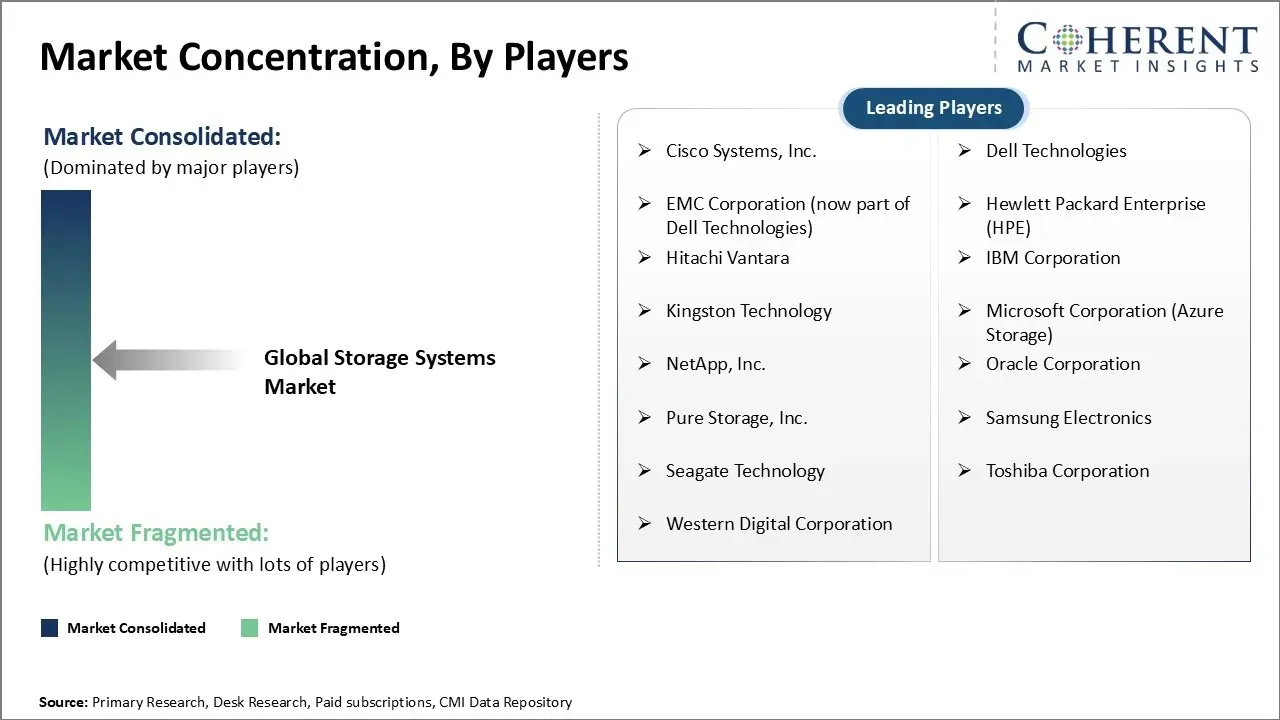
Market Report Scope
Storage Systems Market Report Coverage
| Report Coverage | Details | ||
|---|---|---|---|
| Base Year: | 2025 | Market Size in 2026: | USD 74.70 Bn |
| Historical Data for: | 2020 To 2024 | Forecast Period: | 2026 To 2033 |
| Forecast Period 2026 to 2033 CAGR: | 10.0% | 2033 Value Projection: | USD 145.55 Bn |
| Geographies covered: |
| ||
| Segments covered: |
| ||
| Companies covered: | Cisco Systems, Inc., Dell Technologies, EMC Corporation (now part of Dell Technologies), Hewlett Packard Enterprise (HPE), Hitachi Vantara, IBM Corporation, Kingston Technology, Microsoft Corporation (Azure Storage), NetApp, Inc., Oracle Corporation, Pure Storage, Inc., Samsung Electronics, Seagate Technology, Toshiba Corporation, Western Digital Corporation | ||
| Growth Drivers: |
| ||
| Restraints & Challenges: |
| ||
Market Dynamics
Storage Systems Market Driver
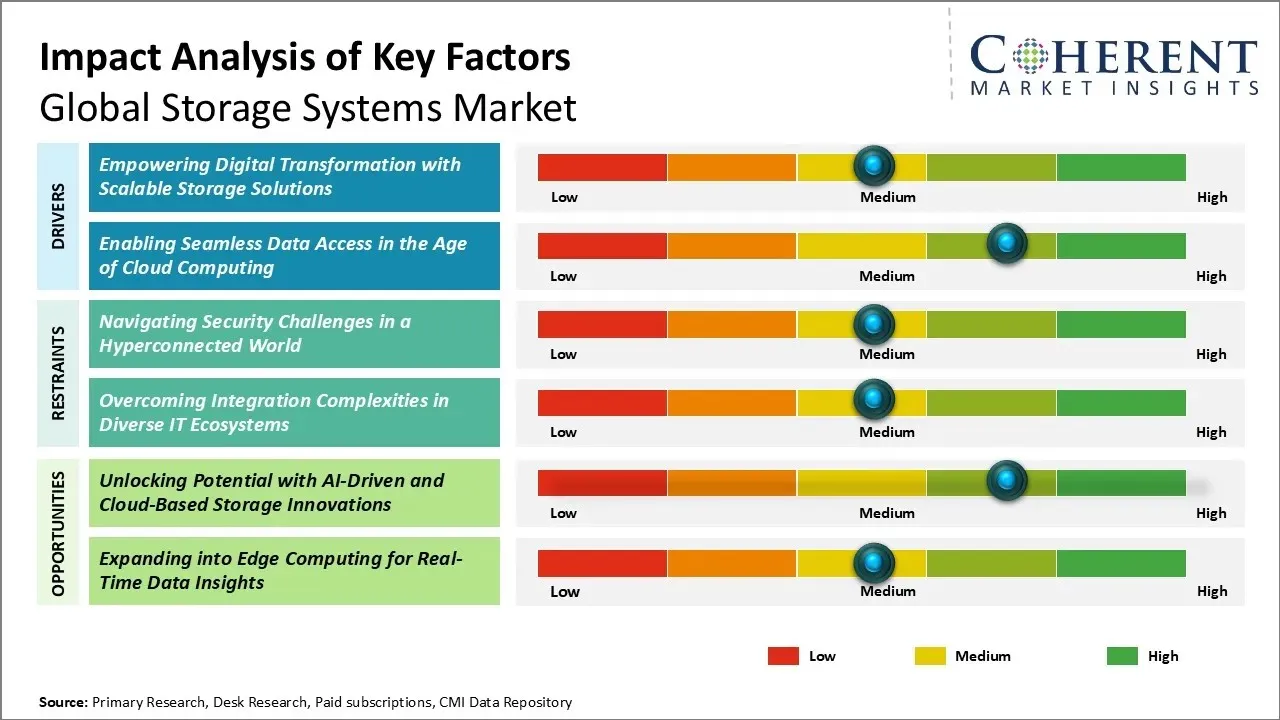
How are storage solutions empowering digital transformation?
With digitalization accelerating at a breakneck pace across industries, companies are investing heavily in technologies that can help automate processes, improve customer experiences and create new revenue streams. Rather than being restricted by pre-defined storage capacity limits, scalable storage empowers enterprises to start small and pay only for what they use. Furthermore, the software-defined and cloud-like operational models offered by scalable storage reduce complexities and facilitate utilization of optimized storage tiers for different workload needs. Advanced analytics and automation further help improve efficiency of storage infrastructure while maintaining regulatory compliance.
This is proving particularly useful for organizations transitioning mission-critical workloads between private infrastructure and public clouds. As digital transformation programs look to modernize IT, the ability of scalable storage solutions to support evolving hybrid storage strategies in a simple and cost-effective manner makes them a compelling choice for future-ready infrastructure needs.
Storage Systems Market Opportunity
What innovations will AI-driven and cloud-based storage bring?
One of the major opportunities for the global storage systems market is unlocking the potential of AI-driven and cloud-based storage innovations. With rapid data growth across industries, the need for optimizing storage infrastructure is more important than ever. AI and machine learning can be leveraged to simplify management of large, complex storage environments. Predictive analytics can help foresee failures or bottlenecks.
Moreover, several organizations are shifting workloads to public and private clouds to gain scalability and pay-as-you-go flexibility. Storage system vendors are well-positioned to leverage this trend by offering cloud-native storage solutions. They are investing in developing accelerated platforms with integrated compute and analytics that are jointly optimized for scale-out and AI workloads. Such innovations have the potential to enhance performance, lower costs and open up new profitable avenues for addressing evolving storage requirements of organizations. This presents a major opportunity for growth in the future.
Analyst Opinion (Expert Opinion)
- With enterprises increasingly relying on various legacy and modern applications residing in both on-premise and cloud environments, the need for a unified storage platform has become unavoidable. Scalable storage promises seamless data delivery across a hybrid storage cloud through its multi-protocol support and analytics-driven policies. This gives users flexibility to choose application hosting that best meets their business goals without worrying about data accessibility issues.
- Cloud computing has fast become ubiquitous with applications, infrastructure and platforms now delivered via cloud-based as-a-service models. According to estimates, over 90% of enterprises have some form of cloud adoption in place today.
- Seamless data access is also important from a business continuity perspective. As cloud outages and connectivity issues can happen, having the flexibility to failover to alternate data sources without disruptions is crucial. Modern storage platforms with their multi-cloud capabilities address hybrid infrastructure challenges by presenting a unified storage pool while maintaining performance consistency, lower latencies, regulatory compliance and security best practices across locations.
- However, cybercriminals are finding more sophisticated ways to exploit vulnerabilities and steal sensitive data from organizations’ storage infrastructure. This has important implications as data breaches can damage brand reputation and incur heavy fines under data privacy regulations like GDPR.
Speak to the analyst
Want personalized insights?
Take the findings above to one of our principal consultants, or have the report rebuilt around the segments, geographies and competitors you actually track.
Key Developments
- In October 2025, Ola has released Shakti, a cutting-edge energy storage system that will help India's push for green energy. Shakti is made for battery-based storage and improves grid stability, renewable integration, and backup power. The project improves India's clean energy infrastructure, making it more sustainable and resilient, and it also gives Ola an expanded position in the renewable energy ecosystem.
- In May 2024, Hewlett Packard Enterprise (HPE) announced significant expansions to its HPE GreenLake platform, introducing HPE GreenLake Block Storage for Amazon Web Services (AWS). This software-defined storage solution enables seamless management of block storage across hybrid cloud environments, enhancing data mobility and operational efficiency.
- In February 2024, Dell Inc. introduced two new nodes in its all-flash lineup—the PowerScale F210 and F710. These high-performance file storage systems are powered by Dell PowerEdge servers and are optimized for compute-intensive workloads. Integrated with the latest OneFS software, they offer AI-ready data platforms with exceptional performance, efficiency, security, and multi-cloud flexibility.
Market Segmentation
- Deployment Insights (Revenue, USD Bn, 2026 - 2033)
- On-premises
- Cloud
- Storage System Insights (Revenue, USD Bn, 2026 - 2033)
- Direct Attached Storage (DAS)
- Network Attached Storage (NAS)
- Storage Area Network (SAN)
- Application Insights (Revenue, USD Bn, 2026 - 2033)
- BFSI
- IT and Telecom
- Media and Entertainment
- Automotive
- Government and Public sector
- Others
- Regional Insights (Revenue, USD Bn, 2026 - 2033)
- North America
- U.S.
- Canada
- Latin America
- Brazil
- Argentina
- Mexico
- Rest of Latin America
- Europe
- Germany
- U.K.
- Spain
- France
- Italy
- Russia
- Rest of Europe
- Asia Pacific
- China
- India
- Japan
- Australia
- South Korea
- ASEAN
- Rest of Asia Pacific
- Middle East
- GCC Countries
- Israel
- Rest of Middle East
- Africa
- South Africa
- North Africa
- Central Africa
- North America
- Key Players Insights (Revenue, USD Bn, 2021 - 2033)
- Cisco Systems, Inc.
- Dell Technologies
- EMC Corporation (now part of Dell Technologies)
- Hewlett Packard Enterprise (HPE)
- Hitachi Vantara
- IBM Corporation
- Kingston Technology
- Microsoft Corporation (Azure Storage)
- NetApp, Inc.
- Oracle Corporation
- Pure Storage, Inc.
- Samsung Electronics
- Seagate Technology
- Toshiba Corporation
- Western Digital Corporation
Sources
Primary Research Interviews
- Energy Storage System (ESS) Manufacturers
- Battery Cell & Module Manufacturers (Li-ion, LFP, Sodium-ion, Flow Batteries)
- Energy Storage System Integrators & EPC Contractors
- Grid Operators & Utility-Scale Energy Storage Developers
- Renewable Energy Project Developers (Solar & Wind + Storage)
- Thermal and Mechanical Energy Storage Technology Providers
- Energy Storage Technology Consultants
- Others
Databases
- Bloomberg Terminal
- Thomson Reuters Eikon
- IHS Markit
- Wood Mackenzie
- Euromonitor International
- S&P Global Market Intelligence
- Others
Magazines
- Energy Storage News
- Power Engineering Magazine
- Battery Technology Magazine
- Renewable Energy World
- IEEE Spectrum
- Others
Journals
- Journal of Energy Storage
- Journal of Power Sources
- Applied Energy
- Energy & Environmental Science
- IEEE Transactions on Energy Conversion
- Others
Newspapers
- Financial Times
- The Wall Street Journal
- Reuters
- Bloomberg News
- The Economic Times
- Others
Associations
- Energy Storage Association (ESA)
- International Energy Agency (IEA)
- International Renewable Energy Agency (IRENA)
- European Association for Storage of Energy (EASE)
- Battery Council International (BCI)
- Others
Public Domain Sources
- U.S. Department of Energy (DOE) – Office of Electricity & EERE
- International Energy Agency (IEA)
- International Renewable Energy Agency (IRENA)
- National Renewable Energy Laboratory (NREL)
- European Commission – Energy Directorate
- World Bank Open Data
- Others
Proprietary Elements
- CMI Data Analytics Tool
- Proprietary CMI Existing Repository of Information for the Last 8 Years
Get access to 250+ pages report
Every segment, forecast, competitor profile and data table behind the analysis above — available for instant download.
- ESOMAR Member
- ISO 9001:2015 Certified
- D-U-N-S Registered
- GDPR & CCPA Compliant
Missing comfort of reading report in your local language? Find your preferred language:
Transform your Strategy with Exclusive Trending Reports
Frequently Asked Questions
The global storage systems market is estimated to be valued at USD 67.9 Bn in 2025 and is expected to reach USD 130.4 Bn by 2032.
The CAGR of global storage systems market is projected to be 9.8% from 2025 to 2032.
Empowering digital transformation with scalable storage solutions and enabling seamless data access in the age of cloud computing are the major factor driving the growth of global storage systems market.
Navigating security challenges in a hyperconnected world and overcoming integration complexities in diverse IT ecosystems are the major factor hampering the growth of global storage systems market.
In terms of deployment, on-premises, estimated to dominate the market revenue share 2025.
Cisco Systems, Inc., Dell Technologies, EMC Corporation (now part of Dell Technologies), Hewlett Packard Enterprise (HPE), Hitachi Vantara, IBM Corporation, Kingston Technology, Microsoft Corporation (Azure Storage), NetApp, Inc., Oracle Corporation, Pure Storage, Inc., Samsung Electronics, Seagate Technology, Toshiba Corporation, Western Digital Corporation are the major players.
Asia Pacific is expected to lead the global storage systems market.