

Global ATM Managed Services Market Size and Share Analysis
The global ATM managed services market is estimated to be valued at USD 9,014.9 Mn in 2026 and is expected to reach USD 13,825.9 Mn by 2033, exhibiting a compound annual growth rate (CAGR) of 6.3% from 2026 to 2033.
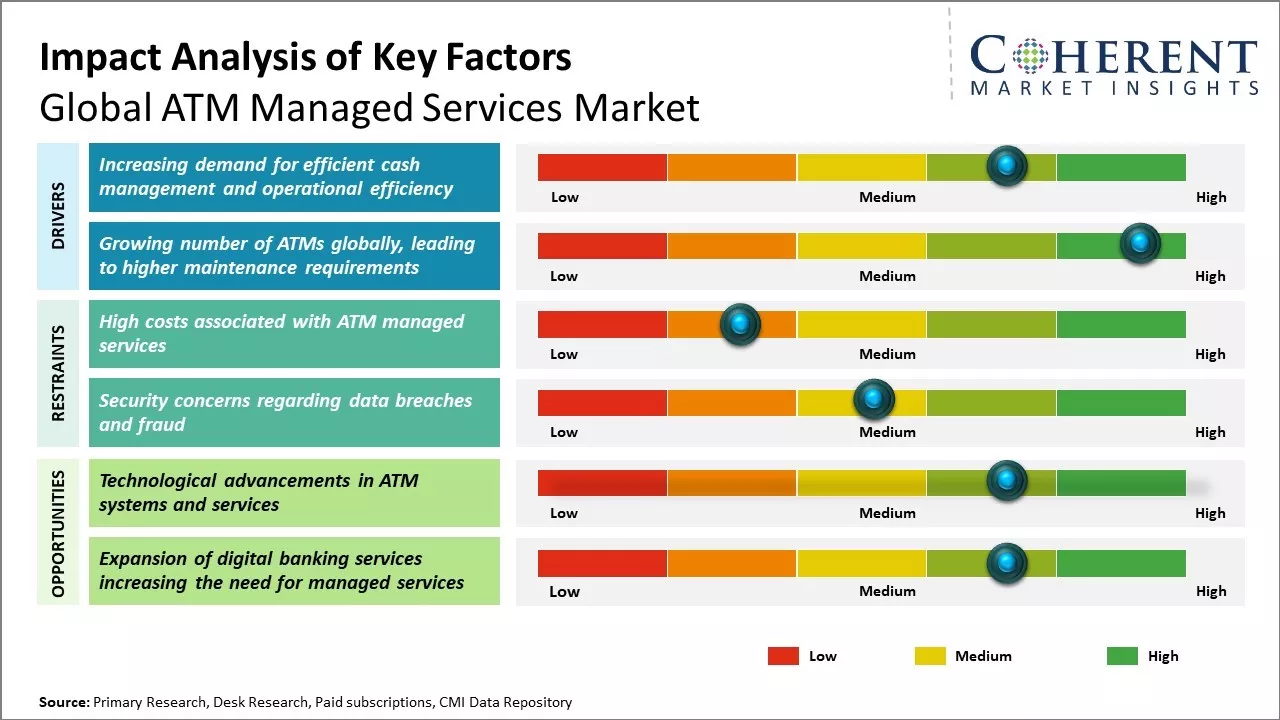
Key Takeaways
- Based on Service, the Cash Management segment leads the market holding an estimated share of 24.9% in 2026, due to rising costs, real-time forecasting needs, and the push for efficient, secure ATM operations across diverse global markets.
- Based on ATM Type, Smart ATM segment is projected to hold the largest share of the market in 2026, with advanced features and rising demand for digital, self-service banking solutions.
- Based on Region, Asia Pacific is estimated to lead the market with a share of 33.8% in 2026. While, North America, holding a share of 28.7% in 2026, is projected to be the fastest growing region.
Market Overview
The ATM managed services industry is evolving at a very fast pace, led by the increasing need for secure, cost-saving, and technologically enabled ATM operations in worldwide banking networks. While the focus of banks and financial institutions is on maximizing operating efficiency, lowering capital costs, and enhancing customer satisfaction, the outsourcing of ATM services like cash replenishment, maintenance, monitoring, and security has gained immense popularity.
For example, in 2024, various international ATM service providers like Diebold Nixdorf and NCR Atleos extended their AI-based monitoring systems that identify anomalous behavior, improve uptime, and minimize service costs. These developments are consistent with the industry's larger trend towards automation, centralized management, and safe transaction environments.
Current Events and Its Impact on the Atm Managed Services Market
Current Events | Description and its impact |
Regulatory Requirement for Coin-Based ATMs in the UK |
|
Integration of AI and Cloud-Based Solutions in ATM Services
|
|
Role of AI in the ATM Managed Services Market
Artificial Intelligence (AI) is progressively revolutionizing the ATM managed services industry by enhancing efficiency, minimizing downtime, and boosting security. AI-powered technologies make it possible to monitor ATM networks in real-time and perform predictive maintenance, enabling service providers to predict technical issues before they arise. This reduces service disruptions, lowers maintenance expenses, and enhances customer satisfaction.
In cash management, historical transaction data is examined by AI algorithms to ensure optimal cash replenishment schedules. This avoids overstocking or understocking ATMs, reducing cash-in-transit and storage costs considerably. AI also assists in cash logistics route optimization, which leads to more efficient and reduced-cost replenishment operations.
In November 2023, Financial Software & Systems Pvt Ltd (FSS), a prominent global provider of payment technology solutions, announced the launch of its new ATMs in India, equipped with IoT and AI/ML capabilities.
- Current Industry Events of 2026
- Market Size Estimation
- Regional Breakdown
- Competitive Landscape
- Customer Intelligence
- Segmental Analysis
- Pricing Analysis
- Key Market Drivers, Challenges & Future Trends
- Customized Insights Section
Segmental Insights
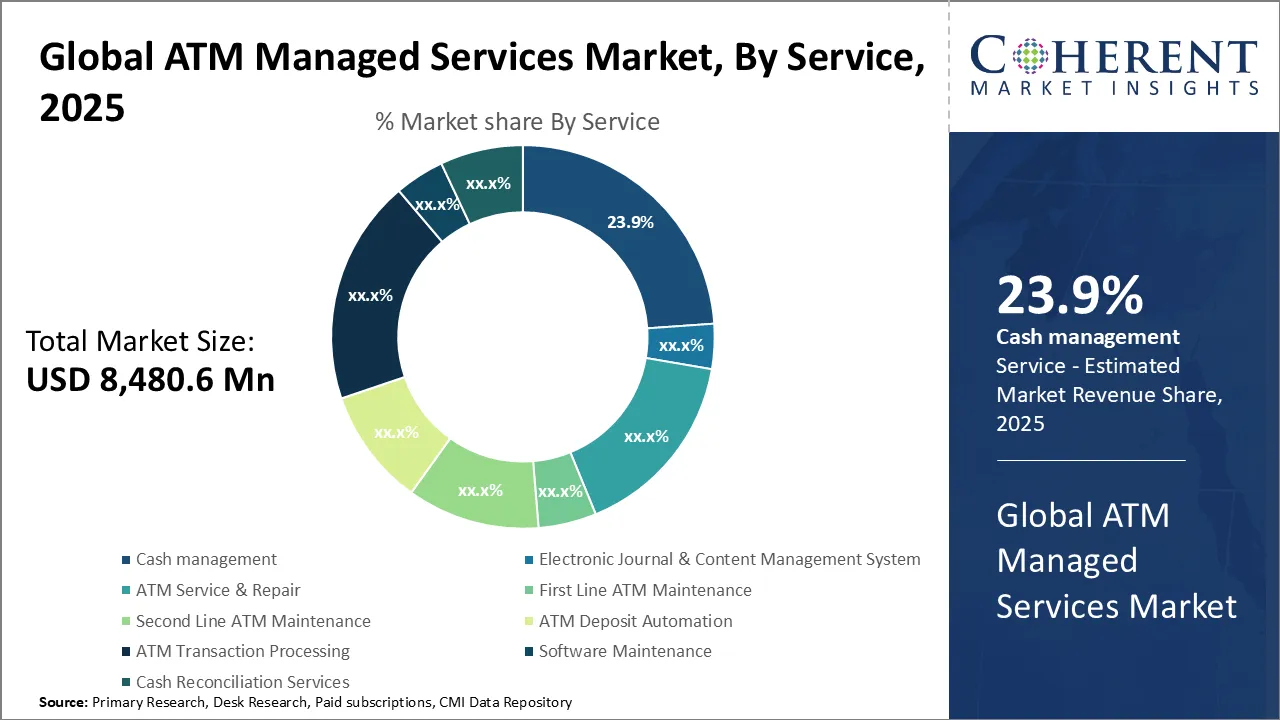
ATM Managed Services Market Insights, By Service: Cash management is Demanding Due To Rising Costs, Real-Time Forecasting Needs, And the Push for Efficient, Secure ATM Operations Across Diverse Global Markets
In terms of service, the cash management segment is estimated to contribute the highest market share of 24.9% in 2026, due to rising operational costs, evolving customer demands, and complex forecasting needs. Despite digital payment growth, cash remains essential in many regions, requiring banks to maintain optimal ATM cash levels. Overloading leads to idle capital, while understocking risks outages. AI-driven analytics are now vital for predicting usage patterns and optimizing replenishment. Additionally, multifunctional ATMs offering deposits and bill payments demand advanced monitoring. Regulatory compliance and regional diversity further complicate operations, making cash management a critical focus for banks and service providers worldwide.
For instance, in September 2025, Tietoevry Banking entered Germany’s ATM market through a five-year SaaS agreement with IC Cash Services. The partnership will support secure, efficient cash distribution across 2,500 ATMs, fully integrated with Germany’s girocard system. This move marks a significant expansion of Tietoevry’s cloud-based ATM platform, enhancing operational efficiency and regulatory compliance across Europe.
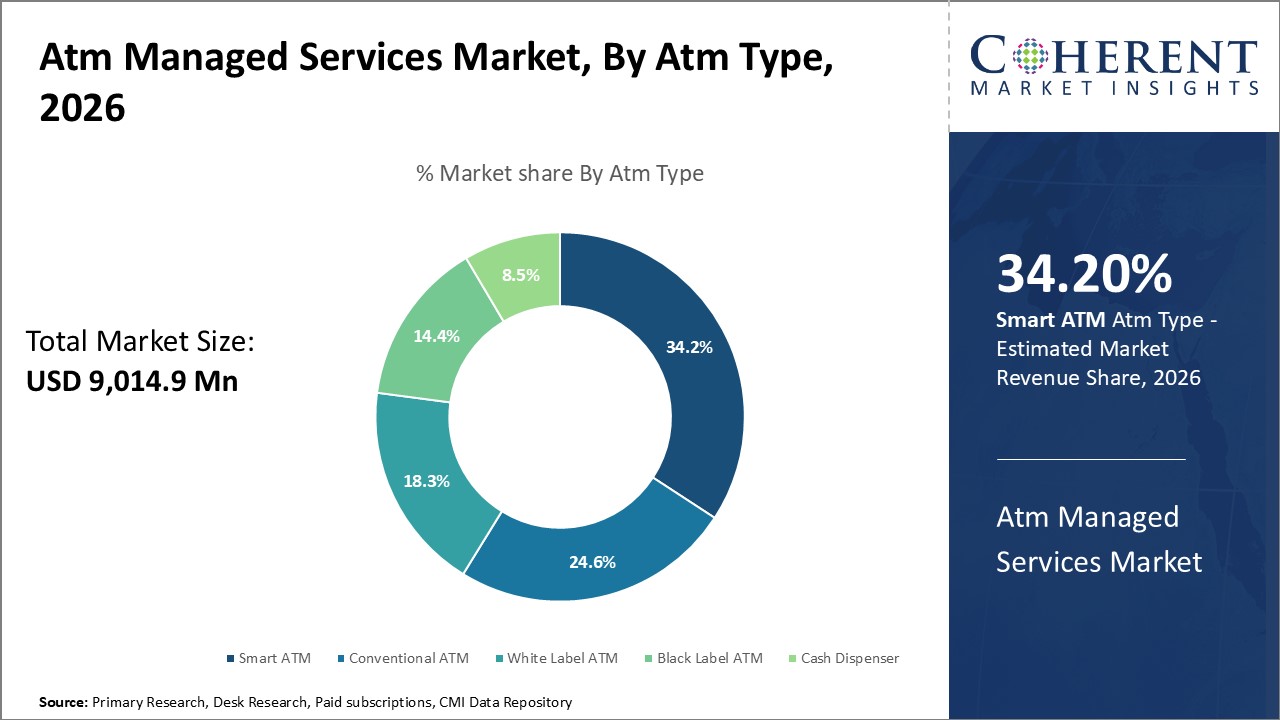
ATM Managed Services Market Insights, By ATM Type: Smart ATMs Dominate the Market with Advanced Features and Rising Demand for Digital, Self-Service Banking Solutions
In terms of ATM Type, the Smart ATM segment is expected to hold the largest share of the market in 2026, due to their advanced capabilities, such as cardless transactions, biometric authentication, and integration with mobile banking platforms. These machines offer enhanced user experiences and operational efficiency, which aligns with the growing demand for digital banking solutions.
Financial institutions are increasingly investing in Smart ATMs to reduce branch traffic, improve customer service, and support self-service banking. Their ability to handle complex transactions including bill payments, fund transfers, and even loan applications make them a preferred choice over traditional ATM types like Conventional or Cash Dispensers. As a result, Smart ATMs are leading the market in terms of deployment and managed service demand in 2025.
For instance, in April 2025, Shanghai launched cutting-edge Smart ATMs that allow users to sell gold for instant cash, marking a major innovation in financial technology. This initiative streamlines gold transactions by integrating real-time valuation and secure exchange, offering residents a fast, convenient way to convert physical assets into currency directly at ATM terminals.
Regional Insights
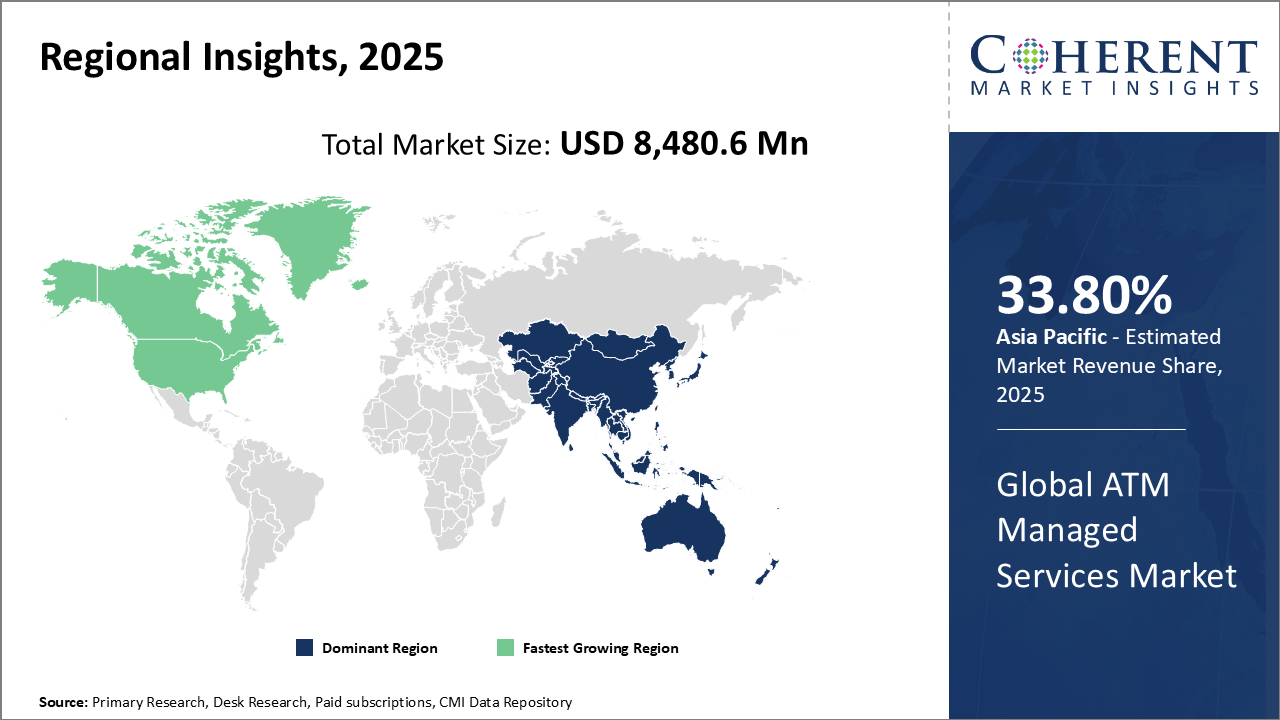
Asia Pacific ATM Managed Services Market Analysis and Trends
The Asia Pacific region, holding a share of 33.8%, is expected to dominate the ATM managed services market due to the region's rising economic growth and development of the banking industry across many nations. While Western markets saturate, developing Asian countries continue investing in ATM infrastructure to meet the needs of an expanding middle class and growing number of bank accounts.
For example, in India after demonetization the government pushed for rapid digitalization which led to huge increase in number of ATMs across urban and rural areas. This has spurred significant growth opportunities for service providers helping banking institutions remotely manage new fleets of ATMs. Many global as well as regional players are focused on gaining ground in Asia to capitalize on the region's high growth potential through partnerships with leading banks and niche acquisitions.
For instance, in March 2026, SCB and GLN launched cardless ATM withdrawals for Korean tourists in Thailand, enabling seamless access to cash via mobile wallets. This innovative service enhances convenience and security by eliminating the need for physical cards, marking a significant step in cross-border financial technology and improving travel experiences for Korean visitors.
North America Atm Managed Services Market Analysis and Trends
North America has dominated the global ATM managed services market. The region is expected to hold 28.7% of the market share in 2026 owing to strong a presence of major banking institutions and ATM managed services providers in the region. Countries like the U.S. and Canada have widespread ATM infrastructure and banking networks. Leading U.S banks have been early adopters of outsourcing non-core functions like ATM maintenance and monitoring.
This has driven major ATM managed service providers to set up their regional headquarters and development centers in North America to cater to prominent client demand. Additionally, high per capita disposable incomes and bank penetration rates have supported regular ATM infrastructure upgrades and enhancements through managed service contracts.
For instance, in August 2026, Diebold Nixdorf unveiled its next-generation branch automation solutions, aimed at transforming banking operations through advanced self-service technologies. The new platform integrates smart ATMs, cash recyclers, and digital interfaces to streamline transactions, reduce operational costs, and enhance customer experience. This launch marks a significant step in modernizing branch infrastructure for financial institutions worldwide.
ATM Managed Services Market Outlook Country-Wise
United States ATM Managed Services Market Analysis and Trend
In 2026, the United States leads the ATM Managed Services Market with a dominant 25.1% share. This is driven by the country’s high ATM density, extensive banking infrastructure, and a strong trend toward outsourcing ATM operations to reduce costs and improve service reliability. The rapid adoption of contactless payments, AI-powered monitoring, and cloud-based ATM services further boosts its demand, as financial institutions seek enhanced uptime, fraud prevention, and customer experience.
For instance, in October 2024, Hyosung Americas launched a pilot program for Hyosung Pay Retail ATMs in partnership with eGlobal. The initiative introduces enhanced ATM capabilities in retail locations, enabling digital payments and expanded financial services. This move aims to modernize ATM infrastructure, improve customer convenience, and support broader adoption of contactless and mobile transaction technologies.
U.K. ATM Managed Services Market Analysis and Trend
The United Kingdom holds a 6.2% share in the ATM Managed Services Market, supported by its mature financial ecosystem. Banks in the UK are increasingly focused on cost optimization and regulatory compliance, prompting a shift toward third-party service providers for ATM maintenance, software upgrades, and cash logistics. The growing preference for cashless transactions also necessitates smarter ATM management solutions.
For instance, in July 2026, Lloyds Banking Group partnered with NCR Atleos to pilot new ATM technology aimed at enhancing customer experience and operational efficiency. The initiative introduces advanced features such as improved accessibility and streamlined transactions, reflecting Lloyds’ commitment to modernizing its banking infrastructure and embracing innovative managed service solutions across its ATM network.
China ATM Managed Services Market Analysis and Trend
China accounts for 9.4% of the market, with demand fueled by the expansion of ATM networks in both urban and rural regions to promote financial inclusion. The integration of mobile wallets, QR code payments, and biometric authentication into ATM systems reflects the country’s commitment to digital transformation. Government-backed initiatives continue to drive the adoption of smart ATM services across the nation.
Brazil ATM Managed Services Market Analysis and Trend
Brazil, with a 1.7% market share, is witnessing increased demand for ATM managed services due to the need for secure and efficient cash handling, particularly in high-crime areas. Financial institutions are turning to managed services to mitigate operational risks and ensure consistent uptime. The deployment of ATMs in underserved regions also contributes to the growing need for remote monitoring and maintenance.
For instance, in March 2026, Elo, Agility, and INETCO have announced a strategic partnership to enhance Brazil’s digital payments ecosystem. The collaboration will leverage INETCO’s real-time transaction monitoring and AI-driven fraud prevention tools, including INETCO Insight® and BullzAI™, to improve network performance, reduce diagnostic time, and strengthen cybersecurity across financial institutions in the region
GCC Countries ATM Managed Services Market Analysis and Trend
GCC countries, including the UAE, Saudi Arabia, and Qatar, represent 3.1% of the ATM Managed Services Market. These nations are rapidly modernizing their banking systems, leading to high demand for smart ATMs equipped with multilingual interfaces and biometric features. Outsourcing ATM services aligns with regional goals for digital banking transformation and operational efficiency.
For instance, in May 2026, Qatar National Bank (QNB) become the first bank in the Middle East to deploy Diebold Nixdorf’s DN Series™ ATMs with bulk cash deposit capability. This innovation enhances customer convenience by allowing large cash deposits in a single transaction, marking a significant step in QNB’s digital transformation and commitment to advanced banking technology.
Market Report Scope
ATM Managed Services Market Report Coverage
| Report Coverage | Details | ||
|---|---|---|---|
| Base Year: | 2025 | Market Size in 2026: | USD 9,014.9 Mn |
| Historical Data for: | 2020 To 2024 | Forecast Period: | 2026 To 2033 |
| Forecast Period 2026 to 2033 CAGR: | 6.3% | 2033 Value Projection: | USD 13,825.9 Mn |
| Geographies covered: |
| ||
| Segments covered: |
| ||
| Companies covered: | FSSTech, CashLink Global Systems Pvt. Ltd., Automated Transaction Delivery (ATM Worldwide), First Data, Electronic Payment and Services Pvt. Ltd., CashTrans, Vocalink, QDS (Quality Data Systems), CMS Info Systems, NCR Managed Services, TetraLink, Hitachi, LD Systems, Fiserv, Cardtronics | ||
| Growth Drivers: |
| ||
| Restraints & Challenges: |
| ||
ATM Managed Services Market Growth Driver
- Growing need for effective cash management and operational effectiveness
As financial institutions concentrate on core banking activities and minimize non-core functions such as ATM maintenance, the need for outsourcing ATM managed services is increasing gradually. Cash management for a large network of ATMs geographically dispersed is a challenging process which needs real-time monitoring and analysis of transaction patterns. It also requires alignment of multiple internal groups for cash replenishment, technical support and regulatory requirements.
In May 2024, companies like Diebold Nixdorf and Cardtronics introduced cloud-based ATM management platforms, enabling real-time monitoring and optimization of cash handling and security. These platforms allow financial institutions to proactively manage cash levels and reduce operational costs.
ATM managed service providers with their domain-specific expertise and centralized command centre operations have better processes and technologies to reduce operational downtime of ATMs. With remote monitoring facilities and account reconciliation systems, they are able to detect technical faults in advance and resolve them quicker. It assures round-the-clock availability of cash and reduces surprise downtime occurrences.
- Increase in the Number of ATMs Across the World, Enhancing Maintenance Needs
As financial inclusion has increased enormously in developed and developing economies, the dependence on ATMs for money withdrawal and simple transactions has skyrocketed. This has seen the number of ATMs installed all over the world balloon over the last decade.
But with the exponential growth in the fleets of ATMs, maintenance and upkeep of these machines have been a huge task. Every ATM on average handles 150 to 200 transactions per day and necessitates stringent service level commitments in terms of up-time as well as availability. Technical flaws, even minor, result in customer inconvenience and revenue loss.
They must also ensure compliance with periodically updating firmware and issues related to security vulnerabilities arising from inter-connected platforms. The expertise involved in processing cash operations, compliance duties and coordination along the value chain has grown substantially.
Market Opportunity - Advances in ATM systems and services
Technological innovations offer tremendous scope for expansion in the worldwide ATM managed services market. The use of innovations such as artificial intelligence, blockchain, predictive maintenance features and improved security solutions enables the provision of better functionality at reduced expenditures by ATM operators.
For example, AI-based monitoring solutions and predictive analytics reduce downtime through proactive detection and resolution of issues. Sophisticated technologies also improve the user experience via functionalities such as multimedia interfaces, mobile-oriented services and bio-metric identification. Large-scale adoption is facilitating multi-purpose utilization beyond simple cash withdrawals.
In addition, cloud-based management platforms enable centralized management of distributed ATM networks. This simplifies management operations and maximizes resource utilization. All these technological developments facilitate ATM managed service providers to expand geographically and deliver customized, scalable solutions. They have a central role to play in tackling industry issues around costs and pushing on with market growth.
ATM Managed Services Industry News
- In September 2024, British supermarket retailer Sainsbury's disposed of its ATM business, which includes 1,370 machines, to Brink's-owned major ATM operator Note Machine. The transaction is in line with Sainsbury's plans to simplify its banking operations and reduce expenses, after its staged withdrawal from core banking services. The transaction guarantees on-going ATM operations at existing sites, with Sainsbury's and Note Machine splitting commission income.
- In June 2025, Brink’s announced a strategic investment in KAL, a global leader in multivendor ATM software, to enhance its ATM managed services capabilities. The partnership aims to improve ATM performance, security, and customer experience across financial institutions. This move supports Brink’s expansion into advanced software-driven ATM solutions and strengthens its global managed services portfolio.
- In November 2024, Findi Ltd, through its subsidiary TSI, signed a strategic deal to acquire Tata Communications Payment Solutions Ltd (TCPSL), one of India’s largest white label ATM operators. The acquisition includes backend operations and payment switch capabilities, positioning Findi to expand its footprint and enhance ATM managed services across the Indian financial landscape.
- In February 2024, Cardtronics, a leading provider of ATM managed services, announced its merger with a technology firm to enhance its ATM managed services portfolio. This strategic move aims to leverage advanced technology solutions to improve the efficiency and functionality of ATMs, ultimately benefiting customers and expanding Cardtronics' service offerings.
Analyst Opinion (Expert Opinion)
The Global ATM Managed Services Market value is evolving from a cost-driven outsourcing model to a technology-led, analytics-driven ecosystem. Traditional offerings cash replenishment, maintenance, and monitoring are now integrated with remote diagnostics, cybersecurity, and predictive analytics. Asia-Pacific dominates due to dense ATM networks and third-party deployers, where cost efficiency and scale remain critical differentiators. Cash management continues to anchor revenue, accounting for nearly 40% of service value, highlighting the operational importance of cash-cycle accuracy and logistics efficiency.
Global vendors such as Diebold Nixdorf, NCR, Euronet, and Brinks are bundling software, analytics, and cash logistics to offset shrinking hardware margins. For instance, the Geldmaat–Diebold Nixdorf partnership covering over 1,800 ATMs exemplifies the preference for long-term, single-vendor accountability. The market is witnessing consolidation, as pure break-fix services become commoditized while data-driven uptime optimization emerges as the new profit center.
Security and compliance demands are reshaping service contracts, favoring providers with certified governance and SLA traceability. Mature markets focus on network optimization, while emerging regions emphasize expansion through specialized operators. Ultimately, competitive advantage lies in adopting telemetry, AI-based predictive maintenance, and integrated cash-cycle management. Vendors that fail to evolve toward analytics-led, end-to-end service delivery risk severe margin erosion and market displacement.
Speak to the analyst
Want personalized insights?
Take the findings above to one of our principal consultants, or have the report rebuilt around the segments, geographies and competitors you actually track.
Market Segmentation
- By Service Insights (Revenue, USD Mn, 2026 - 2033)
- Electronic Journal & Content Management System
- ATM Service & Repair
- First Line ATM Maintenance
- Second Line ATM Maintenance
- ATM Deposit Automation
- Cash Management
- Software Maintenance
- Cash Reconciliation Services
- By ATM Type (Revenue, USD Mn, 2026 - 2033)
- Conventional ATM
- White Label ATM
- Black Label ATM
- Cash Dispenser
- Smart ATM
- Regional Insights (Revenue, USD Mn, 2026 - 2033)
- North America
- U.S.
- Canada
- Latin America
- Brazil
- Argentina
- Mexico
- Rest of Latin America
- Europe
- Germany
- U.K.
- Spain
- France
- Italy
- Russia
- Rest of Europe
- Asia Pacific
- China
- India
- Japan
- Australia
- South Korea
- ASEAN
- Rest of Asia Pacific
- Middle East
- GCC Countries
- Israel
- Rest of Middle East
- Africa
- South Africa
- North Africa
- Central Africa
- North America
- Key Players Insights (Revenue, USD Mn, 2021 - 2033)
- FSSTech
- CashLink Global Systems Pvt. Ltd.
- Automated Transaction Delivery (ATM Worldwide)
- First Data
- Electronic Payment and Services Pvt. Ltd.
- CashTrans
- Vocalink
- QDS (Quality Data Systems)
- CMS Info Systems
- NCR Managed Services
- TetraLink
- Hitachi
- LD Systems
- Fiserv
- Cardtronics
Sources
Primary Research Interviews
- Head of ATM Operations, Global Banking Institution
- Director of Banking Technology Solutions, Leading ATM Manufacturer
- Senior Analyst, Financial Infrastructure Advisory Firm
- VP of Network Management, ATM Managed Service Provider
- Others
Databases
- IBISWorld (Financial Services Outsourcing Data)
- Bloomberg Terminal (Real-time Market Analytics)
- Others
Magazines
- ATM Marketplace (Industry Trends & Innovations)
- Banking Technology (ATM Network Optimization Strategies)
- Global Finance Magazine (Cash Management Insights)
- Others
Journals
- Journal of Payments Strategy & Systems
- International Journal of Financial Services Management
- Journal of Banking and Financial Technology
- Others
Newspapers
- Financial Times (Banking Sector Updates)
- The Wall Street Journal (ATM Regulatory Shifts)
- The Economist (Global Cash Usage Trends)
- Others
Associations
- ATM Industry Association (ATMIA)
- Electronic Transactions Association (ETA)
- Global ATM Security Alliance
- Others
Public Domain Sources
- Federal Reserve Financial Services Reports
- European Central Bank (ECB) Cash Circulation Data
- Reserve Bank of India (RBI) ATM Guidelines
- Others
Proprietary Elements
- CMI Data Analytics Tool
- Proprietary CMI Existing Repository of Information (Last 8 Years)
*Definition: The global ATM managed services market provides end-to-end outsourced services for the installation, maintenance, and management of ATMs. This includes functions like terminal driving, monitoring transaction status, and replenishing cash, reconciling accounts, handling technical and operational issues 24/7. The ATM managed services providers take care of regulatory compliances, software updates, upgrading hardware components to extend the life of aging ATMs. They help banks and financial institutions focus on core business activities while ensuring smooth operations and an enhanced customer experience.
Get access to 250+ pages report
Every segment, forecast, competitor profile and data table behind the analysis above — available for instant download.
- ESOMAR Member
- ISO 9001:2015 Certified
- D-U-N-S Registered
- GDPR & CCPA Compliant
Missing comfort of reading report in your local language? Find your preferred language:
Transform your Strategy with Exclusive Trending Reports
Frequently Asked Questions
The Atm Managed Services Market size is estimated to be valued at USD 9,014.9 Mn in 2026, and is expected to reach USD 13,825.9 Mn by 2033.
The CAGR of the global Market is projected to be 6.3% from 2026 to 2033.
Increasing demand for efficient cash management and operational efficiency and growing number of ATMs globally, leading to higher maintenance requirements are the major factors driving the growth of global ATM managed services industry.
High costs associated with ATM managed services and security concerns regarding data breaches and fraud are the major factors hampering the growth of the global market.
In terms of service type, cash management are estimated to dominate the market revenue share in 2026.
FSSTech, CashLink Global Systems Pvt. Ltd., Automated Transaction Delivery (ATM Worldwide), First Data, Electronic Payment and Services Pvt. Ltd., CashTrans, Vocalink, QDS (Quality Data Systems), CMS Info Systems, NCR Managed Services, TetraLink, Hitachi, LD Systems, Fiserv, Cardtronics are the major players.
North America is expected to lead the global market.