

Commercial Laundry Equipment Market Analysis & Forecast: 2026-2033
Commercial Laundry Equipment Market is estimated to be valued at USD 4,830.3 Mn in 2026 and is expected to reach USD 6,356.3 Mn in 2033, exhibiting a compound annual growth rate (CAGR) of 4.0% from 2026 to 2033.
Key Takeaways
- Based on Product Type, the Multi-Housing segment is projected to dominate the global commercial laundry equipment market with a substantial 62.5 % share in 2026, due to rising urbanization and demand for centralized laundry solutions.
- Based on Capacity, the 30-50kg segment is expected to account for the largest share of the market in 2026, due to its optimal balance of efficiency, versatility, and space-saving design.
- Based on Equipment, the Washing Machine segment is anticipated to dominate the market with the highest share in 2026, due to their essential role and widespread use across all sectors.
- Based on End-User, the hospitality segment is expected to capture the greatest share of the market in 2026, due to its high-volume demand and preference for in-house laundry solutions.
- Based on Region, North America is set to lead the global commercial laundry equipment market in 2026 with a 32.74 % share. While, Europe, with an estimated 26.63% share in 2026, is projected to be the fastest growing region.
Market Overview
Commercial laundry equipment is designed for washing clothes and linens automatically. This laundry equipment includes dry cleaning equipment, commercial dryers, presses, and washers. Commercial laundry equipment offers laundry solutions to various industry verticals such as healthcare, educational, hospitality, and service industries. The popularity of commercial laundry equipment is expected to grow significantly, owing to its several benefits such as less equipment downtime and repair, easy to control, low energy consumption and labor costs, durability, reliability, and high efficiency. The commercial laundry equipment is divided into three types such as coin laundry, on-premise laundry, and multi-housing laundry.
Current Events and Its Impact
Current Event | Description and its Impact |
Regulatory Compliance and Environmental Standards |
|
Labor Market Disruption and Automation Acceleration |
|
Hospitality and Healthcare Sector Recovery and Expansion |
|
Role of AI (Artificial Intelligence) in Commercial Laundry Equipment
AI is transforming commercial laundry equipment by enhancing efficiency, reducing operational costs, and improving user experience. Through intelligent sensors and machine learning, AI can automatically detect fabric types, load sizes, and soil levels to optimize wash cycles, detergent use, and energy consumption. Predictive maintenance powered by AI helps identify potential issues before breakdowns occur, minimizing downtime. Additionally, AI-driven analytics provide actionable insights for better resource management and workflow optimization. These advancements not only streamline laundry operations but also contribute to sustainability by reducing water and energy usage. Overall, AI is revolutionizing the commercial laundry industry with smarter, more efficient systems.
In June 2025, Samsung enhanced its Bespoke AI Laundry series with AI-powered cycles to simplify laundry. Now, it introduces the upgraded AI Wash, featuring improved learning data, in the new front-load Bespoke AI Washer.
- Current Industry Events of 2026
- Market Size Estimation
- Regional Breakdown
- Competitive Landscape
- Customer Intelligence
- Segmental Analysis
- Pricing Analysis
- Key Market Drivers, Challenges & Future Trends
- Customized Insights Section
Technology innovations in the Commercial Laundry Equipment Market
IoT-Enabled Laundry Systems
- Smart Connectivity: Machines now feature built-in IoT modules that allow remote monitoring, diagnostics, and performance tracking via cloud platforms.
- Predictive Maintenance: Sensors detect wear and tear, alerting operators before breakdowns occur—reducing downtime and repair costs.
- User Experience: App-based controls let customers reserve machines, track cycles, and make digital payments, enhancing convenience in laundromats and multi-housing setups.
Energy Efficiency Breakthroughs
- Heat Pump Dryers: These dryers use up to 60% less energy than conventional models by recycling heat during the drying process.
- Low-Water Washers: Advanced drum designs and water flow systems minimize consumption without compromising cleaning performance.
- Smart Load Sensing: Machines automatically adjust water and energy usage based on load size, optimizing resource use.
Water Recycling and Sustainability
- Greywater Reuse Systems: Some commercial setups now reuse rinse water for pre-wash cycles, significantly cutting water bills.
- Eco-Certified Equipment: Manufacturers are launching machines that meet ENERGY STAR and other global sustainability standards.
- Carbon Footprint Reduction: Innovations are helping facilities meet ESG goals by lowering emissions and utility consumption.
AI and Machine Learning Integration
- Cycle Optimization: AI algorithms analyze usage patterns to recommend optimal wash and dry settings for different fabrics and soil levels.
- Operational Analytics: Facilities can track machine performance, customer behavior, and energy metrics to improve efficiency and profitability.
Segmental Insights
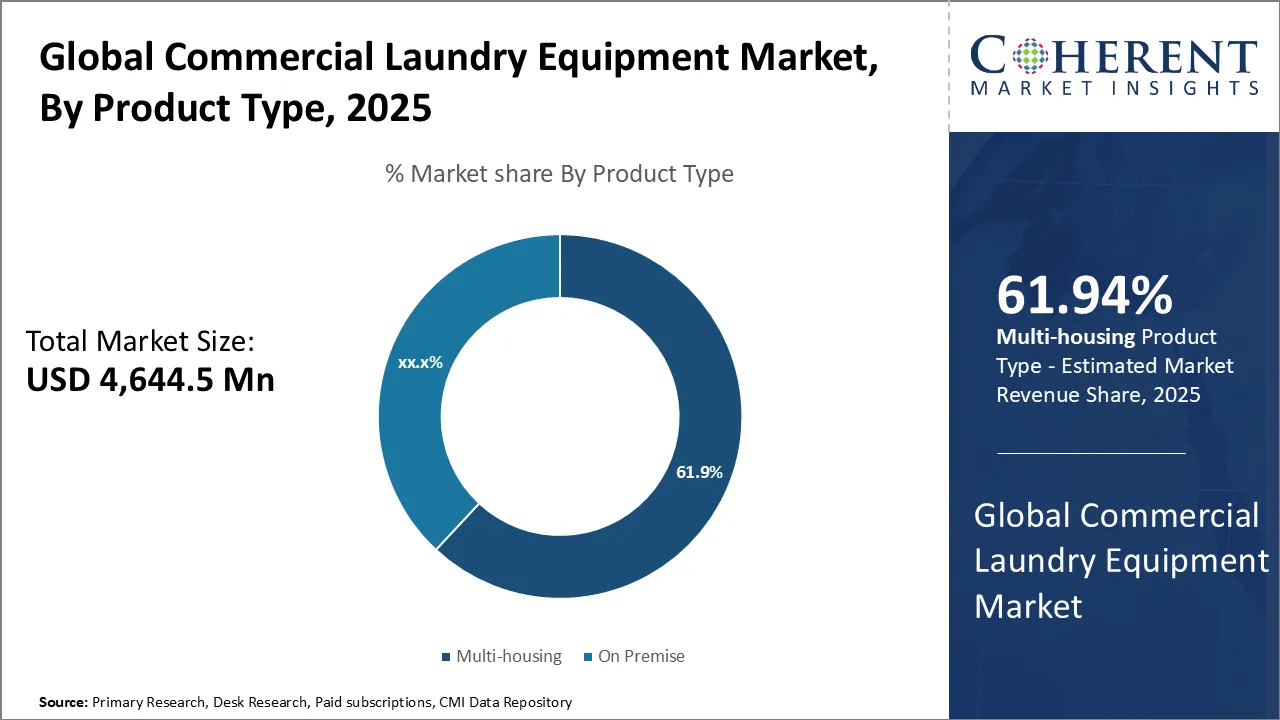
Commercial Laundry Equipment Market Insights, By Product Type - Multi-Housing Leads Due To Rising Urbanization and Demand for Centralized Laundry Solutions
In terms of product type, the multi-housing segment is expected to contribute 62.5% share in 2026. This dominance stems from rising urbanization and the expansion of rental housing, which fuels demand for centralized laundry systems in apartment complexes and dormitories. Multi-housing setups benefit from frequent usage, recurring revenue, and growing adoption of smart, energy-efficient machines. These systems offer convenience and cost-effectiveness for property managers and residents alike. While on-premises laundry used in hotels and hospitals remains vital, it faces limitations due to higher costs and space requirements. As a result, multi-housing solutions continue to outpace on-premises setups, shaping the future of commercial laundry operations.
For instance, in June 2025, Electrolux Professional modernized the communal laundry room at Jyrkkälänpolku in Turku, Finland, enhancing resident convenience and sustainability. The upgrade included energy-efficient washers and dryers, a digital booking system, and improved maintenance access. Despite in-apartment laundry options, residents prefer the shared facility for its eco-friendly design and streamlined user experience.
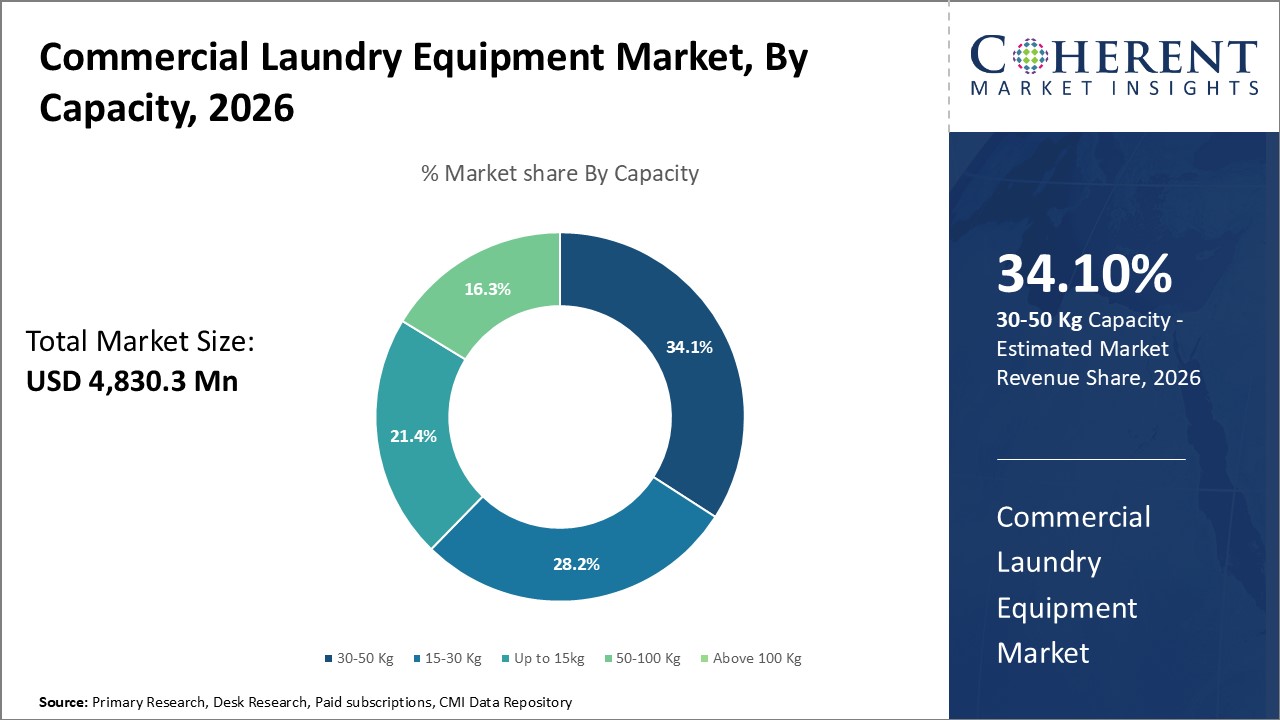
Commercial Laundry Equipment Market Insights, By Capacity - 30–50 Kg Capacity Leads Due To Its Optimal Balance of Efficiency, Versatility, And Space-Saving Design
In terms of capacity, the 30-50 kg segment is expected to hod the largest share in 2026, This range offers the ideal balance between load size and operational efficiency, making it the preferred choice for hotels, hospitals, and laundromats. These machines handle high volumes without the bulk and energy demands of larger units, and they’re more space-efficient than heavier models. Their versatility supports various fabric types and usage patterns, while newer models feature smart controls and energy-saving technologies. As businesses seek cost-effective, high-performance solutions, the 30–50 Kg segment continues to lead the market, driven by its adaptability, reliability, and sustainability advantages.
For instance, in December 2024, At Texcare International 2024, LG Electronics unveiled its advanced professional laundry solutions tailored for the commercial market. Designed for mid- to high-volume operations, the lineup is ideal for sectors like hospitality and healthcare, including 30-kilogram washers and dryers, as well as a washer-dryer combo with heat pump, offering a maximum capacity of 25 kilograms for washing and 16 kilograms for drying.
Commercial Laundry Equipment Market Insights, By Equipment - Washing Machines Dominate Due To Their Essential Role and Widespread Use Across All Sectors
In terms of equipment, the washing machine segment is projected to account for highest share of the market in 2026. They are the cornerstone of laundry operations across sectors like hospitality, healthcare, and multi-housing due to their essential role in cleaning and fabric care. Their widespread use is driven by advancements in energy efficiency, smart controls, and water-saving technologies. Washing machines are often the first investment in commercial setups, making them the most purchased and replaced equipment. While dryers, pressing machines, and dry-cleaning units serve important roles, they are typically secondary or niche. The versatility and necessity of washing machines secure their leading position in the market.
For instance, in October 2025, Xeros Technology signed a landmark launch agreement with a global washing machine manufacturer to integrate its water-saving filtration systems into commercial laundry equipment. The partnership aims to revolutionize washing machine efficiency, reduce environmental impact, and meet rising demand for sustainable solutions in the commercial laundry sector worldwide.
Commercial Laundry Equipment Market Insights, By End-User - Hospitality Segment Leads Due To Its High-Volume Demand and Preference for In-House Laundry Solutions
In terms of end-user, the hospitality segment is projected to acquire the greatest share of the market in 2026. Hotels, resorts, and serviced apartments require frequent laundering of linens, towels, and uniforms, driving high demand for efficient, high-capacity machines. The need for quick turnaround, consistent quality, and in-house control over laundry operations makes commercial equipment essential in this sector. Hospitality businesses also increasingly adopt smart, energy-efficient systems to reduce operational costs and enhance guest satisfaction. While healthcare and laundromats remain significant contributors, their demand is more specialized or localized. The hospitality industry’s scale, consistency, and focus on service quality secure its leading position in the market.
For instance, in September 2025, Alliance Laundry Systems highlights laundromats as the next big investment opportunity, driven by rising demand in hospitality and urban sectors. With commercial washing machines offering energy efficiency and smart features, laundromats serve hotels, hostels, and serviced apartments seeking reliable laundry solutions. The company sees scalable, tech-enabled laundromats as key to meeting modern hospitality needs.
Regional Insights
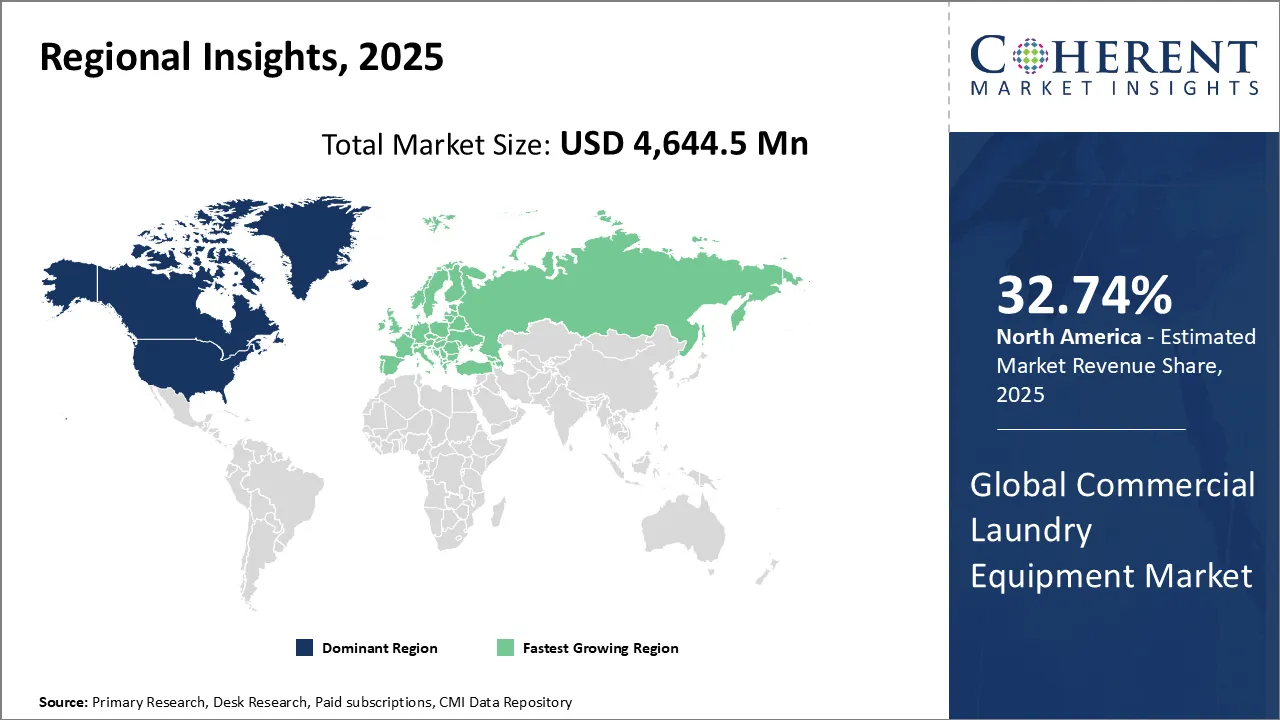
North America Commercial Laundry Equipment Market Analysis & Trends
North America is projected to lead the market with a 32.74% share in 2026, due to strong demand from the hospitality and healthcare sectors, widespread adoption of smart technologies, and a well-established laundromat culture. Hotels and hospitals require frequent, high-volume laundry services, driving investment in efficient, high-capacity machines. The popularity of multi-housing units and rental apartments also boosts demand for shared laundry facilities.
Additionally, North American consumers and businesses favor energy-efficient and IoT-enabled equipment to reduce operational costs and meet environmental standards. With high disposable income and a mature infrastructure, the region continues to lead in innovation, replacement cycles, and overall market share.
For instance, in August 2026, Girbau North America rebranded to Continental Laundry Solutions, marking a strategic shift under EVI Industries. The company, known for its commercial washing machines and laundry systems, aims to strengthen its presence in hospitality, healthcare, and textile care markets. The rebrand reflects a renewed focus on innovation, service, and sustainable laundry solutions.
Europe Commercial Laundry Equipment Market Analysis & Trends
The Europe region is expected to exhibit the fastest growth in the market contributing 26.63% share in 2026, due to strict environmental regulations, a strong hospitality sector, and rising demand for energy-efficient technologies. Hotels, resorts, and healthcare facilities require frequent, high-volume laundry services, driving investment in advanced equipment. The region’s commitment to sustainability encourages adoption of machines with low water and energy consumption. Urbanization and shared housing models also boost demand for centralized laundry setups in residential complexes.
Additionally, European businesses embrace smart laundry systems with automation and IoT features to enhance efficiency. Government incentives for green appliances further accelerate market growth, making Europe a key player in the global landscape.
For instance, in September 2026, LG Electronics has launched Bubble Wash, its first professional laundry shop in Wels, Austria, marking its expansion into Europe’s commercial laundry market. Equipped with LG’s advanced washing machines, the facility offers self-service and full-service options, emphasizing energy efficiency, smart technology, and convenience for both residential and hospitality customers.
Commercial Laundry Equipment Market Outlook Country-Wise
The U.S. Commercial Laundry Equipment Market Trends
The U.S. leads the global Commercial Laundry Equipment Market with a commanding 28.9% share, driven by its expansive hospitality and healthcare sectors. Hotels, resorts, hospitals, and long-term care facilities require frequent, high-volume laundry services, fueling demand for efficient, high-capacity machines. The country also has a strong laundromat culture and widespread use of multi-housing laundry setups. Technological innovation, including smart and energy-efficient systems, is rapidly adopted, and high disposable income supports frequent equipment upgrades and replacements.
For instance, in August 2026, Alliance Laundry Systems, a leading manufacturer of commercial washing machines, is preparing for a U.S. IPO backed by BDT & MSD Partners. Expected to launch post-Labor Day, the offering could raise over $500 million. The move reflects strong investor interest in industrial laundry solutions serving hospitality, healthcare, and multi-housing sectors.
Germany Commercial Laundry Equipment Market Trends
Germany holds 8.0% of the market, propelled by its strict environmental regulations and emphasis on sustainability. Businesses are incentivized to adopt energy- and water-efficient laundry equipment to meet EU standards. The country’s robust hospitality industry and growing elderly care sector contribute to consistent demand for reliable, high-performance machines. Additionally, Germany’s focus on automation and precision engineering makes it a key market for advanced laundry technologies.
For instance, in November 2024, LG Electronics introduced its latest AI-driven commercial washing machines and dryers at Texcare International 2024 in Frankfurt. The lineup includes high-capacity models and an innovative washer-dryer combo with inverter heat pump technology. Designed for hospitality and healthcare sectors, the machines offer faster cycles, energy efficiency, and smart load optimization for professional laundry operations.
China Commercial Laundry Equipment Market Trends
China’s 5.3% market share reflects its rapid urbanization, expanding middle class, and growing healthcare and hospitality sectors. The country is investing heavily in industrial-scale laundry facilities to meet rising demand from hotels, hospitals, and residential complexes. Adoption of smart technologies and automation is accelerating, and the market is projected to grow at a high CAGR, making China one of the fastest-growing regions in the commercial laundry space.
For instance, in March 2026, Jensen Group unveiled its latest commercial laundry innovations at Texcare Asia, blending European engineering with Chinese manufacturing. The showcased equipment includes automated folding systems and energy-efficient washers tailored for hospitality and healthcare sectors. The presentation highlights Jensen’s global strategy and commitment to high-performance, sustainable solutions in industrial laundry operations.
Mexico Commercial Laundry Equipment Market Trends
Mexico commands 5.6% of the market, driven by its thriving tourism industry and increasing urban population. Hotels and resorts require dependable laundry systems to maintain service quality, while urban housing developments are incorporating shared laundry facilities. Rising awareness of energy-efficient solutions and government support for infrastructure modernization further boost demand for commercial laundry equipment across the country.
For instance, in September 2026, Whirlpool Corporation relocated its commercial washing machine production from Monterrey, Mexico, to Fall River, Massachusetts. The move aims to boost manufacturing efficiency and support domestic job growth. The Fall River facility will expand its operations to include commercial laundry equipment, reinforcing Whirlpool’s commitment to U.S.-based production and the professional laundry market.
GCC Countries Commercial Laundry Equipment Market Trends
The GCC region, including nations like Saudi Arabia and the UAE, contributes 3.2% to the market, fueled by investments in luxury hospitality, healthcare, and smart infrastructure. High temperatures and frequent laundry needs in hotels and residential complexes necessitate durable, high-capacity machines. The region’s push for sustainability and automation aligns with global trends, and premium laundry solutions are increasingly favored to meet the expectations of high-end service environments.
For instance, in July 2205, Emirates Laundry expanded its UAE facility to meet rising demand from hospitality, healthcare, and aviation sectors. The upgrade includes advanced commercial washing machines and automated systems to enhance efficiency and hygiene standards. This strategic move strengthens the company’s role in the region’s professional textile care industry and supports sustainable laundry operations.
Market Report Scope
Commercial Laundry Equipment Market Report Coverage
| Report Coverage | Details | ||
|---|---|---|---|
| Base Year: | 2025 | Market Size in 2026: | USD 4,830.3 Mn |
| Historical Data for: | 2020 To 2024 | Forecast Period: | 2026 To 2033 |
| Forecast Period 2026 to 2033 CAGR: | 4.0% | 2033 Value Projection: | USD 6,356.3 Mn |
| Geographies covered: |
| ||
| Segments covered: |
| ||
| Companies covered: | CMV Sharper Finish Inc., EDRO Corporation, American Dryer Corporation, Whirlpool, LG Electronics, GE Appliances, Haier, Electrolux, Alliance Laundry System LLC, Herbert Kannegiesser GmbH, Pellerin Milnor Corporation, Fagor Professional, Jinan Oasis Dry Cleaning and Laundry Equipment Co., Ltd., JIANYE GROUP CO., LTD., Jiangsu Sunflower Machinery Manufacturing Co., ltd, PRIMUS, Miele, MAG LAUNDRY EQUIPMENT, Girbau, SA., DEXTER LAUNDRY, Domus Laundry Equipment, and BÖWE Textile Cleaning | ||
| Growth Drivers: |
| ||
| Restraints & Challenges: |
| ||
Commercial Laundry Equipment Market Driver
Hospitality and Healthcare Expansion
The hospitality and healthcare sectors are major contributors to the growth of the Commercial Laundry Equipment Market size in 2025. Hotels, resorts, hospitals, and long-term care facilities require frequent, high-volume laundering of linens, uniforms, and bedding to maintain hygiene and service standards. This surge in demand is driving investments in advanced laundry systems that offer speed, durability, and energy efficiency. Additionally, the rise in medical tourism and global travel is expanding the footprint of commercial laundry operations. As these industries grow, so does the need for reliable, high-capacity equipment, significantly boosting the overall Commercial Laundry Equipment Market size worldwide.
Laundromat Modernization
Laundromat modernization is a key factor boosting the Commercial Laundry Equipment Market share in 2025. Operators are upgrading facilities with smart washers and dryers that offer app-based controls, digital payments, and real-time machine availability. These innovations enhance customer convenience and operational efficiency, attracting tech-savvy users and increasing repeat visits. Additionally, space-saving designs like stackable units and energy-efficient models are helping laundromats reduce costs and maximize throughput. As urban populations grow and self-service laundry demand rises, modernized laundromats are becoming more competitive and profitable, contributing significantly to the expanding Commercial Laundry Equipment Market share across developed and emerging regions.
Commercial Laundry Equipment Market Opportunity
Smart Laundry Systems & IoT Integration
Smart laundry systems and IoT integration are revolutionizing operations and driving Commercial Laundry Equipment Market demand in 2025. These advanced machines offer remote monitoring, predictive maintenance, and app-based controls, enhancing efficiency and user convenience. Businesses benefit from real-time data analytics that optimize energy use, reduce downtime, and streamline workflows. Features like contactless payments and machine availability tracking attract tech-savvy consumers, especially in urban laundromats and multi-housing facilities. As sustainability and automation become priorities across industries, the demand for intelligent, connected laundry equipment continues to rise, positioning smart systems as a key growth driver in the evolving commercial laundry landscape.
Analyst Opinion (Expert Opinion)
The commercial laundry equipment market value is experiencing a pronounced transformation driven by technological innovation, evolving industry demands, and shifting investor confidence. The integration of artificial intelligence (AI) and machine learning into machines is significantly enhancing operational efficiency. AI-driven systems optimize wash cycles based on load size, fabric type, and soil level, reducing water and energy consumption. This is particularly critical in healthcare and hospitality, where high hygiene standards and rapid turnaround are essential.
Investor sentiment reflects strong confidence in the sector’s potential. The recent IPO of Alliance Laundry Systems, which raised $826 million at a valuation of $4.83 billion, underscores renewed interest in companies demonstrating technological innovation and robust operational models.
Sector-specific demands remain a key driver. Hospitals require durable, high-capacity machines for large volumes of linens, while hotels and resorts increasingly need solutions capable of handling high turnover without compromising quality. This has encouraged manufacturers to develop tailored equipment addressing the specific operational challenges of each industry.
Sustainability is also a decisive factor. Energy-efficient and water-saving technologies are increasingly integrated to meet regulatory pressures and consumer expectations for environmentally conscious solutions. Companies prioritizing eco-friendly innovation are likely to gain a competitive advantage.
Speak to the analyst
Want personalized insights?
Take the findings above to one of our principal consultants, or have the report rebuilt around the segments, geographies and competitors you actually track.
Recent Developments
- In September 2025, Speed Queen Commercial showcases its robust lineup of washers and dryers tailored for laundromats, multi-housing, and on-premises laundry. With operations in over 60 countries and $100M invested in tech, the brand emphasizes smart solutions like Speed Queen Insights, reinforcing its global presence and innovation in the commercial laundry equipment sector.
- In June 2025, Spain-based Primer Laundry introduced a new range of 11–22 kg high-speed washing machines for commercial use. Designed for hospitality and industrial sectors, the washers feature smart controls, IoT connectivity, and energy-saving technology. The launch strengthens Primer’s presence in Europe’s professional laundry market, offering efficient and customizable solutions for modern textile care.
Market Segmentation
- Product Type Insights (Revenue, USD, 2021 - 2033)
- Multi-housing
- On-premises
- Capacity Insights (Revenue, USD, 2021 - 2033)
- Up to 15kg
- 15–30 Kg
- 30–50 Kg
- 50-100 Kg
- Above 100 Kg
- Equipment Insights (Revenue, USD, 2021 - 2033)
- Washing machines
- Commercial Dryers
- Pressing Machines
- Dry Cleaning Equipment
- End User Insights (Revenue, USD, 2021 - 2033)
- Healthcare
- Hospitality
- Laundromats
- Educational
- Public Sectors
- Others
- Regional Insights (Revenue, USD Mn, 2021 - 2033)
- North America
- U.S.
- Canada
- Latin America
- Brazil
- Mexico
- Argentina
- Rest of Latin America
- Europe
- Germany
- U.K.
- Spain
- France
- Italy
- Russia
- Rest of Europe
- Asia Pacific
- China
- India
- Japan
- Australia
- South Korea
- ASEAN
- Rest of Asia Pacific
- Middle East
- GCC
- Israel
- Rest of Middle East
- Africa
- North Africa
- Central Africa
- South Africa
- North America
- Key Players Insights
- CMV Sharper Finish Inc.
- EDRO Corporation
- American Dryer Corporation
- Whirlpool
- LG Electronics
- GE Appliances
- Haier
- Electrolux
- Alliance Laundry System LLC
- Herbert Kannegiesser GmbH
- Pellerin Milnor Corporation
- Fagor Professional
- Jinan Oasis Dry Cleaning and Laundry Equipment Co., Ltd.
- JIANYE GROUP CO., LTD.
- Jiangsu Sunflower Machinery Manufacturing Co,.ltd
- PRIMUS
- Miele
- MAG LAUNDRY EQUIPMENT
- Girbau, SA.
- DEXTER LAUNDRY
- Domus Laundry Equipment
- BOWE Textile Cleaning
Sources
Primary Research Interviews from the following stakeholders
Stakeholders
- Interviews with laundry equipment manufacturers, distributors, laundromat operators, facility managers, and procurement heads across key global markets.
- Discussions with representatives from hospitality, healthcare, and industrial laundry service providers to understand adoption patterns, pricing models, and operational challenges.
- Interactions with supply chain managers, after-sales service providers, and detergent chemical suppliers to assess technological and service integration trends.
Specific Stakeholders
- Procurement and operations heads at hotel chains and resorts
- Facility managers at hospitals and healthcare networks
- Plant managers at large-scale laundry service providers and textile rental companies
- Operations heads at industrial laundries serving manufacturing and food & beverage plants
- Franchise owners and investors in self-service laundromats
- Engineering teams and R&D managers at OEMs producing washing, drying, and finishing equipment
- Energy management and sustainability consultants working with laundry facilities to optimize water and energy consumption
Databases
- World Trade Organization (WTO) Trade Statistics
- UN Comtrade Database
- World Bank Data Portal
- Eurostat
- U.S. Census Bureau – International Trade Data
- China Customs Statistics
- Japan External Trade Organization (JETRO)
- Korea Customs Service Data Portal
- Directorate General of Commercial Intelligence and Statistics (DGCIS), India
- Ministry of Heavy Industries, India
- International Energy Agency (IEA) – Energy Use in Industry Reports
Magazines
- American Laundry News
- Commercial Laundry Equipment Magazine
- Laundry and Cleaning News International (LCNi)
- Cleaning & Maintenance Management (CMM)
- Textile Services Magazine
- Hospitality Technology
- Facility Executive
- Modern Laundry Guide
- Industrial Cleaning Journal
Journals
- Journal of Textile Science and Engineering
- Applied Thermal Engineering (Elsevier)
- Energy and Buildings (Elsevier)
- Journal of Cleaner Production
- International Journal of Hospitality Management
- Journal of Manufacturing Processes
- Textile Research Journal
- Journal of Industrial Ecology
Newspapers
- The Wall Street Journal – Manufacturing & Industry
- The Economic Times – Industrial Equipment & Energy Efficiency
- The Hindu Business Line – Infrastructure & Industrial Machinery
- Financial Times – Manufacturing & Sustainability
- Nikkei Asia – Industrial Automation & Supply Chain
- South China Morning Post – Manufacturing and Export Insights
Associations
- Association for Linen Management (ALM)
- European Textile Services Association (ETSA)
- Coin Laundry Association (CLA)
- International Fabricare Institute (IFI)
- Textile Rental Services Association of America (TRSA)
- National Cleaners Association (NCA)
- American Society of Heating, Refrigerating and Air-Conditioning Engineers (ASHRAE) – Laundry Facility Design Committee
- Confederation of Indian Industry (CII) – Industrial Equipment & Energy Efficiency Forum
Public Domain Sources
- Ministry of Heavy Industries (Government of India)
- Ministry of Micro, Small and Medium Enterprises (MSME), India
- U.S. Department of Energy (DOE) – Industrial Technologies Program
- U.S. Environmental Protection Agency (EPA) – Energy Star Commercial Laundry Reports
- European Commission – EcoDesign and Energy Labeling Directives
- Ministry of Economy, Trade and Industry (METI), Japan
- National Institute of Standards and Technology (NIST), U.S.
- NITI Aayog – Sustainable Manufacturing Reports
- Reserve Bank of India (RBI) – Machinery and Industrial Equipment Reports
- International Labour Organization (ILO) – Industrial Services and Employment Data
Proprietary Elements
- CMI Data Analytics Tool, and Proprietary CMI Existing Repository of information for last 8 years
Get access to 250+ pages report
Every segment, forecast, competitor profile and data table behind the analysis above — available for instant download.
- ESOMAR Member
- ISO 9001:2015 Certified
- D-U-N-S Registered
- GDPR & CCPA Compliant
Missing comfort of reading report in your local language? Find your preferred language:
Transform your Strategy with Exclusive Trending Reports
Frequently Asked Questions
The global Commercial Laundry Equipment Market is valued at USD 4,830.3 million in 2026, and is projected to reach USD 6,356.3 million by 2033, reflecting steady growth
The market is expected to grow at a CAGR of 4.0% from 2026 to 2033.
Growth is hindered by high initial investment costs, space constraints, and limited awareness of energy-efficient technologies in developing regions.
Self-service and full-service laundry operations dominate, with coin-operated and on-premise models gaining popularity for their convenience and cost-efficiency
Stainless steel remains the leading raw material due to its durability, corrosion resistance, and suitability for high-volume commercial use.
North America is expected to lead the market in 2026.
CMV Sharper Finish Inc., EDRO Corporation, American Dryer Corporation, Whirlpool, LG Electronics, GE Appliances, Haier, Electrolux, Alliance Laundry System LLC, Herbert Kannegiesser GmbH, Pellerin Milnor Corporation, Fagor Professional, Jinan Oasis Dry Cleaning and Laundry Equipment Co., Ltd., JIANYE GROUP CO., LTD., Jiangsu Sunflower Machinery Manufacturing Co., ltd, PRIMUS, Miele, MAG LAUNDRY EQUIPMENT, Girbau, SA., DEXTER LAUNDRY, Domus Laundry Equipment, and BÖWE Textile Cleaning are major players.