

Femtocell Market Analysis & Forecast 2026-2033
The Global Femtocell Market is estimated to be valued at USD 7.49 Bn in 2026 and is expected to reach USD 25.90 Bn by 2033, exhibiting a compound annual growth rate (CAGR) of 19.4% from 2026 to 2033.
Key Takeaways
- By Technology, the IU-H segment is projected to dominate the global femtocell market with a substantial 62.9% share in 2026. This dominance is driven by IU-H’s compatibility with wide-scale 3G and 4G network infrastructures.
- By Type, 5G femtocells division is expected to account for 49.6% of the market share in 2026, reflecting the surge in high-bandwidth applications such as 4K video, gaming, and AR/VR.
- By End User, the residential segment is anticipated to dominate with a 54.2% market share in 2026. This growth is attributed to increasing consumer demand for stable home broadband and mobile connectivity.
- By Regional Insight North America is projected to retain its leadership in the global femtocell market with a 35.1% share in 2026.
Market Overview
The global Femtocell Market is experiencing steady expansion, driven by increasing mobile data traffic, growing demand for enhanced indoor network coverage, and rising 5G deployment worldwide. 5G femtocells are gaining popularity due to their ability to deliver high-speed, low-latency connectivity in dense urban and residential environments. IU-H technology remains dominant, offering reliable integration with existing network infrastructure.
Current Events and its Impact on the Femtocell Market
Current Event | Description and its impact |
Technology Commercialization and Product Launches |
|
Strategic Investments and Collaborations |
|
Technology Commercialization and Product Launches |
|
Pricing Analysis – Femtocell Market
The pricing structure of femtocells in 2025 varies significantly based on technology type (3G, 4G, 5G), user capacity, and end-user application (residential, enterprise, or public). Entry-level residential femtocells typically range from USD 100 to USD 250, while enterprise-grade and 5G-compatible units can cost between USD 500 to USD 1,200 due to their advanced capabilities such as higher bandwidth support, improved latency, and broader coverage. Costs are further influenced by integration features, security protocols, and network interoperability.
Vendors are adopting flexible pricing strategies including subscription models and bundled service plans in collaboration with telecom operators to reduce upfront costs for end-users. Additionally, economies of scale, ongoing technological advancements, and chipset standardization are gradually lowering production costs, especially for IU-H and 5G models. However, in regions with limited spectrum availability or regulatory restrictions, deployment costs remain higher, affecting overall pricing dynamics across different markets.
- Current Industry Events of 2026
- Market Size Estimation
- Regional Breakdown
- Competitive Landscape
- Customer Intelligence
- Segmental Analysis
- Pricing Analysis
- Key Market Drivers, Challenges & Future Trends
- Customized Insights Section
Emergence of New Technology – Femtocell Market
The femtocell market is experiencing rapid technological advancements aimed at enhancing signal quality, minimizing latency, and ensuring smooth integration with next-generation network infrastructure. A significant development is the introduction of 5G-enabled femtocells, which offer ultra-low latency and high-speed connectivity for demanding applications such as augmented reality (AR), virtual reality (VR), and 4K video streaming.
These advanced femtocells also feature network slicing and edge computing capabilities, ensuring efficient and tailored service delivery for both residential and enterprise users. Moreover, femtocell technology is playing a crucial role in expanding broadband access in rural areas, bridging the digital divide by providing reliable, high-quality connectivity in underserved regions.
This growing focus on Broadband in rural areas Femtocell Market highlights the potential of femtocells to transform connectivity across diverse geographic and socioeconomic landscapes.
Another breakthrough is the integration of AI and self-organizing network (SON) features that enable femtocells to automatically optimize coverage and handovers based on user traffic patterns and environmental factors. Furthermore, cloud-based management systems are being adopted to facilitate remote diagnostics, provisioning, and updates. These technological enhancements are not only increasing the reliability and scalability of femtocell deployments but also aligning them with evolving demands in smart homes, IoT ecosystems, and future-ready telecom networks.
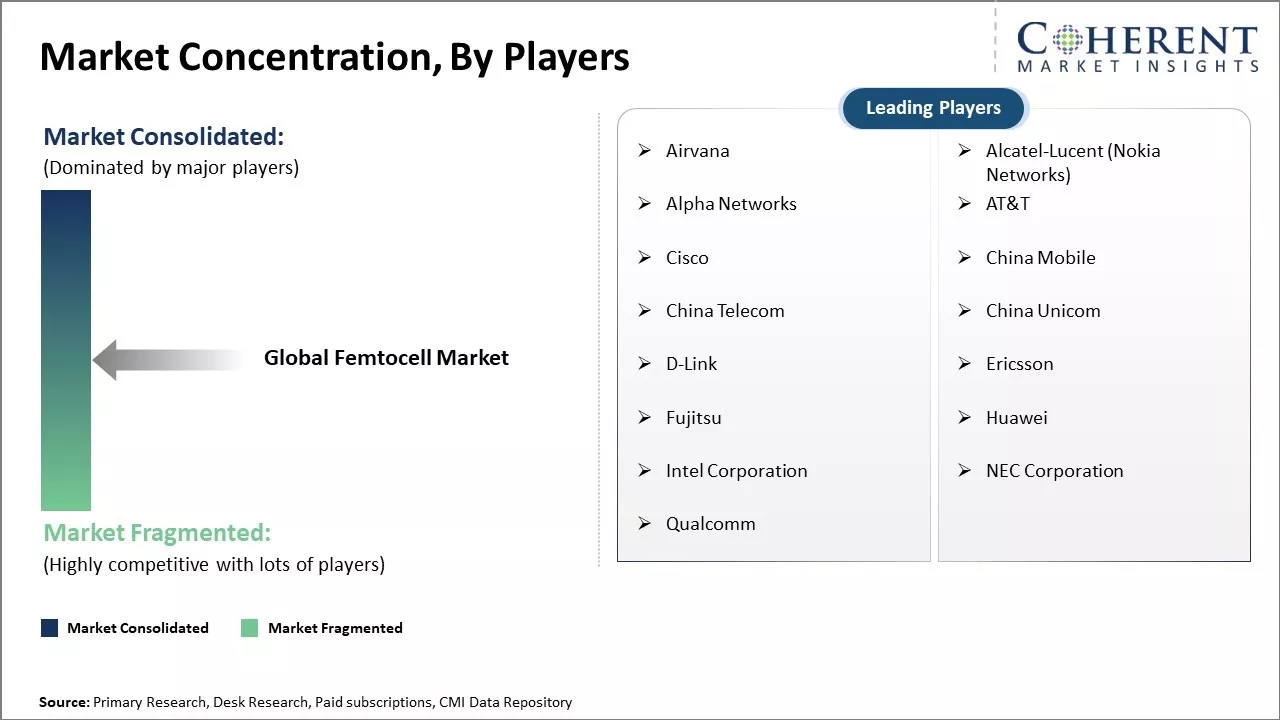
Market Concentration and Competitive Landscape
Femtocell Market Trends
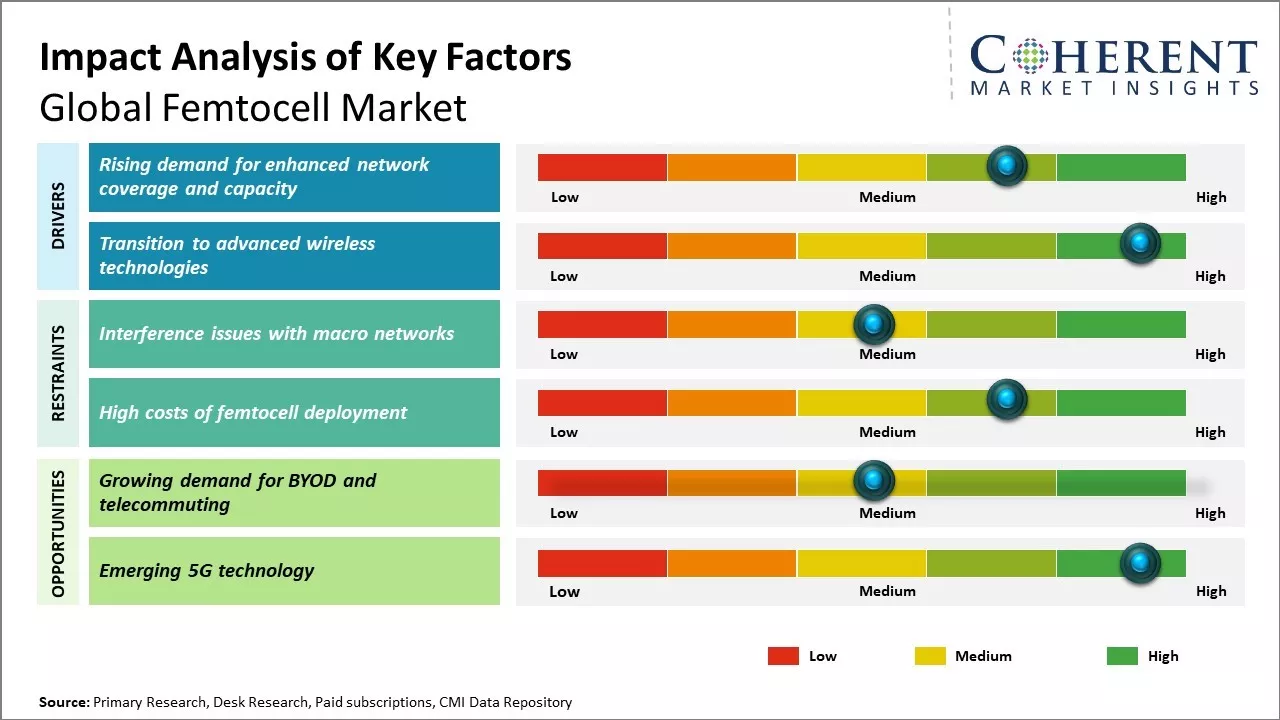
- Rising demand for enhanced network coverage and capacity
With the explosive growth of mobile data usage driven by video streaming, social media, and cloud computing, the demand for high-quality mobile networks continues to increase exponentially. Traditional microcell networks alone are finding it difficult to cope up with this surge as their coverage and capacity are limited.
On the other hand, mobile operators need to improve network performance and customer experience to retain existing subscribers and attract new ones. This is where femtocells are playing a vital role by enhancing network coverage and boosting data capacity.
Femtocells offer independent and dedicated connectivity for users in confined areas like homes and offices. Their short range allows operators to add many low-power nodes in places where coverage was poor earlier. This has helped operators tremendously in plugging network gaps and black spots that previously existed indoors.
By offloading mobile data traffic onto the femtocell network from the macros, operators are also able to reduce network congestion and free up bandwidth. As a result, users enjoy stronger indoor reception, faster data speeds, and a consistent mobile broadband experience.
For operators, femtocells translate to improved customer satisfaction, lower churn rates, and reduced infrastructure spending compared to deploying additional macros. It is therefore not surprising that major carriers globally have been aggressively deploying femtocells to meet the insatiable demand for high-speed data connectivity.
In June 2024, RCR Wireless News highlighted that Vodafone Spain and the University Polytechnic of Valencia (UPV) partnered to deploy a 5G stand-alone Open RAN femtocell network in Valencia. This academic-industry collaboration aims to support advanced 5G research and validation in compact urban environments.
- Transition to advanced wireless technologies
Another key driver for the femtocell industry growth is the ongoing migration towards newer wireless technologies that require sophisticated indoor solutions. While 4G LTE took networks to the next level, it also posed new indoor coverage challenges due to its higher penetration losses through walls and other barriers.
At the same time, users have higher expectations of superfast data speeds everywhere on their 4G devices. To address this, operators are widely adopting LTE femtocells that provide robust in-building 4G reception similar to macros. As 5G networks commence commercial rollouts over the next few years, indoor 5G small cells will become indispensable for seamless coverage indoors. 5G promises ultra-low latency along with multi-Gbps peak speeds to support mission-critical services, and indoor networks will play a key supporting role.
Consequently, all major mobile standards evolutions will continue fuelling femtocell adoption amongst network operators keen on superior indoor user experience. Vendors are also innovating new form factors, multi-technology capabilities and ease of management to help operators.
In October 2024, Telecom Ramblings reported on Axyom.Core launching the industry’s first 4G/5G dual-mode enterprise femtocell. Designed for small offices, hospitals, and retail environments, this compact device offers seamless indoor cellular coverage with both NSA and SA architectures—catering to growing demand from service providers and enterprise clients.
Challenges in the Femtocell Market
- Interference issues with macro networks
One of the major challenges restricting the expansion of the global femtocell market is interference issues with existing macro mobile networks. Femtocells operate within the same spectrum as traditional cellular networks, which means they can cause interference to macrocells and vice versa. Since femtocells have a very small coverage range of just 10 meters typically, even minor interference can disrupt voice and data services for users.
Coordination between femtocells and nearby macrocells is critical so that they do not transmit on the same channel and cause disruptions. However, achieving perfect coordination at a mass scale is still a technical challenge. This is a significant problem especially in densely populated areas where frequencies get crowded. Without proper interference management, the user experience on femtocells would be severely compromised which discourages operators and customers from adopting this technology.
Additionally, the proliferation of unmanaged or rogue femtocells poses new interference risks. Rogue devices are not connected to the operator’s network and their location and activities cannot be monitored. They threaten to interfere with authorized transmissions if not configured and installed correctly.
Opportunities in the Femtocell Market
- Growing demand for BYOD and telecommuting
The changing work dynamics have opened new opportunities for the femtocell market globally. This has pushed the need for reliable and affordable connectivity even in remote locations. Femtocells cater precisely to this rising need.
Femtocells offer cost-effective indoor cellular coverage for homes and small businesses by connecting to the internet via broadband and acting as miniature base stations. When employees work remotely, femtocells ensure seamless connectivity and call/data coverage within offices set up at home. They are proving helpful for families as well where multiple devices are used for work, online classes and entertainment simultaneously.
Segmental Insights
Global Femtocell Market Insights, By Technology
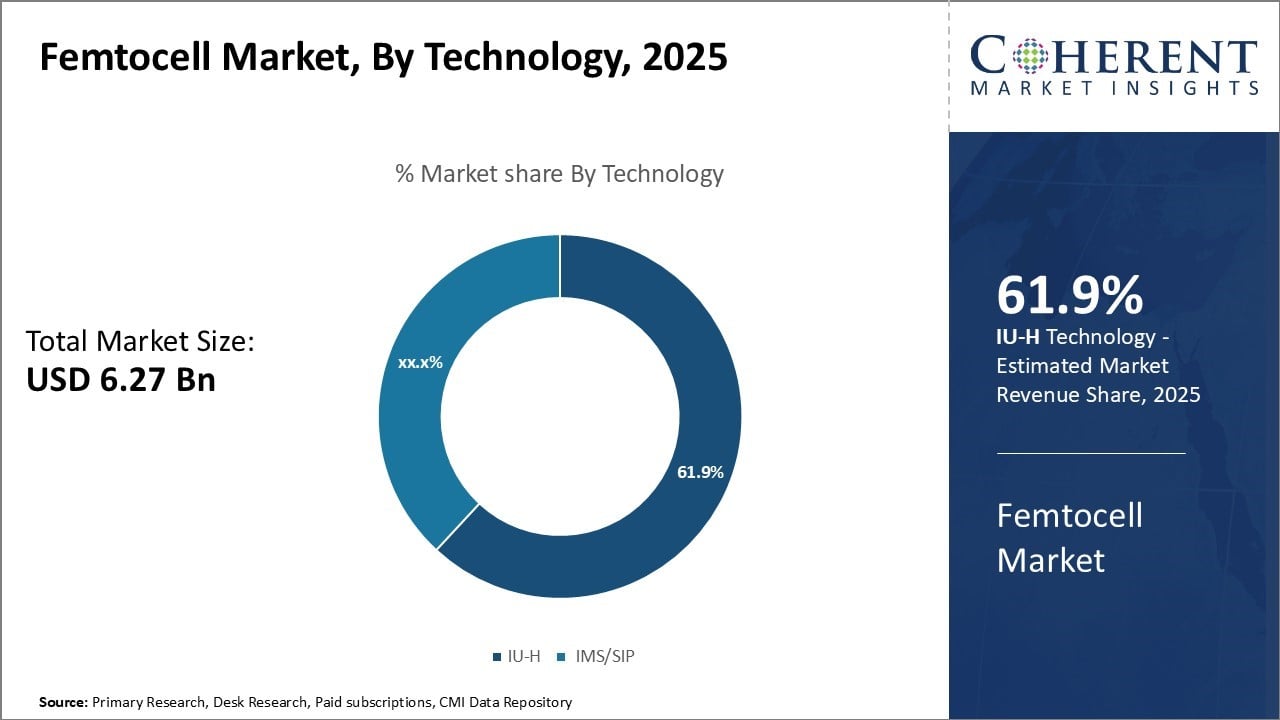
The IU-H segment is projected to dominate the global femtocell market with a substantial 62.9% share in 2026. Its widespread compatibility with existing 3G and 4G infrastructure allows for smooth integration and seamless handovers between macro and micro networks.
IU-H technology offers strong voice call quality, secure handoffs, and reliable data connectivity, making it the go-to solution for telecom operators aiming to improve indoor mobile performance.
Its high scalability and ease of deployment have led to large-scale adoption in enterprise and residential environments. As demand for enhanced indoor coverage in urban buildings, offices, and homes continues to grow, IU-H remains the preferred choice for femtocell technology, ensuring sustained dominance through 2025.
Global Femtocell Market Insights, By Type
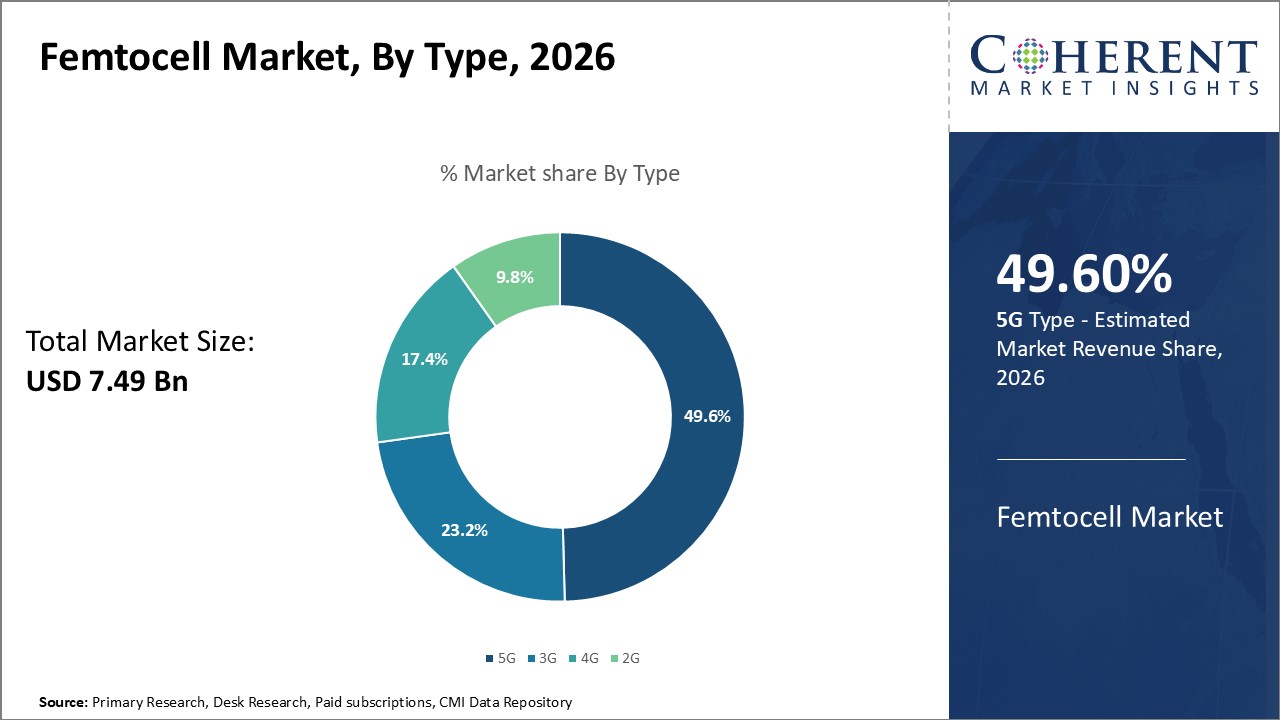
5G femtocells are expected to account for 49.6% of the femtocell market in 2026. This growth is driven by skyrocketing data consumption for high-speed applications such as UHD video streaming, online gaming, and immersive technologies like AR/VR. 5G femtocells are specifically designed to support low latency and high-capacity connections within compact areas.
With their ability to address coverage challenges in high-rise buildings, stadiums, and crowded urban locales, 5G femtocells are rapidly being deployed by operators to complement macro networks. Their role is especially critical in delivering consistent indoor 5G experiences where large towers fail to penetrate, making them an essential tool in the next-gen network ecosystem.
Global Femtocell Market Insights, By End User
The residential segment is anticipated to lead the femtocell market with a 54.2% share in 2026, propelled by rising demand for uninterrupted mobile coverage at home. As remote work, e-learning, and IoT-connected smart homes become more common, households are seeking affordable and effective indoor connectivity solutions.
Femtocells offer users the ability to boost mobile signal strength in apartments, suburban houses, and rural areas where traditional network coverage may be weak or inconsistent. With simple plug-and-play setups and operator support, residential femtocells are becoming a preferred solution for home users demanding strong and reliable broadband and voice services.
Global Femtocell Market – Regional Insights
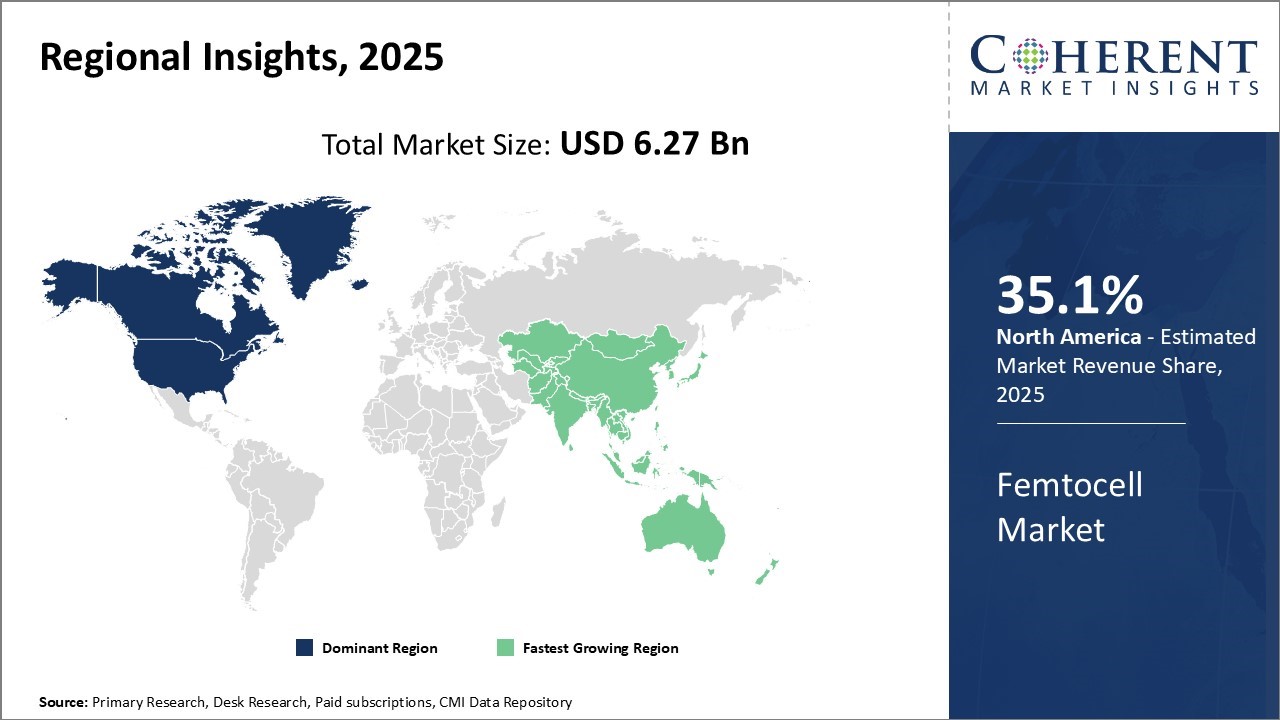
North America Femtocell Market Trends and Analysis
North America is projected to retain its leadership in the global femtocell market, accounting for an estimated 35.1% share in 2026. This dominance is underpinned by the region’s advanced telecom infrastructure, high smartphone penetration, and early adoption of 5G technologies across both urban and rural landscapes.
The U.S. and Canada host several key network operators and infrastructure providers that are actively deploying femtocell solutions to address indoor connectivity gaps and enhance service quality in underserved areas.
The rise in remote work, smart home usage, and IoT integration is fuelling the demand for seamless indoor coverage, particularly in residential and small office environments. Moreover, favourable regulatory frameworks, increased spectrum availability, and public-private partnerships aimed at closing the digital divide are accelerating the rollout of femtocell networks. As telecom providers continue to invest in small cell infrastructure and next-gen connectivity, North America remains a strategic hub for femtocell innovation and commercial adoption.
Femtocell Market Dominating Countries
United States and Canada
The United States is a frontrunner in the global femtocell market, driven by its robust telecom infrastructure, early adoption of 5G networks, and rising demand for uninterrupted indoor connectivity. U.S. telecom giants such as Verizon, AT&T, and T-Mobile are actively investing in femtocell deployments to enhance network performance in residential, enterprise, and rural environments.
The nation's emphasis on smart home integration, remote work, and IoT connectivity has further accelerated the adoption of femtocells. Additionally, favourable FCC spectrum policies, government initiatives to bridge digital gaps, and a tech-savvy consumer base ensure that the U.S. maintains its leadership in next-gen small cell technologies.
Canada complements this growth with strategic investments in broadband infrastructure and an increasing focus on enhancing rural connectivity. Canadian telecom providers like Rogers and Bell are leveraging femtocell solutions to address indoor signal challenges and improve coverage in less densely populated areas.
Government-supported programs aimed at expanding 5G networks and fostering digital inclusivity have made Canada a critical contributor to North America’s strength in the femtocell ecosystem. Combined, both nations form a powerhouse driving technological innovation, network densification, and commercial-scale adoption of femtocell solutions across the region.
Market Report Scope
Femtocell Market Report Coverage
| Report Coverage | Details | ||
|---|---|---|---|
| Base Year: | 2025 | Market Size in 2026: | USD 7.49 Bn |
| Historical Data for: | 2020 To 2024 | Forecast Period: | 2026 To 2033 |
| Forecast Period 2026 to 2033 CAGR: | 19.4% | 2033 Value Projection: | USD 25.90 Bn |
| Geographies covered: |
| ||
| Segments covered: |
| ||
| Companies covered: | Airvana, Alcatel-Lucent (Nokia Networks), Alpha Networks, AT&T, Cisco, China Mobile, China Telecom, China Unicom, D-Link, Ericsson, Fujitsu, Huawei, Intel Corporation, NEC Corporation, and Qualcomm | ||
| Growth Drivers: |
| ||
| Restraints & Challenges: |
| ||
Analyst Viewpoint – Femtocell Market
- The global femtocell market is driven by the rising demand for enhanced indoor mobile connectivity, increasing data consumption, and the rapid deployment of 5G infrastructure. As telecom operators face challenges in delivering seamless network coverage in urban high-rise buildings, rural areas, and enterprise campuses, femtocells are emerging as a critical small-cell solution.
- Experts highlight IU-H technology as a dominant segment due to its robust integration with 3G and 4G networks, enabling smooth handovers, secure connections, and broader device compatibility. The growing adoption of 5G femtocells is also reshaping the market, supported by their ability to deliver ultra-low latency and high throughput in dense environments like stadiums, offices, and smart homes.
- North America continues to lead in femtocell deployment, backed by advanced telecom infrastructure, proactive regulatory frameworks, and aggressive 5G investments. Asia Pacific is expected to follow closely, supported by expanding mobile networks and rising demand in densely populated urban centers.
- Looking ahead, analysts believe that innovation in self-organizing networks (SON), AI-based signal optimization, and integrated backhaul solutions will be key to scaling femtocell deployments. Strategic collaborations between telecom operators, infrastructure providers, and OEMs will drive future growth, particularly in hybrid connectivity environments and underserved areas.
Femtocell Market: Key Development
- In June 2025, Comba Telecom introduced a compact, energy-efficient 4G/5G femtocell tailored for homes and small offices featuring plug-and-play installation and zero-noise operation. This innovation lowers deployment barriers, enabling operators to more easily extend carrier-grade indoor coverage particularly valuable in remote work and entertainment settings while reducing energy use.
- In January 2025, Nokia partnered with Zain KSA to deploy MEA’s first 4G/5G “Smart Node” enterprise femtocell, offering plug-and-play integration with enhanced security via IP Gateway and Femto Manager. This deployment boosts indoor connectivity in enterprises across Saudi Arabia, accelerating B2B adoption of small cells and aligning with Vision 2030 infrastructure goals.
- In October 2024, Axyom.Core unveiled a dual-mode enterprise femtocell supporting both 4G and 5G NSA/SA architectures. This advancement facilitates a seamless transition to 5G for enterprises, reducing infrastructure costs and boosting indoor coverage consistency.
Market Segmentation
- By Technology (Revenue, USD Bn, 2021 - 2033)
- IU H
- IMS/SIP
- By Type (Revenue, USD Bn, 2021 - 2033)
- 2G
- 3G
- 4G
- 5G
- By End User (Revenue, USD Bn, 2021 - 2033)
- Residential
- Commercial
- Public Space
- By Region (Revenue, USD Bn, 2021 - 2033)
- North America
- U.S.
- Canada
- Latin America
- Brazil
- Argentina
- Mexico
- Rest of Latin America
- Europe
- Germany
- U.K.
- Spain
- France
- Italy
- Russia
- Rest of Europe
- Asia Pacific
- China
- India
- Japan
- Australia
- South Korea
- ASEAN
- Rest of Asia Pacific
- Middle East
- GCC Countries
- Israel
- Rest of Middle East
- Africa
- South Africa
- North Africa
- Central Africa
- North America
- Key Players Insights
- Airvana
- Alcatel Lucent (Nokia Networks)
- Alpha Networks
- AT&T
- Cisco
- China Mobile
- China Telecom
- China Unicom
- D Link
- Ericsson
- Fujitsu
- Huawei
- Intel Corporation
- NEC Corporation
- Qualcomm
Sources
The Stakeholders Consulted
- Network infrastructure engineers and telecom architects
- Manufacturers and suppliers of femtocells and small cell equipment
- Mobile Network Operators (MNOs) and Internet Service Providers (ISPs)
- Wireless standards bodies and regulatory advisors (e.g., FCC, TRAI)
- ICT consultants and 5G deployment strategists
- Public and private telecom R&D organizations
- Residential and enterprise end-users across regions adopting small cell technologies
Databases Opened
- GSMA Intelligence – Mobile Network Deployment & Usage Statistics
- International Telecommunication Union (ITU) – ICT Indicators Database
- Telecom Regulatory Authority of India (TRAI) – Telecom Performance Reports
- U.S. Federal Communications Commission (FCC) – Wireless Infrastructure Data
- OECD – Digital Economy Outlook
- SpringerLink, IEEE Xplore – Communications Technology Journals
Magazines & Trade Publications
- Light Reading – Network Infrastructure and 5G Insights
- RCR Wireless News – Telecom Equipment & Carrier Trends
- Telecom Review – Global Telecom Industry Developments
- Fierce Wireless – Small Cell and Network Innovation Reports
- Total Telecom – Operator Interviews and Deployment Announcements
Scientific and Industry Journals
- IEEE Transactions on Wireless Communications
- International Journal of Communication Systems
- Journal of Communications and Networks
- Mobile Networks and Applications (MONET)
- Telecommunication Systems
Newspapers & Media Outlets
- The Wall Street Journal – Technology & Telecom Section
- Bloomberg – Telecom & Wireless Infrastructure Updates
- Reuters – 5G Network Developments and Spectrum News
- The Economic Times – Telecom & Digital India Coverage
- Business Standard – Telecom Equipment and Infrastructure Investments
Associations and Regulatory Bodies
- International Telecommunication Union (ITU)
- 3rd Generation Partnership Project (3GPP) – Femtocell Standards
- U.S. Federal Communications Commission (FCC)
- Telecom Regulatory Authority of India (TRAI)
- Small Cell Forum (SCF)
Public Domain Sources
- U.S. National Telecommunications and Information Administration (NTIA) – Broadband Infrastructure Reports
- European Commission – Digital Connectivity and Telecom Market Reports
- World Bank – ICT Development Indicators
- GSMA Mobile Economy Reports
Proprietary Research Elements
- CMI Data Analytics Tool
- Proprietary CMI Repository of Market Data (covering past 8 years)
- CMI Expert Interviews and Transcripts (focused on small cell deployment trends, operator strategies, and 5G indoor coverage solutions)
Get access to 250+ pages report
Every segment, forecast, competitor profile and data table behind the analysis above — available for instant download.
- ESOMAR Member
- ISO 9001:2015 Certified
- D-U-N-S Registered
- GDPR & CCPA Compliant
Missing comfort of reading report in your local language? Find your preferred language:
Transform your Strategy with Exclusive Trending Reports
Frequently Asked Questions
The Femtocell Market size is estimated to be valued at USD 7.49 Bn in 2026, and is expected to reach USD 25.90 Bn by 2033.
The CAGR of the global Market is projected to be 19.4% from 2026 to 2033.
Rising demand for enhanced network coverage and capacity and transition to advanced wireless technologies are the major factors driving the growth of global femtocell industry.
Interference issues with macro networks and high costs of femtocell deployment are the major factor hampering the growth of global market.
In terms of technology, the IU-H segment is estimated to dominate the market in 2026.
Airvana, Alcatel-Lucent (Nokia Networks), Alpha Networks, AT&T, Cisco, China Mobile, China Telecom, China Unicom, D-Link, Ericsson, Fujitsu, Huawei, Intel Corporation, NEC Corporation, and Qualcomm are the major players.
North America is expected to lead the global femtocell industry.