

Smart Retail Market Size and Trends – 2026-2033
The global smart retail market is estimated to be valued at USD 49.60 Bn in 2026. The market is expected to reach USD 251.32 Bn by 2033, expand at a compound annual growth rate (CAGR) of 26.1% from 2026 to 2033.
Key Takeaways of the Smart Retail Market
- Based on Solution, the Hardware segment is expected to account for 51.8% of the market share in 2026, owing to its effectiveness in optimizing inventory management.
- By Technology, the IoT Solutions segment is expected to capture 45% share of the smart retail market in 2026, driven by the demand for enhanced operational efficiency.
- On the basis of Application, the Inventory Management segment is expected to accounts for 40.1% of the market share in 2026, as it forms the core for elevating the overall customer experience.
- North America is projected to lead the global market with a 36.0% share in 2026, followed by the Asia Pacific region, which is expected to hold a 31.3% share
Market Overview
The introduction of advanced technologies such as artificial intelligence, Internet of Things (IoT), and predictive analytics has boosted the smart retail market growth. Increasing number of companies in the retail supply chain are using digital solutions. AI and the Internet of Things (IoT) make it possible for physical stores to offer automated product recommendations, digital payment options, and personalized shopping experiences. Many stores are investing in digitization to stay competitive in the changing retail world and bring in more customers with an omnichannel experience.
Current Events and Its Impact
Current Event | Description and its Impact |
AI and Machine Learning Technology Advancement (Macro-Level) |
|
Economic Pressures and Investment Climate (Macro-Level) |
|
Role of AI (Artificial Intelligence) in Smart Retail Industry
As artificial intelligence becomes a big part of smart retail operations, the retail landscape is going through a huge change. AI is changing the way stores do business and how people shop, making stores more efficient, responsive, and easy to use. For example, AI can help stores manage their inventory on its own and give customers personalized shopping experiences.
For instance, in September 2024, Huawei unveiled its smart retail solution at the session themed AI unlocks new retail growth. Over 500 experts, partners, and leading companies from retail and logistics discussed how intelligent innovation can boost value growth and shared how they applied AI to business scenarios.
- Current Industry Events of 2026
- Market Size Estimation
- Regional Breakdown
- Competitive Landscape
- Customer Intelligence
- Segmental Analysis
- Pricing Analysis
- Key Market Drivers, Challenges & Future Trends
- Customized Insights Section
Segmental Insights
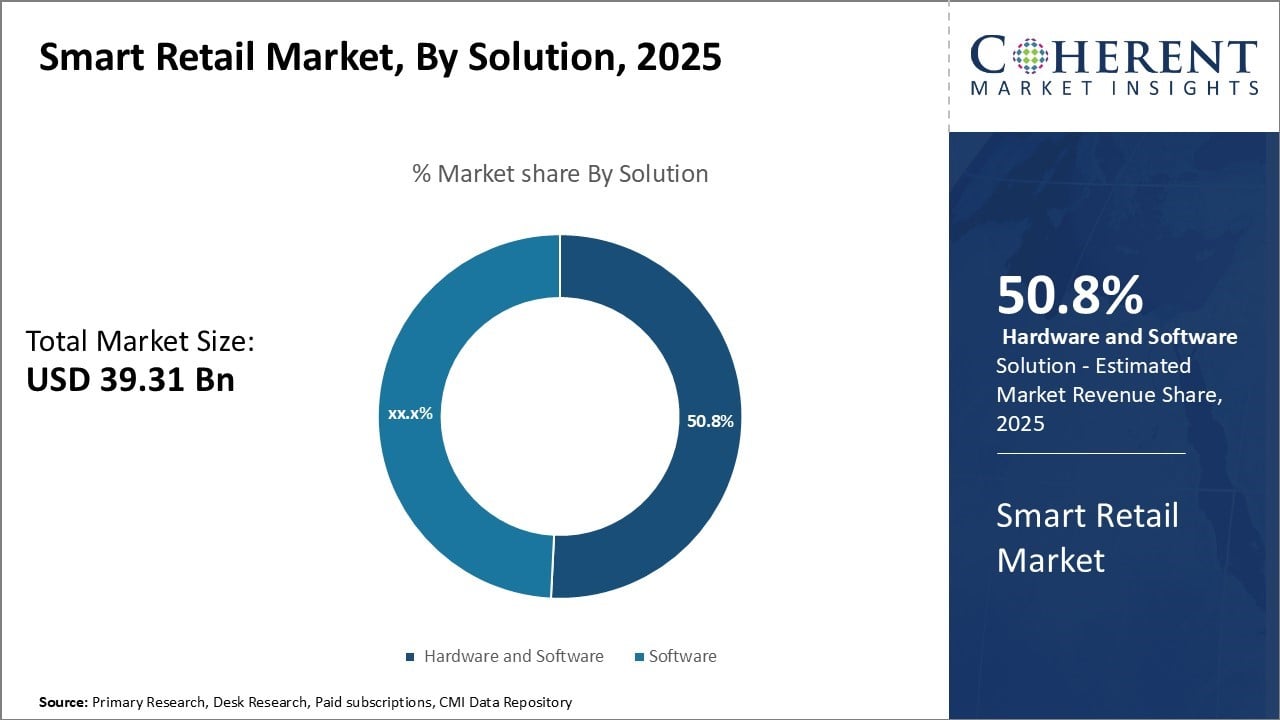
Smart Retail Market Insights, by Solution - Efficiency and cost-effectiveness drive the dominance of hardware in solutions
In terms of solution, the hardware segment is expected to contributes 51.8% share of the market in 2026, owing to its effectiveness in optimizing inventory management and supply chain operations.
Retailers can keep track of their stock levels and automate the process of restocking with hardware solutions like Radio Frequency Identification (RFID) tags, beacons, and electronic shelf labels. This lets you see your inventory in real time across all of your stores and warehouses. There are fewer times when items are out of stock, more times when they are filled, and no times when they are overstocked.
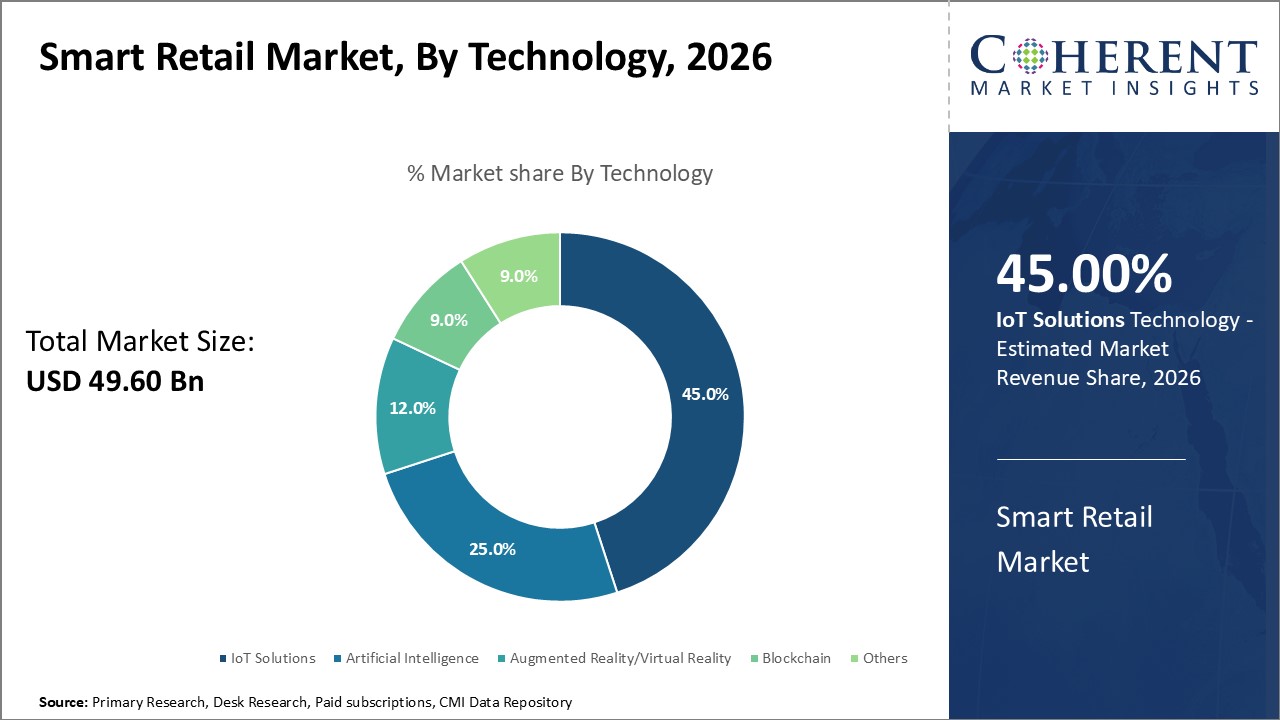
Smart Retail Market Insights, by Technology - Key technologies driving operational efficiency and real-time inventory management in smart retail
In terms of technology, the IoT solutions segment is expected to hold a commanding 45% share of the market in 2026, driven by the demand for enhanced operational efficiency and real-time inventory management.
Key technologies like RFID, electronic shelf labels (ESLs), and automated conveyor systems make it easy for physical inventory to connect to digital platforms. These new technologies help stores keep track of their inventory across many channels, forecast demand trends, make the best use of their stock, and cut down on waste.
For instance, in March 2024, Huawei and SOLUM unveiled a built-in Internet of Things (IoT) solution for the retail industry at Huawei's special session titled "Digital and Intelligent Innovation Unlocks New Retail Growth".
Smart Retail Market Insights, by Application - Enhanced customer experience through inventory management applications
In terms of application, the inventory management segment is expected to contribute 40.1% share of the market in 2026, as it forms the core for elevating the overall customer experience. Technology-enabled inventory applications help achieve critical front-end objectives. Real-time visibility prevents out-of-stocks and enables stores to have demanded variants at all times.
Regional Insights
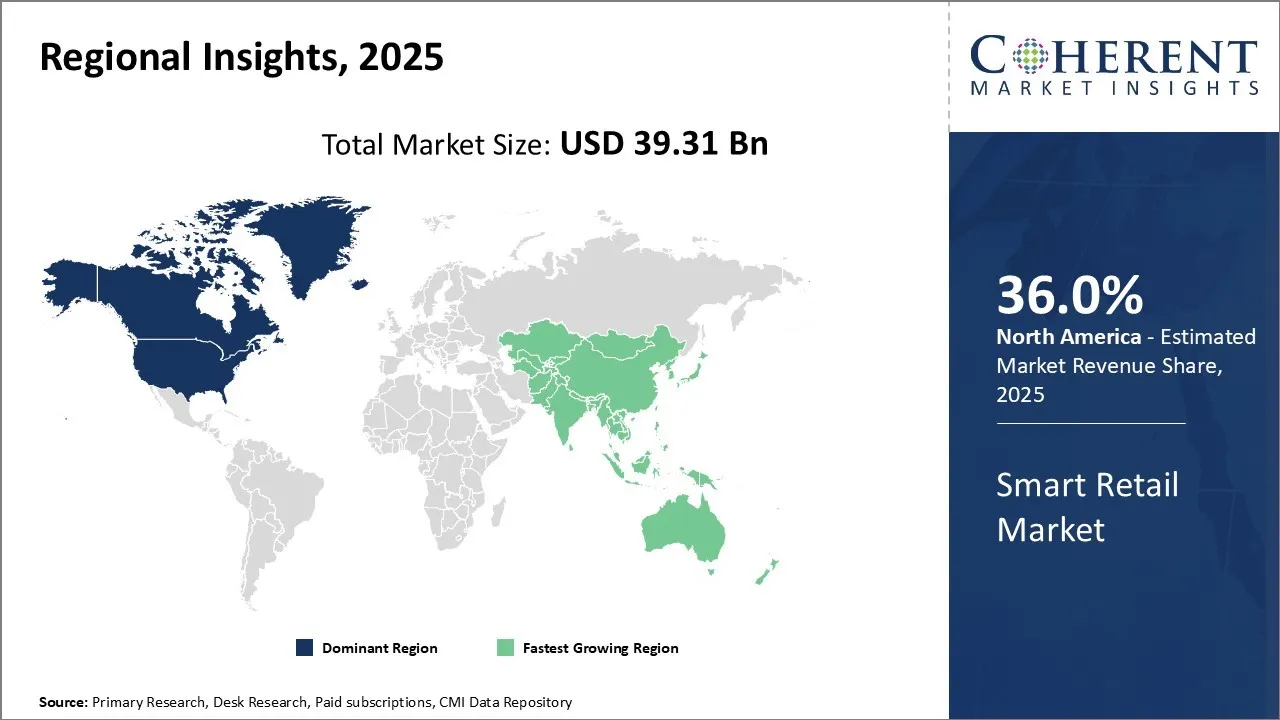
North America Smart Retail Market Trends
North America is projected to dominate the market with a 36.0% share in 2026. This leadership can be attributed to supportive government initiatives encouraging the digital transformation of conventional retail outlets. The widespread adoption of IoT-enabled technologies by major retailers in the region has significantly improved customer experiences and streamlined operational efficiency.
For instance, in June 2026, VenHub Global, Inc. unveiled its flagship smart store at the LAX/Metro Transit Center at Los Angeles International Airport.
Asia Pacific Smart Retail Market Trends
Asia Pacific region is expected to capture a 31.3% market share in 2026, marking the fastest growth rate globally. Driven by countries such as China, India, and Japan, the region's rapid expansion is fueled by growing internet and mobile connectivity. Local companies such as Zebra Technologies Corporation are developing tailored solutions to meet the unique needs of the region's diverse market landscape.
For instance, in June 2026, Hanshow made a notable appearance at NRF APAC 2026: Retail’s Big Show Asia Pacific.
Smart Retail Market Outlook for Key Countries
U.S. Smart Retail Market Trends
The U.S. is a leader in the smart retail market, driven by the rapid adoption of advanced technologies like AI and IoT. In June 2026, VenHub Global, Inc., a pioneer in AI-driven, fully autonomous retail solutions, launched its flagship Smart Store at the LAX/Metro Transit Center near Los Angeles International Airport. Designed to offer secure, seamless, and fully automated shopping, the Smart Store delivers next-generation retail convenience to the millions of travelers and commuters passing through Los Angeles annually. This initiative reflects the growing demand for seamless shopping experiences in the U.S. smart retail market.
China Smart Retail Market Trends
China is leveraging big data analytics and intelligent systems to enhance customer engagement. In March 2023, Alibaba introduced a new AI-driven retail solution aimed at improving inventory management and customer experience, highlighting the trend of technology integration in retail.
Germany Smart Retail Market Trends
Germany is witnessing significant growth in smart retail, primarily due to increasing consumer demand for personalized shopping experiences. In January 2024, SAP announced a partnership with various retailers to implement smart retail solutions that utilize real-time data analytics, enhancing operational efficiency and customer satisfaction. This collaboration underscores the trend of leveraging data for improved retail strategies.
India Smart Retail Market Trends
India smart retail market is on the rise, driven by the increasing penetration of smartphones and digital payment solutions. In May 2022, Amazon launched Smart Commerce, a new offering that will allow stores to create their own online storefronts and also offer in-store shopping experience to their walk-in customers.
Japan Smart Retail Market Trends
Japan is rapidly adopting smart retail technologies, with a focus on enhancing customer experiences through automation and AI. In August 2026, FPT Corporation and Smart Holdings Co., Ltd. established FPT Smart Technologies Japan (FST-Japan), a joint venture headquartered in Nagoya. The partnership combines FPT’s global technology expertise with Smart Holdings’ deep industry knowledge to advance digital transformation across Japan’s manufacturing sector, with an initial focus on the automotive industry.
Market Players, Key Development, and Competitive Intelligence
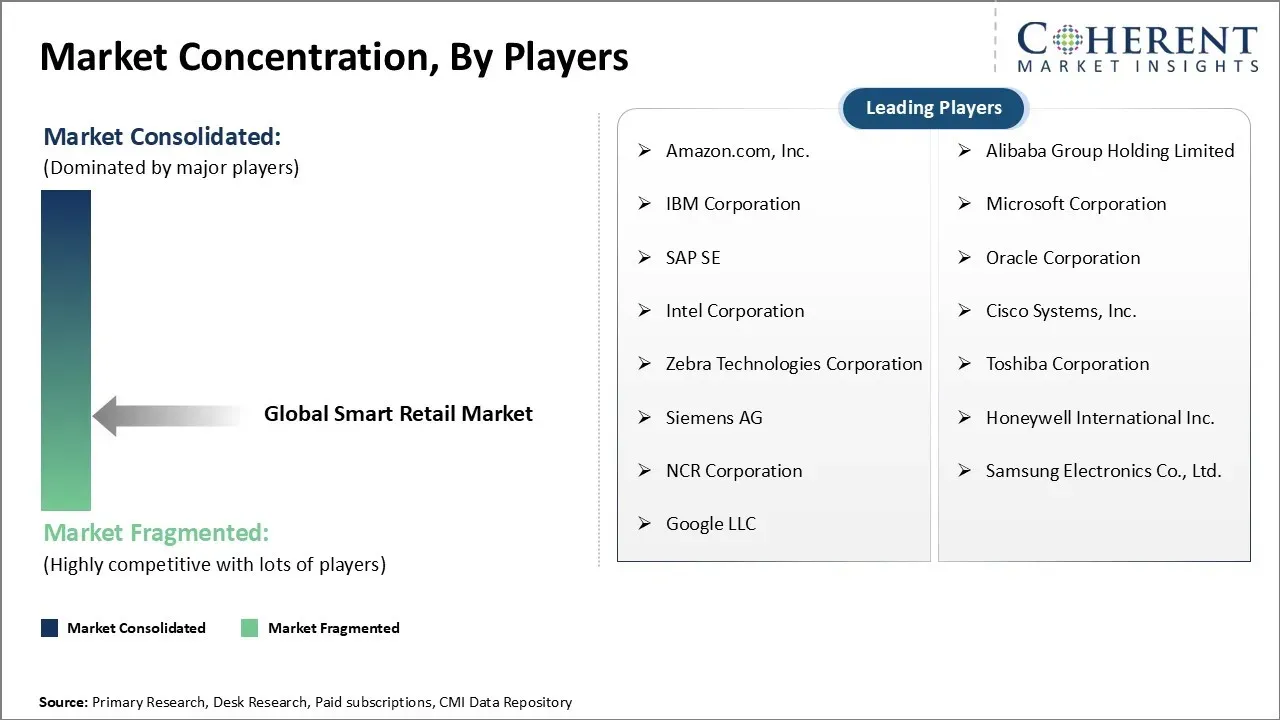
Key Developments
- In June 2025, Swedish sports retailer Stadium, which has around 180 stores, announced a full update of its digital in-store communication strategy.
- May 2024, Wipro Limited, announced significant upgrades to its Wipro VisionEDGE+ solution. Designed to enhance its capabilities in the retail sector, the improved platform focuses on driving retail transformation and maximizing the potential of retail media networks.
Market Report Scope
Smart Retail Market Report Coverage
| Report Coverage | Details | ||
|---|---|---|---|
| Base Year: | 2025 | Market Size in 2026: | USD 49.60 Bn |
| Historical Data for: | 2020 To 2024 | Forecast Period: | 2026 To 2033 |
| Forecast Period 2026 to 2033 CAGR: | 26.1% | 2033 Value Projection: | USD 251.32 Bn |
| Geographies covered: |
| ||
| Segments covered: |
| ||
| Companies covered: | Amazon.com, Inc., Alibaba Group Holding Limited, IBM Corporation, Microsoft Corporation, SAP SE, Oracle Corporation, Intel Corporation, Cisco Systems, Inc., Zebra Technologies Corporation, Toshiba Corporation, Siemens AG, Honeywell International Inc., NCR Corporation, Samsung Electronics Co., Ltd., and Google LLC | ||
| Growth Drivers: |
| ||
| Restraints & Challenges: |
| ||
Market Dynamics
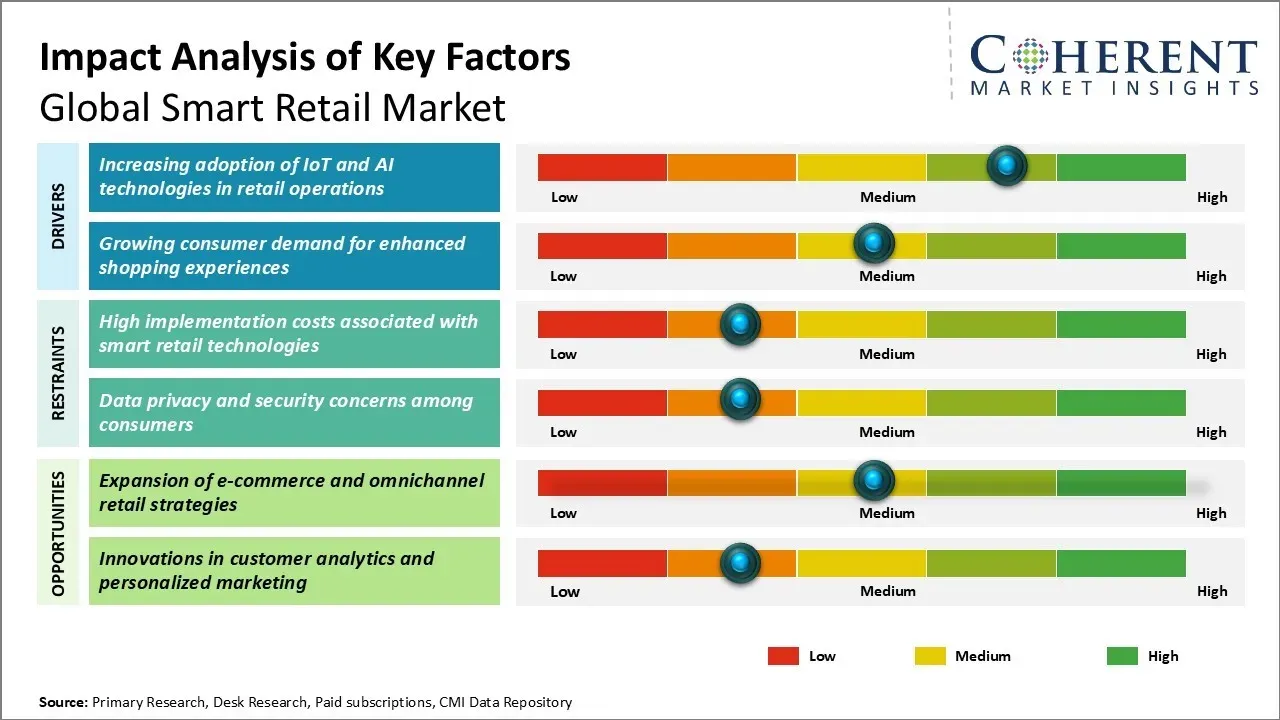
Smart Retail Market Growth Factors
Increasing adoption of IoT and AI technologies in retail operations
The retail sector has seen a gradual rise in the use of emerging technologies such as Internet of Things (IoT) and Artificial Intelligence (AI) in their day-to-day operations over the past few years. IoT enables retailers to gather real-time data from various store assets like shelves, refrigerators, CCTV cameras, etc. This data helps retailers gain insights into customer shopping habits, plan their inventory better, optimize store layout, and improve customer experiences inside the store.
Smart Retail Market Opportunity - Expansion of e-commerce and omnichannel retail strategies
One of the major opportunities for growth in the market is the continued expansion of e-commerce and omnichannel retail strategies. Consumers are increasingly comfortable shopping online and using digital devices throughout the buying process. They expect a seamless shopping experience both in-store and online, with centralization of products, pricing and customer data.
Analyst Opinion (Expert Opinion)
- Rapid adoption of automation technologies across the retail sector is a major driver for this market. Retailers are increasingly automating their stores and supply chains to improve operational efficiencies and enhance customer experience. The growing demand for personalized shopping is also propelling retailers to invest in smart technologies like digital signage, beacons, and IoT.
- North America currently dominates the smart retail market due to high technology adoption. However, Asia Pacific is expected to be the fastest growing region owing to rapidly expanding retail industries in countries like India and China.
- Retailers need to ensure customer data collected through various digital touchpoints is kept private and secure. Lack of common IoT standards is another restraint as it limits interoperability of devices and platforms from different vendors. However, partnerships between retailers and technology providers present opportunities to overcome such restraints. Collaboration between industry players will help define IoT protocols and drive innovation.
Speak to the analyst
Want personalized insights?
Take the findings above to one of our principal consultants, or have the report rebuilt around the segments, geographies and competitors you actually track.
Market Segmentation
- By Solution Insights (Revenue, USD Bn, 2021 - 2033)
- Hardware
- Software
- By Technology Insights (Revenue, USD Bn, 2021 - 2033)
- IoT Solutions
- Artificial Intelligence
- Augmented Reality/Virtual Reality
- Blockchain
- Others
- By Application Insights (Revenue, USD Bn, 2021 - 2033)
- Inventory Management
- Visual Marketing
- Smart Label
- Smart Payment System
- Others (Robotics, Analytics)
- Regional Insights (Revenue, USD Bn, 2021 - 2033)
- North America
- U.S.
- Canada
- Latin America
- Brazil
- Argentina
- Mexico
- Rest of Latin America
- Europe
- Germany
- U.K.
- Spain
- France
- Italy
- Russia
- Rest of Europe
- Asia Pacific
- China
- India
- Japan
- Australia
- South Korea
- ASEAN
- Rest of Asia Pacific
- Middle East
- GCC Countries
- Israel
- Rest of Middle East
- Africa
- South Africa
- North Africa
- Central Africa
- Key Players Insights
- Amazon.com, Inc.
- Alibaba Group Holding Limited
- IBM Corporation
- Microsoft Corporation
- SAP SE
- Oracle Corporation
- Intel Corporation
- Cisco Systems, Inc.
- Zebra Technologies Corporation
- Toshiba Corporation
- Siemens AG
- Honeywell International Inc.
- NCR Corporation
- Samsung Electronics Co., Ltd.
- Google LLC
Sources
Primary Research interviews
- Smart retail technology vendors and solution providers
- Retail chain executives and store managers
- IoT and AI technology integrators
- E-commerce platform developers
- Others
Databases
- Euromonitor International
- IBISWorld Industry Reports
- Bloomberg Terminal
- Others
Magazines
- Retail Dive
- Chain Store Age
- Progressive Grocer
- Store Brands Magazine
- Others
Journals
- Journal of Retailing and Consumer Services
- International Journal of Retail & Distribution Management
- Journal of Business Research
- Others
Newspapers
- The Wall Street Journal
- Financial Times
- Reuters Business News
- The New York Times Business Section
- Others
Associations
- National Retail Federation (NRF)
- Retail Industry Leaders Association (RILA)
- Global Association for the Future of Retail Technology
- International Council of Shopping Centers (ICSC)
- Others
Public Domain sources
- U.S. Census Bureau Economic Indicators
- European Commission Digital Economy Reports
- World Bank Global Economic Prospects
- OECD Digital Economy Outlook
- Others
Proprietary Elements
- CMI Data Analytics Tool, Proprietary CMI Existing Repository of information for last 8 years
Get access to 250+ pages report
Every segment, forecast, competitor profile and data table behind the analysis above — available for instant download.
- ESOMAR Member
- ISO 9001:2015 Certified
- D-U-N-S Registered
- GDPR & CCPA Compliant
Missing comfort of reading report in your local language? Find your preferred language:
Transform your Strategy with Exclusive Trending Reports
Frequently Asked Questions
The smart retail market is estimated to be valued at US$ 49.60 Bn in 2026, and is expected to reach US$ 251.32 Bn by 2033.
The CAGR of the smart retail market is projected to be 26.1% from 2026 to 2033.
Increasing adoption of IoT and AI technologies in retail operations and growing consumer demand for enhanced shopping experiences are the major factors driving the growth of the global smart retail market.
High implementation costs associated with smart retail technologies and data privacy and security concerns among consumers are the major factors hampering the growth of the global smart retail market.
In terms of solution, hardware segment is estimated to dominate the market revenue share in 2026.
Amazon.com, Inc., Alibaba Group Holding Limited, IBM Corporation, Microsoft Corporation, SAP SE, Oracle Corporation, Intel Corporation, Cisco Systems, Inc., Zebra Technologies Corporation, Toshiba Corporation, Siemens AG, Honeywell International Inc., NCR Corporation, Samsung Electronics Co., Ltd., ajnd Google LLC are the major players.
North America is expected to lead the global smart retail market in 2026.