

PropTech Market Size and Forecast – 2026 to 2033
Global PropTech market is estimated to be valued at USD 51.70 Bn in 2026 and is expected to reach USD 139.21 Bn by 2033, exhibiting a compound annual growth rate (CAGR) of 15.2% from 2026 to 2033.
Key Takeaways
- Based on Property Type, the Commercial segment is expected to dominate the market with 57% share in 2026, due to their scale, complexity, and demand for smart solutions.
- Based on Deployment, the Cloud-Based segment is projected to account for the highest share of the market in 2026, due to its flexibility, scalability, and cost-efficiency.
- Based on End User, the Property Owners segment is projected to hold the highest share of the market in 2026, as they use digital tools to optimize asset performance, forecast returns, and streamline operations.
- Based on Region, North America is expected to lead the market, holding a share of 38.6% in 2026. While, Asia Pacific is anticipated to be the fastest growing region.
Market Overview
PropTech refers to technology solutions applied to the real estate industry and encompasses a wide range of software and services including asset management, brokerage, facility management and transaction platforms among others. The market growth is driven by growing need for more efficient management of real estate assets and operations as well as rising adoption of digital technologies across the industry.
The market growth is driven by factors such as increasing digitization and automation of building systems, rising need to enhance tenant experience and operational efficiency, and growing demand for data-driven insights in real estate decision making. Furthermore, growing development of smart building technologies such as IoT, AI and cloud-based platforms boosts investments and innovations inPropTech solutions.
Current Events and Its Impact
Current Event | Description and its Impact |
Global Central Bank Monetary Policy Divergence |
|
Artificial Intelligence Integration Acceleration |
|
Role of Artificial Intelligence (AI) in Proptech Market
Artificial Intelligence plays a transformative role in the PropTech market, serving as the backbone of innovation across the real estate value chain. It enables predictive analytics for portfolio optimization, allowing developers and asset managers to anticipate tenant churn, forecast market trends, and automate maintenance schedules. AI agents have replaced traditional chatbots, offering context-aware, human-like interactions that streamline leasing, support, and tenant engagement. In investment analysis, AI delivers hyper-personalized property recommendations and risk assessments, significantly reducing due diligence time. Smart building operations are increasingly powered by AI-integrated IoT systems, optimizing energy usage, climate control, and space utilization—often resulting in energy savings of up to 30%.
For instance, in June 2025, UAE-based Prop-AI secured $1.5 million in pre-seed funding led by Plus VC, with support from Joa Capital, Oraseya Capital, and others. Founded in 2023, the AI-powered platform automates property search and investment decisions. The capital will fuel regional expansion, enterprise tools, and advanced agentic AI for real estate.
- Current Industry Events of 2026
- Market Size Estimation
- Regional Breakdown
- Competitive Landscape
- Customer Intelligence
- Segmental Analysis
- Pricing Analysis
- Key Market Drivers, Challenges & Future Trends
- Customized Insights Section
Segmental Insights
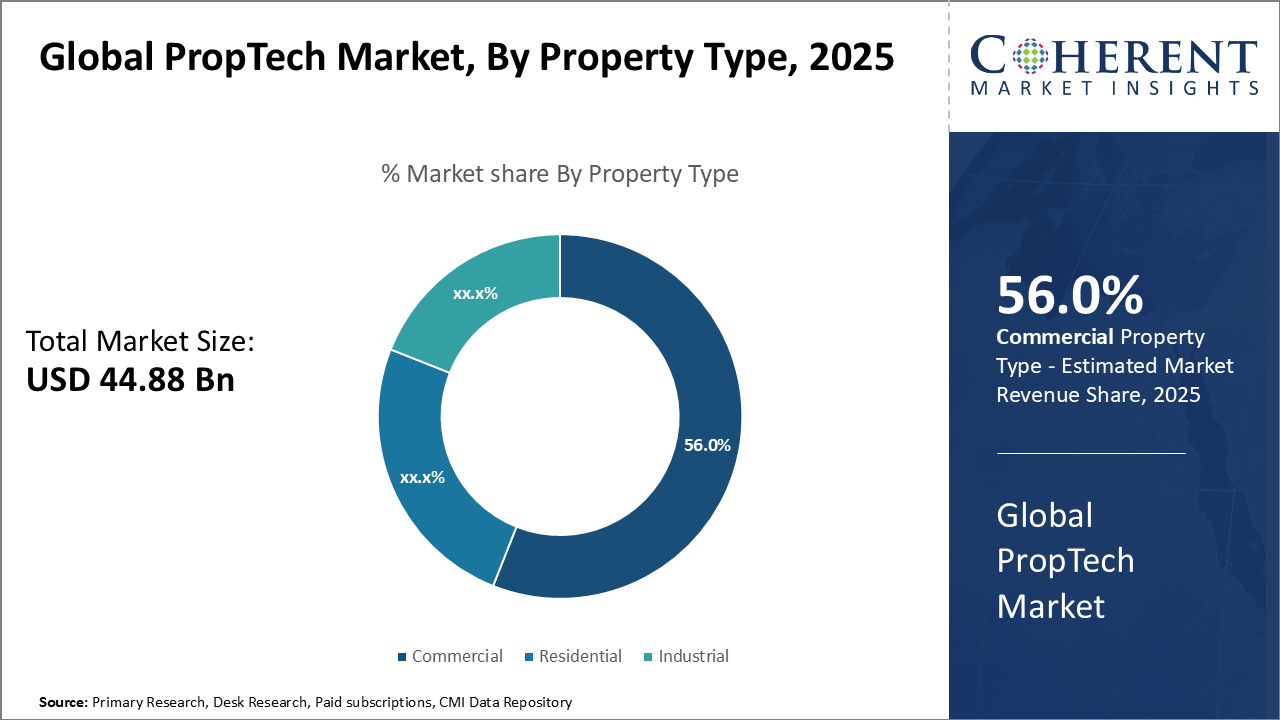
PropTech Market Insights, By Property Type - Commercial Leads Due To Its Demand for Smart Infrastructure and Operational Efficiency
In terms of property type, the commercial segment is expected to lead the market with a 57% share in 2026, due to their scale, complexity, and demand for smart solutions. Offices, retail spaces, and mixed-use developments increasingly rely on automation, analytics, and tenant experience platforms, driving innovation and investment. Their higher ROI potential and operational needs make them prime targets for Proptech integration.
For instance, in September 2026, Qiddiya Investment Company selected Yardi’s cloud-based real estate platform to enhance its commercial property operations. Announced on September 10, 2025, the partnership supports Qiddiya’s digital transformation as it develops a 360-square-kilometre entertainment, sports, and cultural destination near Riyadh, aligning with Saudi Arabia’s Vision 2030 goals.
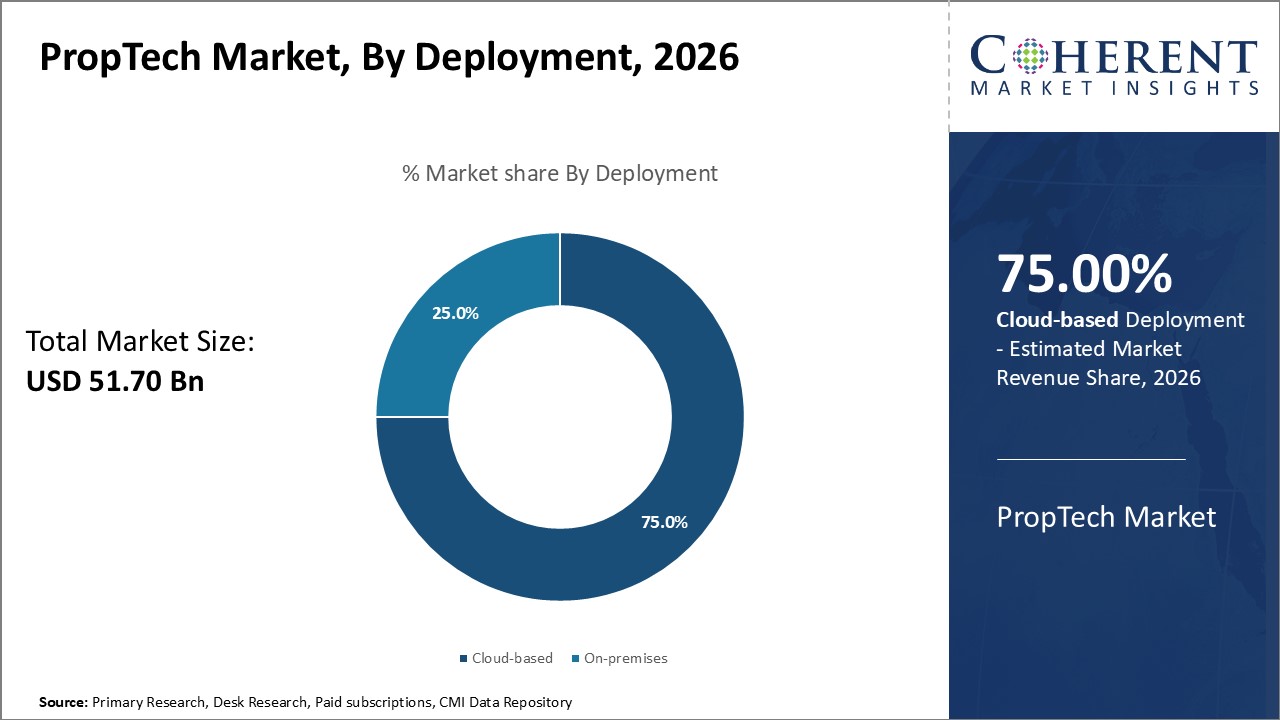
PropTech Market Insights, By Deployment - Cloud-Based Dominate for Their Scalability, Remote Access, And Seamless Integration with Emerging Technologies
In terms of deployment, the cloud-based segment is projected to account for the highest share of the market in 2026, due to its flexibility, scalability, and cost-efficiency. It enables real-time data access, remote property management, and seamless integration with IoT and AI tools. As Proptech evolves, cloud platforms empower stakeholders to make faster decisions, reduce infrastructure costs, and adapt to changing tenant and investor expectations.
PropTech Market Insights, By End User - Property Managers/ Agents Drive Proptech Growth by Leveraging Digital Tools to Maximize Asset Value and Investment Return
In terms of end user, the property managers/ agents segment is expected to capture the largest share of the market in 2026, as they use digital tools to optimize asset performance, forecast returns, and streamline operations. With growing portfolios and rising competition, owners leverage Proptech to gain insights, reduce vacancies, and enhance property value, making them central players in the tech-driven transformation.
For instance, in July 2026, JLL launched its Technology Advisory services in Thailand, targeting smart building and Smart City projects across Southeast Asia. Led by Adam Stark, the cloud-enabled platform helps property stakeholders tackle data fragmentation, sustainability goals, and rising operational costs through integrated digital strategies, enhancing asset performance and tenant experience.
Regional Insights
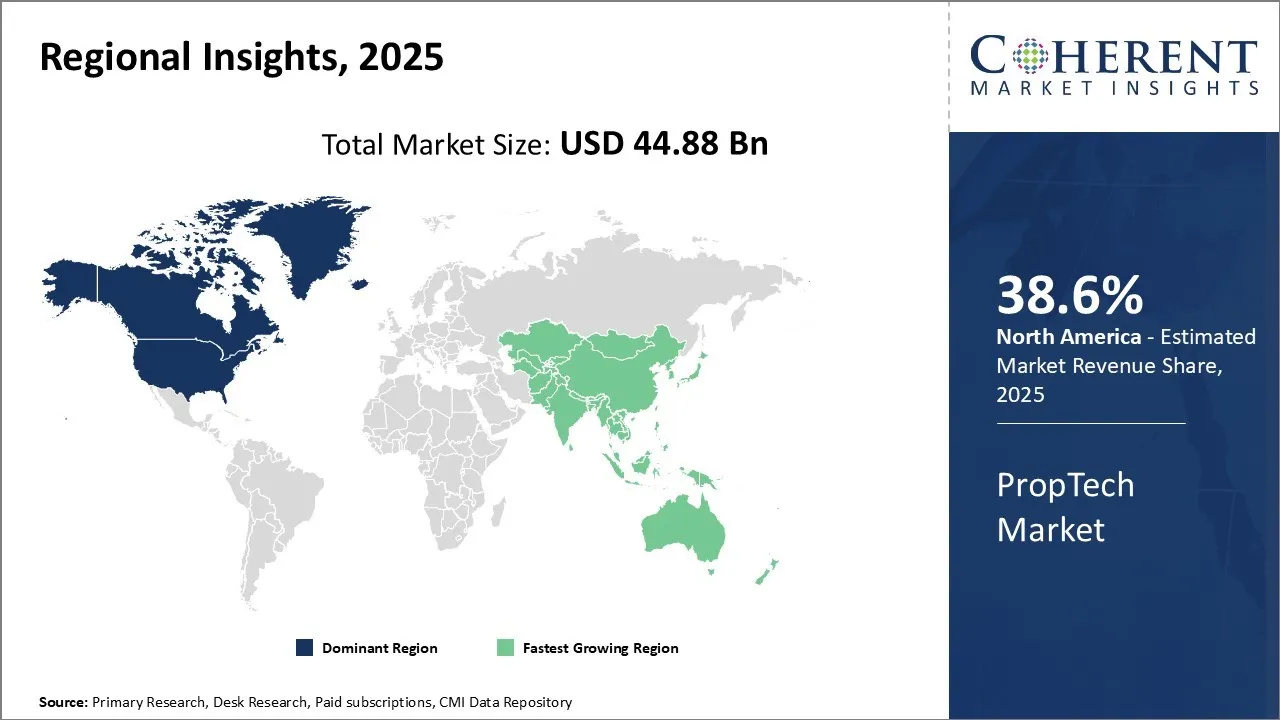
North America PropTech Market Analysis & Trends
North America dominates global PropTech market. The region is expected to account for highest market share of 38.6% in 2026. With widespread digitalization and growing startup culture, the U.S., in particular, has emerged as the innovation hub for new PropTech solutions. Major real estate companies and property developers in the region have keen interest in partnering with startups and adopting new technologies. Moreover, significant venture capital funding in the region has supported the growth of young PropTech companies. The presence of major technology companies has also boosted research and development activities.
For instance, in July 2026, Lone Wolf Technologies launched PropTech Pulse, a bi-monthly podcast delivering real estate technology insights in 20-minute episodes. Hosted by industry leaders, the cloud-based series explores digital strategies, marketing tools, and emerging trends—offering actionable guidance for brokers, PropTech entrepreneurs, and MLS executives navigating the fast-evolving real estate landscape.
Asia Pacific PropTech Market Analysis & Trends
Asia Pacific has been fastest growing regional market for PropTech. Rapid urbanization and growing smartphone penetration have made the consumers more tech-savvy. The governments are also actively supporting startups through various policy initiatives to boost technology adoption. Significant funding from venture capital firms is focused on boosting innovation in real estate sector of the region. Large developers and brokers in major cities have started exploring new ways to embrace technologies to enhance customer experience. Growing construction industry fueled by smart city projects can offer more opportunities for construction tech solutions. Countries like Singapore and Australia are leading adoption whereas India and China offer high growth potential.
For instance, in August 2026, S P Setia and Antler Ibex launched the Setia AI & PropTech Innovation Challenge, under Malaysia’s BIG Programme. Open to global startups, the initiative seeks scalable AI-driven solutions for inclusive homeownership and construction quality, aligning with the MADANI agenda to foster sustainable, tech-enabled housing development.
PropTech Market Outlook Country-Wise
The U.S. PropTech Market Trends
The United States continues to lead global PropTech demand, driven by deep venture capital networks, regulatory clarity, and rapid enterprise adoption of AI and cloud platforms. From predictive leasing to blockchain-based transactions, U.S. firms are redefining real estate operations. Major cities like New York and San Francisco remain hubs for innovation, attracting talent and capital across residential, commercial, and industrial segments.
For instance, in September 2026, VTS has launched VTS AI, a cloud-powered platform enhancing real estate workflows with generative and agentic AI. The solution streamlines leasing proposals, delivers market insights, and automates work orders, saving over 25,000 hours annually and transforming property operations across commercial asset classes.
India PropTech Market Trends
India’s PropTech market is rapidly evolving, driven by urbanization, digital-first consumer behavior, and regulatory innovation. Platforms like Realdom India are pioneering fractional ownership and blockchain-based property transactions, supported by regulatory sandboxes such as GIFT City. With over 1.1 billion smartphone connections and rising millennial demand, digital real estate solutions are reshaping property search, leasing, and investment across urban and semi-urban regions.
For instance, in May 2026, Punjab Governor Gulab Chand Kataria unveiled MrProptek, the world’s first AI-powered property booking app, developed by 23-year-old Aagman Bhatia. The cloud-based platform streamlines real estate transactions, aligning with India’s Digital vision and showcasing the region’s growing influence in global PropTech innovation.
Market Report Scope
PropTech Market Report Coverage
| Report Coverage | Details | ||
|---|---|---|---|
| Base Year: | 2025 | Market Size in 2026: | USD 51.70 Bn |
| Historical Data for: | 2020 To 2024 | Forecast Period: | 2026 To 2033 |
| Forecast Period 2026 to 2033 CAGR: | 15.2% | 2033 Value Projection: | USD 139.21 Bn |
| Geographies covered: |
| ||
| Segments covered: |
| ||
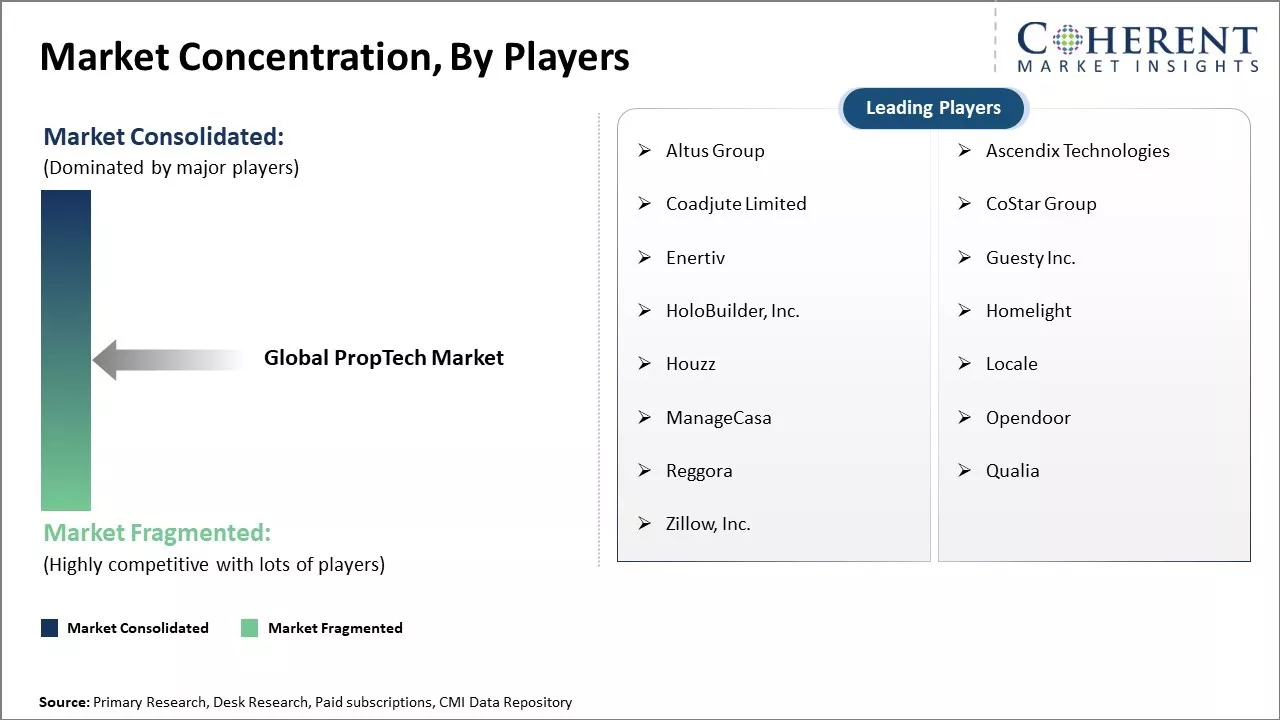
| Companies covered: | Altus Group, Ascendix Technologies, Coadjute Limited, CoStar Group, Enertiv, Guesty Inc., HoloBuilder, Inc., Homelight, Houzz, Locale, ManageCasa, Opendoor, Reggora, Qualia, and Zillow, Inc. | ||
| Growth Drivers: |
| ||
| Restraints & Challenges: |
| ||
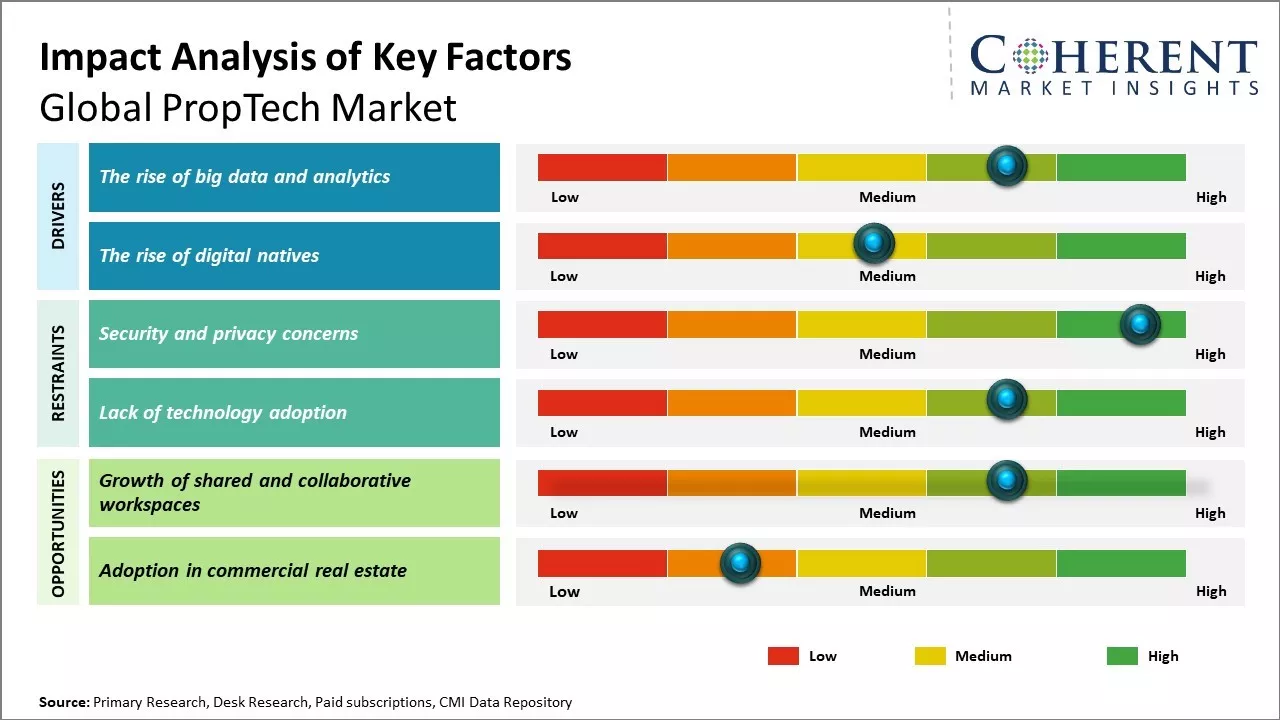
PropTech Market Driver
Rise of big data and analytics
With more and more connected devices, sensors and digitization of everything, petabytes of data are being created on a daily basis. This data holds valuable insights that can help optimize operations, predict trends and understand customer behavior better than ever. Property and real estate companies leverage this data deluge through advanced analytics to drive key business decisions from marketing and sales to maintenance and facility management. Technologies like predictive analytics help to assess customer propensities, likelihood of defaults and move outs. Data driven approaches are improving buyer matching, listings personalization as well as predictive maintenance of physical assets. Several proptech startups are providing big data solutions tailored for real estate needs. Property managers are using IoT sensors and AI to remotely monitor properties for optimal performance. Availability of data and capabilities of advanced analytics are becoming mainstream, and this boosts innovations in the global PropTech industry.
Rise of digital natives
Younger generations, having grown up in a digital environment, are increasingly influencing the real estate sector. These digital natives, accustomed to smartphones, social media, on-demand services, and streaming, expect seamless, personalized, and technology-driven experiences in real estate transactions. They heavily rely on online platforms for everything from property search and discovery to paperwork and relocation, significantly diminishing the traditional dominance of brick-and-mortar establishments.
Digital natives prefer tech-enhanced open houses featuring virtual and augmented reality, 360-degree views, and interactive floor plans for remote property browsing. They seek customized online portals that provide comprehensive listing details, neighborhood insights, and real-time updates accessible via mobile devices. Additionally, they favor paperless online systems for applications, e-signatures, and communication.
This generation is also increasingly inclined to manage their investment properties through proptech solutions, which streamline tenant screening, rent collection, maintenance requests, and repairs. Meeting the evolving demands of these digital-savvy consumers will be a crucial driver of innovation within the global proptech landscape.
PropTech Market Opportunities
Growth of shared and collaborative workspaces
Growing shared and collaborative workspaces can offer opportunity for global Prop Tech market. As more companies transition to hybrid or remote working models, there has been huge demand for flexible, affordable office spaces. This has allowed new PropTech startups to enter the market and provide innovative workspace solutions.
Shared workspaces offer various advantages over traditional offices. These provide cost savings through reduced capital expenditure and operational costs for businesses. There is no long-term commercial lease commitment, which allows companies to scale up or down quickly based on their needs. For remote workers and startups, shared spaces provide a professional environment outside of home where these people can collaborate and network with other businesses. The rise of gig economy and freelancing has further boosted demand for such flexible workspaces.
Market Concentration and Competitive Landscape
Analyst Opinion (Expert Opinion)
The PropTech sector is undergoing a profound transformation, not merely as a byproduct of digitalization but as a deliberate reengineering of the real estate value chain. The convergence of artificial intelligence, blockchain, and IoT is not a trend, it is a structural shift that is redefining how assets are transacted, managed, and monetized.
The tokenization of real estate assets is rapidly moving from fringe innovation to regulated mainstream adoption. In India, for instance, Gujarat International Finance Tec-City (GIFT City) has emerged as a regulatory sandbox for fractional ownership via digital tokens. Entities such as Realdom India Pvt Ltd have received approval from the International Financial Services Centres Authority (IFSCA) to launch platforms that facilitate fractional ownership of Grade-A properties. This is not merely a technological upgrade; it is a liquidity revolution in a traditionally illiquid asset class.
AI is not enhancing property management—it is replacing legacy systems. Platforms now leverage predictive analytics to optimize maintenance schedules, energy consumption, and tenant engagement. This is particularly evident in commercial real estate, where AI algorithms are used to forecast occupancy trends and dynamically adjust leasing strategies. The operational efficiency gains are measurable: buildings equipped with smart management systems have demonstrated energy savings of up to 30%, according to industry benchmarks.
The PropTech sector is increasingly aligned with ESG imperatives. Smart building technologies now integrate renewable energy systems, real-time carbon tracking, and adaptive climate control. These features are not optional—they are becoming decisive factors in asset valuation and tenant retention. In markets like Europe and North America, green-certified buildings command rental premiums of 7–10% over conventional assets. PropTech firms that fail to embed sustainability into their core offerings risk obsolescence.
Speak to the analyst
Want personalized insights?
Take the findings above to one of our principal consultants, or have the report rebuilt around the segments, geographies and competitors you actually track.
PropTech Industry News
- In September 2025, Bright MLS and PropTech startup Ocusell announced a joint venture, aimed at streamlining property listings and agent workflows. The cloud-based platform integrates AI tools to automate marketing, enhance collaboration, and accelerate listing syndication, marking a strategic step toward modernizing real estate operations across multiple U.S. markets.
- In August 2025, Aawas Yojana launched India’s National PropTech Mission to unlock ₹5 lakh crore in idle property inventory. The initiative aims to create 1.5 crore jobs and generate ₹30,000 crore in revenues by 2030, leveraging AI, blockchain, and escrow-first GovTech integration to transform housing and urban rehabilitation.
- In May 2023, CBRE, a leading global real estate consulting firm, collaborated with Nasscom, the premier trade body for the tech industry in India, to launch a proptech challenge program. This initiative, known as 'DISRUPTECH 2.0,' aims to provide support and guidance to startups in the real estate technology sector. CBRE India stated that this collboration marks the second edition of their proptech challenge, focusing on highlighting innovative tech solutions for the real estate industry.
- In March 2023, Tavant, a provider of custom AI-powered solutions, unveiled the next phase of its real estate technology, known as Proptech 3.0. This new stage in Tavant's Proptech evolution introduces innovative end-to-end solutions and interconnected AI-powered analytics designed to optimize the real estate ecosystem for all stakeholders involved.
Market Segmentation
- Property Type Insights (Revenue, US$ Bn, 2026 - 2033)
- Residential
- Commercial
- Industrial
- Deployment Insights (Revenue, US$ Bn, 2026 - 2033)
- Cloud-based
- On-premises
- End User Insights (Revenue, US$ Bn, 2026 - 2033)
- Housing Associations
- Property Managers/ Agents
- Property Investors
- Others
- Regional Insights (Revenue, US$ Bn, 2026 - 2033)
- U.S.
- Canada
- Brazil
- Argentina
- Mexico
- Rest of Latin America
- Germany
- U.K.
- Spain
- France
- Italy
- Russia
- Rest of Europe
- China
- India
- Japan
- Australia
- South Korea
- ASEAN
- Rest of Asia Pacific
- GCC Countries
- Israel
- South Africa
- Rest of Middle East & Africa
- North America
- Latin America
- Europe
- Asia Pacific
- Middle East & Africa
- Key Players Insights
- Altus Group
- Ascendix Technologies
- Coadjute Limited
- CoStar Group
- Enertiv
- Guesty Inc.
- HoloBuilder, Inc.
- Homelight
- Houzz
- Locale
- ManageCasa
- Opendoor
- Reggora
- Qualia
- Zillow, Inc.
Sources
Primary Research Interviews from the following stakeholders
Stakeholders
- Interviews with real estate developers, property managers, facility automation providers, PropTech startups, construction technology providers, and investment heads across leading global markets.
Specific stakeholders
- Chief Digital Officers and CIOs at leading real estate groups
- Facility and operations managers at smart commercial complexes and co-working spaces
- IT infrastructure heads at hospitality and hotel chains
- Asset managers and investment heads at real estate investment trusts (REITs)
- Smart building automation system integrators
- Product managers at PropTech solution providers
- Architects, urban planners, and engineering consultants in smart city projects
Databases
- World Bank – Real Estate & Urban Development Data
- United Nations Human Settlements Programme (UN-Habitat)
- OECD Housing Statistics
- Eurostat – Real Estate and Construction Data
- U.S. Bureau of Economic Analysis (BEA) – Real Estate Sector Data
- National Association of Realtors (U.S.) Housing Statistics
- China National Bureau of Statistics – Real Estate & Construction Data
- Japan Real Estate Institute (JREI) Database
- Directorate General of Commercial Intelligence and Statistics (DGCIS), India
- Korea Statistical Information Service (KOSIS)
Magazines
- PropTech Magazine
- Real Estate Weekly
- Smart Buildings Magazine
- Construction Executive
- Global Real Estate Insight
- Building Design + Construction (BD+C)
- Smart Cities World
- Urban Land Magazine (ULI)
- Connected Real Estate Magazine
Journals
- Journal of Property Investment & Finance
- Journal of Real Estate Research
- Automation in Construction (Elsevier)
- Building and Environment (Elsevier)
- International Journal of Housing Markets and Analysis
- Journal of Urban Technology
- Facilities (Emerald Insight)
- Journal of Sustainable Real Estate
Newspapers
- The Wall Street Journal – Real Estate & Tech
- The Economic Times – Realty & PropTech Section
- Financial Times – Property & Smart Infrastructure Reports
- The Hindu Business Line – Real Estate & Construction Technology
- Nikkei Asia – Property and Smart City Infrastructure
- South China Morning Post – Property & Smart Cities
- The New York Times – Real Estate Technology
Associations
- Royal Institution of Chartered Surveyors (RICS)
- Urban Land Institute (ULI)
- International Facility Management Association (IFMA)
- Building Owners and Managers Association (BOMA) International
- International Real Estate Federation (FIABCI)
- Council on Tall Buildings and Urban Habitat (CTBUH)
- National Association of Realtors (NAR) – PropTech initiatives
- India PropTech Forum
- European Public Real Estate Association (EPRA)
Public Domain Sources
- Ministry of Housing and Urban Affairs (MoHUA), India
- U.S. Department of Housing and Urban Development (HUD)
- NITI Aayog – Smart Cities Mission, India
- European Commission – Smart Buildings and PropTech Reports
- U.S. Green Building Council (USGBC)
- Real Estate Regulatory Authority (RERA), India
- Singapore Building and Construction Authority (BCA)
- Ministry of Land, Infrastructure, Transport and Tourism (MLIT), Japan
- Reserve Bank of India (RBI) – Housing Finance Reports
Proprietary Elements
- CMI Data Analytics Tool, and Proprietary CMI Existing Repository of information for last 8 years
*Definition: Global PropTech market refers to the global market for technology innovations in real estate and property fields. It covers various technologies like security systems, building management systems, infrastructure management solutions, real estate brokerage software and more that are used to enhance the processes in property development, management and transactions. The market is growing rapidly as real estate firms and property owners are increasingly adopting various technologies to improve efficiency, reduce costs and offer enhanced services to customers.
Get access to 250+ pages report
Every segment, forecast, competitor profile and data table behind the analysis above — available for instant download.
- ESOMAR Member
- ISO 9001:2015 Certified
- D-U-N-S Registered
- GDPR & CCPA Compliant
Missing comfort of reading report in your local language? Find your preferred language:
Transform your Strategy with Exclusive Trending Reports
Frequently Asked Questions
The PropTech Market is estimated to be valued at USD 51.70 Bn in 2026, and is expected to reach USD 139.21 Bn by 2033.
The CAGR of the PropTech Market is projected to be 15.2% from 2026 to 2033.
Rise of big data and analytics and rise of digital natives are the major factors driving the growth global PropTech market .
Security and privacy concerns and lack of technology adoption are the major factors hampering the growth of global PropTech market .
In terms of property type, the commercial segment is estimated to dominate the market in 2026.
Altus Group, Ascendix Technologies, Coadjute Limited, CoStar Group, Enertiv, Guesty Inc., HoloBuilder, Inc., Homelight, Houzz, Locale, ManageCasa, Opendoor, Reggora, Qualia, and Zillow, Inc. are the major players.
North America is expected to lead the global PropTech market in 2026.