

End User Computing Market Analysis & Forecast: 2026-2033
The global End User Computing Market size is estimated to be valued at USD 14.50 Bn in 2026 and is expected to reach USD 35.92 Bn by 2033, exhibiting a compound annual growth rate (CAGR) of 13.8% from 2026 to 2033.
Key Takeaways
- By Type, the Solution segment is forecasted to lead the global End User Computing Market growth with 62.7% market share within 2026. This dominance is due to the cost savings associated with economies of scale which, in turn, encourage adoption by large enterprises looking for scalable digital workspace solutions.
- By Deployment, the Cloud-based segment is projected to advance with 57.8% market share in 2026 due to its potential to pool computing resources, provide access to them, and promote remote working environments.
- By End-use Industry, IT and Telecom is anticipated to capture the commanding market share of 44.7% in 2026 supported by the standardization of productivity and collaboration tools to meet diverse operational needs by the industry.
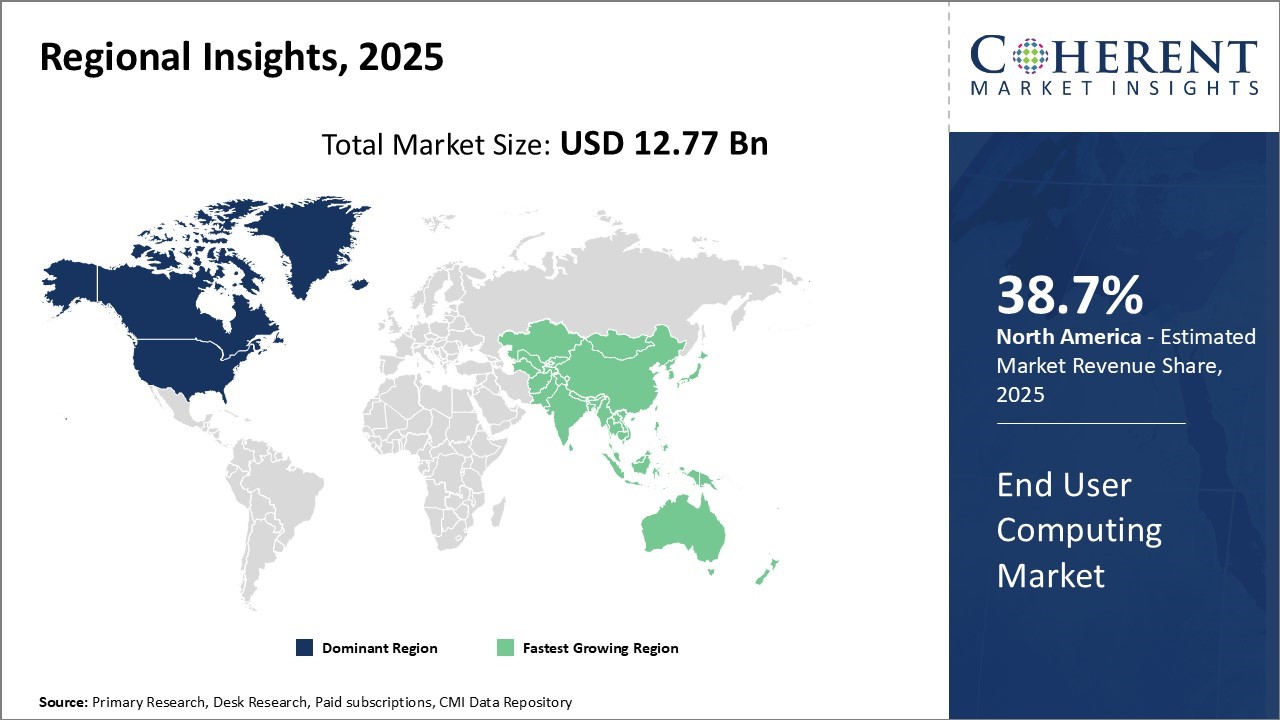
- By Region, North America will continue to have the market share of 38.7% in 2026 and will be supported by the adoption of new technologies and the existence of developed digital infrastructure. On the other hand, Asia Pacific is observed to be the region with the most growth, driven by the initiatives for digital transformation and growing spending on enterprise IT.
Market Overview
The rapid digital transformation among enterprises due to the global pandemic and the rising need for enhanced productivity and collaboration is expected to drive significant demand for end user computing solutions over the next few years.
The End User Computing Market Demand is expected to witness the increased adoption of cloud-based end user computing solutions over the forecast period. Furthermore, growing trend of bring your own device (BYOD) among enterprises will also necessitate proper end user computing infrastructure to securely access business applications remotely. Significant investments by organizations to modernize the aging end user infrastructure is further expected to propel the market growth going forward.
Current Events and Its Impact
Event | Description and Impact |
Economic Shifts in IT Spending |
|
Industry Consolidation Moves |
|
Regulatory Compliance Pressures |
|
Pricing Analysis
- The global End-User Computing (EUC) market is rapidly shifting from traditional perpetual licenses to flexible, consumption-based pricing models driven by cloud adoption and remote work. Subscription pricing dominates, with Microsoft Azure Virtual Desktop costing about $0.20/hour per session host and VMware Horizon Cloud charging $10–$15/user/month. Pay-per-use models, like AWS WorkSpaces ($7.25–$30/user/month) and Citrix DaaS ($8–$25/user/month), are gaining traction due to cost alignment with actual usage. Perpetual licenses now represent less than 15% of new deployments.
- Pricing varies by product: VDI ranges from $6 to $30/user/month depending on vendor and features, DaaS costs $0.20–$0.60/hour per session host, and application virtualization is bundled with Microsoft 365 or priced $4.50–$12/user/month for standalone solutions.
- Regionally, North America has the highest prices ($12–$35/user/month), with compliance adding up to 25%. Europe’s GDPR-compliant services cost 10–20% more, while Asia-Pacific offers competitive pricing ($5–$20/user/month).
- Key pricing drivers include feature tiers ($5–$35/user/month), scalability discounts, and security add-ons. Top vendors compete through bundled offers and usage-based discounts. Future trends focus on AI-driven pricing, enhanced security costs, and green computing incentives. Overall, flexible consumption models now make up 65% of the End User Computing Market Forecast.
- Current Industry Events of 2026
- Market Size Estimation
- Regional Breakdown
- Competitive Landscape
- Customer Intelligence
- Segmental Analysis
- Pricing Analysis
- Key Market Drivers, Challenges & Future Trends
- Customized Insights Section
Role of AI in the End User Computing (EUC) Market
AI is reshaping the End User Computing (EUC) landscape by enhancing user experiences, automating IT support, and fortifying security in hybrid and remote work environments. Its integration is accelerating across cloud platforms, hardware, and enterprise applications, driving intelligent and adaptive computing solutions.
- AI Integration Through Cloud Platforms
Leading hyperscalers such as Microsoft Azure OpenAI and Google Vertex AI are democratizing access to powerful pre-trained AI models. These cloud-native platforms enable businesses to integrate advanced AI capabilities—such as virtual assistants and automated IT support—without the need for deep in-house expertise. This is particularly vital in supporting distributed workforces, where AI-powered endpoint security and device optimization improve both reliability and user productivity.
- Use Cases of Embedded AI in Devices
More consumer devices today are integrating AI systematically with the objective of providing real time value features. For example, Samsung’s Galaxy AI allows for the editing of pictures and real-time translation on the mobile devices. In addition, AI-enabled PCs which are predicted to exceed global sales of 114 million units by the end of 2025 are using machine learning for predictive maintenance, performance tuning based on individual usage, battery optimization and other similar features. These improvements augment functionality and reduce remote work downtime.
- Enterprise Level Deployments by Industry Leaders
With embedded AI into the Azure Virtual Desktop platform, Microsoft has applied features such as tune performance to mitigate adaptive responsiveness for security and real-time anomaly detecting for enhanced operational efficiency. The system decreases the latency by 30% by dynamically allocating the computing resources to mission critical tasks on user behaviour analysis. This not only augments the experience of the users with reduced IT expenses but also assists the companies with soaring IT expenses, Microsoft achieved an annual revenue of over $10 billion from AI innovations.
- Strategic Impact
The merge of AI and EUC is creating smarter, more efficient and personalized digital workspaces. Organizations can easily leverage these innovations as the barriers to adoption fall with the integration of cloud-based solutions and AI at the hardware level.
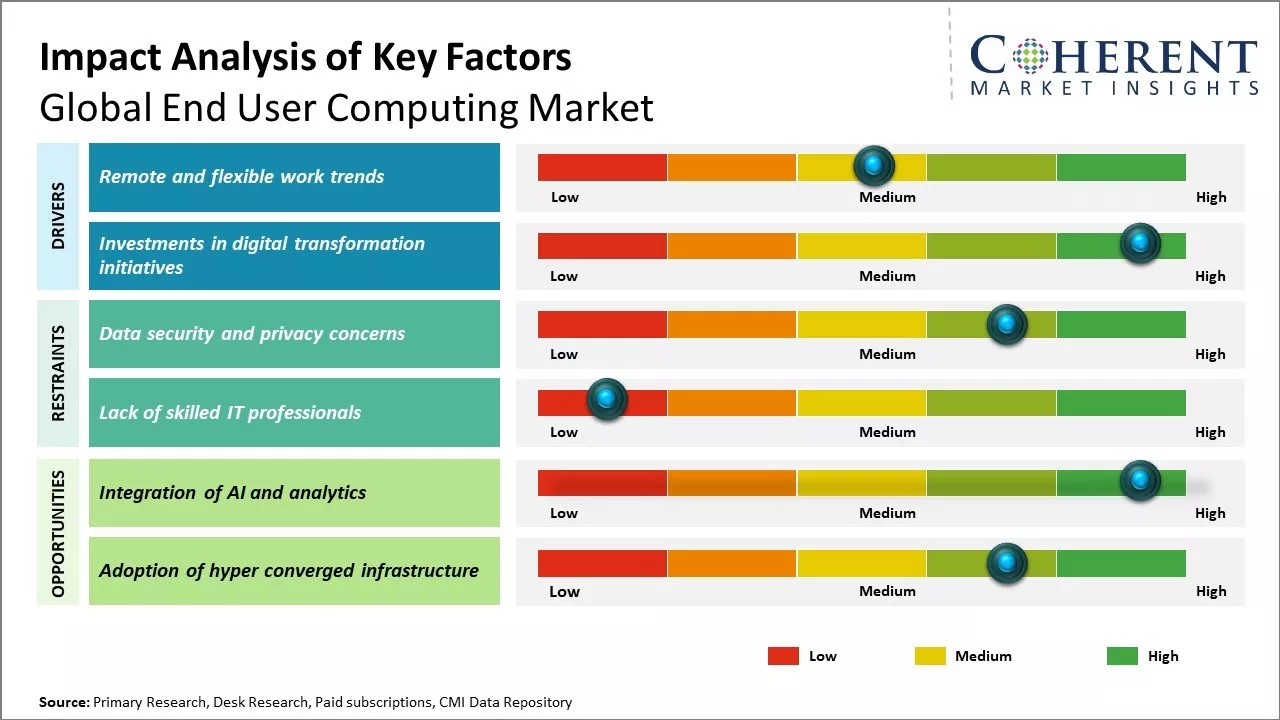
Remote and flexible work trends
With the global pandemic significantly changing workplace dynamics, the ability to work remotely or in a hybrid setup has become increasingly important for both employers and employees. Many global companies have now made remote work a permanent option for certain roles to provide staff with more flexibility. This has driven the demand for end-user computing solutions that allow seamless collaboration and access to all critical applications from any location.
Devices like laptops and tablets that enable mobility are seeing higher sales. Cloud-based platforms for conferencing, project management, and file sharing have also grown in popularity as they remove the barriers of physical distance between team members. Going forward, the flexible work trend is expected to be a major driver in shaping how and where people work. This will sustain the implementation of technologies and services focused on supporting remote and hybrid work models within organizations.
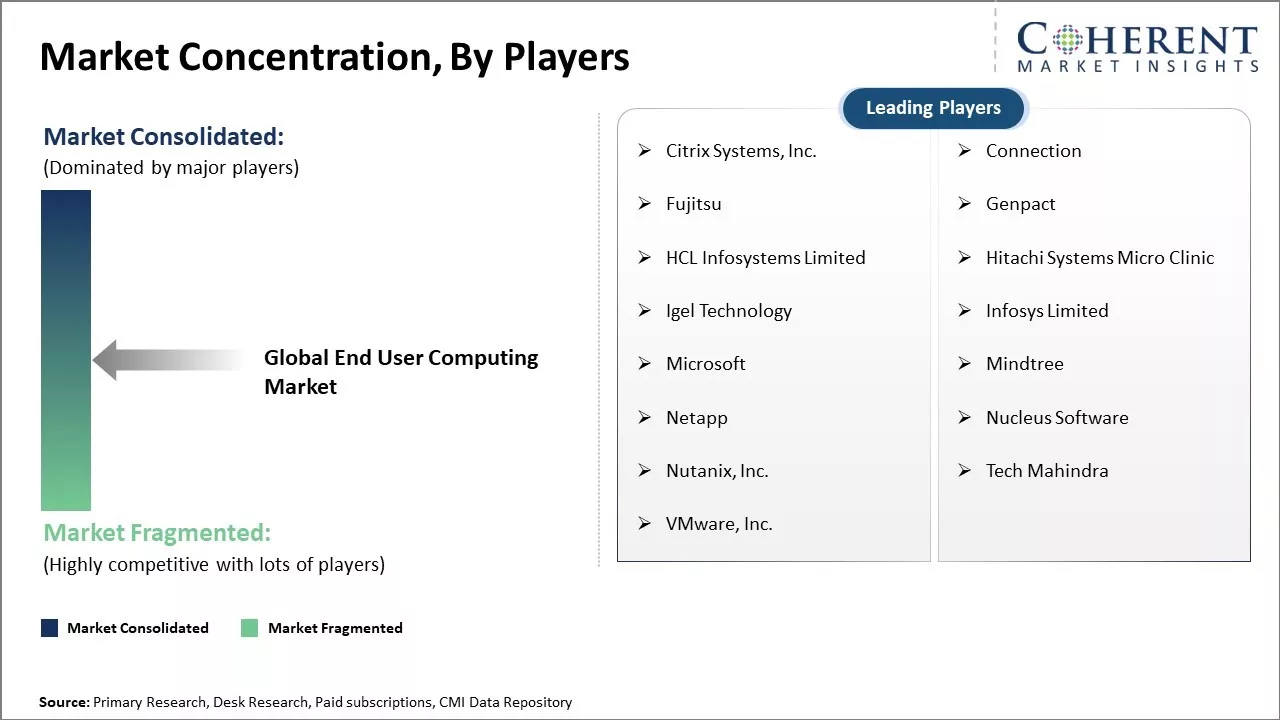
Market Concentration and Competitive Landscape
Investments in digital transformation initiatives
As businesses accelerate their digitalization plans, they are actively investing in modernizing outdated legacy systems and improving employee experiences through advanced workplace solutions. Digital transformation encompasses both upgrading existing infrastructure as well as adopting novel technologies like artificial intelligence, analytics, and automation.
Seamless access to workplace applications from any device is a key requirement in the modern digital workplace. This is fueling increased spending on end-user computing infrastructure including virtual desktop infrastructure, workspace management platforms, secure file sharing solutions and mobile device management. Security also remains a top priority area for investments with growing usage of multi-factor authentication and single sign-on systems.
Market Opportunities
- Integration of AI and analytics
The integration of artificial intelligence and advanced analytics capabilities promises to unlock significant opportunities for innovation and growth within the global End User Computing Market Outlook. As remote and hybrid working setups become more normalized post-pandemic, users are demanding more intelligence, personalization and automation within their workflows.
Technologies like AI, machine learning, and predictive analytics can help meet these evolving needs by gaining insights from large amounts of user data and automating repetitive tasks. For example, AI assistants can provide personalized support to employees based on their roles, previous interactions, and current contexts. Additionally, advanced analytics allows IT teams to better optimize resource allocation, proactively detect and resolve issues.
Segmental Insights
End User Computing (EUC) Market Insights, By Type
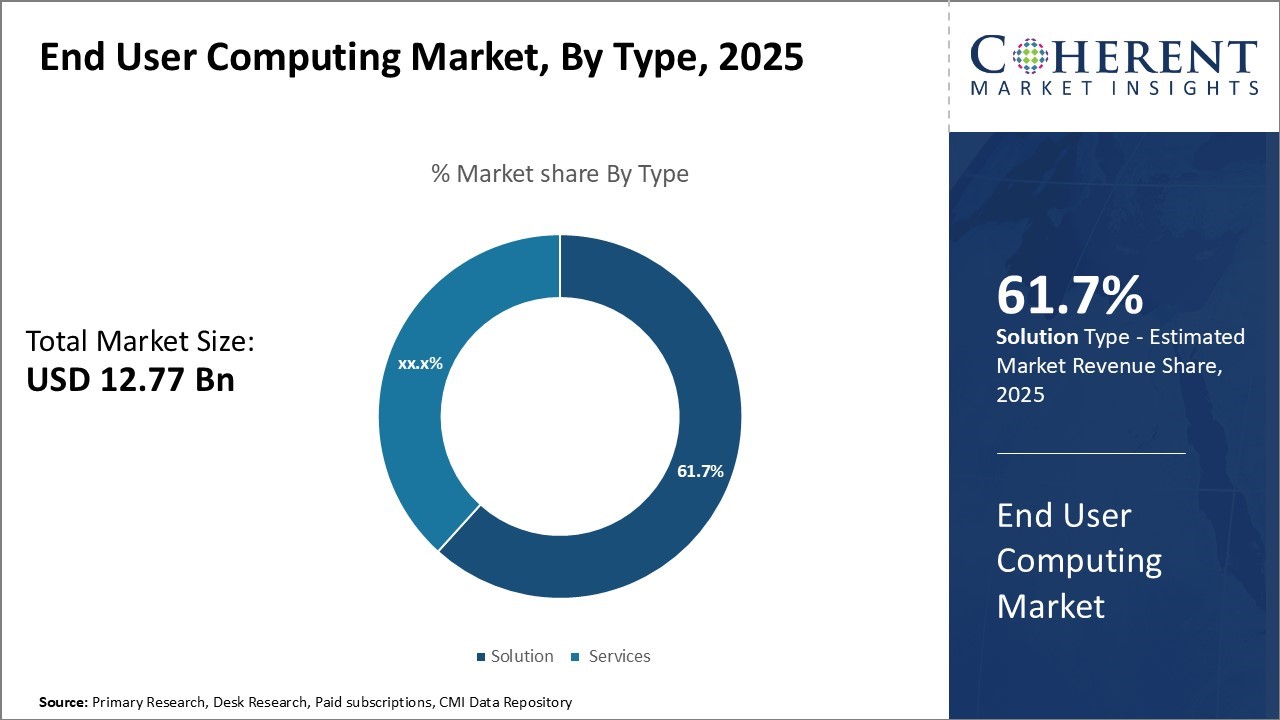
Within the type segment of the global End User Computing Market trend, the solution segment is expected to account for 62.7% of the market share due to advantages of economies of scale. As technology progresses, solutions are able to support more users simultaneously which lowers the average cost per user. Vendors are able to recoup significant research and development investments by licensing solutions to a massive customer base.
Larger enterprises and industry leaders seek out solutions that can scale with their business needs. As user counts increase within an organization, per-user licensing or subscription fees for solutions typically decrease on a sliding scale. This retains affordability as user bases grow over time. Compatibility and consistency are also improved across dispersed teams and offices when standardized solutions are deployed throughout an organization versus one-off services.
End User Computing (EUC) Market Insights, By Deployment
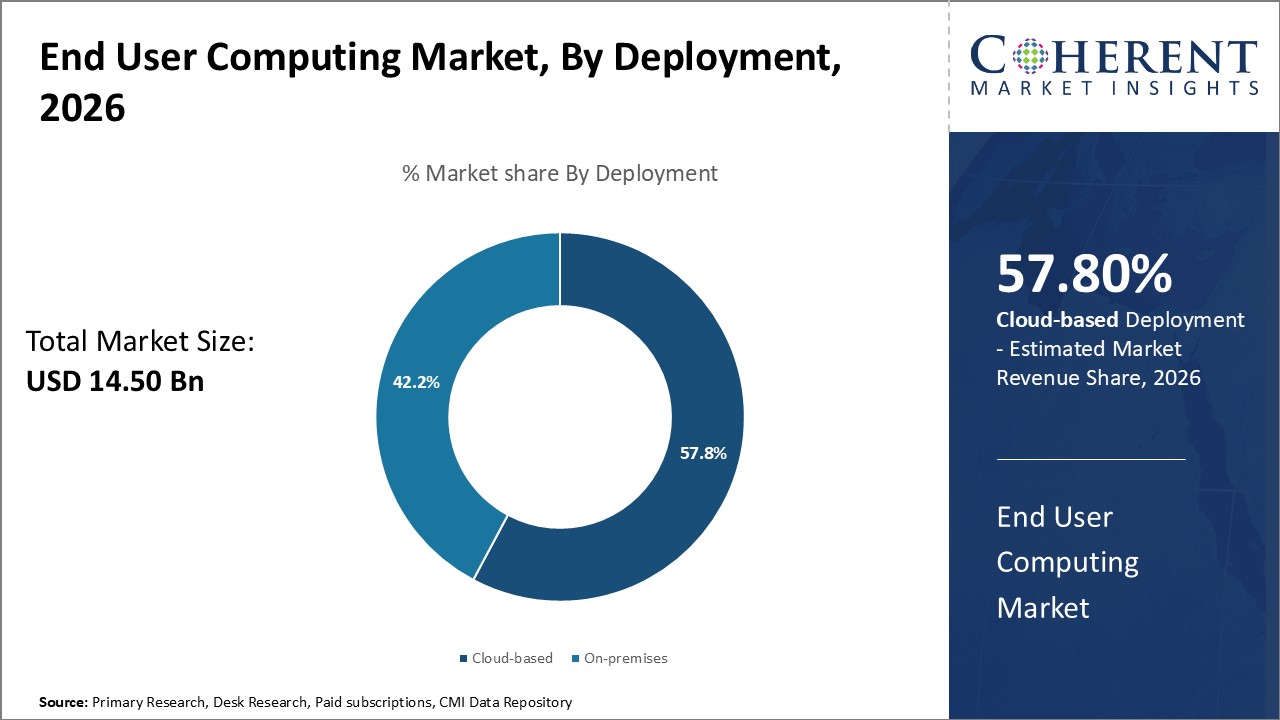
In the deployment segment of the global End User Computing Market Value, the cloud-based segment is expected to account for57.8% of the market share in 2026. Physical hardware and roadblocks of conventional on-premises internal IT environments are removed, allowing streamlined access to computing power. Cloud providers own the underlying servers, storage, networking, and other physical aspects to centrally aggregate computing resources.
This shared resource model has enabled exponential scaling to meet market demand. New customers and incremental users can be onboarded without lead times for procuring, installing, and configuring their own servers. Cloud tenants pay only for the resources they utilize with no upfront capital expenditures or unused capacity. Rapid provisioning supports nimble market responsiveness and growth initiatives in customer businesses.
End User Computing (EUC) Market Insights, By End-use Industry
In the End-use Industry segment of the global End User Computing Market Analysis, the IT and telecom industry has standardized on productivity and collaboration solutions to support its diverse needs with 44.7% share in 2026. Heterogeneous technologies, business models, and partnerships require efficient intra-company coordination on a global scale.
IT operations themselves also involve various software, hardware, networking, security, data analytics, and other specialized systems. User profiles range from individual contributors to large project teams. Deploying unified communications, file sharing, project management, and other productivity suites facilitates collaboration both internally and with business partners. These solutions optimize teams for agile workflows.
Regional Insights
North America End User Computing Market Analysis and Trends
North America is projected to maintain its dominance in the global end user computing market, expected to account for 38.7% of the market share in 2026. This leadership is supported by the presence of major global technology corporations headquartered in the U.S., which continue to invest significantly in research and development as well as innovation.
These investments drive new product launches and technologies that enhance user experience. The widespread adoption of digital transformation strategies across various industries in North America fuels the demand for the latest laptops, desktops, and other end user devices. Additionally, the region benefits from advanced IT infrastructure and high-speed internet availability, enabling users to effectively leverage these devices across diverse workloads.
Asia Pacific End User Computing Market Analysis and Trends
The Asia Pacific region is expected to emerge as the fastest growing market in the global end user computing landscape. Rapid economic growth, increasing internet penetration, urbanization, and strong digital initiatives by governments and enterprises in countries such as China, India, Japan, and South Korea are key growth drivers. The expanding IT spending capacity of organizations and the rise of mobile yet productive workforce demands further accelerate market growth.
The growing adoption of remote and hybrid work models, especially post-pandemic, has boosted demand for laptops, tablets, and desktops. Additionally, rising disposable incomes among consumers are driving demand for devices that support multifunctional lifestyles. Device manufacturers are capitalizing on these opportunities by offering localized product portfolios at competitive prices. With an expanding base of tech-savvy users and ongoing digital skills development programs, the Asia Pacific region is poised to become the global leader in the end user computing market in the coming years.
Dominating Countries in the End User Computing Market
United States End User Computing Market Analysis and Trends
The U.S. continues to lead the North American end user computing market, driven by a strong presence of technology companies and heavy investments in innovation. The country's advanced IT infrastructure, high-speed internet availability, and rapid digital transformation across industries contribute significantly to the demand for cutting-edge computing devices. The focus on enhancing workforce productivity and user experience further fuels adoption of the latest end user devices.
India End User Computing Market Analysis and Trends
India is emerging as a key growth market within the Asia Pacific region, fueled by increasing internet penetration, urbanization, and expanding digital initiatives. Government programs promoting digital skills development and remote work adoption are boosting the demand for laptops, desktops, and tablets. Rapid economic growth and rising disposable incomes among consumers are also driving the uptake of multifunctional computing devices. Indian enterprises are increasingly investing in IT infrastructure upgrades to support a growing mobile and hybrid workforce.
Market Report Scope
End User Computing Market Report Coverage
| Report Coverage | Details | ||
|---|---|---|---|
| Base Year: | 2025 | Market Size in 2026: | USD 14.50 Bn |
| Historical Data for: | 2020 To 2024 | Forecast Period: | 2026 To 2033 |
| Forecast Period 2026 to 2033 CAGR: | 13.8% | 2033 Value Projection: | USD 35.92 Bn |
| Geographies covered: |
| ||
| Segments covered: |
| ||
| Companies covered: | Citrix Systems, Inc., Connection, Fujitsu, Genpact, HCL Infosystems Limited, Hitachi Systems Micro Clinic, Igel Technology, Infosys Limited, Microsoft, Mindtree, Netapp, Nucleus Software, Nutanix, Inc., Tech Mahindra, and VMware, Inc. | ||
| Growth Drivers: |
| ||
| Restraints & Challenges: |
| ||
End User Computing Market Key Developments
- In March 2024, Dell Technologies unveiled AI-powered enhancements to Workspace ONE, automating endpoint management and improving security for remote workforces with proactive issue resolution.
- In January 2024, Citrix launched Citrix Workspace Premium Plus, integrating virtual apps, desktops, and endpoint management with AI-driven analytics and security for hybrid work environments.
- In December 2023, VMware introduced AI-enhanced features in Horizon, including intelligent resource allocation and real-time threat detection to optimize cloud use and strengthen endpoint security.
- In September 2023, Microsoft expanded Azure Virtual Desktop with AI-based anomaly detection and adaptive performance tuning to reduce latency and boost productivity in hybrid settings.
Analyst View
- The End-User Computing (EUC) market is rapidly evolving due to changing workplace dynamics and technological advances. The rise of bring-your-own-device (BYOD) policies is driving demand for secure, platform-agnostic solutions that support workforce flexibility.
- Industries such as renewable energy, healthcare, and electric vehicles are expanding EUC’s role to enable specialized workflows, especially within IoT-enabled smart manufacturing environments. However, managing security risks in decentralized, hybrid work models remains a major challenge, particularly for legacy systems.
- Modernizing application management is a key focus, with enterprises moving toward cloud-native delivery and containerization to improve update efficiency and reduce costs. Desktop-as-a-service (DaaS) adoption is accelerating, fueled by scalability needs and Windows 10’s upcoming end of life. The browser’s evolution into a “new endpoint” highlights growing reliance on web-based apps, requiring enhanced optimization.
- Regionally, Asia-Pacific shows strong growth from digital transformation, Western Europe leads on compliance-driven EUC investments, and North America remains the innovation hub, powered by hyperscalers and AI-driven endpoint analytics. Looking forward, AI-driven insights and predictive maintenance will enhance user experience and operational efficiency, though talent shortages and integration challenges may slow adoption. Vertical-specific solutions in healthcare and energy management present promising growth opportunities.
Speak to the analyst
Want personalized insights?
Take the findings above to one of our principal consultants, or have the report rebuilt around the segments, geographies and competitors you actually track.
Market Segmentation
- Type Insights (Revenue, US$ Bn, 2021 - 2033) (Revenue, USD Bn, 2021 - 2033)
- Solution
- Services
- Deployment Insights (Revenue, US$ Bn, 2021 - 2033) (Revenue, USD Bn, 2021 - 2033)
- Cloud-based
- On-premises
- End-use Industry Insights (Revenue, US$ Bn, 2021 - 2033) (Revenue, USD Bn, 2021 - 2033)
- IT and Telecom
- BFSI
- Healthcare
- Retail
- Others
- Regional Insights (Revenue, US$ Bn, 2021 - 2033) (Revenue, USD Bn, 2021 - 2033)
- North America
- U.S.
- Canada
- Latin America
- Brazil
- Argentina
- Mexico
- Rest of Latin America
- Europe
- Germany
- U.K.
- Spain
- France
- Italy
- Russia
- Rest of Europe
- Asia Pacific
- China
- India
- Japan
- Australia
- South Korea
- ASEAN
- Rest of Asia Pacific
- Middle East & Africa
- GCC Countries
- Israel
- South Africa
- Rest of Middle East & Africa
- Key Players Insights
- Citrix Systems, Inc.
- Connection
- Fujitsu
- Genpact
- HCL Infosystems Limited
- Hitachi Systems Micro Clinic
- Igel Technology
- Infosys Limited
- Microsoft
- Mindtree
- Netapp
- Nucleus Software
- Nutanix, Inc.
- Tech Mahindra
- VMware, Inc.
Sources
Primary Research Interviews
- Avasant EUC Services Advisors [3]
- Research Nester Analysts
- Others
Databases
- Gartner End-User Spending Database
- IDC Worldwide Quarterly Device Tracker
- Others
Magazines
- Forbes Technology Insights
- Bloomberg Businessweek Enterprise Tech
- CIO Magazine
- Others
Journals
- International Journal of Cloud Computing
- Journal of Information Technology Management
- IEEE Transactions on Services Computing
- Others
Newspapers
- Financial Times Tech Section
- The Wall Street Journal CIO Journal
- The Economic Times IT Insights
- Others
Associations
- ISACA (Information Systems Audit and Control Association)
- CompTIA (Computing Technology Industry Association)
- IEEE Computer Society
- Others
Public Domain Sources
- U.S. Bureau of Labor Statistics IT Employment Reports
- EU Open Data Portal (Digital Economy Metrics)
- World Bank Digital Adoption Index
- Others
Proprietary Elements
- CMI Data Analytics Tool
- Proprietary CMI Existing Repository of Information (Last 8 Years)
*Definition: The global end user computing market involves providing end-user devices, applications, and services that allow knowledge workers and general users to be more productive and collaborative. This market includes procurement, deployment, and management of desktop computers, laptops, tablets, and smartphones that enable mobile workforces along with related peripherals, software, and support services. Key players in this market focus on securely connecting and empowering today's distributed knowledge workers through end-user computing solutions in order to drive productivity and collaboration across the distributed global workforce.
Get access to 250+ pages report
Every segment, forecast, competitor profile and data table behind the analysis above — available for instant download.
- ESOMAR Member
- ISO 9001:2015 Certified
- D-U-N-S Registered
- GDPR & CCPA Compliant
Missing comfort of reading report in your local language? Find your preferred language:
Transform your Strategy with Exclusive Trending Reports
Frequently Asked Questions
The End User Computing Market size is estimated to be valued at USD 14.50 Bn in 2026, and is expected to reach USD 35.92 Bn by 2033.
The CAGR of the End User Computing industry is projected to be 13.8% from 2026 to 2033.
Remote and flexible work trends and investments in digital transformation initiatives are the major factors driving the growth of the global market.
Data security and privacy concerns and lack of skilled IT professionals are the major factors hampering the growth of the global end user computing market.
In terms of type, solution is estimated to dominate the market revenue share in 2026.
Citrix Systems, Inc., Connection, Fujitsu, Genpact, HCL Infosystems Limited, Hitachi Systems Micro Clinic, Igel Technology, Infosys Limited, Microsoft, Mindtree, Netapp, Nucleus Software, Nutanix, Inc., Tech Mahindra, and VMware, Inc. are the major players.
North America is expected to lead the global end user computing industry in 2026.