

Online Hyperlocal Services Market Size and Forecast – 2026 to 2033
The Online Hyperlocal Services Market is anticipated to grow at a CAGR of 11.7% with USD 14.7 Bn share in 2026 and is expected to reach USD 22.4 Bn in 2033. Consumers increasingly prefer convenient, instant delivery of groceries, food, and essentials, which strengthens demand and encourages platform-based services to expand rapidly and improve efficiency.
Key Takeaways
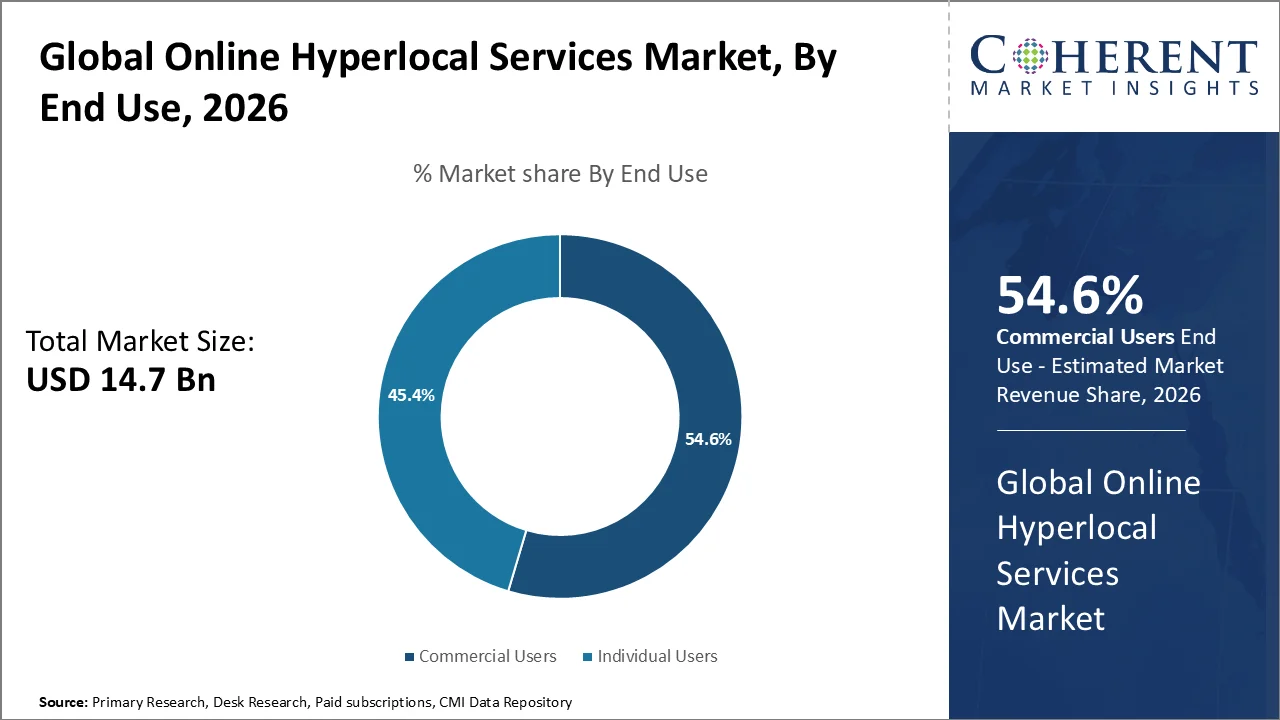
- Commercial Users hold the largest market share of 54.6% in 2026, owing to the strong need for efficient last-mile logistics among e-commerce firms, retailers, restaurants, grocery platforms, and pharmacy delivery operators. Last-mile delivery can account for over 50% of total shipping costs, making route optimization, faster fulfillment, real-time tracking, and automated delivery solutions critical for commercial users.
- Grocery Ordering is expected to hold the largest market share of 43.3% in 2026, driven by frequent repeat purchases, demand for instant delivery, and rising app-based grocery adoption. In India, quick-commerce orders accounted for about two-thirds of all online grocery orders in 2024, while urban shoppers’ preference for online daily-needs purchases increased from 33% to 87% after instant-delivery services expanded.
- Asia Pacific is expected to acquire the dominant share of 42.30% in 2026, owing to rapid urbanization, dense city clusters, and high delivery-volume concentration across countries such as India, China, Indonesia, Japan, and the Philippines. The UN World Urbanization Prospects 2025 noted that the number of global megacities reached 33 in 2025, with more than half located in Asia.
Current Events and Their Impact on the Online Hyperlocal Services Market
Current Event | Description and its Impact |
FSSAI Tightens Dark-Store and Food Safety Compliance for Quick Commerce |
|
U.S. FTC Scrutinizes Hidden Fees in Online Food and Grocery Delivery |
|
Segmental Insights
- Current Industry Events of 2026
- Market Size Estimation
- Regional Breakdown
- Competitive Landscape
- Customer Intelligence
- Segmental Analysis
- Pricing Analysis
- Key Market Drivers, Challenges & Future Trends
- Customized Insights Section
Why is Commercial Users Acquiring the Largest Market Share?
Commercial Users hold the largest market share of 54.6% in 2026. Commercial users drive adoption of the online hyperlocal services market to achieve efficient last-mile delivery, reduce costs, and improve operational flexibility. Retailers, restaurants, and pharmacies use hyperlocal platforms to quickly reach nearby customers and manage on-demand orders without building large logistics systems. They scale delivery operations during peak demand, improve inventory turnover, and integrate with digital marketplaces to expand reach. They also use real-time tracking and simplified order management to enhance efficiency, streamline operations, and improve customer satisfaction. For instance, in December 2025, PhonePe launched its e-commerce app Pincode as a major expansion into online retail, building it on the government-backed Open Network for Digital Commerce (ONDC). The hyperlocal platform enables users to buy groceries, medicines, food, electronics, and home décor directly from nearby neighborhood stores.
Grocery Ordering expected to hold the largest market share
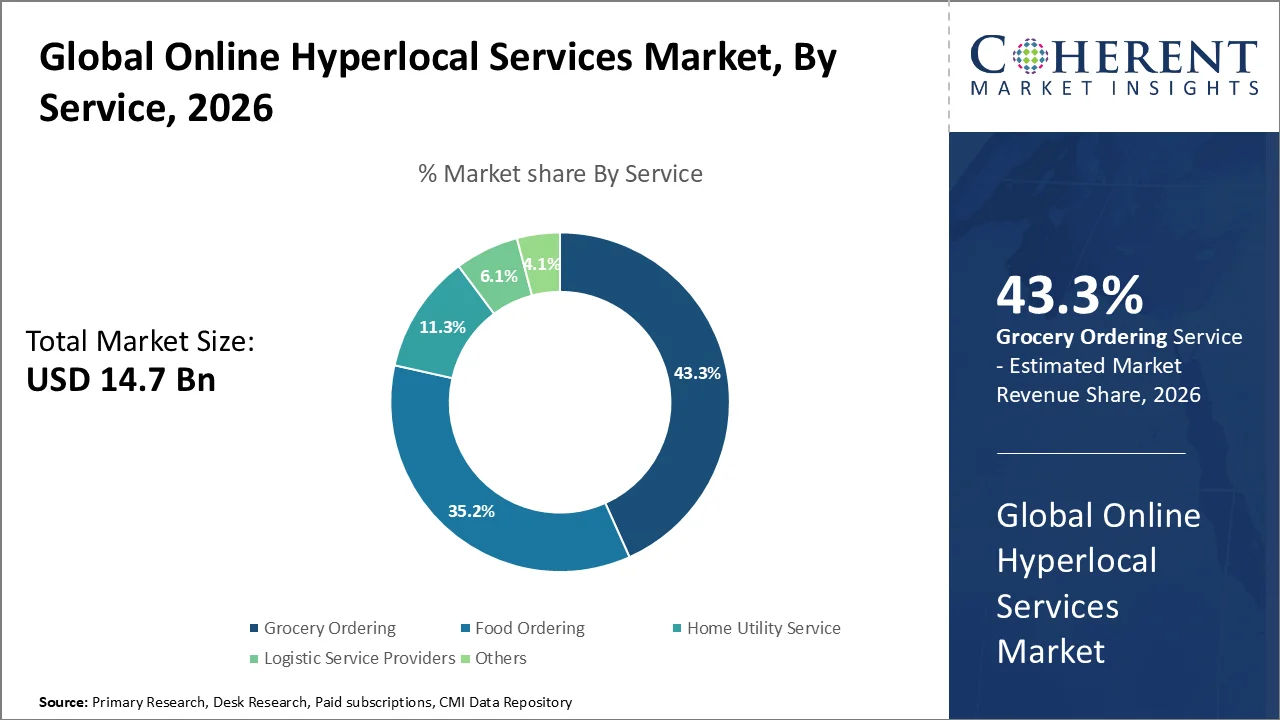
Grocery Ordering expected to hold the largest market share of 43.3% in 2026 owing to its expansion of digital payments ecosystem. Consumers drive grocery ordering in the online hyperlocal services market by seeking convenience, instant delivery, and time-saving shopping solutions. By the end of 2025, 61% of U.S. households had purchased groceries online, while online grocery accounted for 19% of total U.S. grocery spending in December 2025. They increasingly use mobile apps instead of visiting physical stores due to busy lifestyles and urbanization. They adopt these services more easily through widespread smartphone access, digital payment systems, and user-friendly platforms. Improved supply chains and quick-commerce models help platforms deliver fresh and essential products quickly. Discounts, wide product selection, and reliable doorstep delivery further encourage frequent online grocery purchases. For instance, Walmart-owned Flipkart plans to launch a new hyperlocal delivery service that will allow customers to get products from nearby stores, according to sources. The company intends to begin testing the service in Bengaluru in the coming weeks, starting with grocery deliveries, sources close to the development said.
Online Hyperlocal Services Market Trends
- Rising penetration of smartphones, affordable internet, and location-based technologies is driving rapid adoption of hyperlocal platforms for food delivery, groceries, healthcare, and home services. In 2025, 74% of the global population, or nearly 6 billion people, used the internet, while Asia-Pacific internet use reached 77%.
- Increasing integration of AI-driven recommendation engines, predictive analytics, and geolocation tracking is improving service matching and delivery efficiency. McKinsey’s 2025 global AI survey found that 88% of organizations regularly use AI in at least one business function, while 23% are scaling agentic AI systems.
- Expansion of quick commerce models is increasing the need for dense micro-fulfillment centers and dark stores near consumers. In India, quick-commerce orders made up about two-thirds of all online grocery orders in 2024, while frequent urban shoppers’ preference for online daily-needs purchases rose from 33% to 87% after instant-delivery models expanded. Swiggy Instamart also added 316 new dark stores in one quarter and expanded to 124 cities, reflecting the infrastructure shift behind 10–30 minute delivery models.
Regional Insights
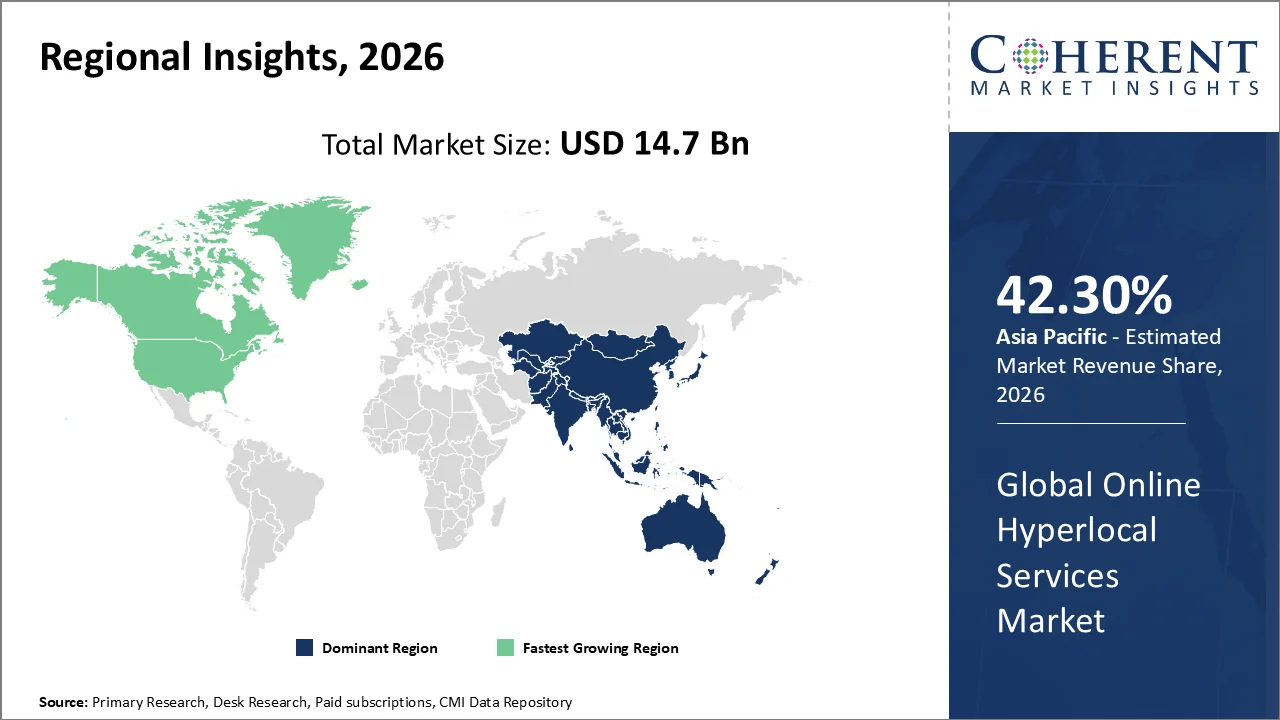
Asia Pacific dominates owing to expanding e-commerce and quick-commerce ecosystems
Asia Pacific is expected to acquire the dominant share of 42.30% in 2026. Rapid urbanization, rising smartphone usage, and the expanding e-commerce ecosystem drive the Asia Pacific online hyperlocal services market. Consumers increasingly prefer instant delivery of food, groceries, and essential services, shifting toward convenience-based habits. Digital payment adoption, better internet connectivity, and mobile-first platforms enable smooth access to services. Growing middle-class populations further support demand, while companies invest in logistics, AI-based routing, and dark store networks. These developments improve last-mile delivery efficiency and boost market growth across urban and semi-urban areas. For instance, in February 2026, Gurugram-based drone delivery company Skye Air has launched India’s first AI-driven doorstep delivery system that integrates drones with autonomous robots. The company plans to expand its operations across India and later globally, focusing on automation, hyperlocal logistics, and sustainable delivery solutions.
North America Online Hyperlocal Services Market Trends
Strong smartphone and internet penetration in North America drives the online hyperlocal services market by enabling easy access to on-demand platforms. Consumers increasingly prefer convenience and instant delivery of food, groceries, and essential services, which boosts adoption. Gig economy-based delivery networks expand and improve last-mile fulfillment efficiency. Advanced digital payment systems and real-time tracking improve user experience. Urban lifestyles, busy work schedules, and the use of AI-driven logistics and route optimization further enhance service efficiency and support market growth across the region.
Japan Online Hyperlocal Services Market Trends
Strong urbanization in Japan drives demand for online hyperlocal services as dense city populations actively seek quick access to nearby food, groceries, and daily essentials. Consumers increasingly use smartphones and on-demand apps, which makes these services easily accessible. People prefer convenience, speed, and high-quality service, which boosts adoption further. Companies expand quick commerce into retail and daily necessities, increasing usage. Gig and part-time workers support deliveries, while advanced logistics systems and route optimization improve efficiency and strengthen market growth. In October 2025, Bryan Marsal, Co-founder and Co-CEO of A&M, highlighted the significance of the company’s entry and said that Japan’s business environment is experiencing growing activity in restructuring, divestitures, and cross-border M&A transactions. He noted that this shift requires a different kind of consultancy that combines global reach with hyperlocal expertise and delivers nuanced, value-driven solutions, which A&M provides.
United States Online Hyperlocal Services Market Trends
Rising demand for instant, on-demand delivery of food, groceries, and essential services drives the United States online hyperlocal services market, supported by fast-paced urban lifestyles. High smartphone penetration, widespread internet access, and strong adoption of digital payments enable users to easily access platforms. Consumers increasingly prefer convenience, time-saving options, and real-time tracking, which boosts usage. Expanding e-commerce ecosystems, advanced logistics networks, and investments in AI-powered route optimization and last-mile delivery efficiency further support growth. Higher disposable income and continuous innovation in mobile applications also encourage adoption across urban and suburban areas.
Who are the Major Companies in Online Hyperlocal Services Industry
Some of the major key players in Online Hyperlocal Services are Delivery Hero AG, Instacart, Uber Technologies, Rocket Internet SE, Ibibogroup (redBus, goibibo, and ryde), Airtasker, ANI Technologies, AskForTask, Laurel & Wolf, PriceGrabber.com, Swiggy, and Taskbob.
Key News
- In February 2025, DTDC has launched a two-to-four-hour same-day delivery service, entering the rapidly growing quick commerce segment. As part of this strategy, the company has established its first dark store in Bengaluru, marking the start of a hyperlocal fulfilment network designed to enhance the speed and efficiency of last-mile deliveries.
Market Report Scope
Online Hyperlocal Services Market Report Coverage
| Report Coverage | Details | ||
|---|---|---|---|
| Base Year: | 2025 | Market Size in 2026: | USD 14.7 Bn |
| Historical Data for: | 2020 To 2024 | Forecast Period: | 2026 To 2033 |
| Forecast Period 2026 to 2033 CAGR: | 11.7% | 2033 Value Projection: | USD 22.4 Bn |
| Geographies covered: |
| ||
| Segments covered: |
| ||
| Companies covered: | Delivery Hero AG, Instacart, Uber Technologies, Rocket Internet SE, Ibibogroup (redBus, goibibo, and ryde), Airtasker, ANI Technologies, AskForTask, Laurel & Wolf, PriceGrabber.com, Swiggy, and Taskbob. | ||
Analyst Opinion
- Online hyperlocal services are being pulled forward by structural shifts in urban consumption rather than short-term digital trends. With more than half of global consumers now living in cities, demand concentrates heavily on instant access to food, groceries, and essentials, making “near-me” fulfilment a default expectation rather than a convenience feature.
- Food delivery has become one of the largest anchors of hyperlocal ecosystems, with global online food delivery orders estimated in the tens of billions annually. In mature urban markets, repeat usage patterns dominate—studies from major delivery platforms show that a small cohort of users often generates a disproportionately large share of orders, reinforcing the idea that hyperlocal services are habit-forming infrastructure rather than discretionary apps.
- Grocery and quick commerce are now the real accelerators of the category. Companies like Instacart and India-based Zomato (via Blinkit) demonstrate how delivery windows have collapsed to under an hour in many dense cities, fundamentally reshaping consumer expectations.
- Operational feasibility is being redefined by logistics density and labor flexibility. Gig-based delivery networks have enabled platforms to scale without owning traditional retail infrastructure, while route optimization and real-time dispatch systems reduce idle time per order.
Speak to the analyst
Want personalized insights?
Take the findings above to one of our principal consultants, or have the report rebuilt around the segments, geographies and competitors you actually track.
Market Segmentation
- By End Use (Revenue, USD Bn, 2021-2033)
- Individual Users
- Commercial Users
- By Service (Revenue, USD Bn, 2021-2033)
- Food Ordering
- Grocery Ordering
- Home Utility Service
- Logistic Service Providers
- Others
- By Region (Revenue, USD Bn, 2021-2033)
- North America
- U.S.
- Canada
- Latin America
- Brazil
- Mexico
- Argentina
- Rest of Latin America
- Europe
- Germany
- U.K.
- France
- Italy
- Spain
- Russia
- Rest of Europe
- Asia Pacific
- China
- India
- Japan
- Australia
- South Korea
- ASEAN
- Rest of Asia Pacific
- Middle East
- GCC
- Israel
- Rest of Middle East
- Africa
- South Africa
- Central Africa
- North Africa
- North America
Sources
Primary Research interviews
- Interviews with online hyperlocal service providers, platform operators, delivery partners, and local merchants
- Discussions with end-users of hyperlocal services (urban and semi-urban consumers)
- Inputs from logistics and last-mile delivery professionals
- Feedback from small businesses and retail store owners using hyperlocal platforms
Databases
- Government open data portals and economic databases
- Industry trade statistics databases
- Company filings and annual reports repositories
- International trade and commerce data repositories
- Statistical databases covering e-commerce, logistics, and digital services
Magazines
- Technology and digital economy magazines covering e-commerce trends
- Business and retail-focused magazines reporting on local commerce
- Logistics and supply chain industry magazines
- Consumer lifestyle magazines highlighting online delivery and on-demand services
Journals
- E-commerce and digital transformation journals
- Supply chain and logistics research journals
- Urban economics and smart city development journals
- Information systems and digital platforms journals
Newspapers
- National newspapers covering business and technology developments
- Financial newspapers reporting on e-commerce and retail sector growth
- Regional newspapers highlighting hyperlocal market adoption trends
- Online news portals tracking digital economy and startup ecosystems
Associations
- E-commerce and digital trade associations
- Retail and small business associations
- Logistics and supply chain industry associations
- Internet and mobile commerce industry groups
- Urban development and smart city initiatives organizations
Public Domain sources
- Government ministry publications related to commerce, IT, and urban development
- Census and demographic reports
- Regulatory filings and policy documents
- World development and digital economy public reports
- Open access research papers and whitepapers
Proprietary Elements
- CMI Data Analytics Tool
- Proprietary CMI Existing Repository of information for last 10 years (this will remain same)
Get access to 250+ pages report
Every segment, forecast, competitor profile and data table behind the analysis above — available for instant download.
- ESOMAR Member
- ISO 9001:2015 Certified
- D-U-N-S Registered
- GDPR & CCPA Compliant
Missing comfort of reading report in your local language? Find your preferred language:
Transform your Strategy with Exclusive Trending Reports
Frequently Asked Questions
The global online hyperlocal services market is estimated to exhibit a CAGR of 11.7% over the forecast period.
Major players operating in the global online hyperlocal services market include Delivery Hero AG, Instacart, Uber Technologies, Rocket Internet SE, Ibibogroup (redBus, goibibo, and ryde), Airtasker, ANI Technologies, AskForTask, Laurel & Wolf, PriceGrabber.com, Swiggy, and Taskbob.
Expansion in rural regions and maintaining optimum profitability are some of the major factors that are expected to hamper growth of the market over the forecast period.
Affordable costs and efficient delivery of servicesare some of the major factors that are expected to propel growth of the market over the forecast period.
Among service, grocery ordering segment is expected to witness highest growth over the forecast period.
Among regions, Asia Pacific is expected to exhibit highest growth rate over forecast period, owing to high untapped consumer base in the region and changing lifestyle in the region.