

5G Smartphone Market Size and Share Analysis: (2026–2033)
The global 5G smartphone market size is expected to increase from USD 3,883 Bn in 2026 to USD 1,124,260 Bn by 2033, growing at a CAGR of 124.9%. The high growth path has been attributed to quick adoption of 5G technology across the globe, rising consumer preference for fast internet speed, expanding use of data-driven applications like cloud gaming and video streaming, and consistent efforts by smartphone companies.
Key Takeaways for 5G Smartphone Market
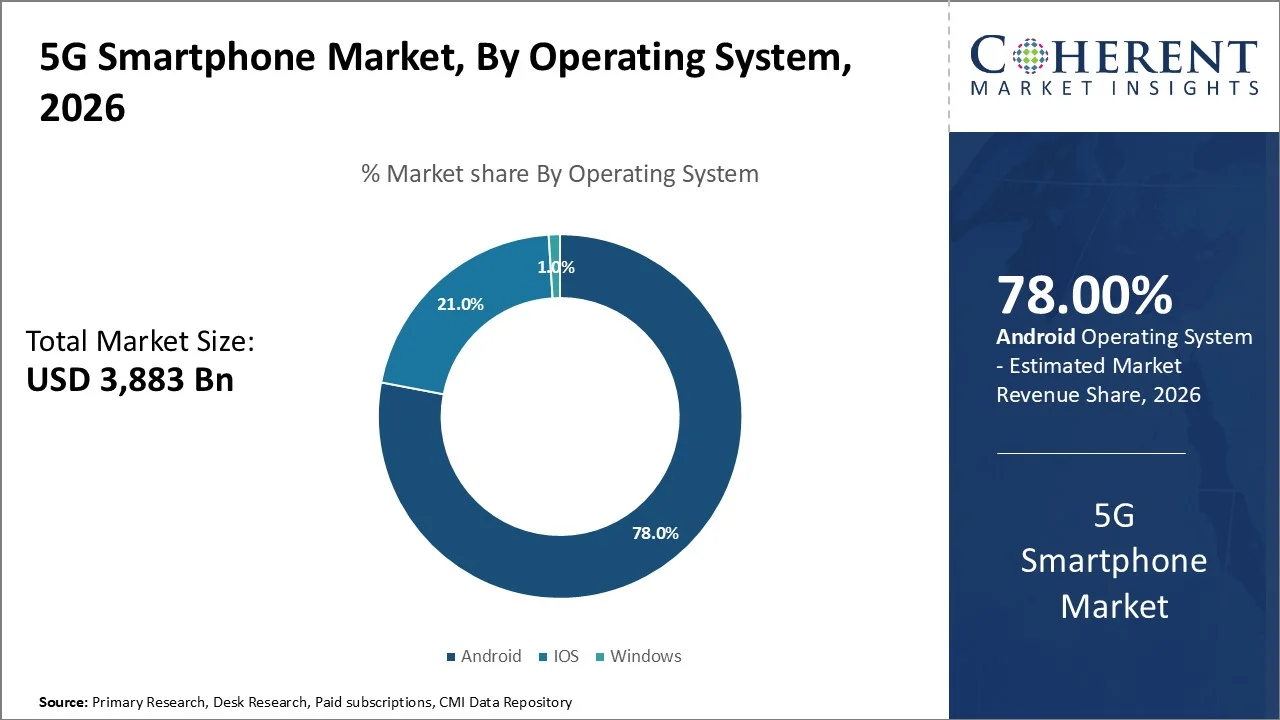
- Based on operating system, the Android segment is expected to have the largest share of the market in 2026, with about 78%, because it is widely used across all price ranges and has a strong global OEM presence. According to IDC (International Data Corporation), Android holds more than 75% of all smartphone sales globally because of its wide-ranging ecosystem and involvement of several manufacturers.
- By sales channel, the offline segment is projected to capture the largest market share of 60% by 2026, owing to customers’ preference for offline transactions and the bundled offerings by operators. According to GSMA, a large portion of the total smartphones sold across developing markets are still accounted for through operator retail channels and offline stores, especially 5G smartphones.
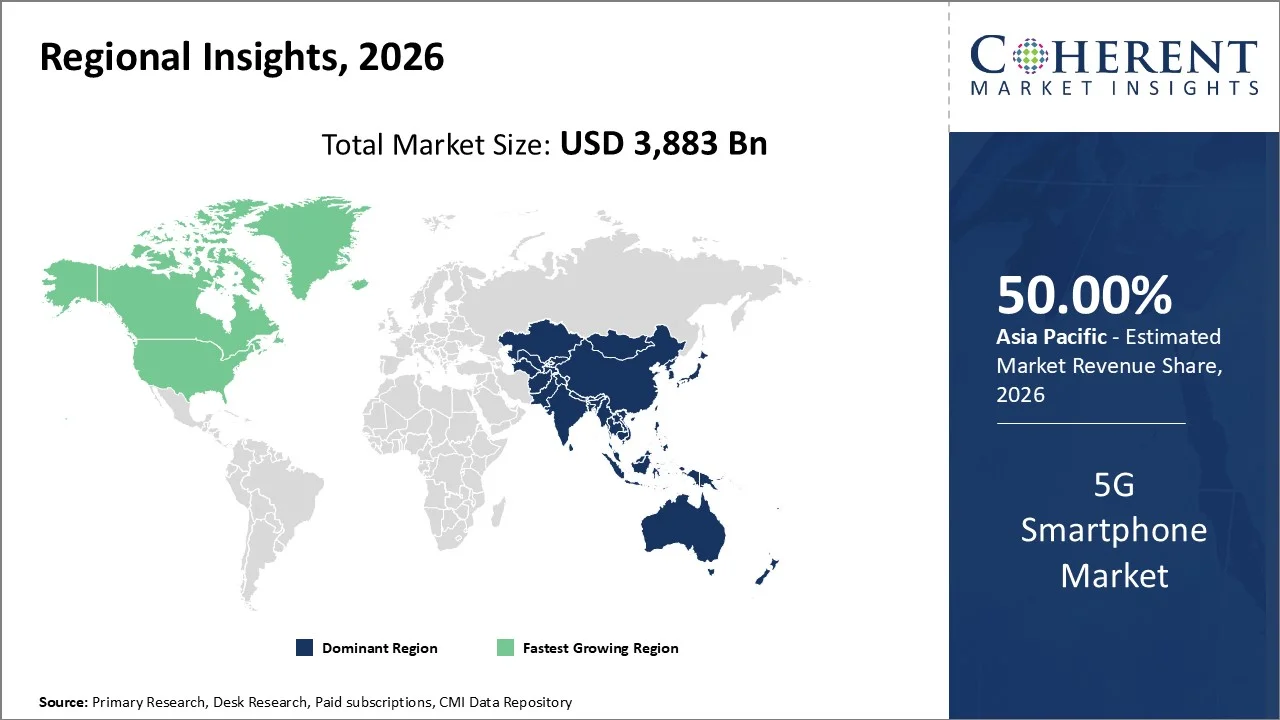
- The Asia Pacific region is anticipated to lead the global market for 5G smartphones owing to its dominance in terms of market share of 50% in 2026. This is due to the high demand in countries like China, India, and South Korea along with the mass adoption of 5G technology. As per a recent study by TechInsights, the Asia Pacific region alone contributes over 54% to the global shipment of 5G smartphones.
Rapid Expansion of 5G Network Infrastructure is Driving the 5G Smartphone Market
The rapid deployment of 5G network facilities, which is accelerating market growth in the worldwide 5G smartphones market. There is an immense investment by telecommunications firms on networks to ensure speed and low latency. Such developments are prompting people to purchase 5G smartphones to maximize benefits of such upgrades.
According to reports from Ericsson, the number of global 5G subscriptions will hit the 5 billion marks by the year 2028, with these numbers making up more than 50 percent of all mobile subscriptions globally. Increased network coverage and especially in urban and semi-urban areas will boost demand for devices.
In May 2025, Vodafone Idea (Vi) collaborated with Ericsson to deploy advanced 5G radio solutions and expand 5G infrastructure across major Indian telecom circles, including Delhi and other regions, significantly increasing network capacity and coverage.
Growing Demand for High-Speed Data and Advanced Applications is Accelerating Market Growth
Increasing use of applications requiring higher bandwidth such as video streaming and gaming apps, there is growing demand for 5G smartphones. The need for fast internet access by consumers is on the increase and the 5G smartphones offer significantly better performance than previous generation.
Based on GSMA, the data traffic via mobile will increase by more than triple from 2023 to 2030, mainly due to videos and immersive media, meaning that there is going to be a demand for 5G-enabled devices. In addition, increasing digitalization in developing nations will fuel this demand.
In March 2026, Qualcomm announced advancements in its Snapdragon 5G AI platform, designed to enhance high-speed data processing, cloud gaming performance, and immersive AR/VR practices on next-generation smartphones.
- Current Industry Events of 2026
- Market Size Estimation
- Regional Breakdown
- Competitive Landscape
- Customer Intelligence
- Segmental Analysis
- Pricing Analysis
- Key Market Drivers, Challenges & Future Trends
- Customized Insights Section
Current Events and Their Impact on the 5G Smartphone Market
Current Event | Description and its Impact |
2026 Expansion of 5G Spectrum Allocation and Digital India Policy Push |
|
Regulatory Drive for Open and Secure 5G Network Infrastructure (Open RAN) |
|
Segmental Insights
Why is Android Expected to Acquire the Largest Market Share in the 5G Smartphone Market?
The Android operating system market share will be the largest in 2026 in the global 5G smartphones market, accounting for 78%. This market dominance by the Android operating system is largely due to the fact that it is extensively used across all price ranges, the presence of different global OEMs such as Samsung, Xiaomi, OPPO, and Vivo, and the open-source model, enabling mass production at relatively lower costs. As a result of the flexibility of the Android operating system, it is applicable for users from both premium and budget 5G smartphone segments.
In March 2026, Qualcomm announced at Mobile World Congress 2026 the expansion of its Snapdragon ecosystem, introducing new AI-powered platforms and 5G connectivity solutions for Android smartphones.
Why does the Offline Sales Channel Dominate the 5G Smartphone Market?
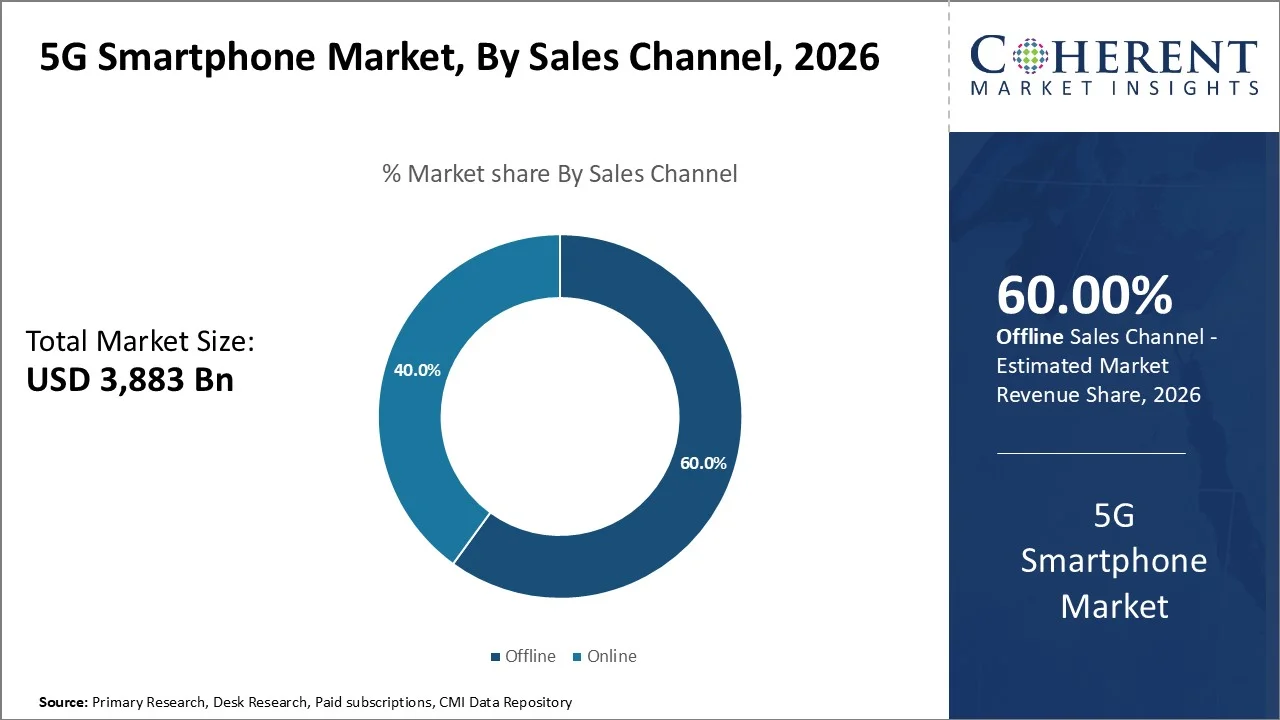
Offline channels will continue to dominate with a market share of about 60% in 2026 because of the high level of consumers’ preference for in-person shopping. Consumers have the chance to test devices in physical stores, and even consult experts on how to choose among the various available products. This is especially important when dealing with costly 5G phones.
Offline sales channels also dominate due to the role played by telecom partnerships in developing nations such as India and China, where telecom companies sell affordable smartphones in packages that include data plans to their clients.
In June 2025, smartphone brands in India increasingly expanded their offline retail strategies in Tier-2 and Tier-3 cities, as companies shifted focus away from purely online sales due to plateauing e-commerce growth.
5G Smartphone Market Trends
Growing demand for low and mid-range 5G smartphones urging mass adoption
The 5G smartphone market would continue to be dominated by affordable and mid-tier phones that offer cheap 5G connectivity to their users. According to research findings reported by IDC, about 60% of all 5G phones that would be shipped across the world by 2025 would be mid-tier 5G phones.
Growing consumption of high-bandwidth applications (video streaming, gaming, AR/VR) is accelerating 5G demand
The growing use of data-heavy apps is contributing considerably to the demand for 5G connectivity. Mobile data traffic across the world is expected to increase by almost 4× from 2023 to 2030 on account of the rise in video streaming and cloud gaming.
Regional Insights
Asia-Pacific Dominates the 5G Smartphone Market
The Asia Pacific region is expected to hold a market share of around 50% in the global 5G smartphones market in 2026 driven by increasing adoption of 5G-enabled phones in countries such as China, India, and South Korea. The dominance of the region would be due to the wide availability of 5G services, high manufacturing capacity of smartphones, and consumption of mid-to-low range 5G smartphones. According to TechInsights, Asia-Pacific contributed over 54% of global 5G smartphone shipments, making it the largest regional market globally.
The leadership within the region is further reinforced owing to the rapid development of the telecom network infrastructure, coupled with the availability of affordable 5G gadgets from prominent brands such as Samsung, Xiaomi, and Oppo.
In April 2026, Xiaomi launched the Redmi A7 Pro 5G in India, expanding its entry-level 5G portfolio. The device features a 32MP AI camera, 6,300mAh battery, and octa-core 5G processor, and is priced at an ultra-affordable segment to boost 5G adoption in price-sensitive markets.
North America is the Fastest-Growing Region in the 5G Smartphone Market
North America is expected to be the fastest-growing region throughout the forecast period, to its quick adoption of 5G technology, purchasing power, and fast pace of innovation of digital products. The region has a high penetration rate for smartphones, particularly premium smartphones.
In October 2025, AT&T announced the nationwide expansion of its 5G Standalone (SA) network, allowing customers to access ultra-low latency services and improved network performance.
5G Smartphone Market Outlook – Country-wise
U.S. 5G Smartphone Market Trends
The U.S. 5G smartphone market is expected to remain continuous during the forecast period because of several factors, including the quick adoption of 5G SA technology, growing demand for premium smartphones, more interest in devices with artificial intelligence, and greater use of data-intensive apps like cloud gaming and AR/VR.
In November 2025, AT&T announced the large-scale deployment of new mid-band spectrum across 23,000 cell sites, significantly increasing 5G network capacity and improving download speeds by up to 80%.
China 5G Smartphone Market Forecast
China will still be among the most significant markets for 5G handsets as a result of its wide deployment of 5G network, vibrant phone manufacturing sector, and the increasing preference for 5G-enabled devices in China. The rapid adoption of smartphones in China is also evident in both urban and rural areas as well as increasing demand for fast internet services.
According to Huawei, more than 300 cities across China have already experienced the availability of 5G-A services and the number of 5G-A users in the country has exceeded 10 million. This is contributing to the increased demand for advanced 5G smartphones.
Who are the Major Companies in 5G Smartphone Industry
Some of the major key players in 5G Smartphone are Huawei Technologies Co., Ltd., SAMSUNG, Apple Inc., BBK Electronics Corporation, Motorola Mobility LLC, LG Electronics, OPPO Mobile Communication Co., Ltd., Xiaomi, Nokia, ASUSTeK Computer Inc., Sony Corporation, Micromax, HTC Corporation, and Lenovo.
Industry News
- In November 2025, Huawei launched the Mate 80 series and Mate X7 foldable smartphone, featuring the Kirin 9030 chipset and HarmonyOS NEXT, marking a fully Android-independent ecosystem with advanced AI and display technologies.
- In February 2026, Samsung Electronics launched the Galaxy S26 series, introducing Privacy Display technology (Galaxy S26 Ultra), enhanced Galaxy AI tools, and Snapdragon 8 Elite chipset integration (U.S. models).
Market Report Scope
5G Smartphone Market Report Coverage
| Report Coverage | Details | ||
|---|---|---|---|
| Base Year: | 2025 | Market Size in 2026: | USD 3,883 Bn |
| Historical Data for: | 2020 To 2024 | Forecast Period: | 2026 To 2033 |
| Forecast Period 2026 to 2033 CAGR: | 124.9% | 2033 Value Projection: | USD 1,124,260 Bn |
| Geographies covered: |
| ||
| Segments covered: |
| ||
| Companies covered: | Huawei Technologies Co., Ltd., SAMSUNG, Apple Inc., BBK Electronics Corporation, Motorola Mobility LLC, LG Electronics, OPPO Mobile Communication Co., Ltd., Xiaomi, Nokia, ASUSTeK Computer Inc., Sony Corporation, Micromax, HTC Corporation, and Lenovo. | ||
| Growth Drivers: |
| ||
| Restraints & Challenges: |
| ||
Analyst Opinion
- The 5G smartphone industry is driven by infrastructure development rather than consumption. The current estimates for worldwide 5G connections stand at above 5 billion by 2028 (GSMA). Therefore, the driver for this development remains infrastructure investments as opposed to consumption-driven ones.
- Shortening of smartphone upgrade cycles will be facilitated by integration of 5G and AI technologies into smartphones. In accordance with IDC analysts, the majority of sold smartphones now are 5G smartphones, as the share of 5G smartphones is greater than 60%. The trend will remain due to demand for speed and AI functionality.
- Mid-range 5G smartphones are the driver for development in the market. In accordance with expert opinion, 5G technology is affordable in developing countries, which makes middle-tier smartphones the largest share of smartphones shipped in terms of 5G market penetration.
Speak to the analyst
Want personalized insights?
Take the findings above to one of our principal consultants, or have the report rebuilt around the segments, geographies and competitors you actually track.
5G Smartphone Market Segmentation
- By Operating System
- IOS
- Android
- Windows
- By Sales Channel
- Online
- Offline
- Global 5G Smartphone Market, By Region
- North America
- U.S.
- Canada
- Latin America
- Brazil
- Mexico
- Argentina
- Rest of Latin America
- Europe
- Germany
- U.K.
- France
- Italy
- Spain
- Russia
- Rest of Europe
- Asia Pacific
- China
- India
- Japan
- Australia
- South Korea
- ASEAN
- Rest of Asia Pacific
- Middle East
- GCC
- Israel
- Rest of Middle East
- Africa
- South Africa
- Central Africa
- North Africa
- North America
Sources
Primary Research Interviews
- Telecom and Mobile Industry Experts
- Smartphone OEM product managers
- 5G chipset manufacturers (Qualcomm, MediaTek ecosystem experts)
- Telecom operators (network planning and deployment teams)
- Retail and e-commerce channel distributors
- Key Opinion Leaders (KOLs) in telecom, mobile networks, and 5G technology
Databases
- International Data Corporation (IDC)
- Gartner Market Research
- GSMA Intelligence Reports
- Ericsson Mobility Reports
- Statista Digital Market Insights
- World Bank Digital Development Indicators
Magazines
- Mobile World Live
- Telecom Review
- Network World
- TechCrunch (Mobile & Wireless section)
- Android Authority
Journals
- IEEE Communications Magazine
- IEEE Transactions on Wireless Communications
- Journal of Network and Computer Applications
- Telecommunications Policy (Elsevier)
- Mobile Networks and Applications (Springer)
Newspapers
- The Wall Street Journal
- Financial Times
- Reuters Technology News
- The Economic Times (Technology section)
- The New York Times (Technology section)
Associations
- 3rd Generation Partnership Project (3GPP)
- GSMA
- 5G Americas
- European Telecommunications Standards Institute (ETSI)
- International Telecommunication Union (ITU)
Public Domain Sources
- Annual reports of smartphone OEMs (Apple, Samsung, Xiaomi, OPPO, etc.)
- Telecom operator annual reports (AT&T, Verizon, T-Mobile, China Mobile, Vodafone)
- Government telecom policy publications (FCC, DoT India, MIIT China)
- Official press releases from smartphone manufacturers and chipset companies
- 3GPP technical specifications and global 5G standard documentation
Proprietary Elements
- Market intelligence and syndicated telecom datasets
- Internal 5G smartphone shipment tracking models
- Competitive benchmarking frameworks for smartphone OEMs
- Historical global smartphone adoption databases
- AI-based telecom and device market forecasting systems
Get access to 250+ pages report
Every segment, forecast, competitor profile and data table behind the analysis above — available for instant download.
- ESOMAR Member
- ISO 9001:2015 Certified
- D-U-N-S Registered
- GDPR & CCPA Compliant
Missing comfort of reading report in your local language? Find your preferred language:
Transform your Strategy with Exclusive Trending Reports
Frequently Asked Questions
The global 5G smartphone market is estimated to be valued at USD 3,883 Bn in 2026.
The global 5G smartphone market value is expected to reach approximately USD 1,124,260 Bn by 2033.
The global market is poised to exhibit a CAGR of 124.9% from 2026 to 2033.
Major growth factors include rapid 5G network expansion, rising demand for high-speed data applications, increasing AI integration in smartphones, and growing adoption of affordable 5G devices.
The Android segment dominates the market with around 78% share in 2026, driven by strong OEM presence and wide affordability across price segments.
Asia-Pacific dominates the market with around 50% share in 2026, driven by strong demand in China, India, and South Korea.
Major companies include Huawei Technologies Co., Ltd., Samsung Electronics, Apple Inc., BBK Electronics Corporation, Xiaomi, OPPO Mobile Communication Co., Ltd., Motorola Mobility LLC, Nokia, ASUS, Sony Corporation, Micromax, HTC Corporation, and Lenovo.