

Global Category Management Software Market Size and Forecast 2026-2033
Global category management software market is estimated to be valued at USD 2.10 Bn in 2026 and is expected to reach USD 4.47 Bn by 2033, exhibiting a compound annual growth rate CAGR of 11.3% from 2026 to 2033.
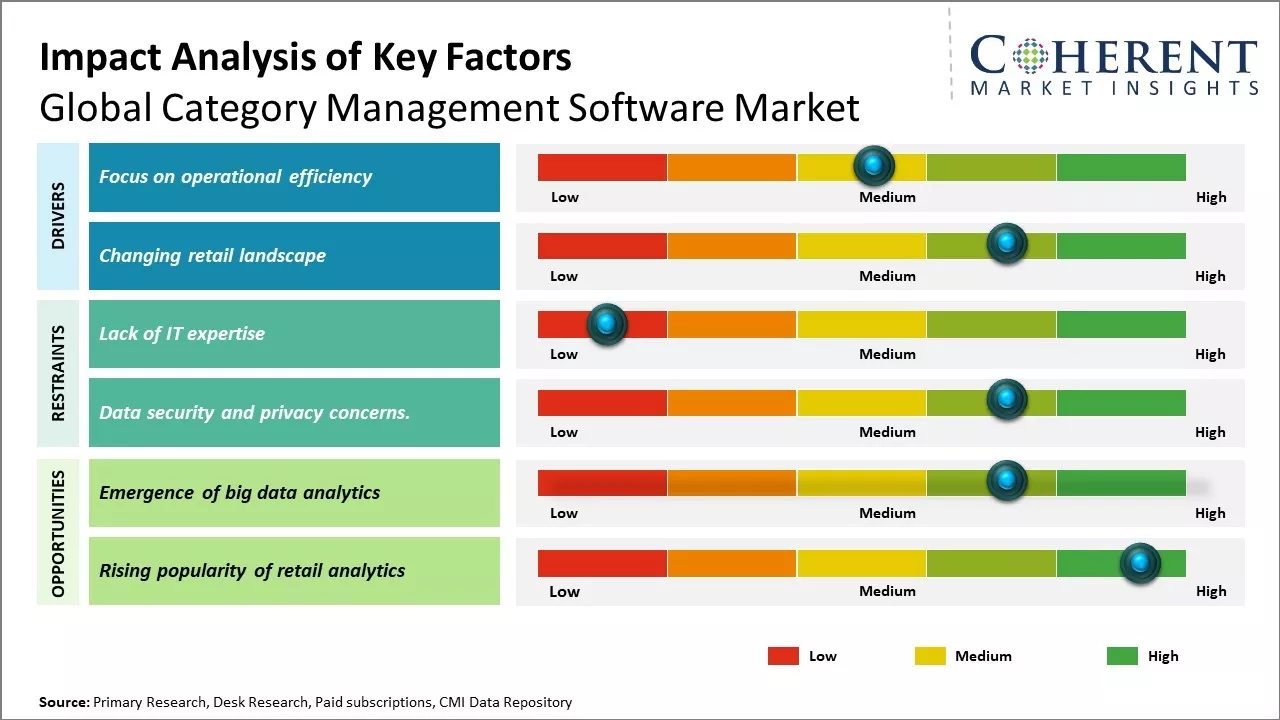
Key Takeaways of the Global Category Management Software Market
- The solutions segment is estimated to contribute the highest market share of 10% in 2026.
- By enterprise size, the large enterprises segment is estimated to contribute the highest market share of 64% in 2026.
- By end-use industry, the retail segment is estimated to contribute the highest market share of 9% in 2026.
- North America dominates the global category management software market with an estimated market share of 7% in 2026.
Market Overview
Category management software is increasingly being adopted by retailers to streamline category planning and optimization processes. The software helps organizations to extract valuable insights from large sets of structured and unstructured data related to customer purchase behavior, pricing, assortment, inventory, and others. It assists merchandisers and category managers in identifying growth opportunities through analytics-driven recommendations. With the retail industry undergoing significant transformation through e-commerce growth, evolving consumer preferences, and competitive pressures, companies are focusing on leveraging big data and advanced analytics to improve category performance. This can boost the demand for category management solutions in the near future.
Market Trends
Focus on operational efficiency
Category management software provides retailers and CPG companies a centralized platform to manage their category operations in a more streamlined manner. The software enables them to analyze category performance, get insights into sales patterns, forecast demand more accurately, and make data-driven decisions regarding assortment, pricing, promotions, and shelf placements. All of this helps optimize operations and boost efficiency. With category management software, companies can save time and effort involved in manual data collection and analysis. The integrated platform automates tasks, brings visibility across departments, and ensures category teams are working with the same set of information and KPIs.
For instance, Walmart continues to leverage AI within its category management and supply chain for precise demand forecasting, working with companies like Helios AI as of February 2025 to predict agricultural commodity prices and availability, ultimately streamlining inventory replenishment and minimizing stock-outs across its vast retail network.
Changing retail landscape
The retail industry is witnessing disruption due to evolving customer needs, growing importance of data, and digitization. Shoppers expect high quality personalized shopping experiences across both online and offline channels. These want seamless omnichannel fulfillment and want to access information the go through mobile apps.
Moreover, these heavily rely on reviews and recommendations while making purchase decisions. This has put retailers under pressure to level their game and focus on customer centricity. Data usage is increasing in retail as companies recognize the need to gain actionable insights from customer transactions, social listening, location intel, and more to stay ahead of the competition. A recent example is Target, which as of early 2025, continues to excel in providing a seamless omnichannel experience, allowing customers to easily check in-store stock via their app and utilize convenient services like "Drive Up" for online orders, integrating their digital and physical shopping journeys effectively.
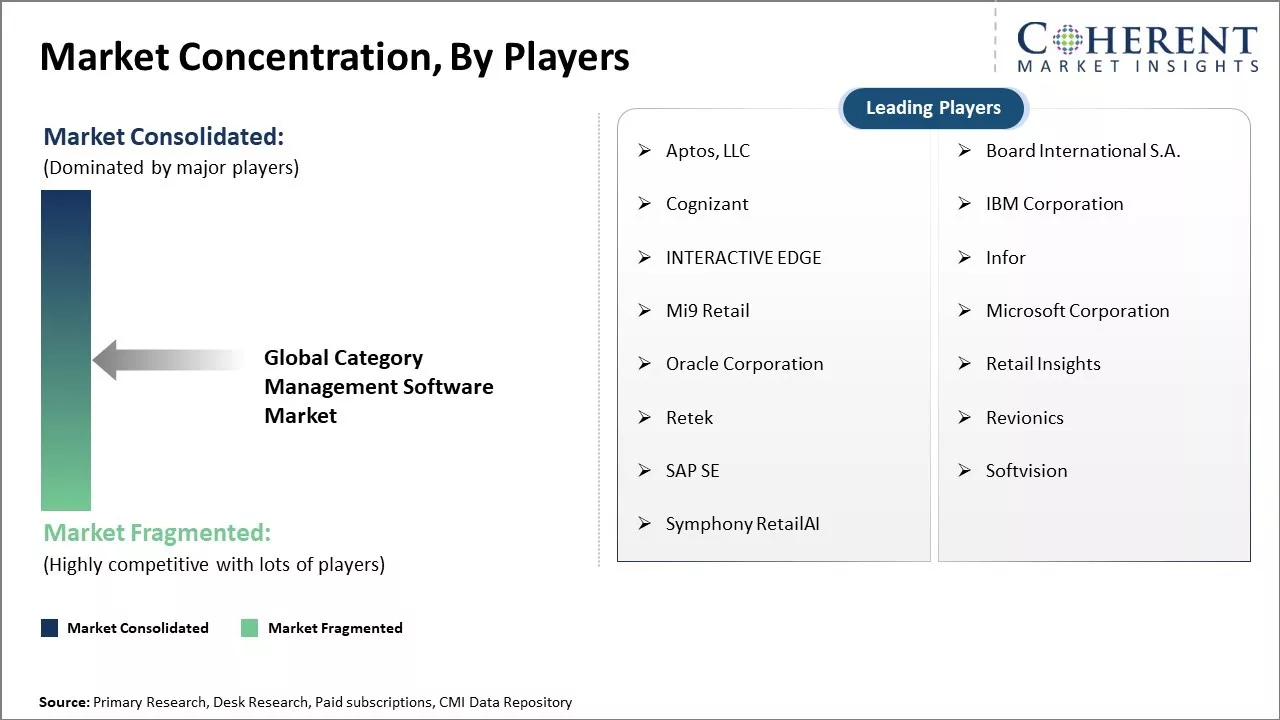
Market Concentration and Competitive Landscape
- Current Industry Events of 2026
- Market Size Estimation
- Regional Breakdown
- Competitive Landscape
- Customer Intelligence
- Segmental Analysis
- Pricing Analysis
- Key Market Drivers, Challenges & Future Trends
- Customized Insights Section
Analyst View
- The global category management software market is clearly on a roll, driven by the overdue realization that retailers and CPG companies desperately need these tools. It's about time businesses embraced data-driven insights to streamline operations, plan smarter assortments, and actually win negotiations, finally gaining a real competitive edge.
- While North America might have had a head start, the real growth story is undeniably unfolding in Asia Pacific, especially with the explosive digitalization in China and India. Businesses not focusing on these markets are simply missing out on the biggest opportunities, despite minor concerns like data privacy and pesky open-source alternatives.
- The path forward is crystal clear: integrate advanced technologies like AI, ML, and cutting-edge analytics. Any platform that isn't heavily investing in these for superior demand forecasting and real-time merchandising is frankly becoming obsolete and will be left behind by those embracing intelligent tools.
Speak to the analyst
Want personalized insights?
Take the findings above to one of our principal consultants, or have the report rebuilt around the segments, geographies and competitors you actually track.
Market Opportunity: Emergence of big data analytics
The emergence of big data analytics can offer an opportunity for the global category management software market growth. Category management software tools that are equipped with advanced big data analytics capabilities allow companies to gain deeper consumer insights and make smarter decisions.
With the abundance of consumer data now available from various online and offline sources, category management software powered by big data analytics can collect, organize, and analyze large volumes of both structured and unstructured data from diverse sources like purchase transactions, loyalty programs, social media, websites, and others. This vast variety of consumer data, when fed into sophisticated analytics models, can provide invaluable insights into customer preferences, purchase behaviors, trends over time, and across regions.
Current Events and Its Impact
Current Events | Description and its impact |
Strategic Industry Consolidation
|
|
Trade Policy Realignments
|
|
Segmental Insights
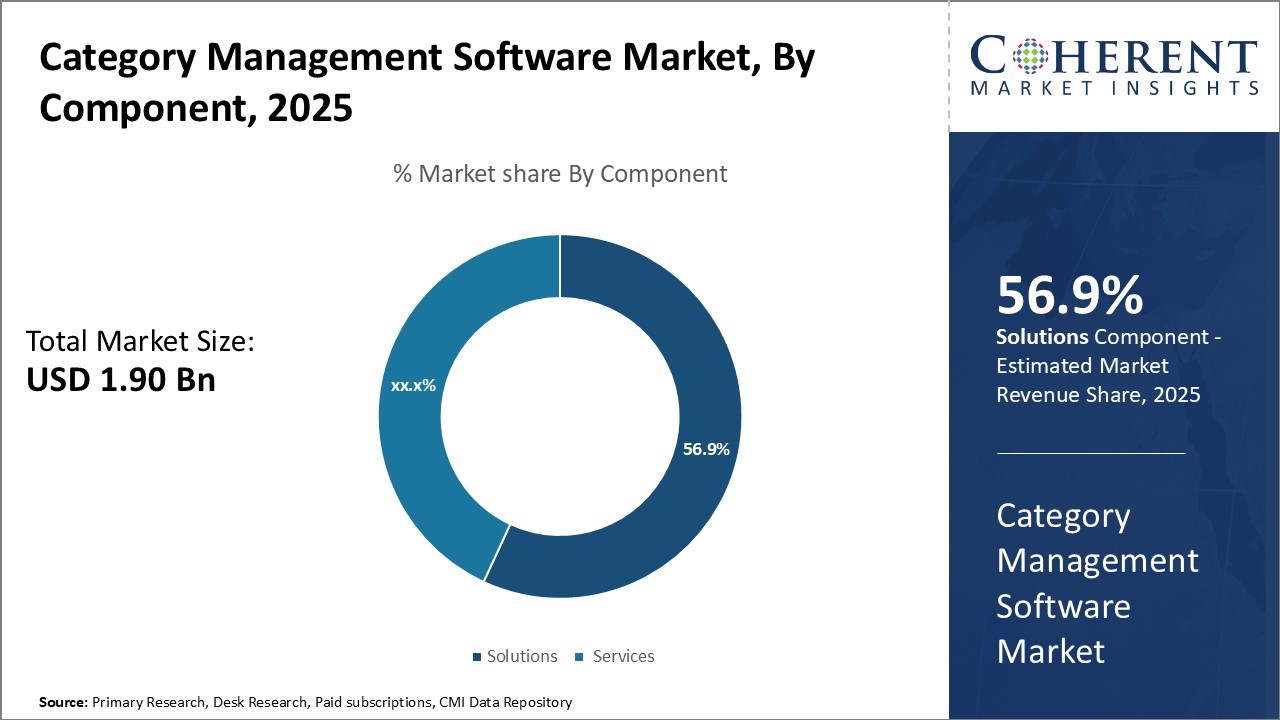
Global Category Management Software Market Insights, by Component
By component, the solutions subsegment is estimated to contribute the highest market share of 57.9% in 2026, owing to its ability to continuously evolve with the changing business needs of organizations. As retail and CPG industries undergo rapid digital transformation, the traditional services-based approach is no longer sufficient to address the complex category management challenges faced by companies. Customers expect highly optimized inventory and personalized shopping experiences across all sales channels at any time.
Solution providers have responded enthusiastically by investing heavily in research and development to roll out new capabilities at a fast pace. Advanced analytics, predictive modeling, and AI-powered decision support have become core features of modern category management platforms. Many solutions now offer out-of-the-box integrations with major ERP, supply chain, and e-commerce systems to provide a 360-degree view of the end-to-end category performance.
Furthermore, vendors are focusing on delivering enhanced flexibility and scalability through cloud-hosted SaaS models. This allows customers instant access to the latest upgrades and innovations without additional infrastructure costs and maintenance headaches. The ability to instantly deploy centralized category strategies across global operations has transformed how multinational businesses optimize their portfolio.
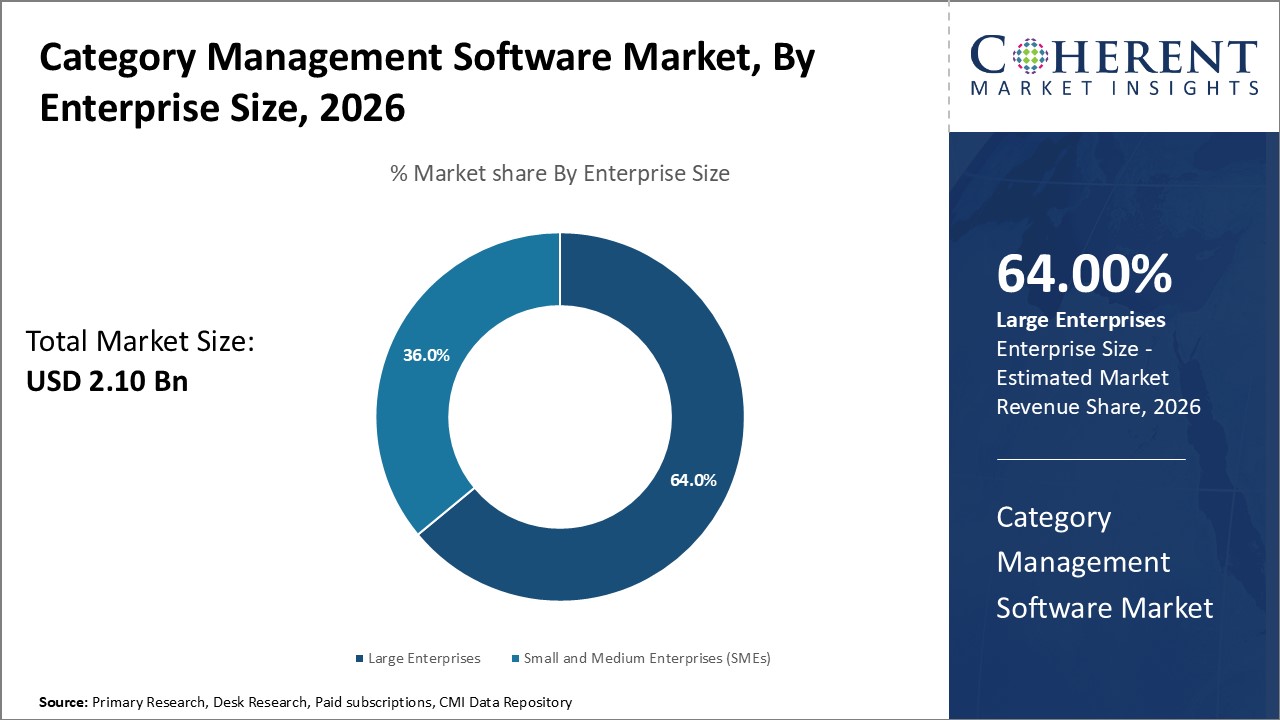
Global Category Management Software Market Insights, by Enterprise Size
By enterprise size, the large enterprises segment is estimated to contribute the highest market share of 64% in 2026, due to their ability to leverage economies of scale advantages. Category management is a complex discipline requiring significant investments in specialized software, implementation services, data management infrastructure and ongoing training/support costs. This presents a substantial barrier for smaller businesses to adopt advanced solutions.
Large enterprises have considerably deeper pockets to devote large annual budgets towards category enablement initiatives. These can negotiate favorable enterprise licensing deals, often receiving additional customization and priority support services bundled in. For large retailers and CPGs with operations spanning multiple countries/regions, a centralized category management platform provides consolidated visibility and control over global operations. This drives further standardization, best practice sharing, and optimization of efforts.
Global Category Management Software Market Insights, by End-use Industry
By end-use industry, the retail subsegment is estimated to contribute the highest market share of 48.8% in 2026, due to its need for quick reaction times. As the frontline battleground between brands and shoppers, retail operations require real-time visibility and responsiveness to optimize in-store merchandising and promotional strategies. Shoppers expect ever-changing yet enticing product displays, personalized deals, and recommendations tailored for their individual preferences and buying moments.
Furthermore, retailers must optimize localized assortments, factoring in hyper-local demand patterns and competitive landscape variations. While national brands face uniform demands, retailers stock products from hundreds of vendors and own private labels. Intensive category reviews encompassing micro-level store performance details are crucial. Advanced software automates these highly customized, frequent reviews, factoring shifts in consumer preferences, seasons, and even weather changes.
Regional Insights
North America Category Management Software Industry Trends and Market Analysis
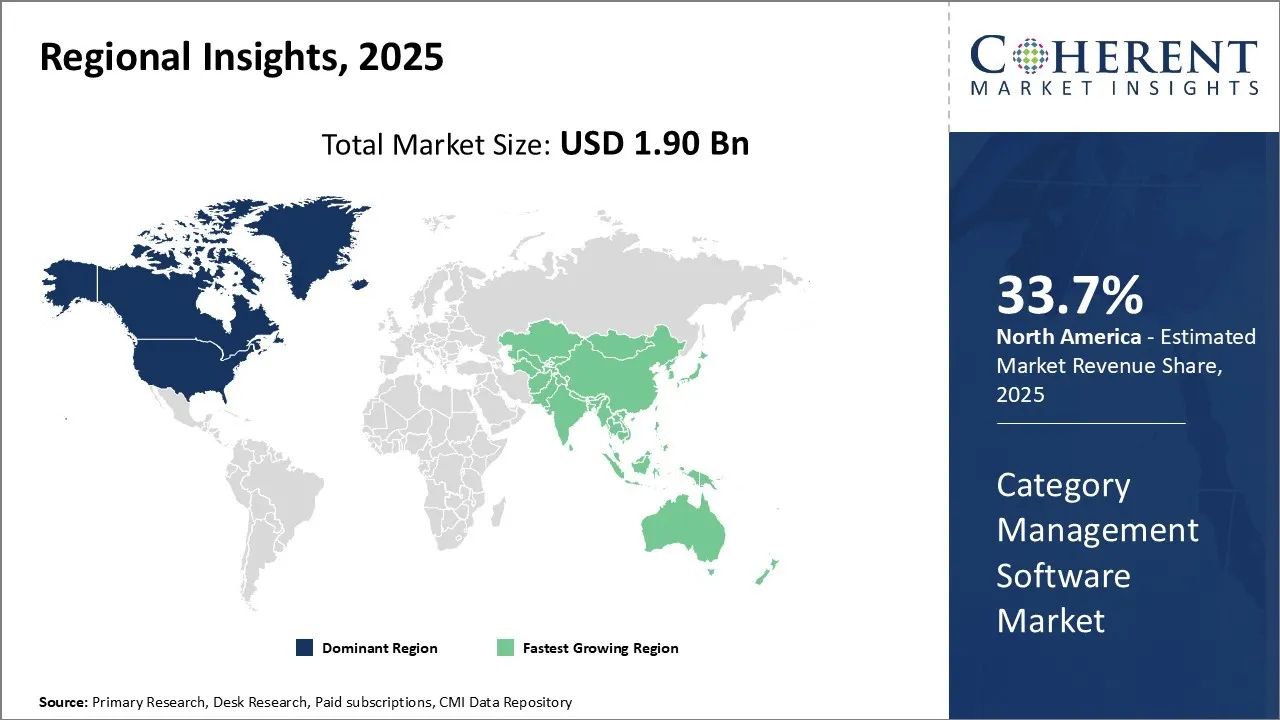
North America dominates the global category management software market with an estimated market share of 33.7% in 2026, owing to early adoption by retailers looking to streamline operations and gain efficiencies. The large and highly competitive retail landscape in the U.S. and Canada prompted many major retailers to invest in category management software to get a competitive edge through optimized assortment and pricing strategies. The presence of headquarters of leading category management software vendors in the U.S. also drives the market growth. This growth is also supported by the continued rise in retail store numbers, with U.S. convenience stores alone seeing a 1.5% increase in 2024 to 152,396.
Market Research on Asia Pacific Category Management Software Market: Key Trends and Regional Insights
Asia Pacific region is emerging as the fastest growing regional market for category management software. Rapid growth of the retail sector, rising disposable incomes, and increasing penetration of internet and smartphones can boost adoption of new technologies across Asian retailers. In particular, China and India are displaying high enthusiasm to leverage category management software to manage huge product portfolios and satisfy the demand of vast customer base.
Several large local retailers are implementing category management solutions to better understand changing customer preferences and tailor their private label offerings. Internationalization of Asian retailers through expansion plans also necessitates the implementation of category management practices for overseas markets. Asia Pacific software market is expected to exhibit a robust Compound Annual Growth Rate (CAGR) of 14.8% from 2026 to 2030.
Key software vendors are focusing on the Asia Pacific region by establishing local offices, engaging channel partners for distribution, and customizing products according to regional requirements. The pricing of category management solutions is also relatively affordable for small and medium retailers in Asia compared to developed markets, owing to lower cost of doing business. The demand for category management is also supported by the import and export of consumer products within the region and globally.
U.S. Category Management Software Industry Trends and Market Analysis
The U.S. Category Management Software industry is experiencing rapid growth and is expected to exhibit a 13.9% CAGR during the forecast period. This growth is fueled by the increasing need for data-driven decisions, intense retail competition, and the expansion of e-commerce and omnichannel strategies. Cloud-based solutions, accounting for 67.9% of implementations, and the integration of AI/ML for advanced analytics and automation are key trends, enhancing capabilities like demand forecasting and personalized assortments. The rise in retail stores and complex supply chains further drives the demand for these solutions.
India Category Management Software Industry Trends and Market Analysis
The India Category Management Software industry is driven by a booming retail sector, increased digitalization, and the rising adoption of e-commerce and omnichannel strategies. Businesses are prioritizing data-driven decision-making to optimize product assortments and enhance profitability.
A recent example is Symphony Innovation LLC, an India-based company, which in January 2024 launched an AI-powered "category manager copilot system" in collaboration with Microsoft Azure, demonstrating significant improvements in forecasting accuracy and planning efficiency for retailers and CPG companies. This highlights the industry's shift towards advanced AI and ML capabilities for deeper market insights.
Market Report Scope
Category Management Software Market Report Coverage
| Report Coverage | Details | ||
|---|---|---|---|
| Base Year: | 2025 | Market Size in 2026: | USD 2.10 Bn |
| Historical Data for: | 2020 To 2024 | Forecast Period: | 2026 To 2033 |
| Forecast Period 2026 to 2033 CAGR: | 11.3% | 2033 Value Projection: | USD 4.47 Bn |
| Geographies covered: |
| ||
| Segments covered: |
| ||
| Companies covered: | Aptos, LLC, Board International S.A., Cognizant, IBM Corporation, INTERACTIVE EDGE, Infor, Mi9 Retail, Microsoft Corporation, Oracle Corporation, Retail Insights, Retek, Revionics, SAP SE, Softvision, and Symphony RetailAI | ||
| Growth Drivers: |
| ||
| Restraints & Challenges: |
| ||
Global Category Management Software Industry News
- On May 12, 2025 Ivalua, a global leader in spend management, and Fincons Group, a leading IT business consultancy and system integrator, announced a strategic partnership to support the digital transformation of procurement processes for organizations at an international level.
- On January 29, 2025, ServiceNow and SoftwareOne announced a strategic partnership to transform IT modernization in the cloud
- In 2024, SAP Ariba introduced enhanced features for guided buying and category compliance. These updates included more intuitive interfaces and improved functionalities for ensuring users adhere to established category strategies and preferred supplier agreements, thereby strengthening compliance and efficiency in managing spend categories.
- In 2023, Zycus, a leader in cognitive procurement solutions, announced significant expansions to its Merlin AI Suite.
Impact of AI on Global Category Management Software Market
- AI is revolutionizing category management software by adding automated analytics, predictive insights, and intelligent functions to traditional procurement tools.
- Real-world applications of AI include enhanced demand forecasting, like Walmart's use for inventory optimization, and advanced supplier risk management, enabling more proactive and efficient procurement.
- Companies like SAP, with its Ariba Guided Buying are leveraging AI to streamline procurement processes through personalized recommendations, automated supplier mapping, and real-time compliance checks, leading to significant cost savings and improved decision-making.
Emerging Applications Impacting the Market
- Category management software is increasingly focusing on sustainability and environmental, social, and governance integration, moving beyond its traditional emphasis on efficiency and cost savings.
- The future of this software will heavily rely on advanced analytics and AI for features like predictive supplier risk assessment, automated negotiation processes, and real-time pricing analysis.
- Beyond retail, category management principles are finding novel applications in diverse sectors such as pharmaceutical benefit management, municipal asset categorization, and even emerging areas like food security forecasting and digital asset management.
Market Segmentation
- By Component (Revenue, USD Bn, 2021 - 2033)
- Solutions
- Services
- By Enterprise Size (Revenue, USD Bn, 2021 - 2033)
- Small and Medium Enterprises (SMEs)
- Large Enterprises
- By End-use Industry (Revenue, USD Bn, 2021 - 2033)
- Retail
- Distribution
- Consumer Packaged Goods
- By Region (Revenue, USD Bn, 2021 - 2033)
- North America
- U.S.
- Canada
- Latin America
- Brazil
- Argentina
- Mexico
- Rest of Latin America
- Europe
- Germany
- U.K.
- Spain
- France
- Italy
- Russia
- Rest of Europe
- Asia Pacific
- China
- India
- Japan
- Australia
- South Korea
- ASEAN
- Rest of Asia Pacific
- Middle East
- GCC Countries
- Israel
- Rest of Middle East
- Africa
- South Africa
- North Africa
- Central Africa
- North America
- Key Players Insights
- Aptos, LLC
- Board International S.A.
- Cognizant
- IBM Corporation
- INTERACTIVE EDGE
- Infor
- Mi9 Retail
- Microsoft Corporation
- Oracle Corporation
- Retail Insights
- Retek
- Revionics
- SAP SE
- Softvision
- Symphony RetailAI
Sources
Stakeholders
- Senior Executives from Category Management Software Providers
- Product and Marketing Managers from e-commerce Companies
- Technology Consultants and Industry Experts
- End-users from Retail and FMCG Industries
- Others
Public Domain Sources
- Company Websites/Investor Relations (SAP, Oracle, IBM, etc.)
- Government and Regulatory Bodies Reports (U.S. Department of Commerce, European Commission, etc.)
- Annual Reports of Key Market Players
- Others
Magazines
- Retail Dive
- Internet Retailer Magazine
- CIO Magazine
- Others
Journals
- Journal of Retailing and Consumer Services
- International Journal of Information Management
- Information Systems Journal
- Others
Newspapers
- Financial Times
- The Wall Street Journal
- The Economic Times
- Others
Associations
- National Retail Federation (NRF)
- Category Management Association (CMA)
- Internet Retailing Association
- Others
Proprietary Elements
- CMI Data Analytics Tool, Proprietary CMI Existing Repository of information for last 8 years
*Definition: Global category management software market refers to a type of commercial software that helps companies manage their product categories and assortments more efficiently on a global scale. This type of software allows businesses to analyze category performance, optimize assortments factoring in global demand and supply, source the best products internationally based on price and quality, and collaborate effectively across geographically distributed teams, suppliers, and partners when making category and assortment planning decisions that span multiple countries and regions worldwide.
Get access to 250+ pages report
Every segment, forecast, competitor profile and data table behind the analysis above — available for instant download.
- ESOMAR Member
- ISO 9001:2015 Certified
- D-U-N-S Registered
- GDPR & CCPA Compliant
Missing comfort of reading report in your local language? Find your preferred language:
Transform your Strategy with Exclusive Trending Reports
Frequently Asked Questions
The category management software market is estimated to be valued at USD 2.10 Bn in 2026, and is expected to reach USD 4.47 Bn by 2033.
The CAGR of the category management software market is projected to be 11.3% from 2026 to 2033.
Focus on operational efficiency and the changing retail landscape are the major factors driving the growth of the global category management software market.
Lack of IT expertise and data security, and privacy concerns are the major factors hampering the growth of the global category management software market.
In terms of component, the solutions segment is estimated to dominate the market in 2026.
Aptos, LLC, Board International S.A., Cognizant, IBM Corporation, INTERACTIVE EDGE, Infor, Mi9 Retail, Microsoft Corporation, Oracle Corporation, Retail Insights, Retek, Revionics, SAP SE, Softvision, and Symphony RetailAI are the major players.
North America is expected to lead the global category management software market in 2026.