

Virtual Reality Content Creation Market Size and Share Analysis: (2026-2033)
The virtual reality content creation market size is anticipated to grow at a CAGR of 24.5% with USD 11.28 Bn in 2026 and is expected to reach USD 52.17 Bn in 2033. The primary drivers are largely defined by rising adoption of immersive technologies and VR content across gaming, healthcare, real estate, and engineering sectors. Some of the other contributing factors include the increasing demand for interactive training, simulation-based learning, virtual tours, and digital engagement solutions. In 2026, the global VR user base is projected to reach around 300 million, thereby reflecting strong uptake across North America and Europe and strengthening the growth of the virtual reality content creation market.
Key Takeaways
- The videos segment is likely to dominate the market with 45.8% in 2026. The segment’s growth is owing to the growing demand for immersive storytelling, branded VR experiences, and educational simulations that use 360 degree and 3D video to increase engagement across consumer and enterprise audiences, with an estimated 53 million U.S. adults owning VR systems who could consume such content as of late 2025.
- The software segment is set to lead with 64.2% in 2026. The segment’s growth is owing to its critical role in enabling real time rendering, intuitive creation workflows, AI assisted asset generation, and cross platform publishing, making software the backbone of scalable VR content pipelines, supported by widespread adoption of immersive technologies across federal agencies, with 17 of 23 civilian agencies reporting use of VR and similar technologies in recent years.
- The gaming & entertainment segment is set to lead with 39.6% in 2026. The segment’s growth is owing to the expanding VR gaming community, increased investment in VR titles and interactive media, and the rising consumer expectations for more engaging as well as participatory forms of entertainment.
- North America is expected to acquire the prominent share of 37.40% in 2026. The region’s growth is owing to the high concentration of VR developers, strong technology infrastructure, early adoption of immersive platforms by media and entertainment companies, and widespread integration of VR in training and simulation sectors, with the U.S. Department of Homeland Security alone having used immersive simulators to train nearly 10,000 employees in fiscal year 2022.
Segmental Insights
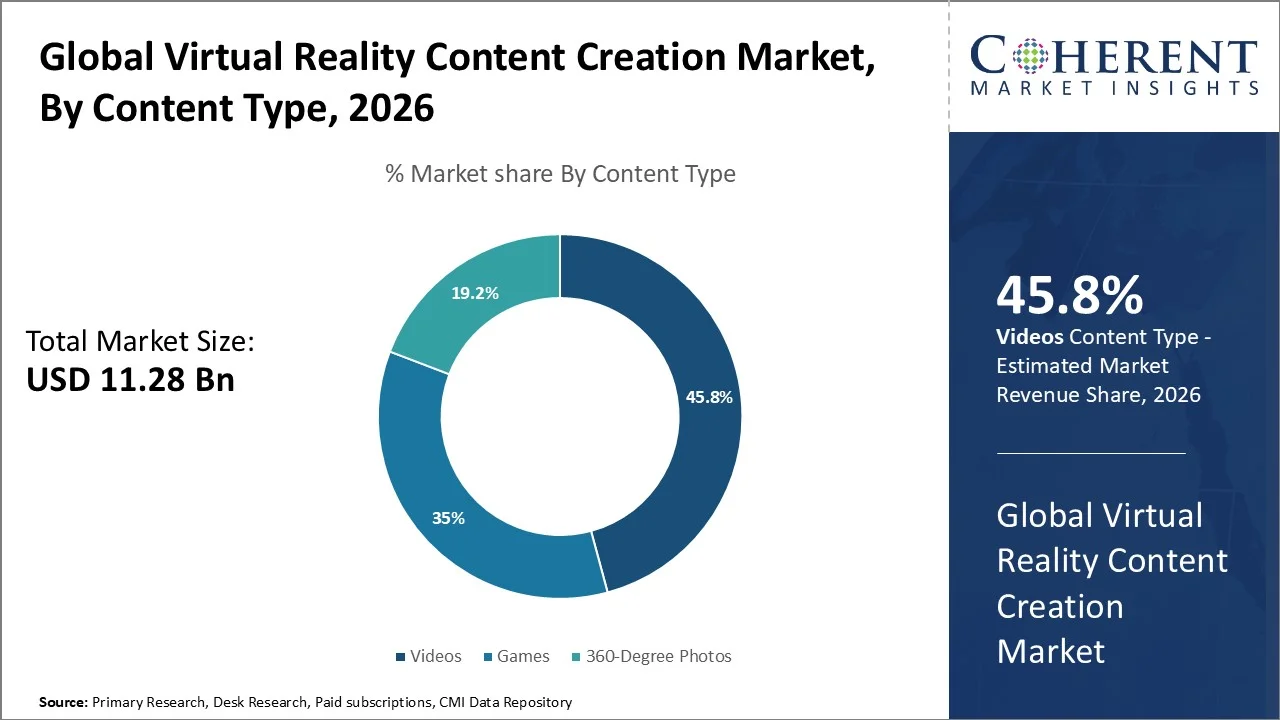
Why is Videos Acquiring the Largest Share?
On the basis of content type, the videos segment is projected to account for the largest Virtual Reality Content Creation Market share of 45.8% in 2026. The segment’s growth is owing to the shift from static 3D assets toward immersive, watchable formats such as 360-degree videos, spatial videos, VR trailers, training videos, virtual tours, and interactive brand films.
Official media-use data supports this shift: Ofcom reported that 91% of adult internet users watched videos or clips on video-sharing platforms, while YouTube alone reached 78% of adult internet users. According to the Ofcom’s 2025 children’s media literacy survey 96% of children aged 3–17 watched videos on video-sharing platforms. This video-first audience base encourages the creators, studios, educators, and enterprises to prioritize VR video production.
In November 2024, Apple launched Final Cut Pro 11 with spatial video editing support for Apple Vision Pro, strengthening professional tools for immersive video creation.
- Current Industry Events of 2026
- Market Size Estimation
- Regional Breakdown
- Competitive Landscape
- Customer Intelligence
- Segmental Analysis
- Pricing Analysis
- Key Market Drivers, Challenges & Future Trends
- Customized Insights Section
Gaming & Entertainment hold the Largest Market Share
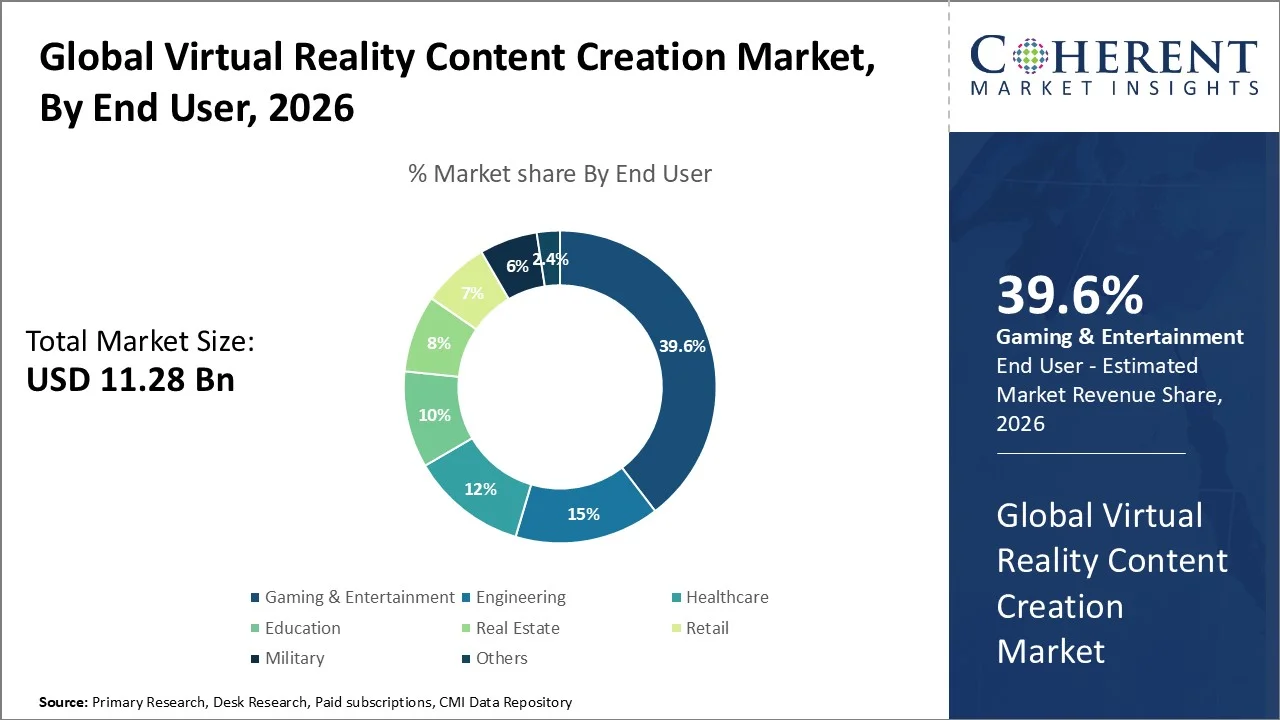
The gaming & entertainment segment lead with a major 39.6% share in 2026. The segment’s growth is owing to the high-capacity public networks and government-backed interactive infrastructure.
For instance, the data published by the Telecom Regulatory Authority of India (TRAI) verifies a solid operating foundation for data-heavy spatial environments, documenting 979.71 million active broadband subscribers. Concurrently, peer-reviewed data hosted by the National Institutes of Health (NIH) reveals that consumer demand for immersive gaming remains exceptionally strong, with 47% of active digital gamers engaging in gameplay for over 10 hours per week.
The state-level agencies are injecting major financial backing to scale these critical development ecosystems. Brazil's National Fund for Scientific and Technological Development (FNDCT) launched targeted, mission-oriented funding programs to channel capital into cutting edge cloud-computing infrastructure, software research platforms, and immersive spatial technology ecosystems.
Market Drivers
Growing Demand for Immersive and Interactive Experiences is Transforming the Virtual Reality Content Creation Market in the US
The Virtual Reality Content Creation Market in the U.S. is expanding at a rapid pace. This is due to the increasing demand for immersive and interactive experiences in gaming, education, training, retail, and enterprise communications. These sectors are adopting real-time 3D environments, 360-degree video, spatial audio, and interactive storytelling to enhance both user engagement as well as learning outcomes.
According to the U.S. Bureau of Economic Analysis, the arts and cultural economic activity grew by 6.6% in 2023, representing 4.2% of U.S. GDP, or approximately USD 1.17 trillion. This demonstrates a strong economic base for digital media and immersive content creation. In addition, the U.S. Bureau of Labor Statistics projects that software developers, quality-assurance analysts, and testers will grow by 15% from 2024 to 2034, thereby creating about 129,200 annual job openings that strengthen the VR application and platform development.
In a key development, Apple launched visionOS 26, providing enhanced volumetric APIs, immersive media capabilities, and cutting edge hand-tracking. It empowers creators to produce richer content for the Vision Pro platform.
Generative AI Based VR World Creation: A Major Breakthrough in the Virtual Reality Content Creation Market
The generative AI-based VR world creation is emerging as a major breakthrough in the Virtual Reality Content Creation Market. This technology allows the creators to transform prompts, images, CAD files, and scenario logic into fully interactive 3D environments, thereby substantially reducing manual modeling time and accelerating prototyping.
The adoption of AI in immersive content is growing at a swift pace. The Eurostat reported that 20% of EU enterprises used artificial intelligence technologies in 2025, up from 13.5% in 2024. Also nearly 9.5% of enterprises specifically used AI to generate pictures, videos, sound, or audio, thereby strengthening the VR asset creation.
In December 2025, the European Commission launched the European Partnership for Virtual Worlds, providing up to €200 million in funding, with matching investments of €200 million from members during 2025–2030. The initiative aims to advance research, standardization, skills development, as well as deployment of human-centric virtual worlds in various sectors like education, healthcare, manufacturing, culture, and creative content.
Current Events and Their Impact on the Virtual Reality Content Creation Market
Current Event | Description and its Impact |
U.S. FTC Endorsement Guides and Advertising Rules Effective 2026
|
|
EU AI Act Article 50 Transparency Rules Effective August 2026 |
|
Virtual Reality Content Creation Market Trends
- The rising demand for immersive storytelling in gaming, films, training, live events, and virtual tours is expanding the need for 360 degree video, spatial audio, and interactive 3D environments.
- The shift toward mixed reality and spatial computing is increasing the demand for creators who can blend virtual assets with the real world spaces. Meta introduced Quest 3S in 2024 at USD 299.99, thereby lowering access barriers, while Apple Vision Pro became available in the U.S. in February 2024.
- The software based VR production workflows using Unity, Unreal Engine, and AI assisted design tools assist in reducing development time and improving content scalability. Unity supports visionOS app modes like Mixed Reality Volume, Immersive Space, and Fully Immersive Space.
- The enterprise adoption in healthcare, education, design, logistics, engineering, and manufacturing is strengthening the demand for simulation and training content. The European Commission stated that 98% of interviewed professionals believe XR technologies will contribute substantially to sector development over the next five years.
- Strong gaming and digital media consumption supports the monetizable VR content libraries. In 2025, the U.S. consumer spending on video games reached USD 60.7 billion, while ESA’s global gaming survey covered more than 24,000 players across 21 countries.
Regional Insights
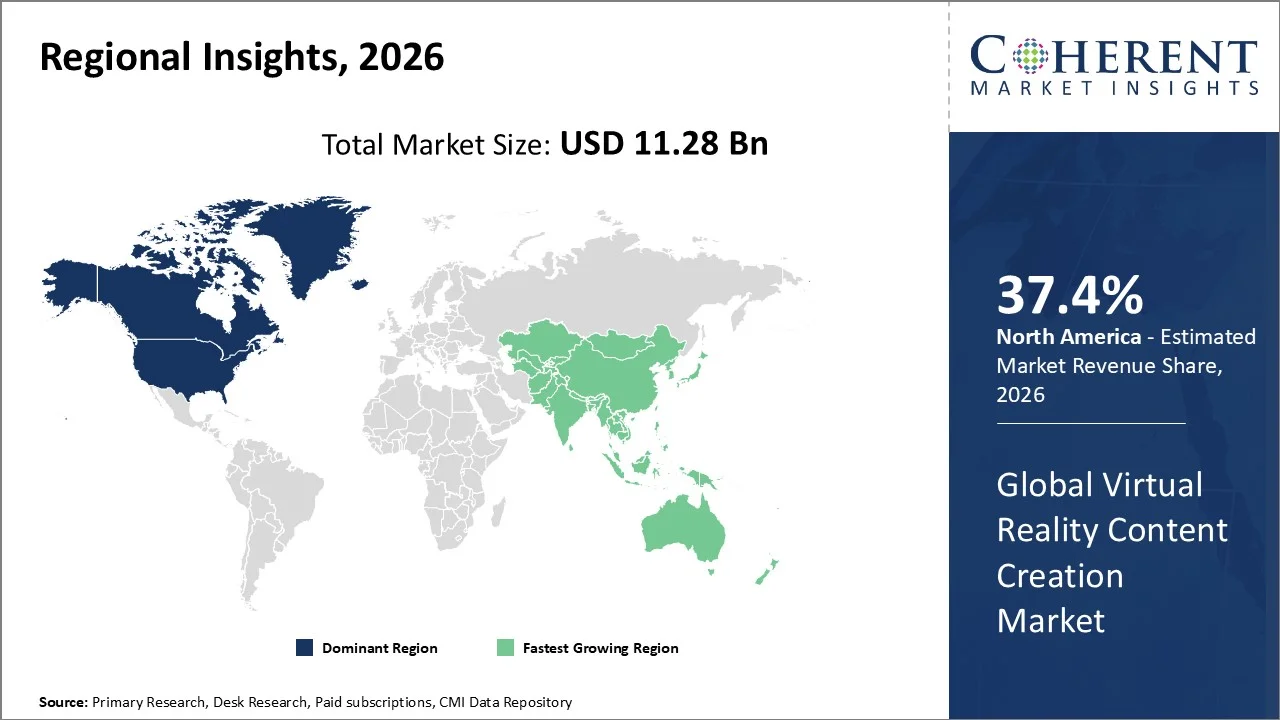
North America Dominates Owing to the Rising Adoption of Immersive Technologies
The North America region accounts for 37.4% of the market share in 2026. The region’s growth is owing to the rising adoption of immersive technologies across federal agencies and increasing investments in evidence-based VR content. The integration of VR in training, analytics, and public engagement initiatives further fuels market expansion.
According to a U.S. GAO report, about 16 federal agencies reported plans to grow or adopt VR and other immersive technologies between fiscal years 2024–2028, thereby highlighting the government-led demand for VR content development. The Canadian government launched a C$300 million (USD 215 million) initiative to expand AR/VR capabilities in education and remote learning. These technologies are becoming central to the development of immersive learning tools as well as virtual training environments.
A notable development is the U.S. Department of Education awarding a nearly USD 1.7 million research grant to study VR’s impact on science learning outcomes, reflecting direct investment in content creation and educational application.
Asia Pacific Virtual Reality Content Creation Market Trends
Asia Pacific is expected to witness strong growth in Virtual Reality Content Creation Market over the forecast period. The region’s growth is owing to government-backed XR infrastructure, expanding creator training, and rising demand for immersive media across gaming, education, tourism, and enterprise applications.
China’s 2022–2026 VR action plan sets a 2026 target for the domestic virtual reality industry to exceed RMB 350 billion, with VR terminal sales surpassing 25 million units, creating a larger base for VR content production and distribution. In India, Budget 2026–27 proposed AVGC Content Creator Labs in 15,000 secondary schools and 500 colleges, backed by ₹250 crore, strengthening the creator pipeline for XR-ready content.
A key recent development was IICT’s May 2025 strategic collaborations with Google, YouTube, Meta, Adobe, Microsoft, NVIDIA, Wacom, and JioStar to support AVGC-XR curricula, internships, incubation, and startup-led immersive content creation across scalable regional creator ecosystems.
Growing Consumer Adoption and Technological Advancements is Accelerating the Virtual Reality Content Creation Market in United States
The U.S. Virtual Reality Content Creation Market is expanding at a rapid pace. This is due to the growing consumer adoption, technological advancements, and favorable policy support. Approximately 18 % of U.S. households now own VR or AR devices, thereby boosting the demand for immersive content in entertainment, education, healthcare, and industrial training applications.
In March 2025, the bipartisan United States Leadership in Immersive Technology Act was introduced to Congress to promote domestic innovation, research, and workforce development in immersive technology fields, thereby potentially benefiting content creators and developers nationwide.
In addition, strategic partnerships between media studios and VR developers are speeding up the production of high-quality, interactive content for next-generation headsets, while enterprise adoption in simulation and training also propels the market growth.
China Virtual Reality Content Creation Market Trends
The growth in China’s virtual reality content creation market is driven by the expanding immersive technology adoption and enhanced policy support for digital industries. As of the end of 2024, China had more than 10,000 companies operating in the VR sector. This reflects rapid ecosystem growth in hardware, software, and immersive content creation niches. The Virtual Reality and Industry Integration Action Plan (2022–2026) seeks to boost VR content production in culture, education, and industrial applications by 2026.
A recent product development signal is the filmmaking sector’s surge in VR films, with over 220 VR films officially registered and 39 receiving formal content certification under a new regulatory notice from China’s national film authority in April 2026, supporting sector‑specific content creation and distribution infrastructure.
Who are the Major Companies in Virtual Reality Content Creation Industry
Some of the major key players in Virtual Reality Content Creation Market are 360 Labs, Blippar, Koncept VR, Matterport, Panedia Pty Ltd., SubVRsive, Vizor, Voxelus, WeMakeVR, and Wevr.
Key News
- In March 2026, the University of Johannesburg (UJ) inaugurated its Library Virtual Reality (VR) Lab at the Bunting Road Campus Library. The lab is designed to provide VR demonstrations and immersive experiences, supporting the development of virtual and augmented reality applications for teaching, academic research, and student projects.
- In March 2026, Digital Rights Network announced the launch of a platform connecting real estate owners with content creators, media companies, brands, and IP holders in order to monetize the digital layer of real-world properties.
- In April 2026, Excurio introduced LBXR Pulse, a large-scale VR system. It is designed for multi-user free-roam experiences, thereby enhancing content creation by overcoming low throughput, rigid space design, and limited content rotation in the VR entertainment sector.
- In July 2025, Tencent’s Hunyuan team launched Hunyuan 3D World Model 1.0, an open-source AI model that can generate interactive, explorable 3D environments from text or image prompts. The model supports faster creation of immersive virtual worlds, making it highly relevant for game development, virtual reality experiences, and digital content creation.
Market Report Scope
Virtual Reality Content Creation Market Report Coverage
| Report Coverage | Details | ||
|---|---|---|---|
| Base Year: | 2025 | Market Size in 2026: | USD 11.28 Bn |
| Historical Data for: | 2020 To 2024 | Forecast Period: | 2026 To 2033 |
| Forecast Period 2026 to 2033 CAGR: | 24.5% | 2033 Value Projection: | USD 52.17 Bn |
| Geographies covered: |
| ||
| Segments covered: |
| ||
| Companies covered: | 360 Labs, Blippar, Koncept VR, Matterport, Panedia Pty Ltd., SubVRsive, Vizor, Voxelus, WeMakeVR, and Wevr. | ||
| Growth Drivers: |
| ||
| Restraints & Challenges: |
| ||
Analyst Opinion
- Virtual reality is moving from niche adoption to mainstream usage. Over 171 million people worldwide engage with VR by 2025, participating in gaming, learning, and immersive media experiences. This growth isn’t driven by trends alone, but its driven by increasing accessibility and consumer demand for interactive, experiential content.
- In key markets like the United States, about tens of millions of consumers own or use VR headsets. The awareness and adoption continue to rise as devices become more affordable, content ecosystems expand, and VR applications extend beyond gaming into education, enterprise, and professional training.
- Gaming remains the dominant driver of VR engagement, but immersive content for training, simulation, collaboration, and creative experiences is growing at a rapid pace. The adoption of high-quality, interactive VR content is encouraging creators to develop richer environments, which in turn propels the market growth across both consumer as well as professional segments, thereby establishing VR as a versatile and enduring platform.
Speak to the analyst
Want personalized insights?
Take the findings above to one of our principal consultants, or have the report rebuilt around the segments, geographies and competitors you actually track.
Market Segmentation
- By Content Type (Revenue, USD Bn, 2021-2033)
- Videos
- 360 Degree Photos
- Games
- By Component (Revenue, USD Bn, 2021-2033)
- Software
- Services
- By End User (Revenue, USD Bn, 2021-2033)
- Gaming and Entertainment
- Engineering
- Healthcare
- Real Estate
- Retail
- Military
- Education
- Others
- By Region (Revenue, USD Bn, 2021-2033)
- North America
- U.S.
- Canada
- Latin America
- Brazil
- Mexico
- Argentina
- Rest of Latin America
- Europe
- Germany
- U.K.
- France
- Italy
- Spain
- Russia
- Rest of Europe
- Asia Pacific
- China
- India
- Japan
- Australia
- South Korea
- ASEAN
- Rest of Asia Pacific
- Middle East
- GCC
- Israel
- Rest of Middle East
- Africa
- South Africa
- Central Africa
- North Africa
- North America
- Key Players
- 360 Labs
- Blippar
- Koncept VR
- Matterport
- Panedia Pty Ltd.
- SubVRsive
- Vizor
- Voxelus
- WeMakeVR
- Wevr
Sources
Primary Research Interviews
- Virtual Reality Content Creation Software Providers
- VR Game and Simulation Developers
- 360-Degree Video Production Studios
- AR/VR Content Designers and 3D Artists
- Enterprise Training and Simulation Solution Providers
- Media & Entertainment Production Houses
- Healthcare VR Content Developers
- Education and E-learning VR Platform Providers
- Real Estate Virtual Tour Solution Providers
- Others
Databases
- Bloomberg Terminal
- Thomson Reuters Eikon
- S&P Global Market Intelligence
- PitchBook
- Crunchbase
- Statista
- Euromonitor International
- IDC
- Gartner
- Others
Magazines
- XR Today
- VRScout
- UploadVR
- Road to VR
- ARPost
- GamesIndustry.biz
- Animation Magazine
- Digital Studio Middle East
- Others
Journals
- IEEE Transactions on Visualization and Computer Graphics
- ACM Transactions on Graphics
- Virtual Reality Journal
- Presence: Teleoperators and Virtual Environments
- Entertainment Computing Journal
- Journal of Virtual Worlds Research
- Computers & Graphics Journal
- International Journal of Human–Computer Studies
- Others
Newspapers
- Financial Times
- The Wall Street Journal
- Reuters
- Bloomberg News
- The New York Times
- The Economic Times
- Business Standard
- Others
Associations
- XR Association
- VR/AR Association
- Augmented World Expo
- Academy Software Foundation
- Khronos Group
- International Game Developers Association
- IEEE Computer Society
- Digital Entertainment Group
- Others
Public Domain Sources
- U.S. Bureau of Labor Statistics
- U.S. Census Bureau
- European Commission – Digital Strategy
- World Bank Open Data
- OECD Digital Economy Outlook
- ITU Digital Development Data
- WIPO Global Innovation Index
- UNESCO Institute for Statistics
- Others
Proprietary Elements
- CMI Data Analytics Tool
- Proprietary CMI Existing Repository of Information for the Last 8 Years
Get access to 250+ pages report
Every segment, forecast, competitor profile and data table behind the analysis above — available for instant download.
- ESOMAR Member
- ISO 9001:2015 Certified
- D-U-N-S Registered
- GDPR & CCPA Compliant
Missing comfort of reading report in your local language? Find your preferred language:
Transform your Strategy with Exclusive Trending Reports
Frequently Asked Questions
The Virtual Reality Content Creation Market is expected to reach USD 52.17 Bn in 2033.
Major players operating in the global Virtual Reality Content Creation Market include 360 Labs, Blippar, Koncept VR, Matterport, Panedia Pty Ltd., SubVRsive, Vizor, Voxelus, WeMakeVR, and Wevr.
The exorbitant development costs, steep technical learning curves, and severe hardware fragmentation across the industry are the key factors hampering growth of the market.
The advancement and accessibility of spatial computing hardware, rising demand for immersive enterprise training, surging interest in the metaverse, and ongoing technological innovations in AI-assisted content creation software is boosting the demand for Virtual Reality Content Creation.
The Virtual Reality Content Creation Market is anticipated to grow at a CAGR of 24.5% between 2026 and 2033.
Among regions, North America is expected to account for a largest market share in the global Virtual Reality Content Creation Market over the forecast period.