

Kiosk Market Size and Forecast – 2026 to 2033
The Kiosk Market is anticipated to grow at a CAGR of 6.3% with USD 29.7 Bn share in 2026 and is expected to reach USD 39.2 Bn in 2033. Businesses are adopting self-service automation, contactless transaction solutions, digital technologies across retail and healthcare, and interactive customer engagement platforms, driving the growth of the kiosk market. Globally, 88% of organizations use AI or automation in at least one business function.
Key Takeaways
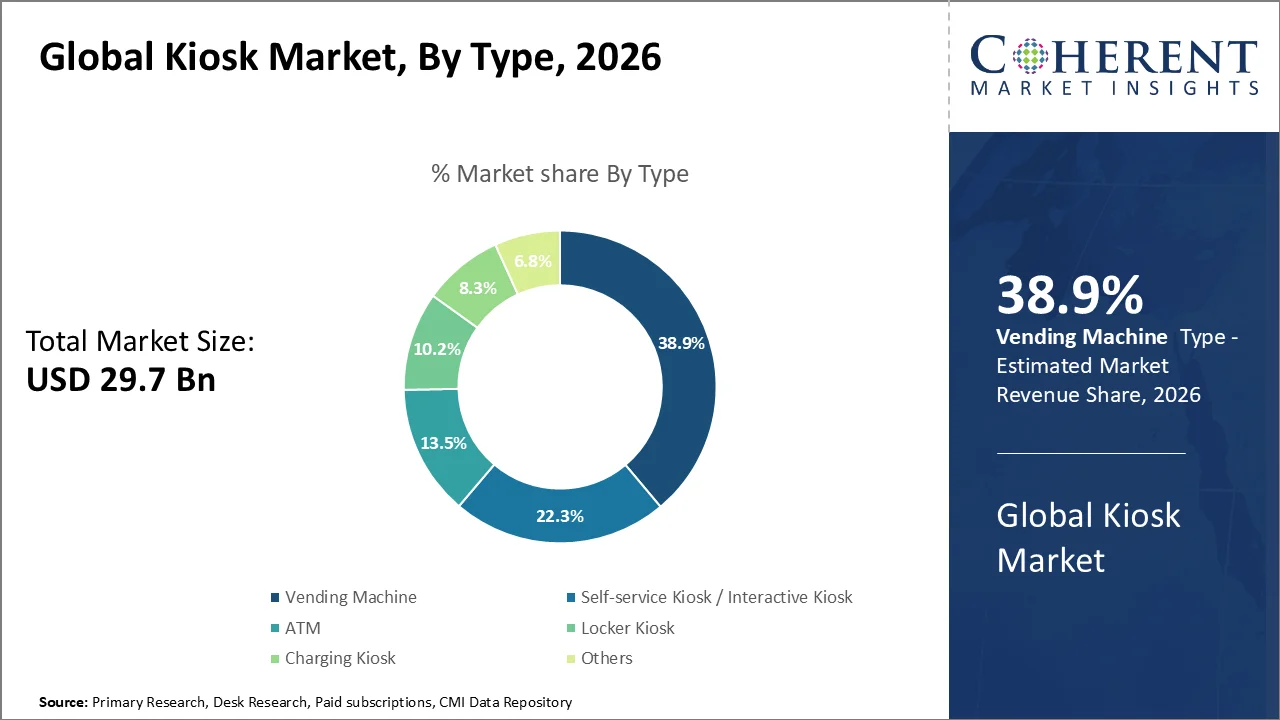
- Vending Machine hold the largest market share of 38.9% in 2026 owing to its growing demand for self-service solutions. Japan has an estimated 5 million vending machines, about one for every 25–30 people.
- Commercial Complexes expected to hold largest market share of 39.1% in 2026 owing to the increasing foot traffic.
- North America is expected to acquire the dominant share of 41.1% in 2026 owing to the high adoption of self-service technologies. The U.S. is projected to have 1.2 million healthcare kiosks by 2025.
Current Events and Their Impact on the Kiosk Market
Current Event | Description and its Impact |
CMS Digital Health Infrastructure Initiative (June 2025) |
|
White House–CMS Digital Health Ecosystem Commitments (July 2025) |
|
Segmental Insights
- Current Industry Events of 2026
- Market Size Estimation
- Regional Breakdown
- Competitive Landscape
- Customer Intelligence
- Segmental Analysis
- Pricing Analysis
- Key Market Drivers, Challenges & Future Trends
- Customized Insights Section
Why is Vending Machine Acquiring the Largest Market Share?
Vending Machine holds the largest market share of 38.9% in 2026. Businesses are driving growth in the kiosk market by deploying vending machines that deliver convenient, self-service retail experiences across transportation hubs, offices, hospitals, educational institutions, and commercial spaces. They are leveraging cashless payment systems, AI, IoT, and remote monitoring to improve operational efficiency, optimize inventory management, and enhance customer engagement. Organizations are installing smart vending machines to overcome labor shortages, lower operating costs, and provide round-the-clock service. They are also expanding product offerings to include fresh food, beverages, electronics, and personal care items, further strengthening market growth. For instance, in October 2025, Amazon unveiled prescription drug kiosks at select One Medical offices in Los Angeles through Amazon Pharmacy, allowing patients to pick up medications within minutes of their doctor visits and potentially disrupting traditional pharmacies.
Which End User segment dominates the market?
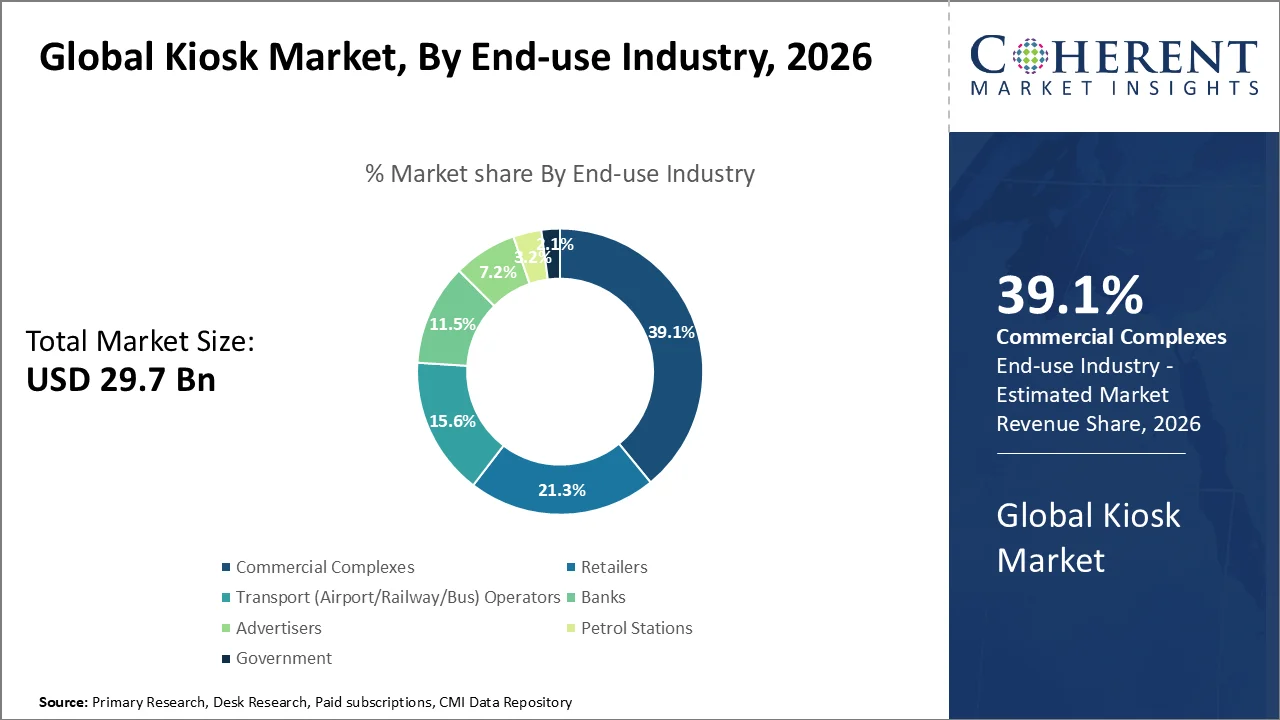
Commercial Complexes expected to hold largest market share of 39.1% in 2026. Shopping malls, mixed-use developments, and office complexes are driving growth in the kiosk market by adopting self-service solutions that improve customer convenience and operational efficiency. Businesses are deploying kiosks for wayfinding, self-ordering, ticketing, payments, and visitor management to streamline customer interactions. They are integrating these kiosks with cashless payment systems, loyalty programs, and digital advertising platforms to enhance customer engagement. Increasing foot traffic, accelerating retail digitalization, and the need to shorten service wait times are further encouraging businesses to expand kiosk deployments across commercial environments. For instance, Russo Modular, a Phoenix-based factory-built steel building manufacturer, partnered with Town Pump, Inc. to create Stonehouse Coffee Shots, a 400-square-foot modular coffee kiosk for placement outside Town Pump convenience stores and truck stops.
Kiosk Market Trends
- Growing demand for contactless and cashless transactions is accelerating the deployment of kiosks integrated with mobile wallets, QR codes, NFC, and biometric authentication. According to the Federal Reserve, 93% of U.S. consumers used at least one digital payment method in 2024, supporting increasing demand for contactless self-service solutions.
- Businesses are expanding self-service kiosk deployments across retail, healthcare, banking, hospitality, transportation, and government sectors to improve customer experience and operational efficiency. Self-service kiosks help reduce transaction times, lower labor requirements, and provide 24/7 service availability, making them an increasingly important customer engagement channel.
- Increasing adoption of self-ordering and self-checkout kiosks is transforming retail and quick-service restaurants by reducing wait times, improving order accuracy, and streamlining customer service. According to the National Restaurant Association, 65% of restaurant operators report that automation and technology improve labor productivity, while self-ordering kiosks typically increase average order values by 10–30% through digital upselling and menu personalization.
Regional Insights
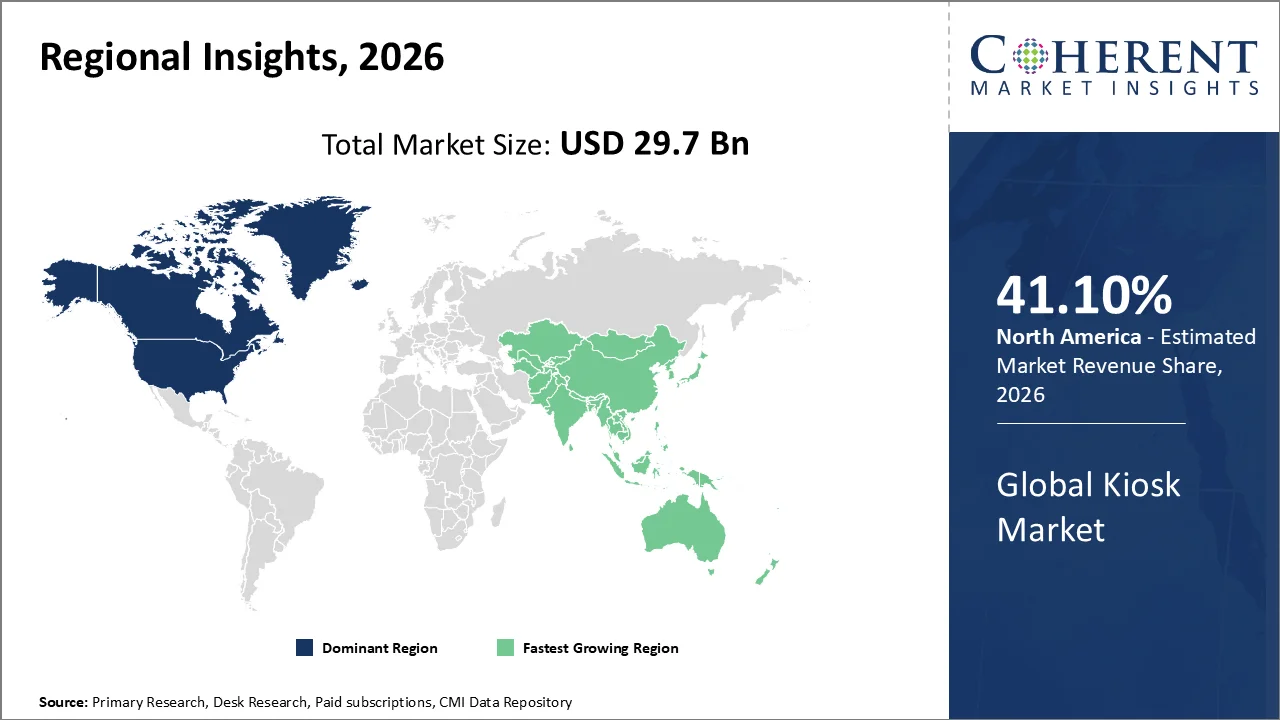
North America dominates owing to expansion of retail and quick-service restaurants (QSRs)
North America is expected to acquire the dominant share of 41.10% in 2026. Retailers, healthcare providers, banks, hospitality companies, transportation operators, and government agencies are driving growth in North America's kiosk market by expanding self-service solutions across their operations. These organizations are adopting AI-enabled kiosks, cashless payment technologies, and cloud-based management systems to enhance customer experience and improve operational efficiency. Retailers and quick-service restaurants are deploying more self-ordering and self-checkout kiosks to address labor shortages and reduce wait times. They are also investing in automation and leveraging the region's strong digital infrastructure and widespread consumer acceptance of self-service technologies to support market expansion. For instance, Bay Area startup Queue launched the first fully autonomous robotic pharmacy kiosks after raising $18.6 million in seed and pre-seed funding led by AlleyCorp and Riot Ventures.
Asia Pacific Kiosk Market Trends
Rapid urbanization, expanding retail networks, and the growing adoption of self-service technologies across transportation, healthcare, banking, and hospitality drive the Asia Pacific kiosk market. About 55% of the global population lives in urban areas, a share projected to reach 68% by 2050. Consumers increasingly demand faster, contactless, and more convenient services, prompting businesses to install interactive kiosks. Governments promote digital transformation and smart city initiatives, accelerating kiosk adoption across the region. Businesses also invest in modern infrastructure, leverage widespread smartphone usage, and integrate advanced digital payment systems to improve operational efficiency, reduce labor dependence, and deliver better customer experiences. For instance, in July 2026, The postal department launched a self-service Speed Post booking kiosk in Jamshedpur, aiming to enhance customer experience and increase revenue through technology-driven services.
United States Kiosk Market Trends
The United States kiosk market grows as businesses across retail, healthcare, banking, transportation, and hospitality sectors increasingly adopt self-service solutions. Companies use kiosks to lower operational expenses, enhance customer convenience, and reduce wait times. Consumers’ growing preference for contactless payments and digital transactions accelerates market adoption. Technology providers integrate advanced touchscreen interfaces, cloud connectivity, artificial intelligence, and biometric authentication to improve kiosk performance and user engagement. Labor constraints, automation efforts, and government initiatives for digital public services further drive businesses and organizations to expand kiosk deployments nationwide. For instance, in May 2026, Outpost launched a second-generation gate automation kiosk that deploys in one day and cuts gate operating costs by up to 70%, supporting more than 3 million annual gate events across 30+ terminals and customer sites.
China Kiosk Market Trends
China’s kiosk market grows as rapid urbanization, rising demand for self-service solutions, and widespread digital payment adoption shape consumer and business behavior. Companies use kiosks to enhance customer experiences, lower operational expenses, and improve service efficiency across retail, transportation, healthcare, and hospitality industries. Government programs promoting smart cities and digital transformation strengthen market expansion. Consumers increasingly seek convenient, fast, and contactless services, encouraging businesses to deploy more interactive and automated kiosk systems throughout China.
Who are the Major Companies in Kiosk Industry
Some of the major key players in Kiosk are ZIVELO, Acrelec, Wincor Nixdorf International, Diebold Nixdorf, Inc., Triton Systems of Delaware, FUJITSU, Slabb Inc., Glory Ltd, Q-Matic Corporation, GRGBanking, Phoenix Kiosk, IER, Olea Kiosk Inc., KIOSK Information Systems, NCR Corporation, Kontron AG, Nautilus Hyosung, and Meridian Kiosk.
Key News
- In May 2026, MedPredict launched MediElaj, an AI-powered healthcare app and smart diagnostic kiosk platform that expands access to early diagnosis, preventive care, and health screenings across India’s urban, semi-urban, and rural areas.
Market Report Scope
Kiosk Market Report Coverage
| Report Coverage | Details | ||
|---|---|---|---|
| Base Year: | 2025 | Market Size in 2026: | USD 29.7 Bn |
| Historical Data for: | 2020 To 2024 | Forecast Period: | 2026 To 2033 |
| Forecast Period 2026 to 2033 CAGR: | 6.3% | 2033 Value Projection: | USD 39.2 Bn |
| Geographies covered: |
| ||
| Segments covered: |
| ||
| Companies covered: | ZIVELO, Acrelec, Wincor Nixdorf International, Diebold Nixdorf, Inc., Triton Systems of Delaware, FUJITSU, Slabb Inc., Glory Ltd, Q-Matic Corporation, GRGBanking, Phoenix Kiosk, IER, Olea Kiosk Inc., KIOSK Information Systems, NCR Corporation, Kontron AG, Nautilus Hyosung, and Meridian Kiosk. | ||
Analyst Opinion
- The kiosk market is shifting from being a convenience tool to becoming a core operational technology for businesses facing labor shortages and rising service expectations. Adoption is no longer driven only by customer preference; enterprises are investing in kiosks to maintain service continuity, improve throughput, and standardize customer interactions. For example, major quick-service restaurant chains have expanded self-ordering kiosks because these systems can handle high-volume transactions while allowing staff to focus on food preparation and customer support.
- Self-service kiosks are becoming increasingly important in sectors where speed and accuracy directly impact customer satisfaction. The retail and transportation industries demonstrate this shift clearly, with automated check-in, ticketing, and payment systems becoming common across airports, metro networks, and large-format stores. According to industry observations, airports worldwide have deployed thousands of self-service check-in and baggage kiosks to reduce queue times and streamline passenger processing, showing how kiosks are evolving into essential infrastructure rather than optional equipment.
- The next phase of kiosk adoption will be defined by artificial intelligence, biometrics, and connected technologies rather than traditional touchscreen functionality. AI-enabled kiosks can provide personalized recommendations, support multiple languages, and analyze customer behavior in real time. For instance, retailers and hospitality operators are increasingly testing AI-powered ordering and information kiosks to improve engagement and operational efficiency. In our assessment, businesses that integrate intelligent features will gain a competitive advantage, as customers increasingly expect faster, more personalized, and contactless service experiences.
Speak to the analyst
Want personalized insights?
Take the findings above to one of our principal consultants, or have the report rebuilt around the segments, geographies and competitors you actually track.
Market Segmentation
- By Type (Revenue, USD Bn, 2021-2033)
- Vending Machine
- Drink Vending Machine
- Food Vending Machine
- Photo Vending Machine
- DVD Rental
- Self-service Kiosk / Interactive Kiosk
- Information Kiosk
- Ticketing Kiosk
- Patient Interactive Kiosk
- Check-in Kiosk
- Employment Kiosk
- Bill Payment Kiosk
- ATM
- Locker Kiosk
- Charging Kiosk Others (such as Web Payphone, Gaming)
- Vending Machine
- By End-use Industry (Revenue, USD Bn, 2021-2033)
- Retailers
- Transport (Airport/Railway/Bus) Operators
- Banks
- Advertisers
- Petrol Stations
- Commercial Complexes (Educational Institutes and Hospitals)
- Government
- By Region (Revenue, USD Bn, 2021-2033)
- North America
- U.S.
- Canada
- Latin America
- Brazil
- Mexico
- Argentina
- Rest of Latin America
- Europe
- Germany
- U.K.
- France
- Italy
- Spain
- Russia
- Rest of Europe
- Asia Pacific
- China
- India
- Japan
- Australia
- South Korea
- ASEAN
- Rest of Asia Pacific
- Middle East
- GCC
- Israel
- Rest of Middle East
- Africa
- South Africa
- Central Africa
- North Africa
- North America
Sources
Primary Research Interviews
- Interviews with kiosk manufacturers, suppliers, technology providers, component vendors, distributors, retailers, and end-user organizations.
- Discussions with industry professionals, business owners, and operational managers involved in kiosk deployment and management.
- Feedback collected from stakeholders across retail, healthcare, transportation, hospitality, banking, and government sectors.
Databases
- Government trade and commerce databases.
- Company annual reports, investor presentations, and regulatory filings.
- Industry-specific business databases and product catalogs.
- Trade statistics and import-export databases.
Magazines
- Industry magazines covering retail technology, self-service solutions, automation, digital transformation, and customer experience technologies.
- Technology and business publications featuring kiosk innovations and deployment trends.
Journals
- Peer-reviewed journals covering human-computer interaction, automation, digital payment systems, retail technology, and self-service technologies.
- Academic publications related to interactive systems, customer behavior, and emerging technologies.
Newspapers
- Business newspapers and technology news publications covering market developments, investments, partnerships, product launches, and industry trends.
- Regional and global news sources reporting on kiosk adoption across different sectors.
Associations:
- Industry associations related to retail technology, automation, payment systems, information technology, and digital transformation.
- Trade organizations and technology forums providing industry standards, insights, and sector updates.
Public Domain Sources
- Government publications, regulatory documents, and statistical databases.
- Publicly available company websites, product information, press releases, and technical documentation.
- Open-access industry reports, white papers, conference materials, and research publications.
- International trade and economic development resources.
Proprietary Elements
- CMI Data Analytics Tool
- Proprietary CMI Existing Repository of information for the last 10 years.
Get access to 250+ pages report
Every segment, forecast, competitor profile and data table behind the analysis above — available for instant download.
- ESOMAR Member
- ISO 9001:2015 Certified
- D-U-N-S Registered
- GDPR & CCPA Compliant
Missing comfort of reading report in your local language? Find your preferred language:
Transform your Strategy with Exclusive Trending Reports
Frequently Asked Questions
This market study covers the global and regional market with an in-depth analysis of the overall growth prospects in the market. Furthermore, it sheds light on the comprehensive competitive landscape of the global market. The report further offers a dashboard overview of leading companies encompassing their successful marketing strategies, market contribution, and recent developments in both historic and present contexts.
By Type: Vending Machine (Drink Vending Machine, Food Vending Machine, Photo Vending Machine, DVD Rental), Self-service Kiosk / Interactive Kiosk (Information Kiosk, Ticketing Kiosk, Patient Interactive Kiosk, Check-in Kiosk, Employment Kiosk, Bill Payment Kiosk), ATM, Locker Kiosk, Charging Kiosk, Others (such as Web Payphone, Gaming), By End-use Industry: Retailers, Transport (Airport/Railway/Bus) Operators, Banks, Advertisers, Petrol Stations, Commercial Complexes (Educational Institutes and Hospitals) and Government
The report provides a detailed evaluation of the market by highlighting information on different aspects which include drivers, restraints, opportunities, and threats. This information can help stakeholders to make appropriate decisions before investing.
The Kiosk Market is anticipated to grow at a CAGR of 6.3% with USD 29.7 Bn share in 2026 and is expected to reach USD 39.2 Bn in 2033.
North America is expected to acquire the dominant share of 41.10% in 2026.