

Workplace Transformation Market Size and Forecast — 2026-2033
The Global Workplace Transformation Market size is estimated to be valued at USD 10.71 billion in 2026 and is expected to reach USD 21.41 billion by 2033, exhibiting a compound annual growth rate (CAGR) of 10.4% from 2026 to 2033.
Overview
Workplace transformation solutions focus on creating agile, digital, and employee-centric work environments through technology integration and process optimization. These products include digital collaboration tools, cloud-based communication platforms, ergonomic office solutions, and hybrid work management systems. The market caters to enterprises shifting toward flexible and remote work models, emphasizing productivity, employee engagement, and operational efficiency through automation and digitalization.
Key Takeaways
The Cloud-based Solutions segment accounts for the largest segment share, driven by scalability and cost-efficiency advantages. Hybrid Solutions are gaining traction as the fastest-growing technology segment due to their flexible deployment models.
Consulting Services remain crucial under service segmentation, facilitating customized workplace strategies, while Managed Services exhibit rapid growth driven by demand for end-to-end implementation support.
In terms of regional insights, North America commands dominant industry share, attributed to early technology adoption and infrastructure maturity.
Asia Pacific demonstrates the highest growth rate fueled by digital transformation in emerging economies like India and China, as well as government policy support.
Workplace Transformation Market Segmentation Analysis
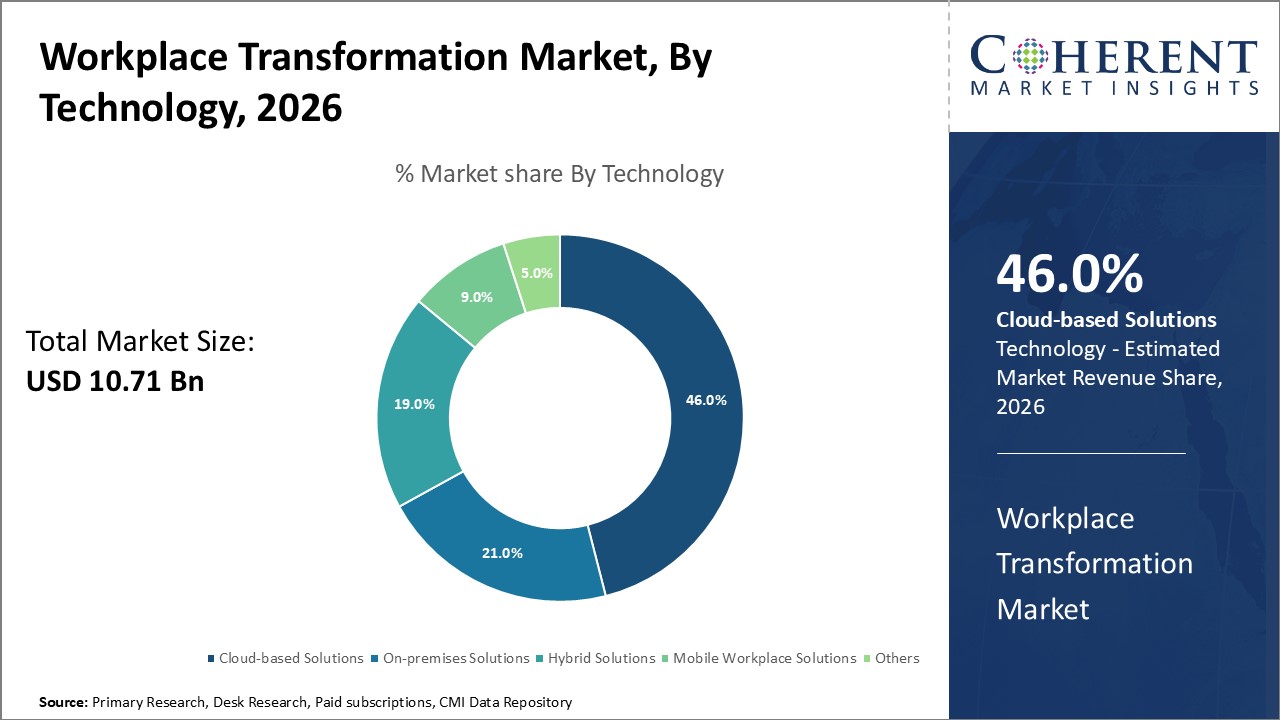
Workplace Transformation Market Insights, By Technology
Cloud-based Solutions dominate the market share with 46%, due to their enhanced scalability, lower upfront costs, and ease of integration with existing IT ecosystems, making them highly preferred for large enterprises undergoing digital transformation. The Hybrid Solutions segment is the fastest growing, as businesses seek flexible architectures combining cloud and on-premises infrastructure to customize performance and security.
Workplace Transformation Market Insights, By Service
Consulting Services dominate the market share. Consulting Services drive growth by enabling organizations to design tailored workplace strategies, focusing on user experience improvement and operational efficiency. Managed Services represent the fastest-growing segment, reflecting increased demand for outsourcing implementation and lifecycle support to reduce internal IT burden and optimize costs.
Workplace Transformation Market Insights, By End User
The BFSI sector leads the market share due to its rapid adoption of digital workplace technologies for compliance, security, and enhanced customer service capabilities. The Healthcare segment is the fastest growing, leveraging workplace transformation for telemedicine, staff collaboration, and patient data management improved by AI tools. IT & Telecom contributes significantly with continuous innovation and adoption of hybrid work models. Manufacturing utilizes workplace digitalization to support smart factories and decentralized workforce coordination.
Workplace Transformation Market Trends
The Workplace Transformation Market is rapidly converging with AI and machine learning to provide predictive workplace analytics, optimizing space usage and enhancing employee productivity, as seen in several Fortune 500 companies adopting these solutions in 2026.
Another major trend is sustainability; organizations are increasingly focusing on green building practices and energy-efficient workspaces, driven by stricter environmental regulations globally, especially in Europe.
Furthermore, virtual and augmented reality technologies are reshaping employee collaboration beyond physical offices, evidenced by increased enterprise spend on AR/VR solutions in 2025 by over 36%. This integration transforms traditional workplaces into immersive environments supporting seamless remote engagement.
Workplace Transformation Market Insights, By Geography
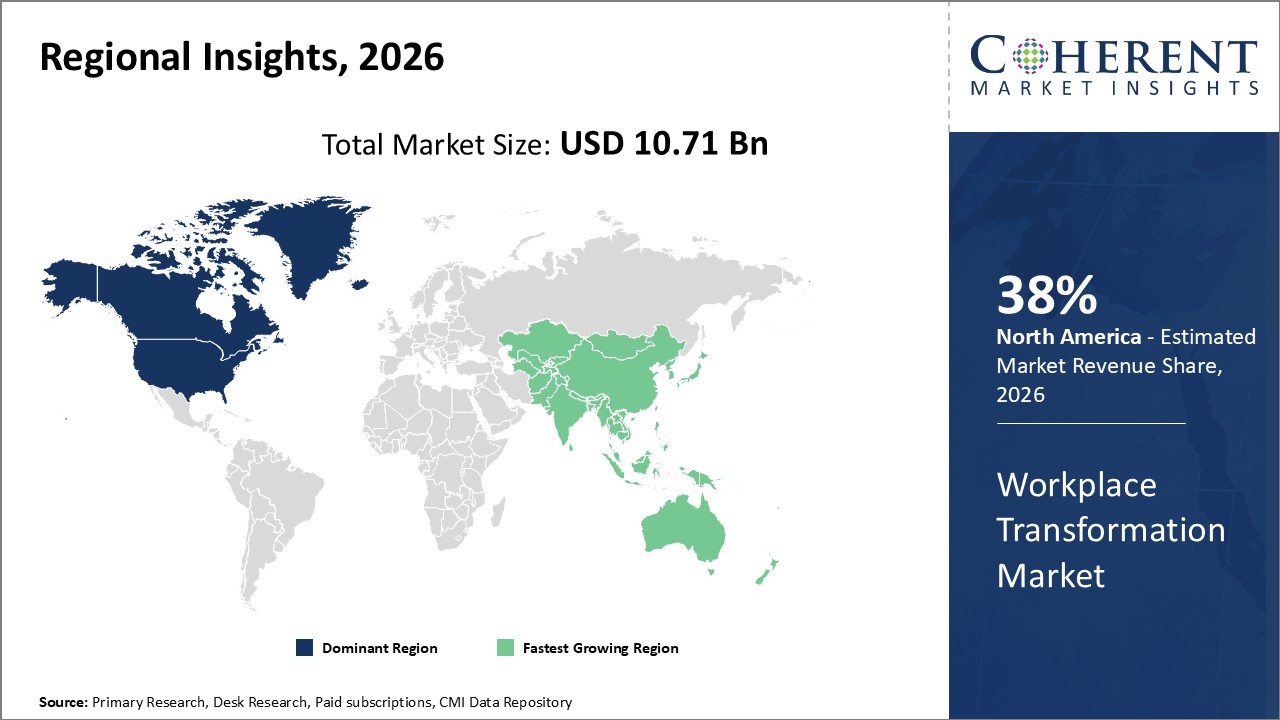
North America Workplace Transformation Market Analysis and Trends
North America leads the market share at 38%, due to mature digital infrastructure, advanced AI adoption, and a high concentration of technology vendors. The U.S. holds a substantial market share, driven by continuous investments in workplace digitalization and progressive regulatory frameworks encouraging flexible work policies. Key market companies such as Microsoft Corporation and Cisco Systems heavily influence innovation and competitive dynamics in this region.
Asia Pacific Workplace Transformation Market Analysis and Trends
The Asia Pacific exhibits the fastest growth with a CAGR surpassing 12%, propelled by rapid urbanization, a burgeoning IT sector, and government-driven smart city initiatives. Countries like India and China are at the forefront of this growth, supported by technology infrastructure expansion and growing demand for hybrid work models. Local players and multinational corporations actively invest in this ecosystem, accelerating business growth.
Workplace Transformation Market Outlook for Key Countries
USA Workplace Transformation Market Analysis and Trends
The USA's market is characterized by advanced cloud adoption, digital workspace innovation, and extensive R&D investments. With over 80% of corporations implementing hybrid workplace policies by 2025, the U.S. remains a pivotal player driving market revenue and size. Significant contributions come from Microsoft’s ongoing integration of AI into collaboration tools and Cisco’s expansion of unified communication services.
India Workplace Transformation Market Analysis and Trends
India's Workplace Transformation Market benefits from its expanding IT and service industries, government incentives for digital infrastructure development, and increasing SME adoption. The surge in start-ups and remote work adoption has accelerated demand for integrated digital workplaces. Prominent technology companies and service providers have established regional centers, contributing to rapid market growth and evolving business strategies.
Analyst Opinion
Increasing adoption of cloud-based collaboration platforms is a critical demand-side indicator accelerating market growth. In 2025, corporate investments in SaaS solutions for workplace collaboration grew over 29%, highlighting an upward trend in digital workplace tools that drive enhanced connectivity and efficiency.
The rising production capacity of smart office hardware such as sensors, IoT devices, and ergonomic furniture also supports the market dynamics. For instance, manufacturing output of smart workplace devices increased by 19% year-over-year in early 2026, reflecting strong supply-side capabilities to meet growing customer demand.
Diverse use cases across verticals such as BFSI, IT, healthcare, and manufacturing have expanded the market scope remarkably. Banking institutions reported a 16% rise in employee productivity post digital workplace integration in 2025, pointing to impactful application benefits.
Import trends reveal growing international trade of workplace transformation solutions, particularly from Asia Pacific to North America, where import value surged by 22% in 2025. This showcases the global interconnectedness and supply chain efficiencies enhancing market revenue.
- Current Industry Events of 2026
- Market Size Estimation
- Regional Breakdown
- Competitive Landscape
- Customer Intelligence
- Segmental Analysis
- Pricing Analysis
- Key Market Drivers, Challenges & Future Trends
- Customized Insights Section
Market Scope
| Report Coverage | Details | ||
|---|---|---|---|
| Base Year: | 2025 | Market Size in 2026: | USD 10.71 billion |
| Historical Data for: | 2020 To 2024 | Forecast Period: | 2026 To 2033 |
| Forecast Period 2026 to 2033 CAGR: | 10.4% | 2033 Value Projection: | USD 21.41 billion |
| Geographies covered: |
| ||
| Segments covered: |
| ||
| Companies covered: | Microsoft Corporation, Google LLC, Cisco Systems, Inc., IBM Corporation, Accenture plc, Honeywell International Inc., Salesforce, Inc., Schneider Electric SE, Nokia Corporation, Amazon Web Services (AWS), Zebra Technologies Corporation, HPE (Hewlett Packard Enterprise) | ||
| Growth Drivers: |
| ||
Workplace Transformation Market Growth Factors
Enterprises’ rising focus on enhancing employee experiences through integrated digital platforms also fuels increased market adoption. Additionally, government initiatives aimed at digital infrastructure upgrades, particularly in developed economies like the U.S. and Germany, provide significant impetus. The surge in cybersecurity investments related to workplace digital assets further propels market revenue, considering a 25% growth in cybersecurity budgets among key enterprises in 2025.
Workplace Transformation Market Development
At WebexOne in 2026, Cisco introduced a new suite of AI agents for its Webex platform under the “Connected Intelligence” initiative. These include tools like task agents (to generate action items), notetaker agents (for meeting transcriptions & summaries), polling agents, a meeting scheduler based on participant availability, and an AI receptionist. Also, enhancements to RoomOS (version 26) bring AI-controlled audio zones and support for digital twins of meeting rooms.
In May 2025, ServiceNow launched updates across its Talent Development and Workplace Service Delivery offerings. These include AI to spot skill gaps, personalized mentoring, and an “Opportunity Marketplace” to match employees to roles. Also introduced were real-time insights for workplace utilization via sensor integrations, helping workplaces make smarter decisions about space & in-person collaboration tools.
Key Players
Leading companies of the market:
Microsoft Corporation
Google LLC
IBM Corporation
Accenture plc
Salesforce, Inc.
Schneider Electric SE
Nokia Corporation
Amazon Web Services (AWS)
Zebra Technologies Corporation
HPE (Hewlett Packard Enterprise)
Several market players have aggressively adopted hybrid cloud integration strategies coupled with strategic partnerships to bolster their presence. For instance, Microsoft’s expansion of Microsoft Viva in 2025 significantly enhanced its positioning in employee experience platforms, leading to a 31% increase in adoption rates. Another example is Cisco’s acquisition of collaboration startup Socio in early 2026, which fortified its event and workspace transformation capabilities, resulting in increased market share. Companies like Accenture continue deploying tailored digital workplace consulting services, generating robust client pipelines globally.
Workplace Transformation Market Future Outlook
In the years ahead, the workplace transformation market is expected to grow rapidly as organizations continue investing in digitalization, automation, and employee-centric strategies. Artificial intelligence, virtual collaboration environments, and immersive technologies like AR and VR will redefine how teams interact and operate. Companies are likely to focus on data-driven workplace analytics to measure engagement and efficiency. Furthermore, sustainability and mental wellness initiatives will become integral components of modern workplace transformation strategies, ensuring long-term adaptability and inclusivity in an increasingly digital corporate landscape.
Workplace Transformation Market Historical Analysis
The workplace transformation market has evolved significantly over the past decade, shaped by rapid technological progress and changing workforce dynamics. Initially, transformation efforts focused on optimizing office layouts and improving collaboration through digital communication tools. However, the rise of cloud computing, mobility, and automation fundamentally redefined workplace models. Organizations worldwide began adopting digital workplace platforms, ergonomic designs, and flexible scheduling to enhance productivity and employee well-being.
Sources
Primary Research interviews:
HR Directors
Facility Managers
Digital Workplace Consultants
Employee Experience Specialists
Databases:
World Economic Forum Workforce Analytics
Others
Magazines:
Forbes WorkLife
HR Magazine
Business Insider (Future of Work)
Fast Company
Journals:
Journal of Organizational Behavior
Human Resource Development Quarterly
International Journal of Workplace Health Management
Employee Relations Journal
Newspapers:
The Times of India (Workplace)
The Guardian (Business)
The New York Times (Business & Tech)
The Economic Times (Future of Work)
Associations:
Society for Human Resource Management (SHRM)
WorldatWork
International Facility Management Association (IFMA)
Chartered Institute of Personnel and Development (CIPD)
Get access to 250+ pages report
Every segment, forecast, competitor profile and data table behind the analysis above — available for instant download.
- ESOMAR Member
- ISO 9001:2015 Certified
- D-U-N-S Registered
- GDPR & CCPA Compliant
Missing comfort of reading report in your local language? Find your preferred language:
Transform your Strategy with Exclusive Trending Reports
Frequently Asked Questions
Leading companies include Microsoft Corporation, Google LLC, Cisco Systems, IBM, and Accenture, with each focusing on strategic expansions and innovative solutions.
The market size is projected to reach USD 21.41 billion by 2033 with a CAGR of 10.4% from 2026 to 2033, indicating robust growth potential.
The BFSI sector leads in market revenue contribution, with healthcare and IT industries showing significant emerging trends supporting expansion.
There will be a strong orientation towards AI-enabled workplaces, sustainability-focused infrastructure, and integrated hybrid solutions enhancing workforce productivity.
The market is highly competitive with rapid innovation cycles; challenges include cybersecurity concerns and integration complexity across legacy systems.
Leading market players invest heavily in partnerships, acquisitions, and product innovation to reinforce their market share and meet evolving client demands.