

Cognitive Systems Spending Market Analysis and Forecasts (2026-2033)
The Cognitive Systems Spending Market is anticipated to grow at a CAGR of 15.2% with USD 21,561.1 Mn share in 2026 and is expected to reach USD 57,140.0 Mn in 2033. Innovations in AI-powered diagnostic tools, predictive analytics, and personalized treatment plans are fostering market growth. In 2026, AI-driven healthcare solutions are expected to account for a 15% increase in global healthcare spending, improving both treatment accuracy and operational efficiency. In 2026, Philips expanded its AI-powered diagnostic tools, enabling hospitals to leverage cognitive systems for faster disease detection, contributing to a projected 10% reduction in treatment costs across major healthcare providers. The rapid adoption of AI and cognitive technologies across industries, driven by investments in automation, digital transformation, and data analytics, is accelerating cognitive systems spending. Innovations in machine learning and natural language processing are expanding use cases in sectors like retail, finance, and healthcare. OECD data shows that 20.2% of firms in 2025 reported using AI, more than doubling the 2023 rate, driving further market growth.
OECD; Koninklijke Philips N.V.
Key Takeaways
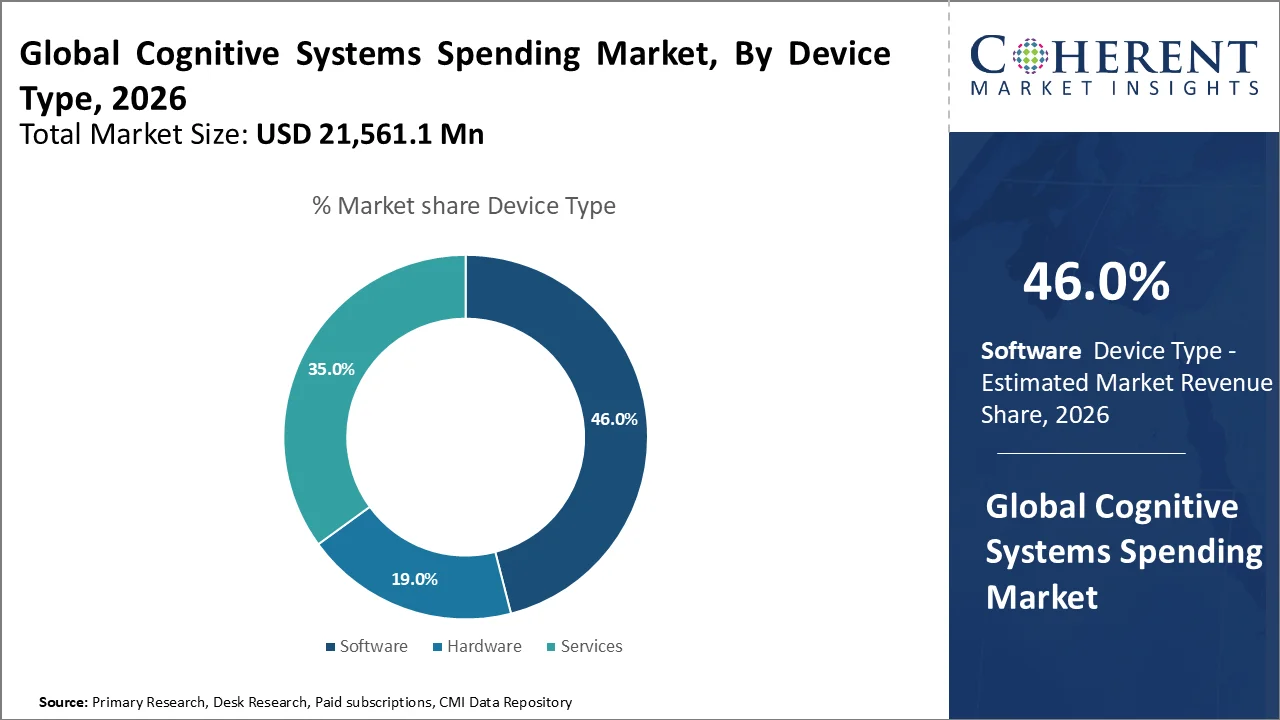
- Software is expected to account the largest share of 46.0% in 2026, driven by the rapid adoption of cloud-based software and wide industry adoption. According to official OECD adoption data, 20.2% of companies in OECD countries stated they used AI tools in 2025, which is a big jump from prior years. OECD data frameworks also reveal that AI adoption is notably robust in software-based applications including routine automation, analytics, and generative tools. Businesses all across the world still utilize software as their main AI interface. OECD gives information about how many companies use something and how they use it.
Source: OECD
- Based on deployment type, cloud will dominate with 57.0% in 2026, supported by the high scalability and flexibility, lower upfront cost and remote accessibility and global reach. Surveys of ICT use related to the government (OECD ICT usage data) demonstrate that AI and digital technologies are mostly accessed through cloud platforms. Businesses choose cloud solutions for AI workloads instead of on-premises systems. The OECD's ICT usage survey is a set of official statistics that national statistical offices use.
- Banking hold the dominant share of 19% in 2026 owing to high need for fraud detection & risk management, massive volume of financial data and growth of fintech and digital payments. AI‑based fraud detection and risk management have demonstrated measurable impact in the financial sector. According to official U.S. government data, AI and machine learning fraud prevention tools helped prevent and recover over US$4 billion in fraud losses in fiscal year 2024, including around $1 billion in Treasury check fraud. Major banking regulators also report wide use of AI for fraud detection, prevention, and risk oversight, underscoring why banking leads adoption.
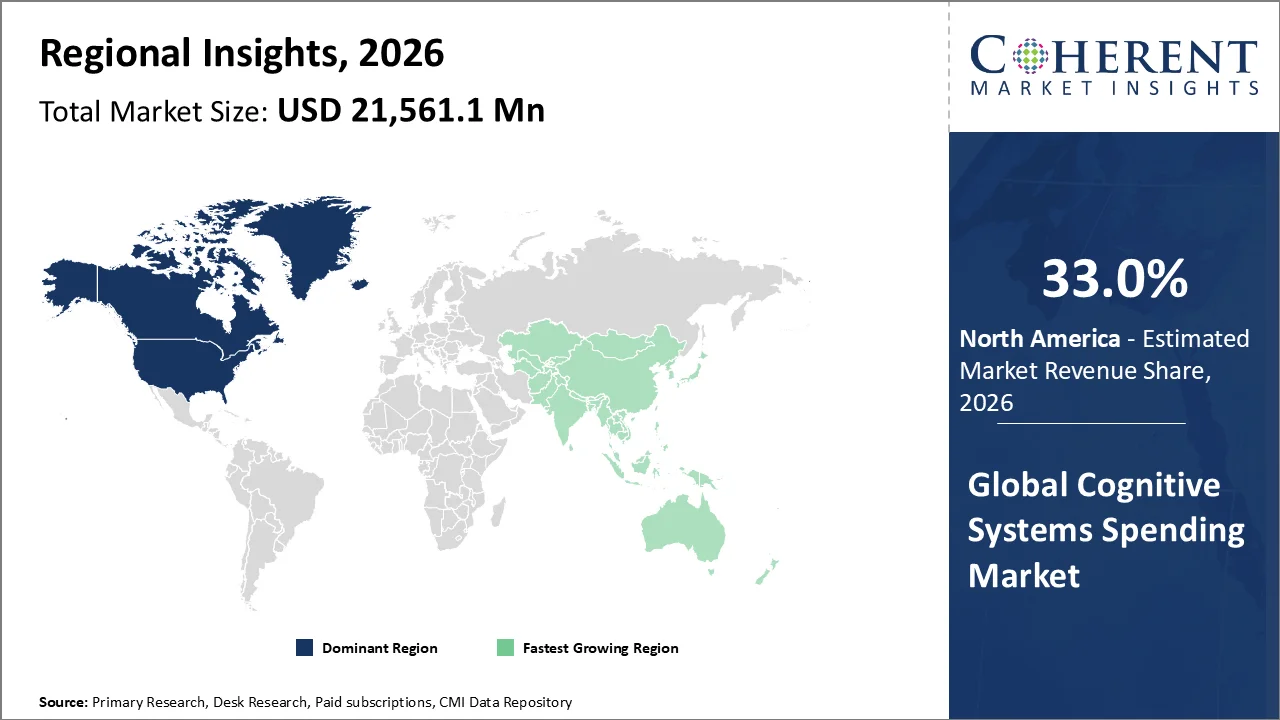
- North America is expected to acquire the dominant share of 33.0% in 2026, attributed to strong investment in R&D funding, advanced infrastructure and ecosystem, and presence of leading tech companies. More than 70% of all private AI funding comes from North America, especially the U.S. The National Science Foundation (NSF) and private venture capital are very important for this since they give AI startups a lot of money, which helps both innovation and market acceptance. This large amount of money speeds up the development of cognitive systems, which opens up new markets.
Current Events and Their Impact on the Cognitive Systems Spending Market
Current Event | Description and its Impact |
Government Funding & AI Research Incentives |
|
Shifts in Global Data Privacy Regulations |
|
Global AI Race & Geopolitical Competitiveness |
|
Segmental Insights
- Current Industry Events of 2026
- Market Size Estimation
- Regional Breakdown
- Competitive Landscape
- Customer Intelligence
- Segmental Analysis
- Pricing Analysis
- Key Market Drivers, Challenges & Future Trends
- Customized Insights Section
Why is Software Acquiring the Largest Market Share?
Software is projected to account for the largest share of cognitive systems spending in 2026, representing approximately 46.0% of the total volume. By 2026, people throughout the world are expected to spend over USD 452 billion on AI software. This shows how important AI is to digital transformation and automated decision-making projects in many fields. This large investment in cognitive software solutions shows how popular they are in general when it comes to spending on cognitive systems.
There are two main factors that are helping the software industry grow. First, a growing number of firms are utilizing AI platforms, integrating generative AI, natural language processing, and data analytics technologies into their core business processes to increase customer engagement and productivity. For instance, Google stated that more than 85,000 businesses are building with its Gemini AI platform, which has led to a big increase in usage from year to year. Second, cloud investments and strategic partnerships are making it possible for cognitive software to be used in more places. For instance, Google Cloud's revenue grew 48% year over year as its AI services attracted bigger enterprise contracts. IBM's shift toward software-led hybrid cloud and AI solutions also led to strong revenue growth in 2025. These patterns show that many people are putting software that can provide scalable, flexible cognitive capabilities for business transformation at the top of their lists.
For instance, In the software world, IBM's generative AI business made more than US$12.5 billion in sales in the fourth quarter of 2025, showing that it was gaining a lot of commercial momentum. Also, Google's Gemini Enterprise got millions of paid seats and billions of AI interactions, showing that cognitive software is being used by a lot of businesses.
Cloud holds the Largest Market Share
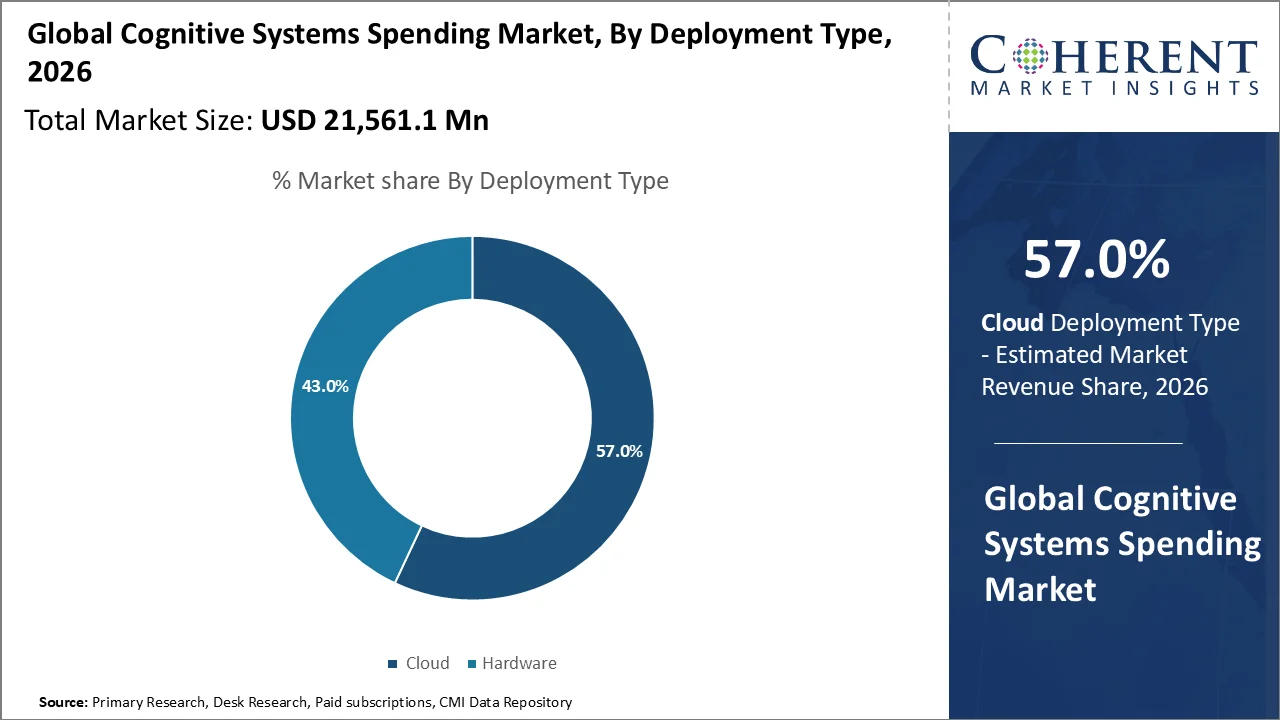
Based on deployment type, cloud dominate the market, accounting for a significant 57.0% share in 2026, reflecting their widespread adoption and cost‑effective cloud platforms for AI and cognitive workloads. This is part of a larger trend in which hyperscale cloud providers like Amazon Web Services (AWS), Microsoft Azure, and Google Cloud together control much of the world's cloud infrastructure demand. As of 2025, AWS alone accounts for about 32% of worldwide cloud spending. Cloud is the best way to deploy cognitive systems because it lets businesses do so quickly and without having to spend a lot of money on infrastructure up front.
Rapid adoption of AI‑optimized cloud infrastructure has estimated to drive the growth of the segment over the forecast period. The need for AI-enabled cloud infrastructure is growing in enterprises that use cloud services that combine analytics, automation, and cognitive processing on a large scale. For instance, Microsoft's Intelligent Cloud revenue went by 29% in early 2026. Furthermore, enterprise focus on security & regulatory compliance which has increased the demand of cloud deployment in the market. Cloud providers like IBM and AWS have made their compliance controls stronger to meet regulatory and industry requirements like FedRAMP and ISO/IEC 27001. This lets regulated businesses like healthcare and financial services use cognitive systems in the cloud without worry. As businesses strike a balance between innovation and data protection requirements, these compliance guarantees hasten cloud adoption.
Microsoft's report of double-digit growth in Azure AI services throughout 2025, with more businesses using them, and IBM's announcement of improvements to IBM Cloud Pak for Data in late 2025 to make cloud deployments ready for AI across all industries are two important events that support cloud dominance. Furthermore, in March 2026, IBM's launch of AI Agents for IBM Cloud Pak for Integration, which will be available to every individual in March 2026, is one of the most important cloud-specific advances. It brings AI-driven operational insights to cloud integration processes.
Which Vertical segment dominates the market?
Banking account for the largest share of 19.0% in 2026 due to extensive reliance on cognitive technologies for data management, security, regulatory compliance, and customer experience. In 2026, the banking sector still has the most cognitive and AI-driven systems in use, showing how smart technologies are being used extensively in core banking operations to better manage risk and offer services. The government's and regulators' focus on safe and efficient financial services has made banks embrace advanced cognitive technologies faster than other industries. This is in line with their goals for digitalization and fraud prevention. For instance, as of March 2026, the RBI has included AI-driven fraud analytics to banking systems.
Regulatory support and risk governance mandates are two of the most important things that are driving the expansion of cognitive systems in banking. In March 2026, the Reserve Bank of India (RBI) changed the rules for electronic banking transactions to incorporate more AI-driven fraud analytics and better ways to protect customers. This showed that the RBI expects cognitive systems to be used to find fraud and lower risk. A second important factor is the operational changes that are happening in the world's biggest banks. For instance, JPMorgan Chase has more than 600 different AI use cases, including risk management, fraud detection, underwriting, and improving operational efficiency. This shows how big banks are using cognitive systems across departments to speed up processing and lower errors.
In March 2026, the Reserve Bank of India released updated guidelines that expanded the use of AI-driven fraud analytics in digital banking systems. This showed that the government supports the use of cognitive technology in financial security systems.
Cognitive Systems Spending Market Trends
- Explosion of use cases across industries- major sectors driving spending are healthcare (personalized care, diagnostics), banking (fraud detection, risk analysis), retail (personalization & recommendation engines), and manufacturing (predictive maintenance). These sectors rely on cognitive systems for real-time decision making.
- Shift Towards hybrid (cloud + on-premise) deployments are rising and currently major trend followed globally to reduce errors. Enterprises are building on-premise AI systems for control & data privacy and still using cloud for scalability. For instance, on industries where data privacy is crucial, such as banking and healthcare, hybrid cloud enables data scientists to train massive AI models on the cloud while doing real-time inference locally to minimize latency and safeguard sensitive data. In 2026, this hybrid model will be the standard corporate architecture for AI workloads as businesses strive for control and scalability while handling security and regulatory needs. Furthermore, in 2026, businesses are constructing their own AI infrastructure on their own premises, but they are still using cloud platforms for workloads that require a lot of computing power, especially where privacy or regulatory issues are most important. For instance, research from Goldman Sachs, investment banking company states that big organizations are putting more money into on-site AI data centers combined with hyperscale cloud usage. This is because they need to keep sensitive data safe, meet compliance standards, and make sure that mission-critical AI workloads run smoothly.
- Vendor consolidation & platform dominance has observed to growth the cognitive systems spending market demand over the forecast period. Enterprises are reducing number of AI vendors and spending more on few trusted platforms which leads to dominance of major players (cloud and enterprise software providers) and creates pressure on smaller AI startups. Research on enterprise AI spending shows that AI budgets are still growing, but the number of vendors who can get those dollars is getting smaller. This shows that major cloud and software providers (like AWS, Azure, Google Cloud, and Snowflake with AI integrations) are taking market share away from smaller standalone AI tools.
- Enterprises are increasingly integrating AI into business processes, with adoption rates climbing sharply. McKinsey’s global AI survey shows that 88% of organizations use AI in at least one business function, up from 78% the prior year, indicating that cognitive technologies are penetrating deeper into daily operations beyond pilots, further validating sustained growth in spending for cognitive systems deployment and scaling.
Regional Insights
North America dominates owing to Strong Technological Infrastructure
North America account 33.0% market share in 2026, supported by because it has a robust digital infrastructure, a lot of people use AI, and it has made big investments in automation and machine learning. To improve operational efficiency and make data-driven decisions, large corporations in industries including healthcare, banking, and retail are increasingly using cognitive technologies. Companies headquartered in North America like IBM, Microsoft, and Google are adding more AI tools to their offerings. For instance, Microsoft plans to spend US$20 billion on AI and machine learning tools for businesses in 2026, which will further solidify North America's position as the leader. This expansion is also fueled by the U.S. government's greater focus on AI policies.
Source: Reuters
Governments in North America, especially in the U.S. and Canada, have put in place a number of policies to help AI research and development. These include financing programs and AI policy frameworks. The U.S. government invested approximately US$10 billion in AI-related R&D in 2025. Furthermore, regulatory frameworks are in place to ensure ethical AI deployment, further encouraging the cognitive systems spending market growth.
Asia Pacific Cognitive Systems Spending Market Trends
The Asia-Pacific region is poised to be as the fastest-growing region through 2026-2033, owing to rapid economic growth & digital expansion. Many Asia Pacific countries like China, India and Southeast Asia are growing quickly economically. Strong growth in technology demand and exports is boosting AI adoption. Asia Pacific has huge population, high smartphone & internet penetration. This generates huge volume of data which requires cognitive systems for analysis and drives demand for AI-based decision making. Countries like China, South Korea, Japan are global leaders in manufacturing. Increasing use of smart factories, robotics and AI-based automation in Asia Pacific countries is a major growth driver. Asia Pacific is the fastest-growing area in the cognitive systems spending industry. This is because businesses are moving from small pilot AI initiatives to larger deployments, due to more public and private funding. NVIDIA reports that 63% of businesses in the Asia-Pacific region are already utilizing AI, and IBM states that 64% of CEOs in the region are moving AI investments from experimentation to core business processes. WIPO says that Asia accounts for 30% of all corporate R&D spending. The AI Impact Summit in India said that companies are projected to invest US$250 billion in AI, and AWS separately promised US$12.7 billion to India's cloud infrastructure.
Source: NVIDIA
Growing Investment in AI & Automation is Accelerating the Cognitive Systems Spending Market Demand in United States
The U.S. cognitive systems spending market dominates North America given its lead in enterprise AI adoption and R&D investment. Business spending on AI tools surged markedly, with data showing use of paid AI services by U.S. companies increasing from 26 % in early 2025 to 47 % in early 2026, reflecting rapid integration of cognitive solutions across sectors.
Major U.S. tech players are driving this trend; for instance, Amazon Web Services reported over US$15 billion in annualized AI‑related revenue run‑rate, highlighting the central role of cloud‑based cognitive infrastructure in 2026 spending.
Source: Amazon.com, Inc.
China Cognitive Systems Spending Market Trends
China has become the biggest player in the Asia Pacific cognitive systems expenditure market in 2026. This is because the country has made huge investments in AI, digital infrastructure, and service-oriented digital transformation. China has more than 6,000 AI businesses, and the AI core industry is predicted to be worth more than ¥1.2 trillion (about US$170 billion) by 2026. This is because China is using AI in business and services, which is increasing the demand for cognitive systems in all areas. Domestic cloud and AI companies like Alibaba Cloud have helped digital services flourish. By late 2025, cloud revenue had grown 36% year over year to ¥43.3 billion (~US$6.2 billion), due to AI-enabled e-commerce and service solutions. These investments and the quick adoption of AI in online shopping, logistics, and digital customer service greatly raise the amount of money spent on cognitive systems across the economy.
Source: China International Electronic Commerce Center (CIECC)
Who are the Major Companies in Cognitive Systems Spending Market
Some of the major key players in Cognitive Systems Spending Marker are IBM Corporation, IPSOFT Inc., Accenture plc, Cognitive Scale Inc., HP Inc., Wipro Limited, Microsoft Corporation, Attivio, and Intel Corporation.
Key News
- In March 2026, NVIDIA launched its Agent Toolkit, an open‑source platform enabling enterprises to build and run autonomous AI agents that can perceive, reason, and execute tasks across business data and workflows. Major partners including Adobe, Cisco, SAP, and Salesforce are expanding agentic AI capabilities within their software portfolios, signaling increasing enterprise investment in cognitive systems and autonomous AI infrastructure.
Source: NVIDIA
- In March 2026, Clarivate published its inaugural AI50 list — a data‑driven benchmark of the top 50 global organizations leading high‑strength AI inventions across sectors. The analysis, based on patent intensity measures from the Derwent World Patents Index, identifies organizations such as NVIDIA, Alphabet, and Qualcomm as leaders in foundational AI innovation. These companies are developing cognitive and AI systems that power next‑generation software, analytics, and autonomous operations, reinforcing the direction of enterprise spending toward advanced cognitive technologies and strategic R&D investment.
Market Report Scope
Cognitive Systems Spending Market Report Coverage
| Report Coverage | Details | ||
|---|---|---|---|
| Base Year: | 2025 | Market Size in 2026: | USD 21,561.1 Mn |
| Historical Data for: | 2020 To 2024 | Forecast Period: | 2026 To 2033 |
| Forecast Period 2026 to 2033 CAGR: | 15.2% | 2033 Value Projection: | USD 57,140.0 Mn |
| Geographies covered: |
| ||
| Segments covered: |
| ||
| Companies covered: | IBM Corporation, IPSOFT Inc., Accenture plc, Cognitive Scale Inc., HP Inc., Wipro Limited, Microsoft Corporation, Attivio, and Intel Corporation. | ||
Analyst Opinion
- The cognitive systems market is far more than a tech trend it’s rapidly becoming a core component of enterprise investment as organizations seek automation, efficiency, and real‑time decision‑making tools. As companies increase their AI budgets for the infrastructure, services, and software that support cognitive applications, global spending on AI technologies a major factor in the adoption of cognitive systems is expected to reach roughly US$2.52 trillion in 2026, a 44% increase from the previous year. This increase shows that even when projects move from pilot to production stages, people continue to have faith in AI-enabled automation and decision support.
- The banking sector is a major driver of cognitive system adoption, especially in fraud prevention and risk management. Banks are increasingly turning to AI and machine learning to detect fraud and assess risks in real-time. With the rise of digital banking and online transactions, fraud detection systems powered by cognitive technology are proving to be indispensable. This shift is allowing financial institutions to reduce fraud costs significantly, while also improving security and customer trust. For instance, in February 2026, multinational payment card services corporation from 2026, 80% of businesses utilizing AI reported doing away with needless manual checks, and 83% indicated that AI significantly decreased false positives and customer attrition, demonstrating the true influence of cognitive technologies on fraud workflows.
- Industry leaders are allocating significant portions of their IT budgets to cognitive‑capable systems, not experimentation, because these technologies deliver measurable business value. An RBC Capital CIO survey indicates that 60% of enterprise technology leaders already have AI systems in production, with an emphasis on operational deployment rather than theoretical exploration, and 90% of them in 2026 are setting aside funds expressly for generative AI and advanced cognitive initiatives, up from 85% the year 2025. This shows that cognitive systems are being included into fundamental business operations in retail, healthcare, and finance, with a focus on competitive differentiation, cost savings, and return on investment.
- Asia Pacific is emerging as the fastest‑growing regional market, propelled by high digital maturity and government‑led AI initiatives in countries like China, India, and Japan. While North America remains the largest region, AI spending in Asia/Pacific is forecast to grow strongly, with AI investments expected to reach US$110 billion by 2028, highlighting the region’s expanding role in cognitive systems deployment. Additionally, countries such as India are rapidly strengthening digital skills, with 71% of Indian employees achieving advanced digital maturity, positioning Asia Pacific as a key future contributor to global cognitive systems demand.
Speak to the analyst
Want personalized insights?
Take the findings above to one of our principal consultants, or have the report rebuilt around the segments, geographies and competitors you actually track.
Market Segmentation
- By Device Type
- Hardware
- Software
- Services
- By Technology Type
- Natural Language Processing
- Machine Learning
- Automated Reasoning
- By Deployment Type
- Cloud
- On-premise
- By Verticals
- Banking
- Education
- Government
- Healthcare
- Insurance
- Manufacturing
- Securities and investment services
- Telecommunications
- Transportation
- Other industries
- By Region
- North America
- U.S.
- Canada
- Latin America
- Brazil
- Mexico
- Argentina
- Rest of Latin America
- Europe
- Germany
- U.K.
- France
- Italy
- Spain
- Russia
- Rest of Europe
- Asia Pacific
- China
- India
- Japan
- Australia
- South Korea
- ASEAN
- Rest of Asia Pacific
- Middle East
- GCC
- Israel
- Rest of Middle East
- Africa
- South Africa
- Central Africa
- North Africa
- North America
Sources
Primary Research Interviews
- Interviews with IT leaders, CIOs, and digital transformation managers to understand adoption challenges, integration issues, and the impact of cognitive systems on business operations.
- Insights from AI providers, software developers, and data scientists on advancements in AI, machine learning, natural language processing, and industry applications.
- Discussions with analysts, consultants, and tech advisors to evaluate market trends, competitive landscape, and cognitive systems’ role in improving efficiency.
- Conversations with decision-makers in enterprises and public-sector organizations to assess investment factors, system implementation challenges, and data privacy concerns.
Databases
- U.S. Bureau of Labor Statistics (BLS)
- OECD (Organisation for Economic Co-operation and Development) ICT Database
- U.S. National Institute of Standards and Technology (NIST)
- U.S. Department of Energy (DOE)
- European Commission Digital Strategy Database
Magazines
- AI & Machine Learning Review (published by IEEE)
- IEEE Spectrum (Technology and AI section)
- MIT Technology Review (AI and cognitive systems sections)
- Government Technology Magazine (for public-sector technology trends)
- The Journal of Cognitive Computing (published by Springer)
Journals
- Journal of Artificial Intelligence Research (AAAI)
- Cognitive Systems Research (Elsevier)
- Journal of Machine Learning Research (MIT Press)
- IEEE Transactions on Cognitive and Developmental Systems (IEEE)
- Journal of AI and Data Mining (Springer)
Newspapers
- Financial Times (Technology Section)
- Government Technology News (U.S. Federal Technology News)
- The New York Times (Technology Section)
- The Guardian (Technology and AI Section)
- The Wall Street Journal (Technology Section)
Associations
- Association for the Advancement of Artificial Intelligence (AAAI)
- Cognitive Science Society (official association for cognitive science professionals)
- International Association for AI and Cognitive Science (IAAI)
- Institute of Electrical and Electronics Engineers (IEEE) AI Section
- U.S. National Artificial Intelligence Initiative (NAII)
Public Domain Sources
- U.S. Government AI Research Reports (AI.gov)
- European Commission AI and Digitalization Policy Documents
- U.S. Federal Government Whitepapers on AI (e.g., from NIST)
- National AI Research and Development Strategic Plan (Office of Science and Technology Policy)
- Company Annual Reports and Investor Presentations from publicly listed firms
Proprietary Elements
- CMI Data Analytics Tool
- Proprietary CMI Existing Repository of information for last 10 years
Get access to 250+ pages report
Every segment, forecast, competitor profile and data table behind the analysis above — available for instant download.
- ESOMAR Member
- ISO 9001:2015 Certified
- D-U-N-S Registered
- GDPR & CCPA Compliant
Missing comfort of reading report in your local language? Find your preferred language:
Transform your Strategy with Exclusive Trending Reports
Frequently Asked Questions
The Cognitive Systems Spending Market is expected to reach USD 57,140.0 Mn in 2033
Major players operating in the global Cognitive Systems Spending Market include IBM Corporation, IPSOFT Inc., Accenture plc, Cognitive Scale Inc., HP Inc., Wipro Limited, Microsoft Corporation, Attivio, and Intel Corporation.
Data privacy and security concerns and lack of skilled workforce are the major factors hampering the growth of the cognitive systems spending market.
Rapid adoption of cognitive systems and rising Enterprise Investment in Cognitive Systems for Workflow Automation and Data-Driven Decision Making
The Cognitive Systems Spending Market is anticipated to grow at a CAGR of 15.2% between 2026 and 2033.
Among regions, North America is expected to account for a largest market share in the global Cognitive Systems Spending Market over the forecast period.
Cognitive systems refer to AI-driven technologies designed to simulate human-like thinking, learning, and decision-making processes. They leverage machine learning, natural language processing, and data analytics to help businesses understand complex data, improve decision-making, and automate processes.