

Europe Cable Joint Market Size and Forecast – 2026 to 2033
The Europe Cable Joint Market is estimated to be valued at USD 3,375.1 Mn in 2026 and is expected to reach USD 5,747.0 Mn by 2033, exhibiting a compound annual growth rate (CAGR) of 7.9% from 2026 to 2033.
Key Takeaways
- By Type, Outdoor hold the largest market share in 2026 owing to its expansion of renewable energy projects.
- By Application, Power dominates the overall market with an estimated share of 32.9% in 2026 owing to the grid modernization and electrification initiatives.
- By Country, Rest of Europe acquired the prominent share of 24.8% in 2026 as accelerated renewable energy integration.
Market Overview
Increasing investments in renewable energy, grid modernization, and infrastructure development are rapidly expanding the Europe Cable Joint Market. The rising demand for reliable power transmission, particularly from offshore wind farms and urban electrification projects, drives the need for advanced cable joint solutions. Technological innovations and strong regulatory support actively boost market growth, with countries like Germany leading through strategic initiatives and industrial expertise. This growth demonstrates Europe’s commitment to building a sustainable and resilient energy network.
Current Events and their Impact on the Europe Cable Joint Market
Current Events | Description and its impact |
Geopolitical Developments in Eastern Europe |
|
Semiconductor and Electronic Component Shortage |
|
Economic Challenges and Inflationary Pressures |
|
End-user Feedback and Unmet Needs in the Europe Cable Joint Market
- Reliability and Durability Concerns: End-users emphasize the need for cable joints that withstand harsh environmental conditions and mechanical stresses. Failures due to moisture ingress or material degradation reduce system uptime, prompting demand for more robust and weather-resistant joint solutions that ensure long-term reliability.
- Ease of Installation: Customers highlight the complexity and time consumption involved in installing cable joints. There is a strong need for user-friendly designs that simplify installation, reduce labor costs, and minimize the chance of human error, especially for field technicians working in challenging environments.
- Compatibility with Emerging Technologies: As power grids evolve, end-users seek cable joints compatible with higher voltage levels and advanced cable types. Current products sometimes lack adaptability, making integration with smart grids and renewable energy infrastructure difficult, thus limiting operational flexibility.
- Current Industry Events of 2026
- Market Size Estimation
- Regional Breakdown
- Competitive Landscape
- Customer Intelligence
- Segmental Analysis
- Pricing Analysis
- Key Market Drivers, Challenges & Future Trends
- Customized Insights Section
Export Import Analysis of Cable Joint
Between October 2023 and September 2024, Poland exported approximately 280 shipments of Cable Jointing, based on a rolling 12-month period. These exports were carried out by two Polish exporters to a single buyer, reflecting an estimated growth of around 240% compared to the previous year.
The primary destinations for Poland’s Cable Jointing exports during this time were India, Peru, and the Philippines.
On a global scale, the leading exporters of Cable Jointing are Germany, China, and Poland. Germany holds the top spot with roughly 5,450 shipments, followed by China with about 1,220, while Poland ranks third with close to 1,030 shipments.
Segmental Insights
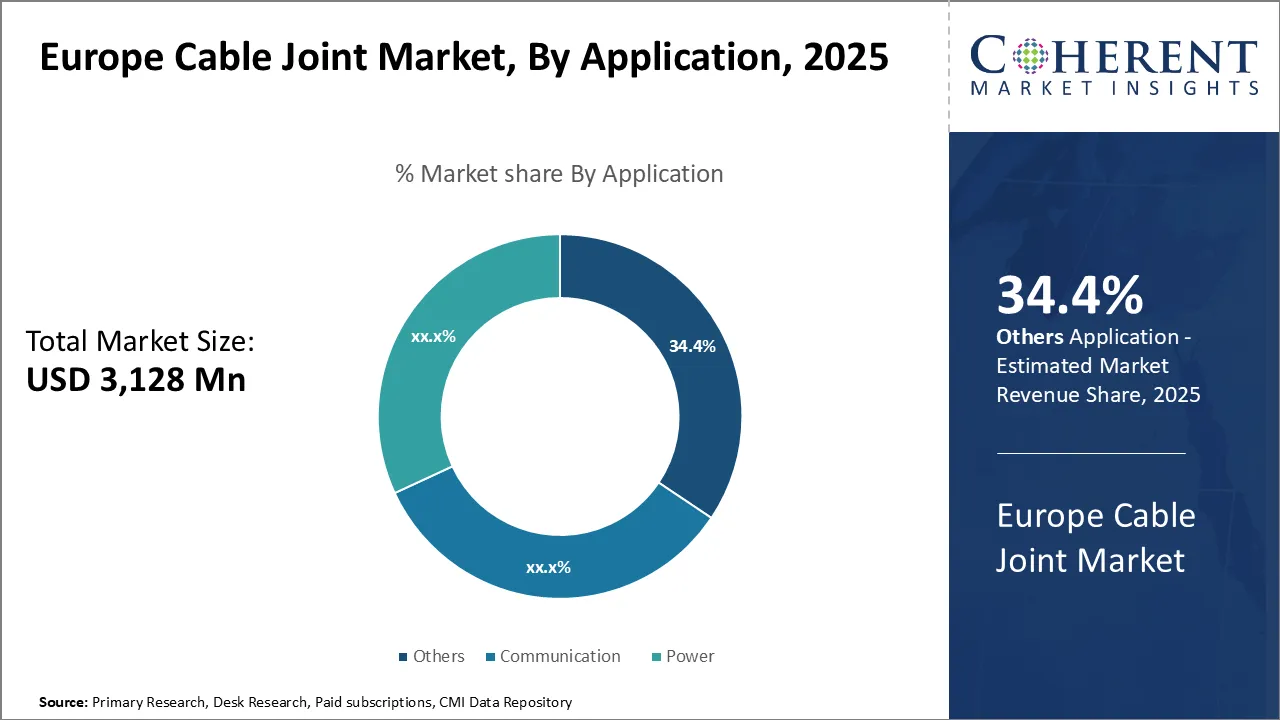
Europe Cable Joint Market Insights, By Application: Others segment contributes the highest share of the market owing to its government policy & local manufacturing push
Others dominate the overall market with an estimated share of 35.4% in 2026. Investors and utilities in Europe are actively driving the "Others" segment by funding smart grid infrastructure, offshore renewable projects, and key interconnectors such as the Celtic Interconnector between France and Ireland. Urban electrification, expanding EV infrastructure, and complex submarine applications are pushing demand for high-performance cable joints. At the same time, European governments are encouraging domestic manufacturing of cable components to boost energy security and cut reliance on imports, which further accelerates the adoption of specialized jointing technologies across the region.
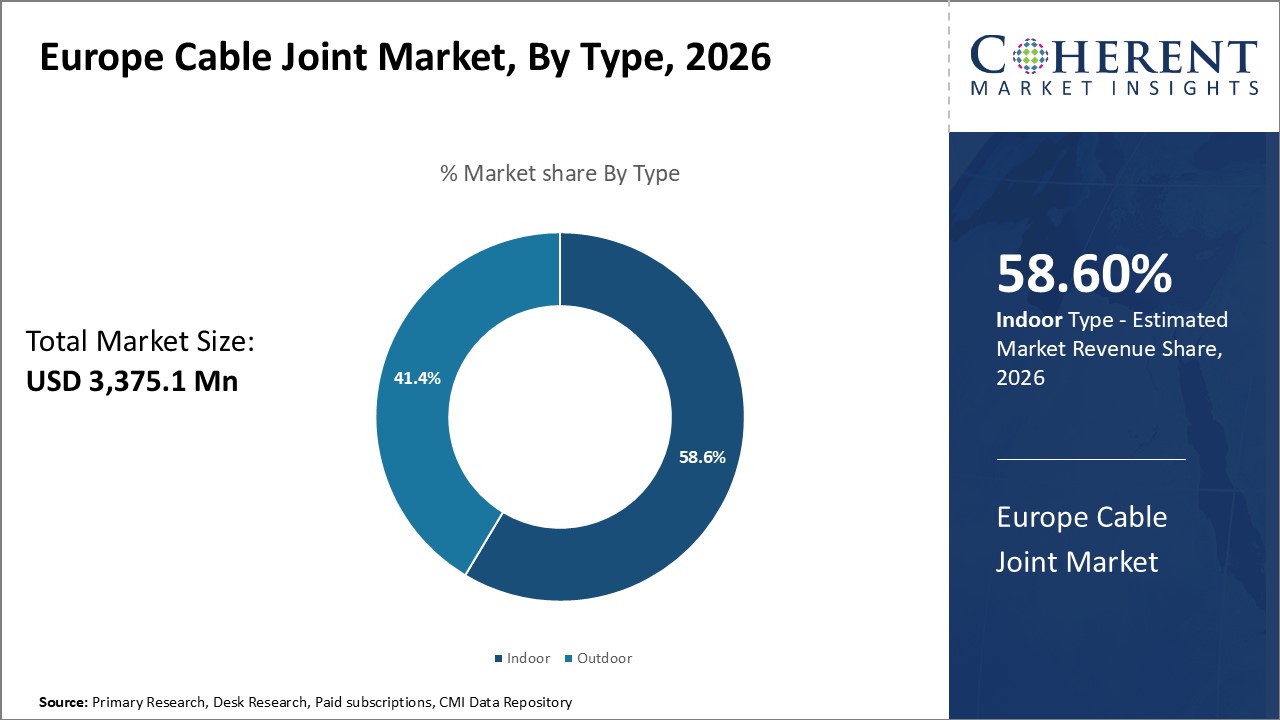
Europe Cable Joint Market Insights, By Type: Outdoor contribute the highest share of the market owing to its urbanization and infrastructure development
Renewable energy projects, especially offshore wind farms, are expanding and driving the need for robust power transmission infrastructure. Governments, particularly in Eastern Europe, are leading electrification programs that install new overhead distribution networks in underserved areas. Rapid urbanization and infrastructure growth across Europe are boosting demand for underground cabling solutions. Manufacturers are innovating cable joint technology by developing smart cable joints with real-time diagnostics and condition monitoring, which improve the performance and reliability of outdoor installations.
Country Insights
Rest of Europe Cable Joint Market Trends
Rest of Europe acquired the prominent share of 25.8% in 2026. Infrastructure modernization and the integration of renewable energy sources drive notable growth in the Rest of Europe cable joint market. Spain, Italy, Poland, and the Netherlands are investing in underground cabling to improve grid reliability and support renewable energy projects. Spain focuses on expanding solar and wind energy, creating high demand for cable jointing solutions to connect grids. Italy advances urban electrification and decentralized energy generation, further boosting the need for cable joints in the region. For instance, in February 2025, The European Commission and the High Representative launched the Joint Communication initiative to enhance the security and resilience of subsea cables. Through this initiative, they aim to support all EU member states by boosting security measures, expanding repair capacity, and enforcing sanctions against the shadow fleet.
Germany Cable Joint Market Trends
Germany holds the largest market share of 22.3% in 2026. Several key factors are driving significant growth in Germany’s cable joint market. Germany’s strong commitment to renewable energy, especially offshore wind farms, demands robust power transmission infrastructure. Governments, particularly in Eastern Europe, are leading electrification programs that install new overhead distribution networks in underserved areas. Rapid urbanization and infrastructure expansion across the country are boosting demand for underground cabling solutions. Manufacturers are advancing cable joint technology by developing smart cable joints with real-time diagnostics and condition monitoring to improve performance and reliability. Apart from this, the growing renewable projects is also contributing to the cable joints industry growth. For instance, in July 2025, Vietnam and Germany have signed a joint declaration to create a strong new energy partnership. This collaboration aims to expand renewable energy sources like offshore wind, enhance energy efficiency, modernize power grids, improve policy frameworks, and support the decarbonisation of industries that are resistant to reducing emissions.
France Cable Joint Market Trends
France acquires the prominent market share of 16.3% in 2026. Rapid urbanization and infrastructure expansion are driving higher demand for underground cabling solutions. Manufacturers are advancing cable joint technology by creating smart joints with real-time diagnostics and condition monitoring to improve power installation performance and reliability. France actively invests in Industry 4.0 and electric vehicle infrastructure, further boosting the need for advanced cable joint solutions. These trends showcase France’s dedication to building a sustainable and resilient energy network. For instance, in October 2024, French subsea power cable manufacturer and service provider Nexans introduced a cable recycling and recovery service in Europe to tackle the growing copper shortage by converting cable waste into recycled raw materials.
UK Cable Joint Market Trends
UK acquired the prominent share of 16.3% in 2026. Strategic infrastructure investments and technological advancements are driving significant developments in the UK cable joint market. These initiatives focus on enhancing grid flexibility and supporting the integration of renewable energy sources. The new £2 billion subsea cable factory in Scotland will strengthen domestic manufacturing of high-voltage direct current cables to meet rising demand for advanced cable joint solutions. Additionally, companies like Scottish Power are actively recruiting thousands of young workers to expand the workforce and support the UK’s ambitious clean energy goals.
In January 2025, UK lawmakers have opened an inquiry to investigate vulnerabilities in subsea cables and assess the country's resilience against potential disruptions to its internet infrastructure.
Belgium Cable Joint Market Trends
Belgium holds the largest market share of 20.3% in 2026. Belgium is evolving its cable joint market to meet ambitious renewable energy targets and modernize infrastructure. These efforts require advanced cable joint solutions to ensure efficient energy transmission. The country is also improving its grid infrastructure by implementing initiatives like cable pooling, which increases grid capacity by linking multiple renewable energy sources to a single point. Strategic investments and innovative approaches are actively driving the demand for reliable and efficient cable joint technologies throughout Belgium.
Market Report Scope
Europe Cable Joint Market Report Coverage
| Report Coverage | Details | ||
|---|---|---|---|
| Base Year: | 2025 | Market Size in 2026: | USD 3,375.1 Mn |
| Historical Data for: | 2020 To 2024 | Forecast Period: | 2026 To 2033 |
| Forecast Period 2026 to 2033 CAGR: | 7.9% | 2033 Value Projection: | USD 5,747.0 Mn |
| Geographies covered: |
| ||
| Segments covered: |
| ||
| Companies covered: | Prysmian Group, General Cable Technologies Corporation (Prysmian Group), Nexans S.A., NKT A/S, ABB Ltd. | ||
| Growth Drivers: |
| ||
| Restraints & Challenges: |
| ||
Europe Cable Joint Market Trend
- Shift Towards Smart and Digitalized Cable Joints
The market is seeing growing adoption of smart cable joints equipped with sensors and monitoring systems. These advanced joints enable real-time diagnostics, predictive maintenance, and remote monitoring, helping utilities reduce downtime and optimize asset management. This digital transformation aligns with the broader push toward smart grids, enhancing reliability and operational efficiency while lowering maintenance costs and improving fault detection in complex electrical networks.
- Increasing Demand for Eco-Friendly and Sustainable Solutions
Environmental regulations and sustainability goals are driving the demand for cable joints made from recyclable and non-toxic materials. Manufacturers are innovating to reduce carbon footprints and hazardous waste by using eco-friendly insulation and joint components. This trend reflects a growing commitment across the industry to green energy initiatives and regulatory compliance, promoting safer and more sustainable electrical infrastructure development.
In April 2024, KEI launched Conflame Green+, a groundbreaking product that transforms home wiring by offering environmentally friendly solutions and exceptional safety features.
Europe Cable Joint Market Opportunity
- Rising Demand for Smart Grid Technologies
As smart grids become more prevalent, the need for cable joints with integrated monitoring and diagnostic capabilities grows. Opportunities exist for products embedded with IoT sensors that enable predictive maintenance and fault detection. Manufacturers offering such intelligent solutions can meet utility operators’ needs for greater control and real-time data, driving operational efficiency and reducing unplanned outages in increasingly complex power networks.
Europe Cable Joint Market News
- In June 2025, PCCW Global, Sparkle, Telecom Egypt, and Zain Omantel International (ZOI) signed a Memorandum of Understanding to jointly build the Asia-Africa-Europe-2 (AAE-2) subsea cable system. This ambitious project will connect Hong Kong and Singapore to Italy by routing through secure, high-capacity terrestrial corridors.
- In September 2024, Romania, Hungary, Georgia, and Azerbaijan have launched a joint venture to lay a power line beneath the Black Sea, aiming to deliver more renewable energy from the eastern Caucasus into the European Union.
- In November 2024, Sweden launched a probe into suspected “sabotage” after someone cut two undersea fibre-optic cables in the Baltic Sea, including one connecting Finland and Germany. The incident echoes earlier sabotage in the same area, such as the Nord Stream natural gas pipeline explosions.
Analyst Opinion (Expert Opinion)
- The Europe cable joint market is at a pivotal inflection point, driven not by mere demand growth but by profound technological and regulatory shifts reshaping industry dynamics. Traditional cable joints, long considered a commoditized product, are rapidly evolving into sophisticated components critical for grid modernization and resilience.
- Moreover, the surging adoption of renewable energy sources like offshore wind farms in the North Sea presents unique technical challenges. Cable joints must now endure highly corrosive marine environments and fluctuating load profiles. The German offshore wind sector alone saw over 1,500 kilometers of subsea cabling commissioned in 2023, underscoring the scale and complexity of cable joint applications. Current standard joints often fall short in these demanding settings, pushing manufacturers toward innovation in advanced insulation materials and hermetic sealing technologies.
- From a regulatory perspective, Europe’s stringent fire safety and environmental mandates are driving a non-negotiable shift. Countries like France and the Netherlands are enforcing new fire-retardant and low-smoke cable joint standards, directly influencing product design and supplier selection. Firms that ignore these evolving norms risk losing critical contracts, as demonstrated by recent tenders in the Scandinavian region where compliance led to supplier disqualification.
Speak to the analyst
Want personalized insights?
Take the findings above to one of our principal consultants, or have the report rebuilt around the segments, geographies and competitors you actually track.
Market Segmentation
- By Type (Revenue, USD Mn, 2021 - 2033)
- Indoor
- Outdoor
- By End-use Vertical (Revenue, USD Mn, 2021 - 2033)
- Power
- Communication
- Others
- By Country (Revenue, USD Mn, 2021 - 2033)
- U.K
- Germany
- Spain
- Italy
- France
- Russia
- Rest of Europe
- Key Players Insights
- Prysmian Group
- General Cable Technologies Corporation (Prysmian Group)
- Nexans S.A.
- NKT A/S
- ABB Ltd.
Sources
Primary Research Interviews
- Industry experts from leading European cable joint manufacturers
- Electrical utilities and grid operators in Europe
- Field technicians and installation contractors
- Regulatory authorities and standards bodies
Databases
- European Network of Transmission System Operators for Electricity (ENTSO-E)
- Eurostat Energy Statistics
- International Electrotechnical Commission (IEC) standards database
- National energy regulatory databases (e.g., Ofgem, Bundesnetzagentur)
Magazines
- T&D World
- Power Engineering International
- Electrical Review
- Energy Storage News
Journals
- IEEE Transactions on Power Delivery
- Journal of Electrical Engineering & Technology
- Renewable Energy Journal
- International Journal of Electrical Power & Energy Systems
Newspapers
- Financial Times (Energy Section)
- The Guardian (Environment & Energy)
- Reuters (Energy News)
- European Energy Review
Associations
- Cigré (International Council on Large Electric Systems)
- European Cable Manufacturers Association (EuCMA)
- International Wire & Cable Symposium (IWCS)
- The Institute of Engineering and Technology (IET)
Public Domain Sources
- European Commission Energy Reports
- National energy policy publications
- Publicly available utility infrastructure investment plans
- Open-access academic publications on cable technology
Proprietary Elements
- CMI Data Analytics Tool, and Proprietary CMI Existing Repository of information for last 8 years
Get access to 250+ pages report
Every segment, forecast, competitor profile and data table behind the analysis above — available for instant download.
- ESOMAR Member
- ISO 9001:2015 Certified
- D-U-N-S Registered
- GDPR & CCPA Compliant
Missing comfort of reading report in your local language? Find your preferred language:
Transform your Strategy with Exclusive Trending Reports
Frequently Asked Questions
The global Europe Cable Joint Market size was valued at USD 3,375.1 Mn in 2026 and is expected to reach USD 5,747.0 Mn in 2033.
The Europe Cable Joint Market is estimated to be valued at USD 3,375.1 Mn in 2026 and is expected to reach USD 5,747.0 Mn by 2033, exhibiting a compound annual growth rate (CAGR) of 7.9% from 2026 to 2033.
The market is expected to witness a CAGR of 7.9% during the forecast period.
The increasing adoption of electric vehicles in the commercial and government sectors is expected to drive the market growth during the forecast period.
The power segment held the largest market share among end-use vertical. This is owing to increased investments in advanced technologies of power transmission and distribution systems, and the development of smart grids increases the demand for cable joints in the market.
Rest of Europe country held the largest share in the market in 2026, accounting for 24.8% share in terms of value.
A good cable joint must ensure reliable electrical continuity, mechanical strength, environmental protection, and ease of installation and maintenance.