

Trucking Market Size and Forecast – 2026-2033
The Global Trucking Market is estimated to be valued at USD 15 Tn in 2026 and is expected to reach USD 22.54 Tn by 2033, exhibiting a compound annual growth rate (CAGR) of 6.0% from 2026 to 2033.
Key Takeaways of the Global Trucking Market:
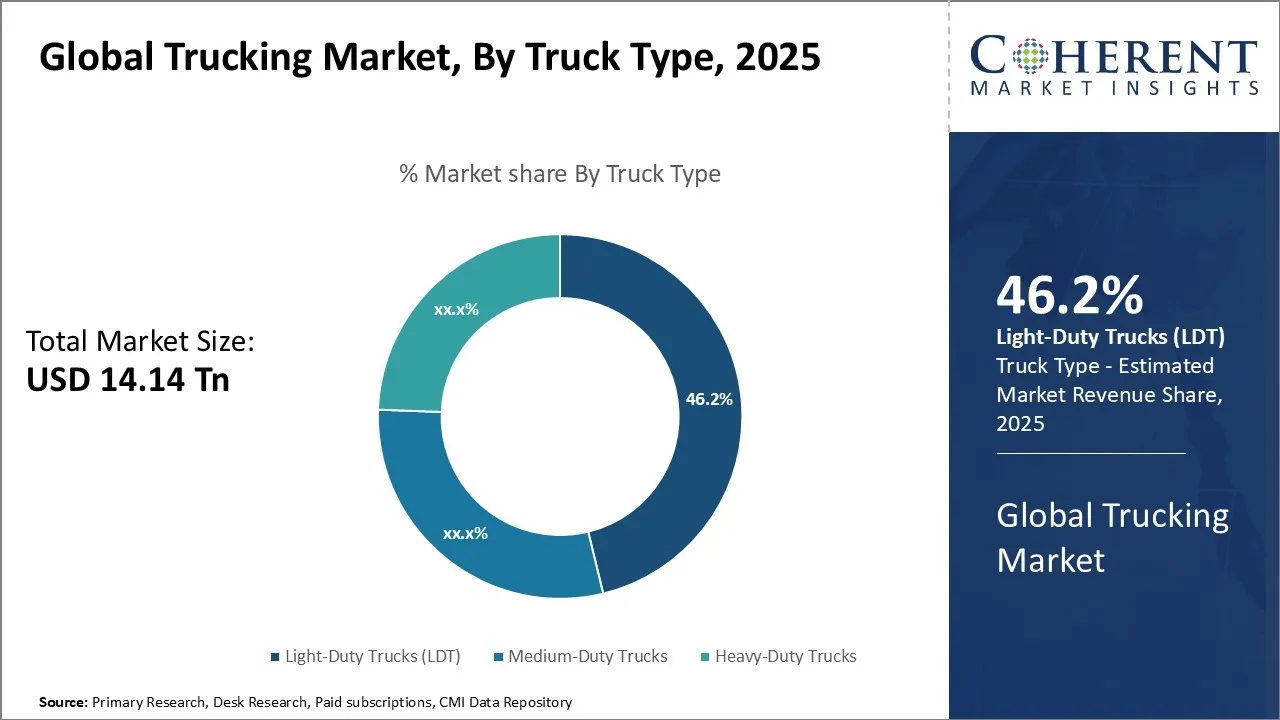
- The Light-Duty Trucks (LDT) segment is expected to lead the market holding a share of 47.2% in 2026.
- The freight transport segment is estimated to lead the market with a share of 63.5% in 2026.
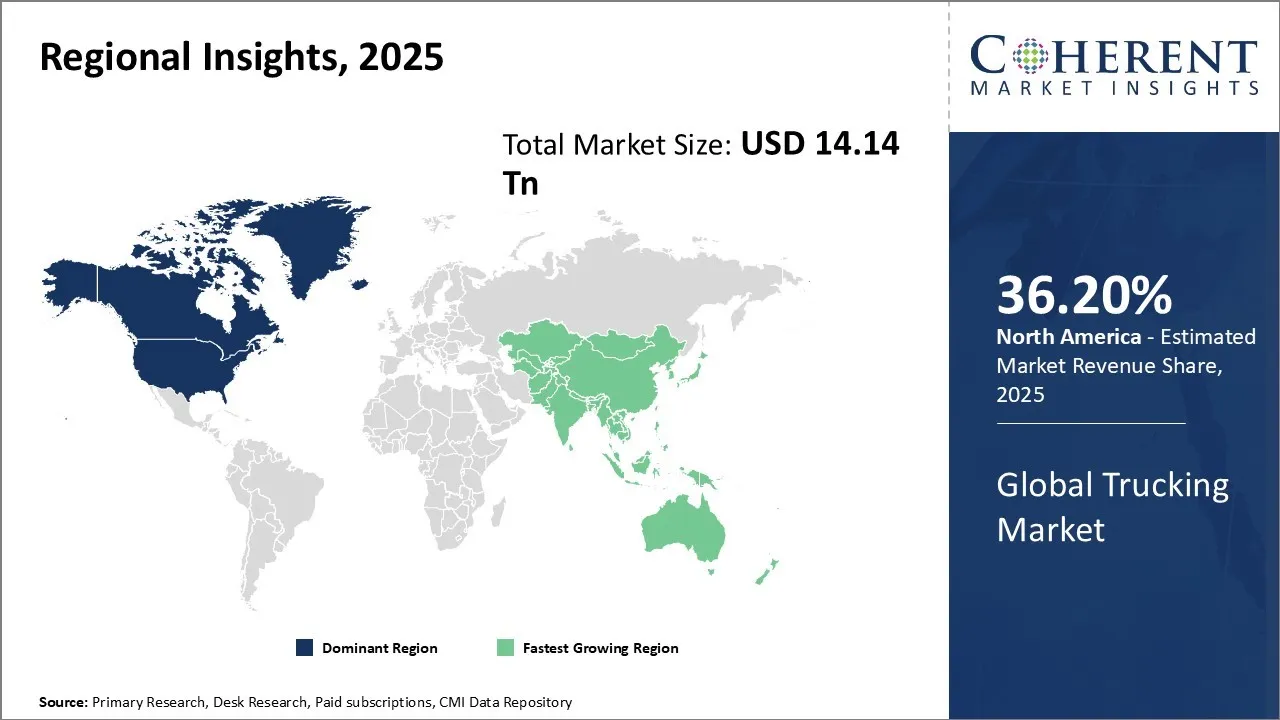
- North America is estimated to lead the market with a share of 36.2% in 2026. Asia Pacific, holding a share of 23.4% in 2026, is projected to be the fastest growing region.
Market Overview:
The trucking industry is experiencing several trends that are shaping its future. Digitalization and automation are transforming the market, with the adoption of advanced technologies like telematics, GPS tracking, and fleet management software. These innovations are improving operational efficiency, reducing costs, and enhancing safety. Additionally, the focus on sustainability is driving the demand for alternative fuel vehicles and eco-friendly practices in the trucking sector.
Current Events and their Impact
Current Events | Description and its impact |
Geopolitical Tensions Disrupting Trade Routes |
|
U.S. Macroeconomic Policy Shifts |
|
Segmental Analysis
- Current Industry Events of 2026
- Market Size Estimation
- Regional Breakdown
- Competitive Landscape
- Customer Intelligence
- Segmental Analysis
- Pricing Analysis
- Key Market Drivers, Challenges & Future Trends
- Customized Insights Section
Global Trucking Market Insights, by Truck Type - Light-Duty Trucks (LDT) Lead due to Versatility and Affordability
The Light-Duty Trucks (LDT) segment is expected to emerge as the dominant force in the global trucking market, capturing the highest share of 47.2% in 2026 among all truck types. LDTs’ adaptability allows them to cater to the diverse needs of businesses across various industries, including e-commerce, retail, and logistics. The flexibility offered by LDTs makes them an attractive choice for companies looking to optimize their transportation operations and improve efficiency.
Another significant factor contributing to the LDT segment's growth is affordability. Compared to medium-duty and heavy-duty trucks, LDTs have a lower initial cost and are more fuel-efficient, resulting in reduced operating expenses for businesses. The cost-effectiveness of LDTs makes them an appealing option for small and medium-sized enterprises (SMEs) that may have limited capital resources but still require reliable transportation solutions.
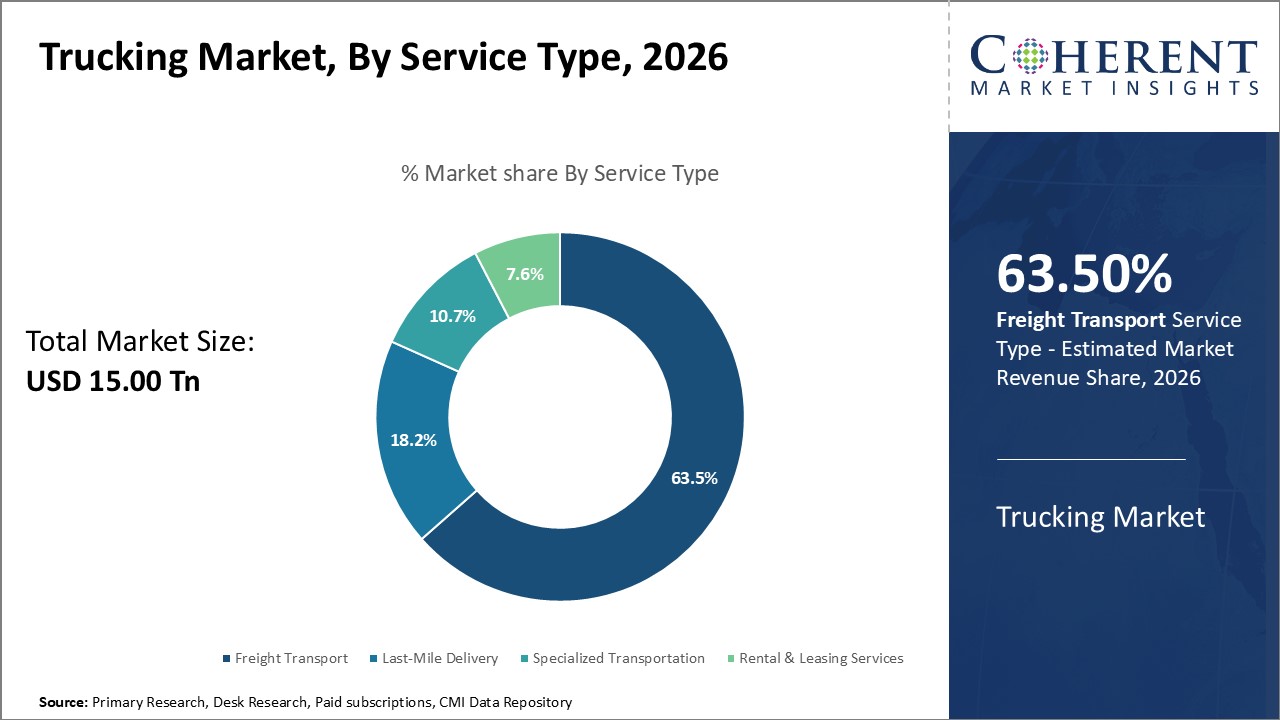
Global Trucking Market Insights, by Service Type - Freight Transport Leads the Market, Driven by Global Trade and Supply Chain Optimization
In the global trucking market, the freight transport segment is expected to emerge as the leading service type, capturing the highest market share of 63.5% in 2026. As economies worldwide become more interconnected, the demand for efficient and reliable freight transportation grow exponentially. Trucking plays a vital role in facilitating the movement of goods across borders, connecting manufacturers, suppliers, and consumers. The freight transport segment's ability to handle large volumes of cargo and provide door-to-door service has made it an essential component of global supply chains.
To add to this, businesses are constantly seeking ways to streamline their logistics operations, reduce costs, and improve delivery times. Freight transport, particularly through trucking, offers flexibility and adaptability in routing and scheduling, allowing companies to optimize their supply chain networks.
Role of Artificial Intelligence (AI) in Trucking Market
Artificial Intelligence (AI) is facilitating smart technologies to be embedded in vehicles and fleet management systems. By integrating AI, trucking solutions go far beyond route planning—they deliver real-time diagnostics, driver behavior monitoring, and predictive maintenance alerts to improve efficiency and safety.
AI algorithms can analyze vehicle data to forecast component failures before they happen, helping fleets reduce downtime and maintenance costs. A notable example is Volvo Trucks' AI-powered system, which uses predictive analytics to alert operators about potential engine issues, enabling preemptive repairs.
Regional Insights
North America Trucking Market Analysis and Trends
North America, holding a share of 36.2% in 2026, is expected to dominate the global trucking market. The region boasts a well-developed transportation infrastructure, with an extensive network of highways and efficient logistics systems. The presence of major trucking companies, such as J.B. Hunt Transport Services, Knight-Swift Transportation, and Schneider National, further solidifies North America's position as a leader in the trucking industry. Additionally, the strong trade relationship between the U.S. and Canada, along with the implementation of the United States-Mexico-Canada Agreement (USMCA), has fostered a favorable environment for cross-border trucking operations.
Asia Pacific Trucking Market Analysis and Trends
The Asia Pacific, holding a share of 23.4% in 2026, is expected to exhibit the fastest growth in the global trucking market. The region's rapid economic development, increasing industrialization, and expanding middle class have fueled the demand for efficient freight transportation.
Moreover, government initiatives aimed at promoting logistics and transportation, such as China's Belt and Road Initiative and India's Bharatmala Pariyojana, have played a crucial role in driving the growth of the trucking market in Asia Pacific. The region has also witnessed the emergence of local trucking companies, such as SF Express and YTO Express in China, and VRL Logistics and TCI Express in India, which have gained significant market share and contributed to the overall growth of the industry.
Global Trucking Market Outlook for Key Countries:
U.S. Trucking Market Analysis and Trends
The U.S. trucking market remains a dominant force in the global landscape. The country's vast geographic expanse and robust consumer demand necessitate a well-established trucking network. Major players such as UPS, FedEx, and XPO Logistics have significantly shaped the market, leveraging advanced technologies and efficient supply chain management practices.
The rise of e-commerce giants like Amazon has further intensified the demand for last-mile delivery services, pushing trucking companies to adapt and innovate. However, the market faces challenges such as driver shortages and regulatory pressures, which have prompted companies to explore autonomous trucking solutions and implement driver-centric initiatives to attract and retain talent.
China Trucking Market Analysis and Trends
China trucking market has experienced remarkable growth, driven by the country's rapid economic development and expanding industrial sector. The market is characterized by a mix of state-owned enterprises and private companies, with players like Sinotrans and China National Petroleum Corporation (CNPC) holding significant market share.
The Chinese government's focus on infrastructure development, including the construction of an extensive highway network, has facilitated the growth of the trucking industry. Additionally, the rise of e-commerce platforms like Alibaba and JD.com has created a surge in demand for efficient logistics and last-mile delivery services. However, the market faces challenges such as fragmentation, inefficiencies, and environmental concerns, leading to efforts to promote consolidation and green transportation solutions.
Germany Trucking Market Analysis and Trends
Germany continues to lead the trucking market in Europe, leveraging its strategic location, advanced transportation infrastructure, and strong manufacturing base. The country's well-developed highway system, known as the Autobahn, enables efficient long-distance trucking operations. Major players like Deutsche Post DHL Group and DB Schenker have established a strong presence in the market, offering comprehensive logistics solutions.
India Trucking Market Analysis and Trends
India trucking market is experiencing rapid growth, driven by the country's expanding economy, increasing trade activities, and growing e-commerce sector. The market is highly fragmented, with a large number of small and medium-sized players operating alongside larger organized companies. The Indian government's push for infrastructure development, including the construction of national highways and dedicated freight corridors, has boosted the growth of the trucking industry.
Companies like TCI Express and VRL Logistics have capitalized on this growth, offering specialized services and leveraging technology to improve efficiency.
Market Players, Key Development, and Competitive Intelligence
Key Developments:
- On May 1, 2025, Aurora Innovation, a self-driving vehicle technology company, launched the first commercial driverless freight service in the U.S., sending autonomous 18-wheelers between Dallas and Houston without a human behind the wheel.
- In May 2024, Volvo Trucks, a truck manufacturing company, announced plans to launch trucks with combustion engines that run on hydrogen. On-road tests with trucks using hydrogen in combustion engines will begin in 2026, and the commercial launch is planned towards the end of this decade.
- In September 2022, DB Schenker, a logistics service provider, acquired USA Truck, a capacity solutions provider
- In May 2022, P. Moller-Maersk (Maersk), an integrated transport and logistics company, acquired Pilot Freight Services, a U.S.-based international and domestic supply chain provider with cross-border solutions into Canada and Mexico. Pilot Freight Services was rebranded to Pilot – A Maersk Company.
Top Strategies Followed by Global Trucking Market Players
- Established players in the global trucking market are focusing on extensive research and development to innovate high-performance products. These companies are investing heavily in R&D to develop advanced technologies, such as fuel-efficient engines, autonomous driving systems, and connected vehicle solutions. Moreover, leading companies are forming strategic partnerships with major industry players and original equipment manufacturers (OEMs) to solidify their market presence. Additionally, established players are making efforts to broaden their global distribution networks for enhanced market reach.
- Daimler has invested heavily in R&D to develop the eActros, a fully electric truck designed for heavy-duty distribution. The company is also advancing autonomous driving through Torc Robotics, a Daimler subsidiary focused on Level 4 autonomous truck technology.
- Mid-level players in the global trucking market are focusing on delivering cost-effective solutions to target price-sensitive consumers. They are developing quality products that offer value for money, without compromising on performance or reliability. Furthermore, mid-level players are exploring collaborations with other companies to boost their technology and production capabilities.
- Ashok Leyland, an Indian mid-tier truck manufacturer, focuses on affordable commercial vehicles that cater to cost-sensitive markets across Asia and Africa.
- Small-scale players in the global trucking market are adopting strategies such as niche specialization and technology adoption to remain competitive. They are targeting specific market segments with unique features or innovative products. Moreover, small-scale players are embracing cutting-edge technologies to enhance their offerings. They are investing in digital solutions, such as fleet management software and predictive maintenance tools, to optimize their operations and improve efficiency.
- Einride specializes in autonomous and electric freight vehicles, targeting a niche market segment. The company has developed the Einride Pod, a cab-less, autonomous electric truck designed for specific logistics applications.
Market Report Scope
Trucking Market Report Coverage
| Report Coverage | Details | ||
|---|---|---|---|
| Base Year: | 2025 | Market Size in 2026: | USD 15 Tn |
| Historical Data for: | 2020 To 2024 | Forecast Period: | 2026 To 2033 |
| Forecast Period 2026 to 2033 CAGR: | 6.0% | 2033 Value Projection: | USD 22.54 Tn |
| Geographies covered: |
| ||
| Segments covered: |
| ||
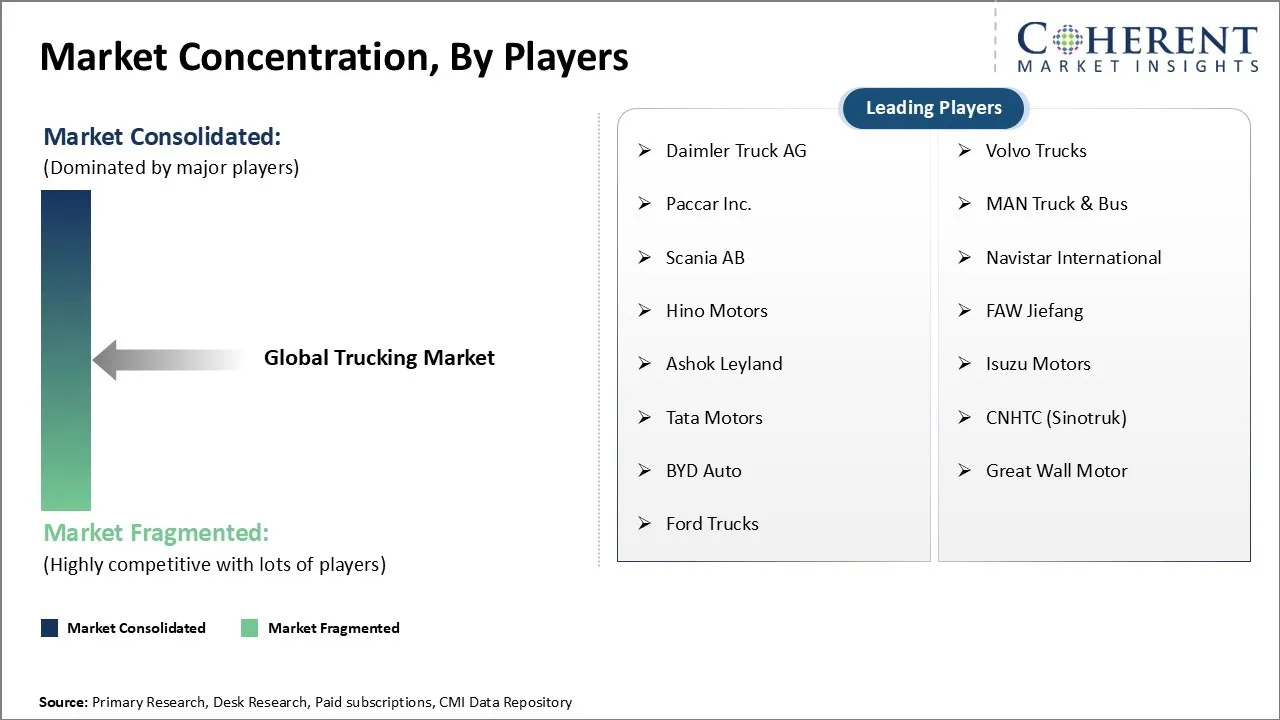
| Companies covered: | Daimler Truck AG, Volvo Trucks, Paccar Inc., MAN Truck & Bus, Scania AB, Navistar International, Hino Motors, FAW Jiefang, Ashok Leyland, Isuzu Motors, Tata Motors, CNHTC (Sinotruk), BYD Auto, Great Wall Motor, and Ford Trucks | ||
| Growth Drivers: |
| ||
| Restraints & Challenges: |
| ||
Market Dynamics
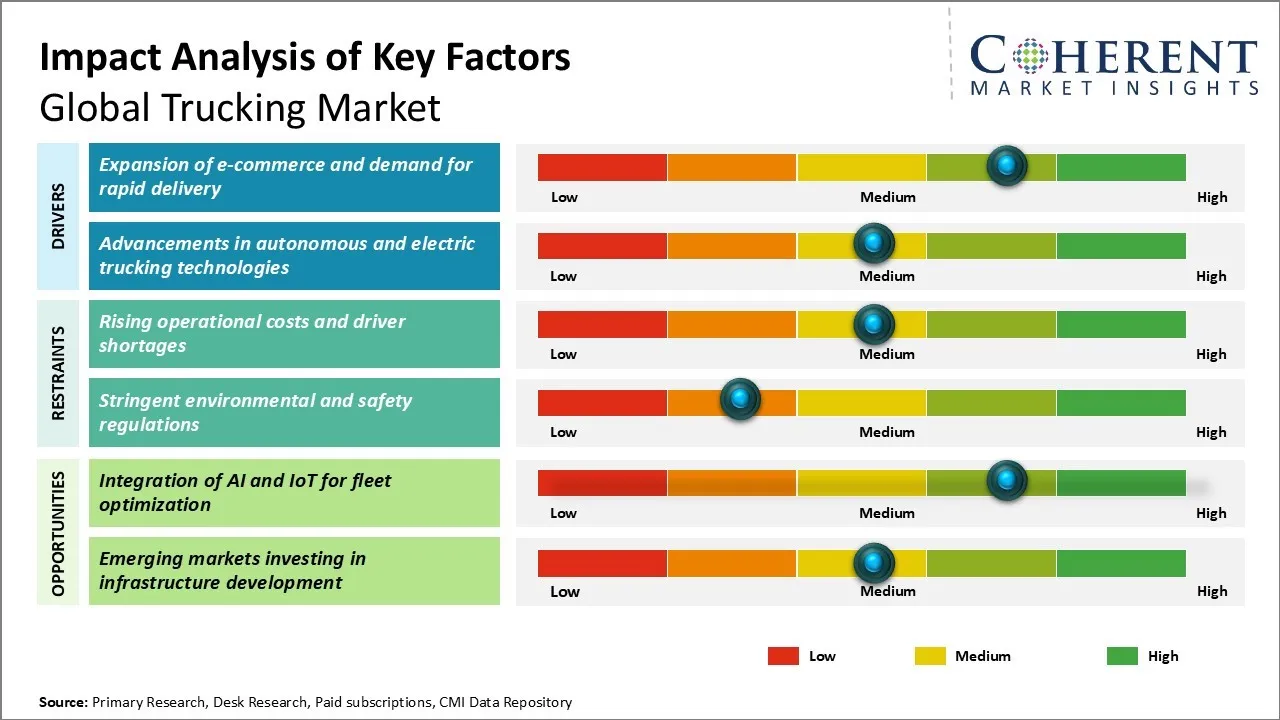
Global Trucking Market Driver - Expansion of E-commerce and Demand for Rapid Delivery
The rapid expansion of e-commerce and the increasing demand for quick delivery services have emerged as significant drivers for the global trucking market. The surge in e-commerce has led to a heightened demand for efficient and reliable trucking services capable of handling the transportation of goods from warehouses to distribution centers and ultimately to the end consumers.
Trucking companies are adapting to this trend by investing in advanced technologies, such as real-time tracking systems and route optimization software, to enhance their delivery capabilities and meet the growing expectations of customers. For instance, the Amazon Relay app connects independent truck drivers with Amazon’s supply chain, using real-time tracking and digital freight matching to ensure faster, more efficient deliveries from fulfillment centers to final destinations.
Global Trucking Market Opportunity - Integration of AI and IoT for Fleet Optimization
The integration of Artificial Intelligence (AI) and the Internet of Things (IoT) presents a significant opportunity for the global trucking market to optimize fleet operations. By leveraging AI-powered analytics and IoT sensors, trucking companies can gain real-time insights into vehicle performance, driver behavior, and route efficiency. This technology enables predictive maintenance, allowing companies to proactively address potential issues before they lead to costly breakdowns and downtime.
Furthermore, AI algorithms can analyze vast amounts of data to identify optimal routes, considering factors such as traffic patterns, weather conditions, and delivery schedules, resulting in reduced fuel consumption and improved delivery times. IoT-connected devices can also monitor driver behavior, promoting safe driving practices and reducing the risk of accidents.
UPS utilizes an AI-powered system called ORION (On-Road Integrated Optimization and Navigation), which leverages IoT data and advanced algorithms to optimize delivery routes daily. By analyzing traffic patterns, package volume, and vehicle locations, ORION helps UPS drivers save millions of miles and gallons of fuel annually.
Analyst Opinion (Expert Opinion):
- The interplay between geopolitical conflicts, crude oil pricing, and the global trucking market has created a complex web of economic impacts, with recent developments. Ongoing conflicts in the Middle East, coupled with U.S.-China trade disputes and the Ukraine war, initially raised concerns about oil supply disruptions.
- However, OPEC+ announced accelerated production increases in early 2025 to stabilize markets, leading to a USD 6/bbl drop in Brent crude prices. Lower crude prices reduce diesel costs, easing operational expenses for trucking companies.
- Also, U.S. tariffs on Canada/Mexico reduced cross-border trucking demand, forcing shippers to reroute through costlier domestic lanes. Trucking market is facing bifurcated pressures: lower fuel costs vs. trade policy disruptions and capacity volatility.
Speak to the analyst
Want personalized insights?
Take the findings above to one of our principal consultants, or have the report rebuilt around the segments, geographies and competitors you actually track.
Market Segmentation
- Truck Type Insights (Revenue, USD Tn, 2021 - 2033)
- Light-Duty Trucks (LDT)
- Medium-Duty Trucks
- Heavy-Duty Trucks
- Service Type Insights (Revenue, USD Tn, 2021 - 2033)
- Freight Transport
- Last-Mile Delivery
- Specialized Transportation
- Rental & Leasing Services
- Regional Insights (Revenue, USD Tn, 2021 - 2033)
- North America
- U.S.
- Canada
- Latin America
- Brazil
- Argentina
- Mexico
- Rest of Latin America
- Europe
- Germany
- U.K.
- Spain
- France
- Italy
- Russia
- Rest of Europe
- Asia Pacific
- China
- India
- Japan
- Australia
- South Korea
- ASEAN
- Rest of Asia Pacific
- Middle East
- GCC Countries
- Israel
- Rest of Middle East
- Africa
- South Africa
- North Africa
- Central Africa
- North America
- Key Players Insights
- Daimler Truck AG
- Volvo Trucks
- Paccar Inc.
- MAN Truck & Bus
- Scania AB
- Navistar International
- Hino Motors
- FAW Jiefang
- Ashok Leyland
- Isuzu Motors
- Tata Motors
- CNHTC (Sinotruk)
- BYD Auto
- Great Wall Motor
- Ford Trucks
Sources
Primary Research Interviews:
Stakeholders:
- Freight Logistics Coordinators and Fleet Managers (e.g., DHL Supply Chain, FedEx Freight)
- Truck Manufacturers and OEM Executives (e.g., Daimler Truck AG, Tata Motors, Volvo Trucks)
- Electric & Autonomous Vehicle Developers (e.g., Einride, Tesla Semi Division)
- Supply Chain Directors in Retail, Agriculture, and Construction sectors
- Transportation Technology Consultants (AI/Fleet Optimization Platforms)
- Trucking Association Representatives (e.g., American Trucking Associations)
Databases:
- U.S. Department of Transportation (DOT)
- European Road Freight Observatory
- ASEAN Freight & Logistics Hub Database
- International Trade Centre (ITC)
- World Road Transport Union (IRU) Archive
Magazines:
- Global Trucking & Logistics Review
- Heavy Vehicle Tech Monthly
- Fleet Management Weekly
- Sustainable Transport World
- The Haulage Insider
Journals:
- Journal of Freight and Supply Chain Optimization
- International Journal of Heavy Transport Studies
- Journal of Advanced Vehicle Technology
- Logistics and Transport Infrastructure Review
- Clean Commercial Vehicles Journal
Newspapers:
- Freight Times (Global)
- The Haulage Daily (U.K.)
- Transport Business Today (India)
- Logistics Post (U.S.)
- Asia-Pacific Commercial Vehicle News
Associations:
- American Trucking Associations (ATA)
- European Automobile Manufacturers Association (ACEA)
- International Road Transport Union (IRU)
- Trucking Industry Council (Australia)
- Electric Truck & Infrastructure Coalition (ETIC)
Public Domain Sources:
- U.S. Census Bureau
- EUROSTAT
- World Bank
- United Nations Economic Commission for Europe (UNECE)
- International Energy Agency (IEA) Reports on Transport
Proprietary Elements:
- CMI Data Analytics Tool, Proprietary CMI Existing Repository of Information for Last 8 Years
Get access to 250+ pages report
Every segment, forecast, competitor profile and data table behind the analysis above — available for instant download.
- ESOMAR Member
- ISO 9001:2015 Certified
- D-U-N-S Registered
- GDPR & CCPA Compliant
Missing comfort of reading report in your local language? Find your preferred language:
Transform your Strategy with Exclusive Trending Reports
Frequently Asked Questions
The global trucking market is estimated to be valued at USD 14.14 trillion in 2025 and is expected to reach USD 20.96 trillion by 2032.
The CAGR of the global trucking market is projected to be 5.8% from 2025 to 2032.
Expansion of e-commerce and demand for rapid delivery and advancements in autonomous and electric trucking technologies are the major factors driving the growth of the global trucking market.
Rising operational costs and driver shortages and stringent environmental and safety regulations are the major factors hampering the growth of the global trucking market.
In terms of truck type, the Light-Duty Trucks (LDT) segment is estimated to dominate the market revenue share in 2025.
Daimler Truck AG, Volvo Trucks, Paccar Inc., MAN Truck & Bus, Scania AB, Navistar International, Hino Motors, FAW Jiefang, Ashok Leyland, Isuzu Motors, Tata Motors, CNHTC (Sinotruk), BYD Auto, Great Wall Motor, and Ford Trucks are the major players.
North America is expected to lead the global trucking market in 2025, holding a share of 36.2%.