

Iris Recognition Market Size and Forecast: 2026 - 2033
The Iris Recognition Market is estimated to be valued at USD 10.2 Bn in 2026 and is expected to reach USD 42.4 Bn by 2033, exhibiting a compound annual growth rate (CAGR) of 23.4% from 2026 to 2033.
Key Takeaways
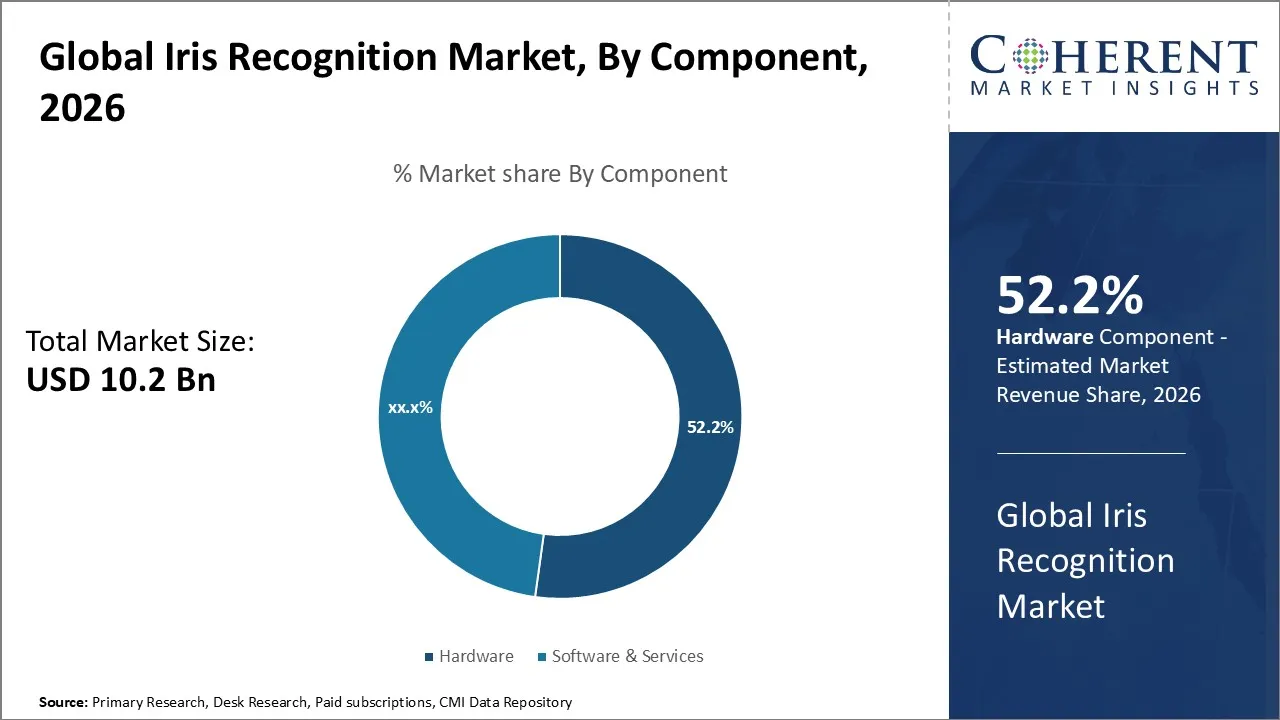
- By Component, Hardware holds the largest market share of 52.2% in 2026 owing to its rising demand for contactless & high‑accuracy biometric authentication.
- By End-user Industry, Healthcare expected to hold largest market share of 34.4% in 2026 owing to the improving patient identification accuracy.
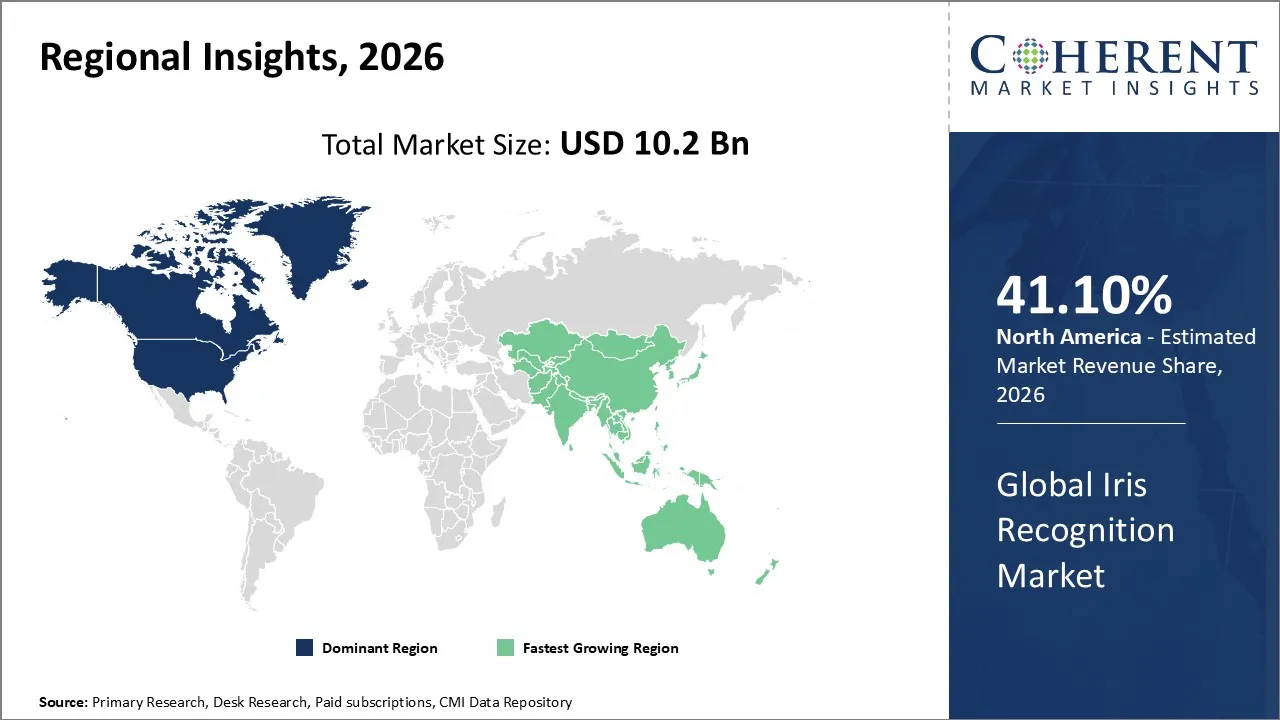
- By Region, North America dominates the overall market with an estimated share of 41.1% in 2026 owing to the high adoption of advanced biometric security.
Market Overview
The Iris Recognition Market is rapidly growing as governments, healthcare providers, banks, and enterprises increasingly adopt secure, contactless authentication solutions. Organizations are leveraging advanced imaging technologies, high-precision sensors, and seamless integration with mobile and access control systems to enhance security. Rising concerns about safety, ongoing digital transformation, and national ID initiatives are driving further adoption. Companies deploy iris recognition hardware, software, and services across hospitals, airports, border checkpoints, and corporate facilities, establishing it as a vital biometric technology worldwide.
Current Events and their Impact on the Iris Recognition Market
Current Events | Description and its impact |
Geopolitical Developments |
|
Technological Innovations |
|
Regional Policy and Infrastructure Trends |
|
Segmental Insights
- Current Industry Events of 2026
- Market Size Estimation
- Regional Breakdown
- Competitive Landscape
- Customer Intelligence
- Segmental Analysis
- Pricing Analysis
- Key Market Drivers, Challenges & Future Trends
- Customized Insights Section
Iris Recognition Market Insights, By Component - Hardware contributes the highest share of the market owing to its integration into consumer electronics
Hardware holds the largest market share of 52.2% in 2026. The hardware segment of the Iris Recognition Market is expanding as organizations actively seek reliable, contactless identity verification in security-sensitive sectors. Companies are deploying high-resolution cameras, near-infrared sensors, and optical modules to enhance accuracy and performance. Airports, government facilities, and consumer electronics increasingly adopt durable, compact hardware, while ongoing innovations in sensor technology, miniaturization, and access control integration continue to drive global deployment of iris recognition hardware.
Iris Recognition Market Insights, By End User Industry - Healthcare contributes the highest share of the market owing to its enhancing security & access control within facilities
Healthcare expected to hold largest market share of 34.4% in 2026. The healthcare segment of the Iris Recognition Market is expanding as hospitals and clinics actively adopt biometric systems to accurately identify patients and minimize medical errors. Healthcare providers use iris recognition to protect sensitive medical records, speed up patient check-ins, and prevent insurance and billing fraud. Contactless authentication enhances hygiene and operational efficiency, while integration with digital health and telemedicine platforms strengthens security. Increasing focus on data protection, regulatory compliance, and efficient patient management drives broader adoption of iris recognition in healthcare settings.
Regional Insights
North America Iris Recognition Market Trends
North America dominates the overall market with an estimated share of 41.10% in 2026. In North America’s Iris Recognition Market, federal and state agencies are actively expanding secure biometric systems for border control, airport security, and law enforcement. Banks, healthcare providers, and enterprises are adopting contactless authentication to strengthen access and identity verification. The United States and Canada drive technological innovation, deploy AI-enhanced solutions, and integrate iris recognition with digital ID platforms, supported by robust IT infrastructure and regulatory focus on secure identity management. Increasing adoption in mobile devices and multimodal biometrics continues to shape regional market trends.
Asia Pacific Iris Recognition Market Trends
In the Asia Pacific Iris Recognition Market, public and private organizations are rapidly adopting advanced, contactless biometric authentication. Governments deploy iris systems for border control, national ID programs, and e-gates, while enterprises and financial institutions implement the technology to secure access and prevent fraud. Companies leverage technological advancements, lower sensor costs, and enhanced imaging performance to expand commercial applications. Healthcare, transportation, and mobile device sectors are actively driving regional growth and increasing market penetration across the Asia Pacific region. For instance, Samsung India has launched the Galaxy Tab Iris, which uses iris-recognition technology for Aadhaar authentication through a secure biometric system. The device enables cashless, paperless services across banking, e-governance, healthcare, education, and more.
United States Iris Recognition Market Trends
In the United States Iris Recognition Market, government agencies, enterprises, and security providers are actively expanding the deployment of biometric systems to improve identity verification and access control. Organizations implement iris technology in border control, law enforcement, healthcare, and finance to boost accuracy and streamline operations. Companies focus on AI-enabled solutions, cloud integration, and secure digital identity frameworks to drive market growth. Increasing use of iris systems in mobile devices and multimodal biometrics continues to accelerate technology adoption across the U.S.
Japan Iris Recognition Market Trends
In the Japan Iris Recognition Market, businesses and government agencies are actively deploying advanced biometric systems to enhance identity verification in national security, border control, and enterprise access management. Japanese organizations integrate high-precision iris technology with their digital ID and security infrastructures. Rising security concerns and technological innovations drive growing adoption of contactless authentication, encouraging wider deployment across healthcare, finance, and transportation sectors and strengthening overall market growth throughout the country.
Iris Recognition Market Trend
Growing Adoption of Contactless Authentication
Organizations across government, healthcare, finance, and enterprise sectors are increasingly implementing contactless iris recognition systems. This trend is driven by the need to reduce physical contact, enhance hygiene, and streamline secure identification processes. Contactless authentication not only improves operational efficiency but also aligns with evolving health and safety standards, especially in high-traffic areas such as airports, hospitals, and offices, encouraging wider adoption of iris recognition technologies.
Integration with Mobile and Digital Platforms
Iris recognition systems are being integrated with smartphones, tablets, and digital identity platforms to enable secure, on-the-go verification. Mobile and digital deployment allows users to authenticate transactions, access applications, or verify identity remotely. Organizations leverage this trend to enhance security, support digital transformation, and provide seamless user experiences, particularly in banking, telehealth, and corporate environments where convenience and rapid verification are essential.
Iris Recognition Market Opportunity
Integration with Healthcare Systems
Hospitals and clinics are seeking advanced iris recognition to improve patient identification, reduce medical errors, and secure access to sensitive health records. Providers are exploring solutions that integrate with electronic health records and telemedicine platforms. Companies can capitalize on this by offering scalable, interoperable iris systems that enhance operational efficiency, support hygiene standards through contactless authentication, and meet healthcare regulations, creating strong adoption potential across public and private healthcare institutions.
Market Report Scope
Iris Recognition Market Report Coverage
| Report Coverage | Details | ||
|---|---|---|---|
| Base Year: | 2025 | Market Size in 2026: | USD 10.2 Bn |
| Historical Data for: | 2020 To 2024 | Forecast Period: | 2026 To 2033 |
| Forecast Period 2026 to 2033 CAGR: | 23.4% | 2033 Value Projection: | USD 42.4 Bn |
| Geographies covered: |
| ||
| Segments covered: |
| ||
| Companies covered: | IDEMIA, Iritech Inc., IrisGuard UK Ltd., BioEnable Technologies Pvt. Ltd., NEC Corporation, Aware Inc., Gemalto NV (Thales Group), Iris ID Inc., Princeton Identity Inc., HID Global, and EyeLock LLC. | ||
| Growth Drivers: |
| ||
| Restraints & Challenges: |
| ||
Iris Recognition Market News
- In June 2025, Sam Altman’s venture World unveiled its biometric identity verification services in the United Kingdom, starting in London and expanding to Manchester, Birmingham, Cardiff, Belfast, and Glasgow in the coming months.
Analyst Opinion (Expert Opinion)
- The Iris Recognition Market is entering a phase where its value is no longer defined by novelty but by deployment depth in high-assurance environments. Compared with other biometric modalities, iris recognition consistently delivers accuracy rates exceeding 99% under controlled conditions, making it indispensable in scenarios where failure is not tolerable. Its continued use in large-scale identity systems such as India’s Aadhaar program, which has enrolled over a billion individuals using multimodal biometrics including iris, demonstrates its scalability and reliability in real-world, population-scale implementations.
- Adoption patterns indicate that iris recognition is becoming a default layer in critical infrastructure rather than a standalone solution. For example, U.S. border control and law enforcement agencies increasingly integrate iris data into multimodal biometric databases to enhance identity resolution across fragmented systems. This reflects a broader shift toward layered authentication architectures, where iris recognition compensates for the limitations of facial recognition in low-light or spoof-prone environments. The technology’s resilience against forgery and its stability over a lifetime provide a measurable advantage in such deployments.
- However, the market remains constrained by a structural imbalance between performance capability and usability expectations. While error rates remain low, real-world throughput often suffers due to positioning sensitivity and environmental dependencies, particularly in high-traffic environments like airports or hospitals. Empirical observations from deployment pilots show that even minor increases in acquisition time—beyond two seconds per scan—can reduce throughput efficiency by more than 20% in mass transit scenarios. This gap underscores the need for hardware innovation focused not just on accuracy, but on frictionless user interaction.
- Another critical inflection point lies in cost dynamics and component integration. Despite advancements, near-infrared sensors and precision optics still impose a cost premium compared to facial recognition systems that leverage standard RGB cameras. This has limited widespread consumer adoption, confining iris recognition largely to government and enterprise use cases. Until component costs decline significantly or are embedded natively into mass-market devices, penetration will remain uneven, particularly in price-sensitive regions.
Speak to the analyst
Want personalized insights?
Take the findings above to one of our principal consultants, or have the report rebuilt around the segments, geographies and competitors you actually track.
Market Segmentation
- By Component
- Hardware
- Software & Services
- By End-User Industry
- Consumer Electronics
- Healthcare
- BFSI
- Government and Law Enforcement
- Other End-user Industries
- By Regional Insights
- North America
- U.S.
- Canada
- Latin America
- Brazil
- Argentina
- Mexico
- Rest of Latin America
- Europe
- Germany
- U.K.
- Spain
- France
- Italy
- Russia
- Rest of Europe
- Asia Pacific
- China
- India
- Japan
- Australia
- South Korea
- ASEAN
- Rest of Asia Pacific
- Middle East
- GCC Countries
- Israel
- Rest of Middle East
- Africa
- South Africa
- North Africa
- Central Africa
- North America
- Key Players Insights
- IDEMIA
- Iritech Inc.
- IrisGuard UK Ltd.
- BioEnable Technologies Pvt. Ltd.
- NEC Corporation
- Aware Inc.
- Gemalto NV (Thales Group)
- Iris ID Inc.
- Princeton Identity Inc.
- HID Global
- EyeLock LLC.
Sources
Primary Research Interviews
- Biometric solution providers and system integrators
- Security infrastructure and access control managers
- Healthcare IT administrators and hospital management professionals
- Government officials involved in identity and border control programs
- Technology experts specializing in AI and biometric authentication
Databases
- World Bank Open Data
- International Monetary Fund (IMF) Data Portal
- United Nations Data Repository
- OECD Statistics Database
- National Informatics Centre (NIC) datasets
Magazines
- Biometric Technology Today
- Security Today
- Government Technology Magazine
- Healthcare IT News Magazine
- Airport Technology Magazine
Journals
- IEEE Transactions on Information Forensics and Security
- International Journal of Biometrics
- Journal of Information Security and Applications
- Pattern Recognition Letters
- ACM Transactions on Privacy and Security
Newspapers
- The New York Times
- The Guardian
- The Wall Street Journal
- The Washington Post
- Financial Times
Associations
- International Biometrics and Identity Association (IBIA)
- Biometrics Institute
- International Association for Identification (IAI)
- Secure Identity Alliance
- FIDO Alliance
Public Domain Sources
- Government publications and white papers
- Regulatory authority reports and policy documents
- Company annual reports and investor presentations
- Conference proceedings and technical papers
- Open-source biometric research datasets
Proprietary Elements
- CMI Data Analytics Tool
- Proprietary CMI Existing Repository of information for last 8 years
Get access to 250+ pages report
Every segment, forecast, competitor profile and data table behind the analysis above — available for instant download.
- ESOMAR Member
- ISO 9001:2015 Certified
- D-U-N-S Registered
- GDPR & CCPA Compliant
Missing comfort of reading report in your local language? Find your preferred language:
Transform your Strategy with Exclusive Trending Reports
Frequently Asked Questions
The Iris Recognition Market is estimated to be valued at USD 10.2 Bn in 2026 and is expected to reach USD 42.4 Bn by 2033.
Rise in cases of fraudulent activities and rise in integration of multi-factor authentication are fuelling the market
The hardware segment is the leading component segment in the market.
Rise in data privacy concerns and presence of competing biometric technologies are the major factors restraining market.
IDEMIA, Iritech Inc., IrisGuard UK Ltd., BioEnable Technologies Pvt. Ltd., NEC Corporation, Aware Inc., Gemalto NV (Thales Group), Iris ID Inc., Princeton Identity Inc., HID Global, and EyeLock LLC.