

Smart Parking Systems Market Size and Forecast – 2026 to 2033
Smart Parking Systems Market is estimated to be valued at USD 13,809.9 Mn in 2026 and is expected to reach USD 51,839.1 Mn in 2033, exhibiting a compound annual growth rate (CAGR) of 20.8% from 2026 to 2033.
Key Takeaways
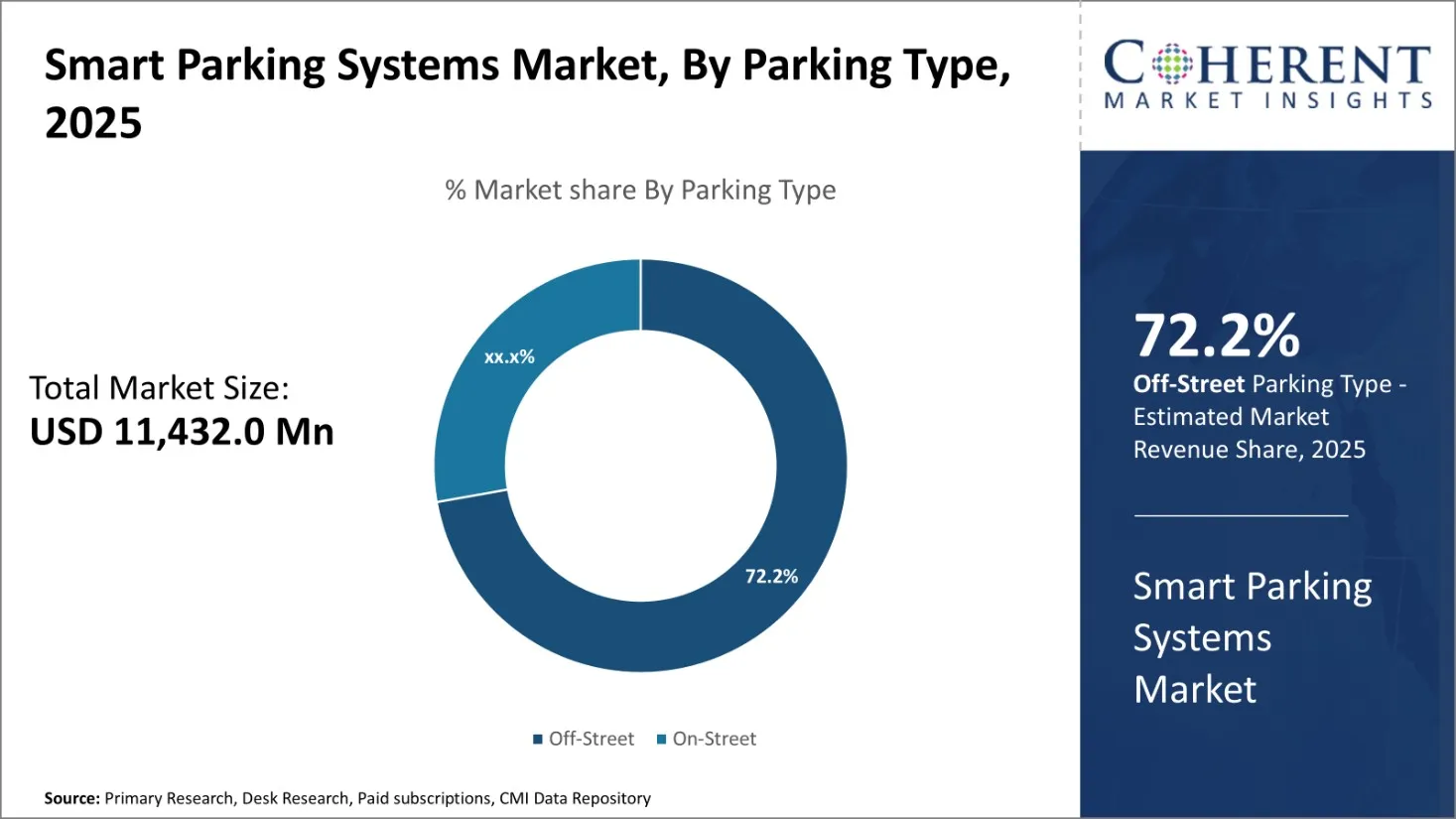
- By Parking Site, Off-Street hold the largest market share of 73.2% in 2026 owing to its rapid urbanisation & increasing vehicle ownership.
- By Component, Software expected to hold largest market share in 2026 owing to the demand for real‑time parking guidance & better user experience.
- By Application, Corporate & commercial institutions acquired the prominent market share in 2026 owing to the high vehicle volumes & constrained parking supply.
- By Region, Europe dominates the overall market with an estimated share of 35.8% in 2026 owing to the stringent environmental / sustainability regulations & urban mobility goals.
Market Overview
The Smart Parking Systems Market is rapidly evolving as urbanization and rising vehicle density drive the demand for efficient parking management. IoT, sensors, AI, and cloud-based platforms are transforming traditional parking into connected, data-driven solutions. These systems provide users with real-time guidance, mobile apps, and automated payments, while helping operators optimize space utilization and streamline operations. Commercial, corporate, and municipal sectors increasingly adopt these solutions, integrating them into smart city projects and EV infrastructure to shape future developments.
Current Events and its Impact on the Smart Parking Systems Market
Current Events | Description and its impact |
Technological Advancements in IoT and AI Integration |
|
Urbanization and Smart City Initiatives |
|
Economic Conditions and Infrastructure Spending |
|
Segmental Insights
- Current Industry Events of 2026
- Market Size Estimation
- Regional Breakdown
- Competitive Landscape
- Customer Intelligence
- Segmental Analysis
- Pricing Analysis
- Key Market Drivers, Challenges & Future Trends
- Customized Insights Section
Smart Parking Systems Market Insights, By Parking Site - Off-Street contribute the highest share of the market owing to its support from smart city initiatives & regulatory push
Off-Street hold the largest market share of 73.2% in 2026. The increasing demand to efficiently manage limited urban parking spaces drives the growth of off-street smart parking systems. These systems use sensors, IoT, and automation to guide vehicles, ease congestion, and enhance user convenience in garages and dedicated lots. Facility operators optimize space, streamline operations, and cut operational costs. Commercial complexes, airports, and municipal authorities are increasingly adopting these solutions, while the push for smarter infrastructure and better traffic management accelerates the deployment of off-street smart parking systems. For instance, in August 2025, the Urban Affairs Department announced the Grant-in-Aid Scheme for Off-Street Parking, providing significant capital grants to private landowners, community organizations, and cooperatives to develop commercial parking facilities.
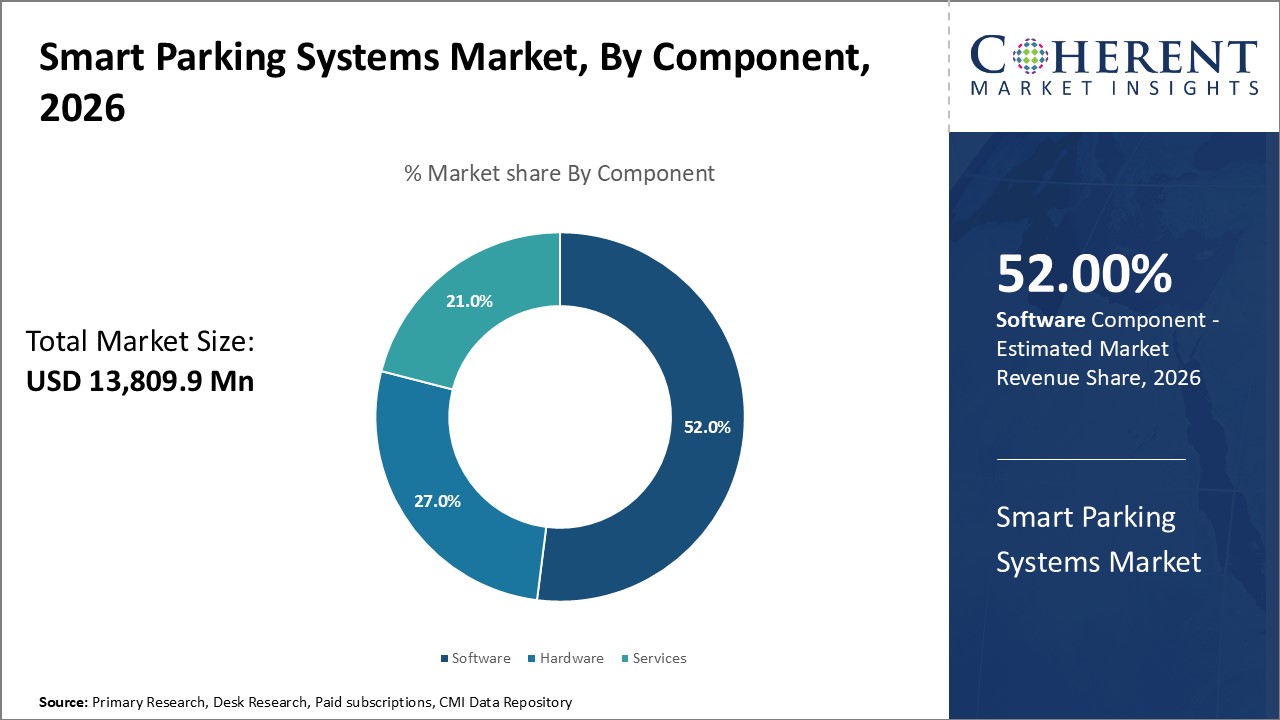
Smart Parking Systems Market Insights, By Component - Software contributes the highest share of the market owing to its increasing use of analytics, ai & data‑driven optimization
The demand for real-time management, data analytics, and seamless user experiences drives the rise of software solutions in smart parking systems. These advanced platforms allocate spaces dynamically, enable mobile reservations and contactless payments, and support predictive maintenance, boosting efficiency for operators and convenience for drivers. By integrating IoT devices, cloud services, and AI-powered analytics, operators monitor occupancy, optimize revenue, and strengthen operational control. Increasing digitalization and smart city initiatives continue to accelerate the adoption of software-driven smart parking solutions. For instance, in July 2025, BYD announced the L4-level autonomous driving feature for its God’s Eye ADAS and pledged to fully cover any losses from its use in parking scenarios, stating the move demonstrates complete confidence in the system.
Smart Parking Systems Market Insights, By Application - Corporate & commercial institutions contribute the highest share of the market owing to its demand for operational efficiency & cost savings
Corporate and commercial institutions adopt smart parking systems to enhance customer and employee convenience and optimize limited parking resources. These systems guide vehicles in real time, enable automated payments, and manage spaces efficiently, boosting operational performance for facility managers. Large offices, shopping centers, hotels, and airports implement smart parking to streamline traffic, reduce congestion, and provide premium services. Growing digital transformation and investment in smarter infrastructure drive commercial entities to expand the use of these intelligent parking solutions. For instance, in November 2025, DP World partnered with Parkin to launch a smart parking system at the Al Aweer Central Fruit and Vegetable Market, a major food logistics hub handling millions of tonnes of fresh produce each year.
Regional Insights
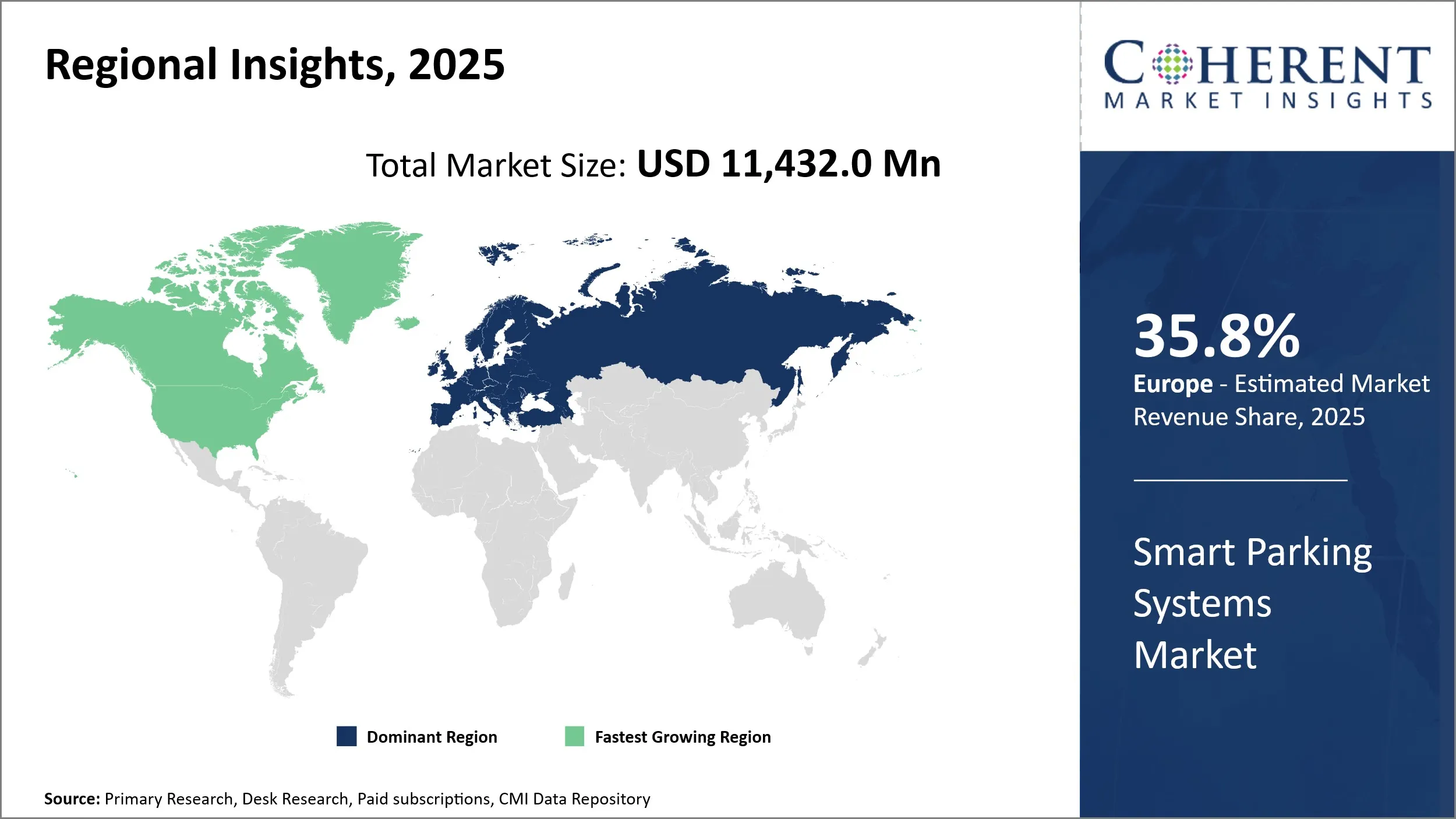
Europe Smart Parking Systems Market Trends
Europe dominates the overall market with an estimated share of 35.8% in 2026. The European smart parking systems market growth is embracing several key trends. New deployments increasingly include mobile apps and reservation features as standard offerings. Cities integrate EV-charging infrastructure into parking bays to support the transition to electric mobility. Municipalities upgrade older parking facilities with cloud-based platforms and IoT sensors in dense urban areas. Operators are also advancing data interoperability and mobility-as-a-service frameworks, aligning smart parking systems with broader transportation networks and sustainability initiatives. For instance, in August 2026, the publicly listed Smart Parking Group founded Smart Parking AG to expand its presence in Switzerland and strengthen its market position in Europe, complementing existing subsidiaries in the United Kingdom, Denmark, and Germany.
North America Smart Parking Systems Market Trends
The North American smart parking systems market follows key trends focused on user convenience and connected infrastructure. Cities implement mobile apps and contactless payment options to simplify entry, reservations, and exits in parking facilities. Municipalities and operators use IoT sensors and cloud platforms to monitor occupancy in real time and manage spaces more efficiently. The region also integrates smart parking into broader mobility networks and urban traffic planning, while commercial facilities adopt analytics and premium services to optimise operations. For instance, in August 2026, Streetline, a leader in intelligent transportation systems, launched its smart Truck Parking Availability System (TPAS) commercially in collaboration with the Arizona Department of Transportation (ADOT).
United States Smart Parking Systems Market Trends
In the United States, cities are rapidly advancing the smart parking systems market by deploying sensor-based platforms, mobile apps, and cloud services to streamline parking operations and reduce congestion. Municipalities and private operators track occupancy in real time, implement automated payments, and offer mobile reservations, turning parking into a seamless digital experience. They also integrate EV charging infrastructure and predictive analytics to enhance system capabilities, while partnerships between technology firms and transport agencies create smarter, city-wide parking networks. For instance, in April 2026, Clemson University partnered with eleven-x® to launch North America’s largest university smart parking program, using the eXactpark™ platform to guide 29,000 students and faculty to available parking in real time.
United Kingdom Smart Parking Systems Market Trends
In the United Kingdom, operators are increasingly shaping smart parking systems through integrated, digital-first strategies. They implement mobile apps and contactless payment platforms to simplify user access and transactions. Municipalities deploy sensor-based occupancy monitoring and ANPR solutions to reduce congestion and increase space turnover. Operators also integrate EV-charging infrastructure into parking facilities to support green mobility policies. Partnerships among councils, technology providers, and parking operators accelerate rollouts, while the shift toward unified platforms simplifies parking management across public and private sites.
End-user Feedback and Unmet Needs in the Smart Parking Systems Market
- User Experience & Interface Challenges: End‑users report that many smart parking applications and systems have steep learning curves, confusing navigation, or lack clear real‑time information. For example, systems may not match user intention or context, leading to frustration with the technology.
- Availability & Reliability Issues: Drivers frequently face the problem of being shown a “available” spot, yet the space is either occupied or inaccessible. This undermines trust in the system and accentuates the need for more accurate occupancy detection and verification.
- Integration & Interoperability Gaps: Users and facility operators highlight the difficulty in having a single system that works seamlessly across different parking lots, payment systems, EV chargers and mobility services. Fragmented platforms reduce usability and efficiency.
Smart Parking Systems Market Trend
AI, ML & analytics‑driven optimization
Smart parking deployments increasingly incorporate artificial intelligence and machine learning to predict demand, guide drivers to available spots, and optimize space allocation. Real‑time analytics enable operators to adjust operations dynamically—such as redirecting incoming vehicles, automating payment flows or forecasting high‑occupancy periods—to reduce vehicle idle time and traffic congestion. IoT sensor data feeds into cloud platforms, where algorithms suggest optimal pricing or maintenance schedules, turning parking facilities into data‑driven assets rather than static infrastructure.
In November 2025, Cochin Smart Mission Ltd (CSML) launched ParKochi, the city’s first AI-based smart parking system, inaugurated by Transport Minister K. B. Ganesh Kumar. Implemented at 30 key locations with around 2,000 parking slots managed by various local agencies, the ₹4.8-crore project is part of CSML’s Smart Parking Management initiative under the Smart City’s Integrated Command and Control Centre. The minister said ParKochi will help bring discipline to Kochi’s parking system.
Mobile‑first user experience & connected services
Increasingly, smart parking systems focus on mobile‑enabled, seamless user journeys: drivers can locate, book, enter and pay for parking all via smartphone apps, often in real time. Integrating contactless payment, app‑based reservations, notifications and vehicle guidance turns parking into a service rather than an inconvenience. Meanwhile operators adopt cloud‑connected platforms that support remote management, multi‑site visibility and user behavior tracking. This mobile‑first and connected‑service approach improves user convenience, boosts facility utilisation and meshes parking into wider mobility ecosystems rather than treating it as isolated infrastructure.
Smart Parking Systems Market Opportunity
Retrofitting Existing Parking Facilities
Many urban parking lots and garages were built decades ago and lack automation or digital management. This creates an opportunity for vendors to retrofit these facilities with IoT sensors, cloud‑based management software, mobile payments and occupancy guidance systems. Operators can deliver improved utilisation, reduce search time for drivers, and convert legacy infrastructure into intelligent assets. Since the physical shells already exist, the focus shifts to software/hardware upgrades rather than green‑field builds—allowing faster deployment and monetisation of under‑used parking capacity.
Market Report Scope
Smart Parking Systems Market Report Coverage
| Report Coverage | Details | ||
|---|---|---|---|
| Base Year: | 2025 | Market Size in 2026: | USD 13,809.9 Mn |
| Historical Data for: | 2020 To 2024 | Forecast Period: | 2026 To 2033 |
| Forecast Period 2026 to 2033 CAGR: | 20.8% | 2033 Value Projection: | USD 51,839.1 Mn |
| Geographies covered: |
| ||
| Segments covered: |
| ||
| Companies covered: | Streetline, Inc., Worldsensing, Smart Parking Limited, Swarco AG, Amano McGann, Skidata AG, Nedap N.V., ParkMe, Inc., Cisco System, Inc., Parkmobile LLC, and Urbiotica. | ||
| Growth Drivers: |
| ||
| Restraints & Challenges: |
| ||
Smart Parking Systems Market News
- In October 2025, Q Mobility showcased its AI-powered "Zero Barrier AI Parking" system on the Abu Dhabi Government platform at GITEX Global 2025, demonstrating a seamless and efficient parking solution for residents and visitors.
- In November 2025, Kochi announced to enhance convenience for residents and tourists with its Smart Parking Management System, streamlining parking and improving the city’s overall experience.
- In February 2025, to reduce daily traffic congestion in Mumbai, the Brihanmumbai Municipal Corporation (BMC) launched a parking app that lets citizens book slots in advance and pay online.
Analyst Opinion (Expert Opinion)
- In my view, the Smart Parking Systems Market is no longer just about alleviating parking hassles—it’s emerging as a fundamental urban mobility asset. Consider the city of Pardubice, which went from CZK 23 million to nearly CZK 40 million in annual parking revenue after deploying IoT sensors, license‑plate recognition and digital payment systems. That’s not just efficiency—it's transformation of under‑leveraged infrastructure into cash‑generating, data‑driven real estate.
- Yet, despite this clear value‑creation, many parking operators still treat smart systems as optional upgrades rather than strategic investments. The reality is that deployments delivering ~95 % accuracy in vehicle detection (via edge‑AI models) and significantly reduced search times are raising the baseline expectation. Municipalities now expect measurable gains—in user convenience, revenue, and congestion relief—not just narrower operational wins.
- What concerns me is the persistent gap between proof‑of‑concept and full adoption. For example, the city of Penang reduced search‑time by 50 % and CO₂ emissions by 30 % through smart parking sensors—yet many global markets lag in standardising these outcomes. This disparity means that vendors who treat smart parking as a hardware stack risk being outdated; the winners will deliver actionable analytics, behaviour‑change insights, and integrate parking into broader mobility ecosystems.
- In short, I believe the shift is now less about “smart parking” and more about “smart mobility infrastructure.” Operators and city‑planners who treat parking as a strategic node—connected to EV charging, demand‑forecasting, multimodal routing—will realize the greatest value. Those who still view it as isolated bays with sensors risk being sidelined.
Speak to the analyst
Want personalized insights?
Take the findings above to one of our principal consultants, or have the report rebuilt around the segments, geographies and competitors you actually track.
Market Segmentation
- Global Smart Parking Systems Market, By Parking Site
- On-street
- Off-street
- Global Smart Parking Systems Market, By Component
- Hardware
- Software
- Services
- System Integration and Installation
- Parking Management
- Maintenance
- Global Smart Parking Systems Market, By Application
- Airports
- Government & municipalities
- Corporate & commercial Institutions
- Regional Insights (Revenue, USD Mn, 2021 - 2033)
- North America
- U.S.
- Canada
- Latin America
- Brazil
- Argentina
- Mexico
- Rest of Latin America
- Europe
- Germany
- U.K.
- Spain
- France
- Italy
- Russia
- Rest of Europe
- Asia Pacific
- China
- India
- Japan
- Australia
- South Korea
- ASEAN
- Rest of Asia Pacific
- Middle East
- GCC Countries
- Israel
- Rest of Middle East
- Africa
- South Africa
- North Africa
- Central Africa
- North America
- Key Players Insights
- Streetline, Inc.
- Worldsensing
- Smart Parking Limited
- Swarco AG
- Amano McGann
- Skidata AG
- Nedap N.V.
- ParkMe, Inc.
- Cisco System, Inc.
- Parkmobile LLC
- Urbiotica
Sources
Primary Research interviews
- City traffic and parking authorities in Europe, North America, and Asia-Pacific
- Facility managers of commercial complexes, airports, and corporate offices
- EV infrastructure and mobility service providers
- Smart parking system vendors’ technical teams
- Urban planners and municipal IoT project coordinators
Databases
- IEEE Xplore Digital Library
- Scopus
- ScienceDirect
- Transportation Research Board (TRB) Database
- OpenStreetMap and urban mobility GIS datasets
Magazines
- Smart Cities Dive
- Parking Today
- IoT For All
- Mobility & Transport Technology Magazine
- Intelligent Transport
Journals
- Journal of Intelligent Transportation Systems
- Transportation Research Part C: Emerging Technologies
- IEEE Transactions on Intelligent Transportation Systems
- Journal of Urban Technology
- International Journal of Transport Management
Newspapers
- The Guardian (Transport & Smart Cities section)
- The New York Times (Technology & Mobility section)
- Financial Times (Urban Mobility coverage)
- The Telegraph (UK Smart City features)
- The Hindu Business Line (Smart Infrastructure section)
Associations
- International Parking & Mobility Institute (IPMI)
- European Parking Association (EPA)
- Intelligent Transport Systems Society
- Institute of Transportation Engineers (ITE)
- Smart Cities Council
Public Domain sources
- Government transportation and urban development reports (e.g., US DOT, UK Department for Transport)
- Municipal smart city dashboards and open data portals
- City planning reports and whitepapers
- Publicly available EV adoption and infrastructure data
- National traffic statistics databases
Proprietary Elements
- CMI Data Analytics Tool
- Proprietary CMI Existing Repository of information for last 8 years
Get access to 250+ pages report
Every segment, forecast, competitor profile and data table behind the analysis above — available for instant download.
- ESOMAR Member
- ISO 9001:2015 Certified
- D-U-N-S Registered
- GDPR & CCPA Compliant
Missing comfort of reading report in your local language? Find your preferred language:
Transform your Strategy with Exclusive Trending Reports
Frequently Asked Questions
The Smart Parking Systems Market is estimated to be valued at USD 13,809.9 Mn in 2026, and is expected to reach USD 51,839.1 Mn by 2033.
The CAGR of the Smart Parking Systems Market is projected to be 20.8% from 2026 to 2033.
Major factor driving the growth of market is expanding of urban area with increase in ownership of automobile.
Off-street parking site segment held the major market share in 2026 owing to the continued rollout of smart city and smart infrastructure projects in various parts of the world. This segment offers swift and easy pay solutions to the driver.
Major factor driving the growth of market during the forecast period is increasing number of vehicles and decreased availability of parking spaces.
Some of the key players operating in the market are Streetline, Inc., Worldsensing, Smart Parking Limited, Swarco AG, Amano McGann, Skidata AG, Nedap N.V., ParkMe, Inc., Cisco System, Inc., Parkmobile LLC, and Urbiotica.