

Smart Home Automation Market Analysis & Forecast: 2026-2033
Smart Home Automation Market is estimated to be valued at USD 95.00 Bn in 2026 and is expected to reach USD 232.00 Bn in 2033, exhibiting a compound annual growth rate (CAGR) of 13.6% from 2026 to 2033.
Key Takeaways
- According to Component, The Hardware Category is anticipated to account for the largest share of 55.6% for the Smart Home Automation market in 2026. It includes the actual tools and machinery that make it possible to automate, manage, and keep an eye on residential surroundings.
- According to Technology, The Wireless Systems Segment is anticipated to hold 60.3% share of the Smart Home Automation market in 2026, as these are perfect for both new construction and older properties since thery can be easily installed and adapted into existing homes.
- According to Application, Security And Access Control Category is expected to dominate smart home automation market with 32.4% shares in 2026, as the need for cutting-edge security solutions is being driven by homeowners growing concerns about privacy violations and illegal access as their homes become more networked.
- According to region, North America holds the largest market share of 36.80% for Smart Home Automation market growth by 2026. Partnerships with telecom providers and homebuilders, as well as subscription based services are broadening the market reach in this region.
- Asia Pacific is considered to be the second largest region with 28.9% market share by 2026 for Smart Home Automation market. The adoption of connected home devices is being aided by the high smartphone penetration rates in nations like China and India.
Market Overview
The Smart Home Automation Market Size is expanding quickly due to rising customer demand for improved convenience, energy efficiency, security, and quality of life. The smart home automation market is expected to witness significant growth over the forecast period. The growth can be attributed to rising demand for energy efficiency and convenience across both developed and developing countries. Consumers are increasingly adopting smart home automation systems for safety, security, comfort, and entertainment. Moreover, the increasing trend of building automation and integration of IoT is supporting the demand for smart home automation devices and solutions.
Current Events and Its Impact on the Smart Home Automation Market
Event | Description and Impact |
Government Energy Efficiency Initiatives |
|
Growing Concerns about Data Security and Privacy |
|
Pricing Analysis
The European smart home automation market is characterized by high procurement costs, which remain a significant barrier to widespread adoption. A notable portion of the overall system cost is attributed to the hardware components such as smart lighting, security systems, and HVAC controls with wireless protocol-based devices accounting for approximately 64.9% of the market share in 2024. These advanced wireless devices often command a premium price due to their enhanced connectivity and interoperability features.
Despite ongoing price reductions in some categories due to increased competition and technological advancements, the initial investment for a fully integrated smart home system can still represent a substantial percentage of a household’s annual expenditure, especially when factoring in installation, ongoing maintenance, and potential upgrades. High procurement costs are cited as a primary restraint on the market, particularly for consumers seeking comprehensive, multi-device solutions.
- Current Industry Events of 2026
- Market Size Estimation
- Regional Breakdown
- Competitive Landscape
- Customer Intelligence
- Segmental Analysis
- Pricing Analysis
- Key Market Drivers, Challenges & Future Trends
- Customized Insights Section
Role of Advanced Technology
- Advanced technology is a primary driver of growth in the smart home automation market. The integration of IoT in smart home automation has enabled seamless connectivity among devices, while advancements in wireless infrastructure standards have improved interoperability and user experience.
- The adoption of AI in smart home automation systems is accelerating, allowing for more intelligent automation, predictive maintenance, and personalized user settings. These technologies not only enhance convenience and energy efficiency but also address key concerns around security and safety.
- Major industry players are investing heavily in R&D to introduce innovative features, such as voice control, remote monitoring, and adaptive learning, which further fuel consumer interest and market expansion.
Segmental Insights
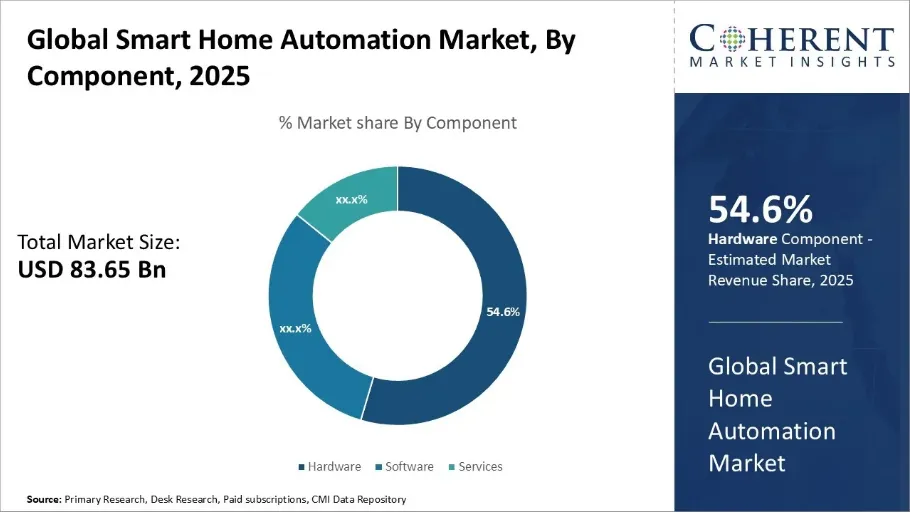
Smart Home Automation Market Insights, By Component
In terms of component, the hardware segment is expected to contribute the highest share of 55.6% in the market in 2026 owing to rapid technological advancements in smart home devices. Advancements in connectivity, memory, and processing have enabled the development of more powerful home automation hardware such as smart home hubs, sensors, security cameras, thermostats, and home appliances that can be controlled remotely.
In particular, the widespread adoption of WiFi and Bluetooth wireless technologies have reduced installation complexity and allowed for the proliferation of different kinds of smart devices that integrate seamlessly into the home network.
Additionally, improvements in battery life now allow for battery-powered smart locks, lights, and sensors that do not require wiring, further driving demand. Manufacturers are also increasingly offering open-platform hardware that can integrate with various virtual assistant software, creating a more cohesive smart home experience for consumers.
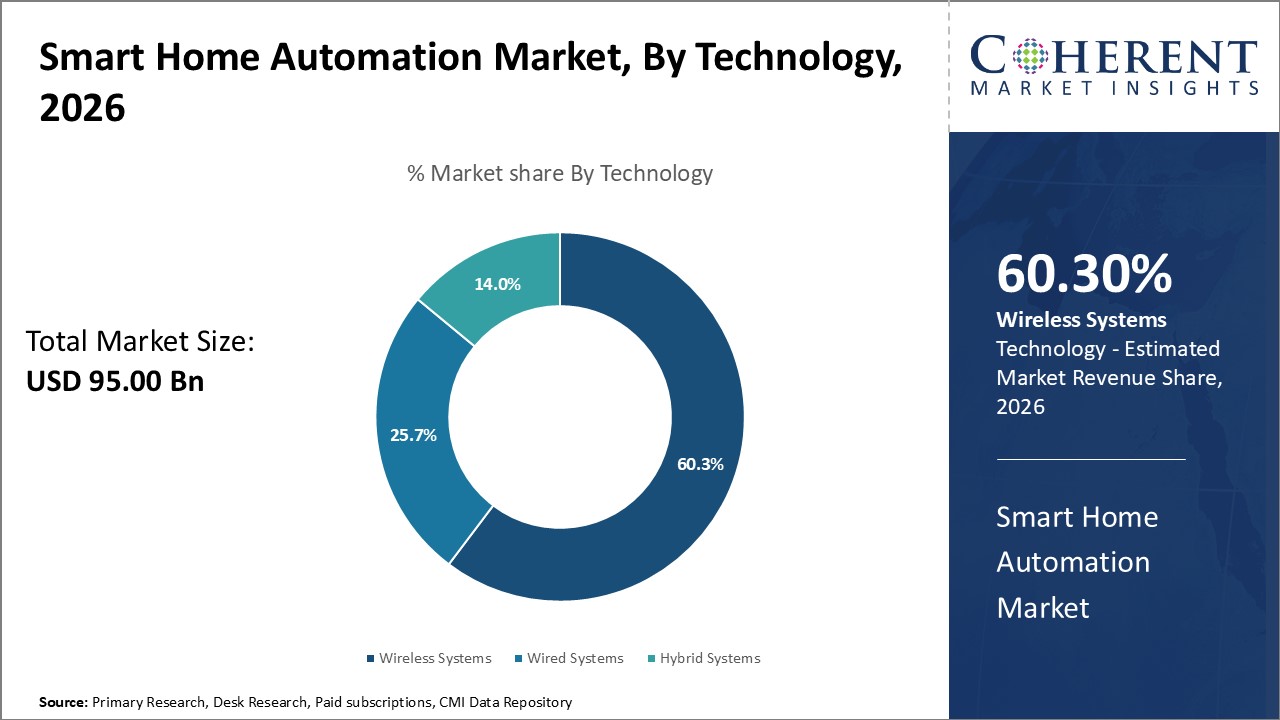
Smart Home Automation Market Insights, By Technology
In terms of technology, the wireless systems segment is expected to contribute the highest share of 60.3% in the market in 2026 due to seamless networks. As more smart home hardware comes installed with built-in WiFi, Bluetooth, and other wireless radios, the ease of setting up a wireless-based home automation system increases exponentially.
Homeowners prefer the flexibility and freedom of controlling their smart home from anywhere without needing to be physically connected to the system. Wireless technologies also avoid expensive wiring setup costs.
Furthermore, major technology companies are investing heavily in developing open communication protocols and mesh networking capabilities that allow for robust, reliable, and scalable whole home controls via wireless connectivity. This ongoing standardization and expansion of wireless coverage area continues to convince more users to opt for a wireless-first smart home ecosystem.
Smart Home Automation Market Insights, By Application
In terms of application, the security and access control segment is expected to contribute the highest share of 32.4% in the market in 2026, driven largely by security concerns. As homes become more connected, privacy, and unauthorized access have emerged as perennial worries for smart home users.
Biometric locks, video doorbells, digital padlocks, and monitoring solutions give homeowners peace of mind regarding who can physically access their property and when. Networked sensor technology integrated with indoor/outdoor cameras also allows for around-the-clock security checks from anywhere.
Smart Home Automation Market – Regional Insights
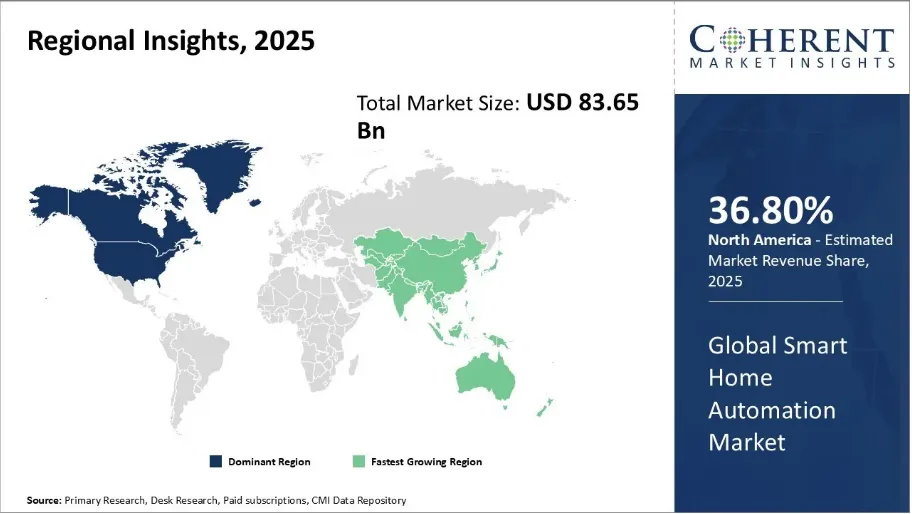
North America Smart Home Automation Market
North America is expected to lead the market with a share of 36.80% in 2026. The region’s dominance in the smart home automation market can be attributed to robust technology adoption and the proliferation of smart devices across households. Early technological developments and rapidly evolving digital infrastructure in countries like the U.S. and Canada have created a conducive environment for smart home solutions.
Additionally, the presence of leading technology companies, Google and Amazon, offering innovative home automation products and services have strengthened the region's position.
Asia Pacific Smart Home Automation Market
The Asia Pacific region, holding a share of 28.9% in 2026, is expected to exhibit the fastest growth, fueled by rapid urbanization, rising disposable incomes, and smart city initiatives of governments across developing nations. Countries like China, India, Japan, and South Korea are witnessing massive smart home deployments on the back of growing broadband penetration, increasing consumer inclination towards convenience, and investments in smart city projects.
Smart Home Automation Market In Europe
While entertainment and multi-room control systems continue to have a sizable market share, product categories including lighting controls are anticipated to grow at the fastest rates. Overall, the European smart home automation market is set for robust expansion, supported by technological advancements and evolving consumer preferences.
Smart Home Automation Market Dominating Countries
U.S Smart Home Automation Market
The U.S. smart home automation market remains a leader in innovation and adoption, driven by strong consumer demand for energy management, security, and convenience. The presence of established brands like Control4, Vivint, Amazon (Alexa ecosystem), and Google (Nest ecosystem) contributes to continuous market growth.
Local players, such as ADT Inc. and Crestron Electronics, also play a crucial role, focusing on high-end residential and commercial automation. Additionally, the growing demand for DIY smart home solutions has encouraged the rise of brands like Wyze and SimpliSafe, catering to budget-conscious consumers.
India Smart Home Automation Market
The market in India is at an inflection point, supported by the Digital India initiative and the rising middle-class population. Affordable smart home products from brands like Instinct Innovations (Oakter) and Nagase Smart Life are making inroads into the residential sector.
Additionally, large conglomerates such as Reliance Jio and Tata Power are entering the space with smart home energy management and security solutions. The rise of local startups like Wozart and ZunPulse highlights a shift toward homegrown innovation, addressing region-specific needs such as voice assistants in local languages and solar-integrated smart homes.
Smart Home Automation Market In China
The China smart home market is expanding rapidly, fueled by government-backed smart city initiatives and a tech-savvy population. Tuya Smart and Aqara (by Xiaomi Ecosystem) have gained prominence by offering cost-effective, AI-integrated smart home solutions tailored to local needs.
Moreover, Alibaba (Tmall Genie) and Baidu (Xiaodu) are investing heavily in voice assistant-powered ecosystems, driving consumer adoption. Local companies like BroadLink and ORVIBO provide affordable, customizable automation solutions, increasing accessibility in lower-tier cities.
Japan Smart Home Automation Market Trends
Japan continues to lead in high-tech home automation with an emphasis on energy-efficient and elderly-care solutions. Companies like Panasonic, Sony, and NTT (Nippon Telegraph and Telephone) have built expansive portfolios of AI-powered home automation, addressing a wide range of consumer needs.
Daikin is a notable player in smart HVAC solutions, while Toshiba has focused on home security integration. Local startups, such as Nature Inc., are bringing innovative energy management solutions, including smart plugs and AI-driven automation, tailored to Japan’s aging population.
Germany Smart Home Automation Market Trends
The market in Germany is gaining momentum, primarily driven by energy efficiency regulations and demand for sustainable building automation. Companies, such as GIRA, Somfy, and Bosch Smart Home, dominate with smart lighting, security, and HVAC solutions designed for energy-conscious consumers.
Local players like Elero, Loxone, and Eltako focus on modular automation solutions tailored for both residential and commercial buildings. The rise of KNX-based automation systems, a European standard in home automation, has led to collaborations between German companies and international players to create scalable, efficient solutions.
Market Report Scope
Smart Home Automation Market Report Coverage
| Report Coverage | Details | ||
|---|---|---|---|
| Base Year: | 2025 | Market Size in 2026: | USD 95.00 Bn |
| Historical Data for: | 2020 To 2024 | Forecast Period: | 2026 To 2033 |
| Forecast Period 2026 to 2033 CAGR: | 13.6% | 2033 Value Projection: | USD 232.00 Bn |
| Geographies covered: |
| ||
| Segments covered: |
| ||
| Companies covered: | Johnson Controls Inc., Honeywell International Inc., Schneider Electric, Siemens AG, Legrand SA, Apple Inc., Samsung Electronics Co., Ltd., Google Nest, Amazon.com, Inc., Robert Bosch GmbH, ABB Ltd., Lutron Electronics Co., Control4 Corporation, Crestron Electronics, and Resideo Technologies, Inc. | ||
| Growth Drivers: |
| ||
| Restraints & Challenges: |
| ||
Market Players, Key Development, and Competitive Intelligence
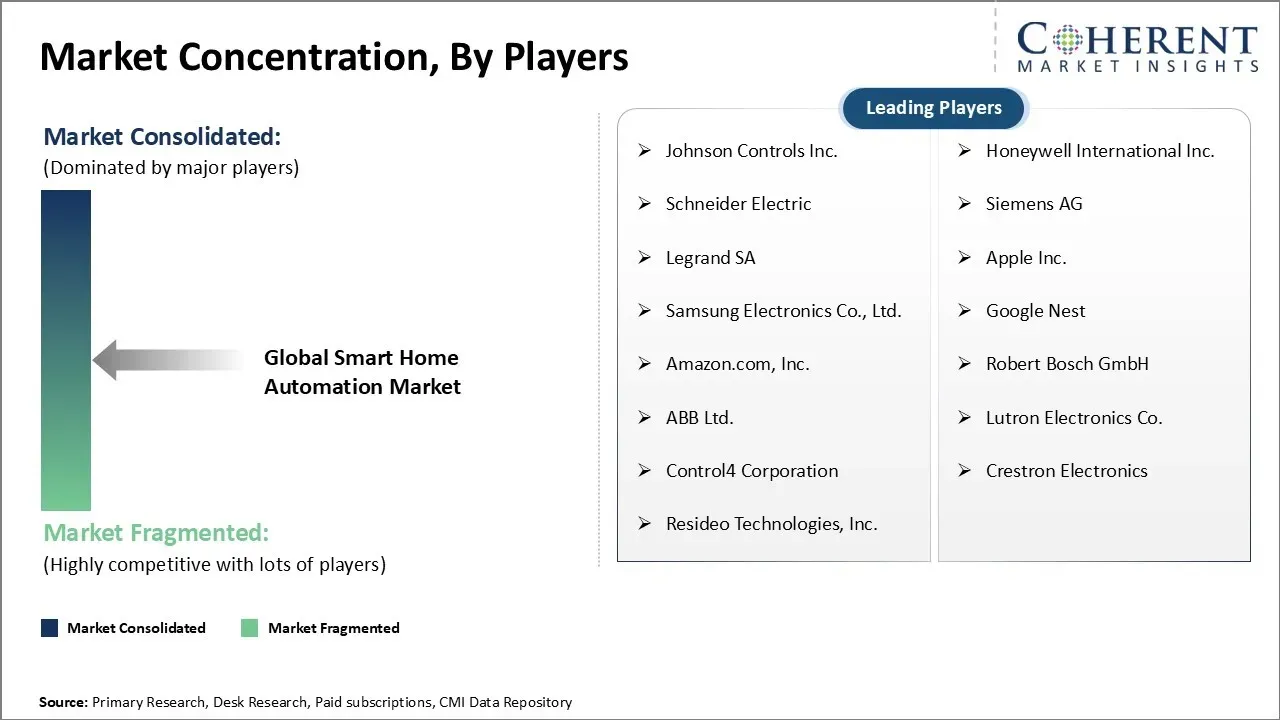
Smart Home Automation Market: Key Developments
- June 2025, Schneider Electric has launched the integrated marketing campaign 'Bring Home the Smart' to enhance emotional connections with homeowners and key stakeholders such as retailers, builders, architects, and electricians. The campaign, thus, moves beyond the functional messaging to highlight Schneider Electric’s global strengths in technology and innovation to create meaningful offers for the Indian market.
- April 2025, BuildTrack Unveils Landmark Smart Automation Experience Centre in Mohali – Bolstering IoT & AI Innovation in North India. BuildTrack, India's top smart automation firm, is pleased to announce the opening of its unique Experience Centre in Mohali, located inside MaxVal Tech Centre, India's Smartest Green Building, ushering in a new era of intelligent living and innovation in North India.
- March 2025, Home Assistant has announced that it has received Matter certification from the Connectivity Standards Alliance (CSA). Different certifications have been given to the Open Home Foundation Matter Server and the Home Assistant interface. By doing this, the company intends to draw in new companies and users to its platform.
- September 2024, ABB India, a global leader in electrification and automation, has announced the launch of ABB-free@home in India, a Smart Home automation system with enhanced interoperability. This cutting-edge and comprehensive wireless home automation solution is designed to enhance comfort, security, and energy efficiency for the residential segment. It allows users to integrate and control additional elements such as white good appliances, third party devices as well as EV chargers, through a single interface.
Smart Home Automation Market: Growth Drivers
- Increasing demand for energy-efficient and eco-friendly home solutions
As climate change concerns have risen globally, consumers are increasingly looking for ways to curb their energy consumption and reduce environmental footprint. Smart home automation solutions have emerged as an effective way to make homes more sustainable. Homeowners are realizing the advantages of smart systems that can precisely control electricity, heating/cooling, and other utilities based on occupancy patterns.
For example, smart lighting, thermostats and appliances automatically switch off when not in use, preventing wastage. Home monitoring apps allow remote control of utilities from any location, enabling optimization of energy usage. The upfront investment in a smart home system is soon recovered through savings on monthly bills. Younger consumers especially appreciate automated solutions that make sustainable living effortless.
Moreover, many governments offer subsidies and tax benefits for green home upgrades, which has accelerated demand. With growing consensus on the need for collective climate action, eco-friendly approaches are gaining wider acceptance. As awareness increases regarding their energy saving capabilities, smart home systems seem poised to become the new normal for residential spaces worldwide in the coming years.
Smart Home Automation Market: Restraints
- High initial costs associated with smart home devices and installation
One of the major challenges faced by the global smart home automation market is the high initial costs associated with smart home devices and their installation. Integrating a smart home system requires purchasing and setting up multiple smart devices like smart lights, security cameras, thermostats, door locks, etc. Along with the costs of devices, additional installation and labor charges are also incurred to network these devices together through platforms like Bluetooth, Wi-Fi, etc. and connect them to central control apps or panels.
For many average consumers, such high upfront investment costs pose a significant barrier against adopting smart home automation solutions. Device manufacturers and system integrators need to focus on developing more affordable smart home packages and financing options to help overcome this challenge and drive further growth in consumer demand.
Smart Home Automation Market: Trends
The proliferation of smartphones and smart gadgets is making remote management of home devices more accessible, further boosting market growth. Security and safety remain key priorities, with advanced monitoring systems and customizable access controls increasingly in demand. A number of significant trends are influencing the European smart home automation market. IoT integration and artificial intelligence (AI) are leading the way in improving the responsiveness and intuitiveness of smart home systems.
AI-powered assistants, such as Google Assistant and Alexa, allow for personalized automation and predictive maintenance. Another significant trend is energy efficiency, which is being driven by government programs supporting green technologies as well as customer demand. Smart appliances and lighting controls that use less energy are becoming more and more popular.
Smart Home Automation Market: Opportunities
- Expansion of smart city projects integrating home automation systems
A major opportunity for the global smart home automation market lies in the expansion of large-scale smart city projects undertaken by governments and municipal authorities. Many such smart city initiatives now aim to integrate advanced home automation infrastructure and solutions into urban residential developments.
This helps provide connectivity between individual "smart homes" with broader urban infrastructure like traffic management, utilities monitoring, etc. The growth in number of smart city projects worldwide is expected to drive the demand for standardized smart home systems that can be rapidly deployed across multiple residential units.
Leading automation players can tap into this opportunity by partnering with smart city consultants, builders, and local administrations to provide end-to-end smart community solutions. This will further augment the mass adoption of home automation technologies.
Top Strategies Followed by Global Smart Home Automation Market Players
- Established Players: Major players focus heavily on R&D investment to innovate high-performance products. Companies like Honeywell, Johnson Controls, and Schneider Electric spend over 5% of annual revenues on R&D. They develop next-generation smart home devices with improved energy efficiency, advanced security features, and IoT integration capabilities.
- Mid-Level Players: Mid-sized players pursue cost-effective solutions to target price-sensitive consumers. Companies, such as TCL Home Appliances and LG Electronics, deliver quality products at affordable prices. They leverage economies of scale through global manufacturing facilities and source components from reliable suppliers at bulk rates.
- Small-Scale Players: Small-scale players focus on niche specialization, targeting specific customer segments with unique product attributes. For example, startup August Home offers smart locks optimized for apartment living. Sensoro specializes in pet monitoring solutions. They leverage crowdfunding platforms to gather early customer feedback and validate niche market demand.
Emerging Startups – Smart Home Automation Industry Ecosystem
- Innovative Technologies: In the area of innovative technologies, Cognimat operates an AI-powered home monitoring system that detects anomalies and prevents issues using machine learning algorithms. Anthropic develops self-supervised AI to enable low-power visual perception in smart home appliances.
- Sustainable Solutions: Regarding sustainable solutions, Bumblebee focuses on developing smart thermostats with eco-friendly, recycled plastic exteriors. Green Hive specializes in smart solar lighting and electrical safety solutions to promote renewable energy adoption. Their offerings help reduce the industry's environmental footprint.
- Market Contribution: Some startups contribute to niche markets. Senic focuses on innovative alarm system integration and control capabilities for commercial buildings. IoT provider, Kasa, targets small businesses with smart plugs, switches and security cameras tailored for office automation needs.
Analyst Opinion
- The smart home automation market is poised for substantial growth, driven by the increasing adoption of IoT and AI technologies that enhance home convenience, security, and energy efficiency. Consumers are increasingly seeking integrated solutions that offer seamless control over various home devices, contributing to market expansion.
- However, challenges such as interoperability issues among different devices and concerns over data privacy may hinder market growth. Ensuring robust security measures and developing universal standards for device compatibility are essential to address these concerns.
- North America currently dominates the market, accounting for approximately 36.8% of the global share in 2025, attributed to high consumer awareness and disposable income. The Asia Pacific region is expected to witness the fastest growth, driven by rapid urbanization and increasing smart device penetration.
Speak to the analyst
Want personalized insights?
Take the findings above to one of our principal consultants, or have the report rebuilt around the segments, geographies and competitors you actually track.
Market Segmentation
- Component Insights (Revenue, USD Bn, 2021 - 2033)
- Hardware
- Software
- Services
- Technology Insights (Revenue, USD Bn, 2021 - 2033)
- Wireless Systems
- Wired Systems
- Hybrid Systems
- Application Insights (Revenue, USD Bn, 2021 - 2033)
- Security and Access Control
- HVAC Control
- Lighting Control
- Entertainment Control
- Smart Kitchen
- Energy Management
- Regional Insights (Revenue, USD Bn, 2021 - 2033)
- North America
- U.S.
- Canada
- Latin America
- Brazil
- Argentina
- Mexico
- Rest of Latin America
- Europe
- Germany
- U.K.
- Spain
- France
- Italy
- Russia
- Rest of Europe
- Asia Pacific
- China
- India
- Japan
- Australia
- South Korea
- ASEAN
- Rest of Asia Pacific
- Middle East
- GCC Countries
- Israel
- Rest of Middle East
- Africa
- South Africa
- North Africa
- Central Africa
- North America
- Key Players Insights
- Johnson Controls Inc.
- Honeywell International Inc.
- Schneider Electric
- Siemens AG
- Legrand SA
- Apple Inc.
- Samsung Electronics Co., Ltd.
- Google Nest
- com, Inc.
- Robert Bosch GmbH
- ABB Ltd.
- Lutron Electronics Co.
- Control4 Corporation
- Crestron Electronics
- Resideo Technologies, Inc.
Sources
Primary Research Interviews
- Product Managers (Smart Devices)
- Home Automation System Installers
- IoT Hardware Engineers
- Smart Home Retailers
- Residential Real Estate Developers
Databases
- IEEE Xplore
- Scopus
- JSTOR
- ScienceDirect
- SpringerLink
- ProQuest
Magazines
- Wired
- Fast Company
- IoT Now
- Home & Design
- CE Pro
Journals
- Journal of Ambient Intelligence and Smart Environments
- International Journal of Smart Home
- ACM Transactions on Internet of Things
- Journal of Intelligent & Robotic Systems
- Sensors and Actuators A Physical
Newspapers
- The Wall Street Journal
- The Economic Times
- The Guardian (Tech Section)
- The New York Times (Tech Section)
- Business Standard
- Financial Times
Associations
- Consumer Technology Association (CTA)
- Zigbee Alliance (now Connectivity Standards Alliance)
- Z-Wave Alliance
- KNX Association
- Open Connectivity Foundation
- Thread Group
Proprietary Elements
- CMI Data Analytics Tool, Proprietary CMI Existing Repository of information for last 8 years
*Definition: Smart Home Automation refers to the integration of technology and internet-connected devices that enable homeowners to remotely monitor, control, and automate various functions within their homes. This includes managing lighting, heating, ventilation, air conditioning (HVAC), security systems, appliances, and entertainment systems through user-friendly interfaces such as mobile apps, voice commands, or web portals.
Get access to 250+ pages report
Every segment, forecast, competitor profile and data table behind the analysis above — available for instant download.
- ESOMAR Member
- ISO 9001:2015 Certified
- D-U-N-S Registered
- GDPR & CCPA Compliant
Missing comfort of reading report in your local language? Find your preferred language:
Transform your Strategy with Exclusive Trending Reports
Frequently Asked Questions
The global smart home automation market size is estimated to be valued at USD 83.65 Bn in 2025 and is expected to reach USD 201.72 Bn by 2032, exhibiting a compound annual growth rate (CAGR) of 13.4% from 2025 to 2032.
The CAGR of global market is projected to be 13.4% from 2025 to 2032.
Increasing demand for energy-efficient and eco-friendly home solutions and proliferation of Internet of Things (IoT) devices enhancing interconnectivity are the major factors driving the growth of the global smart home automation industry.
High initial costs associated with smart home devices and installation and concerns regarding data privacy and security breaches are the major factors hampering the growth of the global smart home automation industry.
In terms of component, the hardware segment is estimated to dominate the market revenue share in 2025.
Johnson Controls Inc., Honeywell International Inc., Schneider Electric, Siemens AG, Legrand SA, Apple Inc., Samsung Electronics Co., Ltd., Google Nest, Amazon.com, Inc., Robert Bosch GmbH, ABB Ltd., Lutron Electronics Co., Control4 Corporation, Crestron Electronics, and Resideo Technologies, Inc. are the major players.
North America is expected to lead the global smart home automation industry, holding a market share of 36.8% in 2025.