

Agricultural Drones Market Size and Trends -2026 to 2033
Global agricultural drones market is estimated to be valued at USD 7.17 Bn in 2026 and is expected to reach USD 29.33 Bn by 2033, exhibiting a compound annual growth rate (CAGR) of 22.3% from 2026 to 2033.
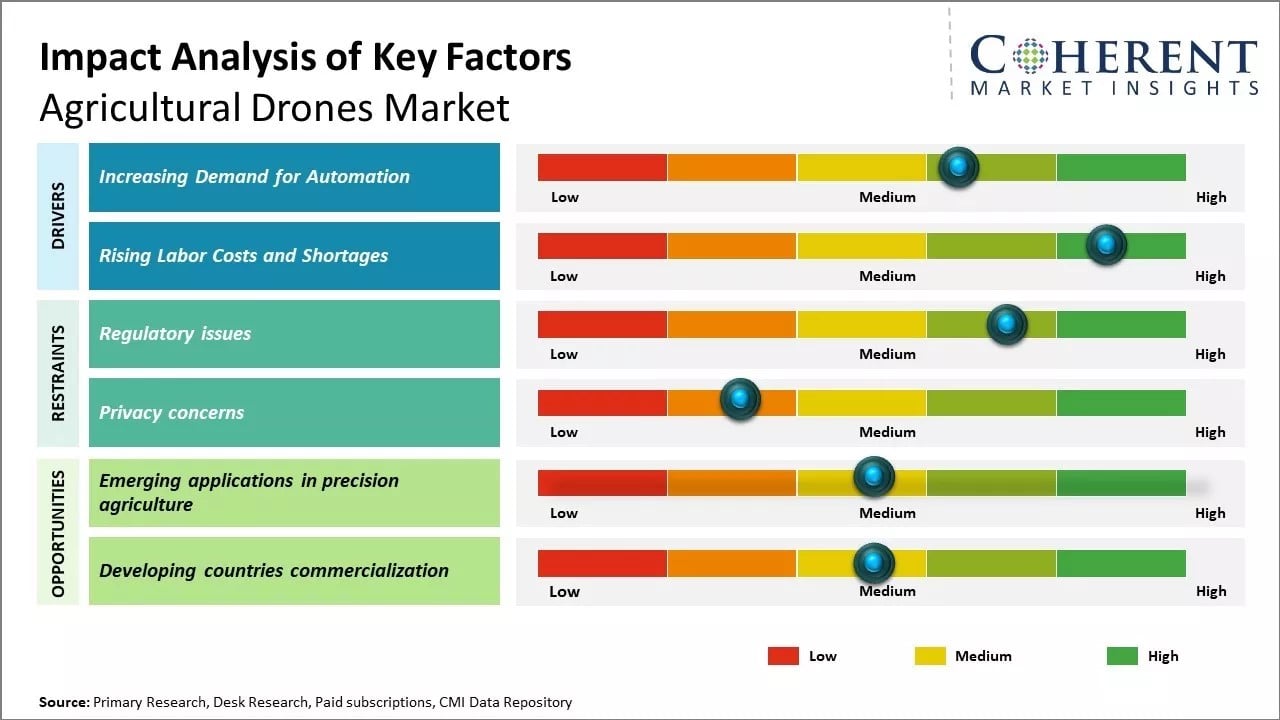
Key Takeaways
- Based on Type, the Rotary Blade segment is expected to lead the market with 44.7% share in 2026, valued for hovering, maneuverability, and precise crop spraying.
- Based on Component, the Hardware segment is expected to hold 69.8% share of the market in 2026, enabling advanced sensors, cameras, and precise drone navigation.
- Based on Application, the Field Mapping & Monitoring segment is projected to account for 35.7% share in 2026, enabling precision insights and automated farm management.
- Based on Region, North America is set to lead the agricultural drones market with 45% share in 2026. While, Asia Pacific is projected to be the fastest growing region.
Market Overview
Global agricultural drones market is witnessing growth due to increasing adoption of advanced technology and cost-effective agricultural drones among farmers. Technology empower farmers to gather field data, monitor crop growth, detect problems, map fields, and optimize irrigation and outputs. Drones enable early detection of diseases and pests, scans large areas of land quickly, monitor crops from the air on a regular basis, and provide much more precise field analysis than traditional methods. This helps farmers to boost productivity and maximize profits using minimal resources and preventive actions. With depleting groundwater supplies and increasing pressures of climate change, agricultural drones are supplementing conventional farming techniques for enhanced crop monitoring and management.
Current Events and Its Impact on the Agricultural Drones Market
Current Event | Description and its Impact |
EU Regulatory Framework Evolution for Unmanned Aircraft Systems |
|
India's Digital Agriculture Mission and Precision Farming Initiatives |
|
Adoption and Impact in Agricultural Drones Market
About 73% of large agricultural enterprises around the world use drones to help them manage their crops. These drones give farmers up-to-date information about the health of the soil, the stress on the plants, and the growth of the crops. This helps them make smart choices about how to water, fertilize, and control pests.
The effect is substantial: farms may decrease their water use for spraying by up to 90% by using drones for precise spraying and monitoring. This targeted use of resources also makes crops more productive, which leads to yields that are 5–10% higher in different crops.
Overall, agricultural drones make farms more sustainable, use resources more efficiently, and make more money. They help farms reduce costs while boosting crop health and productivity.
- Current Industry Events of 2026
- Market Size Estimation
- Regional Breakdown
- Competitive Landscape
- Customer Intelligence
- Segmental Analysis
- Pricing Analysis
- Key Market Drivers, Challenges & Future Trends
- Customized Insights Section
Segmental Insights
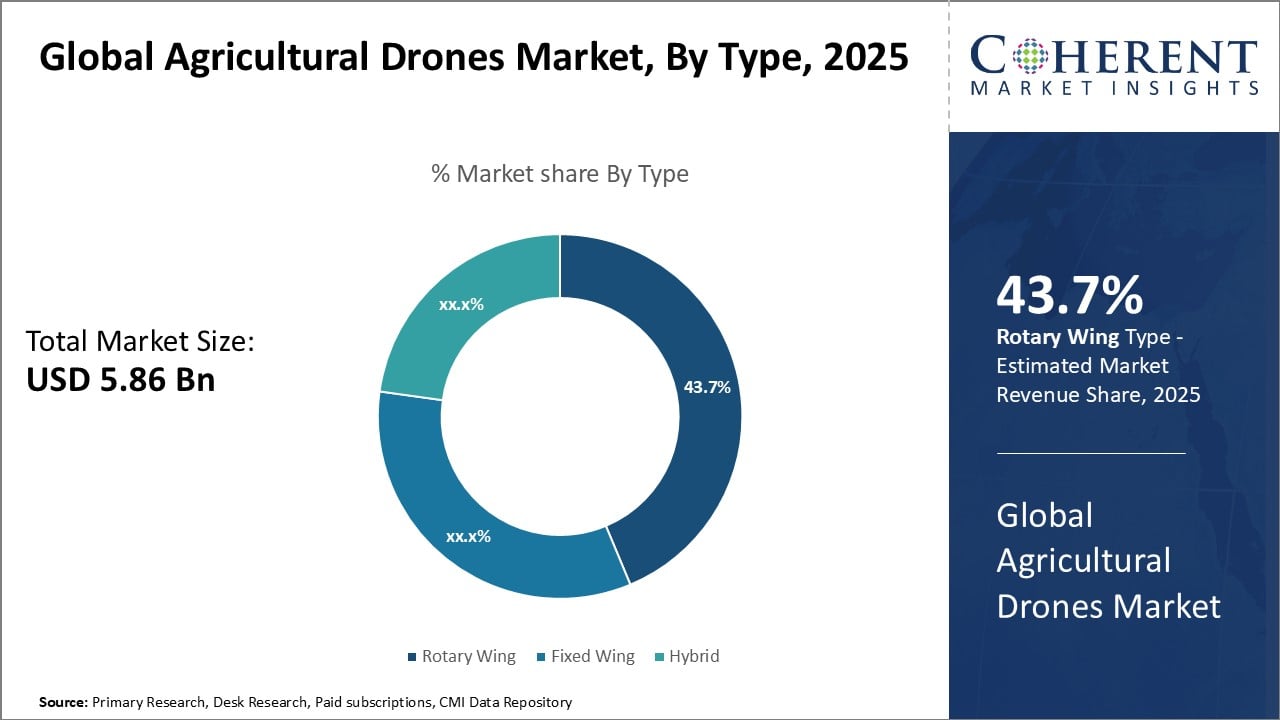
Agricultural Drones Market Insights, By Type- Versatility drives rotary wing adoption
Among type, rotary wing segment is estimated to contribute the highest market share owing 44.7% in 2026 due to their inherent versatility. Unlike fixed wing drones which can only fly horizontally, rotary wing drones excel at hovering, thus, providing valuable aerial footage from any angle. Their maneuverability enables inspection of crops from all sides as well as precise application of inputs like crop sprays directly above fields.
For instance, in December 2026, Jyoti Global Plast released the AeroCrop agricultural drone to improve precision farming in India. The drone helps farmers spray crops, keep an eye on their fields, and make the best use of their resources. AeroCrop wants to make modern farming more productive while lowering labor and input costs by using advanced control systems and building things that last.
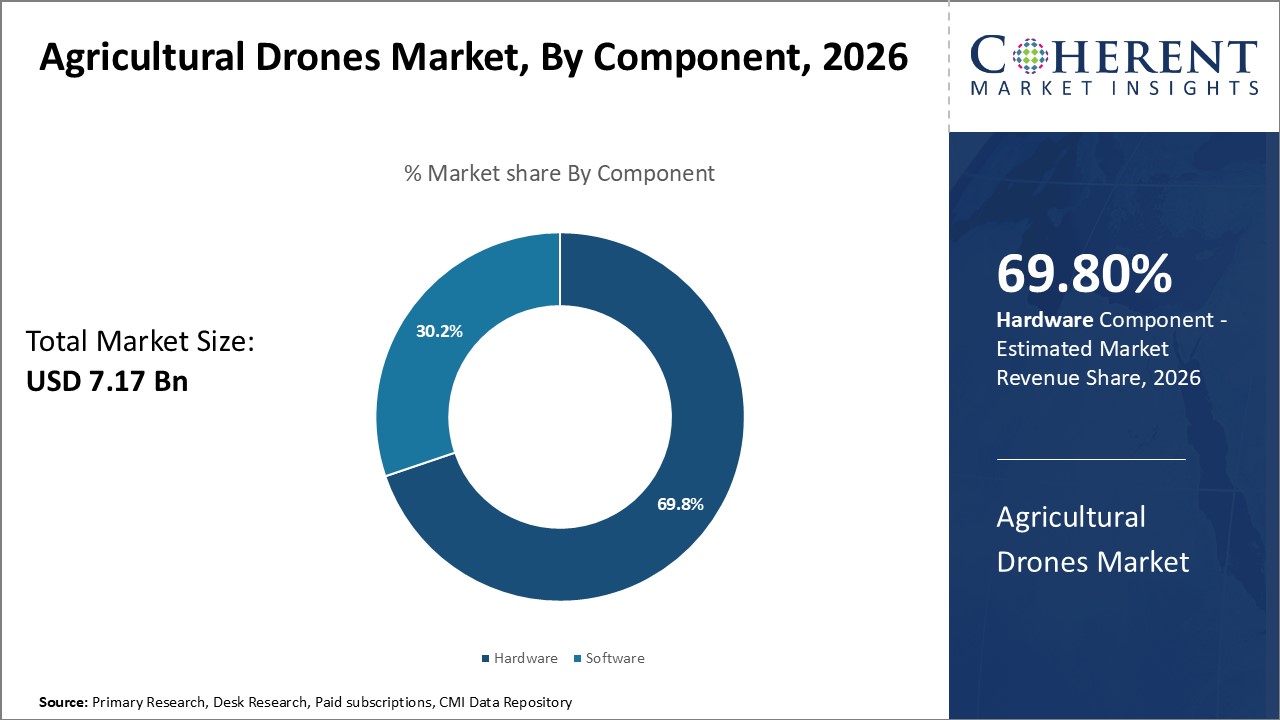
Agricultural Drones Market Insights, By Component- Hardware dominates amid technology advances
Among component, hardware segment is estimated to contribute the highest market share owing 69.8% in 2026 due to ongoing technology advancements. While agricultural drone software enables invaluable data analysis, mapping and automation, hardware delivers the physical tools transforming farm operations.
Advancements in camera, sensor and positioning technologies continually enhance insight extraction from drone imagery. Multispectral, thermal and hyperspectral sensors now detect invisible indicators of crop health with unprecedented accuracy. Precision GPS and inertial measurement units enable precise autonomous navigation.
For instance, in December 2025, Avironix released the AviSpray-10C, a small agricultural spraying drone that fits in a backpack and is made for India's
Agricultural Drones Market Insights, By Application- Field mapping & monitoring drives adoption
Among application, field mapping & monitoring segment is estimated to contribute the highest market share owing 35.7% in 2026 due to the critical insights it provides. Detailed geospatial maps and timeseries imagery build an invaluable historical record of field conditions.
Field maps reveal subtle variations in terrain, moisture or nutrient levels that impact uniform growth and yield. Persistent monitoring detects subtle changes indicative of early issues. Aerial imagery archives seasons of growth stages and transformations difficult to otherwise document.
Field maps and monitoring simplify variable rate inputs of water, seeds or fertilizers tailored to precise needs. Maps guide Autonomous equipment like robot tractors. Comprehensive records substantiate insurance claims or quality audits.
For instance, in November 2025, NIT Rourkela obtained a patent for India's first self-driving drone system that can map land in real time. The new technology makes it possible to accurately monitor farms and terrain, which helps with precision agriculture field mapping. This technology's goal is to make crop planning, resource management, and productivity better by collecting aerial data in new ways.
Regional Insights
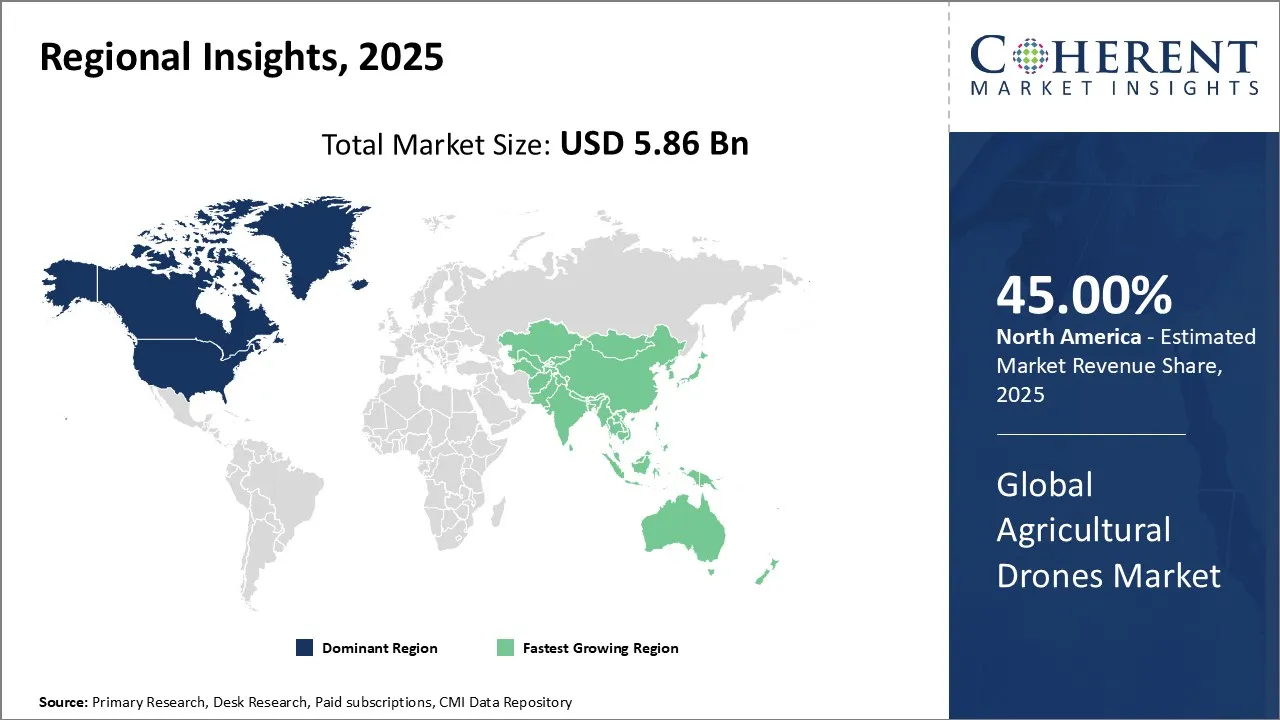
North America Agricultural Drones Market Analysis & Trends
North America has established itself as the dominant force in the global agricultural drones market owing 45.0% in 2026. Home to the largest drone manufacturers like DJI and Intel, the U.S. accounts for over 40.5% of the total market size. With over 2.2 million farms, robust demand comes from large-scale corporate farming, which relies heavily on precision agriculture technologies for increased productivity and yields. Early regulation and legalization of commercial drone flights gave the region a head start. Ongoing R&D investments and a highly skilled workforce have ensured that North American companies set global standards in drone technologies. The region also hosts major agricultural trade shows that facilitate adoption. Exports of high-end drones to European and Asian markets have further augmented regional revenues.
For instance, in December 2026, A Houston-based company built a factory in Cajun Country, Louisiana, to make the Field Ranger X50 agricultural spray drone and other
Asia Pacific Agricultural Drones Market Analysis & Trends
Asia Pacific is anticipated to be the fastest growing region. This is due to precision farming is becoming more popular, labor costs are going up, the government provides funds, and the demand for optimizing crop yields is going up. Countries like China, India, and Japan are using drones for spraying, monitoring, and mapping. This is helping the market grow in the area.
For instance, in July 2026, DJI has released advanced high-impact agricultural drones around the world. These drones are made for precision farming tasks like spraying, seeding, and managing crops automatically. These drones are more efficient, cover more ground, and give farmers more control, which helps them get the most out of their crops, reduction on labor, and use new farming technologies. This strengthens DJI's position as the leader in the global agricultural drone market.
Agricultural Drones Market Outlook Country-Wise
The U.S. Agricultural Drones Market Trends
In 2026, the Agricultural Drones Market is expected to become expanding rapidly in the U.S. since precision farming is becoming more common, labor costs are going up, and there is a need for better crop monitoring, spraying, and mapping. Government policies that help, new technologies, and significant commercial farms all help the use of drones and the growth of the market.
For instance, in November 2026, Mississippi State University (MSU) started a series of educational videos about agricultural unmanned aerial systems (UAS). The series teaches farmers how to use drones, spray crops, and practice precision farming. It encourages the use of agricultural drones in the US and helps people learn more about modern UAV technology for better farm management.
China Agricultural Drones Market Trends
In 2026, the Agricultural Drones Market in China is booming as smart farming technologies are being used increasing amounts, crops are being grown on a large scale, and the government is supporting precision agriculture. The market is growing across the country because there is an immense amount of demand for automated spraying, crop monitoring, and mapping solutions, and there is a considerable amount of top domestic drone makers.
For instance, in November 2026, XAG Co Ltd, one of the top makers of agricultural drones in China, demonstrated a new generation of smart agricultural drones and IoT-enabled farm products in Guangzhou. The drones are made for precision farming and improve crop monitoring, spraying, and data-driven management. They help with efficiency, sustainability, and advanced farming practices all over China.
Market Report Scope
Agricultural Drones Market Report Coverage
| Report Coverage | Details | ||
|---|---|---|---|
| Base Year: | 2025 | Market Size in 2026: | USD 7.17 Bn |
| Historical Data for: | 2020 To 2024 | Forecast Period: | 2026 To 2033 |
| Forecast Period 2026 to 2033 CAGR: | 22.3% | 2033 Value Projection: | USD 29.33 Bn |
| Geographies covered: |
| ||
| Segments covered: |
| ||
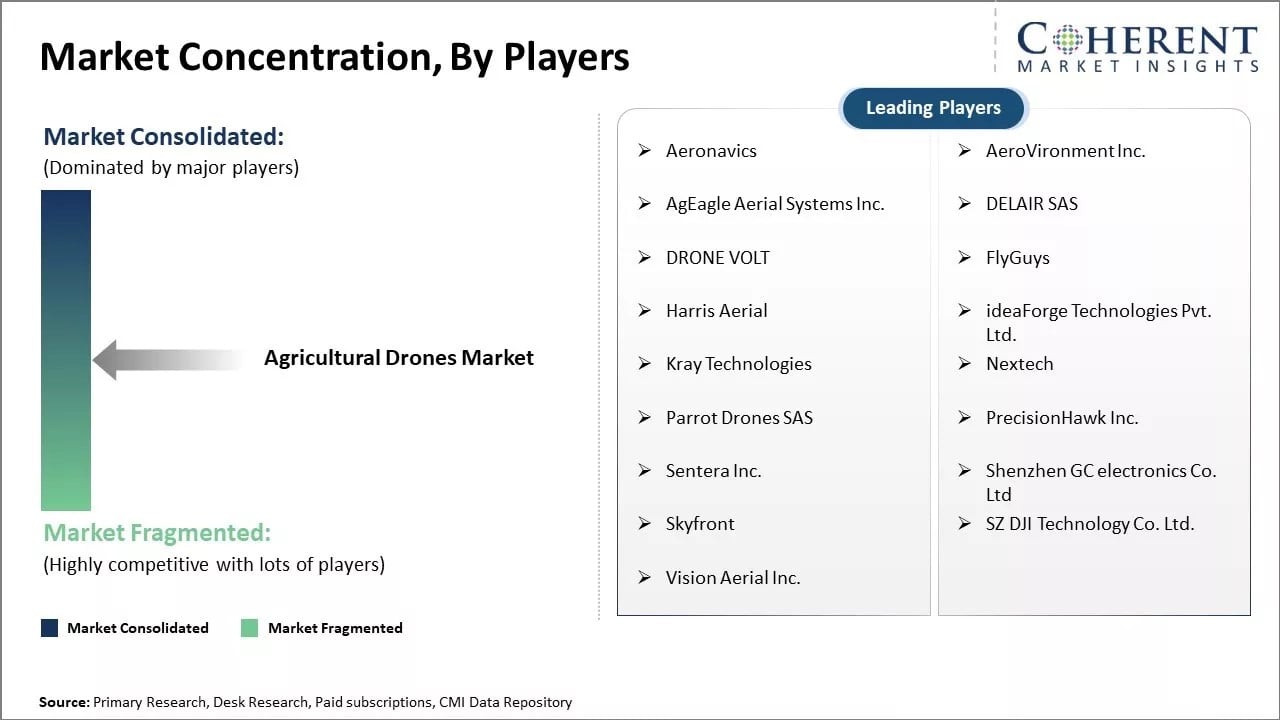
| Companies covered: | Aeronavics, AeroVironment Inc., AgEagle Aerial Systems Inc., DELAIR SAS, DRONE VOLT, FlyGuys, Harris Aerial, ideaForge Technologies Pvt. Ltd., Kray Technologies, Nextech, Parrot Drones SAS, PrecisionHawk Inc., Sentera Inc., Shenzhen GC electronics Co. Ltd, Skyfront, SZ DJI Technology Co. Ltd., Vision Aerial Inc. | ||
| Growth Drivers: |
| ||
| Restraints & Challenges: |
| ||
Agricultural Drones Market Driver
Rising demand for crop monitoring and analysis
Agricultural drones are increasingly being used by farmers to monitor crop growth, analyze fields for problems, and ensure optimal yields. With land holdings becoming larger in size, it is not feasible for farmers to manually inspect vast areas of land. Drones equipped with cameras and sensors enable them to survey fields from above and gather a richer perspective compared to conventional methods. High-resolution images and infrared photography captured by drones allow identification of moisture levels, signs of disease and nutrient deficiencies in crops at an early stage. Any issues that are detected can then be addressed promptly before significant damage occurs.
Drones also facilitate analysis of sowing and fertilizing patterns to determine if changes are required for better results. With agricultural production needs to rise sharply to feed the growing population, maximizing output from available land resources is crucial. Drones streamline crop monitoring activities and help boost productivity through timely interventions based on a birds-eye assessment of farm fields. Precision farming supported by drones plays a key role in sustainably meeting escalating global food demand. Drone technology also aids in evaluating field conditions post-harvesting. Drones can fly over fields to check for leftover plant stalks and find spots that might need new planting or special care to get ready for the next crop season.
Crop residue mapping assists farmers in making informed nutrient and soil management decisions. The use of drones for inspecting vast tracts of agricultural land in a short time has significant potential to increase yields, optimize resource use and lower production costs for farmers. When paired with analytical software, drones transform crop monitoring into an insightful and data-driven process. Their crop analysis capabilities address a pressing need amongst farmers and help improve farm management techniques for higher productivity. As agriculture becomes increasingly technology-reliant, drones can emerge as valuable tools that offer eco-friendly and low-cost solutions for vital crop inspection and surveillance activities.
Market Concentration and Competitive Landscape
Advancements in agricultural drone design
Agricultural drones have witnessed major technological advancements that have augmented their functionalities and suitability for diverse farming operations. Early drone models used for agriculture tended to be basic multi-rotor vehicles equipped with standard cameras. However, ongoing R&D efforts by leading manufacturers have yielded sophisticated drones custom-built for the needs of modern farmers. New-age agricultural drones feature high-performance cameras, advanced sensors, swappable payloads and specialized hardware suited for precision applications such as crop spraying.
Agricultural Drones Market Opportunity
Emerging applications in precision agriculture
As drones become more affordable and integrated with technologies like computer vision, these will be able to perform more complex field analysis and tasks. More accurate crop monitoring and analytics can help boost yields and farm efficiency. Drones allow farms to scale up without increasing their costs dramatically.
Analyst Opinion (Expert Opinion)
The agricultural drones market has evolved from testing to regular use on farms, due to clear gains in productivity, resource efficiency, and decision-making at the field level. Reports from the industry say that the sector is worth billions of dollars around the world, but estimates vary due to depend on what kind of broad the definition is, such as whether analytics and service layers are included. This variability shows that it's important to carefully look at market size data instead of just trusting one source.
Asia Pacific is still the most commercially active region due to strong mechanization programs and the widespread use of drone-as-a-service models. Trials in many countries consistently show measurable benefits, such as significant drops in water use during spraying, substantial improvements in spray uniformity, and field-capacity gains that let operators cover much larger areas per day than manual methods. Research shows that using drones to improve chemical application and crop health monitoring can also lead to measurable increases in revenue per hectare.
New technologies like multispectral sensors, LiDAR payloads, and precise navigation are making it possible to do more things with drones, from mapping to prescriptive spraying and variable-rate application. At the same time, the competitive landscape shows a mix of global platform leaders and regional manufacturers, all of which are supported by a growing network of service providers.
The market's growth is based on clear operational efficiencies, environmental benefits, and the growing commercial viability of large-scale drone service ecosystems.
Speak to the analyst
Want personalized insights?
Take the findings above to one of our principal consultants, or have the report rebuilt around the segments, geographies and competitors you actually track.
Agricultural Drones Industry News
- In June 2025, Under the "Drone Didi" program, Goa launched its first agricultural drone to help with precision farming. The drone will help with spraying pesticides and fertilizers, which can render crops more productive and efficient. The program also wants to give women farmers more power by giving them access to modern drone technology in farming.
- In June 2025, the Union Minister opened the Agri-Drone Indigenization Facility in Chennai, which is run by Garuda Aerospace and is meant to design and build agricultural drones. Along with this, 300 Centers of Excellence and a DGCA-approved drone training program were started to promote precision farming, get more people to use drones, and train operators, all of which helped India's agricultural drone ecosystem grow.
- In January 2023, XAG, a drone manufacturer, announced that the U.K.'s Civil Aviation Authority (CAA) had approved its P40 and V40 agricultural sprayers to operate. This marks the first time drone spraying has been approved on U.K. farms.
- In February 2023, XAG, a company specializing in smart agricultural technology, collaborated with FarmInno is a technology company focused on providing innovative solutions for the agriculture industry. to introduce fully autonomous agricultural drones in Thailand. This collaboration lead to the launch of advanced agricultural drones equipped with intelligent control systems.
- In March 2023, Avikus partnered with Korea Shipbuilding & Offshore Engineering, a subsidiary of Hyundai, to experiment with fuel efficiency by implementing self-governing navigation systems. The project involves five companies: POS SM, Pan Ocean, Korea Shipbuilding & Offshore Engineering, Korean Register of Shipping, and Avikus.
Market Segmentation
- Type Insights (Revenue, USD BN, 2026 - 2033)
- Fixed Wing
- Rotary Wing
- Hybrid
- Component Insights (Revenue, USD BN, 2026 - 2033)
- Hardware
- Software
- Application Insights (Revenue, USD BN, 2026 - 2033)
- Field Mapping & Monitoring
- Crop Spraying
- Crop Scouting
- Variable Rate Application
- Livestock Monitoring
- Others
- Regional Insights (Revenue, USD BN, 2026 - 2033)
- North America
- U.S.
- Canada
- Latin America
- Brazil
- Argentina
- Mexico
- Rest of Latin America
- Europe
- Germany
- U.K.
- France
- Italy
- Russia
- Rest of Europe
- Asia Pacific
- China
- India
- Japan
- Australia
- South Korea
- ASEAN
- Rest of Asia Pacific
- Middle East & Africa
- GCC Countries
- South Africa
- Rest of Middle East & Africa
- Key Players
- Aeronavics
- AeroVironment Inc.
- AgEagle Aerial Systems Inc.
- DELAIR SAS
- DRONE VOLT
- FlyGuys
- Harris Aerial
- ideaForge Technologies Pvt. Ltd.
- Kray Technologies
- Nextech
- Parrot Drones SAS
- PrecisionHawk Inc.
- Sentera Inc.
- Shenzhen GC electronics Co. Ltd
- Skyfront
- SZ DJI Technology Co. Ltd.
- Vision Aerial Inc.
Sources
Primary Research Interviews
- Agricultural Drone Manufacturers
- UAV (Unmanned Aerial Vehicle) System Integrators
- Precision Agriculture Solution Providers
- Farm Equipment Distributors & Dealers
- Agronomists & Remote Sensing Specialists
- Agricultural Input Suppliers (Seeds, Fertilizers, Crop Protection)
- Drone Software & Analytics Platform Developers
- Others
Databases
- Bloomberg Terminal
- Thomson Reuters Eikon
- IHS Markit
- Euromonitor International
- S&P Global Market Intelligence
- FactSet
- Statista
- Others
Magazines
- DroneLife Magazine
- UAV Expert News
- PrecisionAg Magazine
- AgriBusiness Global
- Future Farming Magazine
- Others
Journals
- Precision Agriculture Journal
- Remote Sensing Journal
- International Journal of Agricultural Management
- Computers and Electronics in Agriculture
- Journal of Field Robotics
- Others
Newspapers
- Financial Times
- The Wall Street Journal
- Reuters
- Bloomberg News
- The Economic Times
- Others
Associations
- Association for Unmanned Vehicle Systems International (AUVSI)
- International Society of Precision Agriculture (ISPA)
- Civil Aviation Authority (CAA) / FAA – UAV Regulations
- Global Open Data for Agriculture & Nutrition (GODAN)
- International Commission of Agricultural and Biosystems Engineering (CIGR)
- Others
Public Domain Sources
- Food and Agriculture Organization (FAO)
- U.S. Department of Agriculture (USDA)
- National Aeronautics and Space Administration (NASA) – Earth Observation Data
- European Union Aviation Safety Agency (EASA)
- World Bank Open Data
- International Energy Agency (IEA) – Technology Dataset
- Others
Proprietary Elements
- CMI Data Analytics Tool
- Proprietary CMI Existing Repository of Information for the Last 8 Years
*Definition: The agricultural drones market comprises drones and associated services that help farmers increase crop production and monitor crop growth. Agricultural drones are enabling precision agriculture by capturing images and data that help farmers analyze fields, monitor crops, assess soil conditions, detect pests and diseases, and determine when and where to apply pesticides and water. Drones outfitted with cameras, sensors, and software can survey large plots of land more efficiently than manual labor, helping farmers boost yields while reducing costs and improving sustainability.
Get access to 250+ pages report
Every segment, forecast, competitor profile and data table behind the analysis above — available for instant download.
- ESOMAR Member
- ISO 9001:2015 Certified
- D-U-N-S Registered
- GDPR & CCPA Compliant
Missing comfort of reading report in your local language? Find your preferred language:
Transform your Strategy with Exclusive Trending Reports
Frequently Asked Questions
The Agricultural Drones Market is estimated to be valued at USD 7.17 Bn in 2026, and is expected to reach USD 29.33 Bn by 2033.
The CAGR of the Agricultural Drones Market is projected to be 22.3% from 2026 to 2033.
Increasing demand for automation and rising labor costs and shortages are the major factors driving the growth of global agricultural drones market.
Regulatory issues and privacy concerns are the major factors hampering the growth of global agricultural drones market.
In terms of type, rotary wing segment is estimated to dominate the market in 2026.
Aeronavics, AeroVironment Inc., AgEagle Aerial Systems Inc., DELAIR SAS, DRONE VOLT, FlyGuys, Harris Aerial, ideaForge Technologies Pvt. Ltd., Kray Technologies, Nextech, Parrot Drones SAS, PrecisionHawk Inc., Sentera Inc., Shenzhen GC electronics Co. Ltd, Skyfront, SZ DJI Technology Co. Ltd., Vision Aerial Inc. are the major players.
North America is expected to lead the global agricultural drones market in 2026.