

Automotive Software Market Size and Trends
The Automotive Software Market is estimated to be valued at USD 20.61 Bn in 2026 and is expected to reach USD 49.39 Bn by 2033, exhibiting a compound annual growth rate (CAGR) of 13.3% from 2026 to 2033. With the rapid adoption of electronic systems in vehicles for advanced driver-assistance, in-car connectivity and automation, the demand for automotive software is growing significantly.
Key Takeaways
- Based on Vehicle Type, the Passenger Cars segment leads the market holding an estimated share of 50.4% share in 2026, due to higher production volumes, increasing software integration, and rising adoption of connected and electric vehicles.
- Based on Software Layer, the Application Software segment dominates holding an estimated share of 47.8% in 2026, leads as it powers critical in-vehicle functionalities like ADAS, infotainment, and telematics.
- Based on EV Application, the Battery Management segment is projected to account for the largest share of the market in 2026, due to the growth of EVs and need for efficient energy utilization.
- Based on Offering, the Solution segment is projected to lead the market with a 65% share in 2026, as OEMs increasingly integrate ready-to-deploy software platforms.
- Based on Application, the ADAS & Safety Systems segment is expected to capture the highest share of the market in 2026, driven by regulatory mandates and consumer demand for safety.
- Based on Organization Size, the Large-scale organizations segment is projected to account for the greatest share of the market in 2025, owing to greater resources for software development and integration.
- Based on Region, North America is expected to lead the market, holding a share of 41.9% in 2025. While, Asia Pacific is anticipated to be the fastest-growing region.
Market Overview
Factors such as the rising demand for autonomous and connected vehicles, increasing electronic architectures in modern vehicles, and stringent government regulations regarding vehicle safety and efficiency will boost the automotive software market demand. Additionally, the growing demand for advanced driver-assistance systems and rising demand for smart infotainment systems in vehicles will support the growth of the automotive software market during the forecast period.
Current Events and Its Impact
Current Event | Description and its Impact |
US-China Technology Restrictions and Connected Vehicle Bans |
|
Electric Vehicle Software Architecture Transformation |
|
Regulatory & Safety Compliance
- Implementation of ISO 26262 functional safety standards is pushing automakers to adopt reliable automotive software to ensure vehicle safety.
- UNECE regulations are enforcing global safety compliance, encouraging integration of advanced software systems in vehicles.
- Growing focus on cybersecurity mandates robust protection of vehicle networks and onboard systems against cyber threats.
- Data protection compliance ensures secure handling of user and vehicle data, driving demand for secure automotive software solutions.
- Current Industry Events of 2026
- Market Size Estimation
- Regional Breakdown
- Competitive Landscape
- Customer Intelligence
- Segmental Analysis
- Pricing Analysis
- Key Market Drivers, Challenges & Future Trends
- Customized Insights Section
Segmental Insights
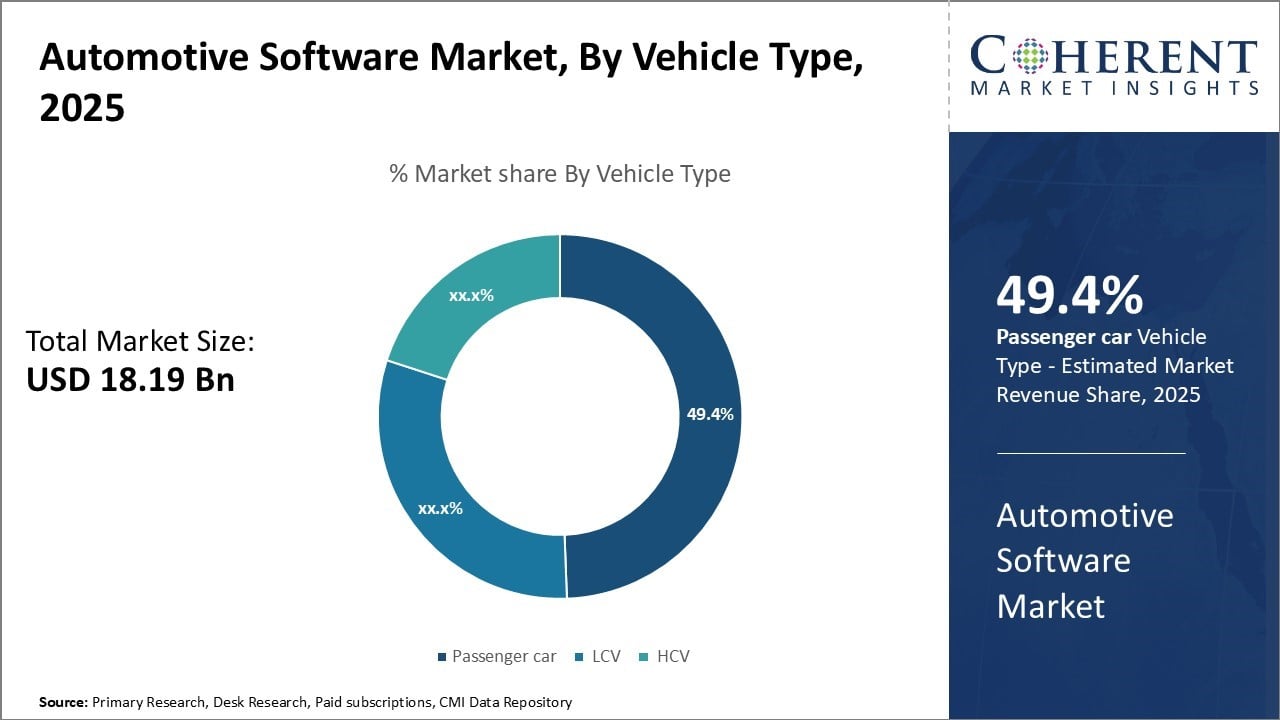
Automotive Software Market Insights, By Vehicle Type - Passenger Cars is Demanding due to higher production volumes, increasing software integration, and rising adoption of connected and electric vehicles
In terms of Vehicle Type, Passenger car segment contributes the highest share of the automotive software market owing 50.4% in 2026 due to their high production volumes and growing demand for software-enabled features, including infotainment, ADAS, and connected vehicle technologies. The rising adoption of electric and hybrid passenger cars further fuels the integration of advanced software, driving market growth in this segment.
For instance, in April 2025, Volkswagen Group unveiled its first AI-powered Advanced Driver Assistance System (ADAS) at Auto Shanghai 2025. Developed by CARIZON, a joint venture between Volkswagen's software division CARIAD and Horizon Robotics, the system is tailored for China's complex traffic conditions. Utilizing a high-performance system-on-chip, it offers Level 2+ automation, with plans to advance to Level 2++ and Urban Navigate on Autopilot by 2026.
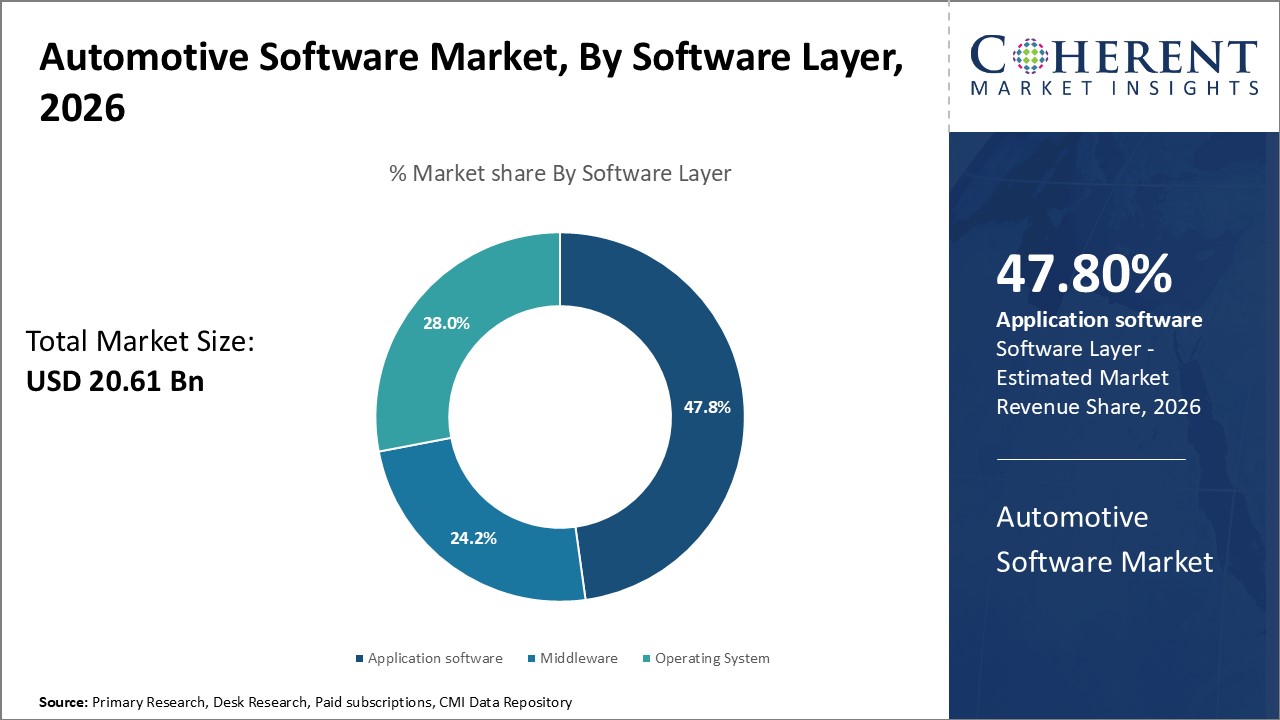
Automotive Software Market Insights, By Software Layer - Application Software Leads as It Powers Critical In-Vehicle Functionalities Like ADAS, Infotainment, And Telematics
In terms of Software Layer, Application software contributes the highest share of the market owing 47.8% in 2026. The application software leads as it governs critical in-vehicle functionalities like advanced driver-assistance systems (ADAS), telematics, infotainment, and vehicle management. OEMs increasingly prefer customizable application software to enhance user experience, ensure safety compliance, and enable seamless integration with hardware components.
For instance, in September 2025, TomTom introduced its Automotive Navigation Application, enabling carmakers to develop, customize, and deploy in-vehicle navigation solutions within weeks. This ready-to-integrate package includes the TomTom NavSDK, a pre-built user interface, application logic, and integration resources. Designed for the fast-paced automotive industry, it supports the shift from traditional four-year production cycles to more agile, software-defined vehicle development.
Automotive Software Market Insights, By EV Application - Battery Management Dominates Due To the Growth of EVs and Need for Efficient Energy Utilization
In terms of EV application, the battery management segment is projected to account for the largest share of the market in 2026, due to the rapid adoption of electric vehicles. Efficient energy utilization, battery life optimization, and real-time monitoring are crucial for EV performance. Increasing government incentives and environmental regulations drive OEMs to integrate sophisticated battery management systems, ensuring optimal vehicle efficiency and safety.
For instance, in November 2024, NXP Semiconductors introduced the industry's first Ultra-Wideband (UWB) wireless battery management system (BMS) for electric vehicles (EVs). This innovative solution enhances EV assembly by reducing wiring complexity, boosting battery energy density, and accelerating time-to-market. Leveraging NXP's Trimension® UWB technology, it offers robust and reliable data transfer within battery packs. The system is part of NXP's FlexCom chipset, supporting both wired and wireless BMS configurations. OEMs can begin evaluation and development in Q2 2025.
Automotive Software Market Insights, By Offering - Solutions is Dominating as OEMs Increasingly Integrate Ready-To-Deploy Software Platforms
In terms of Offering, the solutions segment contributes the highest share of the automotive software market owing 65% in 2026. Software solutions surpass services as automotive manufacturers prefer ready-to-deploy platforms that integrate seamlessly with vehicle systems. Solutions include operating systems, middleware, and application software that enable faster development cycles, reduced costs, and enhanced vehicle functionalities, supporting the increasing demand for connected, autonomous, and electric vehicles.
For instance, in January 2025, BlackBerry's QNX division unveiled QNX Cabin, an industry-first automotive software solution designed to accelerate digital cockpit development. This cloud-enabled, hardware-agnostic platform integrates safety-critical features with consumer applications, utilizing the VirtIO open standard for seamless virtualization. QNX Cabin aims to simplify the development of high-performance, software-defined digital cockpits, enhancing in-vehicle user experiences.
Automotive Software Market Insights, By Application - ADAS & Safety Systems dominate, driven by regulatory mandates and consumer demand for safety
In terms of application, the ADAS & Safety Systems segment holds the highest share of the market in 2026, driven by growing regulatory mandates and consumer demand for enhanced vehicle safety. These systems leverage software for collision avoidance, lane keeping, adaptive cruise control, and pedestrian detection, making them critical in modern passenger vehicles and a major driver for automotive software adoption.
For instance, in June 2026, Mahindra introduced Level 2 Advanced Driver Assistance Systems (ADAS) in its Scorpio-N SUV, enhancing safety and driving convenience. The new Z8T variant, priced from ₹20.29 lakh (ex-showroom), offers features like Forward Collision Warning, Adaptive Cruise Control, and Speed Limit Assist. This launch coincides with the Scorpio-N's third anniversary and over 2.5 lakh units sold.
Automotive Software Market Insights, By Organization Size - Large-Scale Organization Lead Owing to Greater Resources for Software Development and Integration
In terms of organization size, the large-size organization segment is projected to account for the greatest share of the market in 2026, due to their extensive R&D capabilities, resources for developing complex software solutions, and ability to integrate advanced technologies across global vehicle platforms. They benefit from economies of scale and partnerships with tech providers, reinforcing their dominance in automotive software development and deployment.
For instance, in December 2024, HARMAN Automotive introduced two new software solutions, Ready CQuence Loop and Ready Link Marketplace, to accelerate automotive software development and enhance in-vehicle experiences. Ready CQuence Loop offers a virtualized environment for rapid feature delivery, while Ready Link Marketplace enables automakers to integrate cloud-based services, unlocking new revenue streams and improving user engagement.
Regional Insights
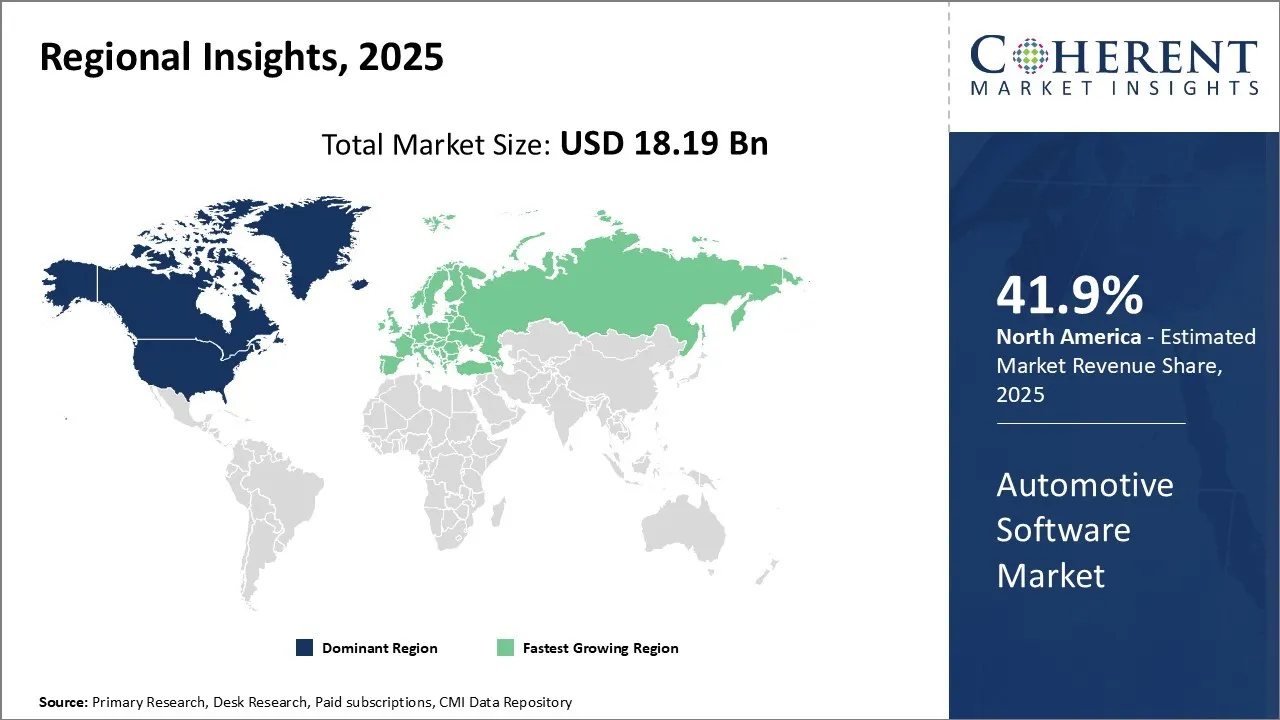
North America Automotive Software Market Analysis & Trends
North America dominates the Automotive Software Market in 2026 with 41.9% share, due to the presence of major OEMs, advanced R&D facilities, and high adoption of connected and autonomous vehicles. Stringent safety and emission regulations drive demand for advanced software solutions, while supportive policies and consumer preference for smart vehicle features further strengthen market leadership in the region.
For instance, in June 2026, BlackBerry's QNX division and Vector Informatik GmbH signed a Memorandum of Understanding to jointly develop a Foundational Vehicle Software Platform. This next-generation platform aims to accelerate the development of software-defined vehicles (SDVs) by combining QNX's safety-certified operating system with Vector's safe middleware technology.
Asia Pacific Automotive Software Market Analysis & Trends
Asia Pacific is the fastest-growing market, driven by rapid vehicle production, increasing EV adoption, and industrialization. Rising consumer demand for connected, infotainment, and autonomous vehicle features, combined with government incentives and expanding automotive R&D hubs in China, Japan, South Korea, and India, accelerates market growth, making the region a hotspot for automotive software innovation and deployment.
For instance, in July 2026, WeRide introduced Southeast Asia’s first fully driverless Robobus at Resorts World Sentosa (RWS), Singapore. This marks the region's inaugural autonomous vehicle operating without a safety officer onboard. The Robobus runs a 1.2 km loop every 12 minutes, connecting key destinations within RWS. Approved by Singapore’s Land Transport Authority after a year of successful trials, the service aligns with the nation's strategy to integrate autonomous vehicles into public transport.
Automotive Software Market Outlook Country-Wise
The U.S. Automotive Software Market Trends
The United States leads the Automotive Software Market due to widespread adoption of connected and autonomous vehicles, supported by a robust presence of major OEMs and advanced automotive R&D infrastructure. High investments in ADAS, EV technologies, and vehicle telematics, combined with a strong regulatory framework for safety and emissions, further drive the demand for innovative automotive software solutions.
For instance, in July 2026, Kioxia America Inc. introduced its new UFS Ver. 4.1 embedded flash memory devices tailored for automotive applications. Leveraging Kioxia’s 8th generation BiCS FLASH™ 3D technology and in-house controller design, these devices offer up to 3.7 times faster random write speeds compared to previous UFS 3.1 models. Available in capacities from 128 GB to 1 TB, they meet AEC-Q100/104 Grade 2 standards for automotive reliability.
China Automotive Software Market Trends
China is witnessing significant growth in automotive software demand due to its rapid adoption of electric vehicles (EVs) and government-backed smart mobility initiatives. Expanding automotive production, coupled with investments in connected car technologies, telematics, and advanced driver-assistance systems (ADAS), is driving the need for sophisticated in-vehicle software solutions. This makes China a key market for automotive software in 2026.
For instance, in September 2026, ECARX announced that its Antora 1000 computing platform will power Geely’s Galaxy E5 electric SUV. The platform, featuring a 7nm SE1000 SoC, delivers 100K DMIPS and 900G FLOPS graphics rendering. It integrates digital cockpit and parking capabilities onto a single board, reducing material costs without compromising safety or efficiency. Additionally, it supports Flyme Auto, enabling seamless smartphone connectivity.
Market Report Scope
Automotive Software Market Report Coverage
| Report Coverage | Details | ||
|---|---|---|---|
| Base Year: | 2025 | Market Size in 2026: | USD 20.61 Bn |
| Historical Data for: | 2020 To 2024 | Forecast Period: | 2026 To 2033 |
| Forecast Period 2026 to 2033 CAGR: | 13.3% | 2033 Value Projection: | USD 49.39 Bn |
| Geographies covered: |
| ||
| Segments covered: |
| ||
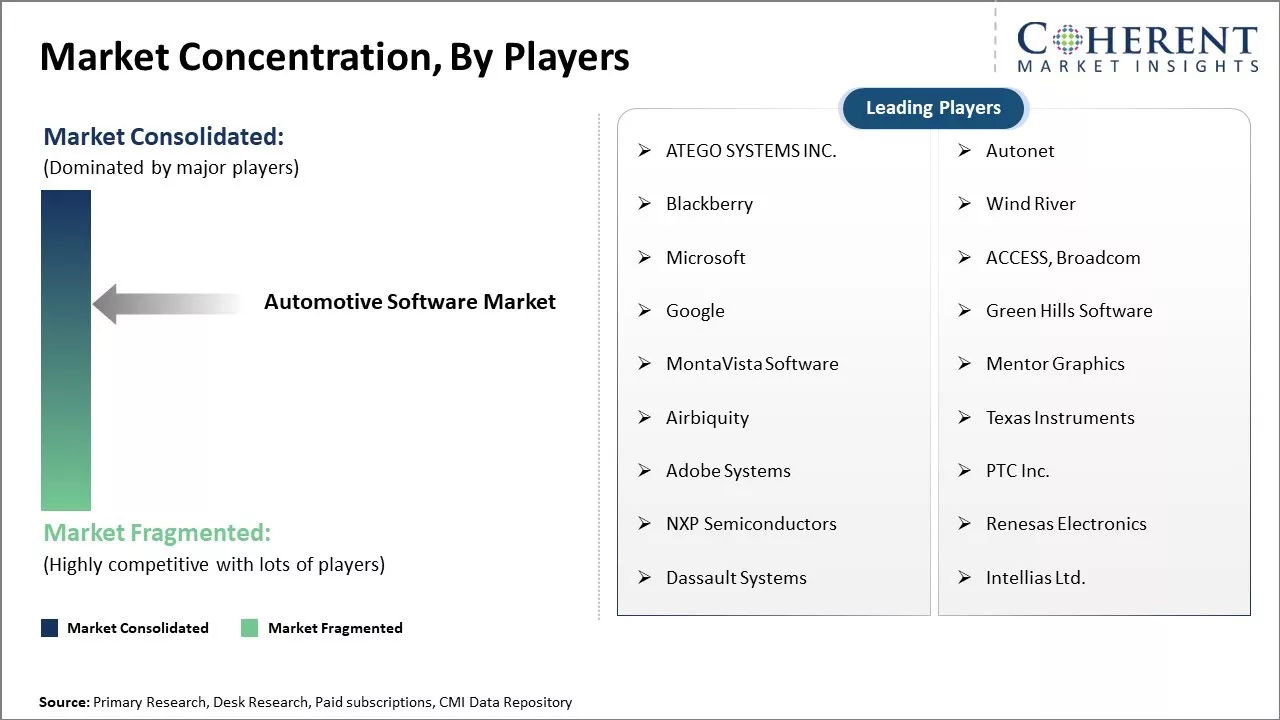
| Companies covered: | ATEGO SYSTEMS INC., Autonet, Blackberry, Wind River, Microsoft, ACCESS, Broadcom, Google, Green Hills Software, MontaVista Software, Mentor Graphics, Airbiquity, Texas Instruments, Adobe Systems, PTC Inc., NXP Semiconductors, Renesas Electronics, Dassault Systems, and Intellias Ltd. | ||
| Growth Drivers: |
| ||
| Restraints & Challenges: |
| ||
Market Dynamics
Automotive Software Market Driver
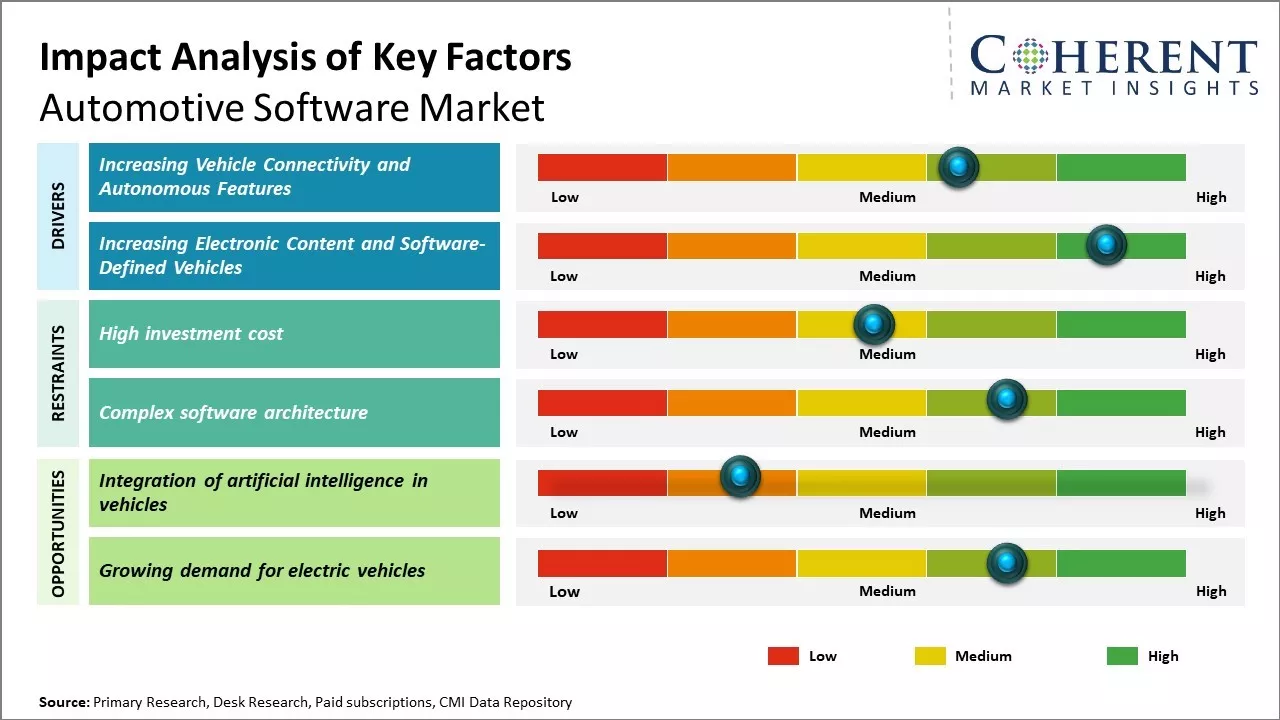
Increasing Vehicle Connectivity and Autonomous Features
With advancements in technology, the automotive industry has seen a rapid increase in the development of connected and autonomous vehicle technologies in recent years. Automakers are striving to integrate more digital capabilities and connectivity features into vehicles to enhance the driving experience for consumers. The growing demand for infotainment, onboard diagnostics, over-the-air updates, advanced driver-assistance features, and future fully autonomous vehicles is significantly driving the need for improved and more sophisticated automotive software. Most new vehicles now come equipped with touchscreen interfaces, Bluetooth, navigation systems, wireless app integration, and active safety systems like lane keeping assist and automatic emergency braking which require underlying software solutions.
Automotive Software Market Opportunities
Integration of artificial intelligence in vehicles
As software takes a more central role in vehicles, it allows automakers to differentiate their brands and build customer loyalty through continuous feature improvements. The growing automation of driving functions also means vehicle systems will demand more sophisticated software control. The rise of electric vehicles and mobility services further increases the need for innovative software solutions.
Market Concentration and Competitive Landscape
Analyst Opinion (Expert Opinion)
The automotive software market value is undergoing a profound transformation, driven by the industry's pivot from traditional hardware-centric vehicles to software-defined platforms. This shift is not merely a technological evolution but a fundamental reimagining of the automotive ecosystem, with significant implications for stakeholders across the value chain.
Automotive manufacturers are increasingly prioritizing software development, recognizing its critical role in enabling advanced functionalities such as autonomous driving, electrification, and connectivity. This strategic reorientation is evident in the substantial investments directed towards SDVs. For instance, Tata Technologies has observed that while the broader automotive market experiences modest annual growth of 3-4%, the SDV sector is expanding at a remarkable rate of approximately 25-30% annually. This disparity underscores the growing emphasis on software as a key differentiator in vehicle development.
The complexity of SDVs necessitates a collaborative approach to software development. Recognizing this, General Motors, Magna International, and Wipro have co-founded SDVerse, a business-to-business marketplace designed to streamline the procurement of automotive software. This initiative reflects a broader industry trend towards open platforms and shared ecosystems, enabling manufacturers to access a diverse array of software solutions and accelerating the development of innovative features.
With the increasing integration of over-the-air (OTA) updates and vehicle-to-everything (V2X) communication, the cybersecurity landscape of SDVs has become a critical concern. Research indicates that SDVs are susceptible to a range of security threats, including API vulnerabilities and supply chain risks. Moreover, the vast amounts of data generated by these vehicles raise significant privacy issues, necessitating the implementation of robust security frameworks and privacy-preserving techniques to safeguard user information.
Speak to the analyst
Want personalized insights?
Take the findings above to one of our principal consultants, or have the report rebuilt around the segments, geographies and competitors you actually track.
Automotive Software Industry News
- In July 2025, ECARX's Cloudpeak® software stack powered the global launch of the Volvo EX30 Cross Country compact electric SUV. Cloudpeak® offers a unified platform adaptable to regional markets, integrating Google Automotive Services in Europe and Android Automotive OS in China. As of January 2025, over 100,000 units of the EX30 have been sold globally, highlighting the effectiveness of ECARX's adaptable software solution in meeting diverse regional requirements.
- In April 2025, Nissan has announced plans to launch its next-generation ProPILOT autonomous driving technology in fiscal year 2027. The system will integrate Nissan's Ground Truth Perception technology, featuring advanced LiDAR sensors, with Wayve's AI Driver software. This collaboration aims to set a new standard in autonomous driving, enhancing collision avoidance capabilities and enabling vehicles to learn from real-world data.
- In March 2025, Hyundai Motor Group introduced 'Pleos,' a new mobility software platform designed to support autonomous movement and smart management of all devices in motion. The platform aims to enhance connectivity and efficiency across various transportation modes, aligning with Hyundai's vision for a future of seamless mobility.
Market Segmentation
- Vehicle Type Insights (Revenue, USD Bn, 2026 - 2033)
- Passenger car
- LCV
- HCV
- Software Layer Insights (Revenue, USD Bn, 2026 - 2033)
- Operating System
- Middleware
- Application software
- EV Application Insights (Revenue, USD Bn, 2026 - 2033)
- Charging Management
- Battery Management
- V2G
- Offering Insights (Revenue, USD Bn, 2026 - 2033)
- Solutions
- Services
- Application Insights (Revenue, USD Bn, 2026 - 2033)
- ADAS & Safety Systems
- Body Control & Comfort System
- Powertrain System
- Infotainment System
- Communication System
- Vehicle Management & Telematics
- Connected Services
- Autonomous Driving
- HMI Application
- Biometrics
- Remote Monitoring
- V2X System
- Organization Size Insights (Revenue, USD Bn, 2026 - 2033)
- Large Scale Organizations
- Medium Scale Organization
- Small Scale Organization
- Regional Insights (Revenue, USD Bn, 2026 - 2033)
- North America
- U.S.
- Canada
- Latin America
- Brazil
- Argentina
- Mexico
- Rest of Latin America
- Europe
- Germany
- U.K.
- France
- Italy
- Russia
- Rest of Europe
- Asia Pacific
- China
- India
- Japan
- Australia
- South Korea
- ASEAN
- Rest of Asia Pacific
- Middle East & Africa
- GCC Countries
- South Africa
- Rest of Middle East & Africa
- Key Players
- ATEGO SYSTEMS INC.
- Autonet
- Blackberry
- Wind River
- Microsoft
- ACCESS, Broadcom
- Green Hills Software
- MontaVista Software
- Mentor Graphics
- Airbiquity
- Texas Instruments
- Adobe Systems
- PTC Inc.
- NXP Semiconductors
- Renesas Electronics
- Dassault Systems
- Intellias Ltd.
Sources
Primary Research Interviews from the following stakeholders
Stakeholders
- Interviews with automotive OEMs, Tier-1 and Tier-2 suppliers, fleet operators, automotive software vendors, mobility service providers, and procurement heads across leading global markets.
Specific stakeholders
- Heads of software development and digital transformation at OEMs (e.g., Toyota, Volkswagen, Hyundai, Tata Motors)
- Product managers and CTOs at Tier-1 and Tier-2 automotive suppliers (e.g., Bosch, Continental, Denso, ZF)
- Fleet operations and IT heads at mobility service providers (e.g., Uber, Lyft, Ola, Grab)
- Software architects and integration lead at autonomous and connected vehicle technology providers
- Heads of in-vehicle infotainment (IVI) and telematics divisions at OEMs
- R&D and product managers at automotive cybersecurity and embedded software companies
Databases
- World Trade Organization (WTO) Trade Statistics
- UN Comtrade Database
- Ministry of Electronics and Information Technology (MeitY), India
- Bureau of Economic Analysis (U.S.)
- Eurostat
- China Customs Statistics
- Korea Customs Service Data Portal
- Japan External Trade Organization (JETRO)
- Directorate General of Commercial Intelligence and Statistics (DGCIS), India
Magazines
- Automotive News
- Ward’s Auto
- Automotive World
- Automotive IT News
- Autocar Professional
- TechRadar Pro (Automotive Software & Mobility section)
- Fleet Management Weekly
Journals
- IEEE Transactions on Intelligent Transportation Systems
- SAE International Journal of Passenger Cars – Electronic and Electrical Systems
- Journal of Automotive Software Engineering
- International Journal of Automotive Technology
- Journal of Vehicle Design and Mobility Systems
Newspapers
- The Wall Street Journal – Automotive & Technology
- The Economic Times – Auto & Mobility
- The Hindu Business Line – Automotive Tech & Software
- Financial Times – Mobility & Automotive Software
- Nikkei Asia – Automotive Electronics and Supply Chain
- South China Morning Post – Automotive Tech & Industry
Associations
- Society of Automotive Engineers (SAE International)
- Automotive Electronics Council (AEC)
- European Automobile Manufacturers Association (ACEA)
- International Organization of Motor Vehicle Manufacturers (OICA)
- Automotive Software & Embedded Systems Association
- Indian Automotive Software Consortium (IASC)
- Connected Vehicle Trade Association
Public Domain Sources
- Ministry of Road Transport and Highways (MoRTH), India
- National Institute of Standards and Technology (NIST), U.S.
- Ministry of Economy, Trade and Industry (METI), Japan
- U.S. International Trade Commission (USITC)
- NITI Aayog – Automotive & EV Reports
- India Investment Grid – Automotive and EV Sector
- EU Single Market Observatory – Automotive Software and Digital Mobility Reports
- Reserve Bank of India (RBI) Reports on Automotive and Technology Investments
Proprietary Elements
- CMI Data Analytics Tool and Proprietary CMI Repository of automotive software data spanning over 8 years, including connected vehicle solutions, embedded software deployments, and regional adoption trends.
*Definition: "The automotive software market is the industry comprising companies that develop, manufacture, and sell software and applications for vehicles. This includes embedded software for engine and transmission control units, entertainment and navigation software, advanced driver-assistance systems, connected-car services, and cybersecurity solutions that help automakers enhance the functionality, entertainment options, safety, and overall driving experience in modern automobiles."
Get access to 250+ pages report
Every segment, forecast, competitor profile and data table behind the analysis above — available for instant download.
- ESOMAR Member
- ISO 9001:2015 Certified
- D-U-N-S Registered
- GDPR & CCPA Compliant
Missing comfort of reading report in your local language? Find your preferred language:
Transform your Strategy with Exclusive Trending Reports
Frequently Asked Questions
The Automotive Software Market is estimated to be valued at USD 20.61 Bn in 2026, and is expected to reach USD 49.39 Bn by 2033.
The CAGR of the Automotive Software Market is projected to be 13.3% from 2026 to 2033.
Increasing vehicle connectivity and autonomous features and increasing electronic content and software-defined vehicles are the major factors driving the growth of the automotive software market.
High investment cost and complex software architecture are the major factors hampering the growth of the automotive software market
In terms of Vehicle Type, Passenger car is estimated to dominate the market revenue share in 2026.
ATEGO SYSTEMS INC., Autonet, Blackberry, Wind River, Microsoft, ACCESS, Broadcom, Google, Green Hills Software, MontaVista Software, Mentor Graphics, Airbiquity, Texas Instruments, Adobe Systems, PTC Inc., NXP Semiconductors, Renesas Electronics, Dassault Systems, and Intellias Ltd. are the major players.
North America is expected to lead the automotive software market in 2026.