

Software Testing and QA Services Market Size and Share Analysis - Growth Trends and Forecasts (2026-2033)
Software Testing and QA Services Market is estimated to be valued at USD 50,672.4 Mn in 2026 and is expected to reach USD 107,248.0 Mn in 2033, exhibiting a compound annual growth rate (CAGR) of 11.5% from 2026 to 2033.
Key Takeaways
- Based on Testing Type, the Functional Testing segment leads the market holding the largest share in 2205, due to its critical role in validating core software features, ensuring reliability, and meeting user expectations across industries.
- Based on Testing Method, the Manual segment is projected to dominate with a share of 48% in 2026, due to its precision, flexibility, and ability to uncover complex UI and usability issues that automation may overlook.
- Based on Endpoint Interface, the Mobile App testing segment is estimated to lead the market with a highest share in 2026, as enterprises prioritize flawless performance across diverse devices to meet rising user expectations in a mobile-first world.
- Based on Service Type, the Testing as a Service (TaaS) segment is expected to account for the greatest share of the market in 2026, due to its scalability, cost-effectiveness, and compatibility with Agile and DevOps methodologies.
- Based on Enterprise Size, the Large Enterprise segment is projected to lead with market with the biggest share in 2026, due to its complex its infrastructures, higher compliance requirements, and substantial budgets for quality assurance.
- Based on Deployment Mode, the Cloud-Based segment is anticipated to dominate, representing the enormous share of the market in 2026, due to its scalability, cost-efficiency, and seamless integration with agile and DevOps workflows.
- Based on Vertical, the BSFI segment is expected to account the outstanding share of the market in 2025, due to its high demand for secure, compliant systems.
- Based on Region, North America is expected to lead the market, holding a share of 34.5% in 2025. While, Asia Pacific is anticipated to be the fastest-growing region, with an estimated share of 30.3% in 2025.
Market Overview
The Software Testing and QA Services market is evolving rapidly, driven by rising demand for reliable, secure, and high-performing digital solutions. Businesses across industries are prioritizing quality assurance to reduce downtime, enhance user experience, and meet compliance standards. The shift toward agile and DevOps methodologies has increased the need for continuous testing, automation, and AI-driven QA tools. Cloud-based testing platforms and outsourced QA services are also gaining traction, enabling scalability and cost-efficiency in global software development.
Current Events and their Impacts on the Global Software Testing and QA Services Market
Current Event | Description and its Impact |
AI Integration and Automation Revolution in Software Testing |
|
Regulatory Compliance Tightening and Standardization |
|
Role of Artificial Intelligence (AI) in the Software Testing and QA Services Market
Artificial Intelligence is revolutionizing the Software Testing and QA Services Market by introducing smarter, faster, and more adaptive testing methodologies. AI enables automatic test case generation, predictive defect detection, and self-healing scripts that reduce manual effort and improve accuracy. Generative AI tools now create realistic test data for APIs, while machine learning models optimize test coverage and prioritize high-risk areas. Natural language processing allows QA teams to write test scenarios in plain English, making automation more accessible. These innovations are accelerating release cycles, enhancing software reliability, and transforming QA workflows across industries. As adoption grows globally, regions like North America, Europe, India, and the GCC are leading the charge in integrating AI into enterprise-level quality assurance.
For instance, in October 2025, Appvance has enhanced its AIQ platform by integrating generative AI to automate API test data creation. This advancement accelerates test coverage, reduces manual effort, and improves accuracy in software testing. The update marks a significant step in leveraging AI to streamline quality assurance for enterprise applications
- Current Industry Events of 2026
- Market Size Estimation
- Regional Breakdown
- Competitive Landscape
- Customer Intelligence
- Segmental Analysis
- Pricing Analysis
- Key Market Drivers, Challenges & Future Trends
- Customized Insights Section
Segmental Insights
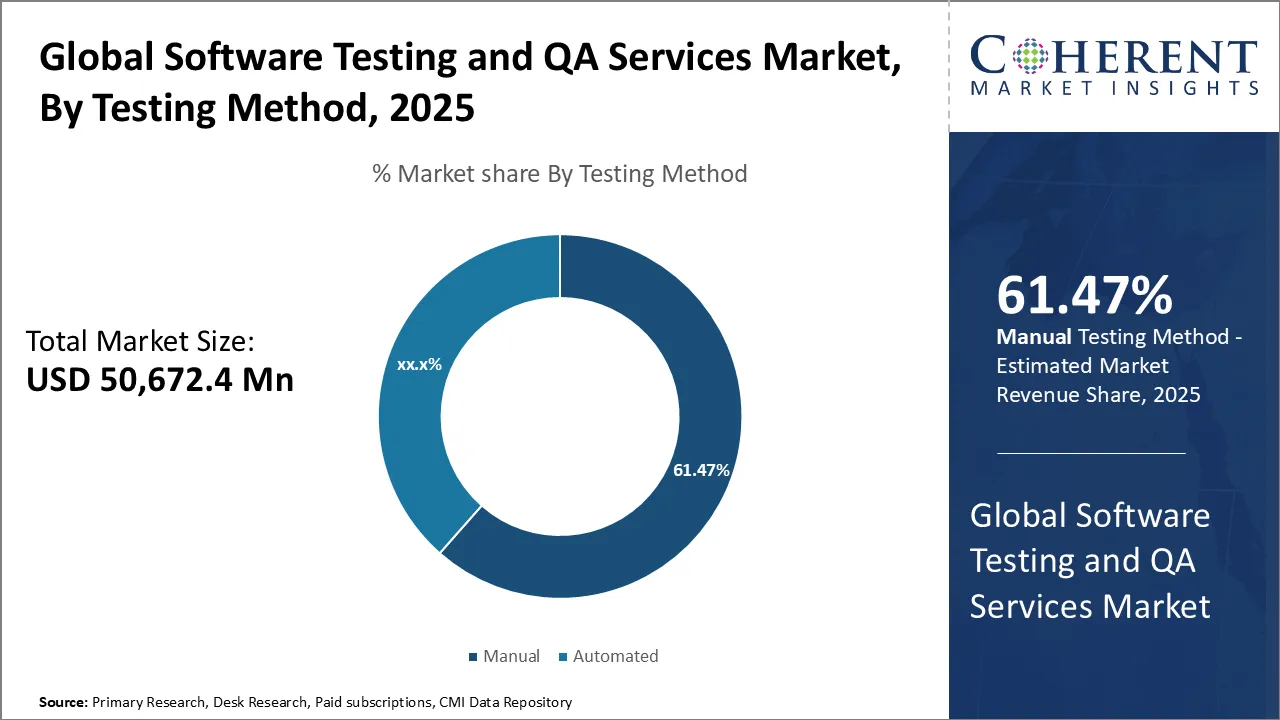
Global Software Testing and QA Services Market Insights, By Testing Method: Manual Testing Dominates Due To Its Precision, Flexibility, And Ability to Uncover Complex UI And Usability Issues That Automation May Overlook
In terms of testing method, the manual segment is projected to hold the 62.5% share of the market in 2026, due to its precision in uncovering complex user interface issues, usability flaws, and exploratory scenarios that automated tools may miss. It’s especially valuable for applications requiring human judgment, such as mobile apps, gaming, and customer-facing platforms. Manual testing also remains essential for ad-hoc, one-time tests and early-stage development cycles where automation setup may not be cost-effective. Despite the rise of automation, enterprises continue to rely on manual methods for their flexibility, accuracy, and ability to simulate real-world user behavior.
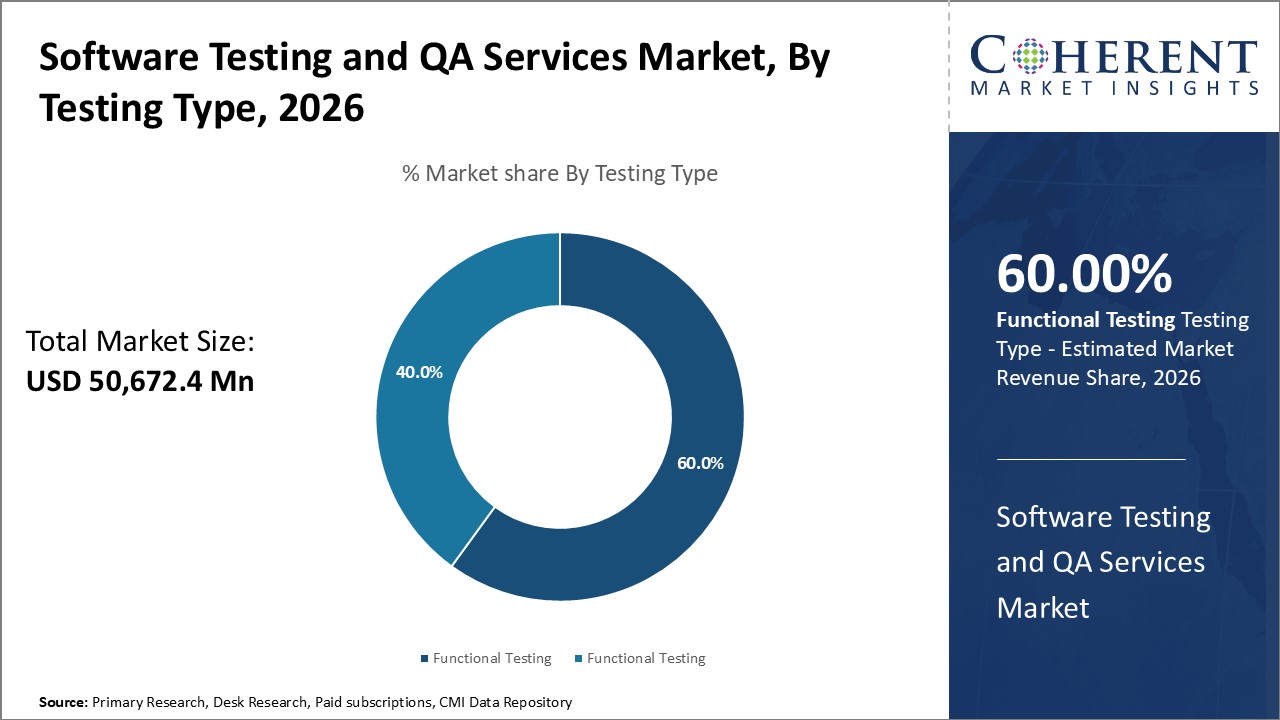
Global Software Testing and QA Services Market Insights, By Testing Type: Functional Testing Dominates Due To Its Critical Role in Validating Core Software Features, Ensuring Reliability, And Meeting User Expectations Across Industries
In terms of testing type, the functional testing segment is expected to account for the outstanding share of the market in 2026, as it ensures that software applications perform according to specified requirements and deliver expected outcomes for end users. As enterprises increasingly rely on digital platforms for customer engagement, verifying core functionalities, such as login systems, payment gateways, and data processing, becomes critical. Functional testing validates these features across various environments, helping prevent costly defects and enhancing user satisfaction. Its relevance spans industries, from finance and healthcare to e-commerce, making it a foundational QA practice. Additionally, the rise of automation tools has made functional testing faster and more scalable, further driving its adoption across large enterprises.
Global Software Testing and QA Services Market Insights, By Endpoint Interface: Mobile App Testing Leads as Enterprises Prioritize Flawless Performance Across Diverse Devices to Meet Rising User Expectations in a Mobile-First World
In terms of endpoint interface, the mobile app testing segment is expected to capture enormous share of the market in 2026, due to the explosive growth of smartphones and mobile-first digital experiences. As consumers increasingly rely on mobile apps for banking, shopping, healthcare, and entertainment, enterprises must ensure flawless performance, security, and usability across diverse devices and operating systems. Mobile app testing enables rapid validation of functionality, compatibility, and responsiveness, which is critical for user retention and brand reputation. Additionally, the rise of Agile and DevOps practices has fueled demand for automated mobile testing tools that support continuous delivery and faster release cycles. This convergence of user expectations, device diversity, and business agility makes mobile app testing a strategic priority in QA services.
For instance, in June 2025, BrowserStack become the first platform to support Playwright testing on real iOS devices using Safari. This breakthrough empowers developers to run automated tests across Apple’s native browser, enhancing accuracy and coverage for mobile web applications. The update marks a significant leap in cross-browser testing capabilities for enterprise QA teams.
Global Software Testing and QA Services Market Insights, By Service Type: Testing as a Service (TaaS) Is Revolutionizing with Scalable, Cost-Effective, And Agile-Friendly Solutions That Accelerate Delivery and Ensure High-Quality Software
In terms of service type, the Testing as a Service (TaaS) segment is projected to account for the biggest share of the market in 2026, due to its scalability, cost-effectiveness, and compatibility with Agile and DevOps methodologies. Enterprises increasingly prefer TaaS because it allows them to outsource testing on-demand, eliminating the need for costly infrastructure and enabling faster release cycles. TaaS providers offer access to advanced automation tools and skilled QA professionals, ensuring high-quality testing across functional, performance, and security domains. This model supports continuous integration and rapid feedback, helping organizations accelerate time-to-market while maintaining robust software quality. As digital transformation intensifies, TaaS continues to gain traction among large enterprises seeking flexible, efficient, and future-ready QA solutions.
For instance, in October 2024, Opkey announced a strategic partnership with De Novo Solutions to enhance automated testing for Oracle Cloud applications. The collaboration aims to streamline digital transformation for enterprises by combining Opkey’s no-code testing platform with De Novo’s Oracle expertise, delivering faster deployments and improved quality assurance across cloud environments.
Global Software Testing and QA Services Market Insights, By Organization Size: Large Enterprise is Surging Due To Its Complex IT Infrastructures, Higher Compliance Requirements, And Substantial Budgets for Quality Assurance
In terms of organization size, the large enterprises segment is projected to hold the greatest share of the market in 2026, due to its complex IT infrastructures, higher compliance requirements, and substantial budgets for quality assurance. These organizations often manage mission-critical applications across multiple geographies and industries, necessitating robust testing frameworks, automation tools, and continuous integration pipelines. Their emphasis on minimizing downtime, ensuring data security, and delivering seamless user experiences drives significant investment in advanced QA services. Additionally, large enterprises are early adopters of AI-driven testing, cloud-based platforms, and Testing as a Service (TaaS), further reinforcing their leadership in the market.
For instance, in January 2025, Autonomous testing platform Functionize raised $41 million in Series B funding to accelerate its AI-driven quality assurance solutions. Led by SignalFire, the round includes participation from existing investors. The funds will support product innovation and global expansion, reinforcing Functionize’s mission to transform software testing through intelligent automation.
Global Software Testing and QA Services Market Insights, By Deployment Mode: Cloud-Based Deployment Dominates Due To Its Scalability, Cost-Efficiency, And Seamless Integration with Agile and DevOps Workflows
In terms of deployment mode, the cloud-based testing segment is expected to capture the highest share of the market in 2026, due to its scalability, flexibility, and cost-efficiency. Organizations increasingly prefer cloud-based testing environments as they support faster test execution, seamless integration with CI/CD pipelines, and remote collaboration across distributed teams. Cloud platforms also enable on-demand resource provisioning, reducing infrastructure costs and accelerating time-to-market. Additionally, the rise of agile and DevOps methodologies has fueled demand for cloud-native testing tools that offer real-time analytics, automated test orchestration, and compatibility across diverse devices and environments. This makes cloud deployment the preferred choice for modern QA strategies.
For instance, in March 2025, UiPath introduced Test Cloud, a new platform designed to embed AI agents into software testing workflows. This cloud-native solution enables scalable, automated testing across environments, enhancing speed and accuracy. Test Cloud marks a strategic move to modernize QA processes and support continuous delivery in enterprise software development.
Global Software Testing and QA Services Market Insights, By Verticals: BFSI Leads Due To Its High Demand for Secure, Compliant Systems
In terms of verticals, the BFSI segment is projected to account for the largest share of the market in 2026. This sector demands rigorous testing due to its reliance on secure, high-performance software systems and strict regulatory compliance. Functional and security testing are critical to ensure data protection, transaction accuracy, and seamless digital experiences. With the rise of mobile banking, digital wallets, and AI-driven financial platforms, BFSI organizations are investing heavily in automated and cloud-based QA solutions to maintain reliability and customer trust.
For instance, in June 2025, LambdaTest joined forces with Compunnel to enhance quality assurance in the financial services sector. The collaboration aims to deliver advanced testing solutions, streamline workflows, and improve software reliability. By integrating automation and cloud-based tools, the partnership supports digital transformation and regulatory compliance across BFSI organizations.
Regional Insights
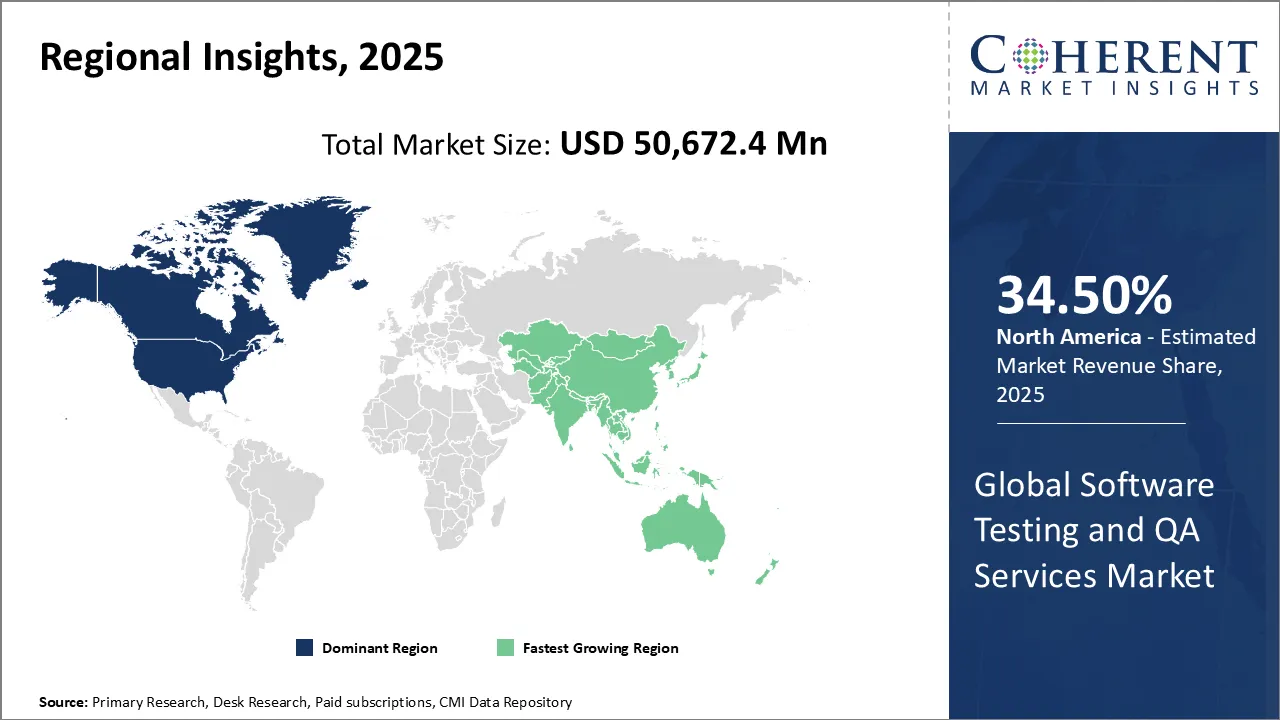
North America Software Testing and QA Services Market Analysis & Trends
North America, holding an estimated share of 34.5% in 2026, dominates the software testing and QA services market, due to the region's concentration of tech-driven enterprises, rapid digital transformation, and strong adoption of Agile and DevOps methodologies. High regulatory standards, a mature IT infrastructure, and the need for secure, high-quality software across industries like finance, healthcare, and e-commerce further fuel the demand.
For instance, in September 2026, Boston-based tech startup QASolve AI introduced an advanced AI software testing platform designed to transform quality assurance. The platform automates test creation and execution, reducing manual effort and accelerating development cycles. This innovation aims to enhance scalability, precision, and efficiency in enterprise software testing across industries.
Asia Pacific Software Testing and QA Services Market Analysis & Trends
Asia Pacific, holding a projected share of 30.3% in 2026, shows the fastest growth in the software testing and QA services market due to the region’s booming IT sector, rapid digitalization, and surge in mobile and web applications. Countries like India, China, and Southeast Asia offer vast talent pools, cost-effective testing services, and strong adoption of Agile and DevOps. Additionally, growing e-commerce, fintech, and healthcare tech ecosystems drive the need for robust QA solutions to ensure software reliability and user satisfaction.
For instance, in September 2026, QA Sphere announced its Asia Pacific deployment, aiming to boost testing speed and efficiency for regional QA teams. This strategic expansion offers enhanced access to local infrastructure, faster execution times, and improved support for Agile and DevOps workflows, empowering enterprises to deliver high-quality software with greater agility.
Software Testing and QA Services Market Outlook Country-Wise
The U.S. Software Testing and QA Services Market Trends
The U.S. leads the market with 28.3% share, due to its concentration of global tech giants, advanced digital infrastructure, and strong adoption of Agile and DevOps methodologies. High regulatory standards and the need for secure, high-quality software across industries like finance, healthcare, and e-commerce drive consistent demand for QA services.
For instance, in April 2026, QA Mentor introduced HIST (Human Intelligence Software Testing), a pioneering QA approach that blends human intuition with advanced testing methodologies. Designed to enhance defect detection and user experience validation, HIST emphasizes cognitive analysis and real-world scenarios, offering a powerful alternative to traditional automation in quality assurance practices.
China Software Testing and QA Services Market Trends
China with a 10.1% share demand is fueled by rapid digitalization, a massive mobile user base, and booming sectors like e-commerce, fintech, and gaming. The country’s focus on innovation and expanding tech ecosystem creates a strong need for scalable and reliable software testing solutions.
For instance, in December 2024, China’s Gientech unveiled a unified software testing framework that merges AI, machine learning, automation, and Agile methodologies. This strategic integration aims to enhance testing speed, accuracy, and scalability for enterprise QA teams, positioning Gientech as a leader in next-generation quality assurance solutions across Asia’s tech landscape.
Germany Software Testing and QA Services Market Trends
Germany’s market is driven with 5.2% share by its precision-focused industries such as automotive, manufacturing, and engineering. These sectors require rigorous QA standards to ensure compliance, safety, and performance, making software testing a critical component of their digital operations.
For instance, in August 2026, Qt launched Squish 9.1.0, featuring a new AI Assistant to enhance automated GUI testing. The update introduces improved test maintenance, smarter script generation, and intuitive debugging support. This release marks a significant step toward integrating AI into software quality assurance workflows for faster and more efficient testing.
Brazil Software Testing and QA Services Market Trends
Brazil shows growing demand with a 4.8% share, due to its expanding digital economy, increasing mobile penetration, and rising need for localized QA services. As more businesses go online, especially in retail and banking, the importance of robust software testing continues to rise.
GCC Countries Software Testing and QA Services Market Trends
The GCC region’s demand with a 3.7% share stems from government-led digital transformation initiatives, smart city projects, and increased investment in tech infrastructure. Countries like Saudi Arabia and the UAE are rapidly modernizing, creating a surge in QA needs to support high-quality digital services.
For instance, in July 2026, Inflectra released Rapise v8.3, its latest AI-powered codeless test automation platform. The update enhances testing speed, precision, and efficiency for enterprise QA teams. With advanced generative AI features, Rapise v8.3 streamlines software testing workflows globally, including expanded support for digital transformation and QA initiatives across the GCC region.
Market Report Scope
Software Testing and QA Services Market Report Coverage
| Report Coverage | Details | ||
|---|---|---|---|
| Base Year: | 2025 | Market Size in 2026: | USD 50,672.4 Mn |
| Historical Data for: | 2020 To 2024 | Forecast Period: | 2026 To 2033 |
| Forecast Period 2026 to 2033 CAGR: | 11.5% | 2033 Value Projection: | USD 107,248.0 Mn |
| Geographies covered: |
| ||
| Segments covered: |
| ||
| Companies covered: | IBM, Cognizant, EPAM Systems, Inc, Intellectsoft US, Accenture, QA Mentor, Atos SE, Qualitest Group, Wipro, HCL Technologies Limited, Mindtree, and Tech Mahindra | ||
| Growth Drivers: |
| ||
| Restraints & Challenges: |
| ||
Global Software Testing and QA Services Market Drivers
- Digital Transformation and Shift toward Cloud-Based Testing: The rapid digital transformation across industries is driving the growth of the software testing and QA services market. Enterprises are modernizing their legacy systems and migrating their IT infrastructure to cloud platforms. This is creating significant demand for testing and QA of new digital products, cloud-based applications, web and mobile apps. Cloud-based testing minimizes infrastructure costs and offers flexibility. The shift towards cloud-based testing is a major driver for the software testing and QA services market.
- Adoption of Agile and DevOps Methodologies: The growing adoption of agile and DevOps methodologies in software development is fueling the demand for agile testing services. Agile methodologies involve continuous development, integration, testing and release of software in rapid iterations. This requires test automation tools and frameworks to perform frequent regression testing. DevOps integration of development and operations also relies heavily on test automation. Agile and DevOps help accelerate software delivery and responding faster to changing business requirements which is driving testing activities.
Software Testing and QA Services Market Opportunities
Increasing Adoption of Test Automation: Test automation is gaining significant traction driven by the benefits of faster feedback, increased efficiency, and coverage in software testing. AI and ML are revolutionizing test automation through auto-generation of test scripts, intelligent test case prioritization, self-healing, and more. As per a survey, around 40% of organizations use AI in testing currently. The increasing adoption of test automation presents huge opportunities for software testing service providers to develop new AI-powered offerings for clients.
Growing Demand for Testing-as-a-Service: Testing-as-a-service (TaaS) model is gaining popularity driven by benefits such as usage-based pricing, faster deployment, reduced overhead, and leveraging external testing expertise. TaaS allows on-demand access to shared test environments, resources, data, and testing tools on the cloud. The pay-per-use model also helps in reducing the total cost of ownership. The growing demand for TaaS offerings provides major opportunities for specialized testing vendors.
Emerging Technologies such as IoT, AI, and Big Data: The adoption of emerging technologies such as IoT, AI, big data and analytics is growing across industries. This presents opportunities for testing companies to provide QA services for solutions built using these next-gen technologies. Testing of connected IoT ecosystems, intelligent algorithms, data security is complex and requires niche expertise. Software testing firms are enhancing their capabilities to capitalize on the new revenue opportunities presented by these emerging technology domains.
Geographic Expansion into Emerging Markets: Emerging countries across Asia Pacific, Latin America, Africa and Middle East are expected to see increased technology investments driven by economic growth. Global testing companies have significant opportunities to expand into these markets and partner with local companies for growth. Emerging regions have large talent pools which can help drive cost optimization. Geographic expansion into high growth emerging markets provides huge growth potential for the software testing and QA services industry.
Global Software Testing and QA Services Market Trends
- Shift Left Testing: Shift-left testing is a growing trend that involves testing earlier in the software development lifecycle. It aims to improve software quality by detecting defects and vulnerabilities early. Unit testing, integration testing, and static code analysis are done as developers’ code. This trend reduces the number of defects down the lifecycle and enables faster feedback. Shift left testing along with test automation enables continuous testing which is essential for agile and DevOps adoption.
- Growth in Multi-Channel and Omnichannel Testing: Enterprises are adopting multi-channel and omnichannel customer engagement strategies across web, mobile, social media, etc. This requires comprehensive testing across channels to deliver seamless user experience. There is a growing need for customer journey mapping and end-to-end testing across touchpoints. Testing across multiple platforms simultaneously is complex and drives demand for specialist testing services. Intelligent test automation is essential for omnichannel testing.
Analyst Opinion (Expert Opinion)
The Software Testing and QA Services market value is rapidly evolving from a support function into a strategic pillar of enterprise resilience and brand trust. Modern QA is no longer about defect detection but about business risk containment. Studies reveal that defects discovered late in the lifecycle can cost up to 100 times more to fix, reinforcing the necessity of early and automated testing.
Automation now drives over 60% of enterprise QA pipelines, while Generative AI adoption in test creation and maintenance exceeds 70%, enhancing coverage and reducing time-to-release. However, automation without architectural discipline often leads to “automation debt”, excessive scripting, poor data management, and false test confidence. The successful QA strategy blends service-level test design, robust data governance, and AI validation frameworks.
A visible shift toward “quality engineering” integrating QA into CI/CD pipelines is redefining skill requirements. Vendors offering domain-led expertise in regulated and complex sectors such as banking, automotive, and healthcare are capturing premium value. Meanwhile, commoditized regression testing faces price erosion and insourcing pressures.
Ultimately, quality assurance is transitioning into an engineering-led, outcome-driven discipline. Market leaders will differentiate through automation maturity, AI augmentation, and measurable reduction in production defects and downtime, transforming QA into a business enabler, not a cost center.
Speak to the analyst
Want personalized insights?
Take the findings above to one of our principal consultants, or have the report rebuilt around the segments, geographies and competitors you actually track.
Recent Developments
- In August 2025, GlobalLogic launched VelocityAI, an advanced testing platform designed to accelerate software development, enhance quality, and reduce time-to-market. By integrating AI-driven automation into QA workflows, VelocityAI empowers engineering teams to streamline testing processes, improve defect detection, and deliver high-performance digital products faster across global markets.
- In July 2025, ALTEN contributed to the ISTQB’s newly launched syllabus focused on testing with generative AI. This initiative aims to equip QA professionals with the skills to validate AI-generated outputs and ensure software reliability. ALTEN’s involvement highlights its commitment to advancing global standards in AI-driven software testing.
- In March 2025, Appvance launched GENI, a groundbreaking AI technology designed to fully automate software testing without scripting or manual effort. Positioned as the first “true AI” for QA, GENI generates and executes tests autonomously, promising faster releases and improved software quality for enterprise applications.
Market Segmentation
- By Testing Type (Revenue, USD Mn, 2021 - 2033)
- Functional Testing
- Unit Testing
- System Testing
- User Acceptance Testing (UAT)
- Others
- Non-functional Testing
- Performance Testing
- Security Testing
- Compatibility Testing
- Compliance Testing
- Others
- Functional Testing
- By Testing Method (Revenue, USD Mn, 2021 - 2033)
- Manual
- Automated
- By Endpoint Interface (Revenue, USD Mn, 2021 - 2033)
- Mobile App Testing
- iOS
- Android
- Website Testing
- Desktop Interface
- API (Application Programming Interface)
- Cloud-Based Interface
- Others
- Mobile App Testing
- By Service Type (Revenue, USD Mn, 2021 - 2033)
- Traditional Testing Services
- Testing as a Service (TaaS)
- By Organization Size (Revenue, USD Mn, 2021 - 2033)
- Small and Medium Enterprises (SMEs)
- Large Enterprises
- By Deployment Mode (Revenue, USD Mn, 2021 - 2033)
- On-Premises
- Cloud-Based
- By Verticals (Revenue, USD Mn, 2021 - 2033)
- BFSI
- Telecom and IT
- Healthcare and Life Sciences
- Retail and eCommerce
- Manufacturing
- Government and Public Sector
- Energy and Utilities
- Transportation and Logistics
- Others (Education, Media & Entertainment, etc.)
- By Region (Revenue, USD Mn, 2021 - 2033)
- North America
- U.S.
- Canada
- Latin America
- Brazil
- Argentina
- Mexico
- Rest of Latin America
- Europe
- Germany
- U.K.
- Spain
- France
- Italy
- Russia
- Rest of Europe
- Asia Pacific
- China
- India
- Japan
- Australia
- South Korea
- ASEAN
- Rest of Asia Pacific
- Middle East
- GCC Countries
- Israel
- Rest of Middle East
- Africa
- South Africa
- North Africa
- Central Africa
- North America
- Software Testing and QA Services Market Companies
- IBM
- Cognizant
- EPAM Systems, Inc
- Intellectsoft US
- Accenture
- QA Mentor
- Atos SE
- Qualitest Group
- Wipro
- HCL Technologies Limited
- Mindtree
- Tech Mahindra
Sources
Primary Research Interviews from the following stakeholders
Stakeholders
- Interviews with software testing service providers, QA automation engineers, DevOps heads, CIOs/CTOs, product managers, IT service vendors, and enterprise digital transformation leads across major global markets.
Specific Stakeholders
- Software Quality Assurance (SQA) managers at leading IT firms
- DevOps and testing automation leads in BFSI, telecom, healthcare, and e-commerce sectors
- Chief Information Officers (CIOs) and IT operations heads at large enterprises
- Product engineering managers at SaaS companies
- Test environment management professionals in cloud infrastructure companies
- Cybersecurity testing specialists and compliance auditors in regulated sectors
- Software architects and QA engineers specializing in AI, IoT, blockchain, and microservices testing
Databases
- World Intellectual Property Organization (WIPO) – Software & Technology Patents
- World Trade Organization (WTO) – IT Services Data
- UN Comtrade Database – ICT and Software Exports
- International Telecommunication Union (ITU) – ICT Indicators
- Statista – Global Software & IT Services Repository
- OECD Digital Economy Outlook
- Bureau of Economic Analysis (U.S.) – Software & IT Services
- Eurostat – ICT Sector Data
- Ministry of Electronics and Information Technology (MeitY), India
- Japan External Trade Organization (JETRO) – IT Service Exports
- Directorate General of Commercial Intelligence and Statistics (DGCIS), India
Magazines
- Software Testing Magazine
- TechBeacon – Testing & DevOps Section
- InfoQ – Quality Engineering and DevOps Insights
- SD Times (Software Development Times)
- IEEE Software Magazine
- Computer Weekly – Software Testing Section
- CIO Review – QA & Automation Features
- com
- Automation Testing Inside
- The Testing Planet
Journals
- IEEE Transactions on Software Engineering
- Empirical Software Engineering (Springer)
- Journal of Systems and Software (Elsevier)
- Software Quality Journal (Springer)
- ACM Transactions on Software Engineering and Methodology
- Journal of Software: Evolution and Process (Wiley)
- Information and Software Technology (Elsevier)
- International Journal of Software Engineering and Knowledge Engineering
Newspapers
- The Wall Street Journal – Technology & Digital Enterprise
- The Economic Times – IT & Software Services
- Financial Times – Technology and Innovation
- The Hindu Business Line – IT Services & Digital Transformation
- Nikkei Asia – Technology & Outsourcing
- South China Morning Post – IT and Software Industry Updates
- The Guardian – Tech Sector
- Business Standard – IT & Technology Services
Associations
- International Software Testing Qualifications Board (ISTQB)
- Software Testing Professionals Association (STP)
- IEEE Computer Society
- International Association for Software Quality (IASQ)
- DevOps Institute
- Association for Software Testing (AST)
- Quality Assurance Institute (QAI)
- Information Systems Audit and Control Association (ISACA)
- Confederation of Indian Industry (CII) – IT & Digital Transformation Forum
Public Domain Sources
- Ministry of Electronics and Information Technology (MeitY), India
- National Institute of Standards and Technology (NIST), U.S.
- S. Department of Commerce – IT Services and Software Reports
- Ministry of Economy, Trade and Industry (METI), Japan
- European Commission – Digital Economy and Society Reports
- NITI Aayog – India Digital Economy Reports
- Reserve Bank of India (RBI) – IT & Services Sector Analysis
- National Cyber Security Centre (NCSC), UK
- India Investment Grid – IT Services & Software Sector
Proprietary Elements
- CMI Data Analytics Tool
- Proprietary CMI Existing Repository of information for last 8 years
*Definition: The software testing and QA services market refers to the global market for outsourced software testing and quality assurance services across different testing types, endpoint interfaces, organization sizes, and industry Verticals. Software testing and QA services help ensure the functional and non-functional quality aspects of a software application before its launch. It is an integral part of the software development lifecycle. Leading IT services companies provide a range of testing services to enterprises worldwide.
Get access to 250+ pages report
Every segment, forecast, competitor profile and data table behind the analysis above — available for instant download.
- ESOMAR Member
- ISO 9001:2015 Certified
- D-U-N-S Registered
- GDPR & CCPA Compliant
Missing comfort of reading report in your local language? Find your preferred language:
Transform your Strategy with Exclusive Trending Reports
Frequently Asked Questions
The Software Testing and QA Services Market is estimated to be valued at USD 50,672.4 Mn in 2026, and is expected to reach USD 107,248.0 Mn by 2033.
The CAGR of the Software Testing and QA Services Market is projected to be 11.5% from 2026 to 2033.
North America is expected to lead the Software Testing and QA Services Market demand.
IBM, Cognizant, EPAM Systems, Inc, Intellectsoft US, Accenture, QA Mentor, Atos SE, Qualitest Group, Wipro, HCL Technologies Limited, Mindtree, and Tech Mahindra.
The key drivers are: digital transformation, shift left testing, adoption of agile and devops, increasing automation, focus on software quality, rise of mobile and web apps.
The leading component segment in the Software Testing and QA Services Market is BFSI.