

Connected Home Security Market Size and Forecast — 2026 - 2033
The Global Connected Home Security Market size is estimated to be valued at USD 12.7 billion in 2026 and is expected to reach USD 27.9 billion by 2033, exhibiting a compound annual growth rate (CAGR) of 11.6% from 2026 to 2033.
Overview
Connected home security products include smart cameras, video doorbells, motion detectors, smart locks, and alarm systems integrated through mobile apps and cloud platforms. These devices enable real-time monitoring, remote access, and instant alerts for enhanced home protection. Advanced solutions often feature AI-based facial recognition, night vision, and two-way audio communication. Integration with voice assistants and smart home ecosystems allows seamless automation and control. Wireless connectivity, easy installation, and scalability make these products attractive to consumers. As technology evolves, connected home security systems continue to offer improved reliability, data security, and user-friendly interfaces, driving widespread adoption globally.
Key Takeaways
Video Surveillance dominates the product type segment with a 45% market share, driven by increasing consumer reliance on camera-based monitoring solutions.
Smart Locks are the fastest-growing segment due to ease of installation and enhanced smartphone compatibility.
The hardware component segment remains the dominant revenue contributor because of its essential role in connected home infrastructure.
The services segment is witnessing strong growth, supported by expanding subscription-based models.
North America holds a leading position with over 38% market share, supported by advanced technological infrastructure and favorable regulations.
Asia Pacific is the fastest-growing region, with a CAGR exceeding 13%, fueled by rapid urbanization, rising disposable incomes, and government-backed smart city initiatives in countries such as China and India.
Connected Home Security Market Segmentation Analysis
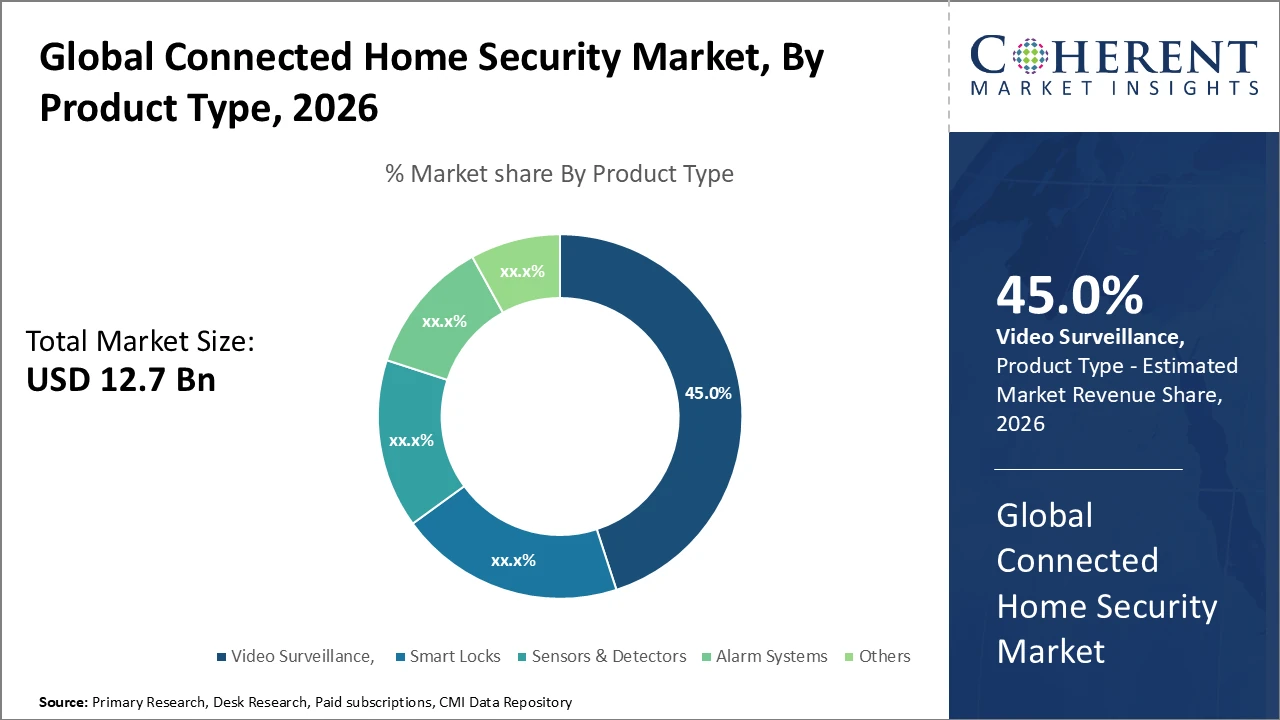
Connected Home Security Market Insights, By Product Type
Video Surveillance dominates the market share, driven by growing consumer preference for high-resolution, AI-enabled cameras that offer real-time analytics and remote access. These systems increasingly integrate with cloud technologies for scalable storage and advanced threat detection. Smart Locks are the fastest-growing segment, supported by rising wireless connectivity and smartphone-based control features. Sensors and Detectors provide specialized security functions such as smoke, motion, and glass break detection, contributing steadily to market growth.
Connected Home Security Market Insights, By Component
Hardware dominates the market due to the essential role of physical devices such as cameras, smart locks, and sensors that form the foundation of connected home security systems. The software segment is experiencing rapid growth, driven by AI-powered analytics and cloud-based platforms that enhance device interoperability and real-time monitoring capabilities. Services are the fastest-growing component, fueled by rising consumer demand for installation, maintenance, and subscription-based monitoring solutions. These managed services provide convenience and professional oversight, especially in regions like North America and Europe. Together, hardware, software, and services contribute significantly to overall market expansion and revenue generation globally.
Connected Home Security Market Insights, By End user
Residential users dominate the market share due to rising demand for personalized, integrated home security solutions, supported by increasing digital literacy and affordability of smart devices. The commercial segment is expanding rapidly as businesses adopt connected alarm and video surveillance systems to meet evolving security standards and minimize operational risks. Industrial end-users utilize connected security solutions for asset protection and workforce safety, contributing a smaller share but demonstrating strong growth potential, particularly in logistics and manufacturing. Others include institutional applications such as schools and hospitals, which increasingly depend on connected security systems to enhance safety, monitoring, and regulatory compliance.
Connected Home Security Market Trends
The market trend from 2024 to 2026 is driven by the rapid adoption of AI-based video analytics, enhancing operational efficiency and user experience.
Advanced facial recognition technology saw a 23% increase in adoption among residential users in 2025, reducing false positives and strengthening security effectiveness.
There is a growing preference for cloud-managed security subscriptions over traditional hardware ownership.
Cloud adoption increased by nearly 40% year-on-year in 2026, reflecting strong demand for scalable and remote-access solutions.
Consumers are increasingly shifting toward integrated smart home ecosystems.
Home security systems are being combined with IoT devices such as smart thermostats and voice assistants, improving convenience and overall system functionality.
Connected Home Security Market Insights, By Geography
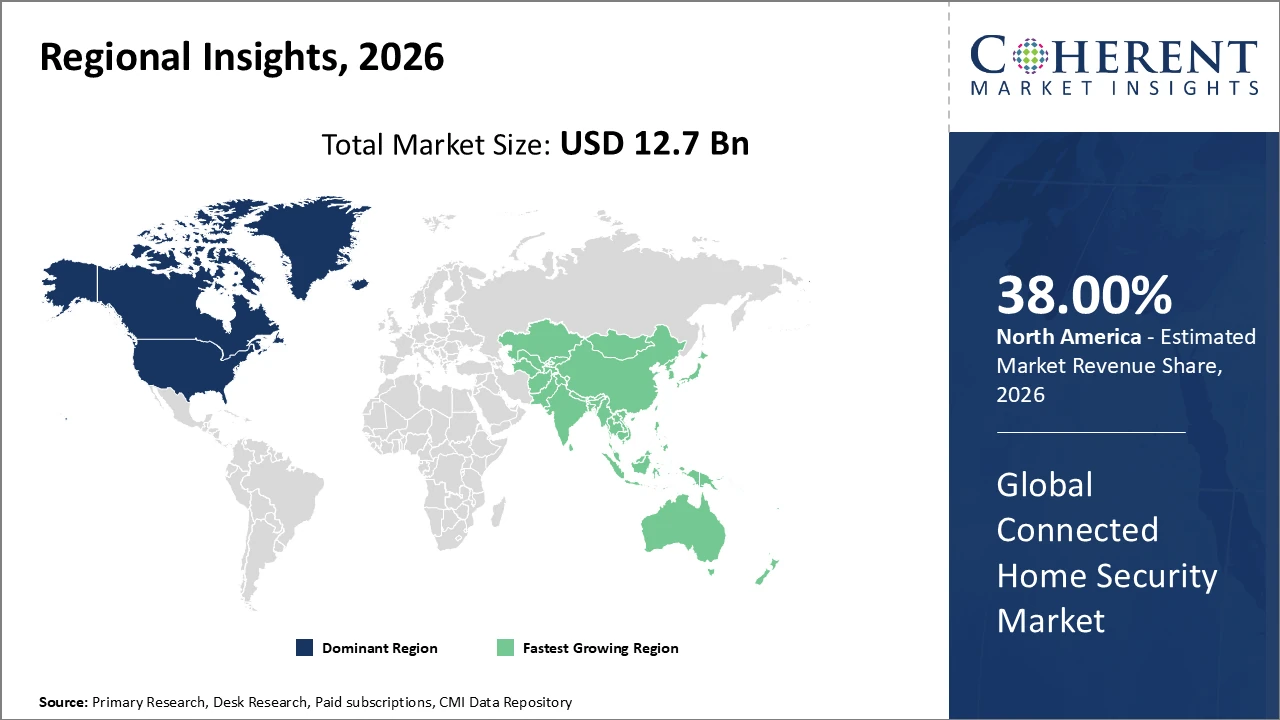
North America Connected Home Security Market Analysis and Trends
North America leads the Connected Home Security market, accounting for over 38% of the global share due to widespread adoption of smart infrastructure and strong consumer awareness of advanced security solutions. The region benefits from robust regulatory frameworks that support IoT integration and data security standards. Major companies such as ADT and Vivint play a significant role by offering comprehensive, bundled smart home security packages that combine hardware, software, and monitoring services. Continuous investments in innovation and strategic partnerships further strengthen market growth, making North America a key revenue-generating region with high adoption of connected home technologies.
Asia Pacific Connected Home Security Market Analysis and Trends
Asia Pacific is the fastest-growing region in the Connected Home Security market, with a CAGR exceeding 13%, driven by rapid urbanization and expanding middle-class populations. Rising disposable incomes and increasing awareness of smart security solutions are accelerating adoption across urban and semi-urban areas. Government initiatives promoting smart city development play a crucial role in boosting demand for connected technologies. China and India lead the regional market, supported by widespread smartphone usage, improved internet connectivity, and strong electronics manufacturing capabilities. These factors collectively enhance accessibility, affordability, and large-scale deployment of connected home security solutions across the region.
Connected Home Security Market Outlook for Key Countries
USA Connected Home Security Market Analysis and Trends
The USA market plays a pivotal role in the Connected Home Security industry, supported by tech-savvy consumers and a well-established smart home ecosystem. Strong regulatory initiatives, including federal cybersecurity frameworks, have encouraged standardized integration and improved data protection. Leading companies such as Ring and ADT continue to drive innovation through AI-based surveillance, smart video doorbells, and advanced remote monitoring solutions. By 2025, smart home adoption had reached approximately 52% of households, significantly boosting demand for connected security systems. This widespread adoption strengthens market share and fuels sustained business growth across residential and commercial segments nationwide.
Germany Connected Home Security Market Analysis and Trends
Germany’s Connected Home Security market is driven by rising consumer awareness, increasing smart home adoption, and strict safety regulations. The market sees strong demand for AI-enabled video surveillance, smart locks, and sensor-based alarm systems, supported by high disposable incomes and technological readiness. Cloud-based monitoring and subscription services are gaining traction as users prefer remote access and professional oversight. Integration with IoT devices and energy management systems further enhances adoption. Major players focus on innovation, offering scalable and interoperable solutions. Government incentives for smart building initiatives and cybersecurity standards reinforce market growth, positioning Germany as a key contributor in Europe’s connected home security landscape.
Analyst Opinion
The surge in smart device adoption across residential units is driving significant market revenue. In 2025, global installation of AI-powered security cameras rose by 34%, boosting demand in smart monitoring segments and expanding market size and share.
Import analysis shows growing penetration of Wi-Fi-enabled security systems, with substantial import volumes from Asia Pacific tech hubs to North America in 2026, supporting competitive pricing and increased consumer accessibility.
Supply-side data indicates production capacity for smart sensors and alarm systems increased by 28% in 2024, driven by advanced manufacturing automation in regions like China and South Korea, supporting market growth.
Integration into new end-use cases, such as healthcare monitoring and elderly care, is broadening market scope. In 2025, around 21% of new smart home installations included medical alert features, reflecting diversification of market segments.
- Current Industry Events of 2026
- Market Size Estimation
- Regional Breakdown
- Competitive Landscape
- Customer Intelligence
- Segmental Analysis
- Pricing Analysis
- Key Market Drivers, Challenges & Future Trends
- Customized Insights Section
Market Scope
| Report Coverage | Details | ||
|---|---|---|---|
| Base Year: | 2025 | Market Size in 2026: | USD 12.7 billion |
| Historical Data for: | 2020 To 2024 | Forecast Period: | 2026 To 2033 |
| Forecast Period 2026 to 2033 CAGR: | 11.6% | 2033 Value Projection: | USD 27.9 billion |
| Geographies covered: |
| ||
| Segments covered: |
| ||
| Companies covered: | ADT Inc., Vivint Smart Home, Bosch Security Systems, Samsung SDS, Assa Abloy AB, ADT Security Services, Allegion plc, Ring | ||
| Growth Drivers: |
| ||
Connected Home Security Market Growth Factors
The connected home security market is increasingly shaped by the integration of AI and machine learning, enabling real-time threat detection and predictive analytics that enhance consumer trust and drive adoption. The rollout of 5G networks improves device responsiveness and expands coverage, supporting seamless interoperability across smart home ecosystems. Government incentives for smart city initiatives, including subsidies for residential smart security installations, particularly in the Asia Pacific, further encourage market growth. Additionally, rising concerns about property safety amid urbanization continue to fuel demand for advanced home security solutions, positioning the market for sustained expansion with innovative, technology-driven offerings.
Connected Home Security Market Development
In December 2025, AT&T launched AT&T Connected Life, a smart home solution combining Google Home and Nest devices with professional monitoring from Abode, powered by AT&T’s high-speed, reliable connectivity nationwide.
Key Players
Leading Companies of the Market
ADT Inc.
Vivint Smart Home
Bosch Security Systems
Samsung SDS
Assa Abloy AB
Ring
ADT Security Services
Allegion plc
In 2025, Honeywell’s launch of cloud-based security management platforms led to a 20% increase in enterprise client acquisition, highlighting the company’s innovation-driven growth strategy. Around the same period, Vivint pursued aggressive expansion into the Latin American market, achieving a 35% revenue rise from the region within two years. This growth was fueled by the integration of localized services and strategic partnerships with telecom providers, demonstrating how targeted regional strategies and technology adoption can significantly enhance market presence and revenue in the connected home security sector.
Connected Home Security Market Future Outlook
The future outlook for the connected home security market is highly promising, driven by increasing adoption of smart home devices, IoT integration, and AI‑enabled security solutions. Consumers are seeking systems that offer real‑time monitoring, advanced threat detection, and seamless interoperability across devices. Emerging technologies like Matter standards and edge AI will enhance device compatibility and reduce response latency. Subscription-based services, professional monitoring, and cloud analytics are expected to grow, while cybersecurity concerns will push companies to prioritize data protection. Overall, the market is set to expand rapidly, with innovations focusing on convenience, automation, and comprehensive, intelligent home protection.
Connected Home Security Market Historical Analysis
The connected home security market has evolved significantly over the past decade, shifting from basic alarm systems to fully integrated smart home solutions. Early growth was driven by standalone security devices such as cameras, door sensors, and motion detectors, primarily in North America and Europe. The introduction of Wi‑Fi–enabled products and smartphone apps around the mid-2010s accelerated adoption, allowing remote monitoring and control. Partnerships between tech companies and service providers expanded offerings, while declining hardware costs made smart security more accessible. By the early 2020s, AI, cloud computing, and IoT integration became key trends, shaping a more connected and intelligent home security ecosystem.
Sources
Primary Research Interviews:
Product managers, engineers, and R&D specialists at smart home security device manufacturers
Procurement managers, supply chain heads, and sales directors in IoT, home automation, and security industries
Industry analysts, consultants, and academic researchers focusing on smart homes, cybersecurity, and connected devices
Magazines:
Security Sales & Integration – Trends in Home Security Systems, Device Launches, and Installation Practices
IoT Agenda – Smart Home Security, Integration Trends, and Technology Updates
CE Pro – Smart Home Devices, Market Innovations, and Consumer Adoption
SecurityInfoWatch – Industry News, Product Reviews, and Market Insights in Home Security
Journals:
IEEE Internet of Things Journal – Research on IoT Security, Device Connectivity, and Smart Home Systems
Journal of Cybersecurity – Home Security, Threat Detection, and Data Privacy Studies
Sensors – Innovations in Smart Sensors, Surveillance, and Connected Home Applications
ACM Transactions on Cyber-Physical Systems – Research on Home Automation and Security Integration
Newspapers:
The Wall Street Journal – Market Developments, Investments, and Consumer Trends in Smart Home Security
Financial Times – Industrial Growth, Technology Adoption, and Global Security Device Markets
TechCrunch – Startup Innovations, IoT Security Products, and Connected Home Integrations
Business Insider – Market Updates, Competitive Analysis, and Regional Expansion in Home Security
Associations:
Security Industry Association (SIA) – Research, Standards, and Conferences on Security Technologies
Consumer Technology Association (CTA) – Smart Home Standards, Product Research, and Industry Insights
International Association for Home & Property Security (IAHPS) – Best Practices, Training, and Market Analysis
Get access to 250+ pages report
Every segment, forecast, competitor profile and data table behind the analysis above — available for instant download.
- ESOMAR Member
- ISO 9001:2015 Certified
- D-U-N-S Registered
- GDPR & CCPA Compliant
Missing comfort of reading report in your local language? Find your preferred language:
Transform your Strategy with Exclusive Trending Reports
Frequently Asked Questions
Key market companies include Honeywell International Inc., ADT Inc., Vivint Smart Home, and Bosch Security Systems, leveraging strategic innovations and regional expansions to sustain leadership.
The market is projected to grow from USD 12.7 billion in 2026 to USD 27.9 billion by 2033, reflecting a CAGR of 11.6%, driven by technological advancements and rising consumer demand.
The Residential segment leads due to increased adoption of smart home solutions, incentivized by government programs and rising security concerns in urban centers.
Integration of AI and 5G technologies will continue to transform product capabilities, creating demand for smart, interoperable connected home security platforms.
The market exhibits intense competition fueled by price competitiveness and innovation, with challenges including supply chain disruptions and data privacy concerns.
Subscription-based pricing, regional manufacturing investments, and strategic partnerships with telecoms and smart home product makers are key strategies driving business growth.